Ihlara Gorge

Leaving Ankara we travelled south to the Ihlara Gorge. En route we stopped at Tuz Golu, a huge salt lake. We walked out on to the solid surface of salt reflecting the light and heat of the sun so that it hurt. A long way beyond where we walked was clear water but if you dug a hole in the salt it soon filled with brown water.
Continuing, we again took a slight detour to see the 13th C Seljuk caravanserais, at present going through some renovation. This was strategically placed on the silk route for travellers and traders to stay and rest. There were many such places every 40km along various routes, 40km being the distance that could be covered by a camel train in a day. It is an impressive building with incredibly thick walls, designed to withstand earthquakes. I expect it will be even more impressive after the renovation work is completed.
By the afternoon we arrived at Selime and the start of our trek up the Ihlara Gorge. The approach to the village brightened up what had been scenically a rather dull and featureless journey. Above the village was a cliff made up of conical towers of rock. Unfortunately we did not stop long enough to admire them. What was to follow was well worth it. The Ihlara Gorge is a deep cleft between 300 and 500 feet deep, cut into the featureless landscape above. From above you would not know it was there until you almost fell over the edge!
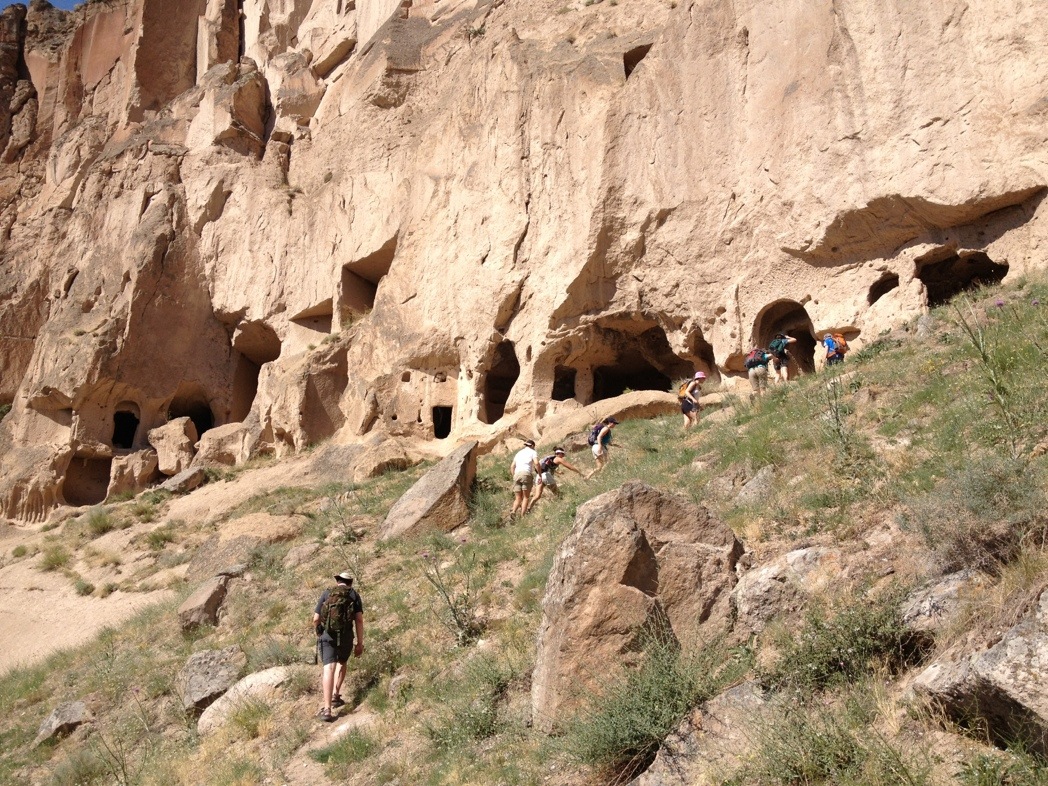
We followed the small river upstream over grassy meadows, through small cultivated areas and willow trees enjoying the moisture provided by the river. The water was clear and teaming with small fish and frogs. Above the lush valley floor sandstone cliffs towered above us. There were many holes carved into them where ancient cave dwellers had once lived. These were often monks and hermits but they would also give good protection during conflict as well as the advantage of height over any would be attacker. We visited a number of these dwellings which provided cool respite from the heat of the afternoon. Something we spotted several times, which carry their own cooling house, we’re tortoises – an unexpected bonus.
After a cooling paddle in the river we soon reached camp in Belsirima village. There we could relax on canopied platforms built over the river with thick cushions to lounge on. The fast running water inches below us helped to cool the air around us making it very pleasant. The night was spoilt by dogs constantly barking and two pups decided to tear a fly sheet to shreds, much to the concern of the occupants.
If we thought the first day in the Ihlara Gorge was impressive, the second was more so. Remarkably dozens of churches were carved into the rock cliffs and we visited a couple of them. Not only were they carved into the rock but the walls and ceilings were painted with frescos.
Just before we came to the top of the gorge the river tumbled over a waterfall into a plunge pool. Ten foot cliffs arched around the pool, which proved to be deep enough for jumping in to. We spent a good hour enjoying the opportunity to get cool and the students became ever more inventive in the way they leapt into the water.
The bus was waiting for us and took us back to Selime for lunch, a feast enjoyed more by the swarms of wasps, which spoilt an otherwise excellent meal. After lunch we drove to Goreme in the heart of Cappadocia and the site of some incredible rock formations.

20120803-164006.jpg

Ankara

A short flight took us from Istanbul to Ankara, the capital of Turkey. The history is quite interesting. Until 1922 Istanbul was the capital but when Ataturk created the modern Republic of Turkey in 1922 he wanted to move the capital to somewhere more central, which was seen to represent all of the people. Ankara only had a population of 10,000 in 1922 but quickly grew under its new status. It continues to grow today and has population of 4.5 million. Although Istanbul has a population of 13 million, Ankara covers a much larger area. This was clear as we drove from the airport, quite some distance from the city, and witnessed massive housing and commercial development taking place.
Our first afternoon in Ankara was free so we set about exploring the areas we could reach by walking. The shopping area was like many others in big cities but it was made more attractive with trees offering shade from the fierce sun above. We found ourselves in a park but it seemed to be a waste of valuable time in a new city to languish in a park, even though we did enjoy playing on the outdoor fitness equipment. Heading back towards the hotel we found ourselves in an open air bar and enjoyed watching people go about their daily lives over a beer or two.
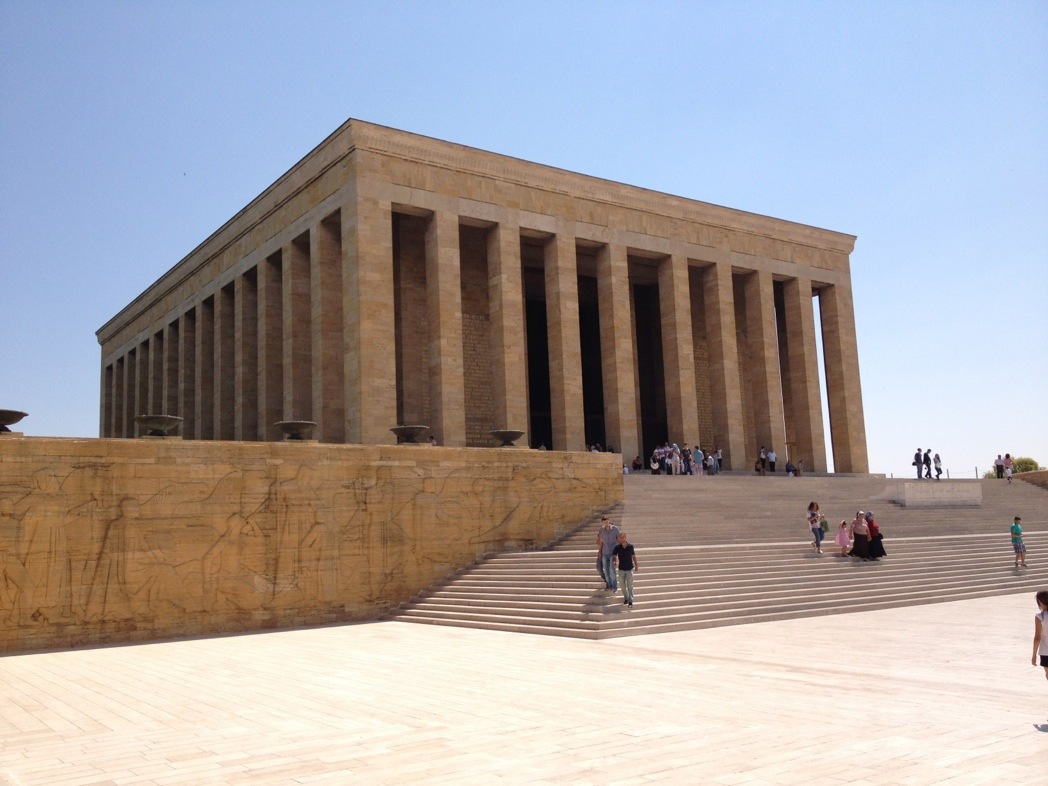
On our second day we had plans to visit the Mausoleum of Ataturk, a huge area on top of a hill with a great deal of extravagance. Ataturk is extremely highly regarded as the founder of modern Turkey and, as such, this is clearly as sign of the respect the nation holds for him. The museum gives detail of the history of the development of modern Turkey but there was just too much to take in.
From there we went to Ankara Castle, part of the defensive fortifications of the old, much smaller city. On arrival we had lunch in a wonderfully rustic restaurant inside the castle walls and it was a superb meal served by a portly chef who was not only extremely efficient but also spoke excellent English.
The castle is a bit run down and some of the houses inside are falling down. What it did do was afford us a wonderful view of the whole city as it spreads out over numerous hilltops.
Later we returned to the same bar to watch the world go by. I couldn’t help notice and mention that we had seen very few overweight people in Turkey and that everybody is smart. It must be something to do with the climate suppressing their appetites. It doesn’t seem to be doing that with mine!!
I didn’t enjoy Ankara as much as Istanbul. It is much too spread out and the traffic seems to be constantly gridlocked. I enjoyed the relaxation and the people watching but it is not a city I would rush back to, whereas Istanbul has a much greater attraction.

20120803-163626.jpg

Istanbul

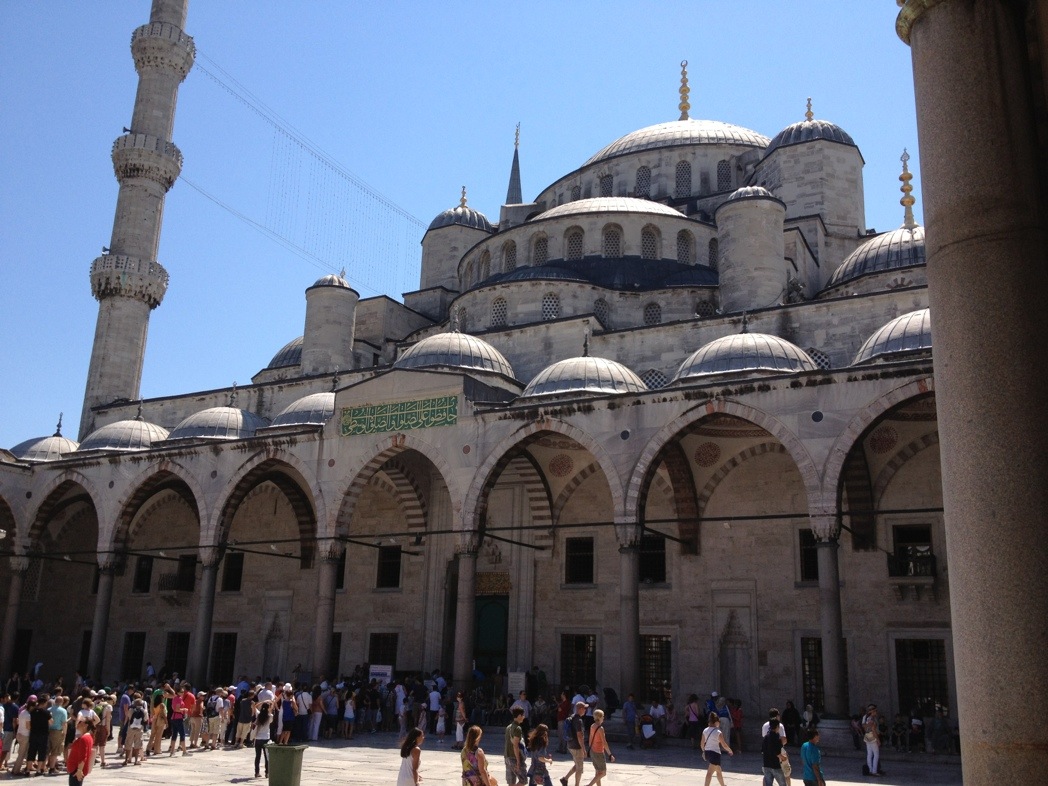
With only a day to enjoy the sights of Istanbul we wanted to make the most of the time we had. The hotel was very conveniently placed so that nothing was very far away. Our first port of call was the Hippodrome, a large area of learning and religion. To one side is a large church converted to a mosque, but now a museum, on the other the Blue Mosque. Dodging from one shady spot to another, Omer, our guide, filled us in on some of the history of Istanbul before we entered into the relative cool of the Blue Mosque, a huge domed prayer house. From there we slowly meandered down to the water front where we bought bread and fish before boarding a boat to take us around the Bosporus. The cool breeze generated by the movement of the boat was most welcome. As we turned to return we had dolphins leaping out of the water alongside out boat.
At 5.00pm we went to explore the spice market, a lively, friendly place with banter and not too much pressure to buy. Having explored I went back to the stalls I had enjoyed most and bought a variety of teas from one stall and spices with a spice grinder from another.
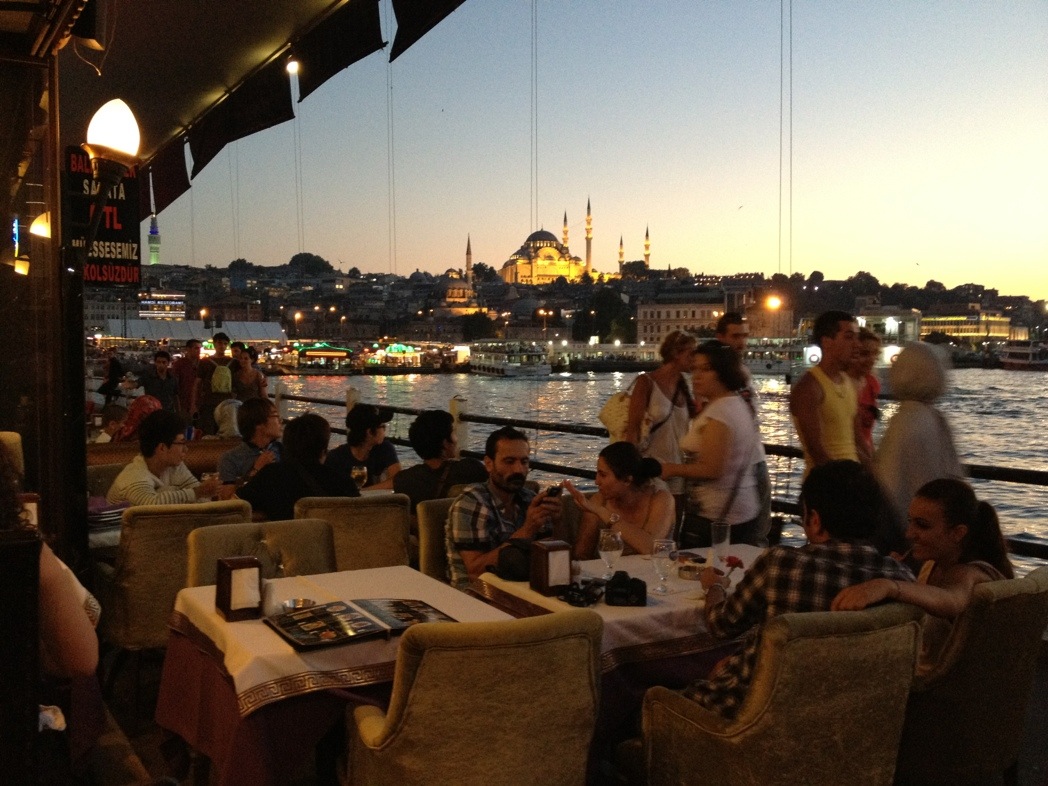
In the evening we went down to the water front for a superb meal as the sun set over the Bosporus.

20120803-163350.jpg

20120803-163725.jpg

Leaving China – 17th – 20th April

In the morning Simon greeted me with the news that Rob was suffering badly with D & V, not really surprising after the excesses of the previous day.

Saying farewell to Hira and Keyoum again, we boarded our bus for the border.  Occasionally stopping for Rob, we arrived at the customs post after an hour and a half.  Rob was in a bad way and Simon seemed to be going down fast.  For the rest of us the process seemed far less arduous than on the way in but it still took us an hour and a half to pass through.  In that time I had to visit the toilets once and that was enough; they were some of the worst toilets I have ever seen and it was nothing to do with Rob and Simon.  How they coped I shall never understand.  Before we left the compound our passports were checked  again, and again a few hundred metres up the road, on the way up to the actual border.

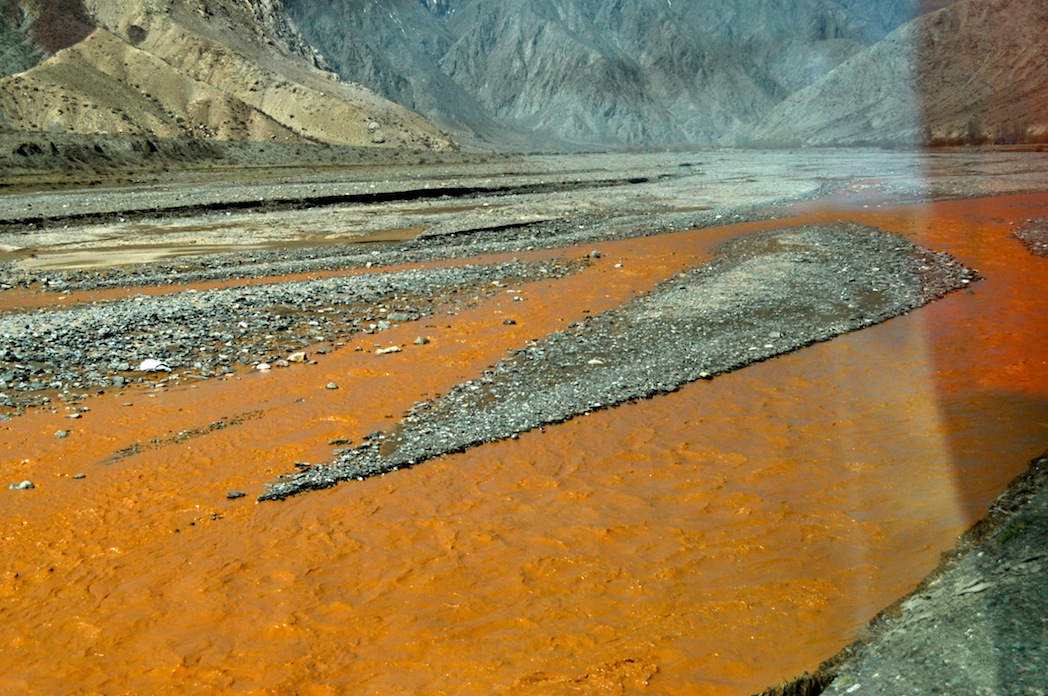
Orange melt water

In the main the slopes were clear of snow, certainly on the lower hills, and the rivers were running with orange water, a sure sign that spring was on its way in these hills.  There was much less snow and hardly a lorry in sight as we approached the top of the Touroget Pass and the actual border.  Fortunately the two buses from Asia Mountains were waiting for us and the transfer was painless, particularly important for Rob and Simon who were really suffering.

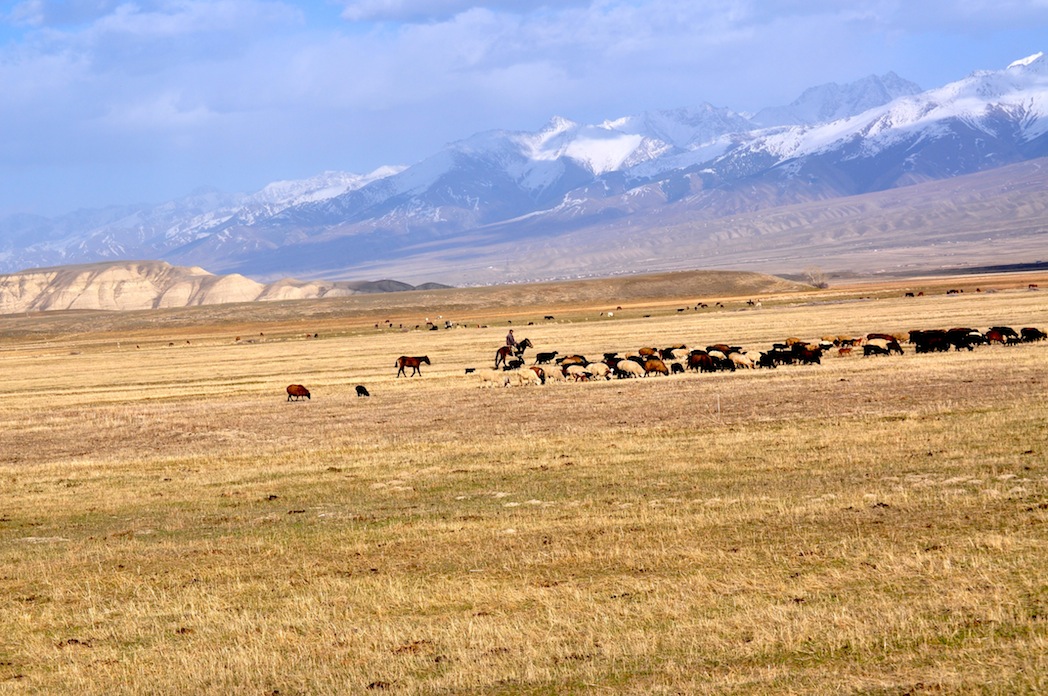
What a transformation from white scape to agricultural scene

Without the snow the road was unmade and uneven, making the journey to Naryn a long, bone rattling affair.  Bring back the snow.  The high altitude plateau was now alive with life.  Where, three weeks ago there had been a white scape, there were now herds of horses, cattle and flocks of sheep and goats grazing and tended to by farmers on horseback.  Woken from their winter sleep, marmots gambolled in the warm sunshine.  It was an idyllic scene, always with the backdrop of snowcapped mountains.

Naryn looked very different without snow but the hospitality was as warm as ever, even if the room temperature was lower: the state heating was turned off on the 1st April.  We put Rob and Simon to bed and I gave them my Sigg bottles for hot water bottles.

The following morning they felt much better and much more able to cope with the remaining journey to Bishkek.

Leaving Naryn, we crossed one more pass before we started our descent to the plains below.

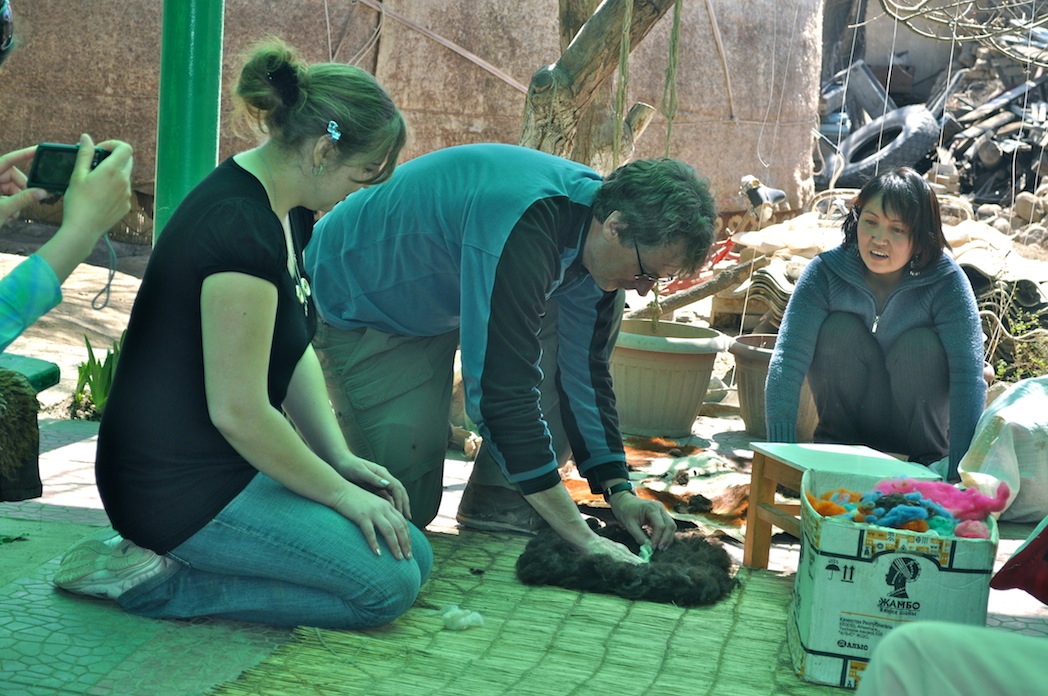
Charles designing his felt picture

After a couple of hours we stopped at Kochkor again, this time to visit a women’s cooperative felt making cottage industry involving 200 of the village women, and for lunch.  We were shown the processes involved, the beating of the unwashed wool, the laying in layers, the creation of a design (Charles had a go at this), the rolling into a reed tube and tying a cloth around it, pouring hot water on the tube and then dancing or jumping on it for about 20 minutes.  We all had a go at the various stages.  Once unwrapped, soap was applied to both sides and the felt thoroughly washed.  It proved to be really resilient and could be pulled and wrung out without fear of it falling apart.  The fibres had, remarkably, all knitted together.

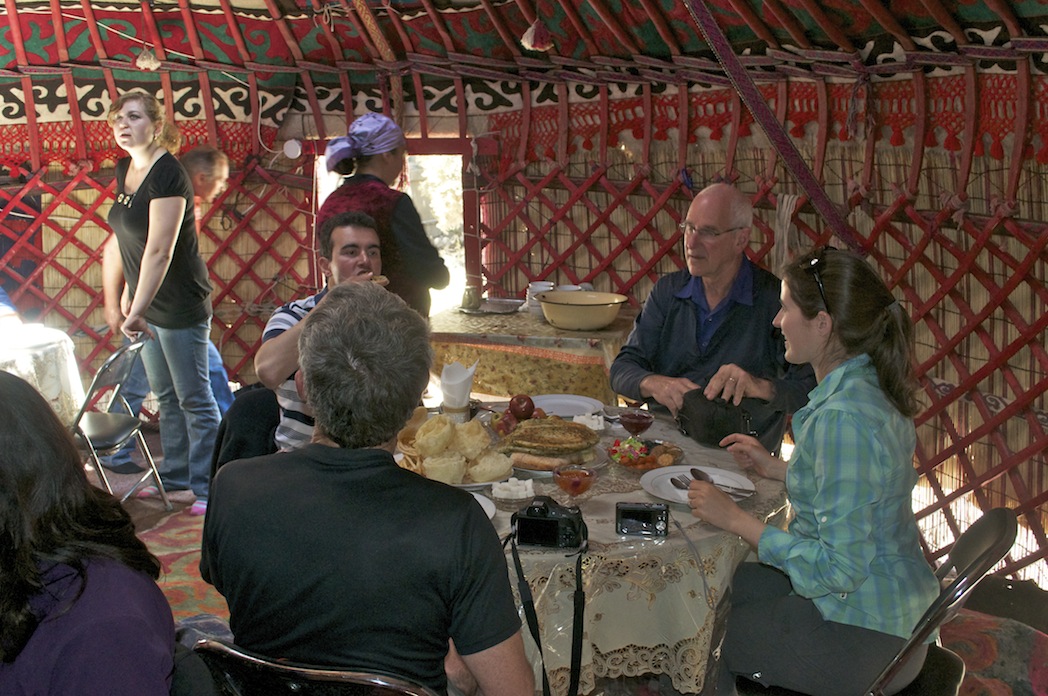
Lunch in a yurt

Process completed, we had lunch provided in a yurt in the garden.  For a temporary structure it was incredibly firm  and was extremely comfortable inside, with carpets on the floor and four tables laid for lunch.  As with most meals we had experienced on this journey, the food just kept coming.  There was far too much for our shrunken stomachs.

After lunch we visited the shop and most of us were well disposed to spending some money on presents and souvenirs, partly, I suspect as a way of thanking them for the hospitality but also because we were not put under any pressure to buy anything.  The products themselves did the hard sell.

Lake Isyk-kol

Carrying on with our journey we took a detour to Lake Isyk-Kol, a huge expanse of water (the second largest mountain lake in the world after Titicaca) where the Russians had a torpedo factory and carried out tests on the lake.  Typical of most industrial sites in Kyrgyzstan, it now lies derelict and testimony to a past under Russian control.  The situation of the lake is superb with snowcapped mountains all around.  It has a much better future as a tourist destination, once the economy can allow investment.

The final leg of our journey took us to Bishkek.  The sunshine was warm, leaves out on the trees, fruit trees in blossom, men fishing in the river running parallel to the road and marking the boundary with Kazakstan, and couples picnicking on the river bank.  Such a different picture through the window of the bus to the one we had only three weeks previously.  In just three weeks Kyrgyzstan has been transported from winter to summer.

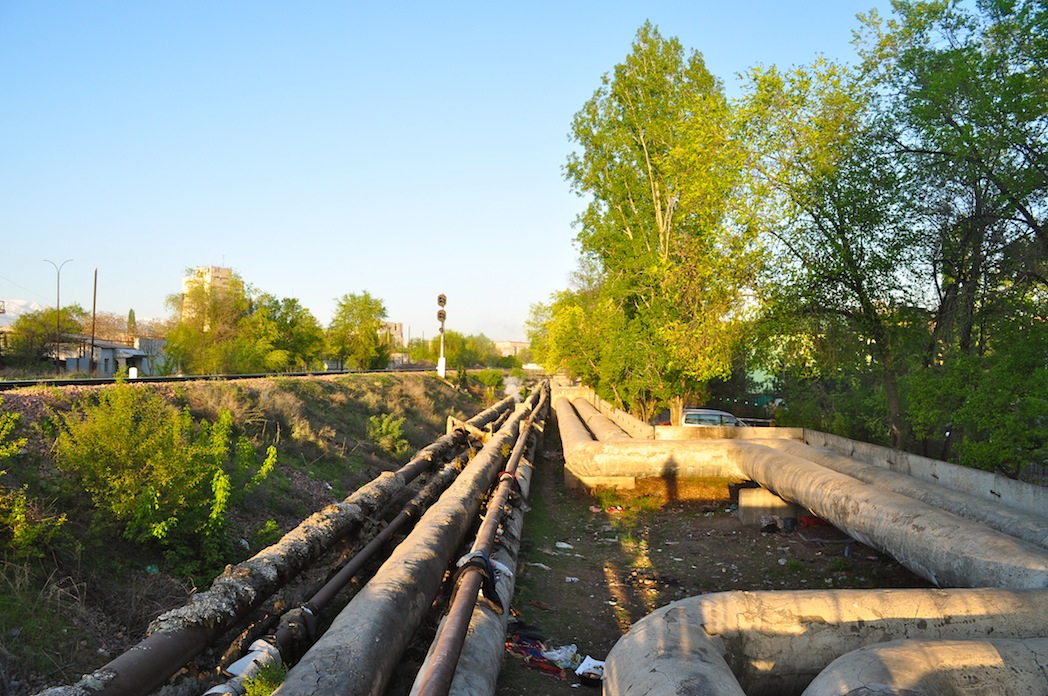
Somehow, even the asbestos pipes look more attractive in summer

In Bishkek the tree lined streets were green, people wore summer clothes and the hotel garden was bathed in the perfume of lilac.  Bishkek looked a lot more attractive.

We had come full circle and it was time to go home.

Related Images:

Back to Kashgar and spring – 14th – 16th April

Everything packed in our land cruisers, we began the two day drive from Yilik to Kashgar via Yarkand.  The early part of the journey was on unmade roads and it was clear that the thaw had had an impact.  The rising temperatures had allowed the ice to release its grip on rocks above the road and many had taken advantage of their new found freedom and come crashing down on to the road.  We had to negotiate our way through some significant rock falls.

From Mazar the road was clearer, but no less bumpy, as we climbed steadily to the top of the first pass.  Here, there was more snow from the recent storm we had experienced on our trek out, and the surface of the road held different problems for the drivers, who sometimes found it difficult to maintain control of the back end of their vehicles.  The first pass crossed we began the long descent to the village, where we would encounter our first check point and have lunch.  As we were leaving a sensitive area, rather than entering, the formalities did not take too long.  Somewhere in the back of the land cruiser, among the bags etc. I lost my lunch, so I visited a roadside cafe/shop and bought, what can best be described as, a pot noodle.  The boiling water and spice sachets were added and I waited.  After five minutes I was able to tuck in.  It nearly blew my head off, causing great hilarity in the cafe among the staff and the other customers.  One of the ladies took the pot from me, drained the liquid, added more, stirring it to dilute the spices, drained it again before adding more water and returning it to me.  It was now a bit tasteless.
The Taklimakan Desert

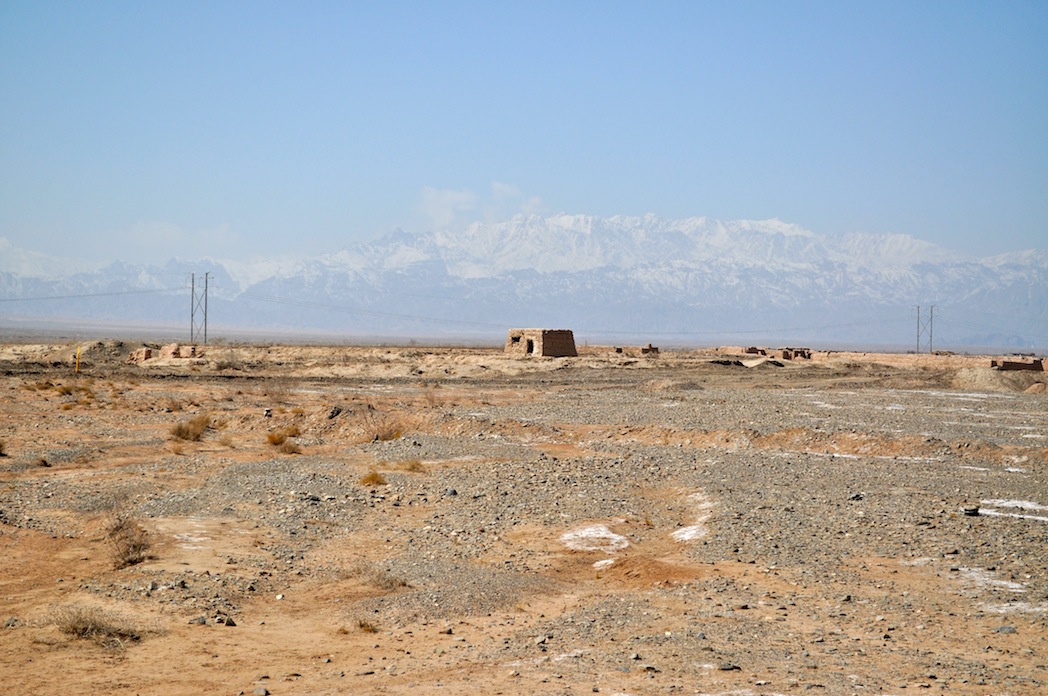
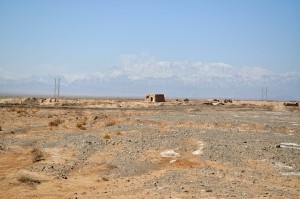
Again we climbed as we crossed the second, more spectacular pass, which now had less snow.  The descent gradually took us out of the mountains and into the Taklimakan Desert, a flat, barren landscape.  Or is it barren?  All along the banks of the Yarkand River it is green for some distance on either bank.  The fertile area is made up of small fields of wheat or barley with rows of almond and apricot trees providing colour and shade.  The trees were full of blossom.  At various points there were little conical clay ovens, which are lit at times when there is a risk of frost.  They provide just enough heat to stave off frost damage.  Also, occasionally, there were rows of beehives to take advantage of the blossom.  Amongst all of this there were thousands of poplar trees lining the tracks and separating the the fields.  These provide shelter from the desert winds and also provide a source of building material.  However, whenever a villager wants to take down a tree he must replace it in order to maintain the status quo.

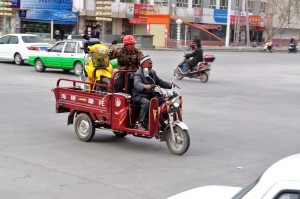
Near Yarkand, we left the motorway and, surprisingly, at the end of the slip road there was nothing.  The roads off have not yet been built and, having been on a modern motorway, we found ourselves transported back a couple of centuries on to dirt tracks through the fields and farm houses.  There seemed to be some confusion about the way to Yarkand.  The route in led us to believe it was quite a small place but when we eventually hit tarmac again and headed towards the town centre it proved, yet again, to be a city of several hundred thousand.  One moment we were in quiet countryside with no inkling that there was a large city nearby, hidden by layers of poplar trees. The next we were in the thick of it with traffic, people, noise and lights all around us.  It sprang up out of nowhere.
Yarkand fuel saving initiative

Our hotel, Queen Hotel, was right in the centre of town.  It was not the hotel we should have been in but the government had taken over ours for a conference.  The room rates, as advertised in reception, amused us.  There were all the usual rooms, ‘single, twin double’ etc. but there were also some ‘o’clock rooms’ at 68 Yuan per hour.  It was noticeable by the nature of some of the women and the shiftiness of the men that the ‘o’clock rooms’ were quite popular.  The shower proved popular with us!!!

The following morning we continued our journey to Kashgar.  The speed and extent of the building development running parallel to the motorway and, nearby, new railway is phenomenal.  Agriculturally, the desert is being cleared of surface stones and the soil underneath irrigated and fertilised at an alarming rate.  The railway, which is not fully functional yet, has stations in the middle of nowhere, and then you look closely at the desert and you see lots of white surveyor’s sticks marking out the next phase of development on a huge scale.

On the way to the trek we stopped at a services, which was nothing more than a large flattened area of desert.  As we drove past it on our return journey there were already two buildings erected on the site with more to follow.  An army of workers had pitched their tents adjacent to the services so the work could be completed as quickly as possible.
An almost impossible task

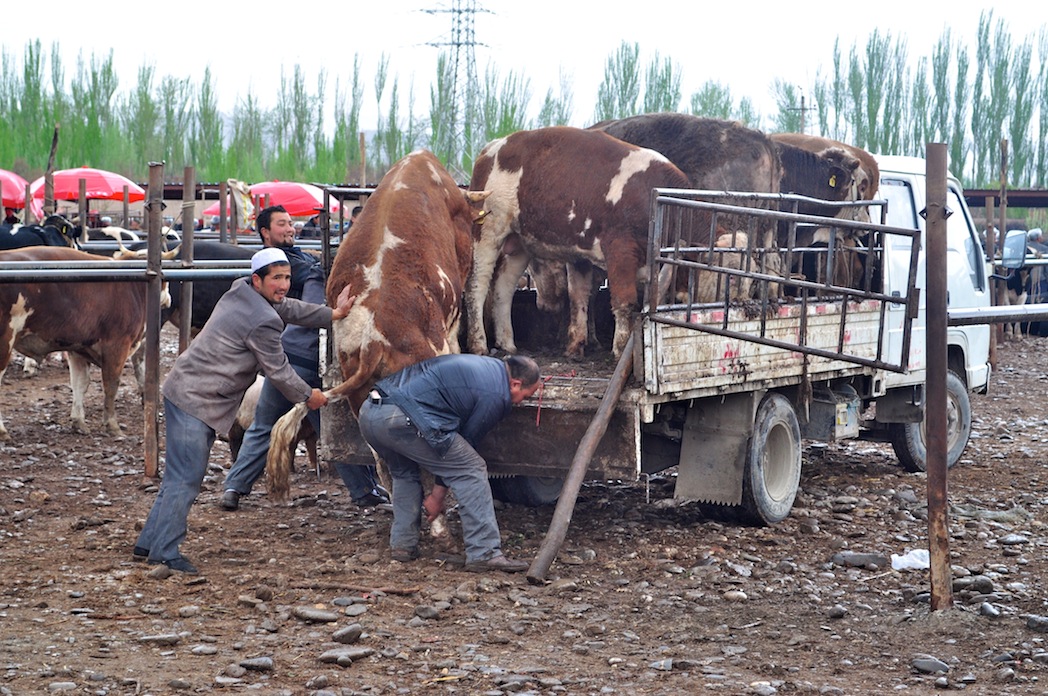
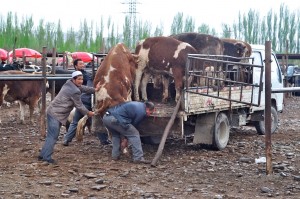
Lunch time saw us arrive in Kashgar.  The blossom was out and the trees were in leaf but it was cold with a stiff breeze and light rain, the first rain we had encountered all trip.  Skipping lunch, the bus took us to the famous animal Sunday market.  It was raining and our journey was marred by a dead child lying in the road, the victim of a collision with a vehicle.  This was the first such incident we had seen, although I am sure it must be a fairly regular occurrence when pedestrians and vehicles vie for position in the road.  Drivers seem very reluctant to give in, even to the laws of the road.  We have found on several occasions that although we were given the green light on a crossing we were never safe.  I am sure there will be more accidents as roads become faster and more congested.  Only this morning we saw children as young as three and four playing on the central reservation of the motorway.  The animal market was beginning to wind down but it was amusing to watch impossibly large cattle being manhandled on to impossibly small trailers.

A cultural entertainment

In the evening we went to a restaurant for dinner and entertainment. We were the guests of Keyoum, the director of Kashgar Mountaineering Adventure.  The meal was Chinese and absolutely stunning, probably the best Chinese meal I have ever had.  Don’t ask what we had; plate after plate of delicious food just kept coming.  The entertainment was also excellent, not lasting too long but giving us a taste of the culture, with the obligatory audience participation at the end.

Back at the hotel a few of us chose to visit the KTV floor, affectionately known amongst us as the KY Jelly Bar.  We had been warned to stay away, largely by Akbar who indicated that they were not suitable places for us.  It’s a bit like telling a child not to do something.

Emerging from the lift on the 5th Floor I went in search of the bar.  There were lots of mirrors, coloured lighting and wailing voices.  When I asked where the bar was we were led along a corridor past rooms full of people making lots of noise and into a room of our own.  The room consisted of a long couch, a coffee table, a large screen TV and a computer.  Drinks were brought in, along with two microphones.  The TV and computer were switched on and the 1960s and ’70s music began to play.  The wailing we had heard before was from people trying to sing their favourite songs.  We had a bizarre selection from the Carpenters to Yellow Submarine and we soon discovered that we could wail as well as the next room.  Beers drunk we were told we could have three more without extra cost; presumably we had paid for the room and a certain number of beers.  I have to confess, that while it was fun initially, the novelty wore off and a sleep in my own bed seemed to be a more attractive option.  I was quite pleased that, having finished the second beers we all decided to get out and retire for the night.

The next day was much warmer and a free day in Kashgar, although I was committed to meeting with Keyoum and Hira.  While I waited in the reception area, in the company of the SWAT team, I was amused to watch a water tanker with a powerful hose wash the dust off the trees.  The operator seemed oblivious to anybody or anything that may be on the other side of the trees; a man sitting on a bench talking into a mobile phone, a news kiosk and a couple of women strolling innocently.  The amazing thing was that nobody overreacted, got angry or protested.  Perhaps they did not wish to draw themselves to the attention of the numerous police or the SWAT team sitting comfortably in the window near me.
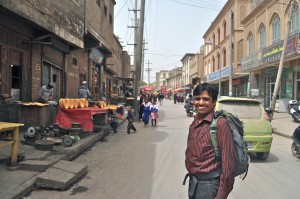
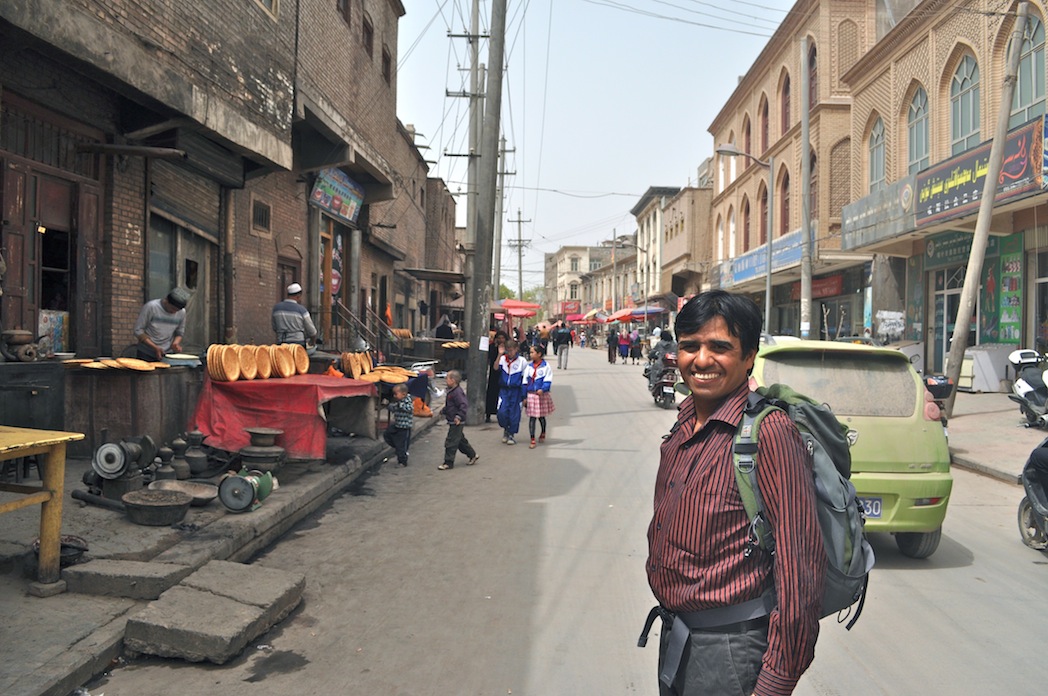
Hira in the Uygar part of town

The meeting with Keyoum was fairly brief and mainly concerned settling up the finances of the expedition.  I refrained from being critical – not the time or the place and anyway  Hira would be the one to assess the positives and negatives.  Hira and Keyoum then went off for a meeting of their own, with Hira promising to be back soon to go into town with me.  When he returned we ventured into the predominantly Uygar part of town for some lunch at the Karakorum Cafe.  On the way we met Simon and Rob who, like little boys at Christmas, were excited and eating everything in sight!

After lunch Hira and I split up, he to return to his hotel, me to do some shopping.  I had a fair idea what I wanted so it did not take too long.
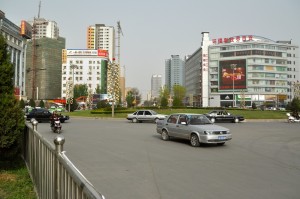
Modern, Chinese Kashgar

Every so often during the trek and a couple of times since I had the odd twinge in my back, largely, I think, the result of spending long periods horizontal in a tent that was really not big enough for me.  I wanted a massage, but unfortunately the spa in our hotel was, for some reason, closed.  I asked at reception if they could recommend somewhere and they suggested another hotel, bundled me into a taxi with a map and a bit of paper with Chinese writing on it, and off I went.  The hotel was not far away and I soon found myself in reception speaking to people with no English who thought I wanted a single room.  The bit of paper did not throw any light on the situation.  I was about to give up when a Chinese lady asked, ‘Can I help you?’  Relieved to meet somebody who could speak English, I began to explain.  We continued to struggle because it soon became apparent that the extent of her English did not go much beyond, ‘Can I help you?’  Having established I did not want a room, not even an o’clock room, and that I did not want a pedicure on the third floor, I finally got the message across that I wanted a massage.  That was on the fifth floor.  Emerging from the lift I was greeted by a number of faces, none of whom could speak English.  However, it was clear that I was requiring a massage.  Why else would I get out of the lift on the fifth floor.  I was taken to a room and left sitting on a bed.  A few moment later a large young man came in and put the fear of God in me.  He was wearing a sweat shirt, tracksuit bottoms tucked into blue wellies.  What frightened me most was the size of his hands.  On the plus side, he could speak a little faltering English and I was able to establish that it was going to cost me 80 Yuan (£8) for an hour with this brute.  I could not back out now.  I was committed.  I was just going to have to man up and take what was coming to me.  A pair of silk pyjamas were produced, which I obediently changed into before being instructed to lie on the bed on my back.  If I close my eyes I can use my imagination.  On hearing the door click shut I opened my eyes and was surprised, and pleased, to see that the incredible hulk had transformed into a young, slim Chinese girl, who then proceeded to beat me up.  Between bouts of pain, she tickled me and our only communication was an occasional smile or chuckle.  At the end of the hour she got up and left.  I got dressed and left.  Phew!  It was a close shave and I dread to think what the brute would have done to me had he got his hands on me.
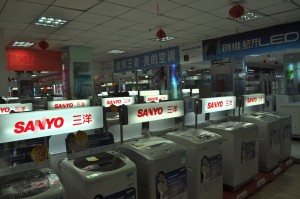
Consumerism

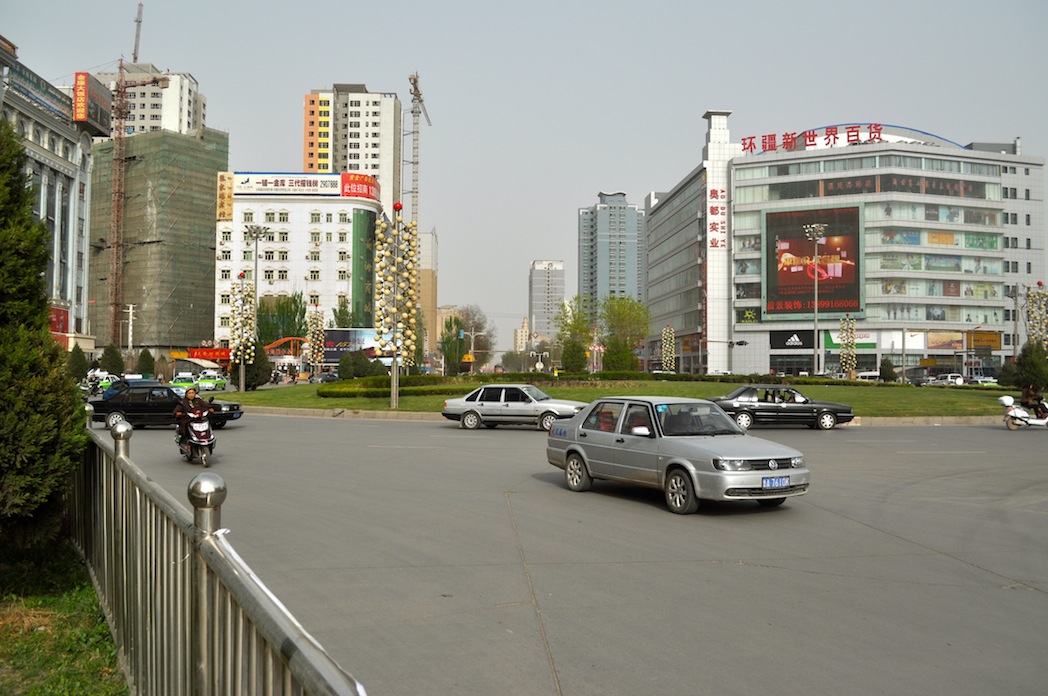
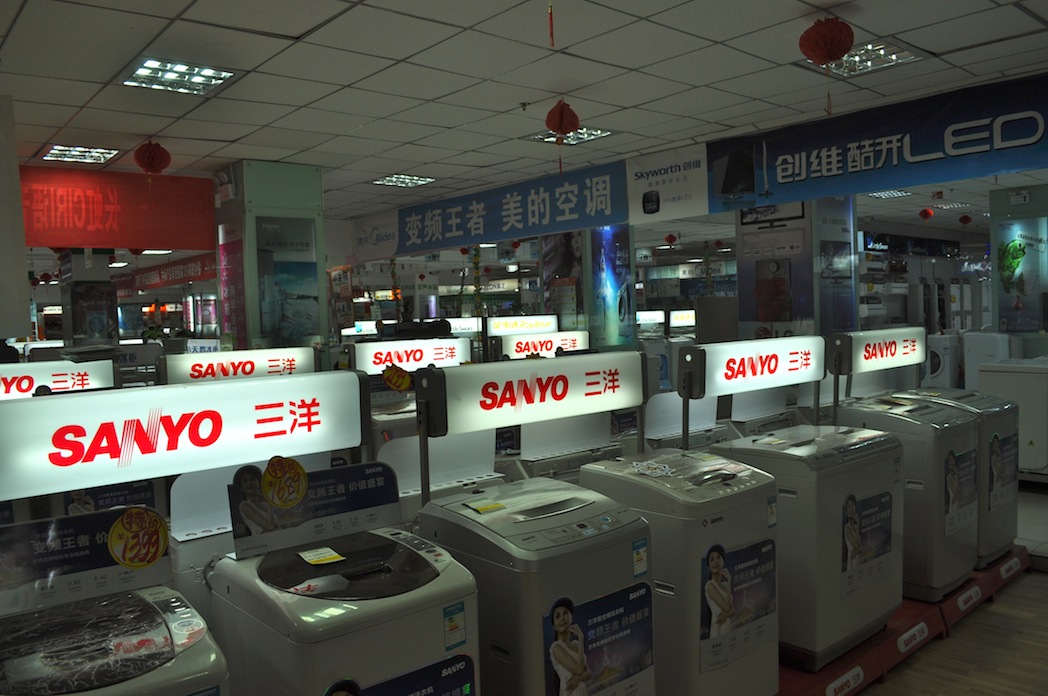
Relieved, I walked back to the hotel via the Chinese shopping district.  It is such a contrast to the Uygar area, which in many respects is still Third World.  In the modern city where everybody is upwardly mobile it is all about consumerism.  Advertising sells all the latest gadgets and the shops are full to the brim with electrical goods and the latest fashions.  Mao must be turning in his grave.  No longer are the Chinese conformist but they are individuals with ambition.

Hira

In the evening we said our thanks to Akbar who could not be with us when we left China as he had a driving test.  We then went out for a meal where we expressed our thanks and said our farewells to Hira.

Related Images: