A Quick dash to Chitwan

After a quiet, groupless night in the hotel, Hira and Bishnu came to pick me up at 7.00am for the drive down to Chitwan, a hot, jungle environment in the south of Nepal bordering India.

Once out of the Kathmandu valley the journey became more civilised. There are a great many slow moving lorries on the road and overtaking on the winding road can be a little scary at times. Our driver was pretty careful but he always had to be prepared for the unexpected from every other driver. Many of the houses at the side of the road had been bulldozed and there were piles of debris where once houses and businesses had stood.  Apparently, they had all been built illegally and, as a result, had been destroyed.  Unfortunately the piles of rubble and timber are less attractive than the buildings had been and your eyes are automatically drawn to the unsightly mess rather than the more attractive scenes beyond.  It just seems typical of Nepal; no job ever seems to get finished!
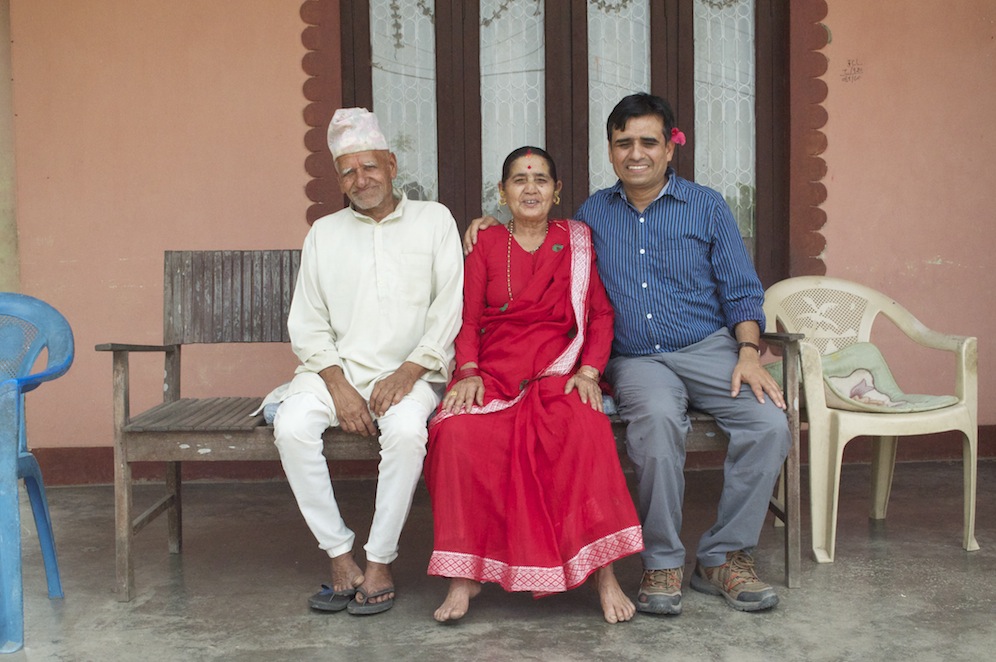
Hira with his parents

Hira with his parents

We reached the Chitwan in about four and a half hours and our first port of call was Hira’s parents, living in their little farmhouse. Hira is the first generation not to be a peasant farmer and the contrast between him, a city dweller, and his parents, particularly his father, was remarkable. The very simple house is surrounded by fields of rice and maize, a tranquil agricultural scene. Birdsong is all around us. Just to one side of the house is a byre with buffalo and a couple of cows. A large hayrick is beside that. The water supply comes from underground via a hand pump and adjacent to that is a digester of animal and human waste which provides all the necessary gas for cooking. It is incredibly basic living which has a charm of its own to the casual visitor.

I was made very welcome, given coke and a plate of mixed fruit, although keeping the flies off the fruit became a real challenge.

Leaving his parents we went to visit the school where Hira was educated as a boy. Certain government schools are selected to cater for and integrate children with disability. This particular school has 27 blind or visually impaired students of variable ages. Hira’s idea is that those involved in the teaching and caring for the blind need practical support rather than financial support. The head teacher may contradict that but we are not looking to give financial aid.
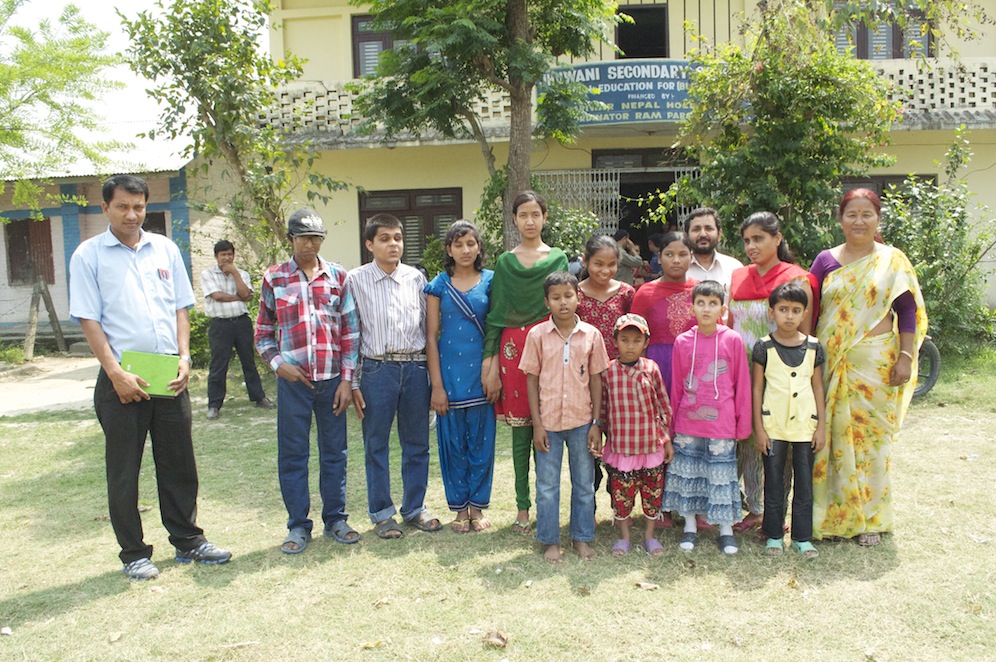
Some of the blind and visually impaired students at  Shree Jhuwani School

Some of the blind and visually impaired students at Shree Jhuwani School

I was met by various people, teachers, village committee and others. There were so many of them I wasn’t really sure who was who. School does not open for another three days but about half the blind children were there. The teaching facilities are limited and the place looks untidy and unkempt.  The facilities in the senior section of the school seemed to be better and more building work was going on.

As we were about to leave I met a Dutchman who has been involved with supporting the blind in the area for a number of years. Adjacent to the primary school there is an almost finished new build which will become a learning and resource centre for blind people in the community. It has a conference room with special computers, a further computer room, a music room, a couple if craft rooms and a couple of bedrooms. This is for adult blind people to come to learn but I really hope these facilities will be available to the blind children in the school as they far exceed anything the school has to offer.

It was an interesting visit, with potential, but I am not making any promises.

A female one horned white rhino

A female one horned white rhino

Potential business side of the trip complete, it was now time to enjoy myself. Settling in to the Rhino Lodge in a pleasant resort type village just outside the park, my first activity was an elephant ride. Normally you share this experience with three other people but now it was just me and my mahout. Also, normally, these rides last about one and a half hours but on this occasion, because I had expressed a desire to see a tiger, we were out for two and a half. We still didn’t see any tigers but we saw a variety of dear, rhino and lots of birds.
I had just enough time for a cold beer before I was off to a Tharu cultural evening in a purpose built theatre in the village. It was an impressive display but lacked the intimacy of other shows I had seen.

There was virtually nobody else staying in the lodge so I returned for a solo dinner, Hira and Bishnu were spending the night with Hira’s parents, before heading off to bed.
At 4.30am a dash of a different type occurred as I felt ill. Was it my meal last night or something else? I began to think it was the result of my time on the elephant with the heat of the sun beating down on my head and neck. By breakfast I was not feeling too bad and continued with the activities planned for me.
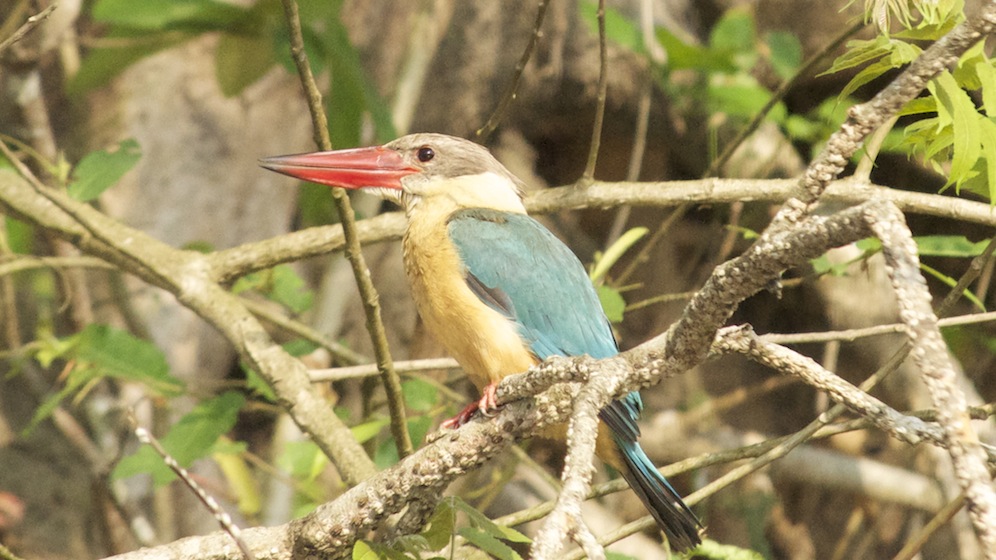
A Stork Kingfisher

A Stork Kingfisher

Going down to the river my guide and I took a dugout canoe along the river. Along the banks were many vividly coloured kingfishers and other fish eating birds, crocodiles with their snouts and eyes appearing just above the surface of the water. As we passed they would disappear under the surface in true Hollywood movie fashion. At one point we came across a large male rhino on the river bank. Here we had to be cautious. If we continued it might decide to charge into the river and attack the canoe. So we waited along with another canoe that joined us and one coming towards us until the rhino lost interest and turned his back on us.

Reaching our disembarkation point we went for a jungle walk to a lake favoured by rhino, tiger and all animals seeking a drink. Sadly nothing was at the water’s edge when we reached it but we did see plenty of deer, wild boar, birds and signs of rhino and cat activity.

The walk led us to the elephant breeding centre where there are mothers with babies of varying ages as well as expectant mothers. Whilst these animals are well cared for it was sad to see them shackled by one leg to a thick wooden post.  One or two of the young elephants were rocking backwards and forwards in a very repetitive way, very similar to children in one or two orphanages I have visited over the years.  I really did not want to linger here too long.
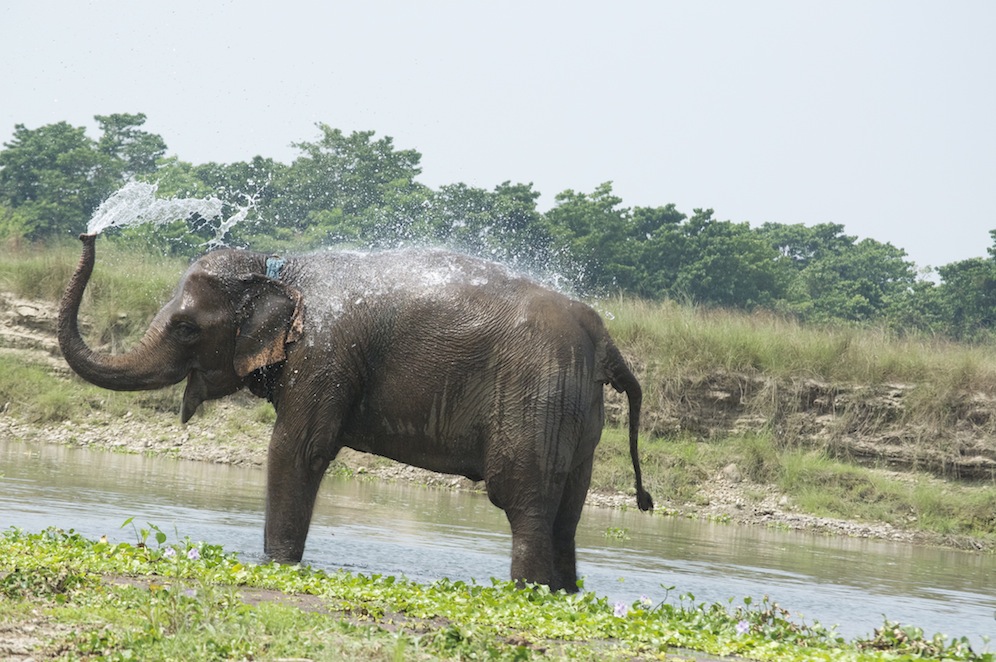
Elephant bath time

Elephant bath time

Returning to the lodge I was looking forward to bathing with the elephants but I found the sun oppressive. When it came to bathing with them I wandered down to take some pictures but soon had had enough and returned to the lodge to prepare for the journey back to Kathmandu. Hira had plans for visits on the return journey but because of my fragility we decided to go straight back to Kathmandu. It was not a comfortable journey but quite swift and I was in bed by 4.30. I intended having just a couple of hours rest but it turned into fifteen hours. Feeling much better this morning , if not a little fragile in the abdominal region, which is still not right. I will be very careful with what I eat today as I don’t want this when travelling tomorrow. Fingers crossed, not for the first time this trip.

Last few days with the group

Having had one of the best night’s sleep of the trip we had a fairly leisurely  breakfast before strolling over to the airport. We discovered that although we were due out on the second wave of Tara flights, we had been bumped on to the third phase. As the morning progresses in Lukla the chances of flying out diminish dramatically as the wind tends to increase, making it significantly more dangerous. To try to ensure our departure, Hira, in Kathmandu, chartered a Sita Air plane to do the job.

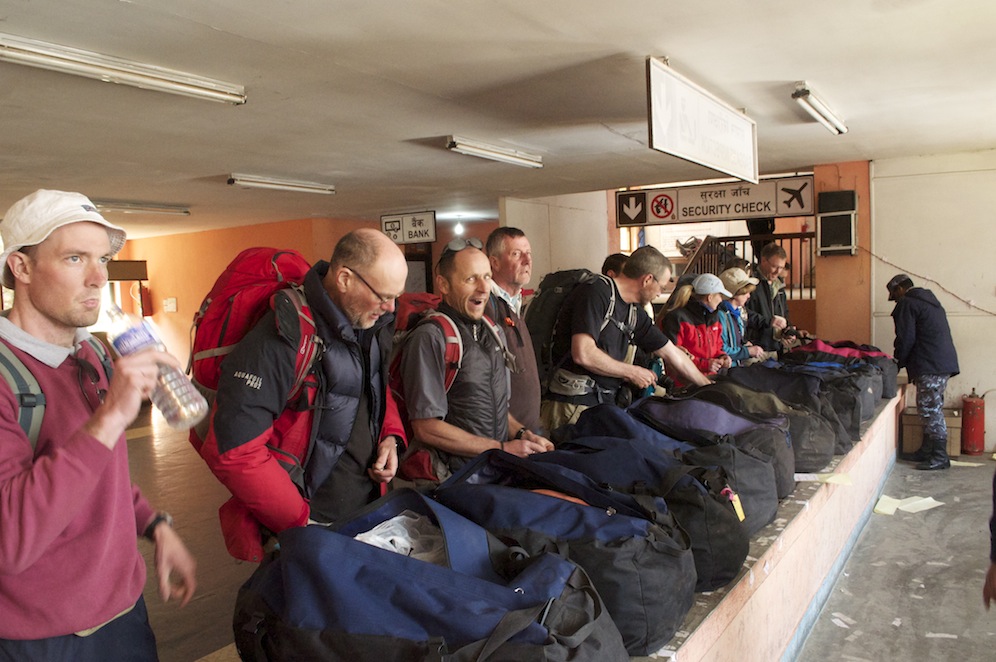
Security check at Lukla Airport with Robert looking particularly nervous

Security check at Lukla Airport with Robert looking particularly nervous

Having gone through all the check in and security processes in the expectation of leaving, originally, at 8.30, we found ourselves still waiting at 10.00 with increasing wind. As the group lined up for security, bags opened for scrutiny, Robert started to worry about his two dried yak dung patties he was hoping to take home as a present for his youngest son!  He managed to get them through, but will it be the same at Heathrow when the yak dung smelling dog, specifically employed for such occasions sniffs him out.  Hopes for our flight out rose as we saw our Sita Air flight approach Lukla, but then fade again as it aborted its landing attempt, banked and returned to Kathmandu. It became clear that there would be no further flights today.

As we walked back to the Paradise Lodge, I bumped into Colin Scott and his family who had been out on Mera Peak. Colin is part of the MEF and is one the organising committee with me for the 60th Anniversary of the First Ascent of Everest. It is such a small world. Only the day before, as we sat in Starbucks, Lukla, I had said I wondered how long I would have to sit there before I saw somebody I knew. Not that long, apparently.

Back at Paradise Lodge we had coffee, pre-ordered lunch and waited to see what the outcome of Tanka ‘s many phone calls was. Eventually, it became very clear that our only chance of getting out in reasonable time was to pay the necessary to charter a couple of helicopters. If we chose to stay another night in Lukla, priority for flights the next day would go to that day’s ticket holders and we would be fitted in, if possible, after they had all gone. The likelihood is that conditions would again interfere and we would find ourselves trapped further in Lukla, jeopardising return international flights. Explaining the situation, the options and the extra $300 cost per person, we put it to a vote. Everybody chose the immediate option of getting helicopters out asap.

More phone calls followed and lunch was served. No sooner had some finished their food than the call came for the first six to go quickly to the airport. The helicopters can take a maximum of six passengers. Very soon afterwards a helicopter landed on the apron, the six climbed aboard and off it went.

The rest of us, knowing there would be some time before it was out turn enjoyed our leisurely yak sizzler before, ourselves heading over to the airport.

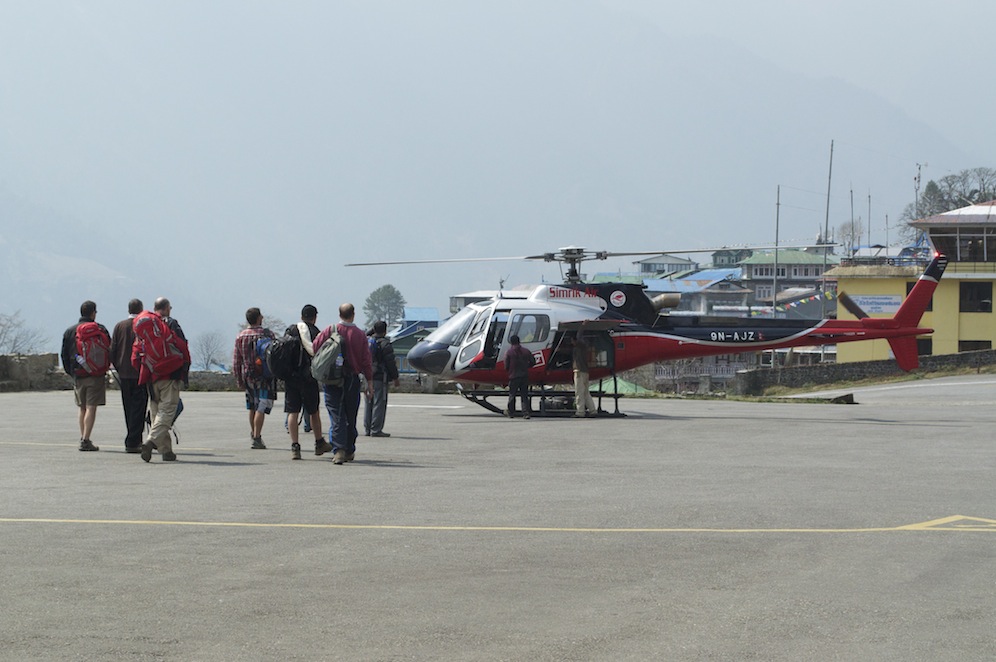
The group approaching their escape to Kathmandu

The group approaching their escape to Kathmandu

Unlike this morning, the place was deserted of security etc. and we sat on the edge of the apron and waited. It took a long time for the second helicopter to arrive, but eventually it did and the second six were quickly ushered aboard and it was off. That just left me with Tanka and Bishnu, who were not planning to return until there was a more cost effective way for them. Others turned up on the apron wanting to get on a flight and it was not much longer for the next helicopter to arrive. I managed to squeeze in the front seat, next to the pilot, with a young lad next to me. It was very cramped but If I could have turned round, I think I would have found it even more cramped in the seats behind.

Helicopters are like bees; in theory they should not be able to fly. This one appeared to be very flimsy. It did give fantastic 180 degree visibility, which you do not get in an aeroplane. Alternatively, it does not go as high as a plane so there were no white peak mountain vistas, just fascinating glimpses, from above, of Nepali rural life. The entire flight took about forty five minutes. The constant vibration seemed to transfer to my chest, which started me coughing. Maybe this is exactly what I needed to clear my chest.

I was soon transported across the airport to be met by Hira’s brother and the second half of the group who had only landed a matter of a few minutes before me.

The Hotel Tibet has an impressive reception area and the rooms are good. There is an adequate outdoor seating area/bar/dining and a pleasant roof garden and bar offering a mixture of sun and shade with pleasant air flow. Sadly the bar and snacks are not available until after 2.00pm. What is lacking are some of the little things that we come to expect, a variety of complimentary soaps and shampoos in the bathroom, a switched on, as well as a well stocked mini bar, free wifi instead of the expensive and irksome system they have in place at the moment.  Remarkably, everybody, despite having a fairly inactive day, was feeling tired and, as a group, we chose to stay in the hotel in the evening and sample the restaurant fare. It proved to be a good decision, like the one we had made earlier with regard to getting back to Kathmandu.

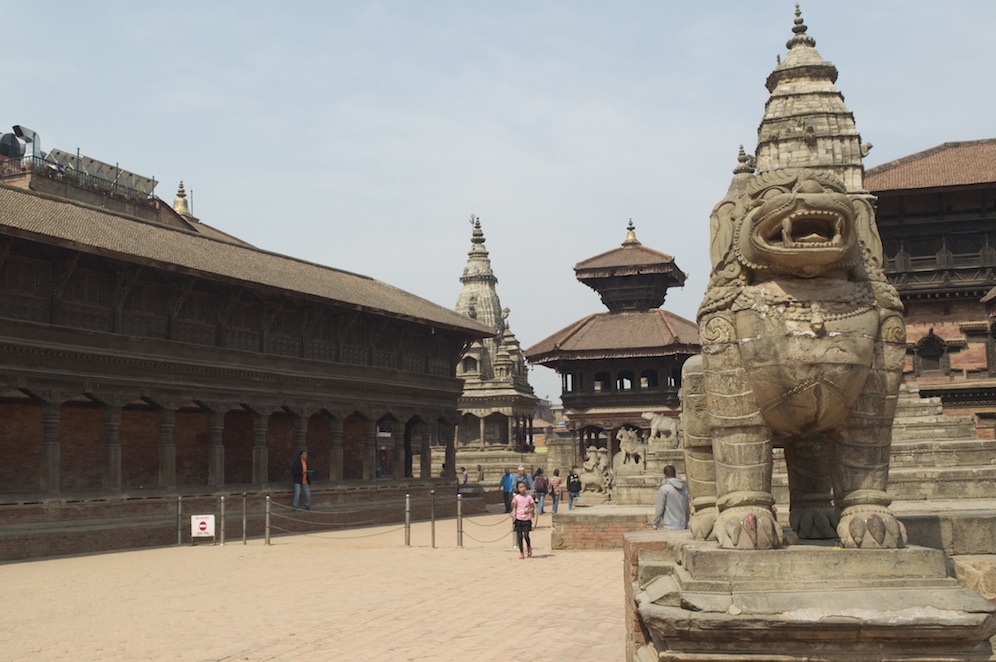
The quiet Durbar Square, Bhaktapur

The quiet Durbar Square, Bhaktapur

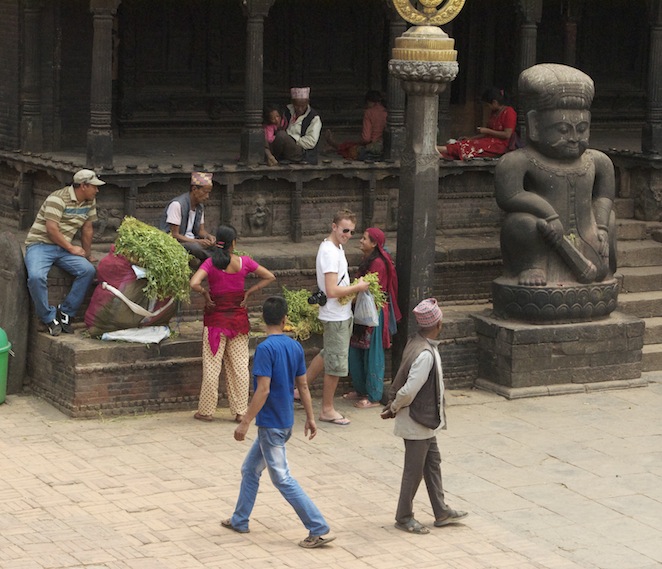
The following morning, feeling somewhat refreshed, ten of us were collected at the hotel and taken to Bhaktapur for a half day tour with our guide, Ramesh.  I love Bhaktapur. It is so much more pleasant than Kathmandu in that the pace of life is much slower. The people seem more content, happier, with ready smiles whether they are drawing water from a well, selling peas on the vine or pleasantly trying to persuade you to buy a silk purse or a necklace. There isn’t the pressure that Kathmandu seems to impose on everybody. It is great place to sit and people watch.

The chariot now lying idle.

The chariot now lying idle.

Ramesh took us the the various temples and gave us a brief résumé of them. I don’t think anybody particularly wanted long, historical details. Having covered the most important temples we we able to concentrate on the more interesting human activity that Bhaktapur is renowned for. Sitting in a small square was the chariot used during the new year celebrations. It is a huge rickety wooden construction built almost in the style of a temple. Crowds of young men clamber aboard as others pull it through the streets. It is such a precarious construction and with the uneven streets it rattles between the houses, often clipping overhanging roofs and causing damage to both buildings and riders, if they are unfortunate enough to be in the wrong place at the wrong time. Used only yesterday, there were two fatalities when participants fell off the chariot and  were crushed by its giant wheels. Two fatalities is two too many but there have been times in the past when there have been many more.

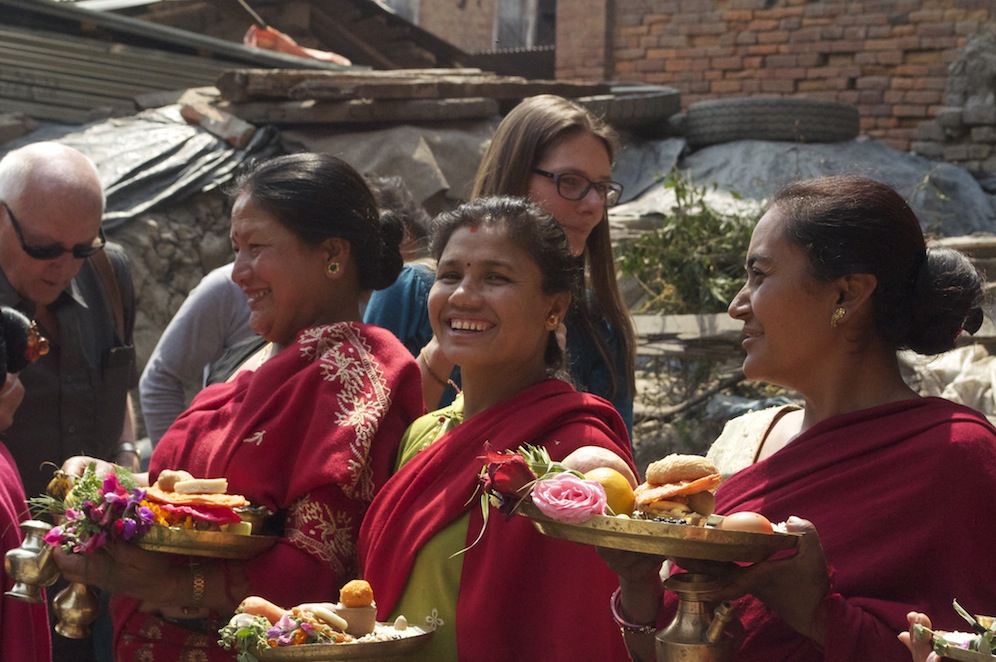
Newari women waiting with their gifts

Newari women waiting with their gifts

We soon found ourselves in the square renowned for its pottery. Whenever I have been there in the past there has been a great deal of activity related to that craft. This year there was none because of the continuing new year celebrations. In one corner of the square there was a gathering of people with a lot of music coming from two or three different musical groups who seemed intent on drowning out the opposition. There was a fabulously happy atmosphere about the gathering as the red saried women presented their sweet gifts to the shrine held aloft on the shoulders of giggling men.  Tourists mingled with the groups and you were never given the feeling that you were in the way or imposing yourself upon their event. So much more relaxed than Kathmandu.

The paper factory

The paper factory

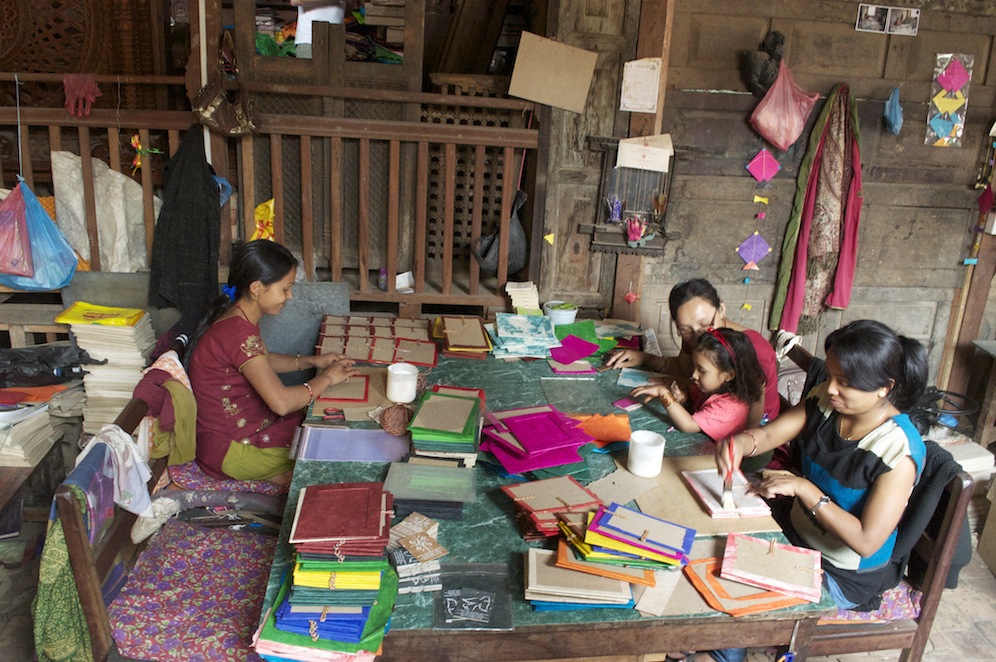
Moving on we went to see the peacock window before visiting a paper making factory. This gave us an insight, not only to the skills involved in making paper but also into the working conditions.  The building was a labyrinth of staircases and small working areas but the space was crammed with paper and paper products in various stages of production and finished products showcasing the wide range of products on sale.  The workers seemed happy and relaxed and one or two mothers had their children with them, presumably because the schools were on holiday and not because they were employing child labour.

Stephen buying his peas on the vine

Stephen buying his peas on the vine

It was time for coffee, so we went to the Peacock Cafe, overlooking a square where we spent the best part of an hour people watching from our balcony tables. From here we could watch the women drawing water from the well. Soon after we assumed our lofty lookout a young girl arrived with a large bundle of peas on the vine wrapped in a cloth. She sat on the base stone of a temple and, for a long time, nothing happened. Then, like bees round a honey pot, she was surrounded by people eager to buy her crop. Stephen popped down and bought some. Soon her crop way gone and another woman took over with a similar bundle. For the rest of our time in Bhaktapur, shopkeepers sat in their shop doorways eating peas from the pod.

Our last visit in Bhaktapur was to a wood carving centre. Because it was still festival time no carving was being done but we could look at samples of their work.

Slowly we ambled back to the bus which returned us to the hotel for a late lunch.
In the afternoon I took Stephen and Nathan into Thamel for some last minute shopping.

In the evening we went to the Nepali Kitchen for a traditional Nepalese meal with cultural dancing.

Today had been one of those nothing days waiting to go home. The boys left after breakfast for their flight to Kuala Lumpa, not an enjoyable experience saying goodbye at the best of times but especially when the next time I see Stephen will be some way in the future. I popped into Thamel but had no real reason to be there, so returned to the hotel and spent the rest of the day on the roof terrace.

The group has now gone so it is very quiet. A large part of me wishes I had left with the group but tomorrow is going to be another day with plenty to interest and excite.

What did I miss?

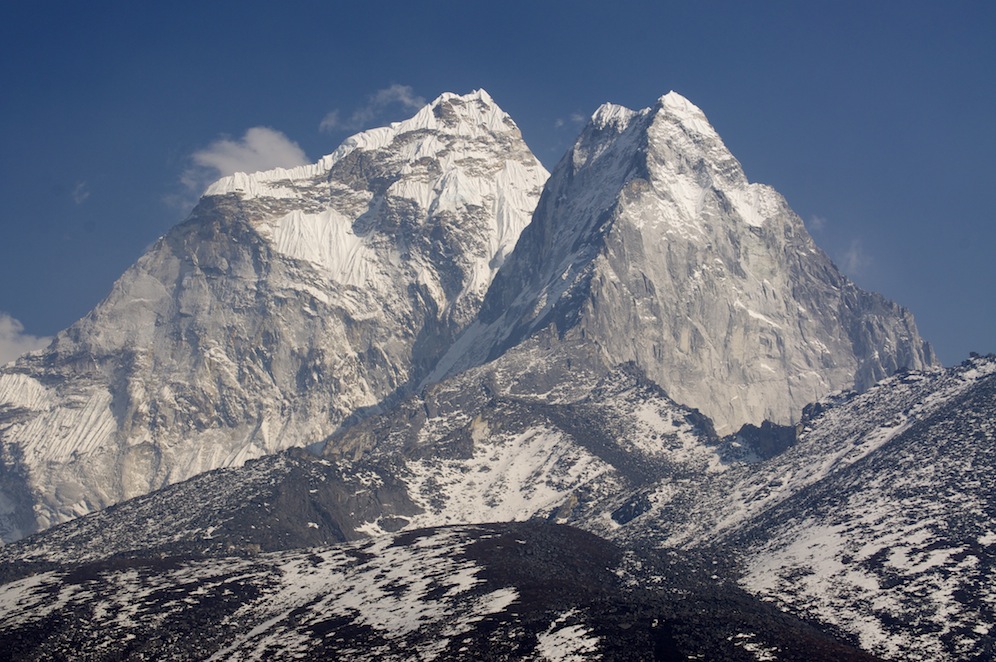
Ama Dablam from Dingboche

Ama Dablam from Dingboche

Having had a fairly emotional separation, the group left Phortse for the relatively long trek to Dingboche. It included, throughout the distance, a climb of 600m but because it was a longer linear distance none of the climbing was steep. All the time, to spur them on, they had stunning Ama Dablam towering above them and getting closer all the time. By the time they reached Dingboche it was opposite the lodge and, although looked very different, was no less magnificent, particularly as the light changed on its dramatic surfaces.

One or two of the group were feeling a little fragile, or tiredness was beginning to creep in, so they took the day at a leisurely pace in the knowledge that the next day was a “rest day”.

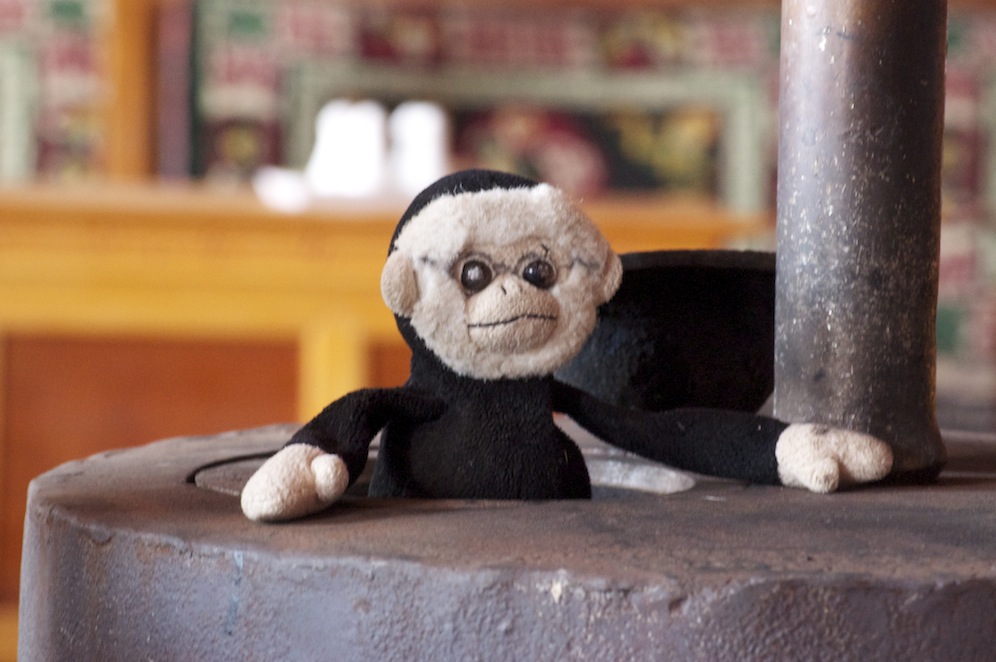
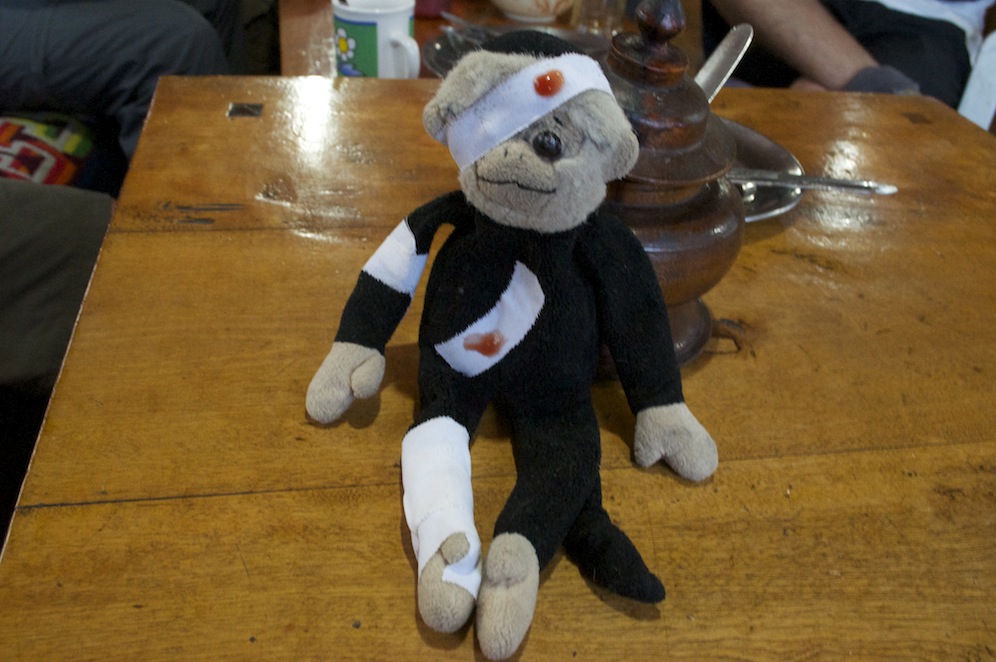
Monkey climbing out (or into) the yak dung burning stove!

Monkey climbing out (or into) the yak dung burning stove!

Since the start of the trip we had had daily nominations followed by the daily award.  Nominations could be for anything that was said or done that caused amusement to the rest of the group, however innocent the words or act might be.  The recipient of the award, then had to look after a stuffed monkey for twenty four hours, living with the knowledge that other members of the group might wish to kidnap or create some mischief involving the monkey.  Failure to look after the monkey properly might incur a forfeit of some sort, designed at making the culprit feel as uncomfortable as possible.  With me away from the group, they decided that they could relax the rules a little and have some fun.  Hence, Monkey found himself the victim of a number of abuses and got himself into some very tricky scrapes.  The rest day in Dingboche gave them time to apply their minds to some monkeying around!

Apart from a morning stroll up the Pokalde ridge for enhanced views, it was a rest day and full advantage of the opportunity was taken in the afternoon.

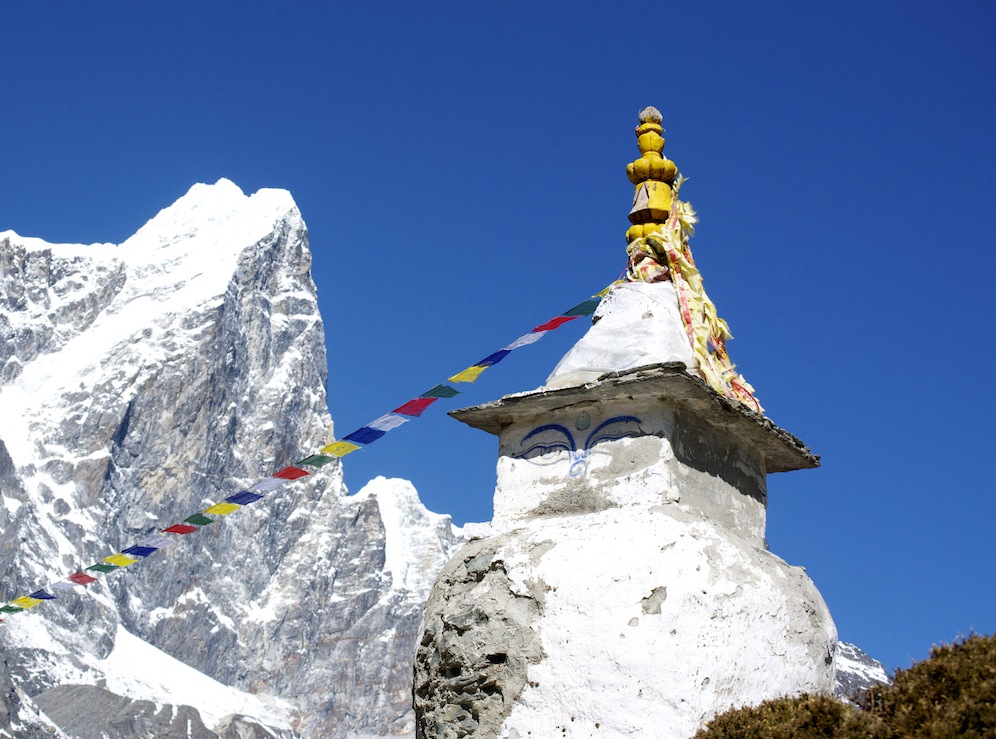
Cholatse & chorten

Cholatse & chorten

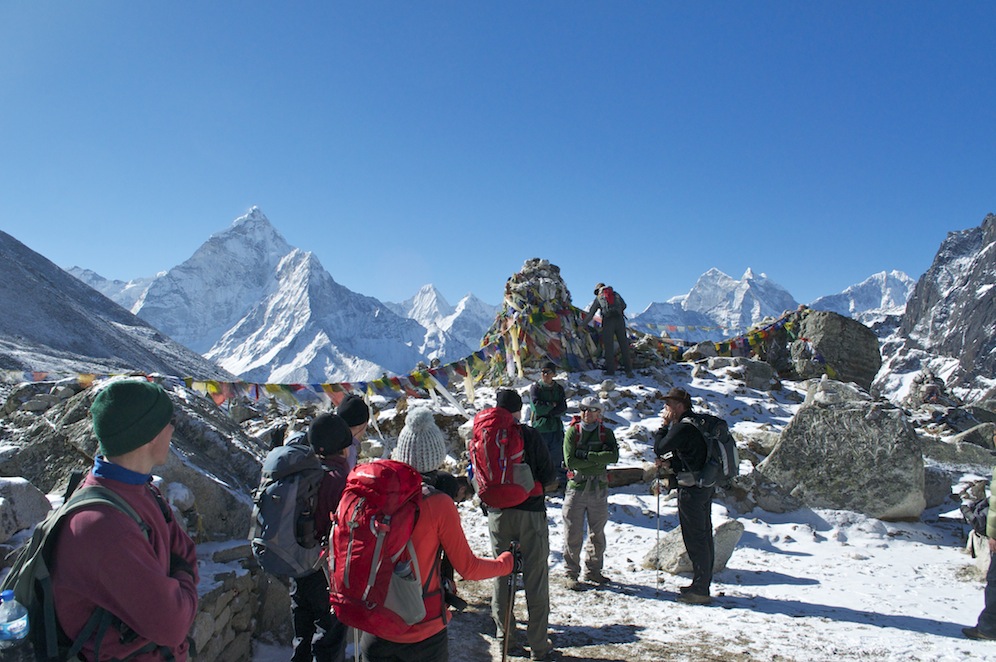
The following day saw them walk around the flanks of Pokalde to Dugla, a small hamlet positioned at the foot of the Khumbu Glacier’s terminal moraine.  This part of the walk gave stunning views of Tawache and The magnificent Cholatse. From Dugla it was necessary to climb up the moraine to a ridge upon which there are many chortens commemorating the too many lives lost on Everest. Only the day before, one of the ice doctors had been killed in the icefall. His home was in Dingboche. Stephen had come across his grieving widow. Soon there would be another chorten.

Having climbed up to the top of the moraine it was a relatively easy, if not a high altitude walk, to Lobouche. I remember Lobouche as being very dirty, over crowded and quite unpleasant. If I am to believe the group it is now much improved.

It was now beginning to get more serious. The altitude was beginning to impose limitations of activity and the trails, although still good considering the height, were less maintained. At least they were not encountering rows and rows of steps!

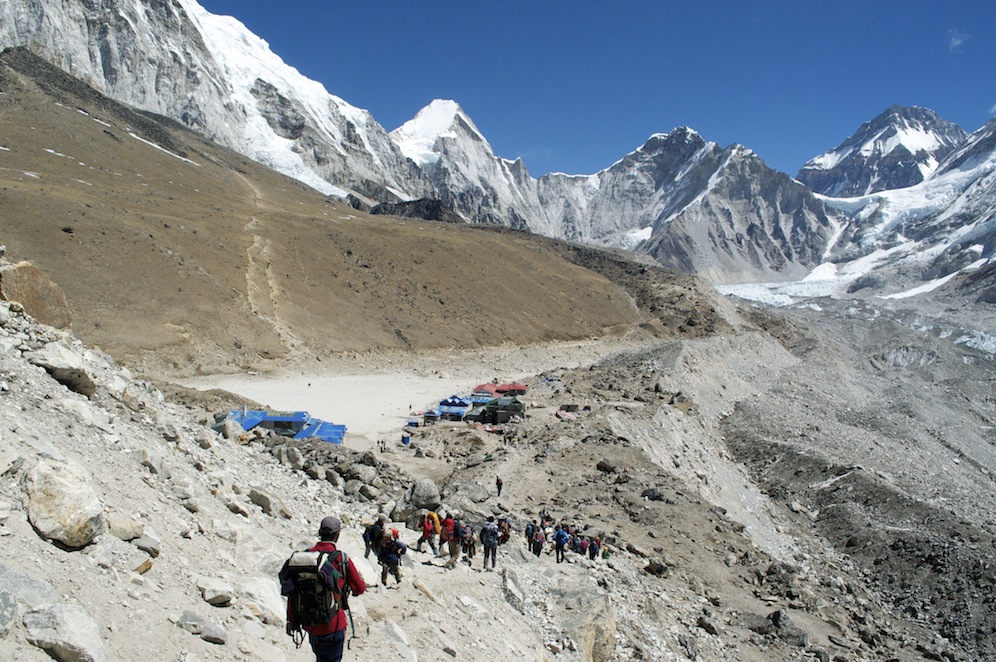
Approaching Gorak Shep

Approaching Gorak Shep

From Lobouche it is only three hours to Gorak Shep, thus giving them time to walk to Base Camp and back to Gorak Shep, making it in total a long day. The walk to Base Camp no longer goes up the middle of the glacier but follows the moraine on the western side of the glacier. This makes it a tiring, undulating path which takes its toll on the energy levels. Robert had been suffering with an upset stomach for several days and had not been able to keep food in. How he managed to summon up the energy each day is remarkable, this day in particular.

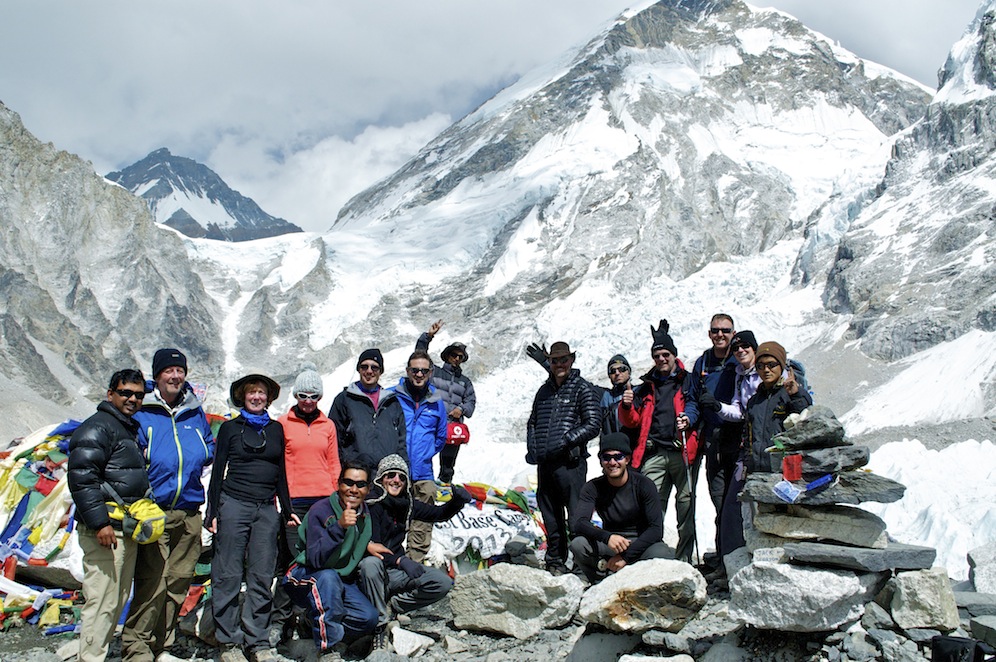
Everest Base Camp celebrations

Everest Base Camp celebrations

Base camp was beginning to establish itself with a range of brightly coloured tents in expedition clusters. Some of the larger tents with the base camp medical centre, the bakery, the Internet cafe and others would come once the climbers began to arrive.
Looking across at the Khumbu Icefall, it is hard to imagine a route through there and the effort it must take to achieve it. What you come away with is a feeling that you have been somewhere very special.

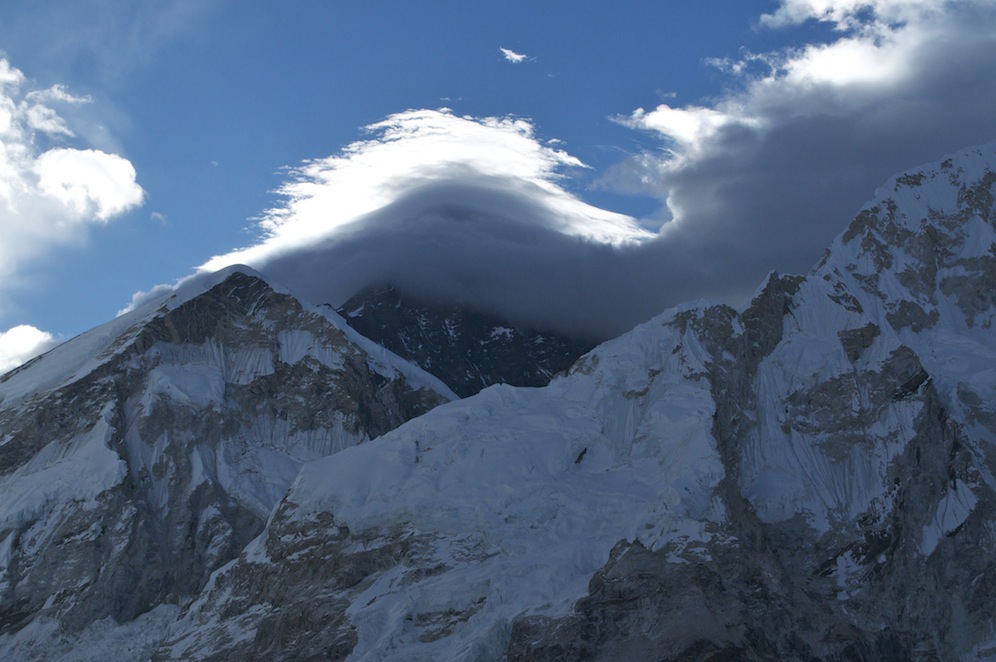
Everest refused to reveal herself properly during the ascent of Kala Patthar

Everest refused to reveal herself properly during the ascent of Kala Patthar

Back in Gorak Shep it was early to bed so that they all felt refreshed for the early ascent of Kala Patthar. Robert declined the opportunity on the grounds that he still had to get himself down. Also, Shona really only had ambition to reach Base Camp so took advantage of a lie in. The rest of the group set out at 4.30 and fairly raced up under the leadership of Bishnu who set a cracking pace. Usually it takes between two and three hours for the 500m ascent but it took the group less than ninety minutes, which was truly remarkable. Not content withe the lower most commonly visited summit, the group went to the higher (5643m) summit. Sadly, Everest refused to show herself in her true glory, hiding behind a shroud of clinging cloud. It was cold on the top of Kala Patthar, so half an hour was plenty of time on the summit before racing down to Gorak Shep for a satisfying and triumphant breakfast, after which they dropped down to Lobouche.

After the light dusting of snow

After the light dusting of snow

That night there was a dusting of snow, giving a whole new perspective on the environment. Like all snow at this time of year it did not last very long once the sun came up. It evaporates rather than melts, leaving the ground beneath dry.

There was a triumphant feeling among the group on the walk down to Debouche. They had succeeded in everything they set out to do. With the exception of the bit of cloud on Everest, they had had stunning conditions throughout. Now, also it was going to warmer as they descended. Every good reason to sing as they walked. While singing ‘I could walk 500 miles’ Nathan learnt the importance of breath control while singing at altitude. In his ambition to sing it properly he forgot to breath. Suddenly he felt light headed, then dizzy. Realising what was happening he uttered, “Oh, oh!”, walked a further couple of steps and then pitched forward in a faint. That night he was a very fitting recipient of the wally award.
That night was also a top class lodge at Debouche, with excellent accommodation and food. Sadly Robert was not in any fit state to appreciate the latter.

Thyangboche Monastery

Thyangboche Monastery

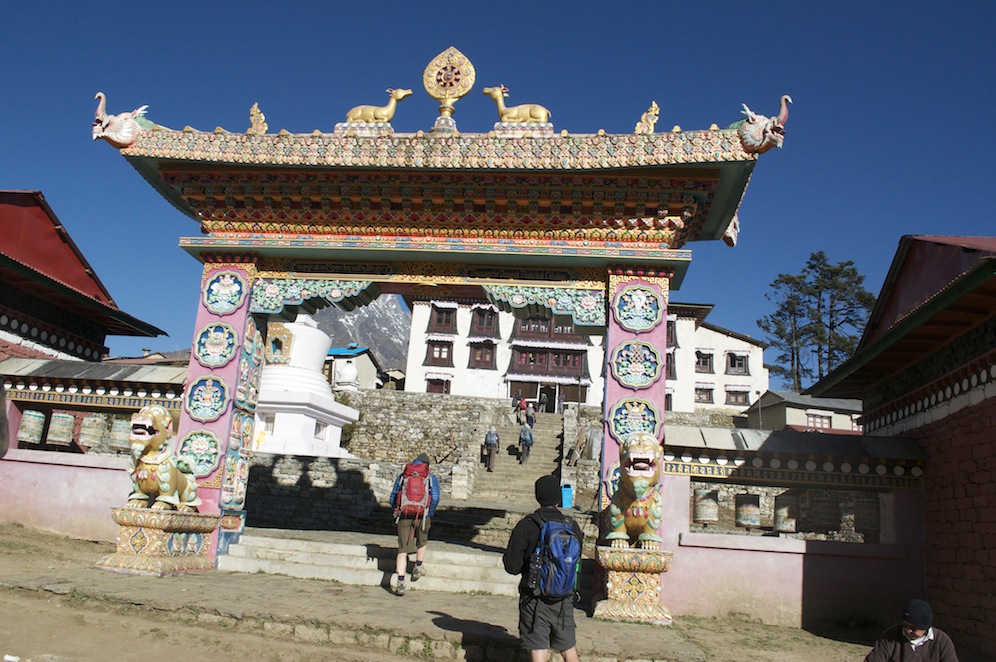
The next day was quite a long one. Firstly there was a gentle climb up to Thyangboche and the monastery followed by a long descent to Phinke Tenga, another climb and a traverse to Namche where they called in to Camp de Base Lodge, where it turned out I had left my sunglasses a few days previously. Guess who won the monkey that night and weren’t they eager to award it. Leaving Namche, they had the long, but much more preferable, descent of Namche hill before eventually meeting up, unexpectedly, with me in Monjo.

That just about fills in the gap between me leaving the group and us meeting up again.

Heading back briefly to the hills

When we flew to Lukla for the start of our trek I was pleasantly surprised by the swift efficiency and the quiet atmosphere of the check in. Not so today. Words like chaos and pandemonium spring to mind. It appears that what has made it so today in particular is a forest fire near Lukla. It did not help that a group of Japanese trekkers were blocking up the area while their leader checked them in. There is no need for everybody to crowd round the desk and make it very difficult for everybody else. More bizarrely, in the middle of all the chaos were trays of eggs stacked up in front of the desk, belonging to no one obvious. Eventually they were removed and one can only assume that they found themselves on a flight to Lukla.

Out of all the pandemonium a boarding card is eventually produced allowing me to pass through security into the relative calm of departures. Transit through departures was quite swift, but having reached the plane we then sat on the tarmac for twenty minutes while they refuelled it.

The flight was good but as we made our approach to Lukla the whole hillside on our left was on fire. Huge plumes of smoke rose and followed the shape of the hill, fortunately away from our flight path, and flames could be seen leaping above the smoke. There is absolutely no mechanism for putting these fires out, no access and no easily available water supply. As the day lengthens the wind increases and fans the fire. All that anybody can hope for is either heavy and prolonged rain, or for the fire to burn itself out. So far it has been burning for two days and seems to be growing with no prospect of either.
As I walked up the Khumbu the smokey haze provided much diminished views of the mountains and the smell of burning pervaded the air.

Phakding

Phakding

I managed to reach Phakding in two hours and stopped for lunch and a short rest. Although I only had Rara Soup I felt full and my afternoon walk up to Monjo became more of a tired trudge. Nevertheless I reached Monjo in less than two hours from Phakding, arriving shortly after 3.30, before the arrival of the group.

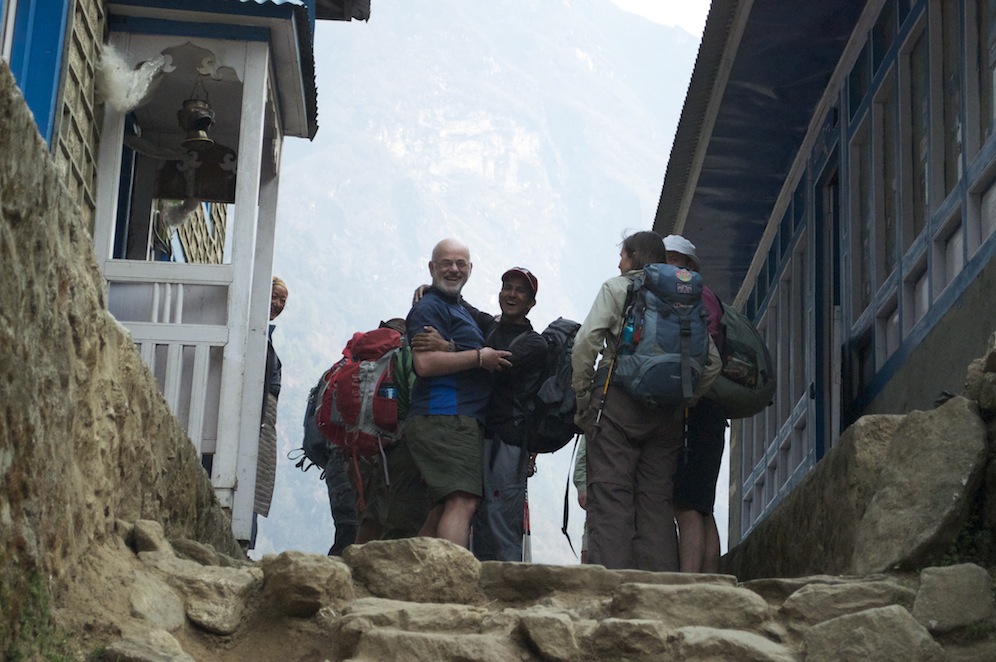
After about half an hour Mark, followed by the rest of the group, appeared at the top of the steps leading up to the exit from the national park. As they walked passed Ang Darki’s lodge I stood in the doorway and asked if they were going to ignore me. My appearance took them by surprise and there was much noise and hugging.

Bishnu is happy to see me!

Bishnu is happy to see me!

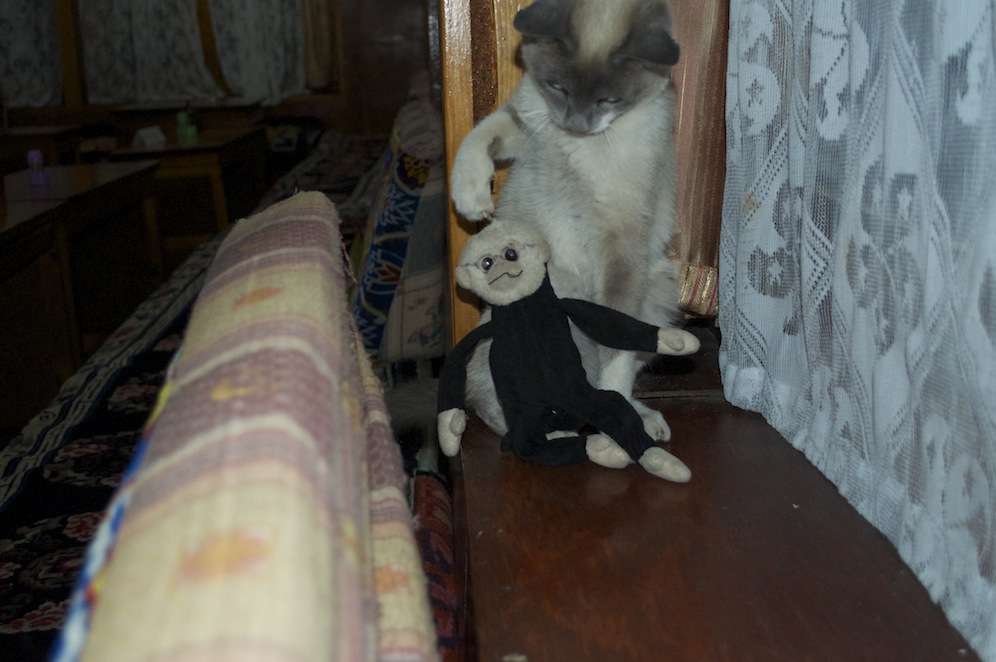
Monkey gets a pasting

Monkey gets a pasting

Our lodge was just a little way down the hill. It looked good but the rooms were a bit dungeon like and the food was a huge, tasteless disappointment. I shared a room with Stephen and Nathan and we had a problem with our shower providing us with an indoor pool. Nigel and Mike had sewage swilling around on their bathroom floor. The poor food and disappointing accommodation left us feeling the need for some entertainment.  The lodge had a resident kitten, an attractive creature with a playful nature.  For some reason I had already been awarded the monkey for leaving my sun glasses at the lodge in Namche several days earlier. It seemed we had some ready made potential entertainment.  Here we had a kitten that wanted to play and a monkey that would make an ideal toy.  The kitten did not need much encouragement to attack and it proved very entertaining.

The scars of battle!

The scars of battle!

In the morning the monkey came to breakfast bearing the scars of battle!

We were quite pleased to leave but before we did we thanked our porters and gave them their tips as they would be wanting to return to Base Camp with another group as soon as they had delivered our bags.

The walk back to Lukla passed without incident although it was very hot and the second half spent predominantly climbing up to Lukla proved tiring and arduous. At some point I got fed up of carrying the monkey, which has, incidentally, made a remarkable recovery from its battle with the kitten, and gave it to a little boy on the understanding that he shared it with his sister.  Clearly he didn’t understand me and before we left the rest spot an argument over the monkey was already brewing.  Their mother will love me!

There are some pretty tired bodies in the group and, whilst they have had a fantastic time, they are quite relieved that the walk is completed.

Our only concern now is getting out. There have been problems today and not everybody got out. The wind, often a tail wind, makes landing at Lukla very difficult.  Landing speed on such a short runway is crucial if the plane is to slow down in time before the runway ends.  If there is a significant tails wind, that increases the speed of the plane as it lands, reducing the time is has to slow down.  When the wind reaches the point where doubt is cast in the pilot’s mind, flights are cancelled.  That is what happened today and while some people failed to get out, others did not manage to leave Kathmandu. As a result  there has been a flurry of activity around the helipad with stranded passengers paying the extra to keep to their schedules. The problem with those that are stranded is that they do not get priority the next day; that goes to those with day specific tickets.  The stranded passengers are forced to wait for the third or fourth group of flights, and, as is so often the case, those are the flights that are cancelled.  The potential for being stuck in Lukla for several days is a stark reality.  Fingers crossed.

Last day in Kathmandu

Today I achieved success. Tshewang emailed me with a phone number for the principal of Tashi Waldorf. One if the problems, I guess, with making contact has been that the school, like Saptagandaki, is presently closed for a holiday and decorators are in residence there.

Finally getting hold of Eva we agreed to meet at Ying Yang at 11.00. At last I was able to hand over 300,000 Rupees. Job done! We chatted over drinks and I explained that KSWNT will cease to exist once we have finalised the accounts. It is up to them to try to find a new organisation to look after funding from the UK. I also pointed out that their website is seriously out of date and that had led to some of the difficulty in making contact. Eva agreed and promised to put things right as soon as possible. I may well pay them a visit one day.

Reading between the lines I think they have had a difficult time with moving properties, with a subsequent loss of some students, and a change of personnel at the top. At the end of our meeting I felt satisfied that I had achieved pretty much everything I wanted to achieve before I see the group again.

I have also come to the decision that I am going to surprise them. Tomorrow night they are staying in Monjo. Tomorrow I will walk up to Monjo and join them in the lodge. I am really looking forward to that and to the several hours of walking on my own, with my own thoughts, at my own pace. More than anything, I am looking forward to hearing their tales and seeing Stephen.