Indonesia – Getting There

With news reports of man eating tigers in the Gunung Leuser National Park, the closure of Heathrow and hundreds of prisoners escaping from Medan jail we travelled along the M4 not knowing whether we were going to get away or not, nor what might happen when we arrive in Sumatra.  As it turned out our passage through check-in and security was as smooth as I have ever known it.  The check-in staff knew nothing of the runway closures, or of the fire which caused it all in the first place.

The A380 is a huge plane with 471 passengers and a multitude of crew.  I worked out, based on what we had paid for our tickets, that had all 471 passengers paid the same fare  the income from this flight would be in excess of half a million pounds!  Many would have paid more so my guesstimate is conservative.  With two floors running the length of the plane you are, perhaps, not aware that everything you can see on your level is replicated above.  the service was good and the food excellent.  Twelve and a half hours is a long time to be cooped up in a plane, no matter how large it is.  Fortunately, I was sitting in row 62, the back row, so it was easy for me to get up and stretch my legs. However, the strange thing about this flight was that it was dark when we took off, the window blinds were kept down until the point of landing in Singapore when it was getting dark for the next night.  In effect we were getting two nights together without a day between.

Our time in Singapore was reduced to about an hour before our short flight to Medan.  Wanto and Sam met us on arrival in Medan.  By the time I had sorted out changing money all the students were through immigration, the bags collected off the carousel and we were heading for the waiting bus.  It was about 28C and very humid.  Before we left Medan we went to a restaurant where they were waiting to provide us with our first taste of Indonesia. Either all the prisoners had been recaptured or were as far away from Medan as possible, we saw none of them. Just the tigers to liven up our jungle trek to come!

By the time we left the restaurant the hour was quite late but this meant that the roads were not crowded and the expected four hour journey was covered in two.  We arrived at the Rindu Alam Hotel in Bukit Lawang at midnight.  The rooms were fairly basic with less than adequate air conditioning.  Remarkably I slept quite well and overslept!

Bukit Lawang

Bukit Lawang

We decided not to visit the orangutans in the morning but to use the time to acclimatise ourselves, organise personal money and to acquaint ourselves with Bukit Lawing, a village where all life seems to revolve around the banks of the Borhorok River.  It was quiet and relaxed and where ever we went we were met with friendly faces and smiles.

Last few days with the group

Having had one of the best night’s sleep of the trip we had a fairly leisurely  breakfast before strolling over to the airport. We discovered that although we were due out on the second wave of Tara flights, we had been bumped on to the third phase. As the morning progresses in Lukla the chances of flying out diminish dramatically as the wind tends to increase, making it significantly more dangerous. To try to ensure our departure, Hira, in Kathmandu, chartered a Sita Air plane to do the job.
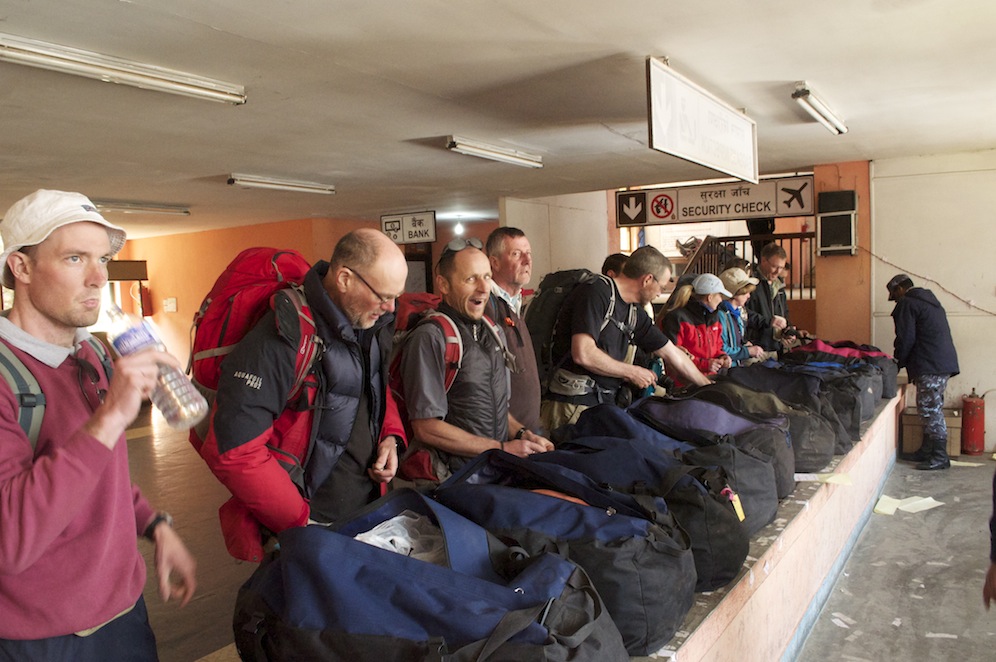
Security check at Lukla Airport with Robert looking particularly nervous

Security check at Lukla Airport with Robert looking particularly nervous

Having gone through all the check in and security processes in the expectation of leaving, originally, at 8.30, we found ourselves still waiting at 10.00 with increasing wind. As the group lined up for security, bags opened for scrutiny, Robert started to worry about his two dried yak dung patties he was hoping to take home as a present for his youngest son!  He managed to get them through, but will it be the same at Heathrow when the yak dung smelling dog, specifically employed for such occasions sniffs him out.  Hopes for our flight out rose as we saw our Sita Air flight approach Lukla, but then fade again as it aborted its landing attempt, banked and returned to Kathmandu. It became clear that there would be no further flights today.

As we walked back to the Paradise Lodge, I bumped into Colin Scott and his family who had been out on Mera Peak. Colin is part of the MEF and is one the organising committee with me for the 60th Anniversary of the First Ascent of Everest. It is such a small world. Only the day before, as we sat in Starbucks, Lukla, I had said I wondered how long I would have to sit there before I saw somebody I knew. Not that long, apparently.

Back at Paradise Lodge we had coffee, pre-ordered lunch and waited to see what the outcome of Tanka ‘s many phone calls was. Eventually, it became very clear that our only chance of getting out in reasonable time was to pay the necessary to charter a couple of helicopters. If we chose to stay another night in Lukla, priority for flights the next day would go to that day’s ticket holders and we would be fitted in, if possible, after they had all gone. The likelihood is that conditions would again interfere and we would find ourselves trapped further in Lukla, jeopardising return international flights. Explaining the situation, the options and the extra $300 cost per person, we put it to a vote. Everybody chose the immediate option of getting helicopters out asap.

More phone calls followed and lunch was served. No sooner had some finished their food than the call came for the first six to go quickly to the airport. The helicopters can take a maximum of six passengers. Very soon afterwards a helicopter landed on the apron, the six climbed aboard and off it went.

The rest of us, knowing there would be some time before it was out turn enjoyed our leisurely yak sizzler before, ourselves heading over to the airport.
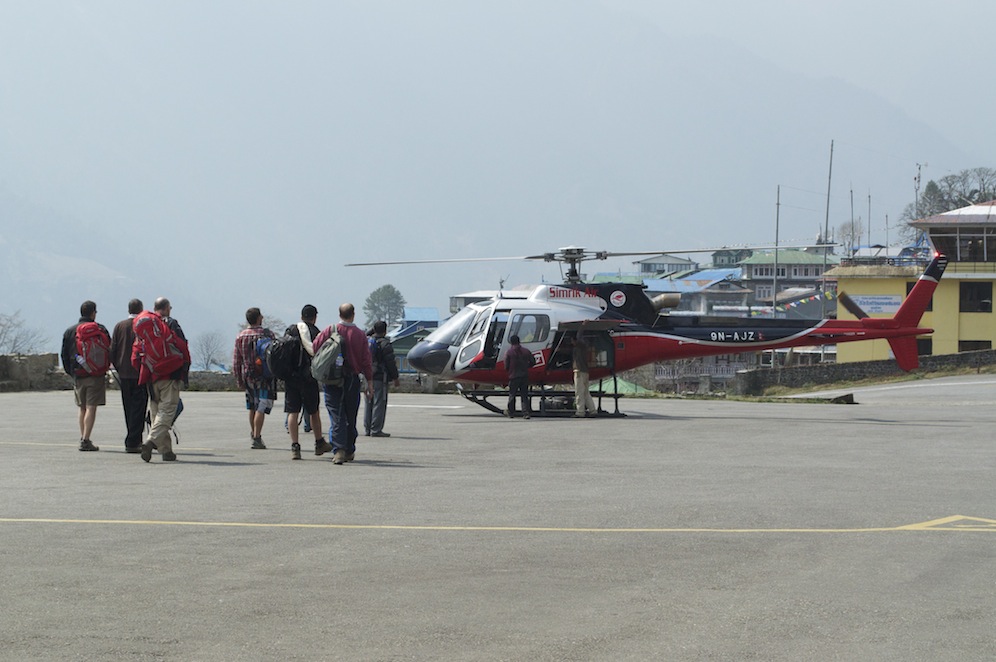
The group approaching their escape to Kathmandu

The group approaching their escape to Kathmandu

Unlike this morning, the place was deserted of security etc. and we sat on the edge of the apron and waited. It took a long time for the second helicopter to arrive, but eventually it did and the second six were quickly ushered aboard and it was off. That just left me with Tanka and Bishnu, who were not planning to return until there was a more cost effective way for them. Others turned up on the apron wanting to get on a flight and it was not much longer for the next helicopter to arrive. I managed to squeeze in the front seat, next to the pilot, with a young lad next to me. It was very cramped but If I could have turned round, I think I would have found it even more cramped in the seats behind.

Helicopters are like bees; in theory they should not be able to fly. This one appeared to be very flimsy. It did give fantastic 180 degree visibility, which you do not get in an aeroplane. Alternatively, it does not go as high as a plane so there were no white peak mountain vistas, just fascinating glimpses, from above, of Nepali rural life. The entire flight took about forty five minutes. The constant vibration seemed to transfer to my chest, which started me coughing. Maybe this is exactly what I needed to clear my chest.

I was soon transported across the airport to be met by Hira’s brother and the second half of the group who had only landed a matter of a few minutes before me.

The Hotel Tibet has an impressive reception area and the rooms are good. There is an adequate outdoor seating area/bar/dining and a pleasant roof garden and bar offering a mixture of sun and shade with pleasant air flow. Sadly the bar and snacks are not available until after 2.00pm. What is lacking are some of the little things that we come to expect, a variety of complimentary soaps and shampoos in the bathroom, a switched on, as well as a well stocked mini bar, free wifi instead of the expensive and irksome system they have in place at the moment.  Remarkably, everybody, despite having a fairly inactive day, was feeling tired and, as a group, we chose to stay in the hotel in the evening and sample the restaurant fare. It proved to be a good decision, like the one we had made earlier with regard to getting back to Kathmandu.
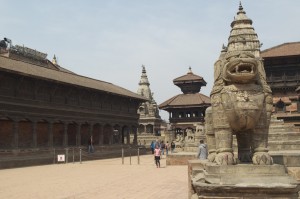
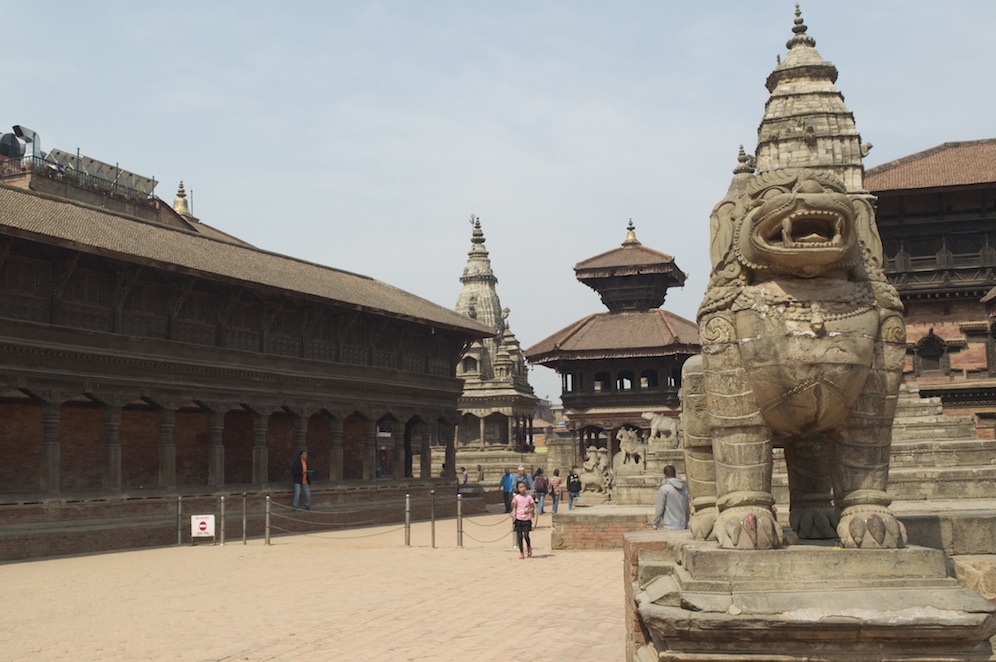
The quiet Durbar Square, Bhaktapur

The quiet Durbar Square, Bhaktapur

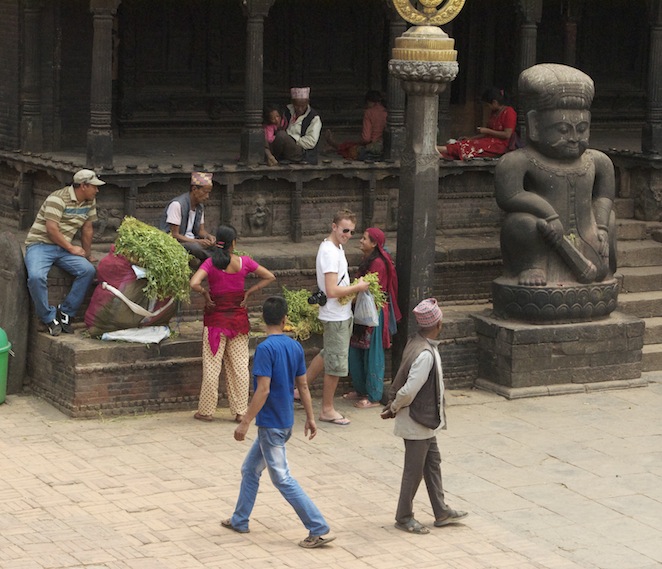
The following morning, feeling somewhat refreshed, ten of us were collected at the hotel and taken to Bhaktapur for a half day tour with our guide, Ramesh.  I love Bhaktapur. It is so much more pleasant than Kathmandu in that the pace of life is much slower. The people seem more content, happier, with ready smiles whether they are drawing water from a well, selling peas on the vine or pleasantly trying to persuade you to buy a silk purse or a necklace. There isn’t the pressure that Kathmandu seems to impose on everybody. It is great place to sit and people watch.
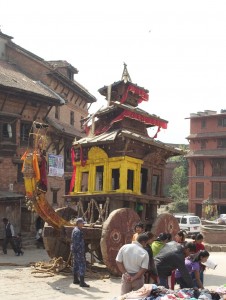
The chariot now lying idle.

The chariot now lying idle.

Ramesh took us the the various temples and gave us a brief résumé of them. I don’t think anybody particularly wanted long, historical details. Having covered the most important temples we we able to concentrate on the more interesting human activity that Bhaktapur is renowned for. Sitting in a small square was the chariot used during the new year celebrations. It is a huge rickety wooden construction built almost in the style of a temple. Crowds of young men clamber aboard as others pull it through the streets. It is such a precarious construction and with the uneven streets it rattles between the houses, often clipping overhanging roofs and causing damage to both buildings and riders, if they are unfortunate enough to be in the wrong place at the wrong time. Used only yesterday, there were two fatalities when participants fell off the chariot and  were crushed by its giant wheels. Two fatalities is two too many but there have been times in the past when there have been many more.
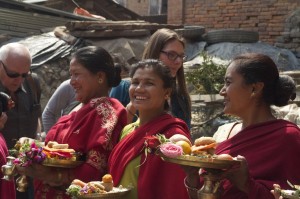
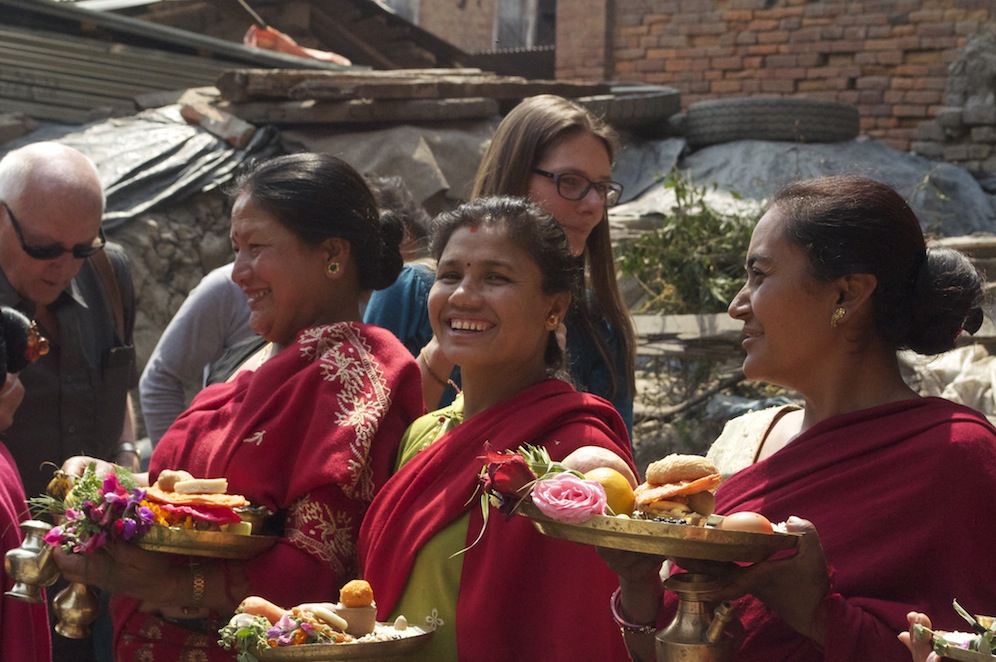
Newari women waiting with their gifts

Newari women waiting with their gifts

We soon found ourselves in the square renowned for its pottery. Whenever I have been there in the past there has been a great deal of activity related to that craft. This year there was none because of the continuing new year celebrations. In one corner of the square there was a gathering of people with a lot of music coming from two or three different musical groups who seemed intent on drowning out the opposition. There was a fabulously happy atmosphere about the gathering as the red saried women presented their sweet gifts to the shrine held aloft on the shoulders of giggling men.  Tourists mingled with the groups and you were never given the feeling that you were in the way or imposing yourself upon their event. So much more relaxed than Kathmandu.
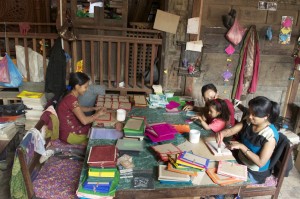
The paper factory

The paper factory

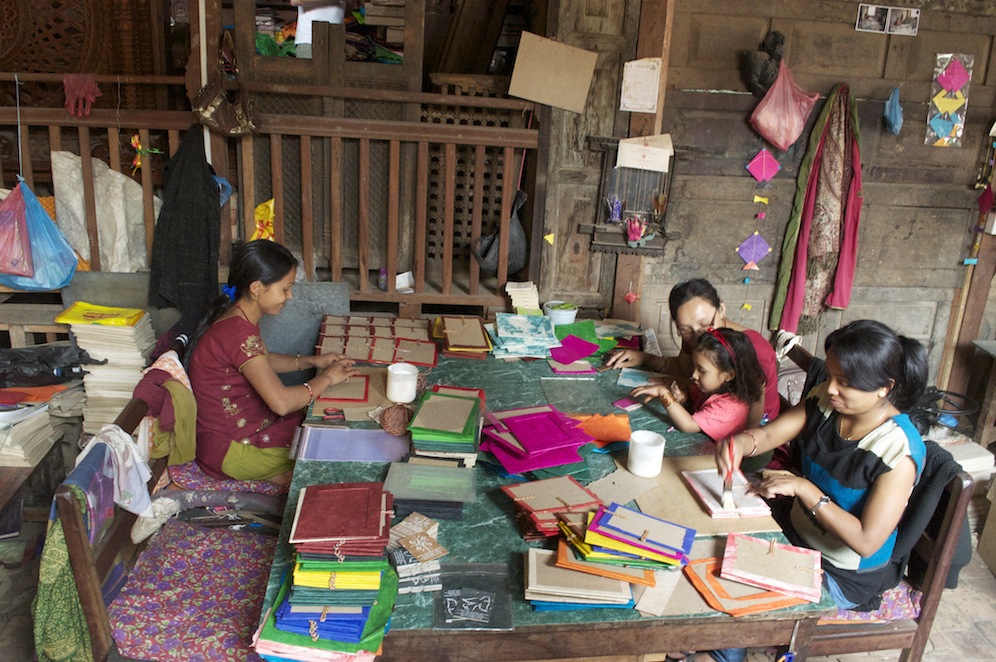
Moving on we went to see the peacock window before visiting a paper making factory. This gave us an insight, not only to the skills involved in making paper but also into the working conditions.  The building was a labyrinth of staircases and small working areas but the space was crammed with paper and paper products in various stages of production and finished products showcasing the wide range of products on sale.  The workers seemed happy and relaxed and one or two mothers had their children with them, presumably because the schools were on holiday and not because they were employing child labour.
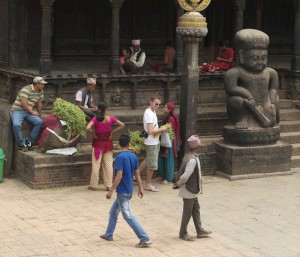
Stephen buying his peas on the vine

Stephen buying his peas on the vine

It was time for coffee, so we went to the Peacock Cafe, overlooking a square where we spent the best part of an hour people watching from our balcony tables. From here we could watch the women drawing water from the well. Soon after we assumed our lofty lookout a young girl arrived with a large bundle of peas on the vine wrapped in a cloth. She sat on the base stone of a temple and, for a long time, nothing happened. Then, like bees round a honey pot, she was surrounded by people eager to buy her crop. Stephen popped down and bought some. Soon her crop way gone and another woman took over with a similar bundle. For the rest of our time in Bhaktapur, shopkeepers sat in their shop doorways eating peas from the pod.

Our last visit in Bhaktapur was to a wood carving centre. Because it was still festival time no carving was being done but we could look at samples of their work.

Slowly we ambled back to the bus which returned us to the hotel for a late lunch.
In the afternoon I took Stephen and Nathan into Thamel for some last minute shopping.

In the evening we went to the Nepali Kitchen for a traditional Nepalese meal with cultural dancing.

Today had been one of those nothing days waiting to go home. The boys left after breakfast for their flight to Kuala Lumpa, not an enjoyable experience saying goodbye at the best of times but especially when the next time I see Stephen will be some way in the future. I popped into Thamel but had no real reason to be there, so returned to the hotel and spent the rest of the day on the roof terrace.

The group has now gone so it is very quiet. A large part of me wishes I had left with the group but tomorrow is going to be another day with plenty to interest and excite.

Heading back briefly to the hills

When we flew to Lukla for the start of our trek I was pleasantly surprised by the swift efficiency and the quiet atmosphere of the check in. Not so today. Words like chaos and pandemonium spring to mind. It appears that what has made it so today in particular is a forest fire near Lukla. It did not help that a group of Japanese trekkers were blocking up the area while their leader checked them in. There is no need for everybody to crowd round the desk and make it very difficult for everybody else. More bizarrely, in the middle of all the chaos were trays of eggs stacked up in front of the desk, belonging to no one obvious. Eventually they were removed and one can only assume that they found themselves on a flight to Lukla.

Out of all the pandemonium a boarding card is eventually produced allowing me to pass through security into the relative calm of departures. Transit through departures was quite swift, but having reached the plane we then sat on the tarmac for twenty minutes while they refuelled it.

The flight was good but as we made our approach to Lukla the whole hillside on our left was on fire. Huge plumes of smoke rose and followed the shape of the hill, fortunately away from our flight path, and flames could be seen leaping above the smoke. There is absolutely no mechanism for putting these fires out, no access and no easily available water supply. As the day lengthens the wind increases and fans the fire. All that anybody can hope for is either heavy and prolonged rain, or for the fire to burn itself out. So far it has been burning for two days and seems to be growing with no prospect of either.
As I walked up the Khumbu the smokey haze provided much diminished views of the mountains and the smell of burning pervaded the air.

Phakding

Phakding

I managed to reach Phakding in two hours and stopped for lunch and a short rest. Although I only had Rara Soup I felt full and my afternoon walk up to Monjo became more of a tired trudge. Nevertheless I reached Monjo in less than two hours from Phakding, arriving shortly after 3.30, before the arrival of the group.

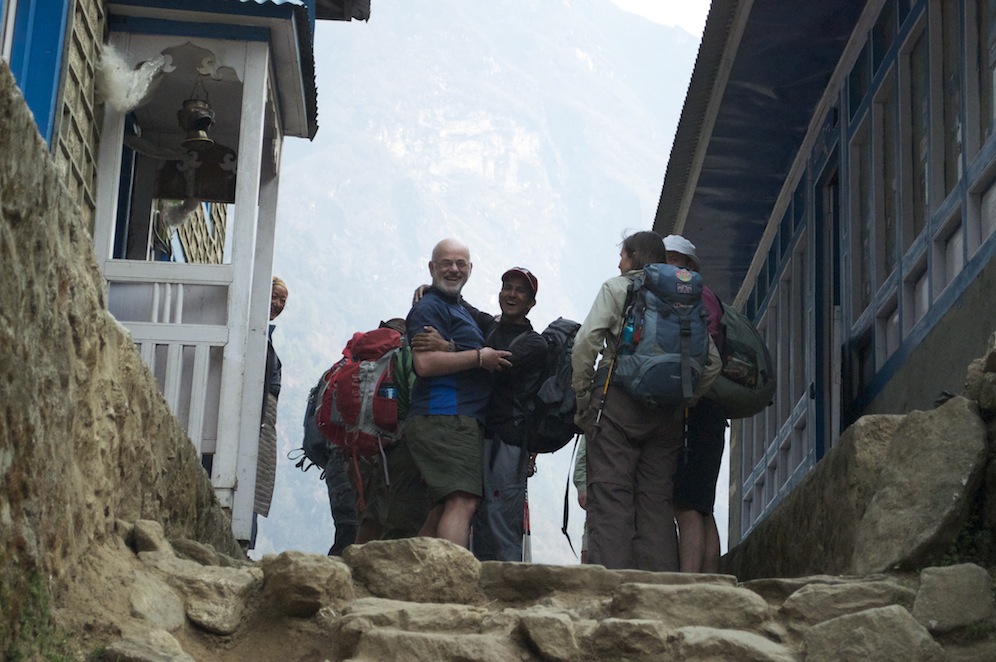
After about half an hour Mark, followed by the rest of the group, appeared at the top of the steps leading up to the exit from the national park. As they walked passed Ang Darki’s lodge I stood in the doorway and asked if they were going to ignore me. My appearance took them by surprise and there was much noise and hugging.

Bishnu is happy to see me!

Bishnu is happy to see me!

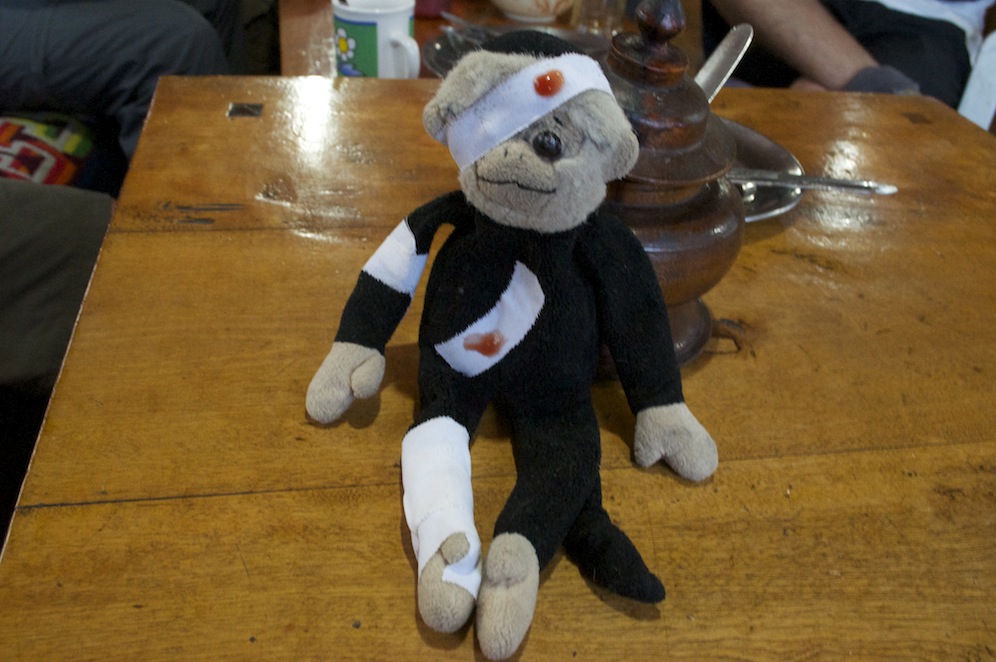
Monkey gets a pasting

Monkey gets a pasting

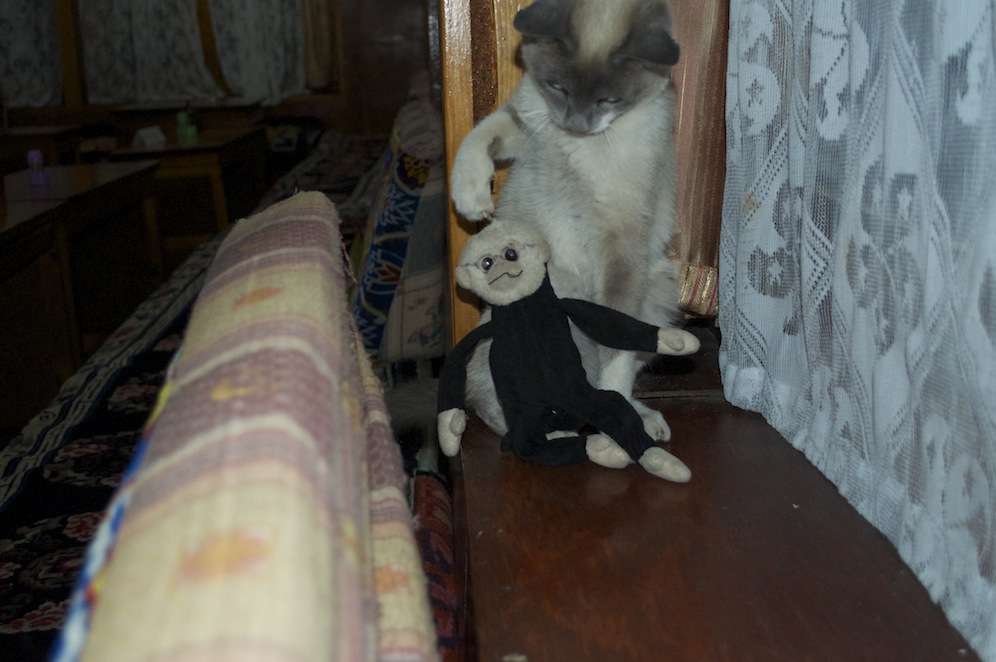
Our lodge was just a little way down the hill. It looked good but the rooms were a bit dungeon like and the food was a huge, tasteless disappointment. I shared a room with Stephen and Nathan and we had a problem with our shower providing us with an indoor pool. Nigel and Mike had sewage swilling around on their bathroom floor. The poor food and disappointing accommodation left us feeling the need for some entertainment.  The lodge had a resident kitten, an attractive creature with a playful nature.  For some reason I had already been awarded the monkey for leaving my sun glasses at the lodge in Namche several days earlier. It seemed we had some ready made potential entertainment.  Here we had a kitten that wanted to play and a monkey that would make an ideal toy.  The kitten did not need much encouragement to attack and it proved very entertaining.

The scars of battle!

The scars of battle!

In the morning the monkey came to breakfast bearing the scars of battle!

We were quite pleased to leave but before we did we thanked our porters and gave them their tips as they would be wanting to return to Base Camp with another group as soon as they had delivered our bags.

The walk back to Lukla passed without incident although it was very hot and the second half spent predominantly climbing up to Lukla proved tiring and arduous. At some point I got fed up of carrying the monkey, which has, incidentally, made a remarkable recovery from its battle with the kitten, and gave it to a little boy on the understanding that he shared it with his sister.  Clearly he didn’t understand me and before we left the rest spot an argument over the monkey was already brewing.  Their mother will love me!

There are some pretty tired bodies in the group and, whilst they have had a fantastic time, they are quite relieved that the walk is completed.

Our only concern now is getting out. There have been problems today and not everybody got out. The wind, often a tail wind, makes landing at Lukla very difficult.  Landing speed on such a short runway is crucial if the plane is to slow down in time before the runway ends.  If there is a significant tails wind, that increases the speed of the plane as it lands, reducing the time is has to slow down.  When the wind reaches the point where doubt is cast in the pilot’s mind, flights are cancelled.  That is what happened today and while some people failed to get out, others did not manage to leave Kathmandu. As a result  there has been a flurry of activity around the helipad with stranded passengers paying the extra to keep to their schedules. The problem with those that are stranded is that they do not get priority the next day; that goes to those with day specific tickets.  The stranded passengers are forced to wait for the third or fourth group of flights, and, as is so often the case, those are the flights that are cancelled.  The potential for being stuck in Lukla for several days is a stark reality.  Fingers crossed.

Myanmar (Burma)

For those of you still interested in going to Burma, don’t give up on me yet.  I am travelling there in November to see for myself and to come up with a much more cost effective itinerary for either 2014 or 2015

George Lowe

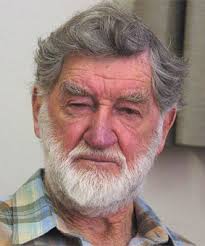
George Lowe, the last surviving member of the Everest ’53 Team and Patron of King’s Himalayan Club, passed away last night (March 20th) aged 89.  He had been suffering from a debilitating illness for a number of years.  I am proud to have known him and to have worked with him when he was Chairman of the Himalayan Trust UK.

Unknown

As well as being a man of action, a mountaineer chiselled out of Kiwi stone, George was a quiet, gentle man.  During one of the King’s expeditions to the Everest region the group met up with George and Mary, his wife, at Namche  Bazaar.  Sitting in a lodge one of the team asked George if he had been here before.  George answered quietly that he had.  Later that same evening we managed to get hold of a copy of George’s film “The Conquest of Everest”.  We sat in the lodge attached to the Sherpa Museum in Namche and watched it. The same boy, not having learnt his lesson the first time, turned to George and made a not too complimentary remark about the film, asking ‘who made it?’  George, again, quietly turned to him and said, “I did.”  Having spent all of his non expedition life in education, he knew exactly how to handle young people.

George’s passing ends an era and he shall be sadly missed by his family and those who were close to him.  However, George will not be forgotten. Having talked to him and listened to the story of Everest ’53, I am convinced that the expedition would not have succeeded without George spending eleven gruelling days cutting steps and preparing the route up the Lhotse Face to the South Col.

George could never be sure when he embarked on the expedition in 1953 that he would return.  Just in case he didn’t, he wrote a letter to his sister every day.  Collectively they give a detailed and insightful view of the expedition.  It is a fitting tribute to him that those letters will be published in a book ‘Letters From Everest’ on the 28th May, the eve of the 60th Anniversary of that first ascent.