The Gower Peninsular

On a sultry Friday evening in late September, eleven of us gathered at the Ship Inn in Port Eynon at the start of a Gower Peninsular walking weekend. It was remarkably warm and we were able to sit outside and enjoy the fine food and ale on offer. During the evening we watched many new arrivals having journeyed from afar at the end of the working week. There was excitement in the air as, on Saturday, it was the Port Eynon triathlon and many of those arriving were lean looking. I seem to be following these events – last weekend it was Snowdon, this Port Eynon!

Looking across Port Eynon Bay from the youth hostel

Looking across Port Eynon Bay from the youth hostel

We were staying in Port Eynon youth hostel, a converted former lifeboat station, understandably right on the edge of the shore. The old boat house is now the dining room with wonderful views down the ramp and out across Port Eynon Bay. The ladies in the group had the room above giving a slightly elevated outlook. Although the morning dawned cloudy and grey, it was warm and dry. The forecast looked good but it was likely to stay overcast for the majority of the day.

During breakfast at the hostel there was much activity on the beach and in the bay. Canoeists were positioned in a line along the course to two large, orange buoys, where the swim was to take place, and swimmers were gathering at the water’s edge. The sound of a horn heralded the start and, maybe, up to 200 competitors, surged forward turning the still water into turbulent action. My admiration for the spectacle soon turned to concern when it occurred to me that the transition from swim to bike was at the end of the lane leading from the hostel and we might have difficulty getting out.

I wandered down to have a chat with a steward to see what were the prospects of escaping. By now the quickest of the swimmers were emerging from the water and transferring to their bikes. The steward, who seemed to have most control, was the one ensuring the cyclists did not mount before a red line across the road. It was worth being there just to listen to her words of encouragement. All competitors were treated to,”Come on my lovely!” in that delightful Welsh accent, which assured you that she meant it every time. The outcome of my conversation was that it would be best if we could delay until after the fancy dress swimmers had gone through the transition by 9.30 at the latest. This was going to delay us but not really cause us any inconvenience.

Pwlldu Bay

Pwlldu Bay

Having escaped in three cars we drove east, towards Swansea, turning off to Caswell Bay, a pretty inlet to the west of Mumbles Head and right on the edge of the sprawling suburbs of Swansea. There is a whole network of paths criss-crossing their way along the cliff edge and it was sometimes difficult to determine which was the right path to take but we generally got it right and made steady progress towards our designated coffee stop at West Cliff. The path had so far taken us along the cliff edge, through coastal woodland, which I always find unique among woodlands. The trees are rarely huge and the on-shore winds have shaped them and moulded them into, often, life-like creatures with flailing arms that come to life at night. Between the trees we had vistas of hidden coves, sandy beaches and blue sea, still blue despite the greyness of the day.
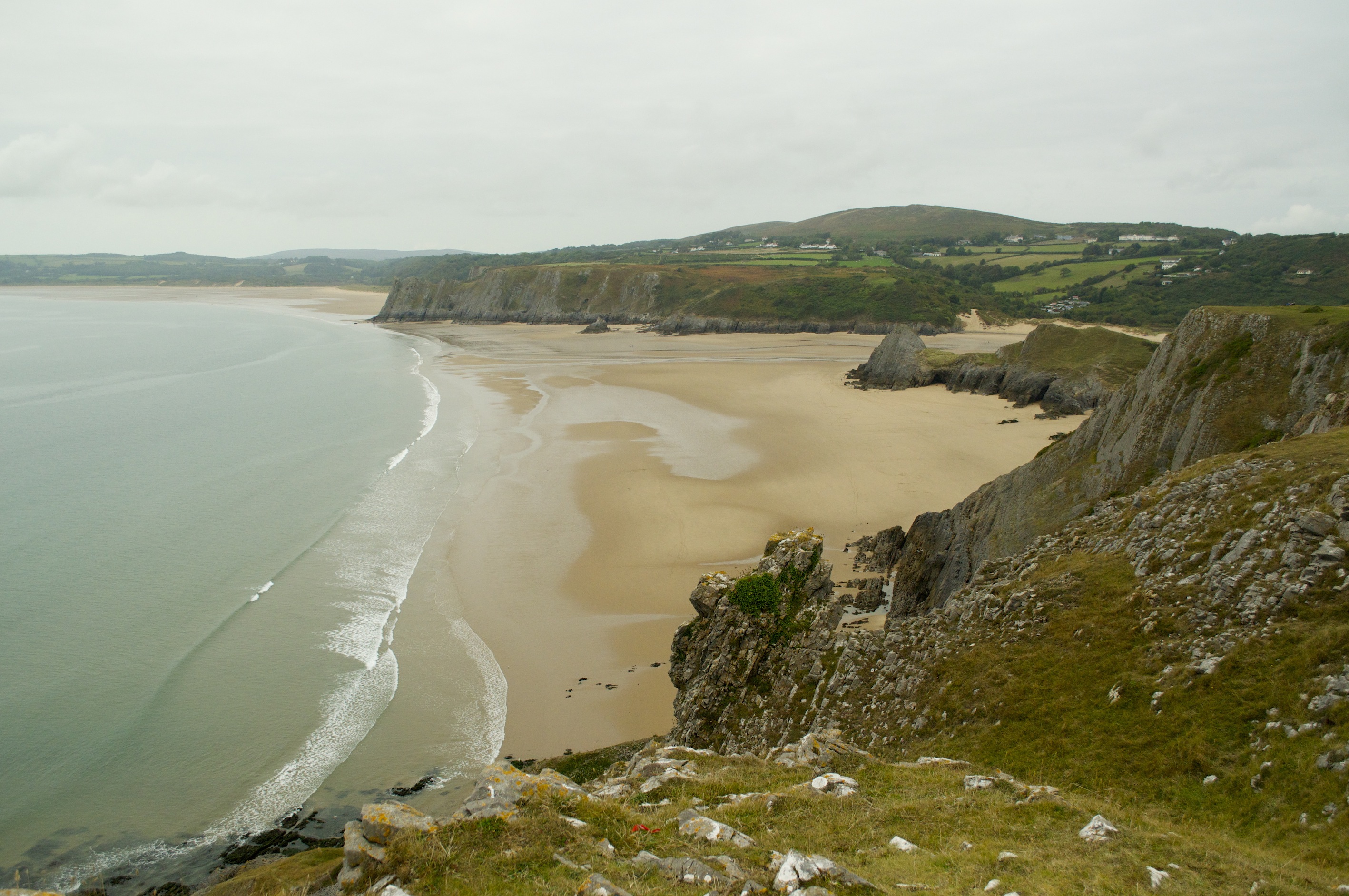
Three Cliffs Bay

Three Cliffs Bay

Following coffee, we were heading to what I consider to be one of the most beautiful parts of the Gower Peninsular, Three Cliffs Bay. Half an hour walking along the cliff top brought us to a sandy descent to the beach, quite extensive now as the tide was nearing its lowest point. When the tide is in it covers virtually the whole of the beach, so the sand is firm, golden and clean. Perched on barnacled rocks at the foot of the cliffs and adjacent to the dramatic arch cutting through to another section of beach, we had lunch. It never ceases to amaze me how quiet this beautiful beach is. A few families were dotted about and some climbers were tackling the cliffs. It is a large expanse, which takes a little effort to get to and thus tends to be fairly quiet.
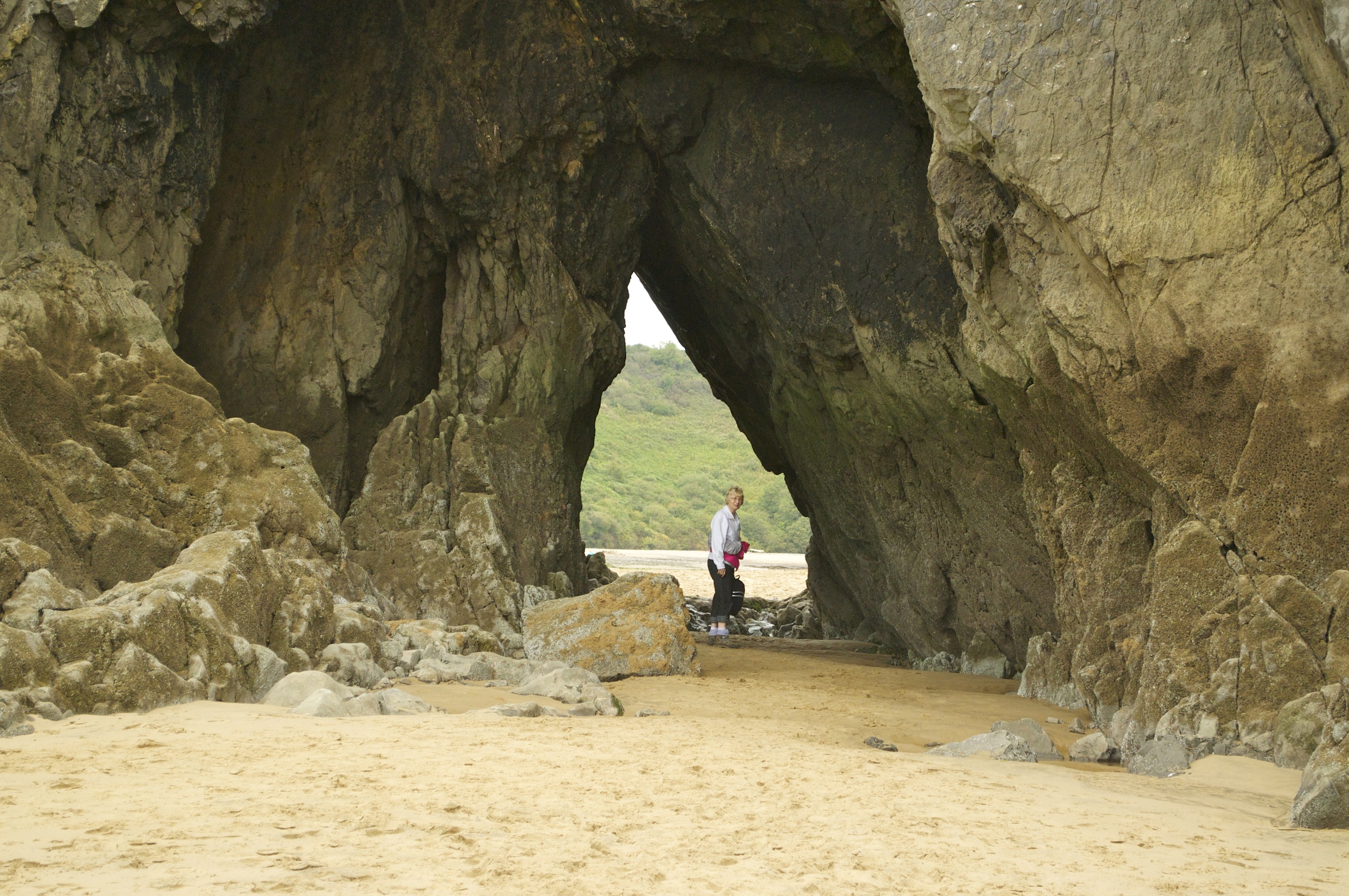
Chris framed by the arch in the three cliffs

Chris framed by the arch in the three cliffs

Low tide meant that we could take a short cut across the much wider sands of Oxwich Bay towards Oxwich Point, to emerge on to the land at the Oxwich Bay Hotel, a distance of about 4km. It was a perfect opportunity to de-boot and walk in the still warm waters. Not many took this opportunity, fearing sand chaffing the feet on the latter stages of the day’s walk. Towards the western end of the beach we came across a group of young Chinese armed with spades and buckets, not for making sandcastles, but hunting for razor clams. They disturbed the surface with the spades and watched for bubbles rising out of the wet sand. Whenever they spotted any they became excited and, probing further, pulled out large razor clams, which would end up on a dinner plate that evening.
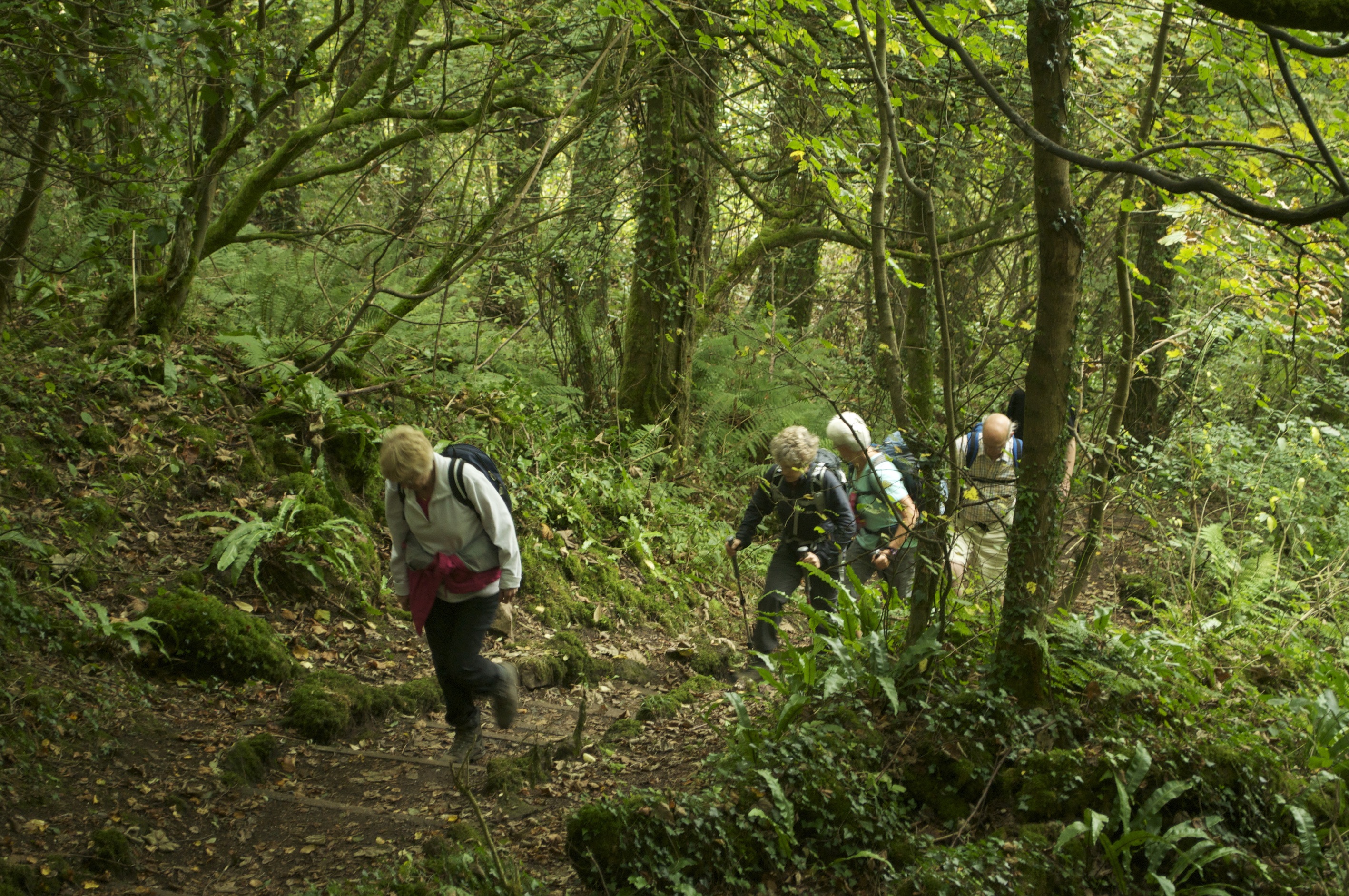
Climbing up from Oxwich Bay

Climbing up from Oxwich Bay

On reaching the Oxwich Bay Hotel it was time for a cup of tea before the steep climb up through the woods to Oxwich Point. Whilst the climb is not particularly long, it is steep, and in the balmy conditions we were experiencing, it was hot work with sweat pouring freely. Emerging from the trees and rounding the point we could see Port Eynon, the end was in sight. Below us, on the rocks exposed by low tide, a lone fisherman was walking back to Oxwich with a large fish in his hand; clearly his supper for the evening.

The path now was wide, grassy and relatively flat, following the line between two cliffs, an ancient higher one and a geologically much younger one between us and the sea. The youth of this cliff was clearly apparent in places as there were fresh landslides, one of which we had to make a significant detour for. The path eventually emerged on to the beach at Horton and we were able to take a direct line across it to the youth hostel. Our late start meant that we finished rather later than I had intended but it did not matter as our only plan, after retrieving the cars, was to eat at the Ship Inn again.

The pub was heaving, not with lean triathletes (they had all gone home), but with locals. Our food took some time to come but it was worth the wait. The Ship Inn is a goldmine; it has all the ingredients for success, a good menu, a variety of quality drinks, space to accommodate a lot of people, and very little local competition. I highly recommend it if you are in the area.

Sunday dawned bright and sunny. Instead of staying in the hostel I had camped in the field next door and the clearing overnight skies allowed the dew to settle. On saturday morning my tent, the grass and my car were bone dry.

Today, we had no excuses to delay our start so we shuffled some vehicles and the group to Llanmadoc, only to find that, it too, was busy as it was the Llanmadoc Run. Cars were queuing to get into the small car park and inside it was full of activity. The participants weren’t as lean, or mean, as the triathletes of yesterday but there was an air of amateurish enthusiasm, apart from the cool chap parked next to me who sat on the tail gate of his pick-up drinking a cup of coffee.
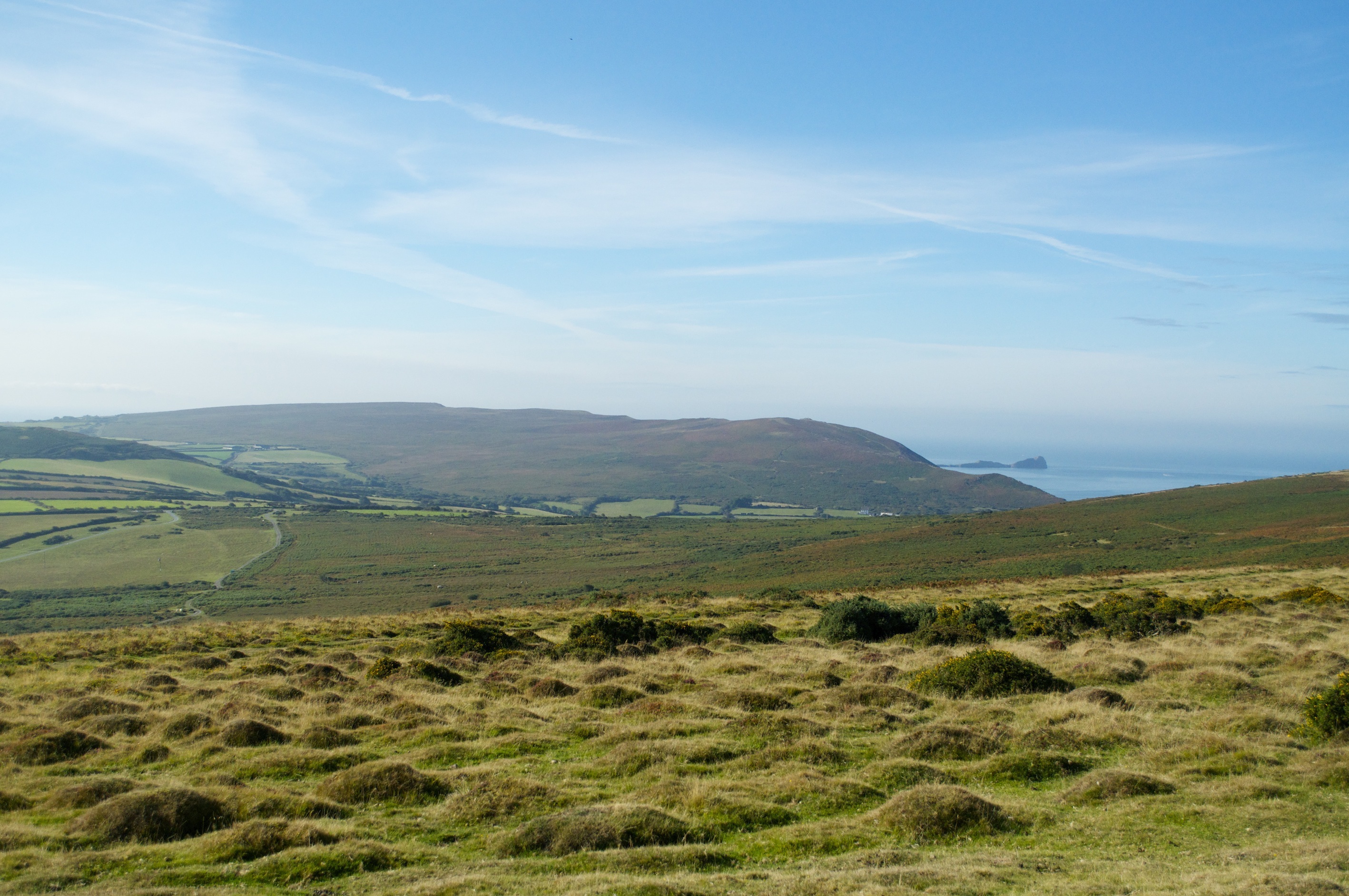
Looking towards Rhossili Down and Worm's head from Llanmadoc Hill

Looking towards Rhossili Down and Worm’s head from Llanmadoc Hill

Leaving the beautiful village of Llanmadoc behind we climbed immediately up the bracken covered slopes of Llanmadoc Hill. Through the bracken a narrow path led the way but there were many others criss-crossing the hillside. The sun glistened on the dewy cobwebs straddling the path and it was a shame that I had to undo all the hard work the spiders had done to build their traps. Crane flies disturbed by our passage fluttered about our legs. It was a stunning morning, the view from the summit down to the mud flats of the River Loughor with Llanelli beyond was stunning. A layer of non-threatening cloud hung over the shore to the north and was reflected in the flat waters of the sea, giving the appearance of a shimmering mist. There was no need to rush as we enjoyed the warmth and the views in all directions.
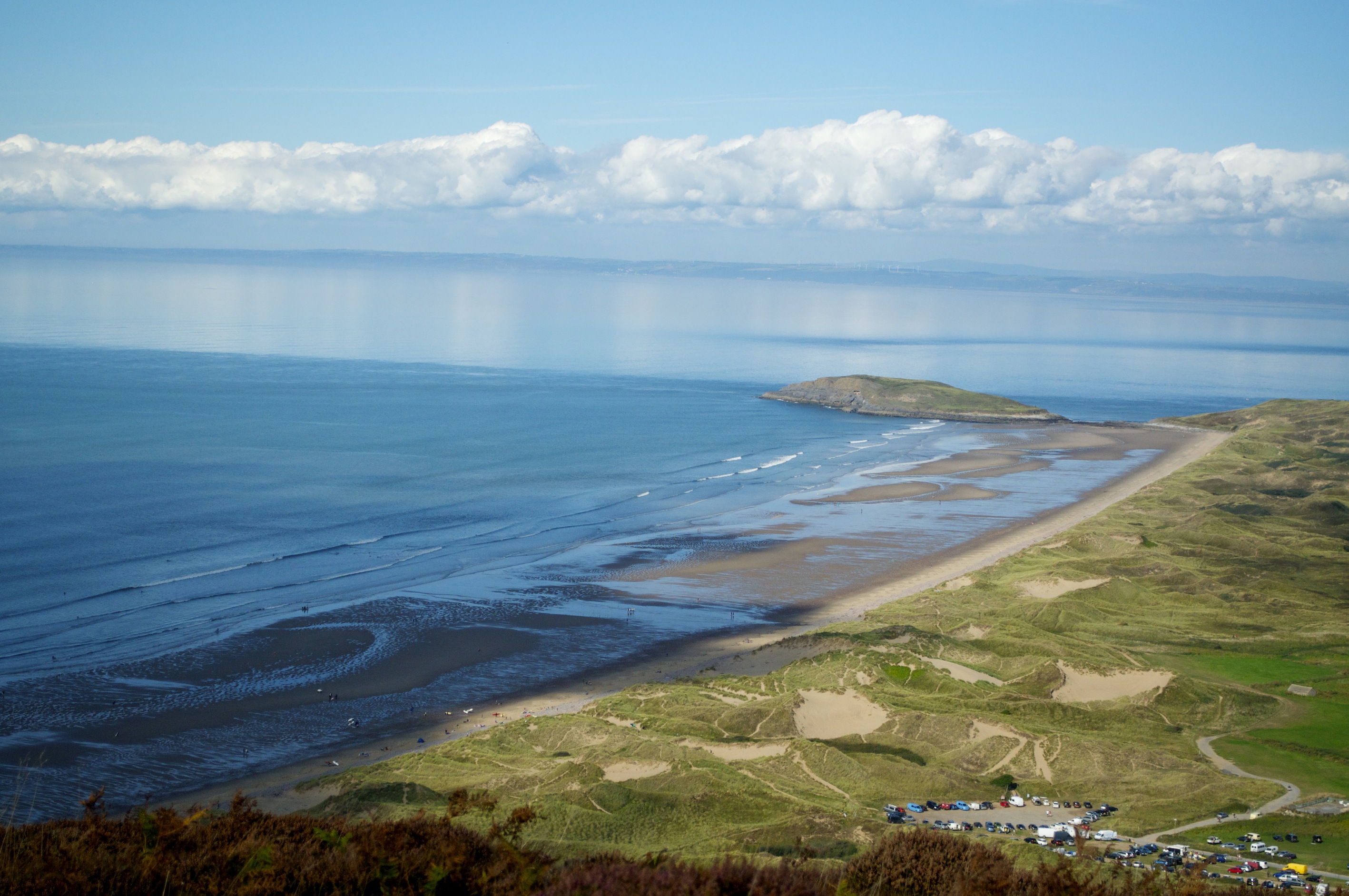
Clouds reflecting in the calm waters

Clouds reflecting in the calm waters

Descending to Llangenith, we picked our way through fields to the foot of the northern end of Rhossili Down. As we climbed the steep slope the splendour of Rhossili Beach and bay came into view, the outgoing tide leaving behind a pristine beach of smooth, golden sand. The view was only blighted by the regimented rows of static caravans at the northern end. This more accessible end was busier with surfers riding the waves, while the southern end was virtually deserted.
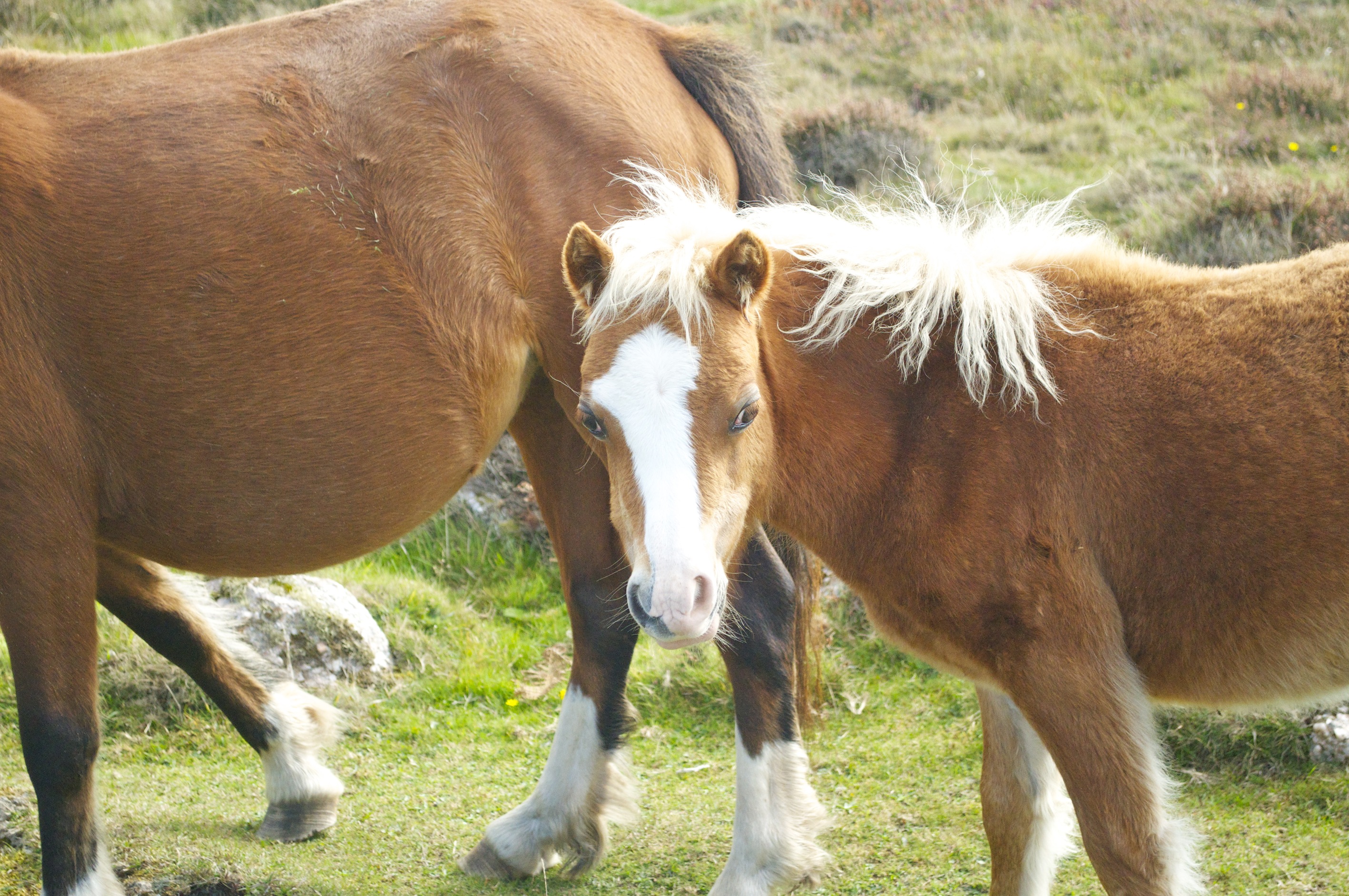
A foal sticking close to its mother

A foal sticking close to its mother

Once up on the downs it was an undulating path along the ridge, now with views inland as well as those out to sea. The inland views are not unattractive but they lack the grandeur of the coastal views. There are very few trees inland, farmers making the most out of the land they have. The concrete remains of a radar station sit in a hollow just below the ridge, built to track potential German bombers and shipping heading for Milford Haven during the war. Having fulfilled its purpose, it was dismantled in 1946, leaving just the concrete foundations. Wild horses populate the hillsides today.

Worm's Head

Worm’s Head

Rhossili is only a small village but it attracts a significant number of tourists, many of who do not venture down to the beach but frequent the Worm’s Head Hotel, offering fabulous views as well as food and drink. Many walk the short distance to the information point overlooking the interestingly shaped Worm’s Head jutting out to sea. We didn’t have time to venture out on to the headland despite the tide being in favour of doing so.
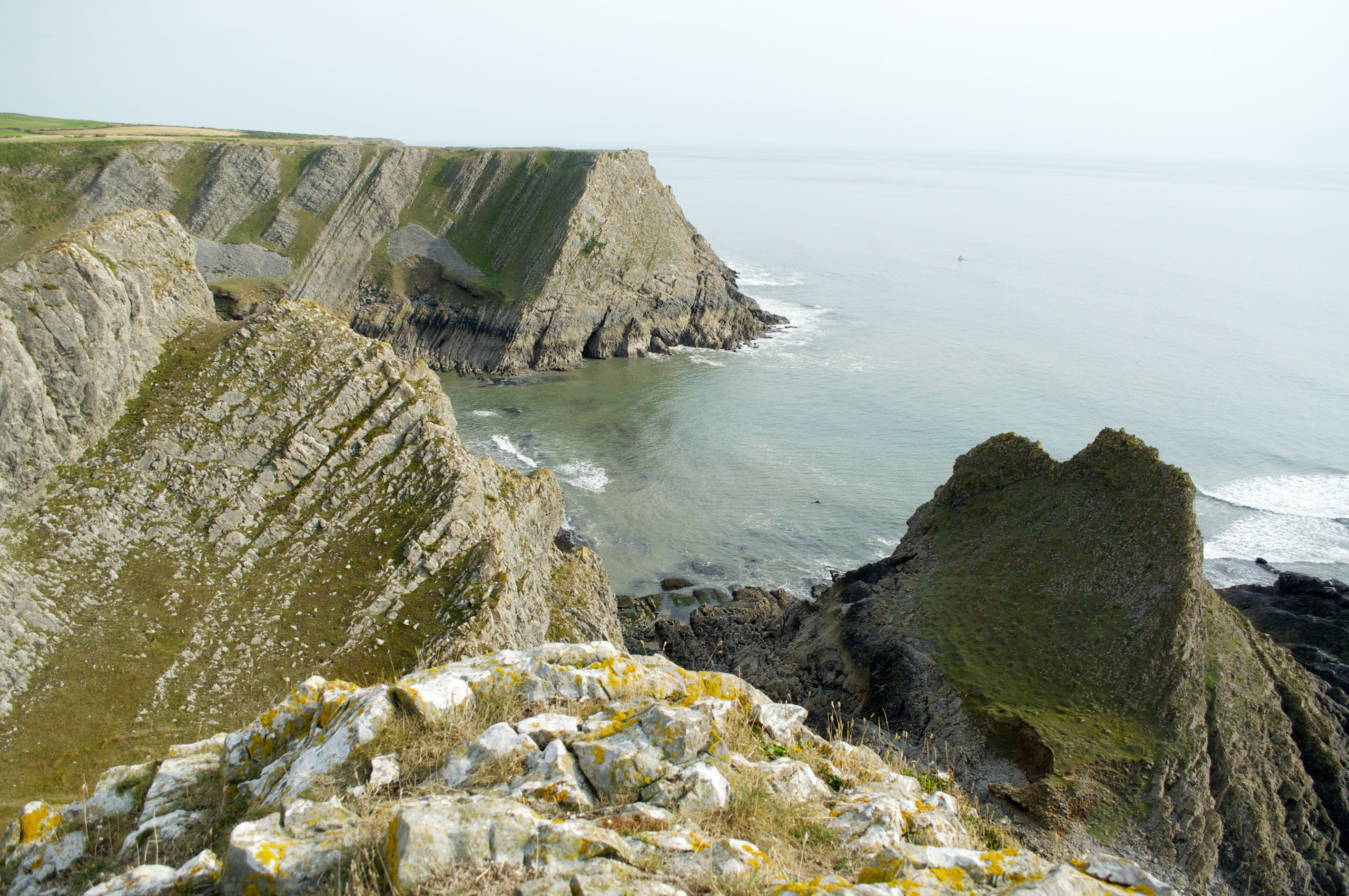
The Knave in the foreground with Horse Cliff beyond

The Knave in the foreground with Horse Cliff beyond

Rounding the point, we now had a few miles of fairly flat cliff top walking to do to take us back to Port Eynon. Every-so-often we would cross the head of a small bay or inlet with a path enticing us down to the water, but we resisted on this occasion. It may well be worth returning to give these deserted coves and inlets more attention in future. Some of them have very evocative names, conjuring up images of smugglers; names like ‘Deborah’s Hole’, ‘Blackhole Gut’, ‘The Knave’ and ‘Horse Cliff’ to name four. These are all accessible on the internet but it might be best just to let the imagination take control and not look too deeply into their meanings.

Group photo at Port Eynon Point

Group photo at Port Eynon Point

Soon we rounded the headland of Port Eynon Point and the youth hostel came into view. We finished on a still balmy late September day. We had not only been very lucky with the weather but the youth hostel provided perfect accommodation and Port Eynon was perfectly placed for our activities of the weekend. We left with every reason to return one day for more exploration of the Gower Peninsular.


Share the Vision training weekend – Snowdonia

After a superb Indian summer, it was with a little disappointment that Caz and I set out  from Worcester, on Friday morning, in the rain. We were the advance party heading to Snowdonia, preparing camp for sixteen students, some of whom were visually impaired, and who were due to arrive in the evening. However, our fears of a wet weekend were unfounded, for, as we approached Snowdonia, the skies cleared and we were bathed in warm sunshine. The campsite at Llyn Gwynant is superbly placed on the lake shore, surrounded by mountains. Unusually, the ground was dry and firm. It took us about three hours to set up camp and make ready for the arrival of the group.

This gave us time to enjoy a pizza from Jones’ Pizza Co., a mobile pizza oven on site and only open at weekends this late in the season. With many weekend campers arriving, they did a roaring trade, and certainly filled an ever increasing hole in my stomach.

At 8.30 the NCW group arrived with Phil, and the King’s group arrived half an hour later with Russ. Sitting in the mess tent, drinking hot chocolate, broke the ice for the two groups who have, so far, had limited experience of each other. Eventually, the group drifted off to their tents, to sleep under a star filled sky and high hopes for good weather in the morning.

Perhaps it was too much to hope that Snowdonia would display herself in all her glory for us. We woke to cloud shrouding the summits of the hills but the forecast assured us that it would clear during the course of the day. At least it was dry.

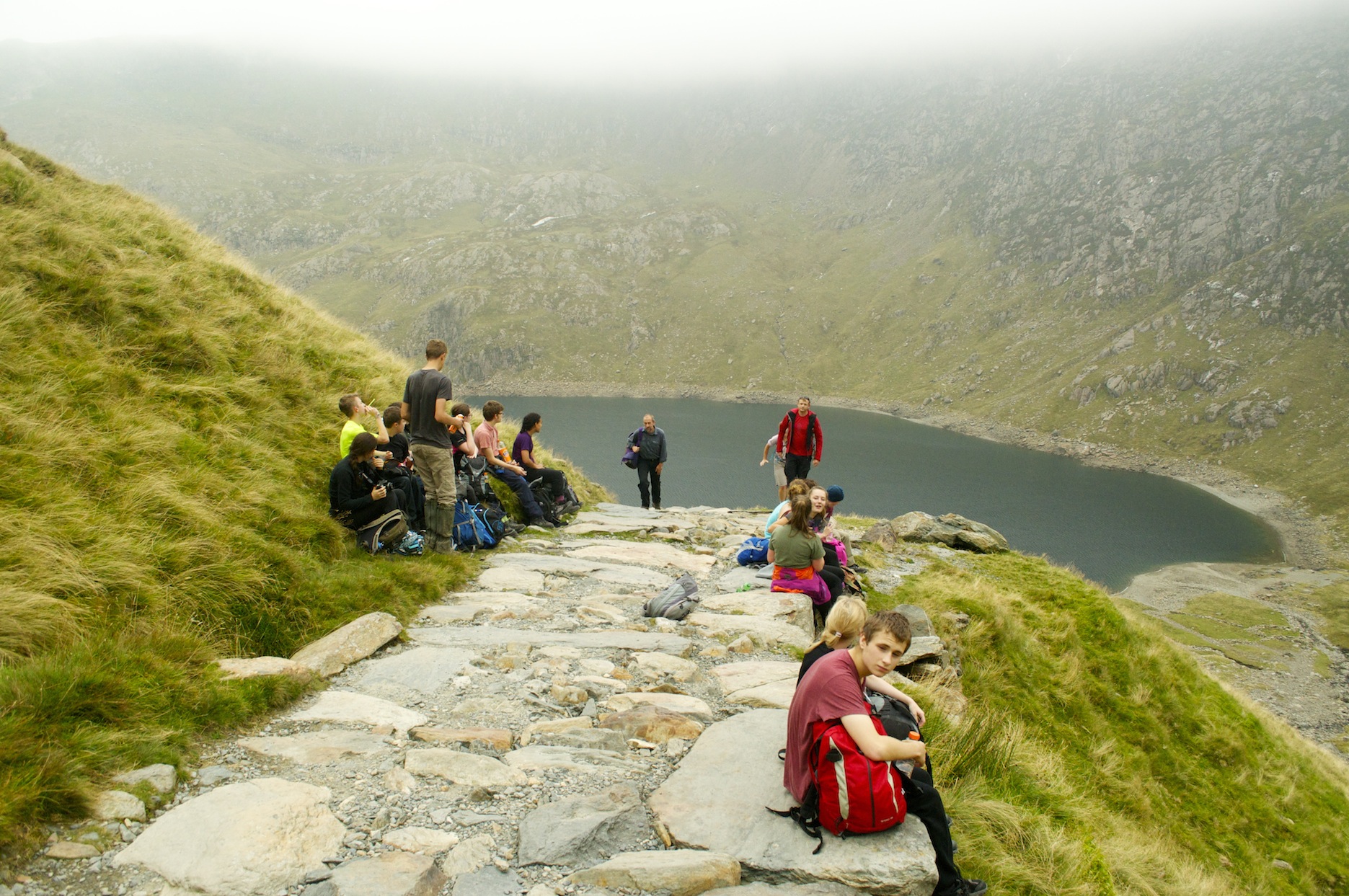
Resting at the side of the pavement above the second lake

Resting at the side of the pavement above the second lake

Fortified with bacon butties, we travelled the short distance to Pen-y-pass where I was to lead the group up the Miner’s Track while the rest of the staff shuffled vehicles down to Llanberis where we were finishing, and then catching up. The students, despite some of them having a disability, set off at a good pace, making good time over the well manufactured path. It is some years since I had walked this route and I was saddened to see such a well maintained path. While it makes the walking a lot easier, it degrades the mountain. There were a lot of people walking the route but nothing like the numbers we would encounter later in the day.

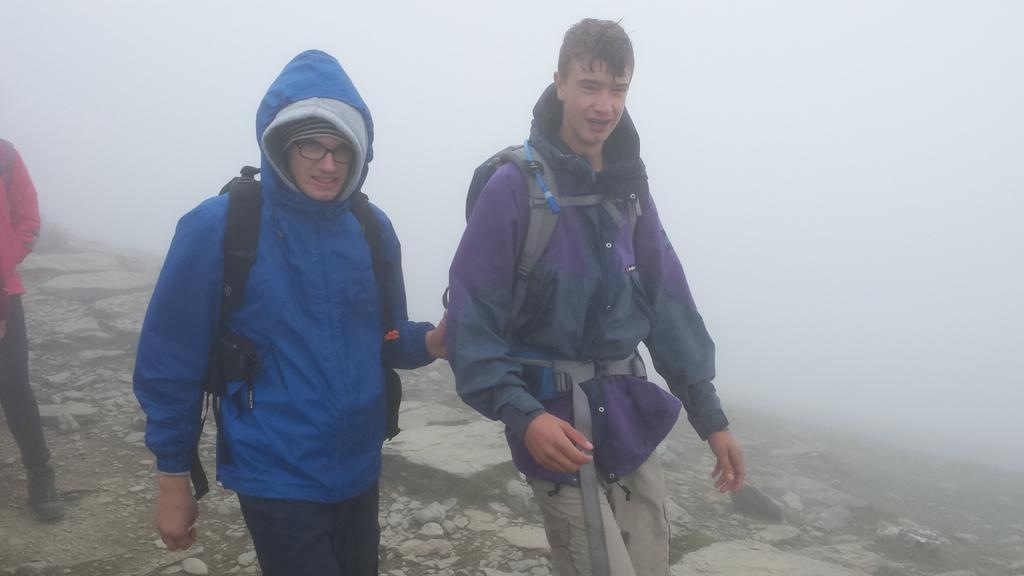
Guiding in the mists of Snowdon

Guiding in the mists of Snowdon

Caz, Phil and Russ eventually caught up between the second and third lake and we continued as a group. Phil now took the lead while I became the back marker, particularly useful on the steep section leading up to the Pig Track, where there was greater need for care and attention. We were now entering the cloud and it was important that we maintained ourselves as a group. It was not always easy when other walkers, not realising we were a unique group, mixed in with us. The cloud, while not really producing rain, gave a moist hew on our clothing. By the time we reached the Pig Track there was a constant stream of walkers heading for the summit, while others were already on the way down. Many were representing a variety of charities as they toiled up to raise money. Some were even rattling buckets.

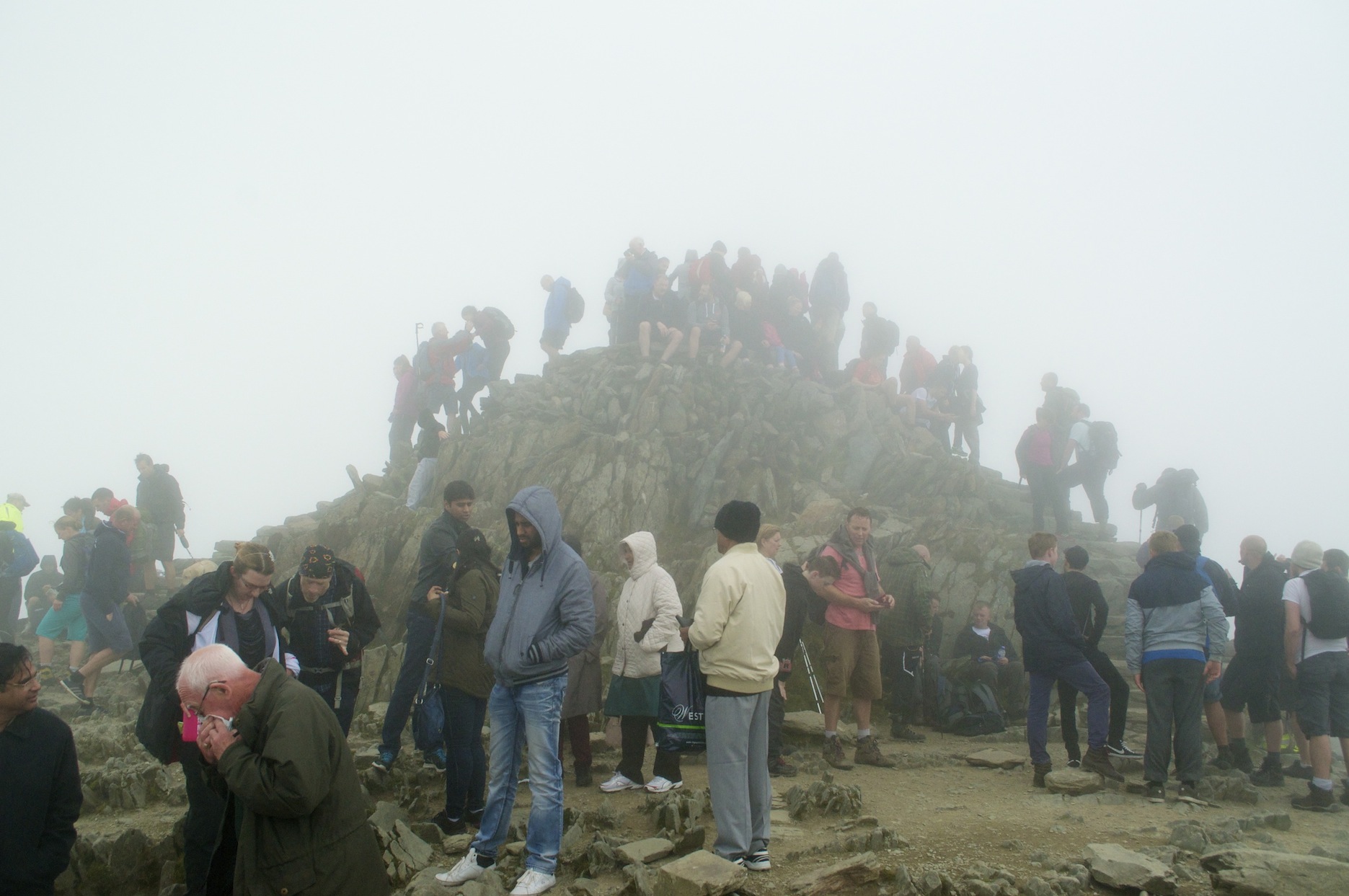
The crowded summit of Snowdon

The crowded summit of Snowdon

By the time we reached the obalisk and more paths converged for the final pull to the summit, the numbers were unbelievable. We now encountered fancy dress costumes, Spider Man and the like. Others were clearly not properly equipped for mountain walking, and into the melee came triathletes running to and from the summit. While most were good natured and politely asked for clear passage there were a few who were aggressive and bullying, thinking that they had absolute right to the mountain. Visually impaired people cannot see as well as the rest of us, particularly in murky conditions, and, because of their uncertainty with their surroundings, they do not always react as quickly as others. They have as much right, perhaps more so, than triathletes. Whatever your activity on the mountain you should always be aware of the need to share the space. Perhaps, the organisers should have had a lesser used route closed to the general public so that there was not a clash of interests.

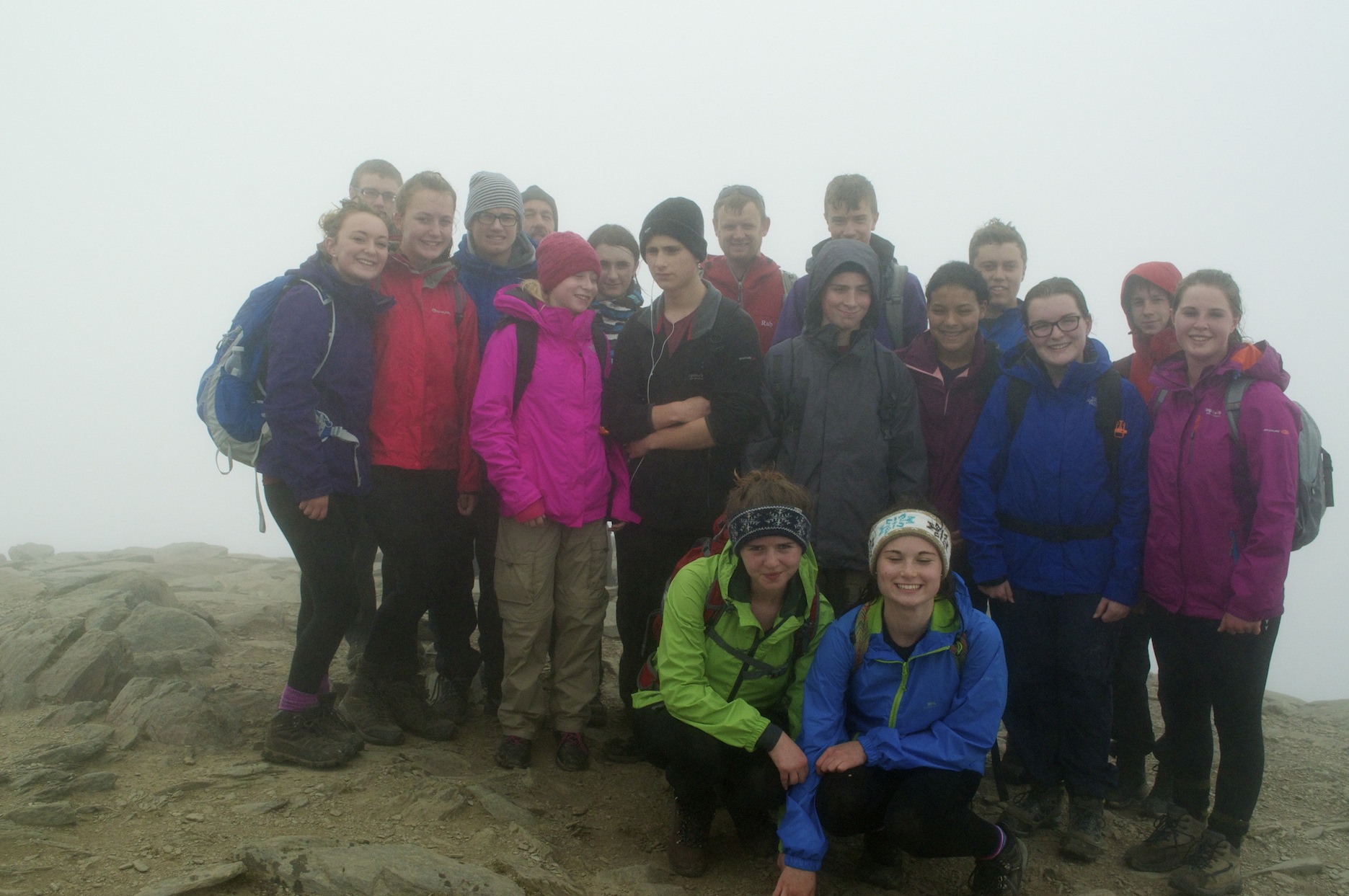
High achievers!

High achievers!

Having lunched close to the summit while avoiding the crowds queueing in the cafe, we took the straight forward descending route to Llanberis finishing at 3.30. The Snowdon traverse had taken us six hours, an hour quicker than we anticipated and gave credit to the fitness and skills of both groups of students. The NCW students stuck to the task and never once complained about the pace or the murky conditions. The King’s students readily accepted the challenge and their responsibilities to look after their partners, maintaining high spirits throughout. They all thoroughly deserved the reward of a hot drink at Pete’s Eats, a Mecca for all climbing and walking enthusiasts.

Back at camp we ate well before the students gathered round a camp fire under the starlit sky and exchanged stories, getting to know each other and to appreciate each other’s company.

Sunday morning dawned bright and sunny, although the clear skies forced the temperatures to dip quite severely during the night. At least one boy discovered that his sleeping bag was not up to the task as he shivered the night away.

Having provided them with sausage butties for breakfast, I waved goodbye to the group as they headed out for their second day of walking. I was remaining in camp to take the tents down, dry them and pack them and all the kit away, in the hope that by the time they were finished it would be simply a matter of heading back to Worcester.

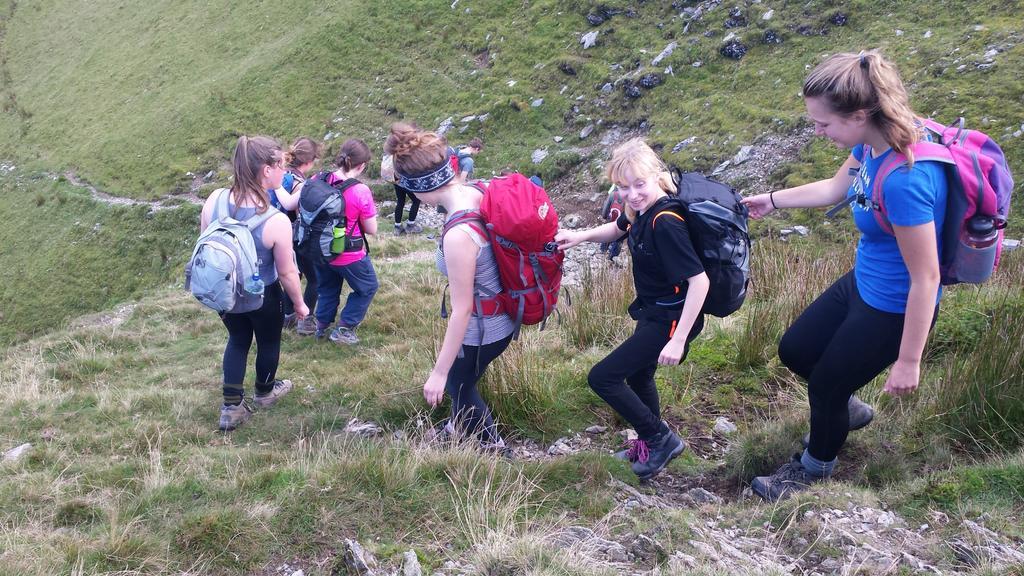
Negotiating difficult terrain

Negotiating difficult terrain

Driving over to Llanberis, they headed out to climb Moel Eilio and following a circular route over Foel Goch and around Llyn Dwythwch. Although they were not going as high as they did on Snowdon, they were still gaining about the same height and it was going to be a challenging walk, but at least without the crowds. In places the path was narrow and it gave the visually impaired, who are often fiercely independent, an understanding of the need for support, and the guides the importance of making sure that the journey was achieved in the safest manner possible.

By the time they returned to camp, it was struck and packed away, and they were buzzing with excitement for all they had achieved over the weekend.

I bet they were tired by the time they got home but I am also sure that they are looking forward to our next outing on the Long Myndd next month.

Frank Loveder 1951 – 2014

After a long illness, Frank Loveder passed away on the 2nd May.  This is my tribute to him.

I first met Frank when I joined the staff of King’s Worcester in January 1988. He had already been Head of Chemistry for a few months. Initially our paths did not cross but Frank was very difficult to miss as his blond head stood head and shoulders above everybody else in the school.

Our friendship began with the Himalayan Club. Frank was already running a hill -walking club for pupils when I went to talk to him about my intentions of taking a group of Sixth Formers to the Himalayas. His eyes lit up and his immediate response was that he wanted to be a part of it. Hence, with his support, I launched the Himalayan Club. Frank was a great asset to the club and a huge support to me. We created a fairly comprehensive training programme in order to prepare the boys (it was only boys in those early days) for a major trek in the Himalaya. As well as numerous visits to Snowdonia and the Lake District, we backpacked the Pembrokeshire Coast Path, Wainwright’s Coast to Coast and the hardest of the lot, the Lakeland Round. When Frank organised a trip to walk part of the GR5 in the Alps for a group combining his hill-walking club, scouting friends and the Himalayan Club I was only too happy to lead the support team.

Frank had a huge reserve of energy, and after a full day of hard walking he would happily set about erecting tents and preparing a sumptuous meal, regaling us with tales of adventure in the mountains and on the sea. He was immensely practical and, although I had years of experience of my own, I really appreciated his help in those early days of the Himalayan Club.

In addition to all the training, we had three fantastic trips to Nepal together. I say fantastic. The first to Everest went a bit pear shaped but the second to Annapurna and the third to Everest again were successful in every respect, inspiring me to carry on and Frank to set up his own Himalayan Clubs in St Edward’s College, Liverpool and Presentation College, Reading. On that first trip we had a lot of illness and ended up with students dotted about in various parts of the Khumbu. Frank had the constitution of an ox, so while I was not wanting to venture too far from a toilet, Frank forsook his own ambitions and focused on gathering the various lost sheep, ensuring they were well and cared for. I think, had we not been returning to Nepal three months later with the next group, we might have thrown the towel in.

At the end of that first trip Frank bought two t-shirts and had them embroidered. His idea was that we would wear them in school on our return. We wore them with pride. Frank, being a chemistry teacher, had not checked his for spelling and it caused great amusement to everybody when they read his embroidered message. It read, “Been there, done it, and this is the t-shit.”

Our relationship was not always a bed of roses. We often shared tents and hotel rooms and it did not take me long to discover that Frank snored. It was important to get to sleep first. However, on one night in the Marshyangdi Hotel the combined efforts of Frank lying in the bed next to me and the dogs barking in the streets around the hotel, sleep was impossible. I tried encouraging Frank to rollover on to his front only to discover he was already lying on it. At about 3.00am the solution to my problem was found. I heard a window open, a gun shot, a dog yelp and die. I was so close to opening our window and asking if I could borrow the gun.

Occasionally at Christmas, the staff at King’s would put on a pantomime and for some reason Frank and I found ourselves playing the Ugly Sisters. These were fun time, especially as neither of us were confidently word perfect and tried to trip each other up by adlibbing. However, we were so used to each other by this time that we managed to pull it off, much to our own and the audiences amusement.

I alluded earlier to Frank’s culinary skills and was fortunate enough to experience his world famous pancake parties where he produced pancakes with every conceivable filling and, boy, were they delicious.

In 1992 I had a serious skiing accident, which required surgery to put me together again. The six weeks I had to take off work were mind numbing and Frank knew how hard I would find confinement. One afternoon, when he was not committed to the lab teaching, he turned up at my house laden with Tesco bags. He then proceeded to destroy my kitchen while he concocted six fabulous main courses and numerous puddings for a group of friends he had invited that evening to cheer me up. Frank was a true friend and was always there when he saw there was a need.

It was a shame for the Himalayan Club when Frank moved on to St. Edward’s in Liverpool but it was not the end of our working together. Once Frank had settled he set about forming his own branch of the Himalayan Club, and I went up to visit and help him launch a trip to Everest Base Camp. The event coincided with another of his famous pancake parties.

When he moved to Presentation College he fulfilled his ambition to become a Head Teacher. I went along to present the prizes and I also helped him launch a trip to Nepal for his pupils. Sadly it was not to prove a happy move and through the callous behaviour of the chapter of monks who owned the land and through no fault of Frank, the school went into a decline. I am convinced that that very stressful time was the catalyst for Frank’s subsequent ill health, which makes me feel very bitter.

In more recent years we kept in touch, largely when Frank would appear unannounced on our doorstep during his annual Christmas or New Year travels to visit people. Then we would catch up on his news. In recent years he would update us on his health and treatment but, at no time, was he less than positive or down hearted about the hand he had been dealt. As I write this I am so pleased that he was able to join us for the two Himalayan Club 20th Anniversary Dinners that I organised last year. At those dinners he was able to meet up with those boys who had gained so much from sharing a remarkable experience with him. I too am so grateful for his knowledge, his skill, his towering sense of fun and his friendship, and I can forgive him for his snoring.

Normal service resumed on Cadair Idris!

A beautiful summer's morning on the top of Cadair  Idris

A beautiful summer’s morning on the top of Cadair Idris

My early morning dash up Cadair Idris last summer provided stunning views from the summit before the heat of the day hazed it out. That stunning excursion gave me enough desire to return with a group and so we found ourselves, twenty four of us in total, gathering at King’s YHA on the evening of Friday 24th January. It had been a wet drive through mid Wales to Dolgellau and the forecast for the weekend did not show much promise. The last of the group arrived by 10.00pm and we were well on the way to clearing some space on the shelves where the alcohol was stored in reception.

King's YHA

King’s YHA

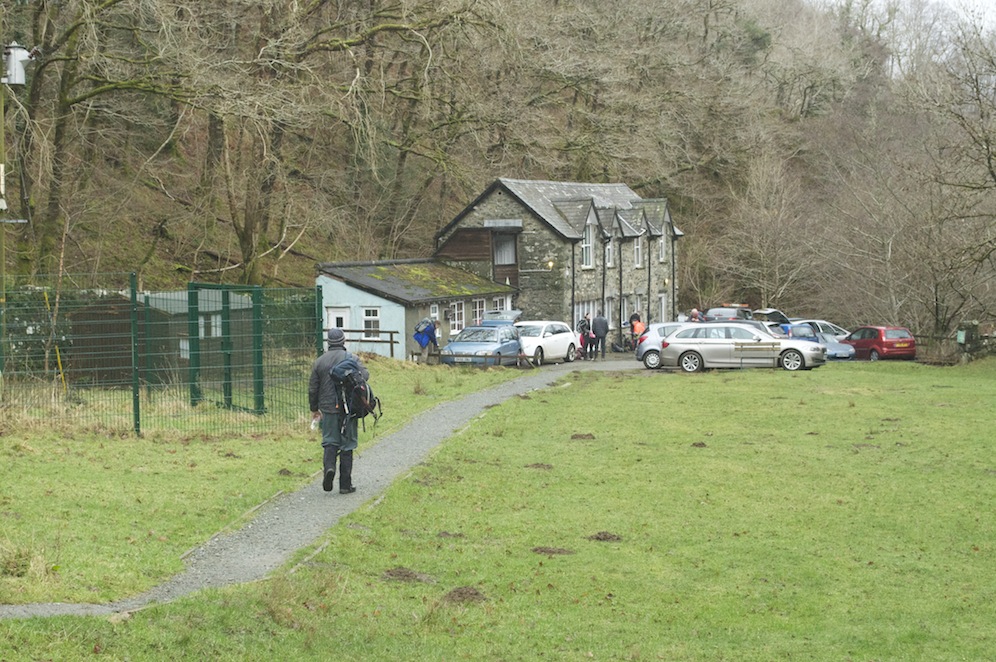
King’s YHA is superbly placed, a long way from anywhere, approached by a narrow lane meandering through beautiful Welsh countryside. The hostel is going through a phase of refurbishment and improvement. The staff give a very friendly welcome and the facilities are good, and will be even better once all the work is done.

The morning dawned dry but mainly cloudy and it was clearly very windy at altitude. Following breakfast we prepared for our day on Cadair. Departure was delayed slightly while Ann’s car was loaded on to a flatbed so it could have a new tyre fitted while we were walking. The mechanic who came to collect it was well beyond retirement age and Ann felt she needed to support his arm as he walked around. He turned out to be 87. The car park was very crowded and some maneuvering had to take place before its departure to Barmouth could be achieved.
The walk up from the hostel along the river is beautiful. Out on the open hillside the tops of the hills were shrouded in mist but at least it wasn’t raining, yet! The wind increased as the morning progressed, getting close to the predicted 50 mph forecast. After a couple of hours we reached the ridge and were hit with a fierce wind. Several were bowled over, the wind being so forceful that we stood little chance of staying upright. Gathering in a huddle we decided that it was too dangerous. Despite the fact we were probably only 15 minutes from the summit, it was just not worth the risk. The path skirted very close to the edge of a long precipitous drop and there was the potential for somebody becoming airborne and going over.
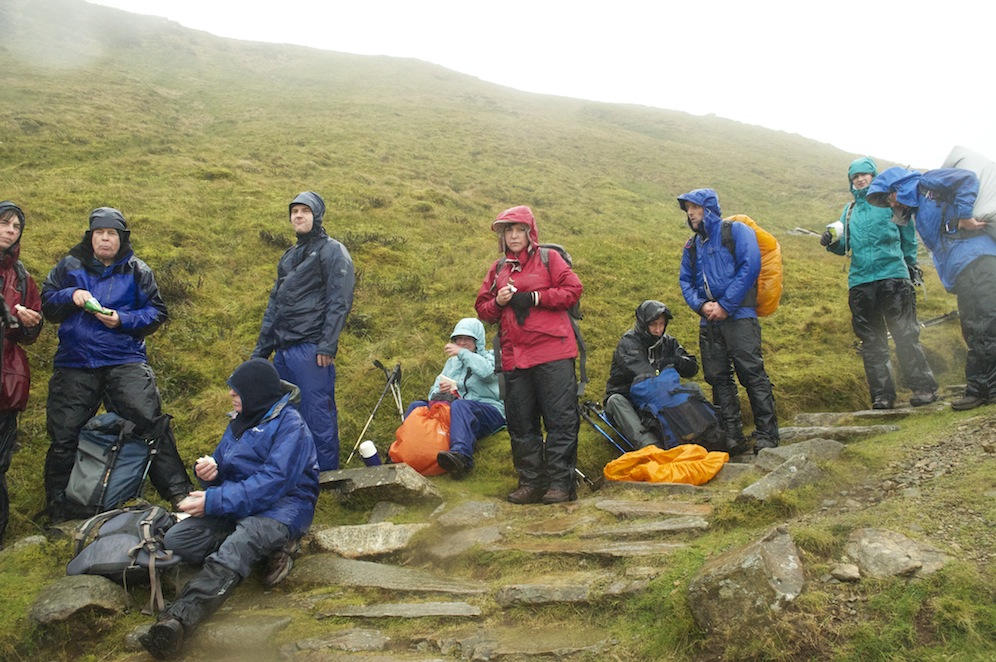
Snatching a bite of wet lunch

Snatching a bite of wet lunch

As we began the descent it started to rain heavily, the wind whipping it into our faces. Rucksack covers were wrenched off by the wind and flapped furiously behind us. Thunder rumbled above us and we were relieved to get back. A slip on wet rock saw me tumble and take a bit of skin of my knuckles but more annoyingly rip my new waterproof trousers! It was a relief to get back to the hostel at about 2.30.

The prospect of a good walk on the Sunday did not look good with torrential rain forecast accompanied by strong winds gusting to 85mph. Yuck!!
Predictably the morning dawned with heavy rain and very strong winds. Over breakfast we deliberated the prospect of a low level walk along the disused railway path on the southern side if the Barmouth estuary. A hardy group decided to go for it while the majority decided to call it a day and head for home. With me heading this week on a nine week trip, I decided to duck out and give some time to sorting myself out before embarking on a long trip.
I have now been up Cadair Idris about a dozen times and last summer remains the only time when conditions were good and I achieved the splendour of the views from the top.

 THIS BLOG HAS BEEN CAPTURED BY PIRATE CAPTAIN DAVE AND HIS CREW!!

Following the departure of Captain “Fairweather” Walton and half the crew in a whaler this blog has been taken over by Pirate Captain Dave Thomas and his band of brigands:-

First Mate Steve – dastardly fighter with his recent scar having seen off a vacuum cleaner and a stairwell.

Ship’s Carpenter – one eyed Simon and his mate Sandie, Ship’s Doctor.

Lookouts Mike and Alison – no one less than 6ft may apply.

Intellectual heavyweight Chris – so we can fight mentally as well as physically

Ship’s software engineer, Pete – a forward looking crew expecting major changes in technology then he will have something to do.

Recent recruit Tom the Cabin Boy – a hot shot with a Lee Enfield 303.

The pirate scoundrels!

The pirate scoundrels!

The gale was a blowin’ from the south west so prudence told us to seek shelter in the Mawddach Estuary in the lee of the mighty Cadair. We set sail in rough seas and high wind rain from the aptly named and deadly Arthog Bog and after some tacking set an easterly course at a good 3 knots. The First Mate had forecast fine weather at six bells and sure as ships biscuits it was to be. Captain Dave opened up the mainsail and with the Cabin Boy steered the crew to Penmaenpool where we moored up outside the George III Hotel and re-victualled on fine soup, whitebait and ale.

The crew was then dismissed and sent homeward, happy and tired.

It is foretold that Captain “Fairweather” and his mate Nurse Angela of the soothing words and calming manner are off to sunnier climes to explore the eastern and southern oceans. We wish them fair weather and if it gets foul and Nurse Angela is abandoned then Captain Dave and Crew are standing by for the rescue.

No doubt we shall meet again, maybe on some eastern river in the land of temples – in which case “Watch out, “Fairweather! You never know what might befall.”

Over and Out.

The Lawley & Caer Caradoc

It is easy to assume that when you organise a walk well in advance of the weather forecast there is a good chance you be unlucky, particularly in December. However, the twenty three of us walking the Lawley and Caer Caradoc on Sunday 8th Dec. could not have had a better day. The sun shone throughout, the wind was light and it was relatively warm for the time of year. Add to that, it was an area most had not walked before but had seen it on many occasions as they drove up the A49.

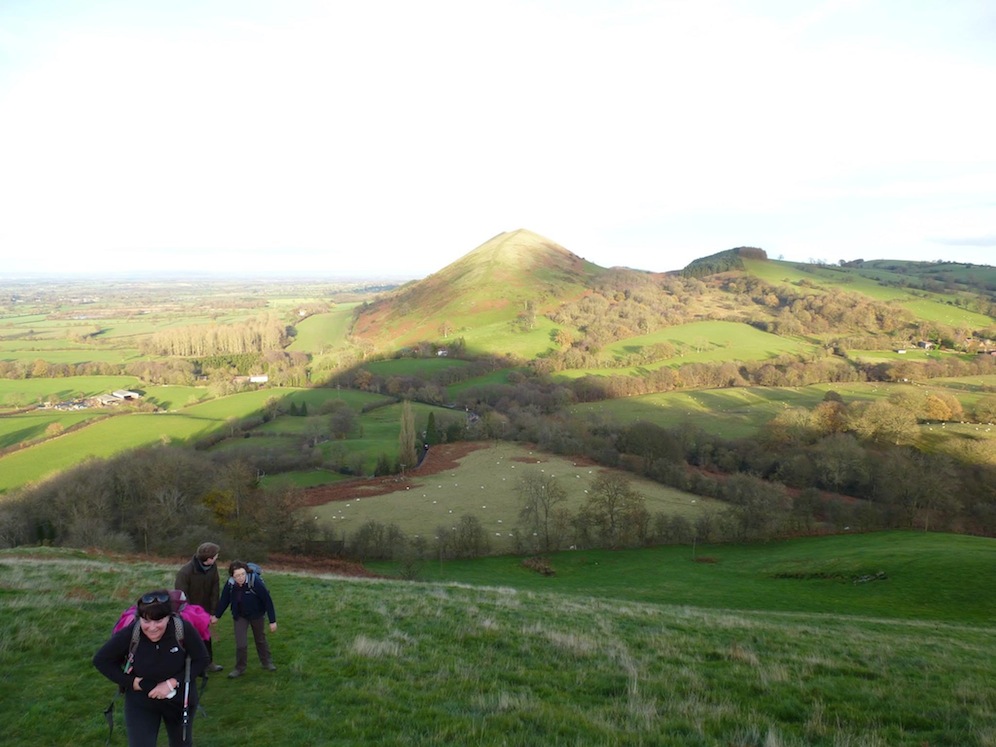
Meandering up the Lawley Ridge with the Wrekin in the distant background

Meandering up the Lawley Ridge with the Wrekin in the distant background

Leaving Church Stretton, crossing the railway and the busy A49, we headed over fields for a gap in the hills to access the eastern side of Caer Caradoc. We then followed a track up to a col where we ventured across a ridge known as the Wilderness. This took us to the hamlet of Enchmarsh, from which we gained access to Hoar Ridge running parallel to the east of the Lawley. By the time we reached the northern tip of the Lawley Ridge it was time to relax in the sun, using trees as back rests and enjoy some lunch. To the north the whale back of the Wrekin rose steeply out of the Shropshire plain.

The summit of the Lawley

The summit of the Lawley

The Lawley is a delightfully easy ridge with the rolling hills of Hope Bowdler, the Wenlock Edge and the Clee Hills to the east, and the Long Mynd, the Stiperstones and the hills of mid-Wales beyond. The grassy path undulates up the ridge and as it drops quite steeply either side it gives a more dramatic feeling of exposure than actually exists. Had the weather been foul I think we would have felt very exposed. On the summit of the Lawley there is a weather vane with a large seagull on the top. It is strange that this should be so when we about as far from the sea as you can get and there are many more interesting birds local to the area they could have used.

Nearing the top of Little Caradoc with the Lawley in the background

Nearing the top of Little Caradoc with the Lawley in the background

The descent from the Lawley starts out quite gently but steepens significantly down to the hamlet of Gomley. From here we began our ascent, first of Little Caradoc. On this route all the steep ascents and descents were saved towards the end of the day. The ascent up Little Caradoc is about 125m but it is steep and the first time on the entire walk when you have to make an effort. It comes as a bit of a shock. Once there the ridge plateaus out to a saddle before another slightly less steep climb up to the main summit. By now the sun was quite low in the sky and the light effects on the hill and the surrounding area was fantastic. England is a beautiful part of the world and it was great to have this opportunity to appreciate it.

The rocky summit of Caer Caradoc

The rocky summit of Caer Caradoc

Reaching the summit it flattens out but is made more interesting by a variety of rocky outcrops. It has quite a large summit area before it begins to descend to the col we walked through several hours earlier. The nearer we got to the col the steeper the descent. Fortunately, recent good weather meant that it wasn’t too slippery. When wet this descent can be quite treacherous. As the light began to fade we crossed the fields, the road and the railway into Church Stretton having had a good walk in good company and in excellent weather. Thanks to Claire Cox for the photos.

Let us hope for a similar day for our New Year walk on the Malverns on the 2nd Jan.