Namche to Khumjung via Thami

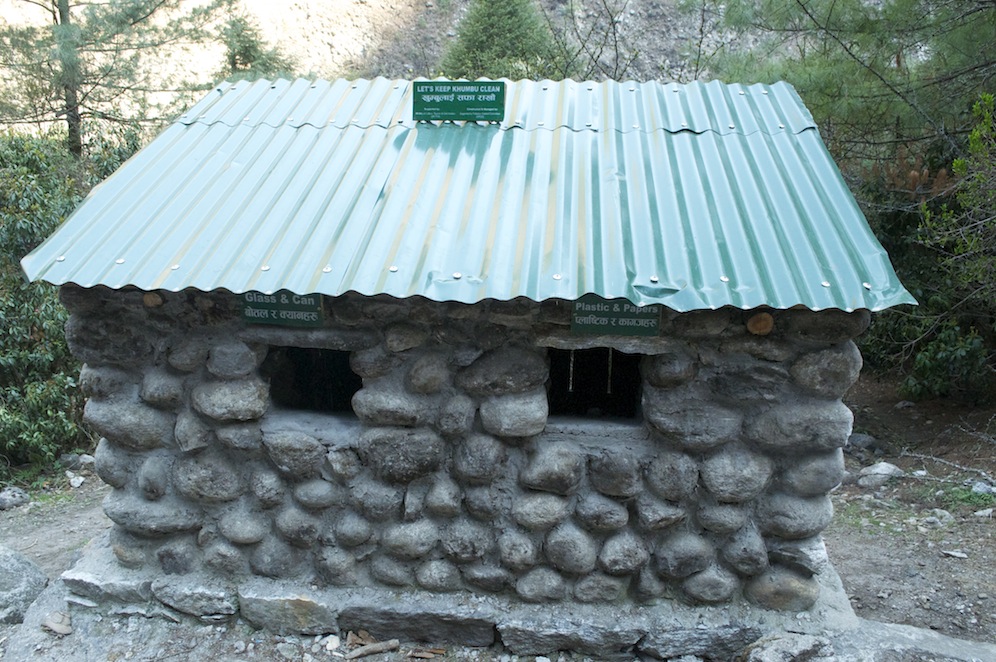
One of the new, successful rubbish bins

One of the new, successful rubbish bins

The Everest Trek was always known as ‘The Pink Tissue Trail’ but not any more. It is almost litter free. Every so often there are stone built waste bins segregated according to type – tin cans, plastic bottles and general waste. It is not only good to see a scheme in place but to see it working so well.

There are other differences. Virtually all of Nepal has mobile coverage and everybody has a mobile phone. Porters, as soon as they put their loads down, pull their phones out of their pockets and start communicating. Young people are plugged into their music and, as a result, there are fewer opportunities to say ‘Namaste’.

Porters in the Thami Valley

Porters in the Thami Valley

Namche has grown enormously and there is a chorus of hammers hitting stone from 6.00am to 7.00pm as yet more lodges fill in the odd vacant plots of land. In front of our lodge, Camp de Base, work is in progress building a new lodge surrounding and incorporating an existing lodge.  To one side huge lumps of rock, clearly needing to be disposed of for building work to commence, were being split and disposed of.  Under normal circumstances this would be a relatively simple task for a piece of heavy machinery to achieve.  Hear in Namche it is far from normal.  There is no heavy machinery, only young men armed with hammers and chisels.  The amount of effort these young men use is phenomenal, yet, somehow, they achieve their aim and the obstructing rock gets smaller until such time as it is no longer an obstruction.  At the end of each day there is noticeable progress, fine testament to the skill, determination and perseverance of the workforce. The broken lumps are carried to the other half of the building site where construction is taking place.  There, an army of stone dressers are chipping away, creating square edged building blocks, which, as soon as they are ready, are cemented into place.  Again the growth rate of the building is rapid and proves what can be achieved if there are enough people to working on it despite the lack of equipment.  What is happening in front of the Camp de Base Lodge is being mirrored in two or three other places in Namche.  More and more land is disappearing under buildings.  There is now very little room for camp grounds as, increasingly, people prefer to stay in lodges. This is in many respects a much more comfortable option but there is certainly less variety in diet with virtually no fresh vegetables and fruit.  At the start of the trek I made comment on how good the food was and how efficient the service.  Now that we have stayed in a number of lodges it is apparent that the menus are virtually the same with a ‘heavy’ reliance on potatoes, eggs and cheese.  Already I am beginning to tire of what is available and on offer and am experiencing early cravings for something fresh.

Internet connection is available in most of the lodges. The 21st C has reached the Khumbu. It is good to know that they still light stoves with dried yak dung.

Helicopters fly overhead constantly re supplying the increasing needs of the region but, sadly, denying many porters of work.
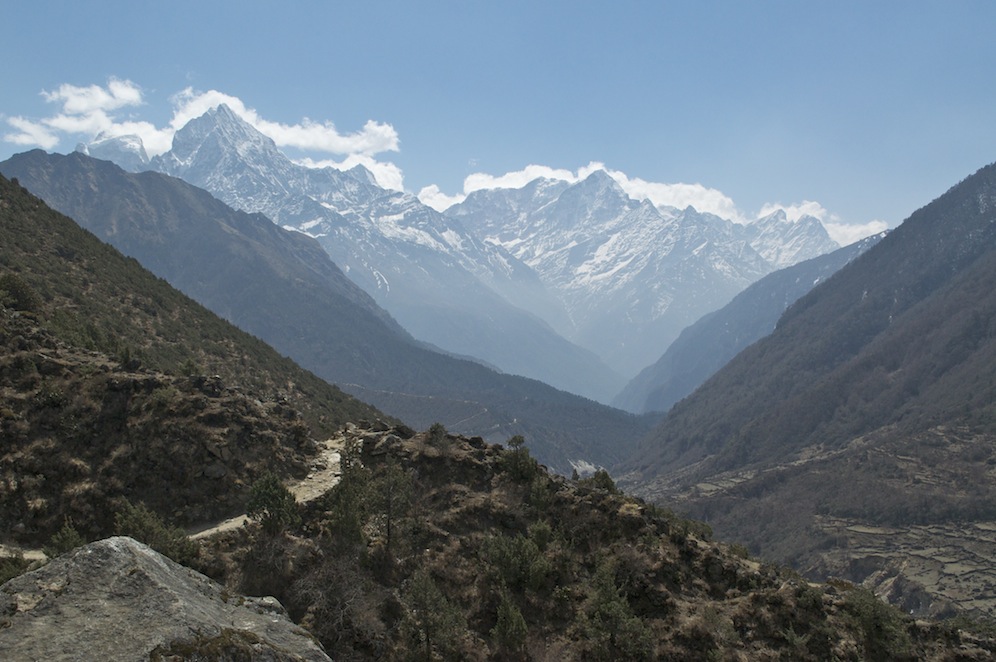
Looking back along the Thami Valley

Looking back along the Thami Valley

Leaving Namche, we headed into the Thame valley walking through forests of pine. The trail was generally uphill but at a relatively gentle gradient. We passed through the village of Thamo where Ang Rita Sherpa has a house, although he now lives in America. His claim to fame is that he has summited Everest 14 times. At the next village we stopped at a lodge for tea. There we were introduced to Dawa Nuru Sherpa who has climbed Everest 12 times and will shortly be joining an American expedition for his thirteenth. He looked about 35 but was in fact 49.
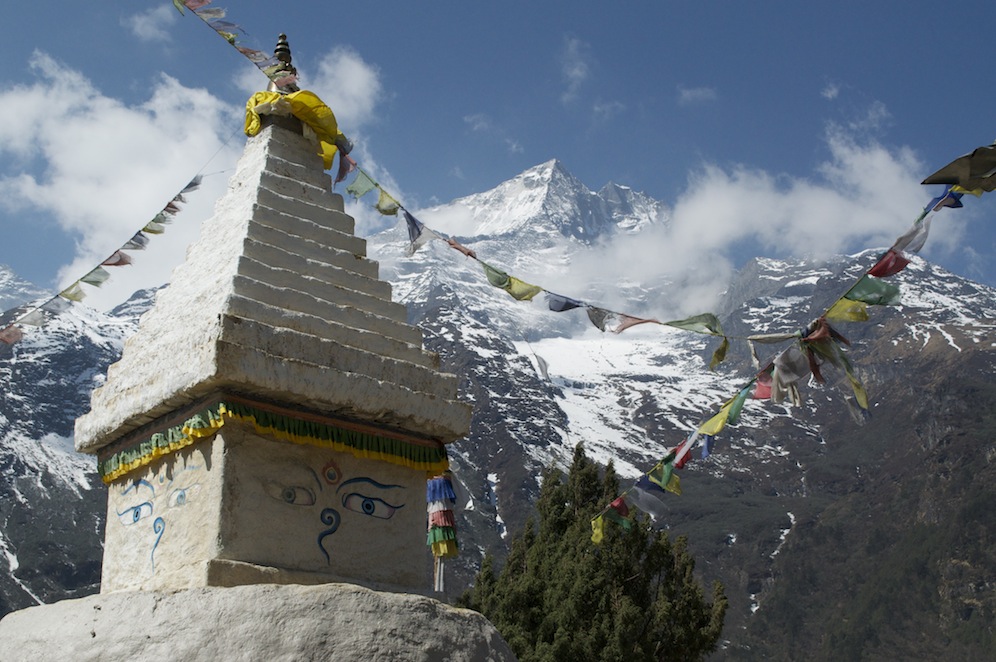
The beautiful Thami Valley

The beautiful Thami Valley

Dropping down to the Dhud Khosi we crossed the river and climbed up to the village of Thame. This valley and the villages within are much as the Khumbu was when I first came in 1993. We settled into our lodge run by the wife of Kami Temba Sherpa, the doctor at Kunde hospital. Later in the afternoon we climbed up to the monastery and watched the light change on the surrounding spectacular mountains. In the distance, to the east was the towering bulk of Cho Oyu, the world’s sixth highest mountain.

The following morning we retraced our steps. The going was good and we covered the ground well. Instead of returning all the way to Namche we took a detour up to Shyangboche airstrip and on to Kunde for lunch.
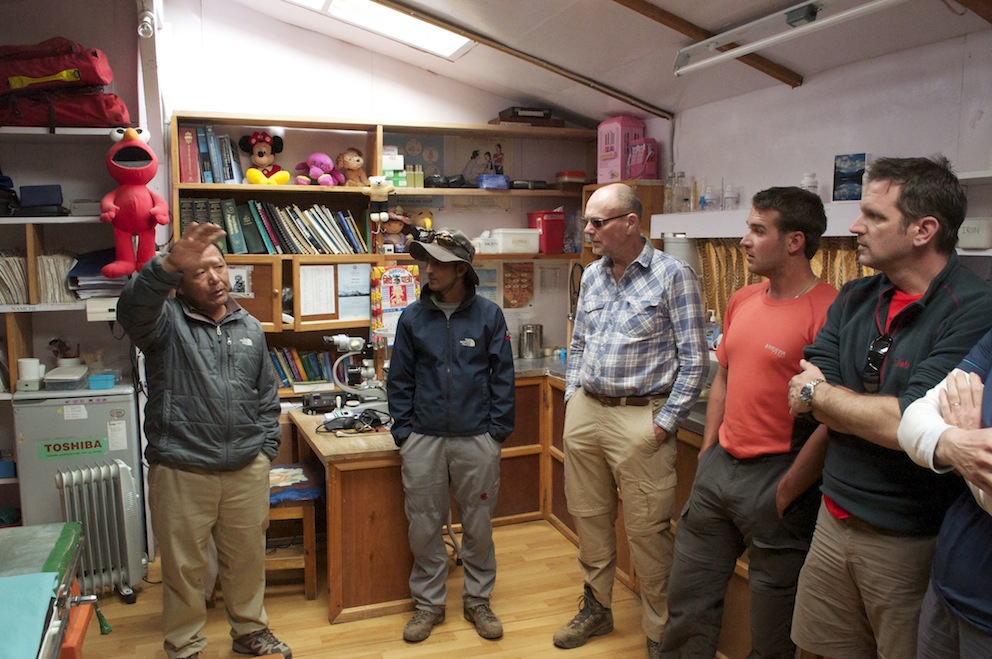
Dr Kami Temba explains the work of Kunde Hospital

Dr Kami Temba explains the work of Kunde Hospital

After lunch most of us went up to Kunde hospital to have a look, to meet Dr Kami and for him to tell them something of the work of the hospital. We had to wait a while while he treated some rather elderly Americans. He was very welcoming and warmly received us. He is a great ambassador for the achievements of the Himalayan Trust, a former student of a Hillary school who then went on to become a doctor after learning the skills as an assistant at Kunde Hospital.

From Kunde it was just a short walk to Khumjung and our lodge for the night opposite Khumjung School. Not only did the lodge have hot showers, it also had a washing machine in the front porch.  This really is progress.  Fraser decided to do his washing, paid his money and then spent ages trying to understand how the machine worked.  It was clearly a latest model as it kept giving out verbal instructions.  What it failed to tell him was that the machine was not plumbed in!  After much effort, reading of the handbook, support from the lodge proprietor who poured water into the machine, Fraser ended up with wet, not necessarily very clean, clothes. That evening a shield of wet clothes separated us from the yak dung burning stove.
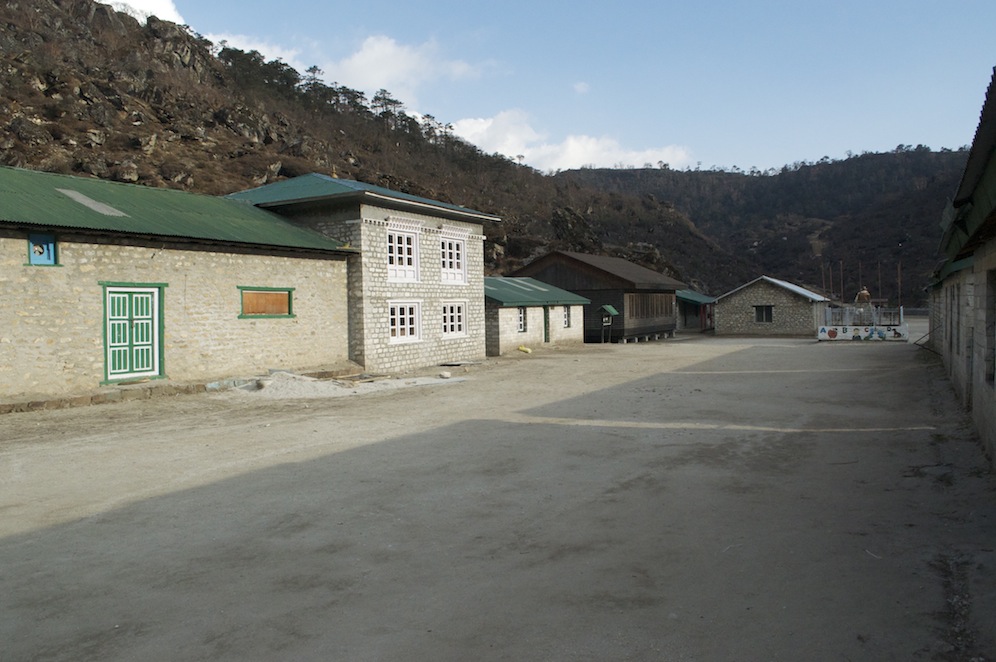
Khumjung School.  The building on the immediate left is the one we helped repair in 1996.

Khumjung School. The building on the immediate left is the one we helped repair in 1996.

Ignoring the temptation to do some washing, I had a very welcome hot shower and   popped over to the school to see Mohendra, the head, but he wasn’t there and it looked very much as though the school was on holiday. There were a number of children playing football and volley ball in the school grounds so I had a wander around to see how it had changed.  There are so many more classrooms and facilities, largely as a result of international fundraising from a variety of countries.

During the evening the temperature dropped but we had the luxury of sitting in the lodge with a yak dung burning stove chucking out a lot of heat while we watched Fraser’s washing dry.

Everest Base Camp 2013 – First few days


High rise, multi-laned Abu Dhabi

High rise, multi-laned Abu Dhabi

The flights with Etihad were good although the seven hours at Abu Dhabi were a bit of a pain.  Some of us took the bus into town to have a look to see what it was like.  Superb service along wide, fast roads.  We were dropped off at the bus station but that, we discovered after much wandering, was actually not very close to the heart of the city.  There are some fantastic pieces of architecture but the roads are all 8 lane highways which take an age to cross.  You can only cross half at a time so much time was spent standing in the middle of the road as cars, none of which were small, sped past at 60 miles an hour.  We eventually finished up in a Philipino bakery for bread rolls and coffee before heading back to the airport.  While we waited for a bus we were pestered to use a taxi at a greatly inflated price.  We waited for the bus which came on time and sped us back to the airport along the wide highway fringed with well manicured flower beds amongst sculpted stones.

Somehow between being given my onward boarding card at Heathrow and returning to Abu Dhabi airport the two halves of the boarding card became separated, rendering it not acceptable to security as I tried to go through passport control.  So, while the rest of the group went back into the terminal to sample the delights there, I queued for an hour at check-in to get a new boarding card.  What a delightful way to kill time.Eventually making it back into departures I met up with Mary Lowe who would be flying with us on the second leg of our journey.  I am not sure I would bother going into Abu Dabi again, if the occasion arose, although if we could have got into the centre or by the water’s edge it might have been more interesting.

Arriving in Kathmandu at 7.30pm it took an age for us to get our visas but the luggage was only just through by the time we were through.  Outside we were met by Hira and Bishnu and taken to our hotel, Hotel Tibet ….ternation… not all the letters were there.  I woke Stephen and Nathan to come and greet us and to have a beer while we waited for some food to be produced.  We waited a long time.  Stephen was clearly very tired from his week of travelling the globe.

The following morning I ventured up to the roof top restaurant for breakfast and a meeting with Gael Robertson who conducted the inspection of Happy Home for us.  It was an interesting conversation and further convinced me that we had made the right decision, although it would appear that Bishwa is beginning to take on board some of the suggestions I have made.

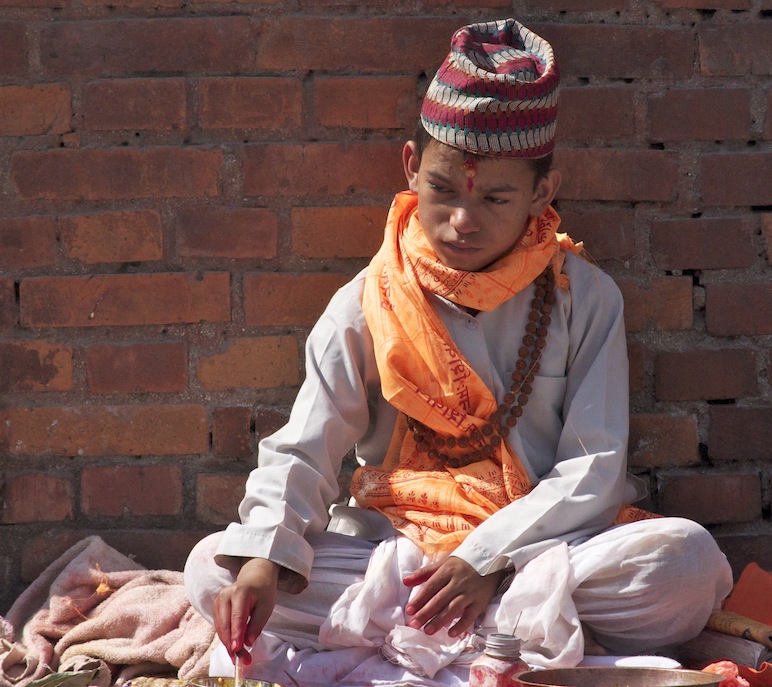
Young boy mixing tikka dyes

Young boy mixing tikka dyes at Pashupatinath

After breakfast we went to Pashupatinath to watch a few cremations and to generally soak up the atmosphere, before heading off to Swayambunath, the Monkey Temple, which was heaving with Hindu worshippers, remarkable in that it is a Buddhist site with Hindu attachments.  Leaving Swayambunath we went to Durbar Square.  Here I was able to have some new experiences for some of the palaces, which had previously been closed to the public, were now open.

Our morning tour over we went to the Organic Cafe, adjacent to the Third Eye, for lunch.  Here we met Hira again and he and I had an opportunity to discuss and plan my few days after the group has returned to the UK.  After lunch I took those who were buying sleeping bags and down jackets to Shonas before heading back to the hotel with Stephen and Nathan to meet up with Jeannie, Laura and Anna.  We sat on a roof terrace drinking beer and hearing of their stories from Nepal.  They were very excited to see us and they had plenty to say.  Tshewang joined us for a while and I was able to give him the funds he was expecting and hoping for.  The girls stayed for dinner.  The service in the restaurant was poor and we waited for an hour and a half for our food to come.  We are not staying here when we return to Kathmandu.  The hotel lacks character, doesn’t have a garden, has extremely poor restaurant service and there is nowhere near to hand where we can eat if we tire of poor service.  Jeannie has decided to give up the idea of being a doctor and wants Stephen to teach her to fly!!!  Having put the girls into a taxi I went back to the dining room to join Fraser, Simon and Nigel and continued there until midnight.

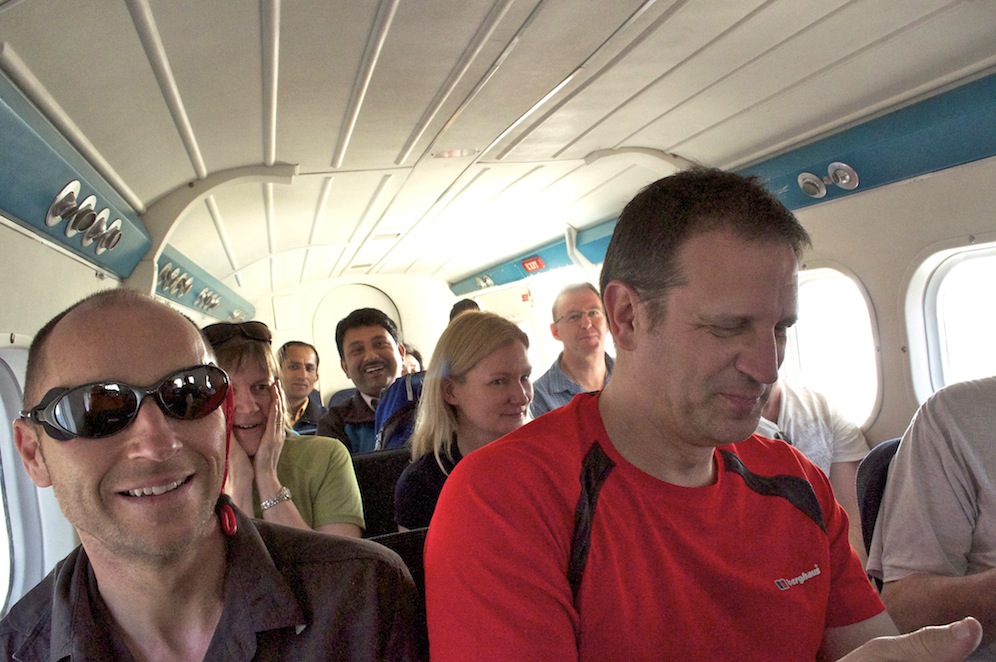
Mixed emotions on the flight to Lukla

Mixed emotions on the flight to Lukla

The following morning we had an early start for our flight to Lukla.  Leaving the hotel at 6.00 we were surprised how organised and relatively quiet the airport was. The domestic departures is usually very chaotic.  Not so today.  We were all on the same flight.  Stephen and Nathan sat in the front two seats so they could take over if disaster loomed.  It was a very smooth flight but they were both impressed and Stephen kept saying he wanted a job in Nepal.  Leaving the airport we went to Paradise Lodge.  Pasang, who runs the lodge, was my first Sirdar 20 years years ago.  He doesn’t really run the lodge, Dawa, his wife does that.  She is a very strong woman who has recruited a team of young, local people to work for her.  They work incredibly long hours but Dawa is like a mother to them and they are incredibly devoted to her.  Dawa gives them skills, discipline and a brilliant work ethic which sets them up for life and probably gives them the start to adult life which will help them achieve success. Mary Lowe is staying here, having floan up the previous day, and she joined us while we waited for our kit to be sorted.  Once that was done we headed up (actually we drop a couple of hundred metres) the valley to Phakding where we were staying for our first night.  Previously I have only ever camped but in the ten years since my last visit to this region there has been a huge amount of development.  Not only did I have a room to myself but I also had en suite facilities.  The food was good and the service was excellent.

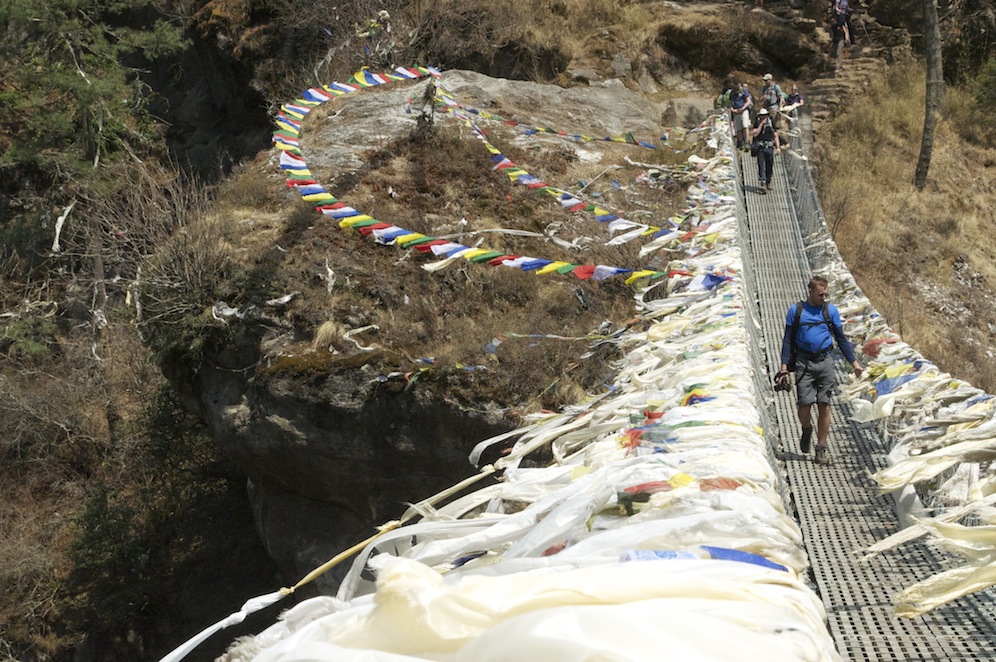
The bridge at the foot of Namche Hill

The bridge at the foot of Namche Hill

The next morning we continued up the valley towards Namche.  Robert was ill and found the going hard.  We stopped at the lodge just before the entrance to the national park run by Ang Darki.  She remembered me despite there being a ten year gap since my previous visit.  She gave me a handful of fruit as we left.  Ahead of us was the dreaded Namche Hill but before we reached it we stopped in Jorsale for lunch.  The hill does not get any easier but we did it, even Robert who managed pretty well to keep up with the rest of us.

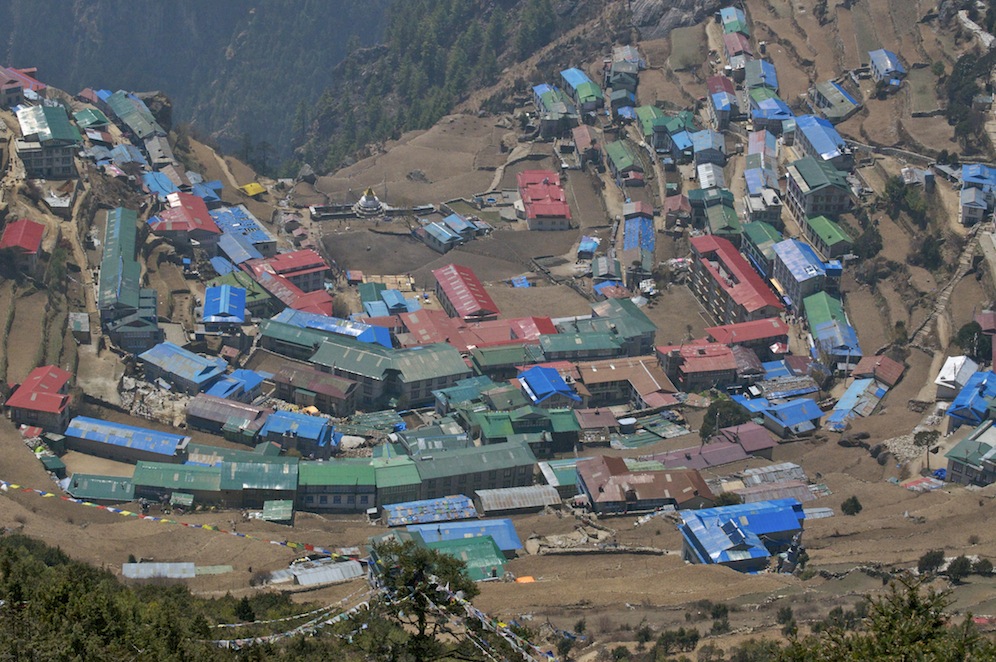
Ever growing Namche Bazaar

Ever growing Namche Bazaar

Namche has grown enormously since my last visit, with hardly a square inch of land left that has not been developed.  There are many more large lodges and virtually all the camping ground has given over to building.  There is the constant noise of hammers hitting chisels as stone is either being broken up or dressed.  Again our lodge provided us with en suite facilities, including hot showers.  How much has changed in just a few years.
I had been expecting to have disturbed nights on this trek with barking dogs but in both Phakding and Namche none were to be heard and long nights of sleep were achieved.

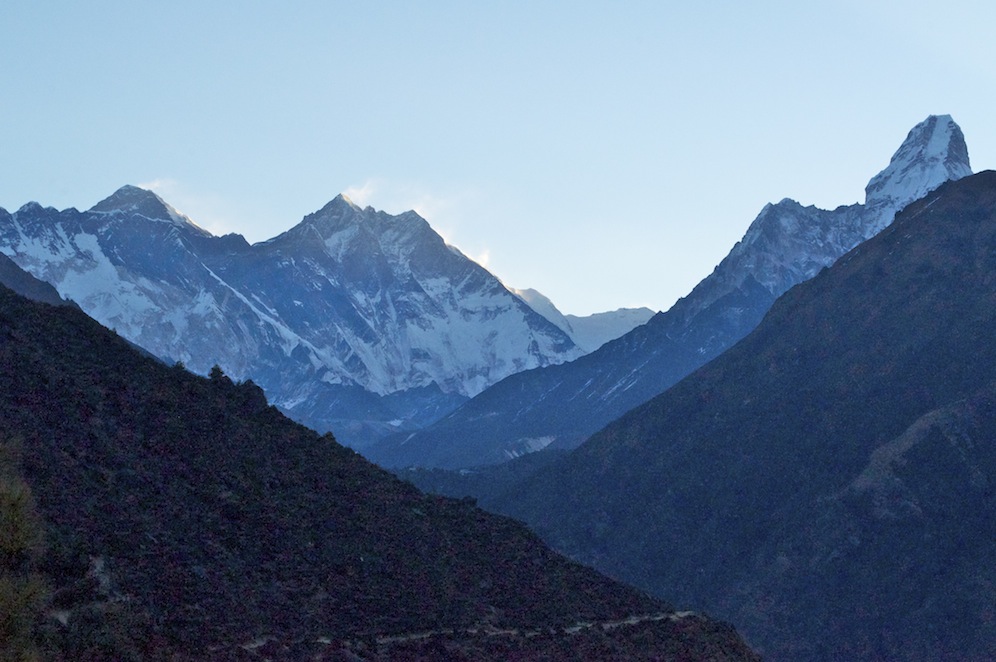
Early morning light on Everest, Lhotse and Ama Dablam

Early morning light on Everest, Lhotse and Ama Dablam

After a good, quiet night’s sleep we got up at 5.15 to go to the National Park headquaters to watch the sun rise.  Spectacular views. Considering how many people were staying in Namche it was remarkably quiet on the knoll as we watched the sun rise, bringing Everest and her neighbours into view and casting a yellow light on the peaks to our east. There can only have been three or four other people to share this spectacular experience.  Their loss was our gain.

Imposing Thamserku towering above Namche

Imposing Thamserku towering above Namche

Following breakfast we then climbed up the steep ridge to Shyangboche air strip (the highest in the world) before continuing to the Everest View Hotel for coffee and chips on the terrace, looking at the view of Everest, and others, up the Khumbu.  Stephen and Nathan were fascinated by the airstrip, which is in the process of being lengthened, so, at the moment, only helicopters can use it.  There has been a lot of helicopter activity with loads being transported up to base camp etc.  Stephen fancies flying helicopters!  Then it was back down for lunch and a free afternoon.
The walking does not get any easier but when it is over the rewards are fantastic.

Myanmar (Burma)

For those of you still interested in going to Burma, don’t give up on me yet.  I am travelling there in November to see for myself and to come up with a much more cost effective itinerary for either 2014 or 2015

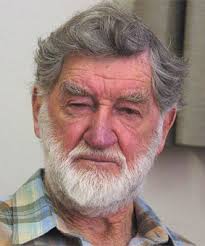
George Lowe

George Lowe, the last surviving member of the Everest ’53 Team and Patron of King’s Himalayan Club, passed away last night (March 20th) aged 89.  He had been suffering from a debilitating illness for a number of years.  I am proud to have known him and to have worked with him when he was Chairman of the Himalayan Trust UK.

Unknown

As well as being a man of action, a mountaineer chiselled out of Kiwi stone, George was a quiet, gentle man.  During one of the King’s expeditions to the Everest region the group met up with George and Mary, his wife, at Namche  Bazaar.  Sitting in a lodge one of the team asked George if he had been here before.  George answered quietly that he had.  Later that same evening we managed to get hold of a copy of George’s film “The Conquest of Everest”.  We sat in the lodge attached to the Sherpa Museum in Namche and watched it. The same boy, not having learnt his lesson the first time, turned to George and made a not too complimentary remark about the film, asking ‘who made it?’  George, again, quietly turned to him and said, “I did.”  Having spent all of his non expedition life in education, he knew exactly how to handle young people.

George’s passing ends an era and he shall be sadly missed by his family and those who were close to him.  However, George will not be forgotten. Having talked to him and listened to the story of Everest ’53, I am convinced that the expedition would not have succeeded without George spending eleven gruelling days cutting steps and preparing the route up the Lhotse Face to the South Col.

George could never be sure when he embarked on the expedition in 1953 that he would return.  Just in case he didn’t, he wrote a letter to his sister every day.  Collectively they give a detailed and insightful view of the expedition.  It is a fitting tribute to him that those letters will be published in a book ‘Letters From Everest’ on the 28th May, the eve of the 60th Anniversary of that first ascent.

Marrakech

We arrived mid-afternoon in Marrakech and there was a mad dash for the showers in the hotel, wanting to get clean with hot water before it ran out.

This was the first time I could really enjoy Marrakech.  Previously, my visits always had young people in tow or my time in the city was very short so everything was rushed.  This time I had no pressures.  I had plans to shop at my leisure, enjoy the banter with the shop keepers and soak up the atmosphere.  Having showered I ventured out into the souk but, having anticipated a spending spree, felt no desire to buy and satisfied myself with a gentle amble.

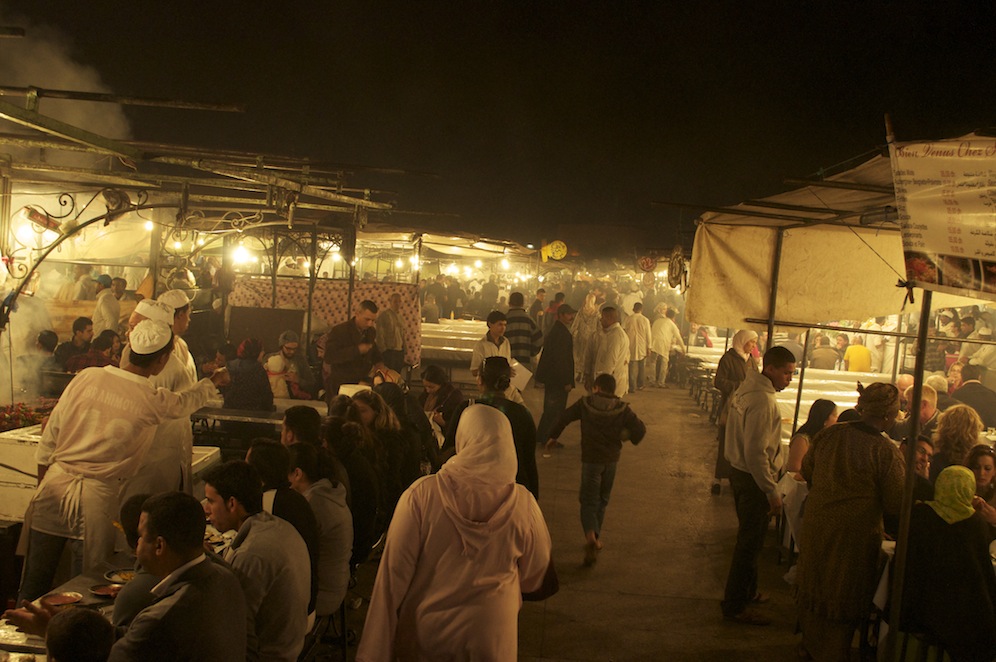
With nothing bought I decided it was time to visit the Cafe Glacier for a drink and observe the goings on in Djeema el-Fna from the terrace.  Magda and Sarah Cullen, also in Marrakech, joined me and we chatted as the sun went down and people’s attention was drawn from daytime to night time activities.  The multitude of restaurants were erected, the barbecues lit with smoke drifting across the square and the atmosphere intensified.  By now the terrace was heaving with people, all wanting the same view and to watch the night unfold.  Remarkably, it got quite chilly so we relinquished our ringside seat and went our separate ways.

Later that evening we met up with Mohamed and went to Restaurant Omar for a traditional Moroccan meal.  It was much more sedate than the square but the food was good and ample.  Before we left the restaurant, the heavens opened and we knew we were going to get wet returning to the hotel.  Remarkably, the streets were still a throng of people who seemed not to mind the rain.  Like slugs, which appear when it rains, nearly every hawker on the street was selling umbrellas.  We never saw them before.

The following morning we all decided to walk to Jardin Marjorelle beyond the old city walls.  Originally belonging to the artist Marjorelle, the garden went into decline after his death.  Eventually Yves St Laurent bought it and restored it to its original glory.  Working our way through the souks in the hope of going in the right direction was fun.  Although we had a map it did not have the detail to show all the passageways through the souks.  I just followed my nose, and instinct, and was pleased that we got there without any difficulty at all.

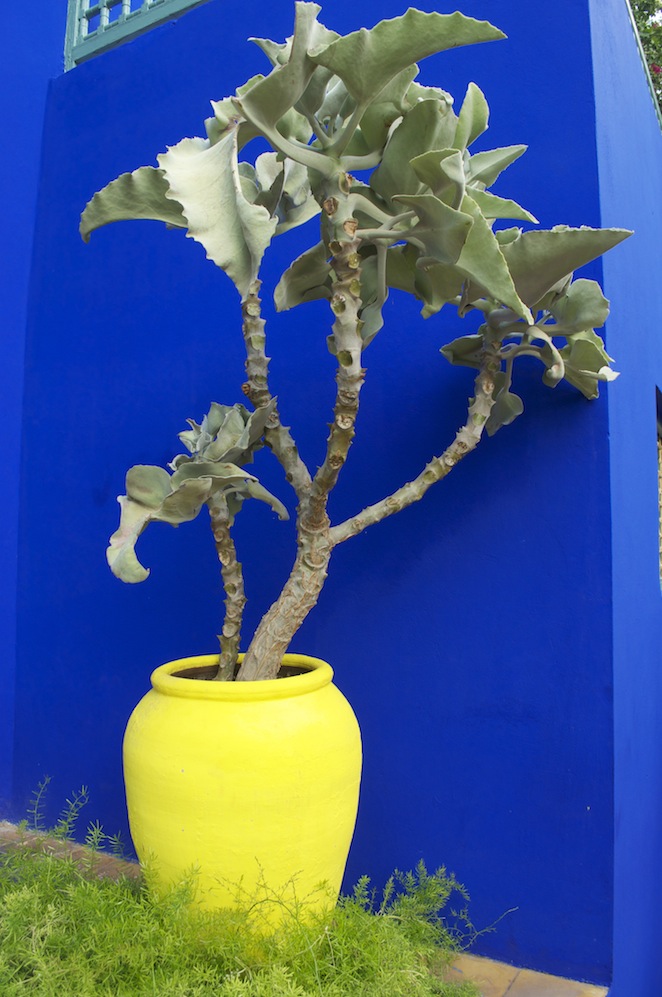
Contrasting colours

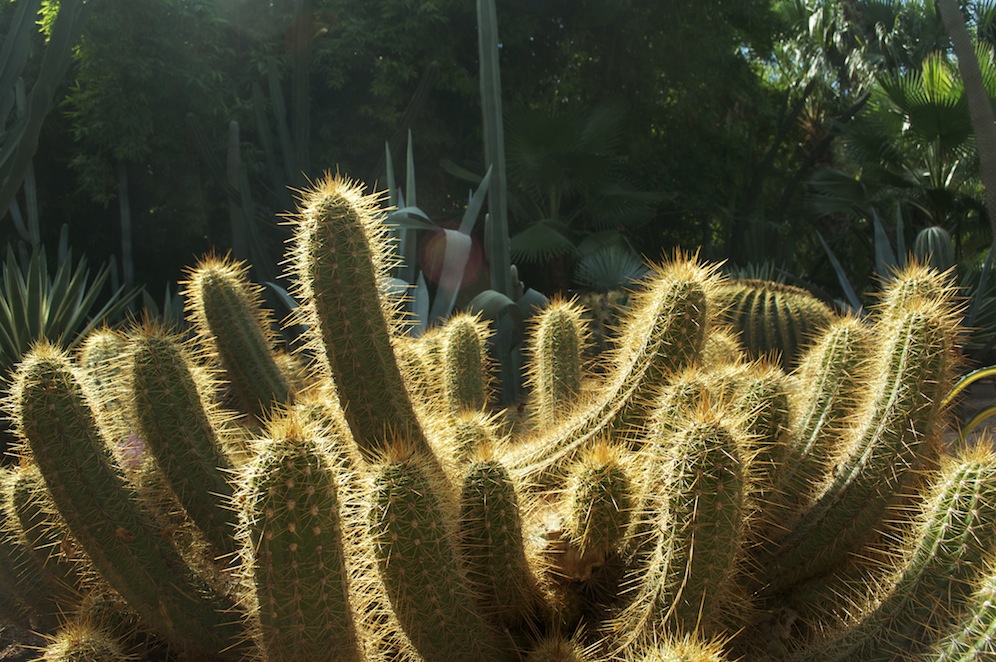
The garden, despite being in a busy city, is a garden of peace and tranquility.  There are few flowers but plenty of greenery.  To compensate for the lack of variety of colour in the garden there are pots of vivid blue, yellow, orange and red.  Marjorelle’s old studio, now a fascinating Berbar museum, is also painted the most striking blue, a stunning contrast to the greens around it and the sky above.  It was a very popular destination for tourists but it never felt crowded and all sound seemed muted.  It was also a place to people watch.  Because of its association with Yves St Laurent (there is a memorial to him in the garden) a lot of ‘beautiful’ people come to pay their respects to an icon of fashion.

Afterwards, three of us took a pony and trap, well, two ponies, in fact, back to Djeema el-Fna and a spot of lunch in another rooftop restaurant.  Following lunch we went shopping, and while it had been difficult the previous afternoon to be inspired, today it was so much easier.  I knew what I wanted and I went for it.  It was so much more pleasurable.  By accident, we stumbled across a herbalist whom I had visited in 2007 with the blind group.  I was immediately remembered.  There followed a demonstration of all of the products and then more purchasing took place.

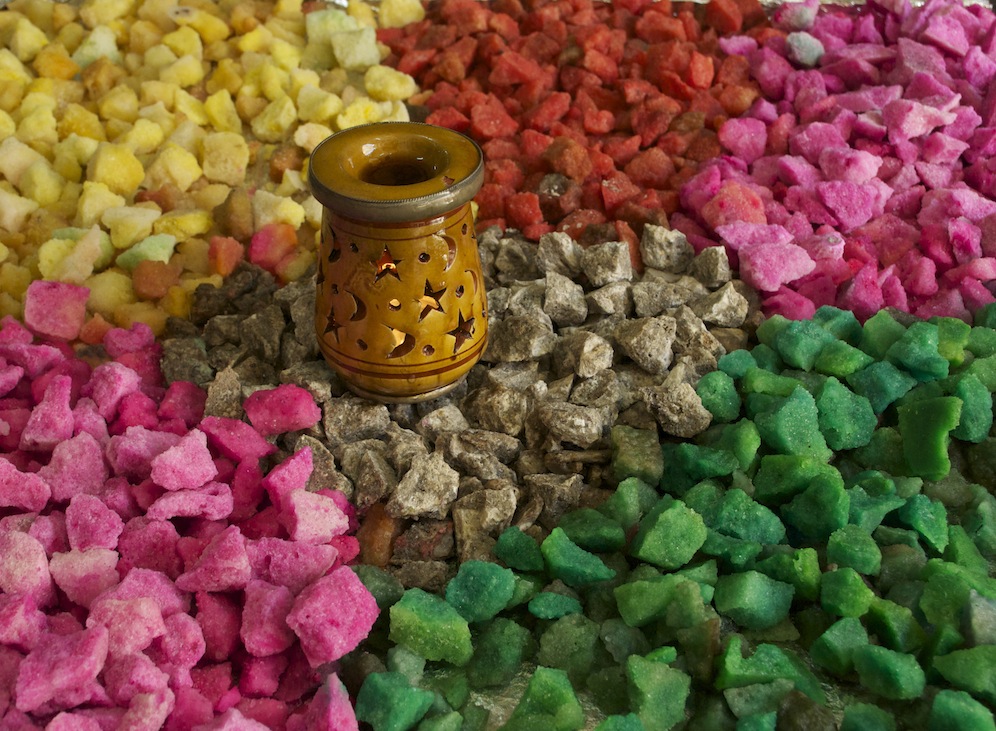
Now laden with shopping, I returned to the hotel, whereupon I met the rest of the group who all expressed a desire to meet the herbalist.  Back we went and this time I was given some free samples, bought some crystals and a crystal burner and had a neck and shoulder massage using Argon oil. By the time we had finished, that was really that.  No more spending.

Stall 22

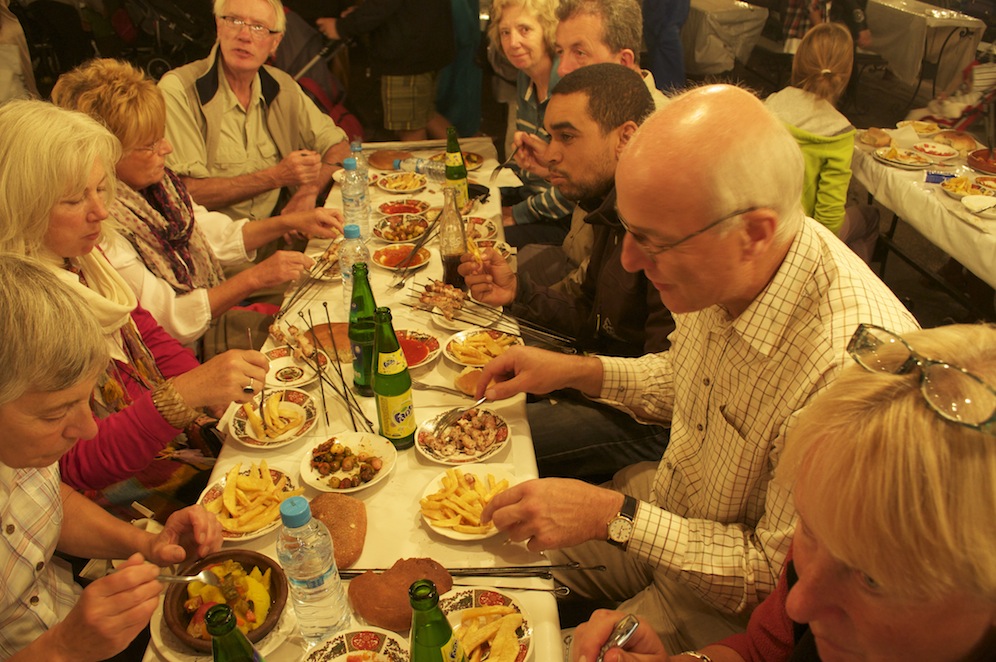
In the evening we went out to Djeema el-Fna and ate at stall 22.  I had met them earlier in the day and their banter and encouragement is infectious and hard to refuse.  They have all the catch phrases on the tip of their tongues, all watch East Enders and are all related to Jamie Oliver.  As we all turned up and began to take our seats, all the boys working on the stall clapped and cheered.  This could be heard throughout the square as customers were secured by the various stalls.  The atmosphere was electric and there was so much going on.  The food is simple, but very good, most of us having chicken brouchette  and fries, not exactly a la carte but you don’t have so much fun and banter with a la carte.

Afterwards we strolled around the square and up one of the main streets.  I was surprised to see how many beggars there were, and many of them seemed to be in genuine need, so much so that I gave away my loose change, not something I normally do.  We were approached by several men suggesting we might like wine or beer and even a belly dancer or two.  Having gone several days without, we declined and slowly filtered our way back to the hotel for one last night before our journey home.

A good trip for a variety of reasons.  Already there are plans afoot for another!