More time in Kathmandu

Still on the case of Tashi Waldorf I managed to get through to somebody at the school. They didn’t really want to speak to me but pass me on to Eva via a mobile number. Because I was not using a local sim card all calls were blocked from my phone. It worked so much better in the mountains. Hence any calls I made had to go through the hotel reception. Only a small hurdle. I have a number, I have a helpful receptionist. I will soon be able to complete the mission to give some money away. That is if the number I had been given was still in use. Another stone wall. I decided not let this ruin my day so I put it at the back of my mind and went on some retail therapy before meeting Kanchhi Maya and the children tor lunch. I had a wonderful time buying things for Molly and Ben and Kelly’s impending family addition. I quickly found things for those I care most for.  Depositing my goods back at the hotel I returned to the Northfield Cafe to meet my lunch partners.

Kanchhi  Maya, Tshering and GN joined me at the Northfield. Kanchhi presented me with a basket of flowers. What I would do with them is beyond me. It is not the first time she has done this but the gesture is one if kindness and friendship. Chering has grown up to be a beautiful young woman. She is now 16 years old and is preparing to go to Trinity College to do her A Levels. She talked freely about her ambitions to become a doctor and is committed to learning as much as she can so that she can develop her potential fully. She gets that from Tshewang, her father, whom she clearly idolises.

GN is a lanky 13 year old who has limited conversational skills as a result of his present hormonal state. He looks like a younger, taller version of his father, having the same smile. He is unsure of his future but seems to be veering towards some sort of engineering, following mother’s natural inclinations.

The conversation flowed freely while we waited for our food and it was largely led by Chering who was so eager to talk about her many plans. She is likely to want to train and qualify in the UK, the States or Canada but is adamant that she will return to Nepal once she has done so as she has a social conscience, not unlike get parents in that respect.
We chatted about Tshewang always working and never relaxing. Having had a bit of a heart scare a few years ago he needs to let go a little. I discovered, to my horror, that he does not have a deputy head he can off load some responsibility to. He could not join us today because the school is closed post exams and he is busy marking papers, writing reports and overseeing painters decorating the school. I think a lot of it is to do with image and prestige within the school community; he is the head and he is in charge of everything. It would do him good to find a colleague he trusts and values to take some of the burden and responsibility from his shoulders. I passed on my words of wisdom to Kanchhi Maya and subsequently in an email to Tshewang but it will be like water off a ducks back.
The conversation continued to flow after the food arrived and it took an age for it all to be eaten.

I had a couple of favours to ask Kanchhi Maya – 1) could she find out anything about how I might be able to make constructive contact with Tashi Waldorf, and 2) where I could buy some leaf plates and bowls from for my ‘Tastes of Indonesia’ lunch? The former she would let me know about and the latter was easily solved if I had time to go with them. I had nothing else to do so it was agreed that after we finished at the restaurant we would go shopping together. GN took this as an opportunity to escape and go home on the bus but before he went I popped into a shop at the Northfield run by an organisation called ‘Beni’ creating a number of hand crafted items from recycled rubbish. I had read the leaflet before but I hadn’t seen the finished products. They are brilliant and range from bags of all shapes and sizes to wallets, to stools, to place mats, door mats etc. I bought Chering a shoulder bag made from an old rice bag and for GN I bought a wallet, using amongst other things old sweet wrappers. All the money goes to supporting the numerous women’s cooperatives set up to collect, clean and create.
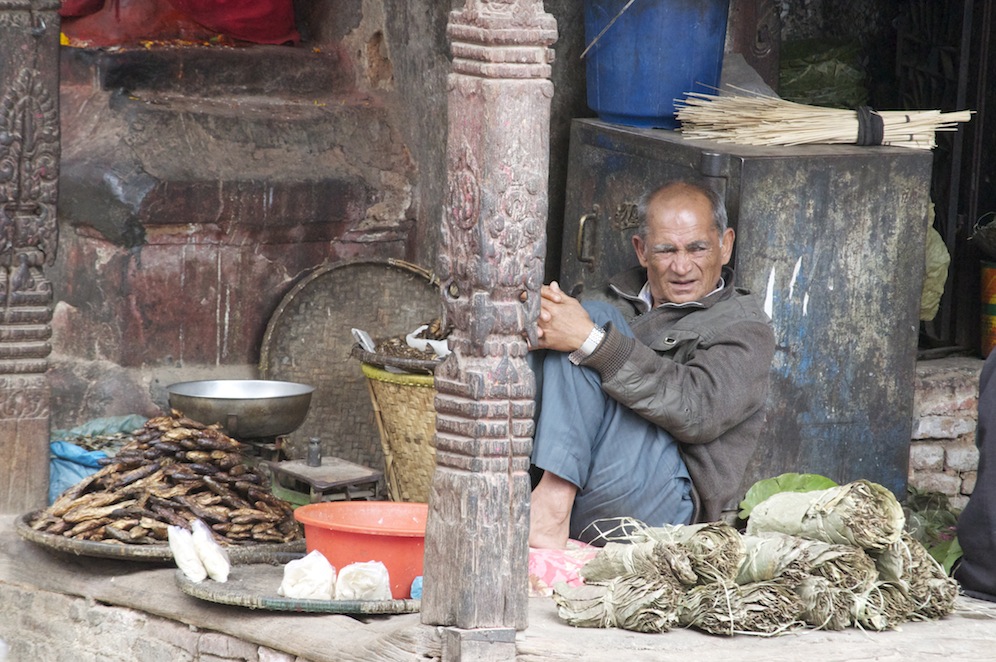
A relaxed shop keeper selling dried fish

A relaxed shop keeper selling dried fish

As we left the tourist area of Thamel the streets became narrower and a lot more crowded. Now all the faces were Nepali. Eventually we arrived at a Newari vegetable markets where they sold packs of plates and bowls of a variety of sizes. They came in packs of one hundred and are perfect for the purposes I have in mind. I just hope I can get them home safely in one piece.

Kanchhi then insisted on taking me to another shop to buy me a jumper. She has always wanted to buy me one but wanted me there so she could get the size right. The shop was not large but it must have had at least 10 sales staff, mostly attractive young women, waiting for a customer to brighten their day. Kanchhi went straight to the only male sales assistant who looked me up and down before producing a normal V knecked jumper of excellent quality. I tried it on. It was a perfect fit and I liked the colour. Taking it off became a bit of a spectator sport. I needed Kanchhi to hold my shirt to stop it riding over my head exposing myself to the onlooking, amused sales girls. Kanchhi refused to help, cracking up in fits of laughter. It was like going shopping with my mum but more fun. Eventually I managed to get the jumper off and, at the same time, retain some dignity. At the entrance to the shop there was a sign saying ‘Fixed Price’. That did not stop Kanchhi from entering a bartering duel with the salesman who crumbled under her forceful charm.
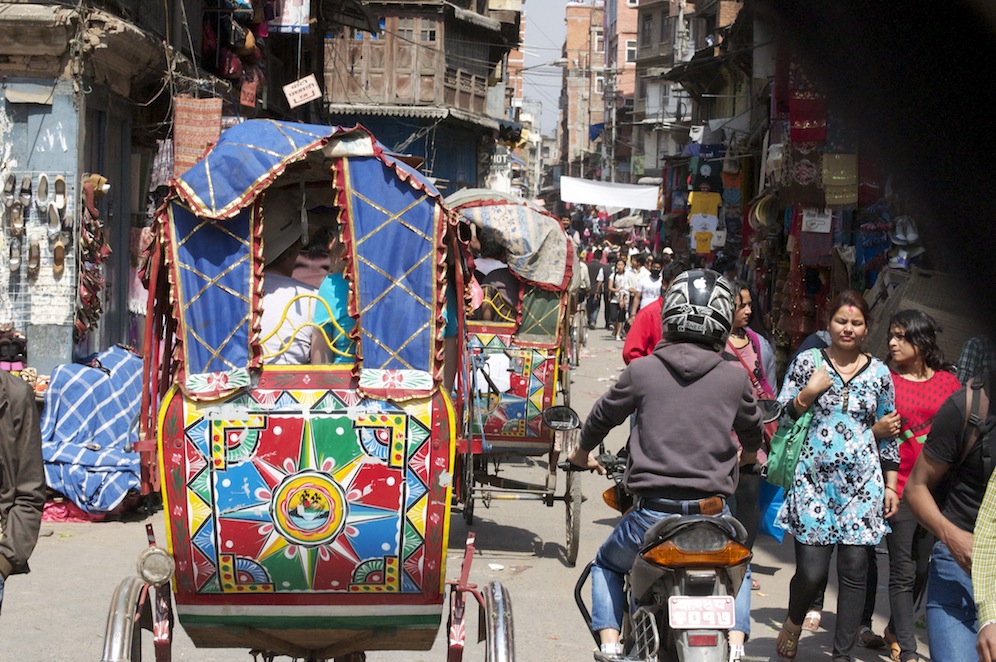
Busy narrow streets where pedestrians always have to be alert

Busy narrow streets where pedestrians always have to be alert

Then we had to visit a shoe shop to buy shoes for Angela. It helped that I knew her shoe size and it proved quite a painless ordeal. Walking back through the extremely crowded streets, avoiding motor cyclists and rickshaws while ladened with several shopping bags, proved interesting and it was only when we returned to the tourist area that the streets, which I normally associate with crowds, became less of a problem to walk along.

We returned to the Northfield so that Kanchhi could collect her motorbike for her and Chering to return home. It had been a delightful few hours in good company and some interesting experiences. After they left I popped into the recycled goods shop, gave the assistant a lovely basket of flowers and bought some more of her wares.

Kathmandu

Hira’s brother met me at the airport and a car took me to the International Guest House on the outskirts of Thamel.  The hotel was not too bad but its position in relation to its surrounding was a bit of a let down. It was perfectly adequate for me but not really suitable for a group.  Like so many hotels in Kathmandu it lacked some of the finer details.  The bathroom was quite basic and the only cosmetic available was a small bar of green soap.  It would have been no trouble to provide a small basket with a selection.  The white towels were really off-white veering towards grey. Things looked up a bit when the cupboard beneath the antique television set contained a minibar fridge.  Sadly it was not only empty but also not switched on so I couldn’t even keep my bottled water cold.  Beyond the room the public areas were quite pleasant but could probably do with a fresh coat of paint.  Slightly disconcertingly, there were easy chairs on the open corridors.  I had one outside my door and beneath my bathroom window.  I never did get used to opening my door and finding somebody sitting there.  The small square garden also doubled up as a dining area with tables on two sides.  Half were under cover, which during daylight hours were preferable as the outside tables were plagued by flies.  The most disappointing aspect of the area was the sullen, somewhat dishevelled waiter who shuffled around, could not muster up a smile and appeared to be totally disinterested in the customers or the job he was doing.  Plates of food were ungraciously placed before me. Clearly he was not working on receiving a tip. He would have been more at home at Fawlty Towers.

You would have thought that by being in Kathmandu that communication using a mobile phone would have been easier.  Far from it.  My mobile, which had worked almost anywhere in the mountains, now was rendered useless.  It was impossible to both make and receive calls. It was the same for texts, unless they were very short and to the point. Fortunately email worked but, having decided that I would use my time to deal with all the charitable issues, communication became a bit of a nightmare.

One of the reasons for returning to Kathmandu was to make best use of my time instead of idling the days away in Lukla. One of my objectives was to hand over a significant sum of money to Tashi Waldorf School for whom KSWNT had accrued funds. This was beginning to prove to be a lot more difficult than you would imagine. Before I left England I emailed the director to advise her of my intentions. Unfortunately that communication bounced back because her in box was full. Never mind, a visit will not go amiss, particularly as I have unexpected time on my hands. So, having showered and breakfasted, I first visited my friendly money changer and exchanged a large(ish) bundle of £20 notes for an even larger bundle of Nepalese Rupees.

I cannot visit the money changer without Azam, the next door jeweller, coming to see me because he has recognised my voice. Over the years I have put quite a bit of business his way. I think he is good but he is never happy about the level of business he achieves on a day to day basis; he is not right in the hub of the tourist area and there is lots of competition nearby. However, on this occasion he does not want to sell me any jewellery but would like to chat about marriage, if I had time. I explained that I had to visit Tashi Waldorf but then I would come and see him. By this time a taxi driver I have known for years and who hangs about outside the Marshyangdi Hotel opposite came to see me.
All these acquaintances took time and it was clear that I was not going to get the job done before I had to meet Hira for lunch. Tashi Waldorf would have to wait until the afternoon when I would return to have a chat with Azam before my friendly taxi driver took me to Tashi Waldorf.

Meeting Hira at Pilgrims Read ‘n Feed we chatted openly about various aspects of the trip, the pros and cons of the hotels we were using, the need to maintain high quality service at the beginning and end of the trek and that if it was necessary to increase the cost slightly as a result, it would be appreciated and understood.

After lunch he took me to have a look at Samsara Hotel on the edge of Thamel and the hotel he is recommending we use in October. It is not the Shangrila but it is adequate. It has a garden and is close enough to all that Thamel has to offer. At the moment (and it looks as if it may continue for a great many months to come) the road passing the Shangrila is being widened. The road is gridlocked. There are no pavements and they are taking the frontages off buildings too close to the road. The Shangrila would not be ideal at the moment.

I was now able to focus my attention on Tashi Waldorf, after, of course, I had my fatherly chat with Azam. Sitting on stools in his shop he told me his mother wanted to see him married. She is ill with diabetes, and, reading between the lines, wants to see him married and settled before she parts this earth. Before I realised it was to be an arranged marriage I asked him if he was marrying for all the right reasons! His mother wants it done quickly, in April, but he does not want to rush. Weddings are expensive affairs worldwide but in Indian/Nepali society there is a huge financial burden on the groom. He prefers to have a few more months to earn more from his shop so that he can feel more financially able to cope. It is easy to understand his dilemma. He does not want to offend his mother. He is marrying someone he does not yet love and if he is struggling financially it will make love even harder to come by.

Then came the crunch question. Can you come to my wedding in September? I pointed out that I was coming to Nepal in October and that I couldn’t possibly prefix that trip with a wedding in India.

Excuses made, it really was time I sorted out the transfer of funds to Tashi Waldorf. Finding my taxi we drove through the slow, horn reliant traffic. During the journey he told me how expensive petrol was and how it was in such short supply, how expensive everything was and how useless the government was. All a pretext for a generous fare from me. On the other side if the ring road we turned into the little side street that led to the school. The school was no longer there. Instead, there was a large, new house and all evidence of there ever having been a school had disappeared. We canvassed information from the local community but nobody was particularly forthcoming or helpful. We were given some indication as to the new location of the school but when we went there we could not find it and nobody seemed know what we were talking about.

Eventually I gave up and got my taxi friend to return me to Thamel. When I asked him how much he said, “How much you want to pay?” I hate questions like that and it did not matter how much I cajoled him for a figure, none came from him. In the end I handed him 1000 Rupees, probably way above the odds, despite the fact that he gave it a rather disdainful look. All being well I won’t have to see him again. Any thoughts on sorting out the Tashi Waldorf problem would now have to be delayed until tomorrow.


Leaving Lukla

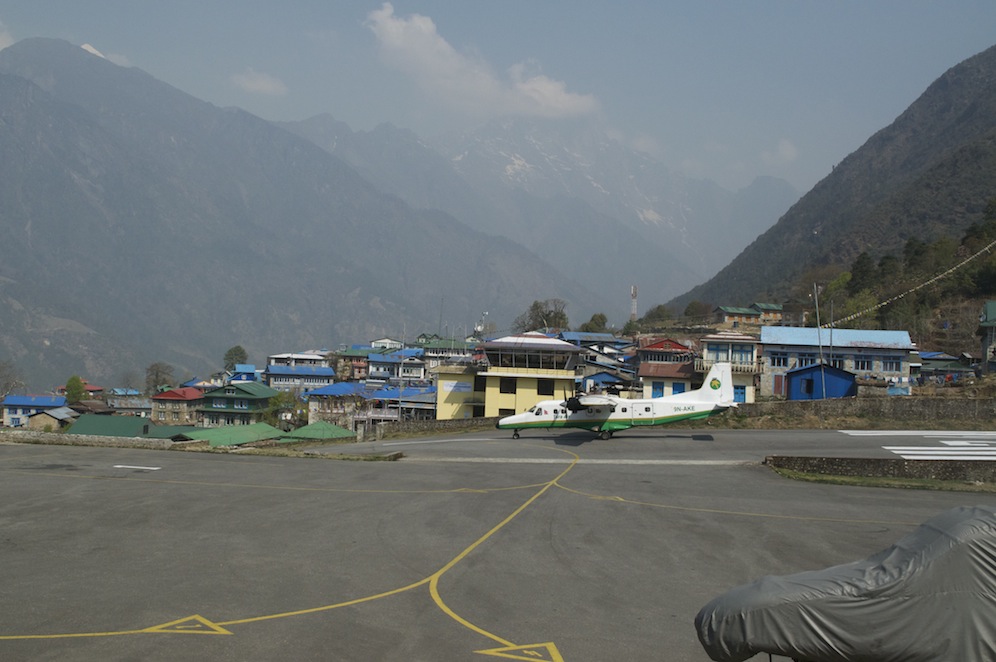
Paradise Lodge is immediately behind the control tower

Paradise Lodge is immediately behind the control tower

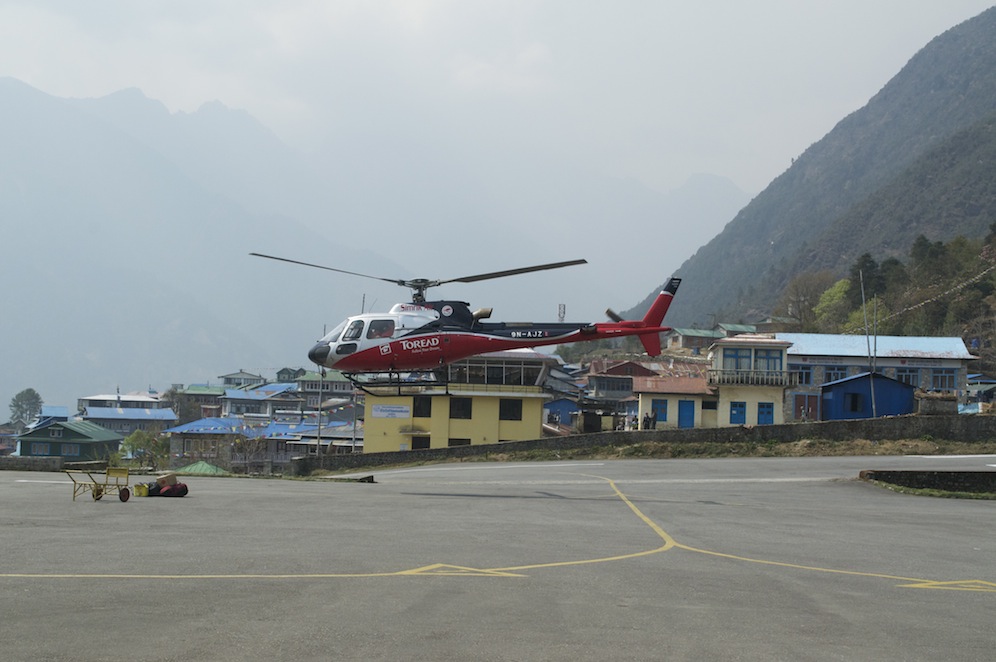
There are only so many times you can walk up and down the one street in Lukla in a day. There are only so many Sudokus you can do in a day. There are only so many chapters of a book you can read in a day. All of these activities are accompanied by the constant roar of helicopters taking off, landing or just idling while they wait. The helipad is adjacent to Paradise Lodge as is the airport runway with its busy schedule of planes coming in and out throughout the morning rush to get people to the mountains and others back to Kathmandu.

Helicopter at Lukla Airport

Helicopter at Lukla Airport

The prospect of six days having my ears and chest cavity rattled and vibrated held little appeal so I asked Hira to see if he could organise a flight for me from Kathmandu to Lukla on Friday or Saturday so that I could ask Ang Passang to get me a seat out on Tuesday.

To break the monotony, I went out in search of Pradip and his group, returning from their own trek. It did not take long to find them at the Shangrila Lodge at the top of the runway. I have used it as a base at the start and finish of a trek many times. They had had a good time but it had not been without incident with a number of illnesses, including one girl who kept passing out and had to wait in Namche for five days with a member of staff. We chatted for a while but as they had things to sort I did not stay long. Having been invited for supper there would be plenty of time. I admit to looking forward to something other than lodge food.

More time killed at Paradise Lodge being rattled by choppers. At least not all the flights were of fancy as there was a mission to rescue one of the ice doctors who had fallen down a crevasse. Sadly it proved in vain and although he was retrieved he did not survive the ordeal.

In the evening I wandered back up to the Shangrila Lodge for a welcome change of diet from the normal lodge food. Leaving the children and some staff to enjoy their soup, Pradip took me, Dambar and a couple of the Tudor Grange staff into the lodge proper to share a plate of delicious buffalo strips and a glass or two of red wine. It was only when this ritual had been completed did we rejoin the rest of their group for the main course, a traditional Nepali rice, dhal, vegetables and chicken. Delicious! This was followed by end of trek chocolate cake, bought from the bakery in Lukla. Prem, Pradip’s father, baked many ‘end of trek’ cakes for us over the years and would be unimpressed with his son resorting to a bought cake. After the pudding I made my leave, wishing to know what my flight arrangements were for the next day. It was good to talk to Kevin Hall from the Worcester branch of Tudor Grange and his Australian counterpart from the Solihull branch.
Back at Paradise Lodge I learned that I was on the first Sita Air flight and had to be at the airport at 6.00am.

I had a terrible night’s sleep waiting for the alarm to go off. For a brief moment after we took off I felt the emotions surge – not only was I leaving the mountains but, more importantly, I was creating even more distance between myself and the group. The horizontal view from my portal in the plane was as stunning as ever and I tried my utmost to put names to the multitude of peaks, so recognisable from the ground but so difficult from a plane. The view below was virtually obliterated by a thick haze. Just occasionally the vivid pinks and reds of rhododendron trees penetrated the murky atmosphere. Kathmandu was even worse and seriously needs some rain to bring the dust down. But it is not all dust in Kathmandu; it is pollution from traffic and hundreds of brick factories belching out thick smoke from their furnaces. Immediately the heat hit you as you stepped from the plane. Fighting Kathmandu traffic, I eventually arrived at the International Guest House on the outskirts of Thamel, not really a hotel I would want to bring a group to but very satisfactory for my individual needs.

Unexpected turn of events

Sometimes things do not always go according to plan. It is never without good reason but in the business of adventure travel one has to be adaptable. At the time it is always hugely disappointing but at the end of the day you stand by your decisions.

In 2005, while climbing Mera Peak, the Sherpas, who have much more experience than ourselves regarding the conditions, deemed the crevasses in the glacier too dangerous. In 2006, an attempt on Menthok Peak in Ladakh was thwarted by bad weather and a particularly dangerous looking cornice, which proved the wisdom of our decision to abort by collapsing into the gully we would have been climbing at the time. Ladakh has provided more than its fair share of problems over the years with collapsed moraines releasing a glacial lake, cloud bursts causing devastating landslides, killing hundreds. All these have to be managed with the safety of the group or individuals of paramount importance.

Sometimes, it is only the individual that has to accept change. Over the years one or two have had to return to lower altitudes or even the UK. To experience it is to understand the emotional impact this has on the individual. It has happened to me more times than I care to remember. In 2003 it was a damaged ankle, in 2011 pneumonia and now, in 2013 a chest infection initially brought out from the UK but made worse by heavy breathing while exerting at altitude and yak dung burning stoves in lodges. Long periods of coughing in the night were producing a slight pinking of my sputum, a classic indication of the early stages of pulmonary edema. I really had no choice in the matter.  If I went higher it will inevitably get worse, making a descent lengthier and more difficult.  Common sense dictates the actions you take but it does not make it any easier, even more so when you are the group leader. There is no easy way to tell them that you are leaving. You hope, above all hopes, that nothing really changes for them, that they still have an experience of a lifetime. What has made this particularly difficult is that I was having a special shared experience with Stephen, whom I rarely see as be lives on the other side of the world.

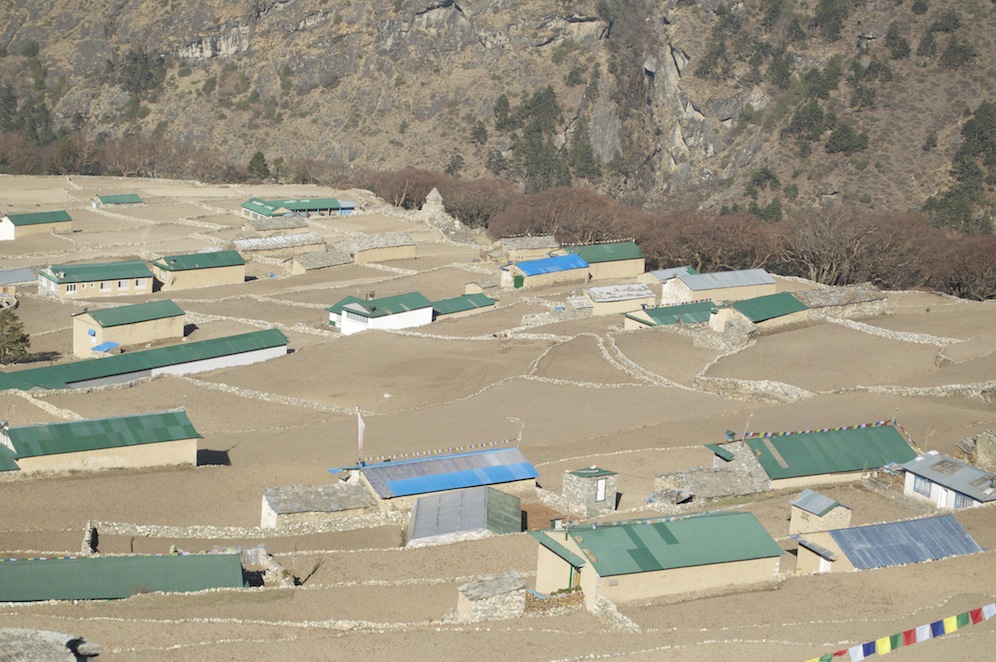
The two dots in the centre of the picture are Karma and me leaving Phortse

The two dots in the centre of the picture are Karma and me leaving Phortse

Having made the decision, I informed Tanka that I had no option but to go down.  He appointed Karma to walk down with me.  After an emotional announcement and parting, the group headed on up the hill, while I retraced our steps of the previous day and headed for Namche.  There was no real alternative to having to drop 200 metres to Phortse Tenga to then climb steeply the 350 metres up to Mong.  The reward was a long rest at the top.  The rest of the journey to Namche was relatively easy with a long, gentle downhill section to the point where you turn into Khumjung, only we continued to traverse the hillside all the way to Namche and the Camp de Base Lodge.  Karma was very patient, carrying my kitbag on his back and his own rucksack at the front.  He made it all look so easy.

In Namche I had a little wander to pass away the time and finished up in one of the bakeries for a bite to eat and a proper coffee.

Setting out from Namche at 7.45am it took just an hour to reach the foot of the hill that took so much effort to climb a few days previously. another hour saw Karma and me drinking coffee with Ang Darki and Nima in their lodge at Monjo, just yards outside the Sagarmatha National Park. It began to occur to me that we could go all the way to Lukla, thus giving Karma a good chance to meet up with the group while they were still high.

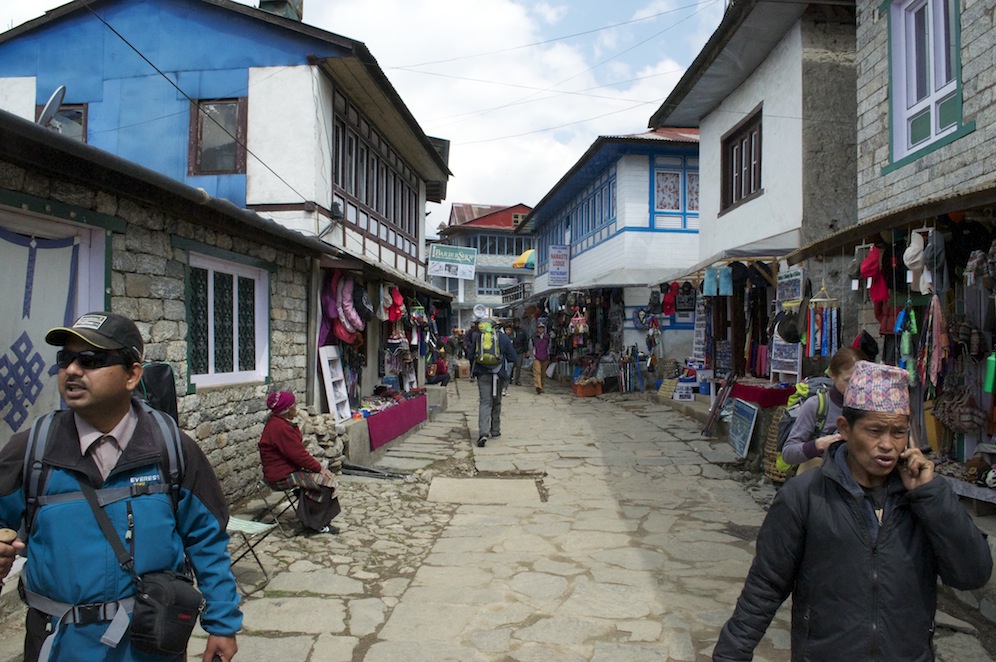
Main street, Lukla

Main street, Lukla

Stopping for an early lunch at Phakding meant we still had plenty of time for the final leg of the journey to Lukla. I was coping well with anything downhill or on the flat but struggled with my breathing on anything that resembled uphill. Karma predicted that it would take about four hours to walk to Lukla from Phakding but we actually did it in two and a half. The upside of completing the walk today is that I no longer need to put further stress on my chest. The down side is that instead of spending five days in Lukla, I now have six days to kill. How best to use this time? There is certainly not enough here to keep me occupied and boredom might feature fairly quickly. It occurred to me that I might best use my time by returning to Kathmandu on Tuesday in order to fulfil my duties for the charity with Saptagandaki and Tashi Waldorf, so that I can return to Lukla on Friday or Saturday to meet the group. The benefit of this is that my time with the group before their return to the UK and my time with Hira after they have gone will not be interrupted by other pressures. It all depends whether I can get a seat for a flight from Kathmandu to Lukla at a very busy time of year. Fingers crossed.

Khumjung to Phortse

I went to bed at 8.00pm convinced I was about to be sick. I went to sleep and had a pretty good night achieving 10 hours without too much interruption. When I woke at 6.00am I had the same sicky feeling I had gone to bed with. I had little motivation for the walk ahead and was not looking forward to it at all. Others were feeling the same without being ill and I could only attribute it to the lack of variety in our diet and the reliance on the potato, cheese and eggs with no room for anything fresh. I talked to Tanka while the rest of the group set off for the gompa. We agreed to simplify the diet with rice, dal and vegetables.

Prayer tablets of Khumjung Gompa

Prayer tablets of Khumjung Gompa

I caught up with the group at the gompa and waited for the key holder to arrive to open the cabinet containing the yeti scalp. There has been tight security since someone stole it a few years ago and got as far as Lukla before they were apprehended. Still the key holder would not open it until I had paid a donation.

We made enquiries about the deaf and dumb artist, Pemba, but nobody seemed to know what or who we were talking about. Sadly we had to give up and make a start on our day’s journey to Phortse. It would not surprise me if he has gone to live in America.Walking through a labyrinth of narrow stone wall tracks between potato fields awaiting their seedlings, we left Khumjung

As soon as we had left the village the track began to climb steeply up a series of steps hugging the cliff face. Since I last walked this track a hand rail has been installed in places suggesting that health and safety is creeping into Nepali society. At the top or the track it turned a corner out of the hanging valley that is home to Khumjung and Kunde into the main valley, all be it several hundred metres above the river below.

Mong

Mong

Before us the track climbed steadily up to Mong where there is a cluster of tea houses around a chorten. Despite taking it slowly we reached it at 10.30 and as this was our designated lunch stop we had plenty of time to relax and enjoy the stunning views of Tamserku and Kantega towering over us and Ama Dablam’s dramatic shape a little further away.I was, by now, feeling much better and more positive about the trek. Although I couldn’t eat all my lunch, it was a very welcome change of diet, also much appreciated by the rest of the group.

Phortse

Phortse

After lunch we dropped down 350m to Phortse Tenga where we crossed the river for the 200m climb up to Phortse. It is quite a windy spot but the sun is still warm out of the wind. We are surrounded by huge mountains, to the east those already mentioned and to the south the wall of mountains which make up the southern side of the Gokyo Valley. I am looking forward to watching the change of light as the day draws to an end.