Wellington

We have now spent nearly a week in Wellington and it is a fabulous city. Wellington is renowned for its strong winds and generally poor weather. We have had virtual dawn to dusk sunshine and only one day that can best be described as breezy.

The business end of Wellington hugs the shore line around the various wharfs. It is the only part of The city that is flat. Behind the tower blocks that make up the centre there are green hills, thick with forest but with houses, making up the suburbs, scattered within.
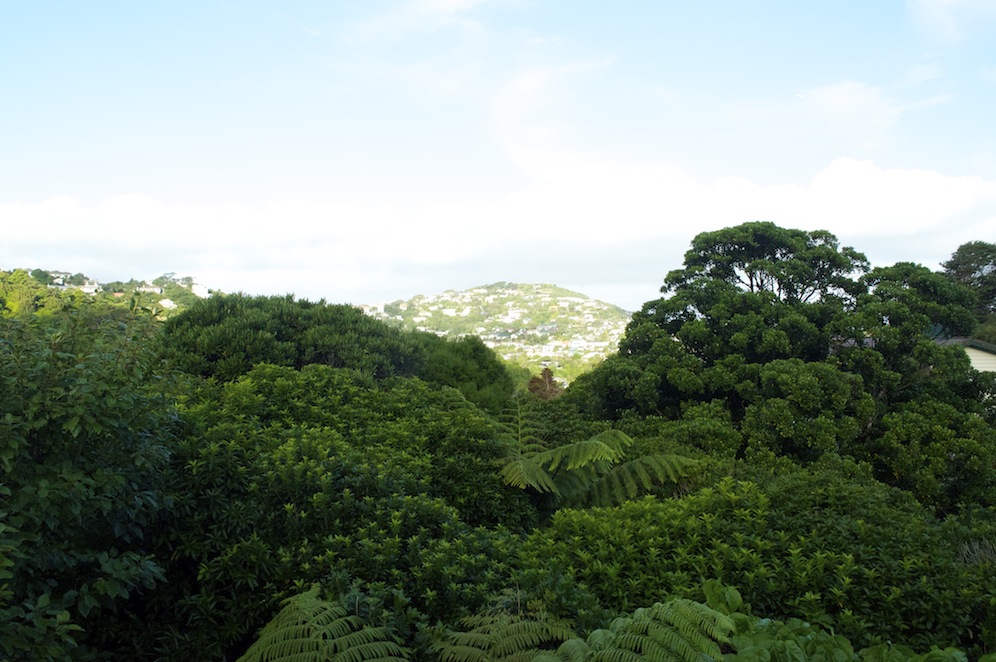
The view from Ben and Kelly's with the canopy below.

The view from Ben and Kelly’s with the canopy below.

Ben and Kelly’s house is in the suburb of Crofton Down, perched on the side of a hill looking east. Below their balcony is a thick canopy of trees hiding the ground beneath, ground that cannot be used unless the trees are destroyed. Why destroy anything as beautiful as a canopy with at least six different varieties of tree in a small area. Many birds use the canopy for a variety of reasons and it means that all their action takes place at eye level or below, making them so much more visible.

Out of the forest the grassy tops of the hills protrude. It is so unlike any other capital city I know. With a population of just over 200,000 it is not large, by any means, and makes travelling around within the city relatively easy and stress free.

Ben, Kelly, Eva and Father Barry

Ben, Kelly, Eva and Father Barry

The weekend was largely given over to the christening of our granddaughter, Eva, either preparing for the barbecue and party which was taking place at the house after the formal ceremony. The sun shone, Eva performed pretty well considering she was feeling off colour and it was great to mix with Kelly’s relatives and both their Kiwi friends whom we last saw at the wedding two years ago.

Wellington, like many capital cities has a generation of people who like to take every opportunity to get or stay fit. Street joggers are a common sight, not just along the flat shore front but also among the hills of the suburbs. It takes a certain dedication and determination to go running in Wellington. Many take to their bikes for work, which is a lot easier going into work than it is going home at the end of the day. It hurts just to see them struggling up the hills. Ben often cycles into work but brings his bike home on the train in the evening. He doesn’t feel that his fitness levels are yet ready to tackle the journey home on his bike.
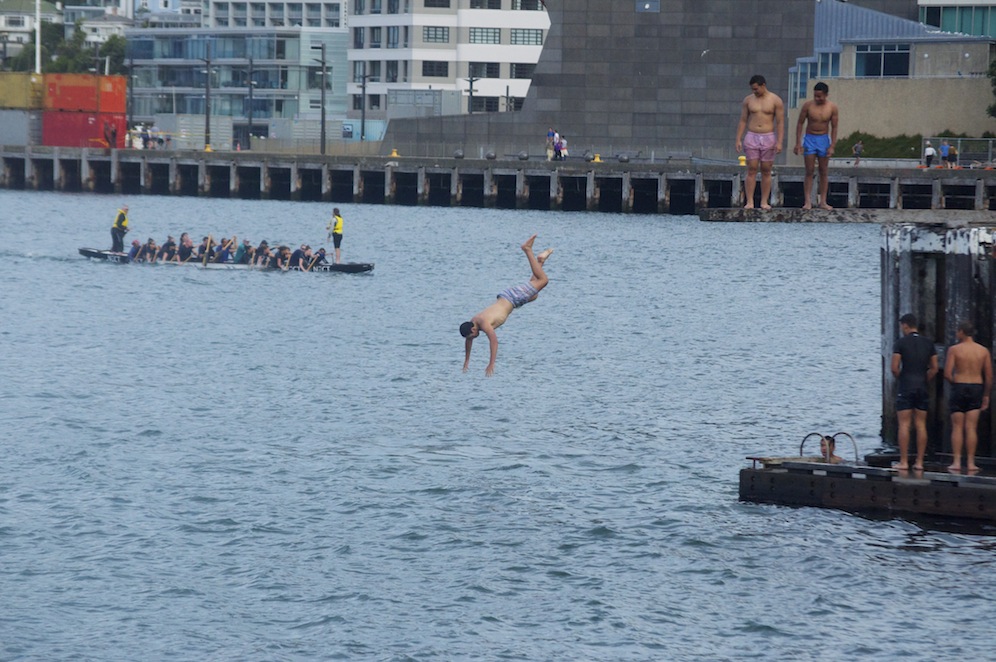
DSC_0646The waterfront is a real mix of people – tourists ambling along, many from the cruise ships which regularly dock during the summer, joggers, cyclists and diners visiting the many excellent restaurants housed in converted wharf side sheds. There is plenty to occupy you as you stroll along. Dragon boat racing is popular and several mixed crews can be seen either practicing or competing. Some of the crews take the opportunity, once they have finished in the boat, to leap off the wharf into the sea and when many of them do it it creates quite a spectacle.
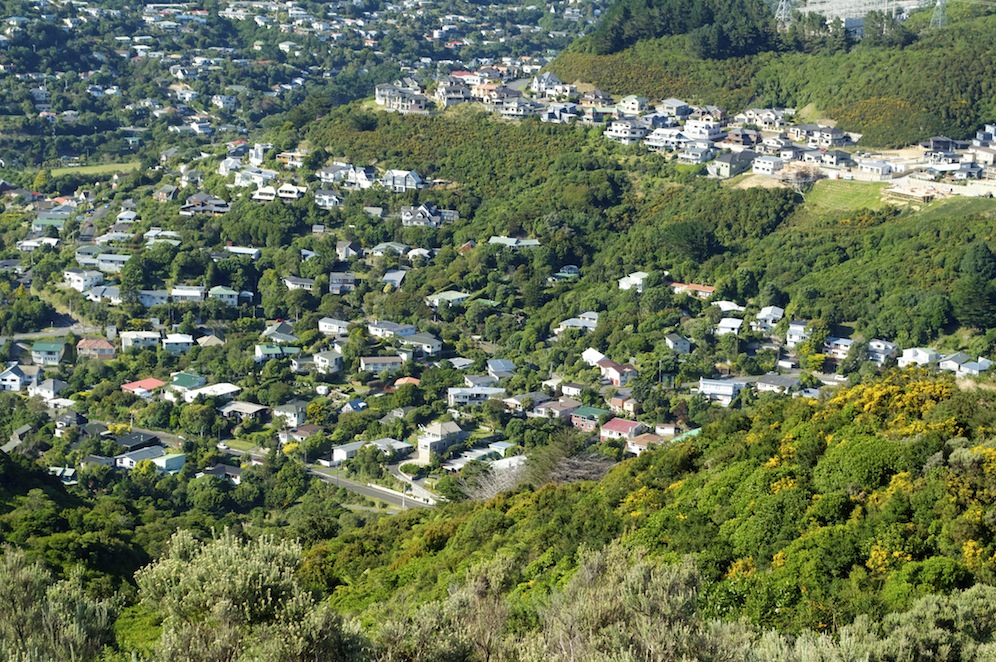
Crofton Down

Crofton Down

Whilst I was in Wellington there were a number of things I wanted to do, knowing that Angela would be more than happy being a grandmother to Eva. One morning I set out to climb the hill overlooking Crofton Downs, access to it, I thought from a track at the end of the street we were living in. It was a beautiful morning with the potential to be very warm as morning progressed into afternoon. The track I was following turned out not to be a track after a quarter of a mile, as a wall of thick bush barred any further progress. There appeared to be a side track off to the right but that again proved fruitless as I fought my way through brambles and vicious stinging nettles.
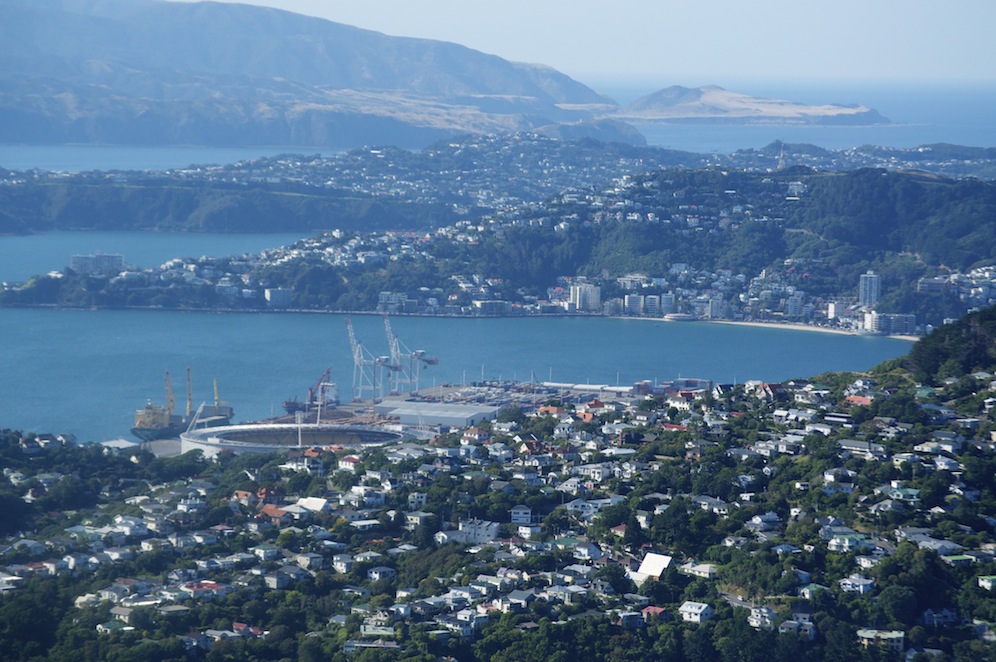
Wellington water front

Wellington water front

Facing defeat I turned back towards the houses and eventually found a track leading from a children’s playground and recreational field. The track climbed steeply through thick forest, so thick that very little light penetrated the canopy. After some time I emerged from the forest on to grassland and gorse. The gradient did not ease and each time I reached a high point it was a false summit with another beyond. This happened several times. It was hot and the exertion of climbing was making me sweat a lot. Thinking I was only going to be out for an hour or so I hadn’t bothered to carry any water, a decision I was beginning to regret. After about an hour of climbing I reached the summit where a cooling breeze helped make me feel more comfortable.

DSC_0600The view from the summit was stunning. Immediately below me was  the suburb of Crofton Down where Angela could look up and see me on the summit. The greater expanse of Wellington spread before me with the bay bathed in sunshine. Somes Island stood like a jewel in the bay. In the other direction, looking through the wind farm was the Cook Straight and South Island clearly visible. It was stunning and remarkable to think that I was probably only 6km from the centre of the city.
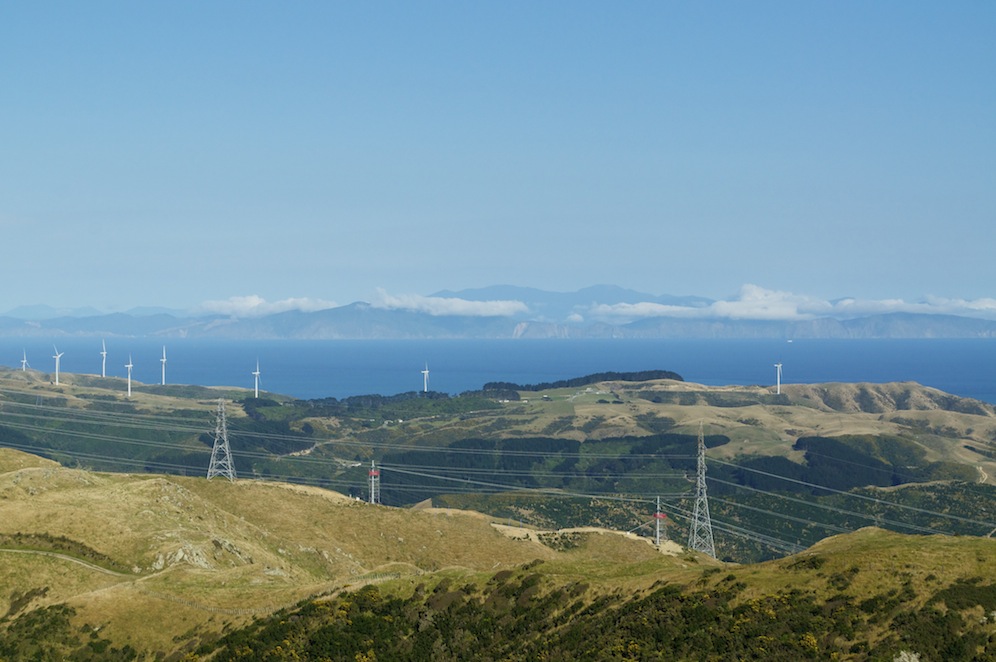
Cook Straight and South Island

Cook Straight and South Island

Choosing to come down a more straightforward way, I followed the ridge over a few more lumps to pick up a major track gradually descending to what I hoped would be a track leading down to the end of our road. All was going well and I picked up the track dropping down but it soon reached a new development and disappeared amongst the newly laid concrete. The houses off were pretty impressive and had commanding views over both the hills and the bay. A number of attempts to drop down were thwarted by new houses or thick bush blocking my way. In the end I had to take the road route out which proved to take much longer than I planned. I was ready for, and deserved, the two pints of water I gulped on my return to the house.
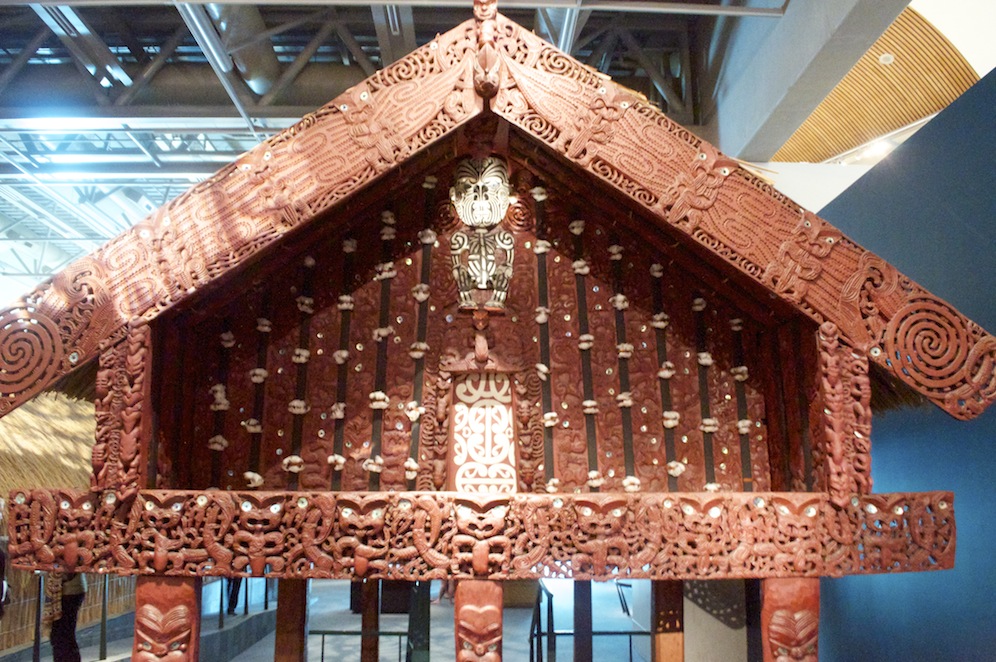
DSC_0636When we were in Wellington last time, one of the highlights for us was Te Papa Museum. Then we spent six hours in there on a wet day and thoroughly enjoyed the experience. No matter how much time you spend it is impossible to take in all of the information and retain it, so a return visit was high on our list of to-dos. It was a cloudy but warm afternoon by the time we ventured into town, using the excellent train service, the line of which follows the tree-filled Ngaio Gorge, which emerged on to the flat coastal strip by the many wharfs.
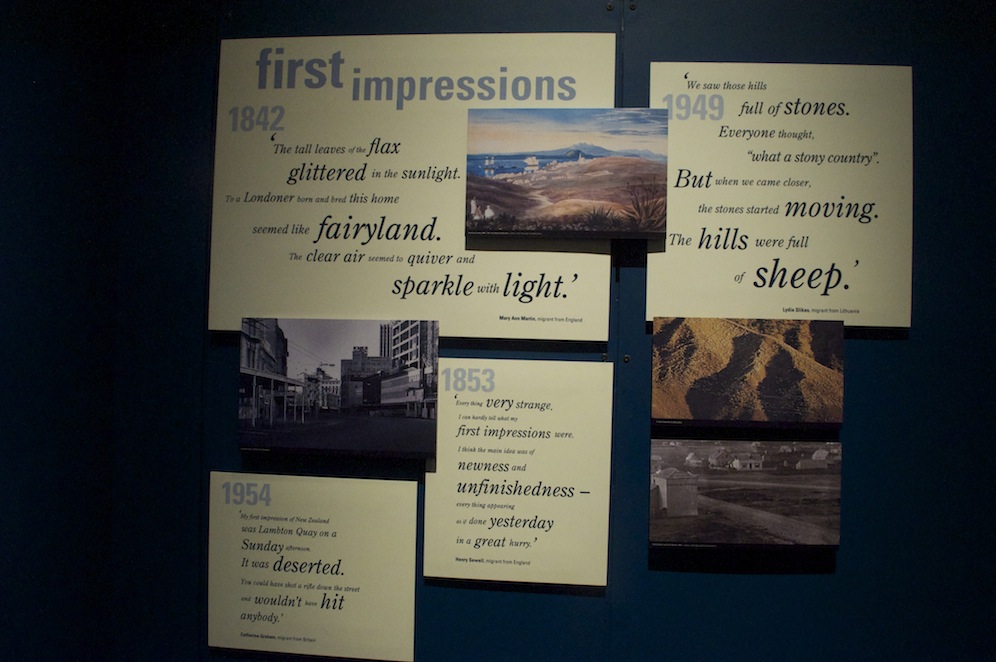
DSC_0635Te Papa covers everything that is New Zealand, from its geological formation and the on going seismic and volcanic activity. It covers in great depth the birds, animals, fish, plants and trees indigenous to New Zealand and how they have had to fight for survival against the influx of non-indigenous species. There are large sections which give the history of the Polynesian migration, the relatively recent influx of western migrants and the eventual drawing up of the treaty between the British government and the Maori chiefs at Waitangi. In addition there are art galleries and more. A lot of the exhibits are hands-on so if you like pressing buttons it is ideal. There is a lot of written information to absorb but it is presented in such a way that  you want to read it. The fact that the subject matter is interesting helps of course.

Naturally, I am interested in the natural sciences sections but I find particularly interesting the section on  human migration and how chain migration occurred relating to specific skills people had in the mid nineteenth century. Pockets of communities left the UK and migrated because of familial links and because of specific skills, whether it be agricultural, fishery, mining etc. some communities in the UK were seriously depleted as people sought a better life.

Being forced to leave the museum at 6.00pm because it was closing for the day, we set about celebrating our 19th wedding anniversary. This particular anniversary is bronze and there is a superb bronze sculpture on the waterfront of a man preparing to dive into the sea. In Te Papa they have miniature bronzes on sale but at $4200 Angela thought it a bit excessive. She gave me a postcard of it instead.

As we sipped our drinks in the Dockside Bar, the sun came out and it was very pleasant. Moving on to Foxglove we had another drink before deciding on a meal. We had picked out Crab Shack as our chosen restaurant but on discovering there was a ninety minute wait for a table we went back to the Dockside but again there was a lengthy wait. We ended up at Potofino where we had an excellent meal before catching a late train back to Crofton Down.

Two years ago I visited Matiu Somes Island but felt rushed and did not manage to see it all. This time I decided to rectify that by spending an afternoon there.
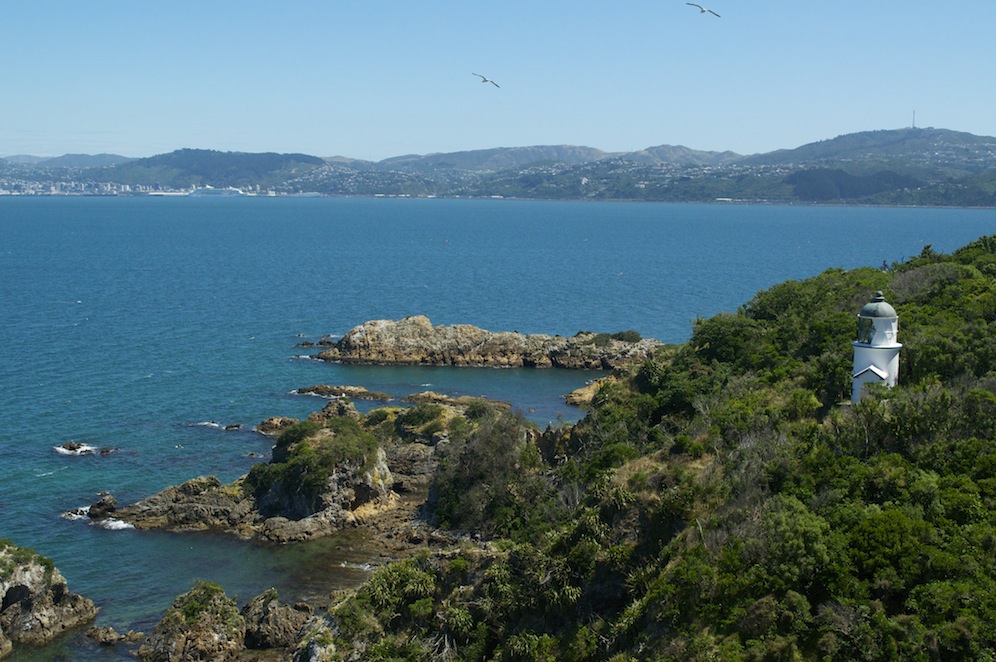
The lighthouse on Matiu Somes Island

The lighthouse on Matiu Somes Island

Catching the boat from Queen’s Wharf for the twenty minute crossing I began to survey my fellow passengers. It became apparent that I was going to be sharing my island visit with what looked like the equivalent of a social services trip. It was a multi tattooed group, some of whom did not really want to be there. Sadly I struggled to tell the difference between those who were in need of social service and those who were supervising. I began to regret my decision to venture to Somes Island on the same day. As it turned out the island was big enough to absorb us all and I hardly saw them until I caught the boat back several hours later.

Matiu Somes Island is named after the Kupe, the Maori chief who created a settlement for his daughters and by the businessman, Joseph Somes of the New Zealand Company who bought it but never actually saw it.
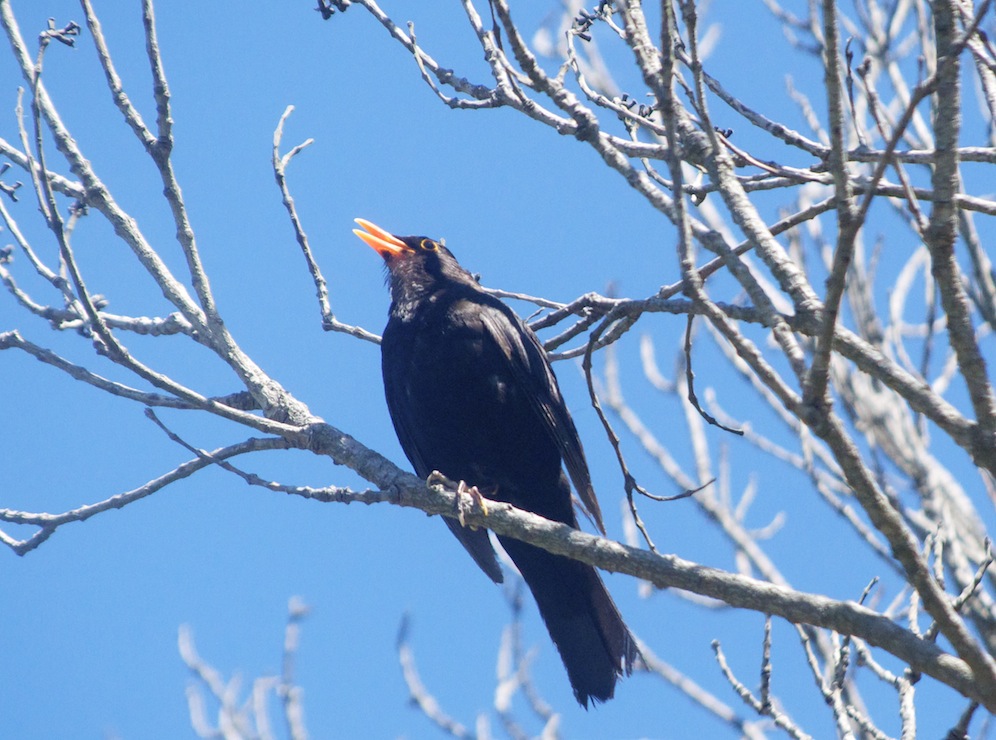
A Tui singing happily

A Tui singing happily

It has had a variety of uses throughout the period if human history. In the mid nineteenth century it was used as a human quarantine station. Many of the migrants taking the long voyage from Europe developed contagious diseases during that voyage, so, rather than let them directly on to the mainland, ships called in at the island where passengers and crew went through a fumigation process. Some, particularly the young and vulnerable, died on arrival and never made it to the mainland. A small cemetery commemorates those whose dream was never fulfilled.

During the war four gun turrets were built on the highest point to defend Wellington from air attack. Despite New Zealand being so far from the rest of the world it was potentially vulnerable. The guns were never fired as the only time enemy aircraft flew near all those manning the guns were asleep.

Also during the war it was used as a degaussing station. The Germans were increasingly using magnetic mines which would be attracted by the magnetism of ships’ hulls. The degaussing process, operated by WRENs, changed the magnetic polarity of the hulls and protected ships from such a demise.

In the 1970s the island became a place of quarantine again, but this time for animals. Farmers were wanting to introduce new breeds from around the world but these could potentially destroy the breeds already in place. Any new animals entering New Zealand had to be cleared for entry by the quarantine establishment on the island. With the development of embryonics it quickly became less important and finally closed down in the mid nineties.
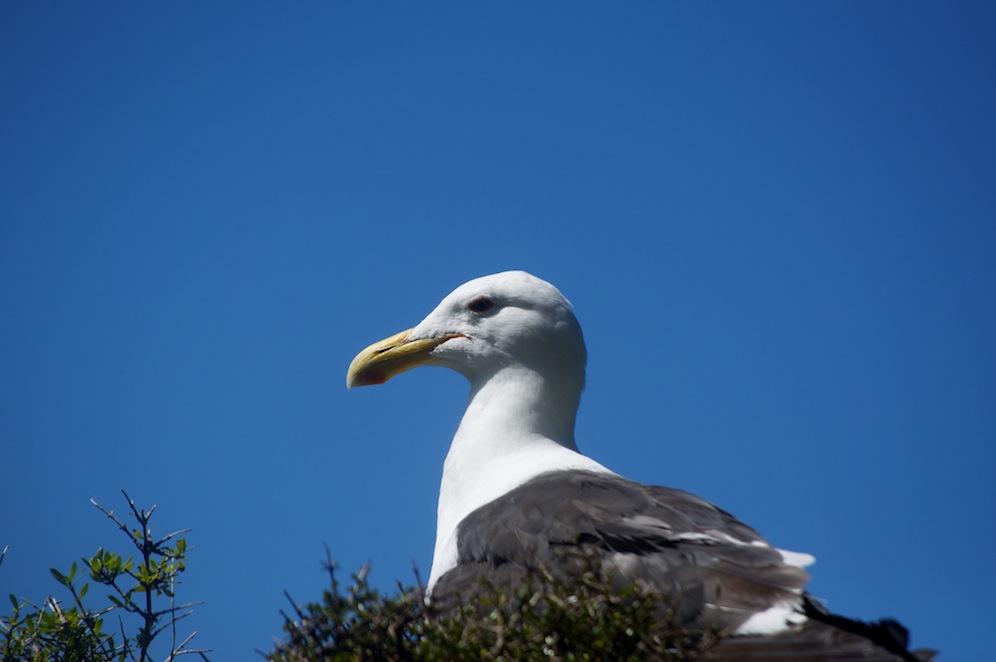
A Somes Island resident

A Somes Island resident

It is now a national reserve and a strict code of conduct in relation to preserving it as a pure New Zealand environment is maintained. There are no non indigenous creatures on the island. It took them three years to eradicate it of rats, mice and other creatures brought in by one means or another.

This time I was able to see all of the island, to enjoy its wildlife, it’s dramatic scenery and it’s peace and quiet.

Tomorrow Ben and I move on, travelling north to complete the Tongariro Crossing, but that will be another chapter.

Gisborne and Napier

DSC_0510Knowing we had a long drive ahead of us we got up early and were on the road by 8.00am. For the first hour the road twisted, turned, climbed and dropped to such an extent that we seemed to cover very little distance and I began to fear that the journey was going to be tediously long. Luckily, once we had reached Waihi the road became straighter and progress was more promising. We wended our way around the coast to Tauranga, which brought us to the huge Bay of Plenty following the lengthy north coast renowned for long expansive beaches. Inland, Rotorua was not too far away and volcanic cones could be seen to the south. Out in the bay more volcanic islands rose steeply out of the sea. When we reached Opitiki we headed inland through the Waineka Gorge, a beautiful tree filled cleft cut into the hills. Having climbed to almost 1000m we began our descent towards Gisborne. The countryside changed from forested mountains to agricultural grassland, and then, nearer the coast vineyards and fruit orchards. We easily found our motel on the outskirts of town. It was a more traditionally built set of low buildings, which, while comfortable and fully equipped was a little dated and in need of a refurbishment. It did have a pool, which would prove useful later in the day. Driving into the town centre we looked for something by way of a late lunch. Town did not seem to have much to offer but we did find a nice waterside restaurant and bar by the port that could only do us a plate of potato wedges lathered with cheese and bacon. It was now mid afternoon and I was happy to eat anything by this stage.

Surf School

Surf School

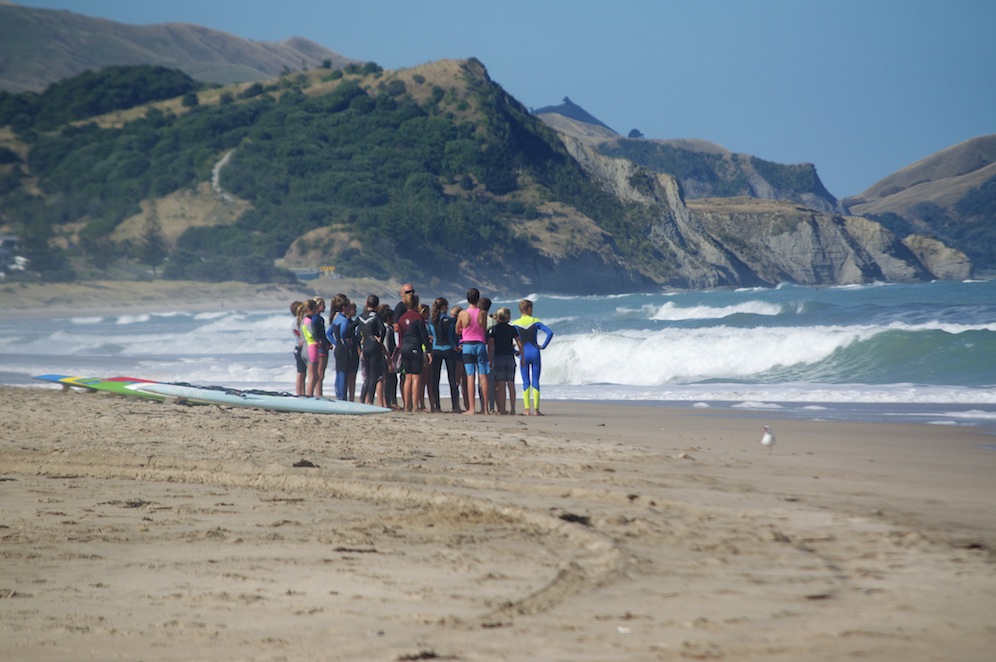
Weighed down by potato wedges we decided to explore the beaches. We had already been told that the beech closest to town was not as good as Wainui, a short distance to the north. Being almost the most easterly point of New Zealand this beach was exposed to the full force of the Pacific Ocean. Today the weather was calm, yet still decent waves rolled in, perfectly suitable for an after school surfing lesson for twenty teenagers. They used so much energy in the hour of their lesson it is unlikely that they would have any energy to do their homework in the evening. I was tired just watching them. It was a lovely beach. Before heading back to our motel for a swim we climbed up to the view point at Titirangi Park, overlooking the harbour and the town. Lots of people were running up and down the various routes in the park, some pushing babies in buggies. It was really quite steep and some sections were long flights of steps. Our reason for going to the top was not to get fit but as I said before, to get an impression of Gisborne.

Gisborne

Gisborne

In 1769, Captain Cook first set foot on New Zealand soil in Gisborne. He needed supplies for his ship, the Endeavour, and seeing a Moari settlement there thought it a good place to land. However, he mistook the greeting he was given (presumably a Haka) and interpreted it as a threat. He left quickly without replenishing his supplies and named the bay the Bay of Poverty.  Today, Gisborne has a population of 34,000. The port, which was immediately below us seems to be a major exit for the logging industry, with huge stock piles of newly felled tree trunks. On the other side of the river flowing into the harbour is the town. It is very much a single storey town with hardly a building having a second floor. The town lacks character and there are no buildings worthy of comment. It is not really a tourist town. However, its modern claim to fame is that it is the first town to see the sun rise in the morning and, therefore, the first town to see in the new year. Despite it being February there were still adverts in town, either left over from last new year or prematurely advertising the next, where over one hundred acts perform on five stages.

The foot of Titirangi Park is surrounded by an estate made up of mainly Moari people, living in quite ordinary houses. However, the Whangara Marae, or Moari meeting house is one of the finest in New Zealand.

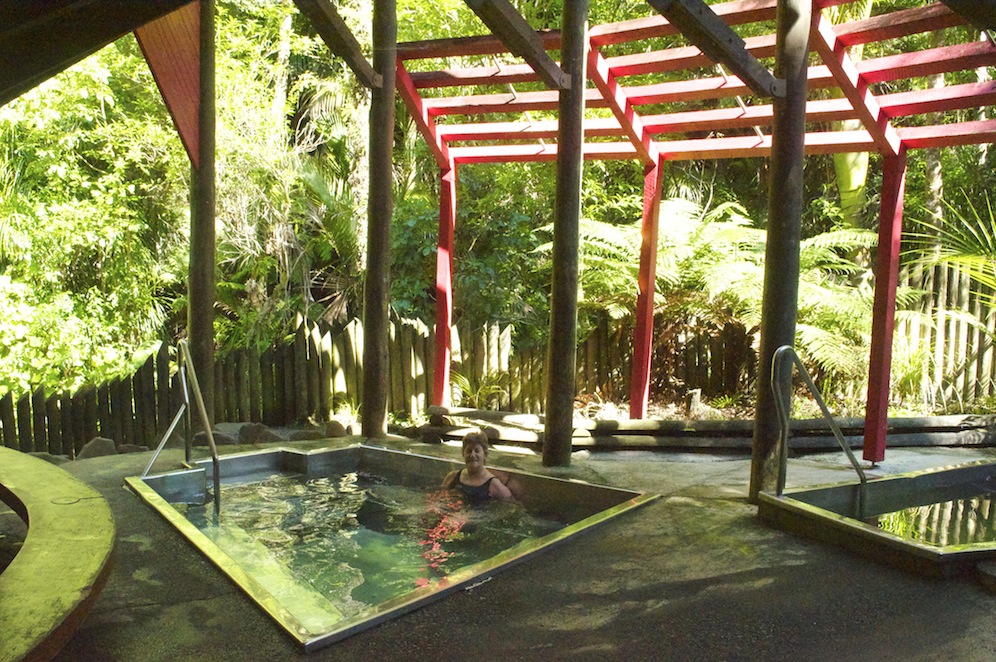
The following morning we left quite early for the relatively short drive to Napier, the Art Deco capital of the world. En route we came across the Merere Hot Springs, so we made a spur of the moment decision to stop and take a look. It was five to ten and not yet open, which gave us five minutes to read the information boards and giggle at the spelling and punctuation mistakes. We were the first visitors of the day so we booked for a hot pool session. Walking up through the forest was fabulous with such variety of trees and the sunlight shafting through the foliage. DSC_0534There were three pools, a very hot one, a medium hot and a cold plunge pool. I tried the very hot one one first but it was just too hot so I acclimatised myself in the medium pool. After a while I was able to cope with the hot pool. I was soon joined by a Maori woman while her husband joined Angela in the medium pool. My pool partner could hold a conversation and the longer I stayed in the hot pool the more peculiar I felt but I did not wish to appear rude by leaping out mid conversation. Eventually there was an appropriate pause which allowed me to climb out and plunge into the cold pool.

Visiting the obligatory shop, run by a retired man, we tried to have a conversation with him but it proved very difficult to understand him as only about every third word was coherent. I wonder if he was the one who wrote the information boards?

Continuing our drive I could feel my feet burning from the scalding effect of the water.
Arriving in Napier in good time we spent the afternoon in the newly built museum learning about the 1931 earthquake that destroyed the town and killed 256 people. The most graphic detail came from a film of survivors stories.

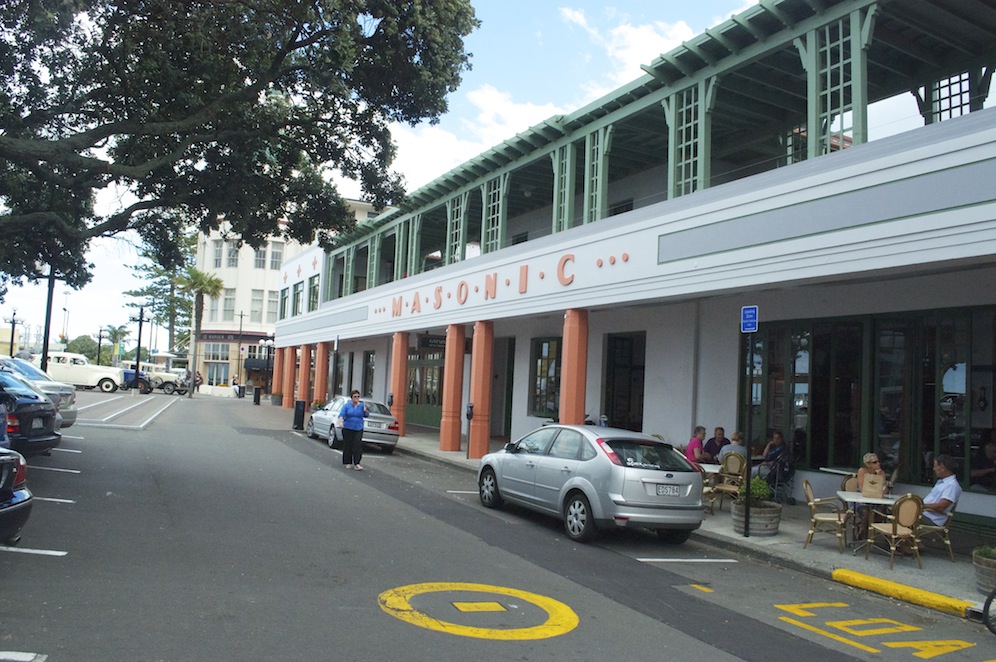
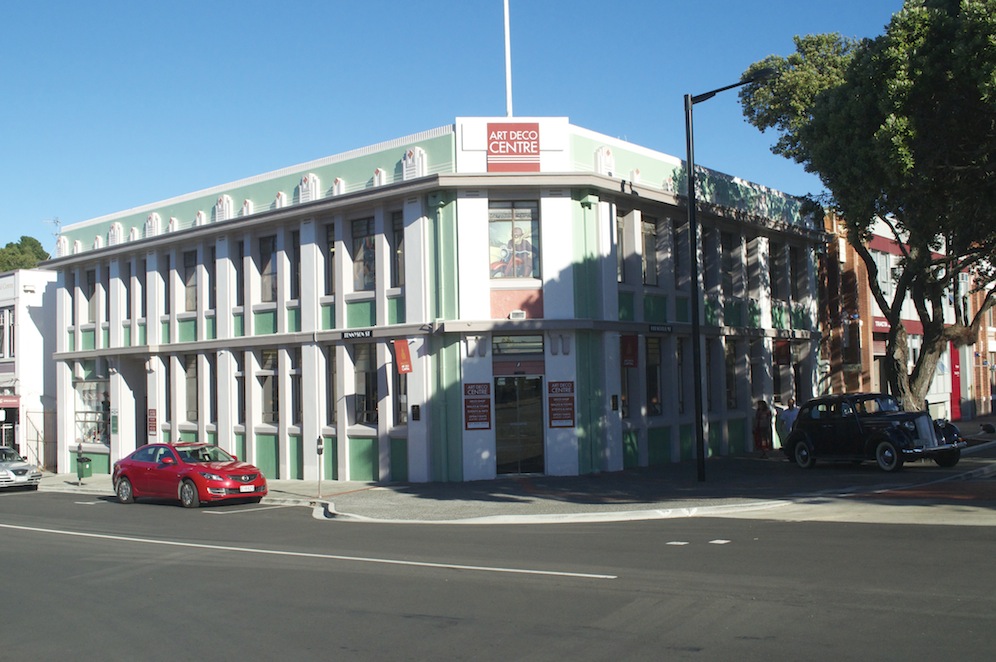
DSC_0549I have never really been a fan of Art Deco, largely, I think, because it is often seen out of context. Here, in Napier, everything is Art Deco and it looks very attractive. We were staying in the Masonic Art Deco Hotel and as the name implies is was all as it should be. Outside cars, beautifully restored and maintained, from the 1930s were parked and available for hire, with a driver, for the Art Deco tour. Shopkeepers, in shops which specialised in the style were dressed appropriately. There is a certain decadence, even frivolity, about the style and we felt it as we sat on the first floor terrace of the hotel, overlooking the street below, drinking wine. Remarkably this was our own wine. It must be one of the few hotels in the world that allows you to consume your own beverages without having to purchase from the hotel in the first place.

DSC_0562Having eaten we took an evening stroll through the meticulously manicured gardens on the sea front, with trees decked with coloured lights casting their glow over the flower beds beneath. Napier proved to be everything that Gisborne had not been. The buildings were interesting, it seemed to welcome tourists and was more geared up for them. A cruise ship was in harbour, so clearly they are used to mass influxes of people. It was a town that was cared for and had been lovingly restored from the disaster of 1931. I liked it. It was quirky. Sadly, the only thing that let Napier down was the quality of the beach, it was a grey shingle, such a contrast to the many golden and white sandy beaches we had encountered so far.

The following morning we drove the 300 plus kilometres to Wellington for some family time.

New Zealand – Bay of Islands and Coromandel

The flight from Singapore proved enjoyable in that I was able to watch some films, the most memorable being Captain Phillips. The eight overnight hours in Brisbane airport trying to sleep but failing, meant that by the time we reached Auckland I was beginning to feel quite jaded. Having successfully passed through customs without being told off this time and not wishing to delay our journey north I went straight to the Avis desk with whom Ben had pre-booked a car for us. By the time we were upgraded and all the other paperwork was done the best part of an hour had passed before we could finally leave the airport. Our first obstacle was getting through Auckland. Somewhere we went wrong and found ourselves heading back towards the airport. The second attempt proved much more successful and we eventually found ourselves heading north towards Whangerei in deteriorating weather. The weather in Northland has some of the best in New Zealand. This summer has been particularly good with hardly a drop of rain for weeks. So, why is it that when we arrive the weather changes from the norm to wet and windy?
After nearly three hours on the road we reached Settlers Hotel. The girl in reception was very friendly and smiley. As I unloaded the car in the rain as the light faded a man stepped out of the adjacent room holding a baby. He asked if I needed a hand. It struck me as quite a strange offer as he seemed to have his hands full so I turned him down. He laughed and I realised it was Ben. He, Kelly and Eva had come up from Wellington to surprise us. Angela was appropriately moved. Ben had had some filming to do for Whaitangi Day, the day commemorating the signing of the treaty between the Maori nation and the British. Having finished he arranged for him and his family to have the room next to us so that they could surprise us. No wonder the girl on reception had such a big smile. It was a lovely surprise and ensured that we did not fall asleep too early.

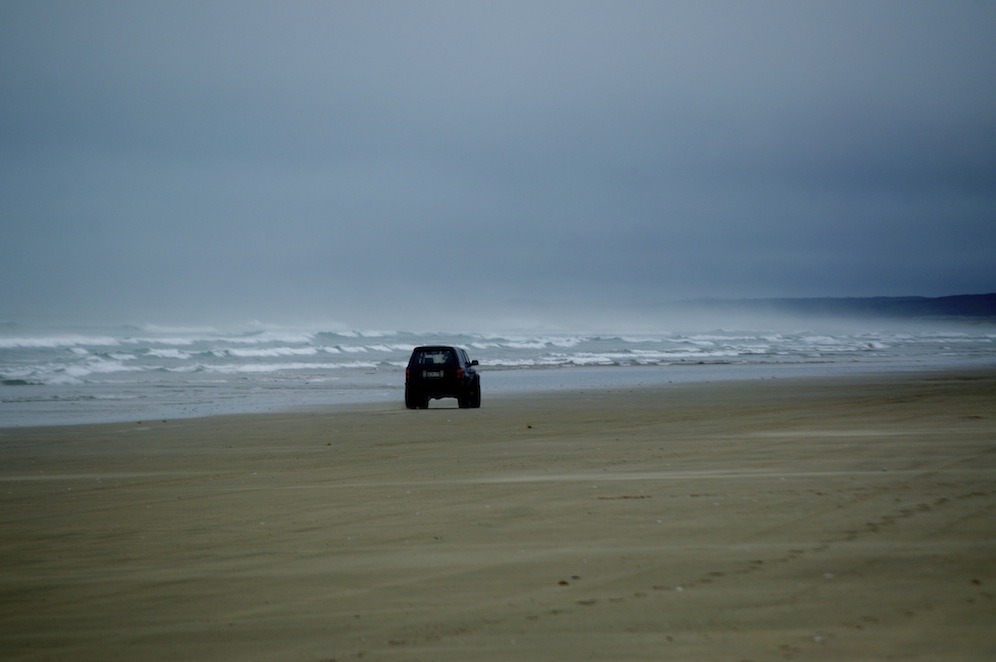
Ninety Mile Beach

Ninety Mile Beach

After breakfast the following morning Ben headed south back to Wellington while Angela and I headed north. Our final destination was only an hour or so further north but as the weather was still foul we decided to head further north and have a look at Ninety Mile Beach, a magnificent stretch of firm sand. It is possible to take your car on to the beach and drive the full length of it. Sadly, there is a clause in our car hire agreement that prevents us from taking the car on to the beach. I was very tempted but the voice of reason was sitting beside me.

Instead, we donned our waterproofs and set out to walk just a short section. As we did so occasional cars sped past us. We came across four young men fishing from the beach. They had a fantastic system. They sent out a line attached to a torpedo. When fully extended the line was 2km long. Along its length were many baited hooks. It took about half an hour for the line to be fully extended. Then it was left in the water for another half hour before it was wound in by hand. Many of the hooks had fish hanging from them, Snapper and Kahawai. It was great to watch them. They were not commercial fishermen but did it for fun for family and friends. They offered us some but we sadly declined.

It was a fabulous walk, despite the weather. The strong wind created a mist of spray giving a mysterious view of the beach as it disappeared beyond the horizon.
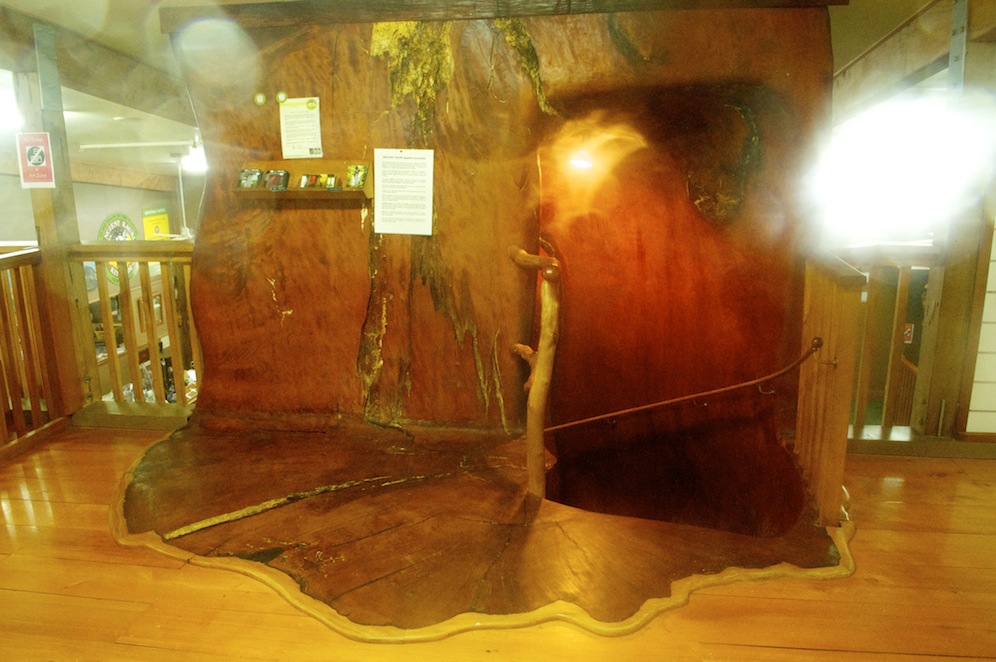
A staircase made from an ancient Kauri tree

A staircase made from an ancient Kauri tree

On the way back south we visited the workshop and showroom of the ancient Kauri tree, the oldest workable wood in the world. Once this area of Northland was covered by massive Kauri trees. Today Kauri trees are protected but those they work with were consumed by swamps and preserved for 45,000 years. Occasionally a farmer may come across an ancient tree, which can then be dried very slowly before the craftsmen are able to work on them. These trees are huge; one in the showroom has a staircase carved through the trunk gaining access to the first floor. Large items of furniture are made, which cost a fortune. Even much smaller items are costly bit the feel of the finished product is a pleasure to touch. It is an incredibly heavy wood so, when buying, we had to think about weight. We did buy a small item from the seconds display, a baguette holder.

We finally reached Paihia, our base for the next two nights at about 7.00pm. The Dolphin Motel situated about 200m inland is well equipped and Paul, our host who’s family heralds from Pershore, was very friendly and welcoming.

This area of Northland played an important part in the early days of New Zealand. Captain Cook came into the Bay of Islands to shelter from a storm and made contact with some of the Maori communities on the islands. The first settlers came to this area and Russell, a small town across from Paihia was the original capital of New Zealand. The first missionaries came to these islands. One of the first was Marsden who on seeing the area where Paihia is said to his Maori friends the it was “pai here”, pai being the Moari for “good”, hence Paihia.

Although it rained most of the night the morning dawned dry with the potential to brighten up. We were booked on the Bay of Islands Cream Tour, named from the time in the early 1900s when a boat used to travel from island to island collecting churns of cream from the farmers and taking them to the mainland.

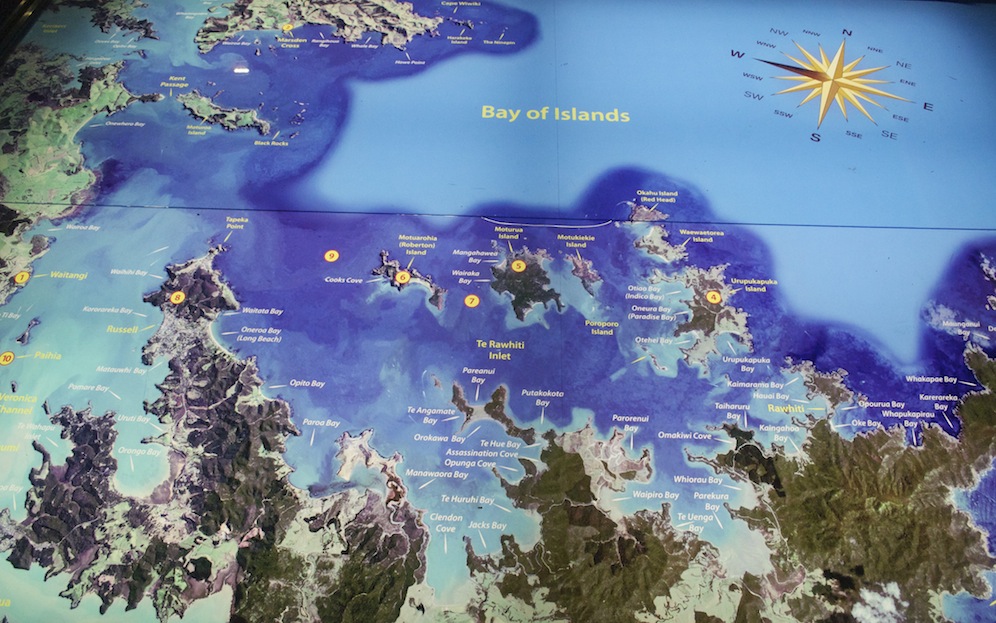
Map of the Bay of Islands

Map of the Bay of Islands

Setting off at 9.30 we had fourteen specific points of interest to visit and the hope of seeing dolphins, and maybe swimming with them. I’m not going to give you detail of the fourteen points but needless to say there were quite a lot of historical references to Captain Cook and the first missionary settlers. As interesting as they were it is impossible to remember the detail and therefore I think it best to avoid.

The Bay of Islands National Park Authority cares for all the islands, although some islands, or parts of islands, are in private ownership. A consortium of twenty-two different families owns one such island, and ownership remains with those families forever. However, if a family wishes to relinquish its ownership it has to remain with the consortium. These properties are fabulous! Who would want to relinquish living in one of them, even if it is just a holiday home?

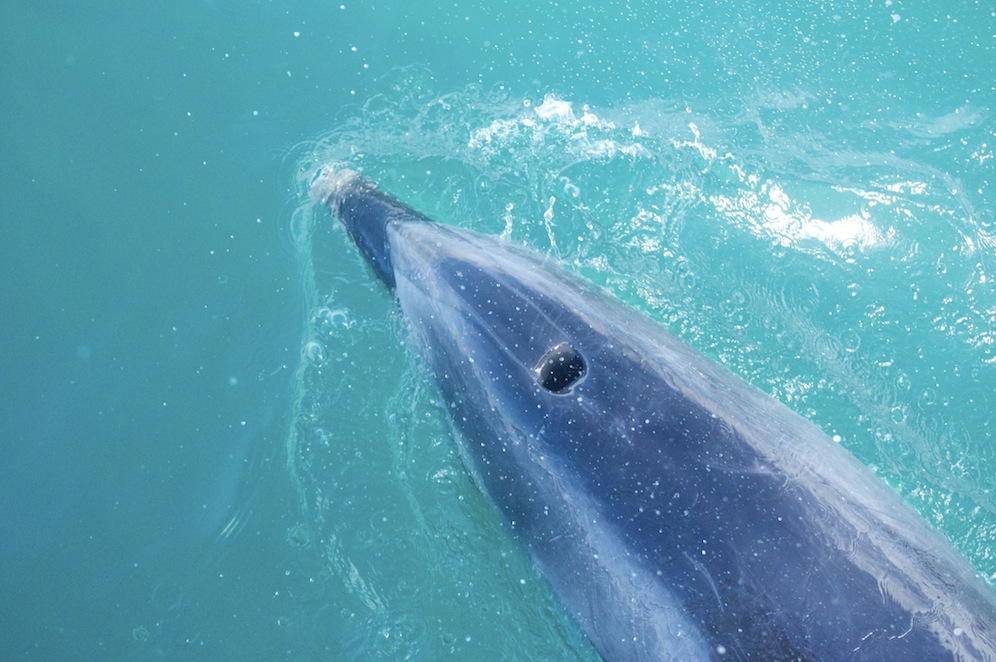
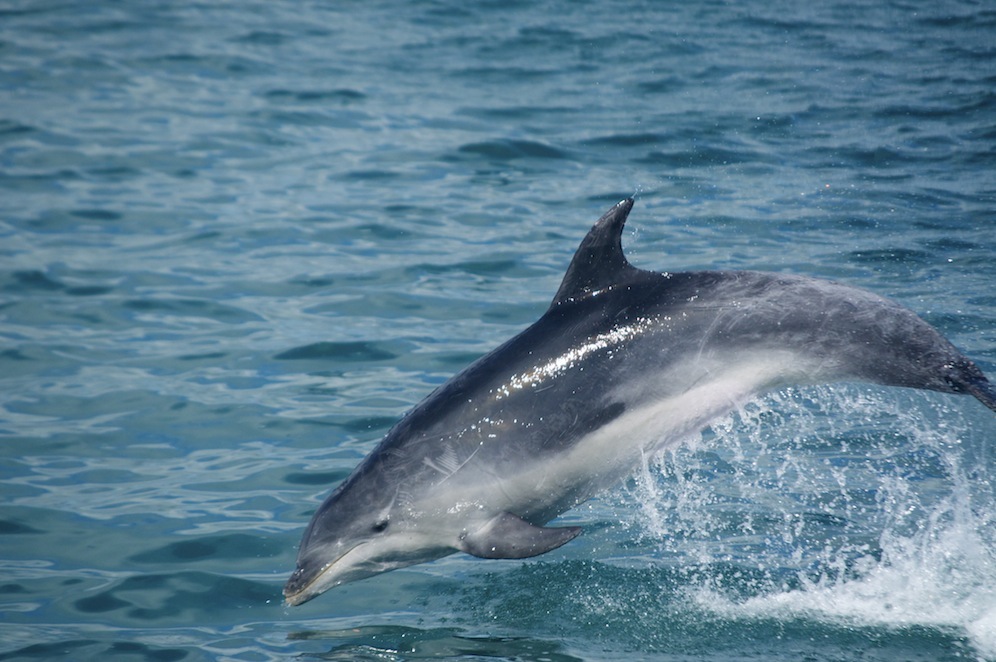
DSC_0243The highlight of the day has to be an encounter with a pod of Bottle Nosed Dolphins. They were quite numerous and clearly enjoyed interaction with humans. They swam alongside our boat, under the bow, and even scratched themselves on the rudder. Often they would swim on their sides so that they could make eye contact with us. There was at least one baby (only two months old), which meant we would not be able to swim with them. Whilst swimming with dolphins is a pleasure, it is, perhaps, even more pleasurable to watch them from close quarters. From the prow of the boat we were able to see much more and witness their speed and agility. They are the most beautiful of creatures.

DSC_0260Again, we were given lots of information about the life style of dolphins, far too many to relate here. However, it is interesting to note that in their natural environment they can live for up to fifty years. In captivity that can be reduced to as few as eight years. The bond between mother and baby is incredibly strong, hence us not being able to swim with them and interfere with that bond. Dolphins are very emotional creatures and if a calf should die, the mother will carry with her until it disintegrates rather than allowing a predator make use of it. Apparently, dolphins are like humans and have sex for pleasure as well as for procreation.

This beach struck me as being particularly attractive

This beach struck me as being particularly attractive

All around us there was activity on the water. Being the weekend there were lots of weekend fishers, many seeming to have lots of success. They attracted sea birds, wishing to pick up any bits that may be offered or come their way. Often the fishermen would read the activity of the birds to gain knowledge of what lay beneath the surface. Gannets dive bombed at great speed and came up with their catches hanging from their beaks or bulging their throats. There was always so much to see.

DSC_0301Our only landing of the day was on an the island of Urupukapuka where we were not only having lunch but an opportunity for a swim and to climb a nearby hill affording fantastic views of the whole of the Bay of Islands. It is interesting how people react to such an opportunity. Many had spent the last three and a half hours sitting on a boat and now spent the next hour and twenty minutes sitting on the beach or on the grass behind. Some people are unbelievably lazy. How can they not want to explore? They are probably never going to visit this place again, so why not make the most of the opportunity.

Angela and I delayed lunching so that we could go snorkeling. As we got off the boat we noticed a huge shoal of Snapper swimming around the stern of the boat. Loaded with my Gopro I swam to the stern of the boat and spent a magical time with the Snapper, who were not afraid of me at all. Wait until I go fishing!!

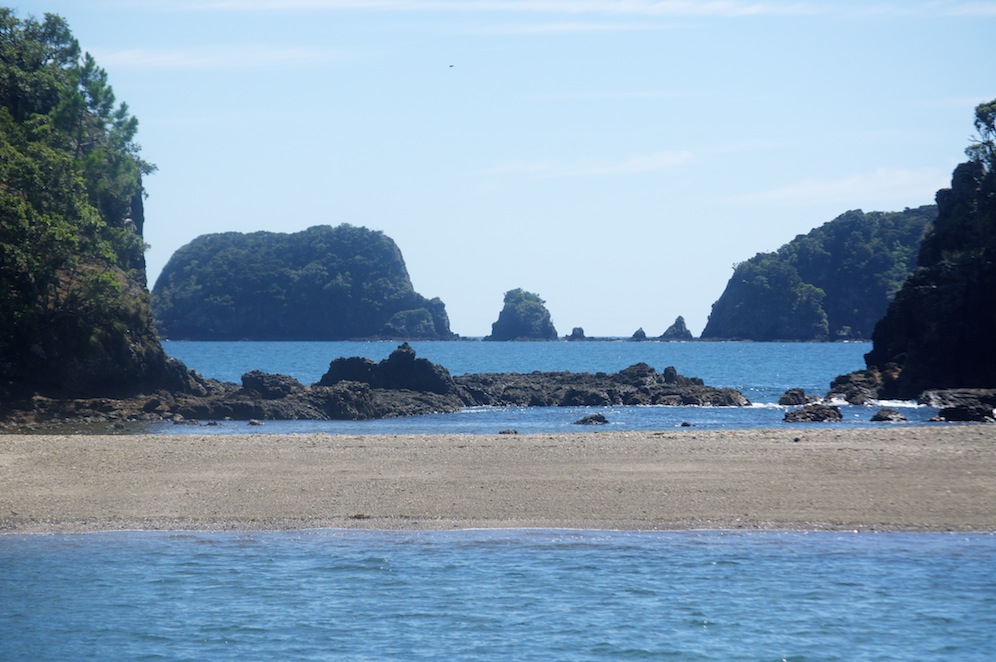
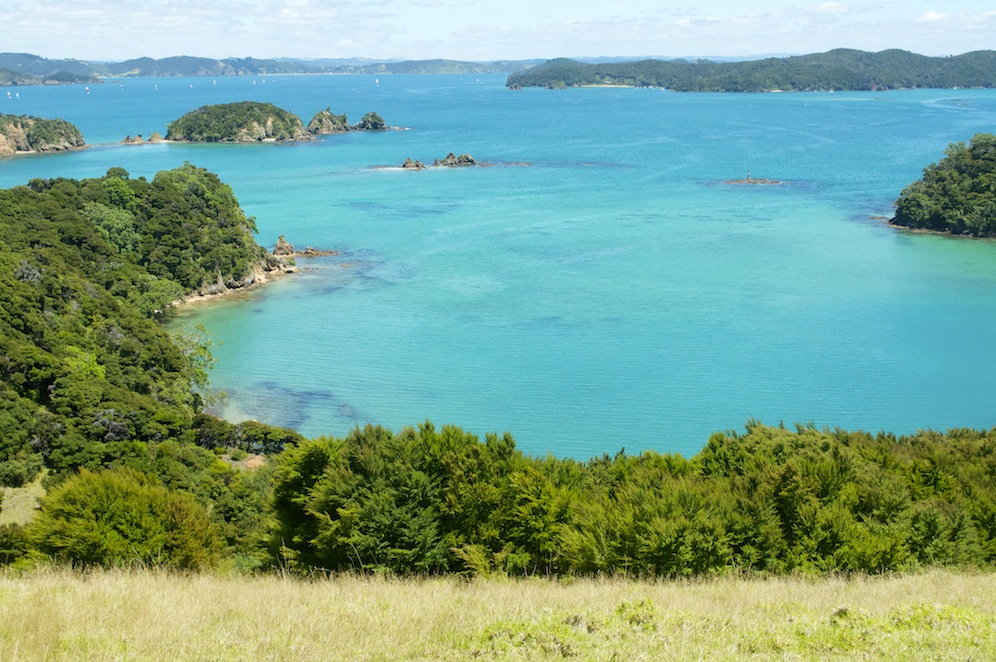
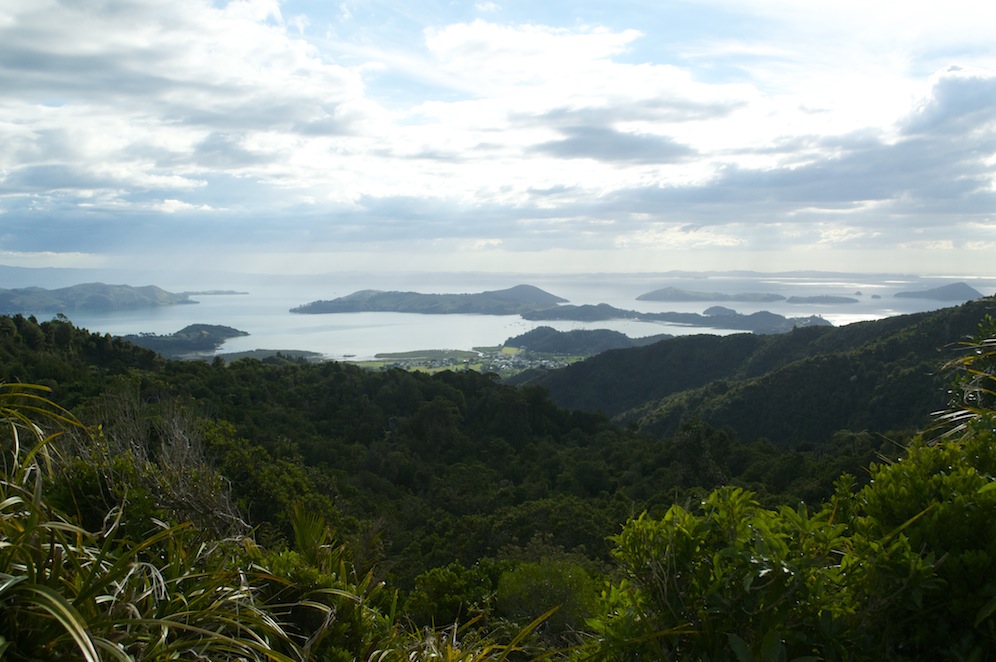
Having eaten we then climbed the nearby hill on the headland. It was a bit steep and the sun beating down meant that it was also quite hot. The view was stunning. It took several shots to get a full 360˚. This has to be one of the most beautiful places in the world and the day was perfect. Wow!! By the time we descended it was time to climb aboard and head out to the Hole in the Rock.

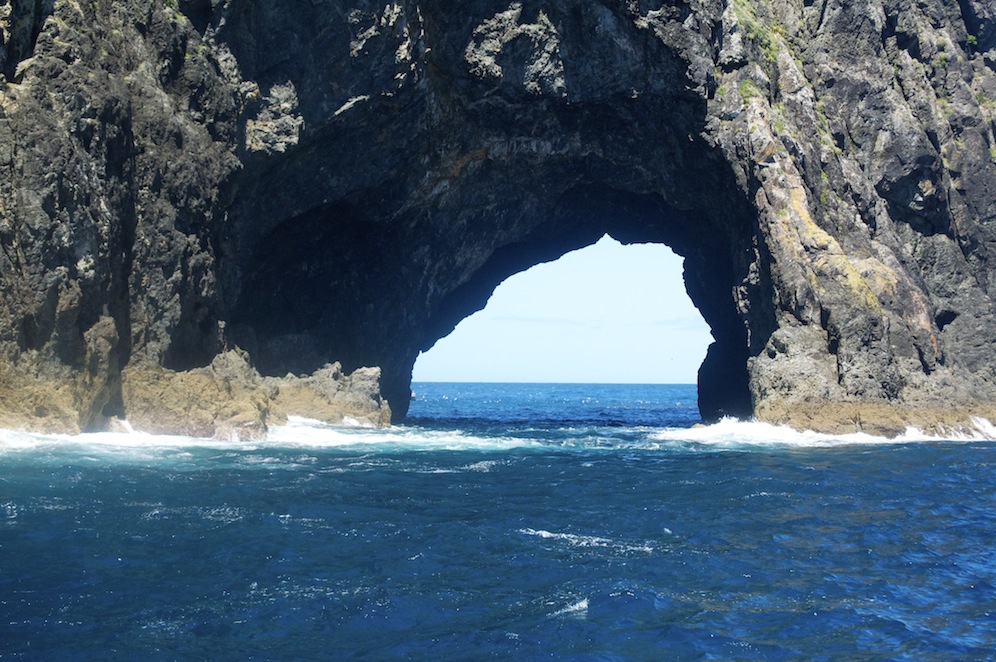
DSC_0314The Hole is the Rock is on the outer limits of the Bay of Islands and necessitates us crossing an open stretch of water exposed to the Pacific Ocean. So far we had been in sheltered waters. As the boat sped across the sea we bounced on the ever-growing swell towards a lump of rock. As we got near we could see that there was a huge arch. Our captain lined the boat up and took us through. The previous three days the weather had been poor and the swell too great to risk such a maneuver so we were privileged.

On the other side of the hole we were given a spectacle that amazed the crew as much as us. Thousands and thousands of fish feeding on krill forced up from the deep by ocean currents rising to meet the continental shelf agitated the surface of the sea. Sitting calmly on the water were gulls also enjoying the krill. Every-so-often there would be frantic movement as the fish were harassed from below by a predator, probably a King Fish. It was incredible to watch, quite easy to film but impossible to photograph.

By now we had visited all fourteen sights so it was time to head back. Reports reached us that there were no other pods of dolphin in the bay so the ‘swimming with dolphins’ option was not going to be available. Disappointing but not the end of the world.

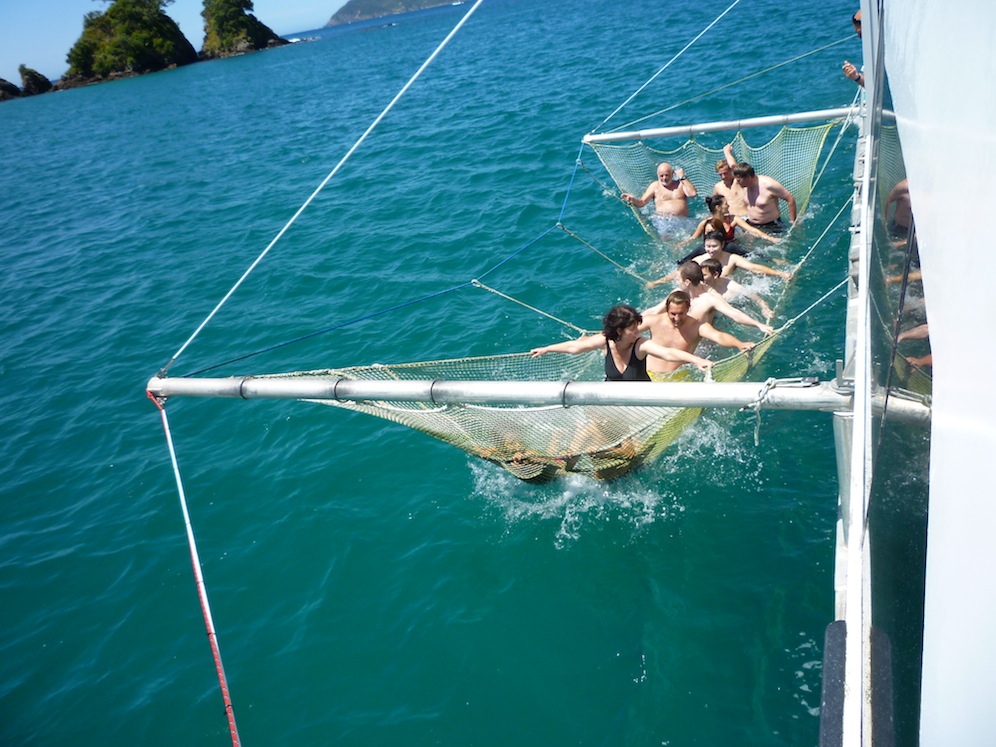
Great fun! I am on the left at the back of the net.

Great fun! I am on the left at the back of the net. Photo curtesy of David Fulcher

There was still one more opportunity to be had. Bringing the boat to a standstill, the crew put a net out to the side of the boat between two booms. It looked like a very large hammock. Those that wished to could jump in and cling on. Not wishing to forgo the opportunity I jumped in and took up position by the rear boom. It proved not to be the best place as all the wash came through me – literally. It was great fun and hopefully a fellow passenger will send me some pictures as Angela was so busy watching she forgot. I now know what a fish feels like to be caught up in a net!

It had been a great day and the skin tingled from the sun and fresh sea air.

The next day, Sunday, we had a long journey through southern Northland, Auckland and round on to the Coromandel Peninsular. The maximum speed limit in New Zealand is 100kph but the roads often don’t allow that speed to be achieved. State Highways, with the exception of either side of Auckland are single carriageways in each direction. The roads tend to twist, turn, climb and descend, so what would be a very straightforward journey in the UK turns into something of an epic. We were covering approximately 400km. The pleasurable thing about journeys here though is the lack of traffic. Except on a Sunday at the end of a bank holiday weekend when everybody is returning to Auckland. We were stuck in a very slow moving traffic jam for an hour north of Warkworth. I though it must be roadwork’s or an accident but no, it was a set of traffic lights causing a 10km queue!

Once through Auckland, via the motorway this time, most of the traffic was coming towards us and the roads in our direction were pretty clear.

DSC_0357Once on the Coromandel Peninsular the road hugged the coastline, twisting and turning, with nothing between us and the sea should we decide to leave the road. The scenery was stunning, particularly so when we had to cut across to the east coast, rising steeply through the mountains to drop just as steeply down the other side.

We eventually arrived at Whitianga just before 7.00pm, having left Paihia at 9.45 in the morning. The motel was excellent, the more so because we had been upgraded to having a full suite with a sea view.

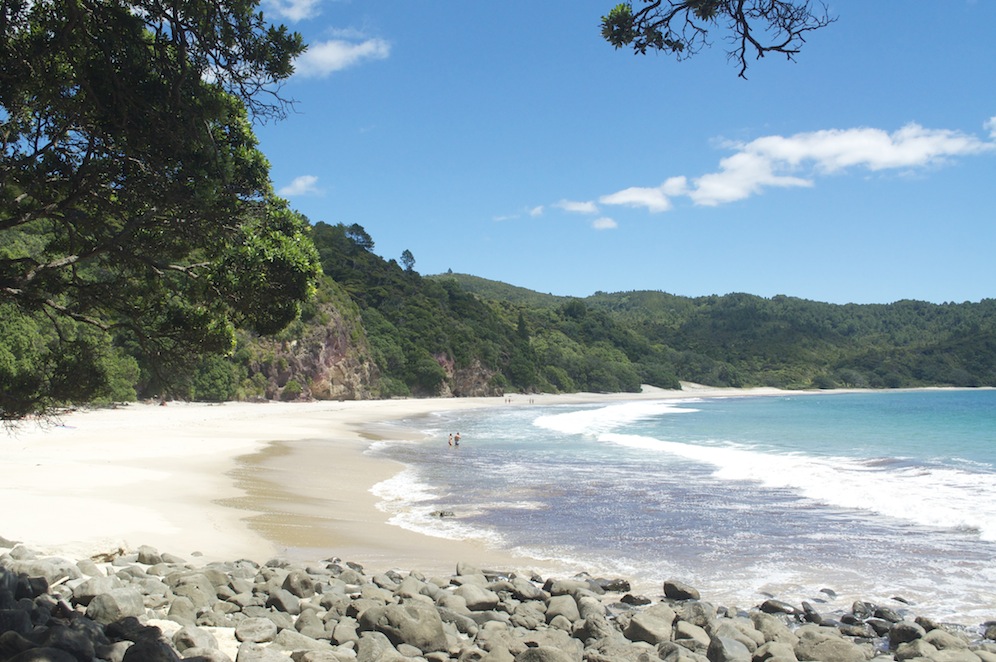
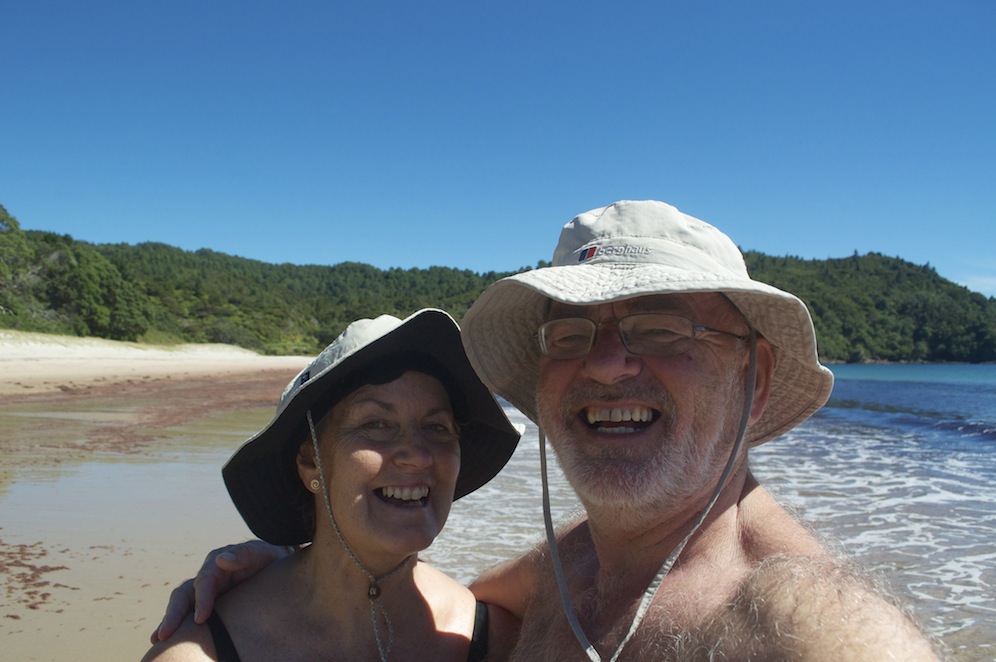
DSC_0395The following morning we decided to visit New Chums Beach. In 2006, the Sunday Observer voted New Chums Beach as one of the top twenty beaches in the world. I guess one of the positives for this beach is that it is only accessible by taking a forty minute walk from the nearest road. A thirty minute drive took us to Whangapoua where we left the car and started the walk, firstly across Whangapoua Beach, itself beautiful, over boulders, through the forest, over a small rise and finally down to New Chums Beach. It is idyllic. Azure blue sea breaking on to almost white sand with a vivid green backdrop of forested hills and hardly another soul in sight.

DSC_0377

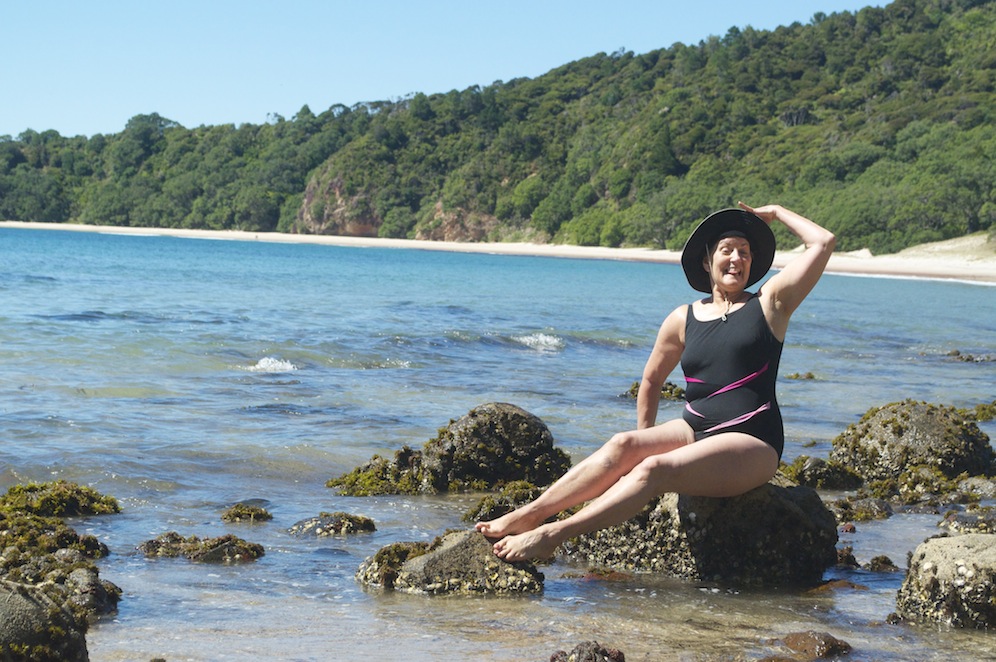
A swim, a walk along the length of the beach, photographs of oyster catchers and sandlins, a laze in the sun, another swim. Life is so hard at times I really don’t know how I cope. At the far end of the beach I met a dazzling babe, an ex star of Health and Efficiency who posed provocatively for me on some rocks at the water’s edge!!

Having been told that access can be difficult either side of high tide we chose to return to Whangapoua and head back to Whitianga and have a walk in the afternoon. We had planned to walk the Coromandel Walkway in the afternoon but it would have meant spending rather more time in the car than we both desired. It also became apparent that the roads we needed to travel on were gravel roads and our car hire insurance forbade us to travel on such roads.

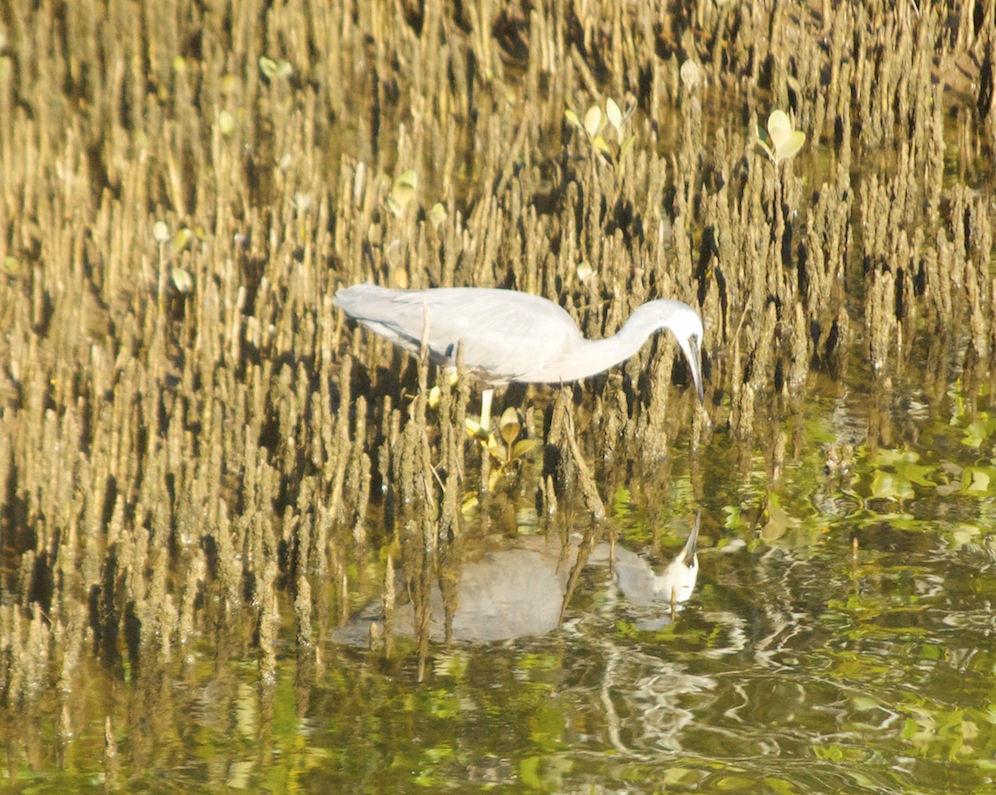
A Blue Heron providing some ornithological interest

A Blue Heron providing some ornithological interest

Taking the ferry across the estuary at Whitianga we followed the Maramarototara track which climbed steeply through the trees to the top of the hill. It was hot, I’d had a couple of beers, and it was hard work. The view from the top was excellent but the disappointment was that we had to drop just as far down to the sea. If we had taken the road we would have got there a lot quicker and without as much effort. We were aiming for Cook’s Beach, another of those coves where Captain Cook anchored his ship. It was a pleasant beach but after the beaches we had encountered in the morning and at the Bay of Islands it was a bit of a disappointment.

Following the road this time we returned to the ferry as quickly as we could and returned to Whitianga. As we landed a launch came in and deposited its half dozen passengers. It takes people out to Cathedral Cove, to a marine reserve for snorkeling, and various other bays on a two and a half hour trip. We had plans to go the Cathedral Cove on route to Whangamata for our next night’s accommodation. However, it was not a long journey and could easily be achieved in a couple of hours, so we decided to spend the morning with Ken and his boat exploring these treats from the sea.

The following morning we met Ken, who had managed to acquire three more passengers and, at the last minute, a non English speaking Chinese man who sat with us and kept giving us the thumbs up.

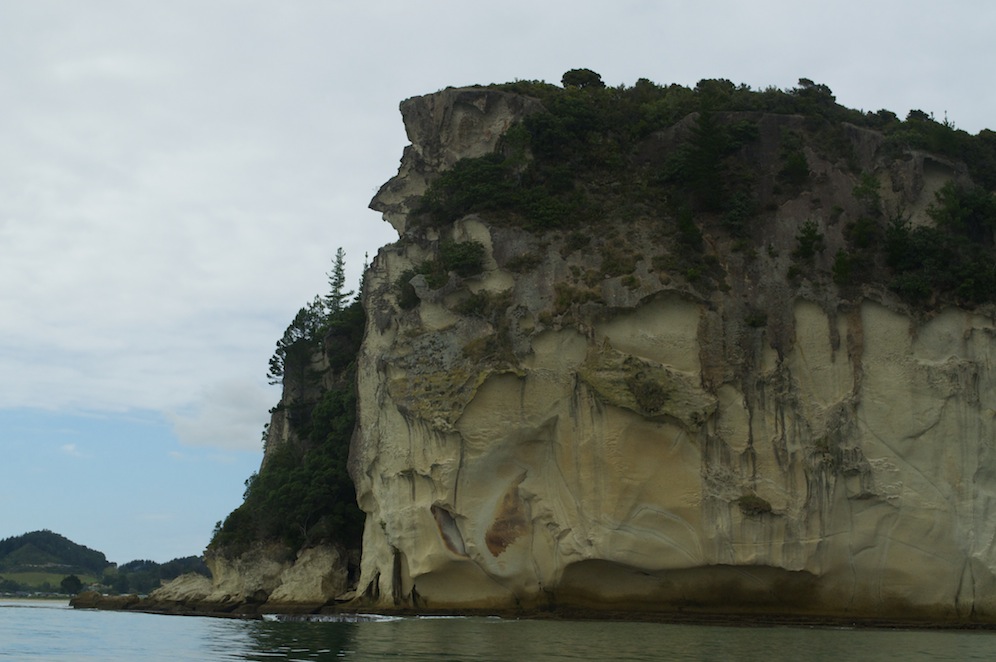
Shakespeare?

Shakespeare?

On the southern end of Mercury bay is Shakespeare Point. I was intrigued how Shakespeare had managed to travel so far. The story goes that when Captain Cook brought his Endeavour into Mercury Bay in 1769 the shape of the cliff reminded him of Shakespeare. A face can easily be seen in profile but as to whether it looks like Shakespeare I’ll leave you to decide.

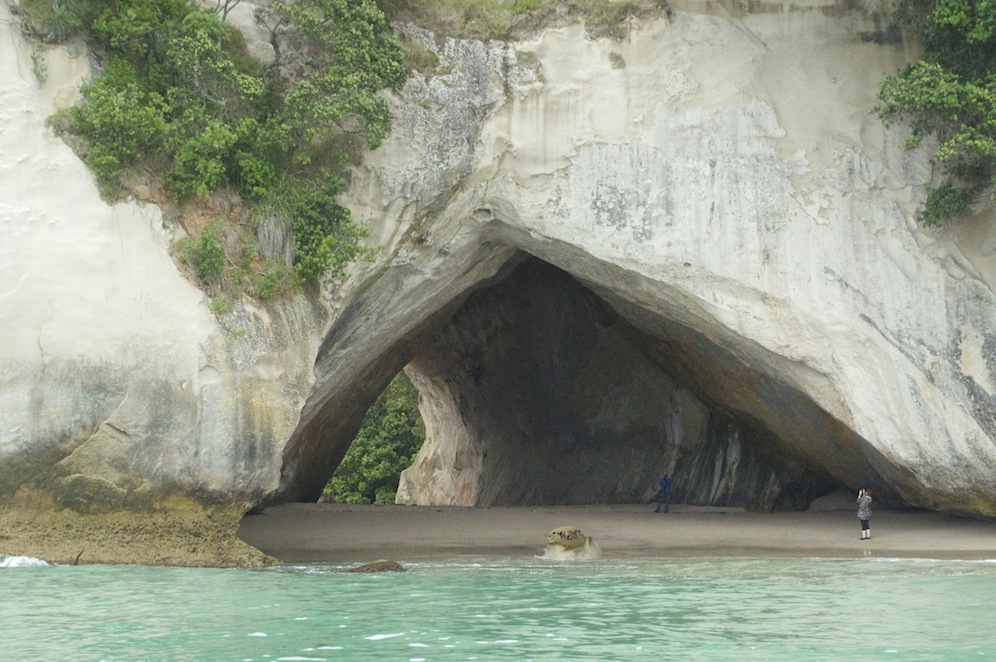
Cathedral Cove

Cathedral Cove

Reaching Cathedral Cove, named because of the shape of the arch linking the two halves of the beach, is spectacular. A large column of rock rises out of the sea and another lump seriously eroded around its base make this a fascinating cove. It is possible to walk to this cove but it takes time and when you want to see everything, sometimes it is best to take the easier option. I think probably the best way is by sea kayak, which allows you to land and see everything from a different perspective. Sadly we did not have time to go ashore.

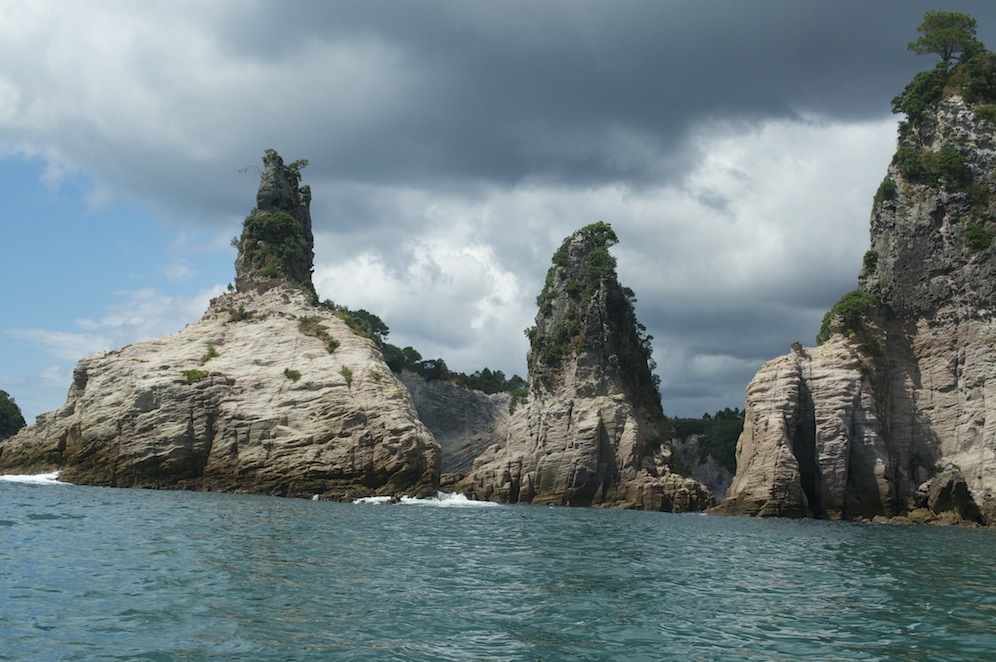
Champagne Cove

Champagne Cove

Another cove, named Champagne Cove because two pillars represented an upturned champagne flute and a bottle. Adjacent to them was a rock looking like a charging elephant.

All of these wonderful places are in a marine reserve, meaning that nothing can be taken from these waters. No fishing is allowed, no shells or anything must be taken. The fish should not be fed but occasionally Ken dropped a few pellets into the water to fertilise the seaweed. The fact that Snapper got to the pellets first was not his fault. What it gave us was a good view of the fish. Here we were able to snorkel among the fish so Angela and I took the opportunity. Not as spectacular as the snorkeling we did in the Bay of Islands, it was still pretty spectacular. One fish was much larger than the other but I’m not sure what it was.

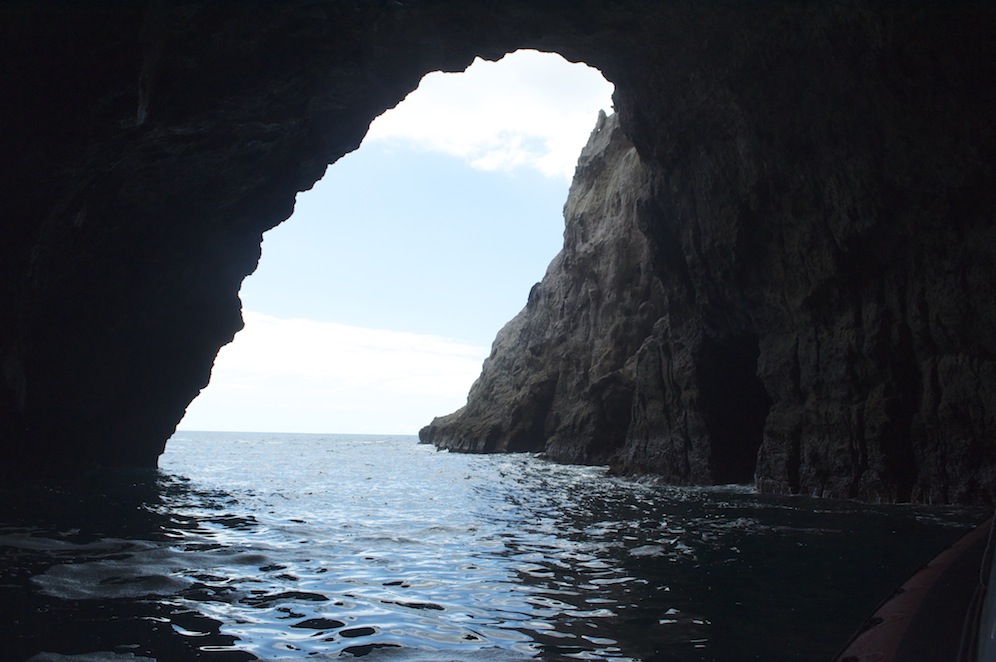
Looking out from within the cave

Looking out from within the cave

Climbing back aboard we went out to an island to see some more sea caves and then back to the mainland to see the third largest sea cave in the southern hemisphere. Ken took his boat right inside. The water beneath us was about thirteen metres deep and the roof of the cave was probably a similar distance above our heads.

From there it was quickly back to Whitianga, a spot of lunch and then the short drive to Whangamata via the Hot Water Beach. Unfortunately we did not get our timing right as the tide was almost at its highest. Beneath the beach there is a thermal fissure of hot water bubbling up. When the tide is out people dig pits in the sand and create their own thermal pool to lie in. Not while we were there. All we could do was stand in the shallows and bore our feet into the sand. I don’t know how people lie in it because when we hit the right spot it was unbearably hot. Remarkably, I found my hands were even less tolerant than my feet. It was like dipping into boiling water.

We arrived in Whangamata in the late afternoon, which is no bad thing as we have a long day on the road to Gisborne tomorrow.

Angela’s Anecdotes

Arrival in NZ after a wonderful week in transit was not blighted by jet lag.

Ben & family’s surprise appearance at our first motel was magical. Eva is 10 months old & nearly walking independently. She eyed us curiously at first but soon smiled and responded with a few gurgles & Dadas!!

Dull but warm weather took us off piste! Great to see 90 mile beach, coffee in a Maori township (3 generations all with robust bodies & broad grins) sat beside us.

More culture at the Ancient Kauri cafe! Wonderful woodwork.

Then we hit beautiful Bay of Islands! A paradise! Especially in hot sunshine, enjoyed every minute.

DSC_0371On to Coromandel. Another playground for grown ups & children alike. By the way the Summer holidays are over & the children went back to school on Feb 1st. Phew!

Fair bit of walking done, we BOTH have sore feet!

Another boat trip taken to view gorgeous geological cliffs, caves & nudist beaches!! Snorkelled with snappers (John included) All amazing.


Singapore

The super efficient hotel shuttle service whisked us along wide, fast moving highways into the city for a mere 9 Singapore dollars each. It was only when we reached Little India that the roads narrowed and became congested by parked cars, sprawling restaurants and evening strollers.

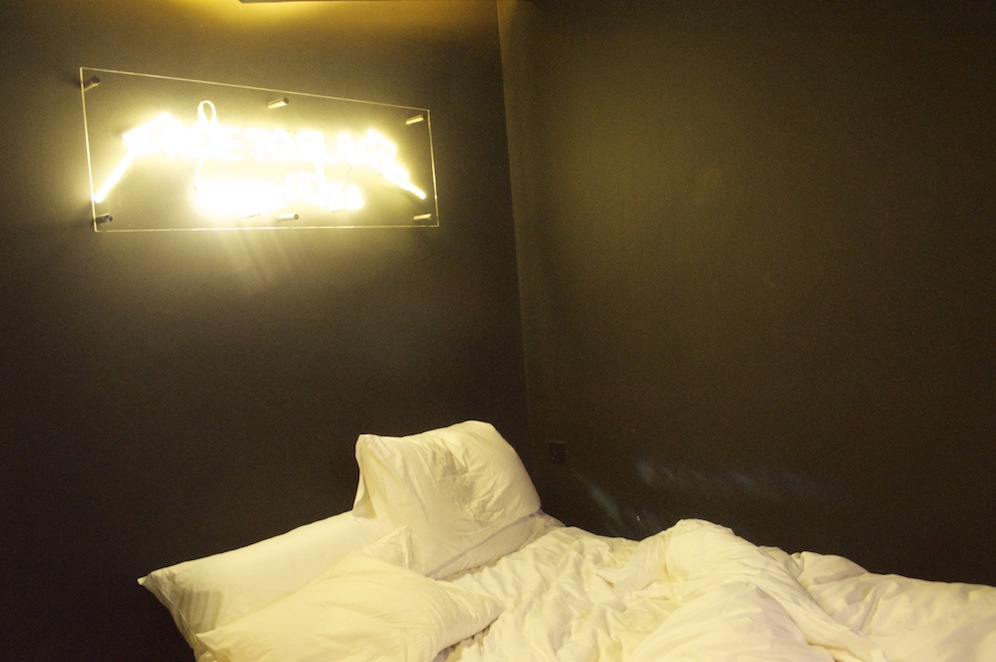
DSC_0081The Wanderlust Hotel is quirky. The decor in reception is a mural of comic type pictures from floor to ceiling and a variety of barber shop chairs.  Each room is colour themed. Ours turned out to be black! Everything was black, the walls, the ceiling, the tiled floor, the window blind and all the fixtures and fittings. Contrasting the black was white bedding, white towels and white cups and saucers. The bed was a raised platform at one end of the room with a white neon light above reading “Fade to Black, Metallica”. A frosted glass cubicle houses a shower and another the toilet.

Dropping our bags we went across the road for a drink and a curry. It was now 11.00pm and all the street restaurants were buzzing. Not able to sleep on a full stomach we took a stroll around the narrow streets to get our bearings. By the time we settled into our luxurious bed it was almost 2.00am.

The combination of a black room and a late night makes it difficult to wake up in the morning. We only just made it down to breakfast before they closed at 10.00am.

With the day ahead of us we needed to make the most of our time in Singapore. Reception gave me a few suggestions but it seemed we needed to get to Marine Bay and spread out from there.

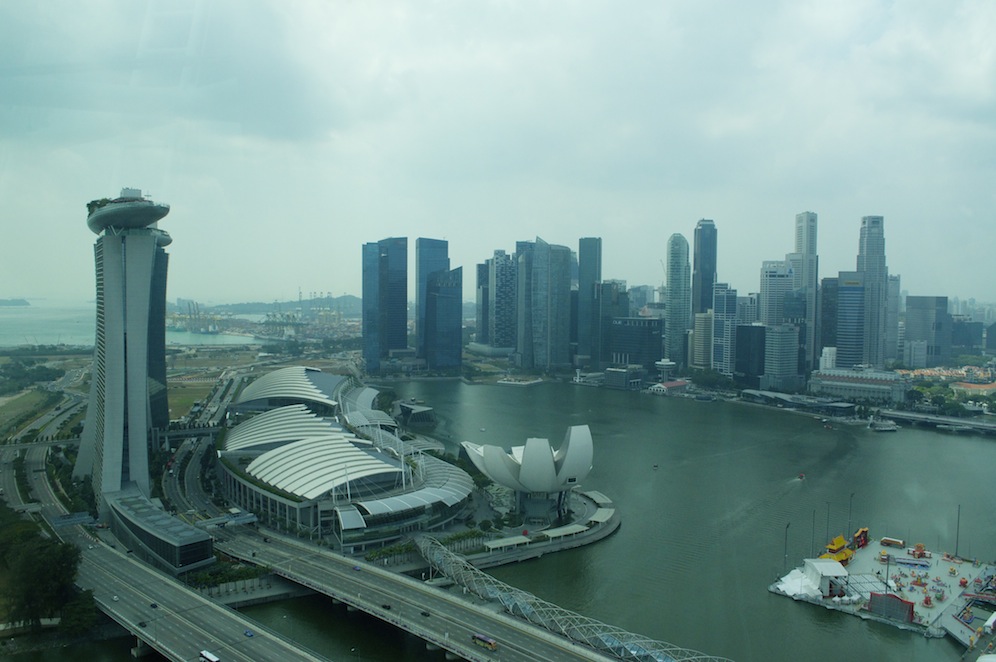
Marine Bay Sands

Marine Bay Sands

The underground is superb, spotlessly clean, efficient and not at all crowded. The platforms are spacious and pleasant areas to wait in. Clearly the benefit of a modern system compared to our Victorian inspired system, which is hard to change.

Marine Bay has a huge backdrop of modern and futuristic tower blocks around its southern and western shores. The eastern shore, where we headed for was dominated by the Marine Bay Sands shopping complex with three huge towers rising from it to be linked by a rooftop complex of restaurants.

DSC_0138Crossing the Helix Bridge we headed for the Singapore Flyer, a wheel to match the London Eye. On the spur of the moment we decided to get an aerial view of the city. Unlike the London Eye, there were no queues and we found ourselves having a pod to ourselves. The Flyer provided fabulous views across the whole of the city and out to sea where there were dozens of ships of all shapes and sizes anchored.

While we were on the wheel we saw the open top buses parked below and decided to take advantage and see as much of the city we could from ground level as well. The Singapore Flyer took half an hour.

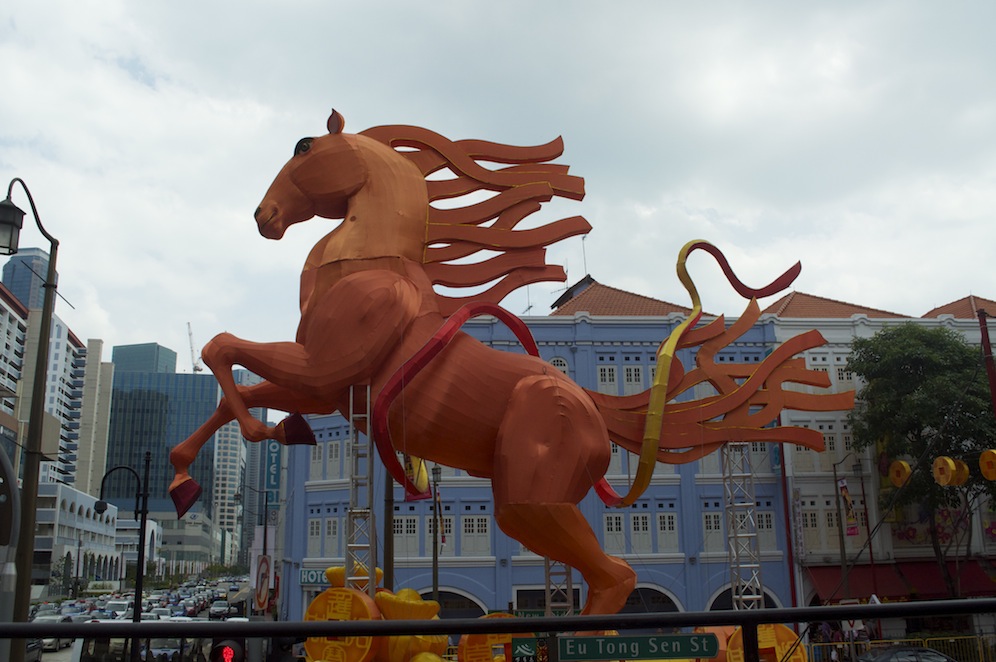
DSC_0161We decided to do the whole journey on the bus so that we could prioritise where we wanted to go when we finished the round trip based on what we had seen. It was good to sit and take it all in, enjoying the warmth of the sun. There was much to sustain the interest from spectacular architecture, the colour of China Town all decked out for Chinese New Year, the much smaller old buildings which are remnants of colonial days, the quantity of shopping malls and the many major schemes in progress, developing Singapore further.

Remarkably, when we alighted from the bus we were both in agreement as to where we wanted to go next. I fully expected that I would want to explore China Town further but I preferred to visit Raffles, probably the most famous landmark for British visitors.

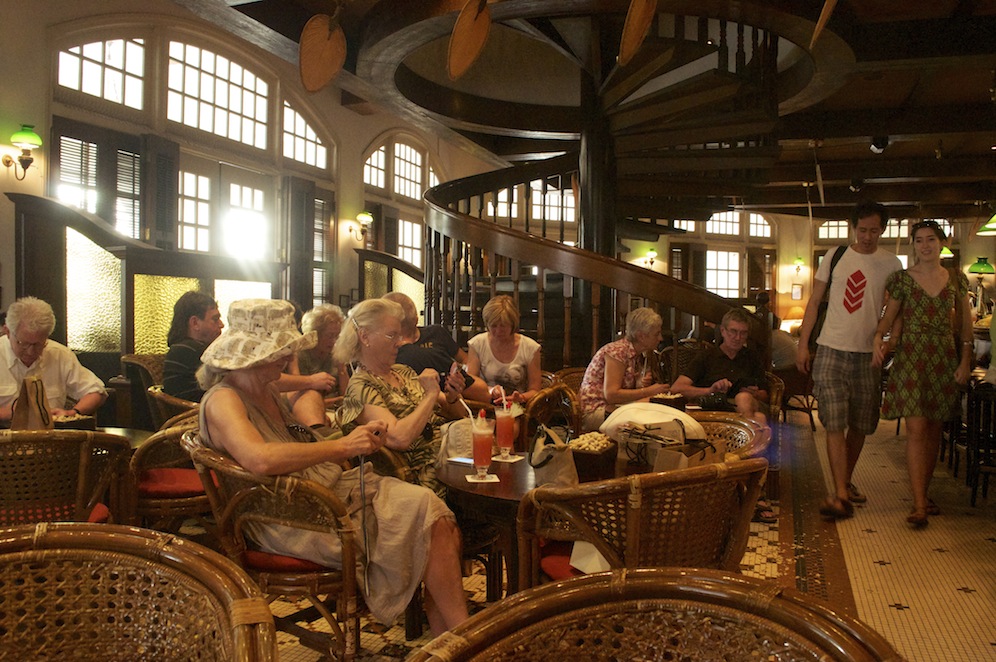
DSC_0176Deciding to walk, we made our way from one shopping mall to another until we reached Raffles Hotel. As well as the hotel there are many boutique type shops in the complex and the Long Bar, which we made for. You really had a feeling that you were walking into a little piece of history. Not a lot has changed since the British were in charge in this small corner of Singapore, the rest of which has clearly changed a great deal. As you walk across the floor your feet crush the shells of peanuts strewn across it. It seems that customers traditionally eat the nuts and discard the husks on the floor. Most customers, Angela included, feel obliged to drink a Singapore Sling, a strange concoction, far too complex a mixture for my basic tastes, where a beer easily satisfies. It was good to sit there, soak up the atmosphere and people watch.

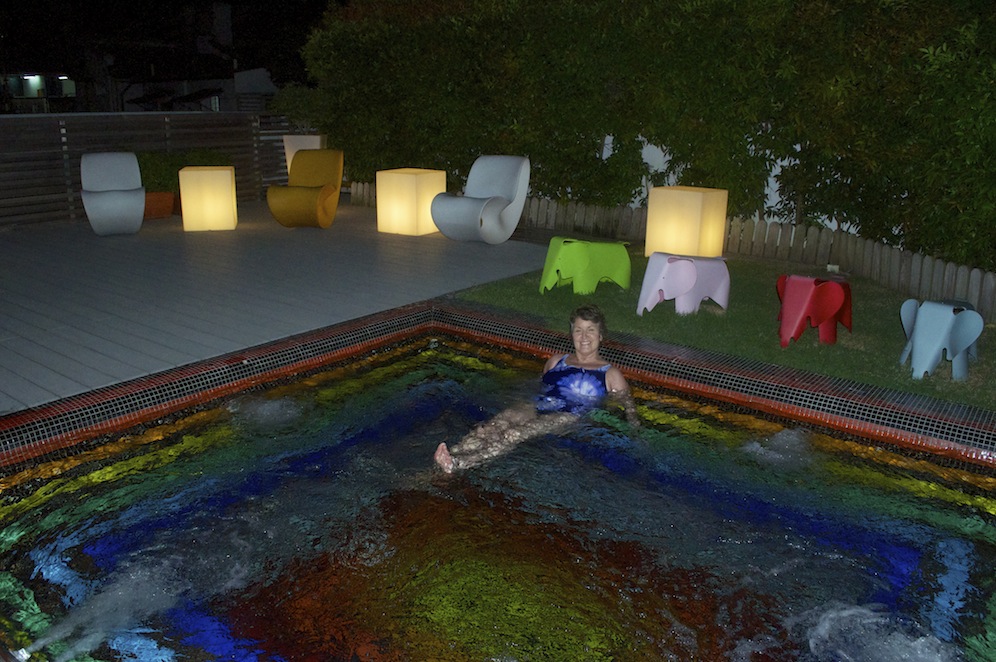
DSC_0182Dusk was approaching so we aimed for yet another mall on the way back to Little India for our meal before completing the journey back to the hotel. Just outside our room is a terrace with funky furniture and a jacuzzi so we decided to finish our day with a frothy soak under the night sky.

What do I think of Singapore? It is a fabulous place to visit. I am gobsmacked by the number of shopping malls there are and how so many can be sustained. I wouldn’t want to spend more than two or three days here at a time so I am quite pleased that tomorrow we head for New Zealand.

Sri Lanka

Sri Lanka. I thought it was only Wales that had impossible to pronounce names. Sri Lanka comes a close second.

First impressions are very good. Coming out of the airport and driving along the new highway towards Colombo is like being in someone’s garden. The flowers and blossom stand out from everything green. The vegetation is so lush. The traffic is relatively light and there are clearly well observed rules of the road. It is not perfect, as I later found out, but it is nothing like India and Nepal for highway chaos. Traffic even stops at pedestrian crossings to allow people to cross the road without harm!

An English teacher working in Colombo told me a few years ago that the air was thick with pollution. Not a sign of it today; the first horticultural impressions proved correct as we drove through the centre of the city. Not only is it a green city with relatively clean air, but the streets are clean; there are no piles of rotting rubbish on every street corner. The pavements are solid and smooth and not likely to break your ankle the first time you venture out on foot. Is it possibly a case that Colombo and the government has made significant improvements. Since the civil war ended in 2009 soldiers have been redeployed on improving the infrastructure of the country with new roads, parkland areas etc. in fact the Ministry for War has been renamed the Ministry for War and Redevelopment.

Our journey from the airport to Maha and Indera’s flat took about 45 minutes. The warmth of their welcome, the cool of their ceiling fans, the icy cold water they offered us to drink, the refreshing shower and the tasty lunch was very welcome after our long, but plain sailing, journey from the UK.

After an early lunch, Priyal, our driver/guide collected us from the flat for the several hour drive to Sigiriya.

The journey from the airport might have seemed efficient but our afternoon road trip proved less so. The road for the volume of traffic was narrow. Varying speed limits according to the size of the vehicle became irrelevant as we were reduced to the speed of the slowest a lot of the time with few opportunities to overtake. For long stretches of the journey we were passing a ribbon of development, behind which there was lush, green vegetation, some of it cultivated with rice paddy fields populated with large numbers of egrets, but largely of tropical forest. To see forests of teak, mahogany and ebon was fabulous. Priyal, as well being our driver was a mine of information constantly pointing out features and places of interest. Some of the greenery belonged to coconut or rubber plantations.

As we approached the five hour mark I was expecting to see Sigiriya but there was absolutely no sign of it, even when we arrived at out hotel, one if the nearest to it there was no sign. Hotel Elephas only opened three months ago and has a number of two storey thatched blocks overlooking an inviting pool, so inviting that the first thing we did once we took possession of our room was to have a refreshing swim. Considering the temperature hovers around the low thirties at the moment the water was not as warm as I was expecting. It came as a bit of a shock but, once accustomed, was perfect.

Sitting on our terrace after a very satisfying meal the noises of the night made you feel as though you were suffering from a bad case of tinnitus with competing insects ringing in your ears.

Sleeping required choices to be made; sleep with the air conditioning on and endure the noise or sleep with it off and endure the heat. We chose the latter and had a remarkably good night’s sleep.

After an early breakfast we drove to Sigiriya along narrow dirt roads with lushness on either side. Kingfishers sat on wires and branches waiting for the opportunity to swoop in a flash of colour on to breakfast in the pools and ditches below.

Sigiriya

Sigiriya

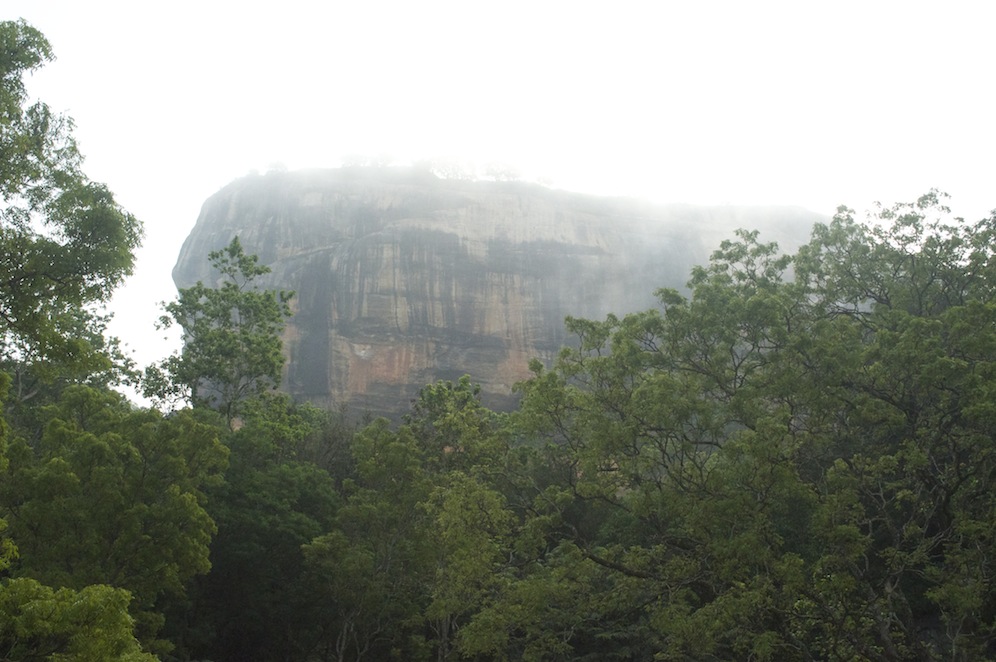
Still there was no sign of of the rock we had come to see. How can a lump of rock so big be so invisible? Suddenly we were there, among a throng of tourists at the entrance to this World Heritage site. And there was the rock emerging from the early morning mist, a huge molar rising from the jungle.

We met our guide Samon and began our 200m, 1246 steps, climb to the top.

Sigiriya, translates to Lion Rock, is an ancient volcanic plug 370m above sea level. However, as impressive as it is, that is not the reason why it has become a World Heritage site. In the fifth century King Dhatusena in the north of the country had two sons, the eldest, Kaysapa being the result of a liaison with a concubine. When Kaysapa asked for his father’s kingdom he was told he could not have it and that his younger brother,Moggallana, would inherit the crown. Kaysapa, therefore asked for treasures instead. When his father offered him water, instead of the precious jewels he was hoping for and expecting, he became very angry and murdered him. Kaysapa felt it necessary to flee. He fled to Sigiriya. Over the next eighteen years he ruled his own kingdom and developed his fortress palace. He was a genius architect. Around the base of the rock he built two moats, the outer full of quicksand and the inner was not only five metres deep but inhabited by crocodiles.

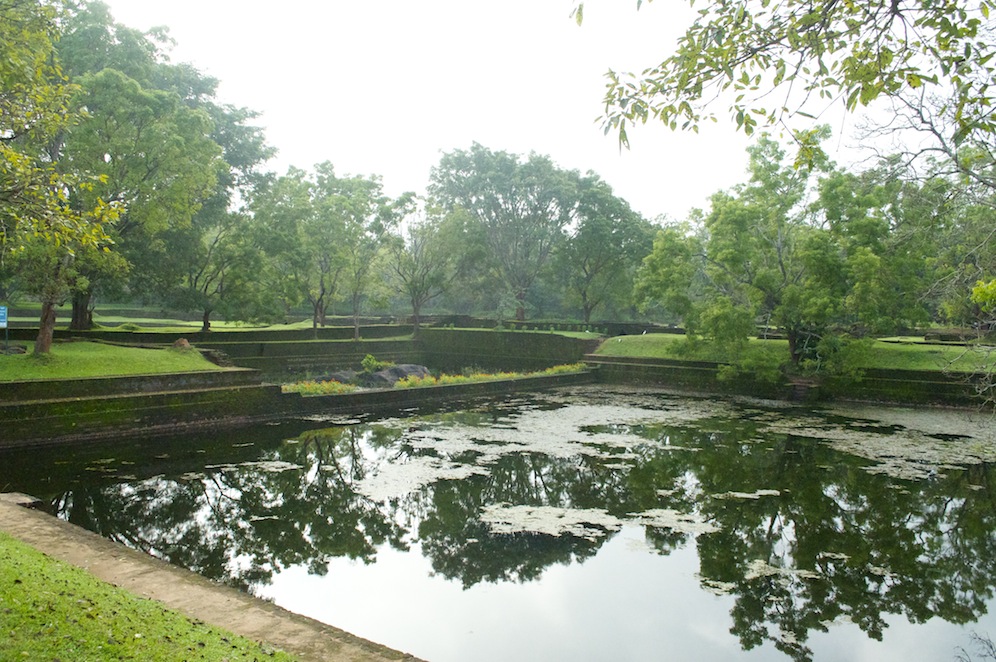
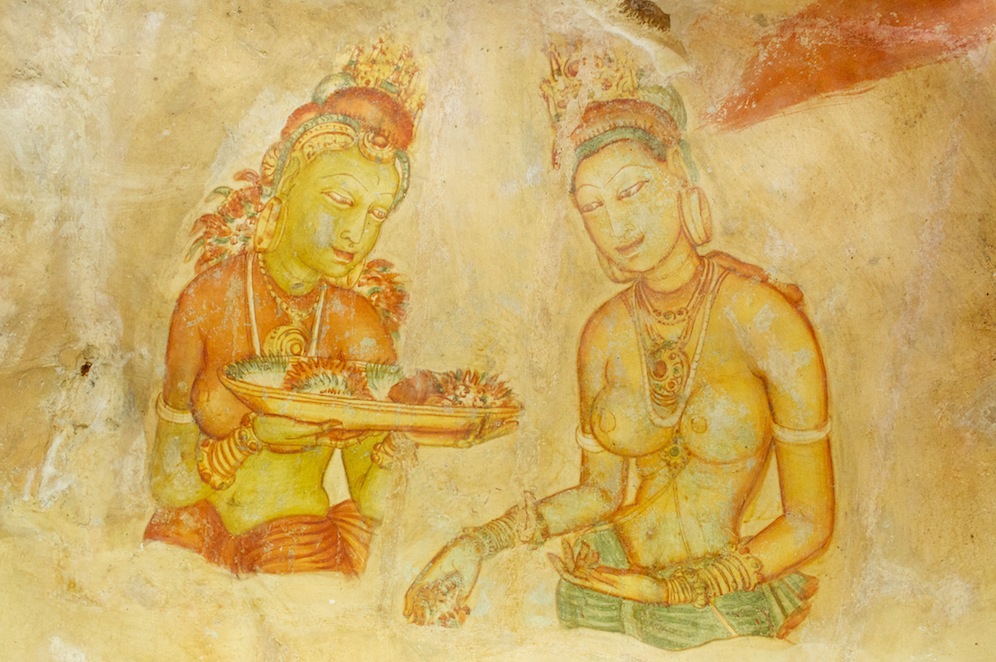
DSC_0007The path took us gently through layers of symmetrical gardens although only half had been excavated. The most distinctive was a water garden with a variety of pools. As we got closer to the rock the steps became more numerous and hugged the side of the rock face. Occasionally we came across caves. These were remarkable. The surface of the rock had been chipped away and then plastered with a mixture of things to allow frescos to be painted. Very little of them remain, having been weathered away over the centuries. Following the demise of Kaysapa Sigiriya was taken over by Buddhist monks for the next six centuries and although they didn’t approve of the subject matter in the frescos they preferred to let nature take its course rather than they vandalise them. These fresco caves were designed in such detail that there was a drip sill above them preventing water from getting to them and ultimately damaging them.

DSC_0020A little higher up, just above the mirrored wall, there is a spiral staircase leading up to an otherwise inaccessible shelf and shallow cave. Here the frescos are largely unscathed and they are fabulous. How they have managed to maintain such quality when they are over 1500 years old is incredible. Predictably, when they were commissioned by a man with over 500 concubines, the subject matter has a certain appeal to the male of the species, but the quality of the paintings is outstanding.

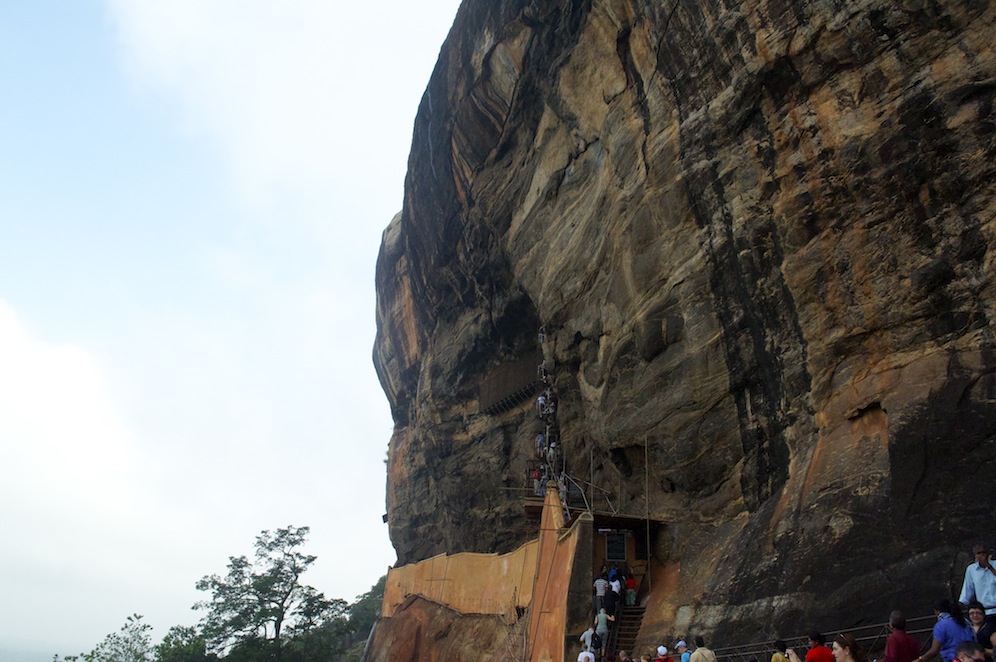
The "mirrored wall" showing the spiral staircase up to the frescos

The “mirrored wall” showing the spiral staircase up to the frescos

Returning to the mirrored wall via a second spiral staircase we continued our climb. The mirrored wall is in fact highly polished plaster-work which held three functions 1. to reflect the images of the frescos 2. so Kaysapa could not be seen from below and 3. this was probably the most exposed part of the climb and it offered protection. Today we are not allowed under any circumstances to touch the wall but throughout its occupied history people have written on it it minute writing. This has given archeologists an insight into the lives of those people and a greater understanding of events.

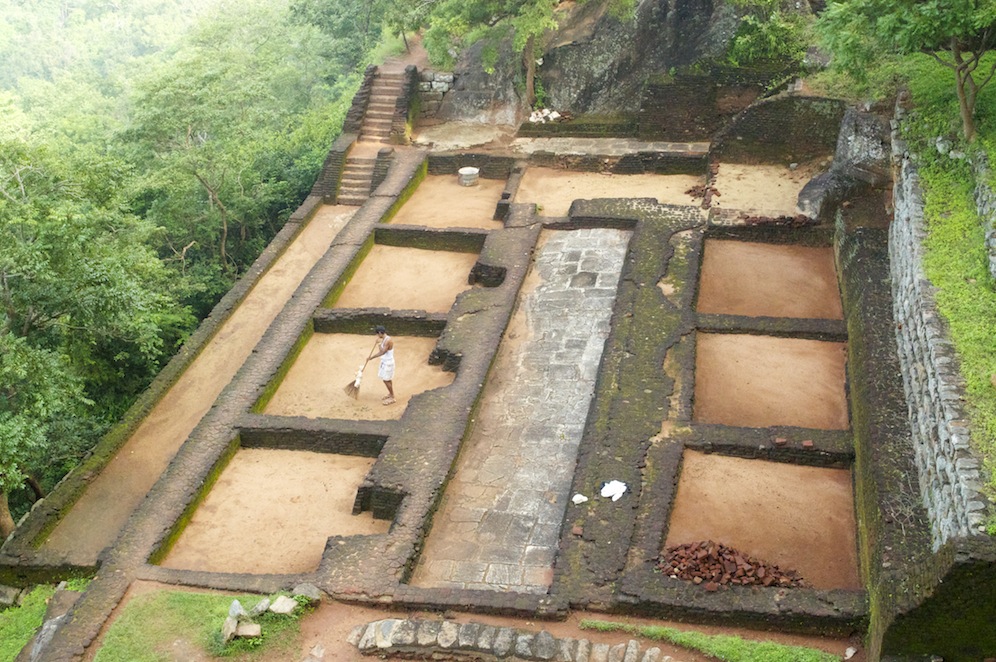
DSC_0026Just before the final climb to the summit there is a partially excavated area showing the site of the barracks for the soldiers who defended the rock. Just beyond, raised on small rock pillars is a piece of rock the size of a small house. Should any invaders manage to get beyond the moats the supports would be removed to send the rock crashing down on to the enemy below. The fact that it is still there is great testament to both the skills of those who created it and to the defence of the rock.

DSC_0027The final climb is up a metal stairway to a series of terraces, the highest showing the foundations of the King’s palace. Another contained a pool for his bathing and so on. On a clear day the view might have been spectacular in every direction, although it would be fair to say that it was very similar whichever way you looked – jungle. To one side, making it different from all others, was a giant statue of Buddha, rising a brilliant white above the green canopy. But the view was let down a little by the developing heat haze.

Looking down upon the gardens, the jungle beyond and the Buddhist statue

Looking down upon the gardens, the jungle beyond and the Buddhist statue

Everything we had seen, the gardens, the defence mechanisms, the staircases, the pools, the magnificent frescos, the palaces and all that came with it was created in just eighteen years. When Kaysapa killed his father the younger son and rightful heir, Moggallana, fled to Southern India fearing he might suffer the same fait. In 495, after eighteen years he managed to muster an army to seek revenge on his brother. Kaysapa, wishing to protect Sigiriya and prevent any army from coming close took his army several kilometres away to meet the attackers. Kaysapa and all the top military allies rode into battle on elephant back followed by an army of foot soldiers. It had rained heavily the night before and the elephants slipped dangerously in the mud. As the elephants withdrew the foot soldiers believed they had already been defeated and fled. Kaysapa, was abandoned so rather that suffer capture and the consequences there after ,he threw himself on to his sword and killed himself.

Whatever you think of Kaysapa as a person, a son and a king, he was a brilliant architect with a vision and imagination to be admired.

With the collapse of the Kingdom Buddhist monks took occupation if Sigiriya for the next six hundred years. After that it was abandoned and left to the jungle for several hundred years until it was discovered by the English explorer and archeologist, H.C.P. Bell, in 1890. By then it was completely consumed by the forest. The fact that we struggled to see it until we were almost upon it suggests that the jungle did a good job in hiding it for so long.

A really fascinating story and visit well worth the journey.

DSC_0044Meeting up with Priyal at the bottom of the rock we took to the road again and drove to the elephant orphanage at Pinnawala. Clearly a tourist attraction, we arrived in time for the baby feeding time held under an octagonal canopy. By the time we arrived most of the crowd had already gathered watching the five tethered babies swaying to and fro. I didn’t particularly enjoy seeing them tethered and behaving as though they wanted tone free. As Angela pointed out, we tether little children to a high chair for feeding whether they like it or not. The babies became much more compliant when the wardens came with a large pail of milk. This was transferred into a bottle with a rubber tube attached. The babies stood with mouths at the ready and one by one were issued several bottles, which they made very short work of.

In an adjoining enclosure was a very sorry sight. A mature elephant was leaning awkwardly against a support, the lower part of its front right leg missing. It had stepped on a land mine. Without a functioning limb there was very little it could do and you couldn’t help but wonder how much better it would have been for the animal if it had been killed.

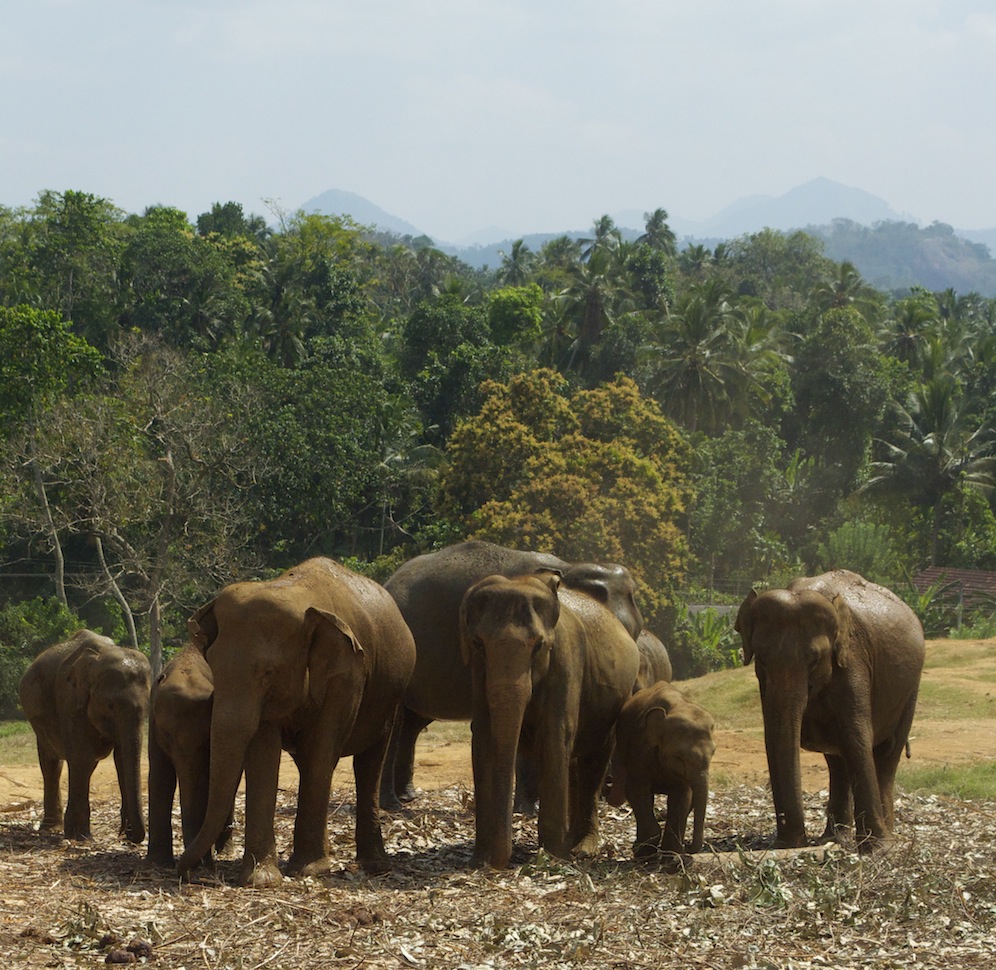
At the top of a small rise was an open area giving a panoramic view of the forested hills around. Here, the elephants looked more at home in this environment against this backdrop. The spectacle improved further when, perhaps as many as thirty elephants, came running up the hill towards us. This is what it should be like in a natural environment.

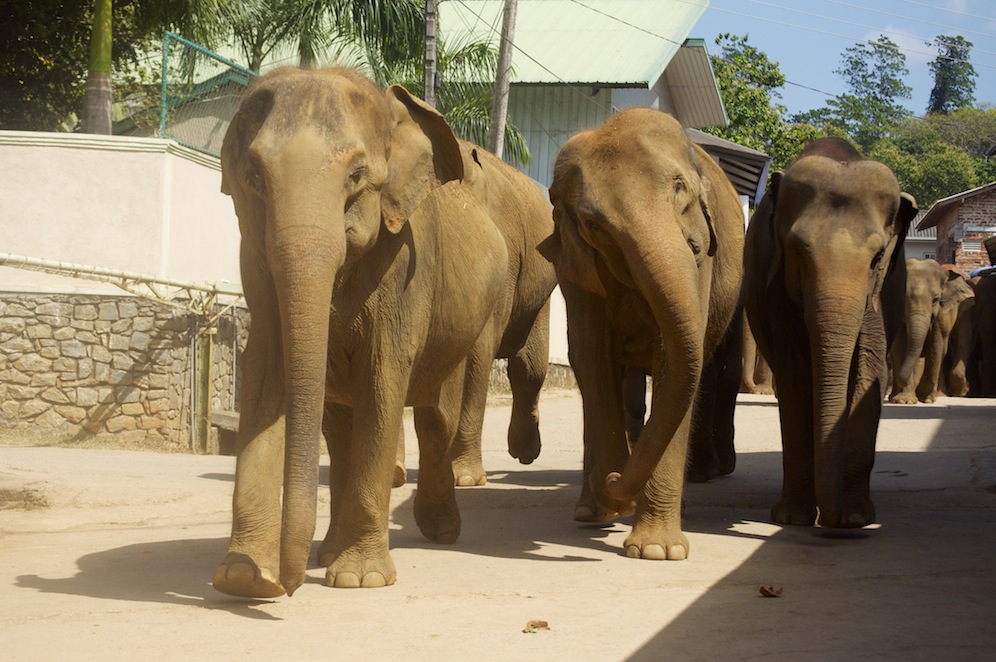
DSC_0054Next on the agenda for the elephants was bathing in the river. Next for us was lunch in a restaurant overlooking the bathing spot. The spectacle of fifty or so elephants almost running in their enthusiasm down the shop-lined street to the river was fabulous. I stood in the road to photograph the spectacle but soon realised that I was in danger of being trampled. Shortly after I retreated one small elephant crashed into the fencing around our restaurant much to the surprise of the diners sitting the other side of it. Fortunately it was robust and took the hit.

DSC_0062Once they reached the water their enthusiasm seemed to wane and most just stood around in the water up to their knees in a huddle. They looked like reluctant swimmers standing in the shallow end chatting. Despite the lack of activity it really was a spectacle to see so many elephants together.

Lunch, and the elephant spectacle over we drove for a further two hours to Negombo, on the coast north of Colombo. We were staying in the Paradise Beach Hotel with a room looking out on the garden with the beach and sea beyond. We took a stroll along the golden sand as the sun set.

DSC_0077Following an excellent and long night’s sleep we only just made it to breakfast before the restaurant closed. The remainder of the morning was spent relaxing in the gardens, swimming and enjoying the warmth the climate provides.

All too soon Priyal arrived to return us to Maha and Indira in Colombo.

At about 4.00pm as the intense heat was beginning to subside, Maha took us on a guided tour of the city. Again all my preconceived ideas about Colombo were shattered. It is a garden city with many fine building dating back to the British colonial rule. These have all been carefully renovated and look really good. Colombo is work in progress. For thirty years money had been directed to fighting the Tamil Tigers. Since the war ended in 2009 there has been money available to improve and develop Colombo into a thriving city. Foreign investors are clammering for part of the action and there is a lot of Chinese interest. Colombo will become the new Singapore. The famous Galle district on the waterfront will be fabulous, although it will take some years for its potential to be achieved.

In the centre of town the old racecourse has been developed and is now home to Colombo Rugby Club with a fine grandstand for spectators. The concept if Sri Lankans, who are naturally quite slight, playing rugby is hard to come to terms with. I guess what they lack in bulk will be more than compensated by speed and agility.

Another fascinating building is a new theatre and arts complex built within a framework that looks like a lotus flower. As well as internal theatre space it includes an open-air theatre on the roof, sufficiently high to avoid the noise of the city below.

In the evening Maha and Indira took us to Raja Bojun, a typical Sri Lankan fair restaurant. There is no menu, just a buffet with so many choices, all of which have to be tried, from egg hoppers, a hemisphere of wafer thin batter with an egg in the middle, a wide range of curries and accompaniments to very sweet sweets. It was a real feast and an excellent recommendation for Sri Lankan cuisine.

We are extremely grateful to Maha and Indira for their hospitality and for Maha coordinating out time in Sri Lanka. It was not long enough but, having dipped my toe in the water, I would not hesitate to return, and for much longer next time.

Next stop Singapore.