A wet day!

As forecast, today has been wet.  We did not rush to do anything this morning but eventually moved ourselves to go and look for the Black Stilt or Kaki, a rare bird only found in certain areas of New Zealand.  It is a wetlands bird that was almost wiped out but through careful conservation and management its numbers are increasing.

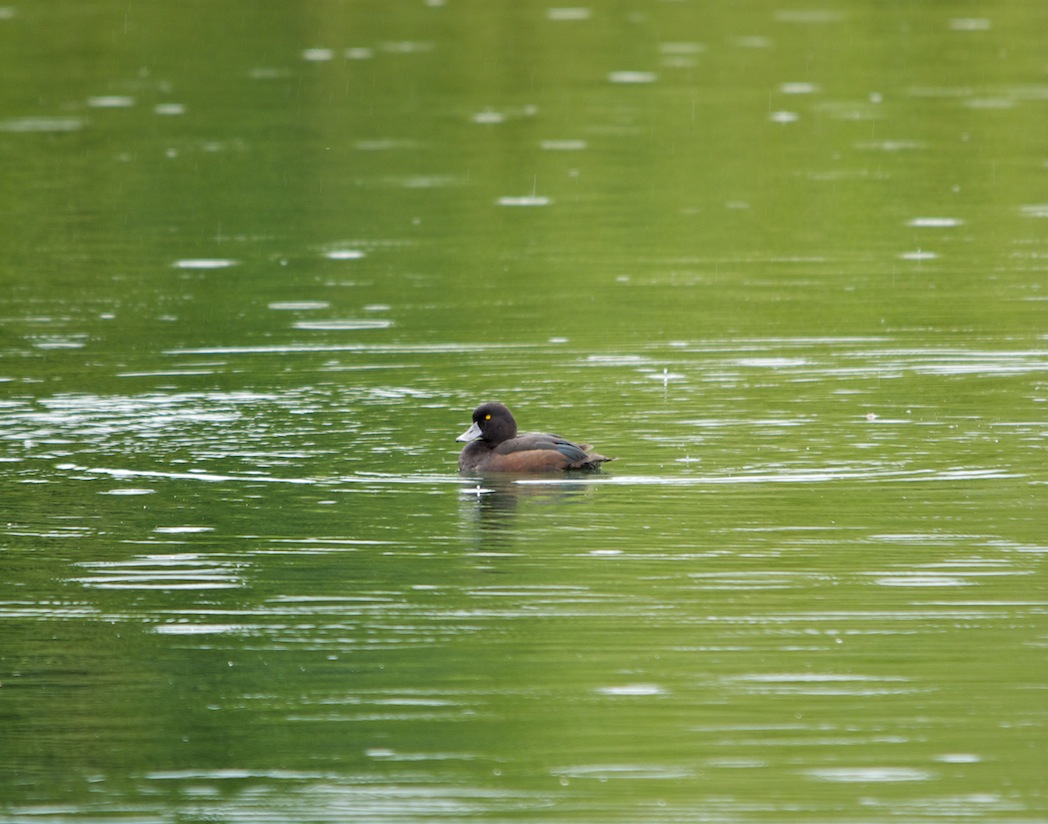
We travelled a short distance from Twizel to a wetland area where they are known to be breeding.  Needless to say that we didn’t find any and satisfied ourselves watching a variety of more commonly seen ducks and oyster catchers.

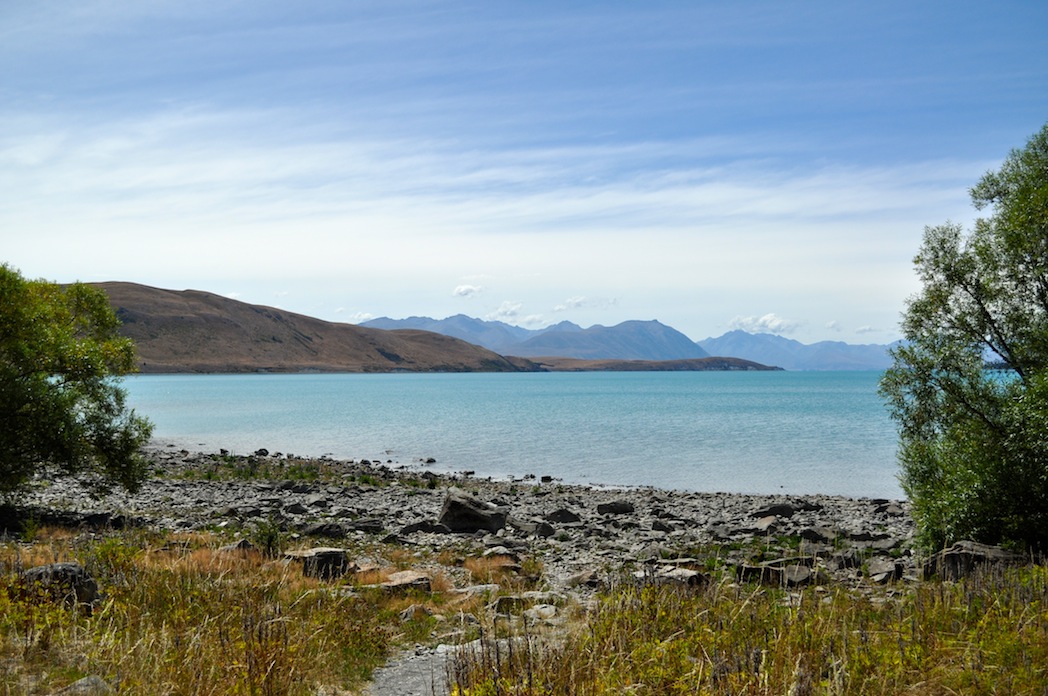
Following a spot of lunch in Twizel we went to have a look at Lake Ohau, another turquoise lake.  The rain was not too bad at this stage.  All the lakes we have seen so far are linked by a huge hydro-electric scheme, making use of the natural environment for generating electricity.

As the afternoon progressed the weather deteriorated and, with the exception of Angela making a dash to the supermarket in Twizel, we confined ourselves to our cabin, hoping that tomorrow will bring an improvement.

Angela’s Bit

This is the first rain in Twizel for 4 weeks!  The parched ground will be grateful even if we are not.  Sean the farmer tells us to keep an eye out of our bedroom window for views of Mt Cook…..

Um, not sure yet.

Have bought steaks & a DVD ‘The World’s Fastest Indian’….. a delightful local story starring Anthony Hopkins.  The till girl told me she grew up down the road from Burt Munro (the real-life hero of the story!)

Happy Valentines! xxx

Lake Tekapo

Following a very hearty English breakfast we drove out of Christchurch with the sun shining favourably on us.  The navigation, provided by Angela was excellent and we soon found ourselves heading south on Route 1.  Driving here is superb.  There was more traffic today but it was well spread out and there was never a reason to rush or to feel rushed.  Not once did I exceed 70mph.  What is important is that I did not feel I wanted to go any faster.  Back home we always seem to be under pressure to go faster, get there quicker and there are always obstacles in the way.  Here, if you come across a slower vehicle there are plenty of places to pass with safety, largely due to the lesser volume of traffic.

We stopped off in Ashburton to visit the Tourist Information Office and to have a coffee before climbing out of the Canterbury Plains.  The hills looked very similar to those in mid Wales, gently rolling with plenty of sheep and cattle grazing. We crossed over two ranges before we reached Lake Tekapo.  As we came up to the brow of the second range the panorama of the Southern Alps came into view.  They stretched north to south as far as the eye could see and beyond.  As we began to descend off the brow the lake appeared in all its turquoise glory.  What a stunning place.

Lake Tekapo

Soon we were in the village, visiting the famous Church of the Good Shepherd, a tiny church built on the shores of the lake.  The west window behind the altar is clear glass instead of the traditional stained glass.  The reason is that no stained glass window can improve upon the work of God as seen through the window.

Our next plan was to find some accommodation, so we sought out the youth hostel, also on the lake shore, and decided to camp in the garden with the view.  It is such a contrast to last night’s accommodation but I wouldn’t want to be anywhere else tonight.

Angela’s Bit

After a generous cooked breakfast and a commiserate with our hosts (their daughter is married to an Englishman and living in Cambridge UK!) We set off on our pleasant drive South West to the lakes and mountains.  The roads are not high speed but the traffic is sparse so hence the pleasant experience.

Our tent is pitched overlooking Lake Tekapo, gorgeous in the evening sunshine.  I have just hung out a load of washing, having found the YHA laundry.  We will have clean socks tomorrow!

Swimming with Dolphins (almost)

We left our cottage just before 8.00 and drove down to Akaroa for our swim with dolphins experience.  Following a brief introductory chat we, along with six fellow travellers, suited up in very thick wet suits.  I hoped swimming would be easy in mine because walking was not.  I felt like one of those animals that is very elegant in water but ugly on land.  Despite the fact that it is summer the air temperature this morning was only 11°C and the water slightly higher at 14°C.  It was cloudy and while I was initially optimistic that the cloud was going to burn off, it proved that the opposite was going to happen and we were hit with squally showers.  There was also a stiff breeze blowing.

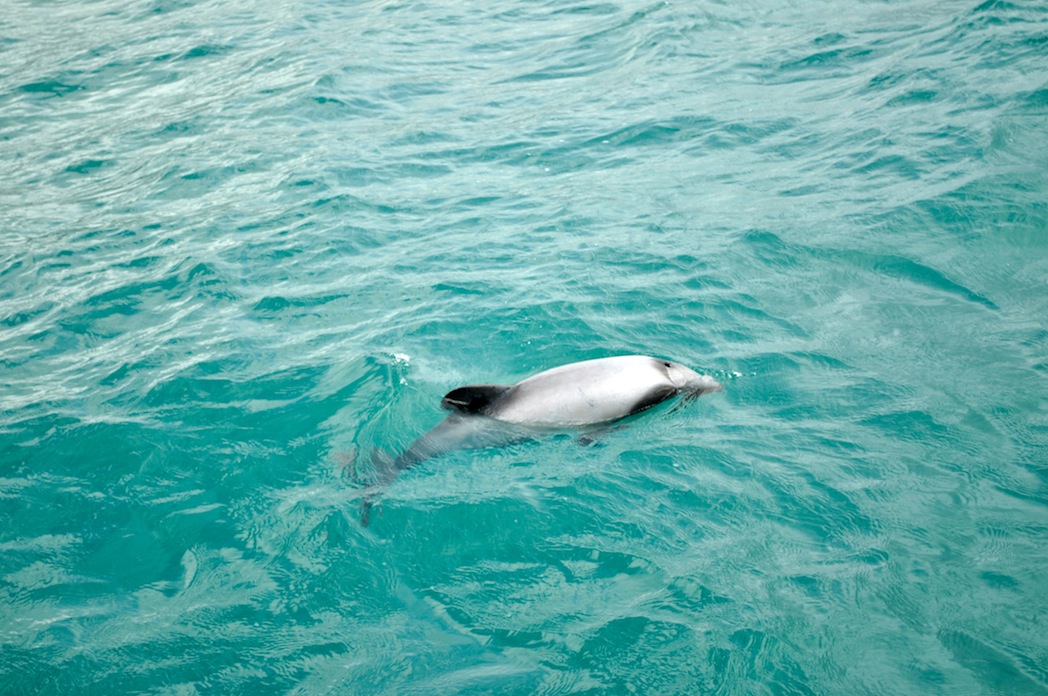
All suited up, we waddled aboard and set sail, immediately heading out towards the mouth of the inlet.  The further we went the rougher the sea became.  We spotted a pod of Hector’s Dolphins, the smallest a rarest breed of dolphin.  There are now only 7,500 of them left and the numbers are still declining despite the valiant conservation work being done at Akaroa.  The problem is that they get caught up in a set net, which drowns them.  Those nets have been banned around Akaroa but are still used in other areas of New Zealand.  So, while the numbers are improving around Akaroa, they are declining at a faster rate elsewhere.
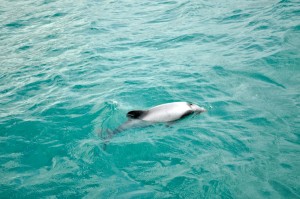
Hector's Dolphin

This first pod included a mother and baby, which meant we could not swim with them.  The baby spends two years closely bonding with its mother and nothing must happen to disrupt that bonding.  The baby drinks mother’s milk approximately every three minutes, so you can imagine the disruption eight human swimmers might cause.

We moved further out to sea, between the two headlands and the swell increased to about 12 feet.  Angela was finding it a bit difficult to cope with but managed to concentrate herself through it.  We found another pod, which swam around the boat but now the sea was too rough for us to get into.  We headed over towards the northern side of the inlet where there was a chance the water would be calmer.  However, before we got too far we came across a third pod of five dolphins.  They seemed reasonably curious so we gently lowered ourselves off the back of the boat into the water.  I was expecting to have to take a sharp intake of breath but, in actual fact, it was not necessary.  The swell was still about 12 feet but now the waves were regular.  We bobbed up and down, treading water, and making noises to attract the dolphins.  Singing down a snorkel tube was recommended, so I tried ‘If you’re happy and you know it clap your hands’.  Maybe the dolphins did not like my singing but they clearly did not want to play and while they made a couple of approaches to us, we did not really have the interaction we were hoping for.  It was exhausting in the water and after about 15 minutes we decided to get out.  Our captain and dolphin guide both decided it was not going to happen today and took us back to the wharf at Akaroa with the promise of a partial refund.

It was still a pleasurable experience and we did at least see dolphins swimming around the boat and we also saw the world’s smallest penguin swimming by the boat.  Angela mistook it for a duck to begin with!

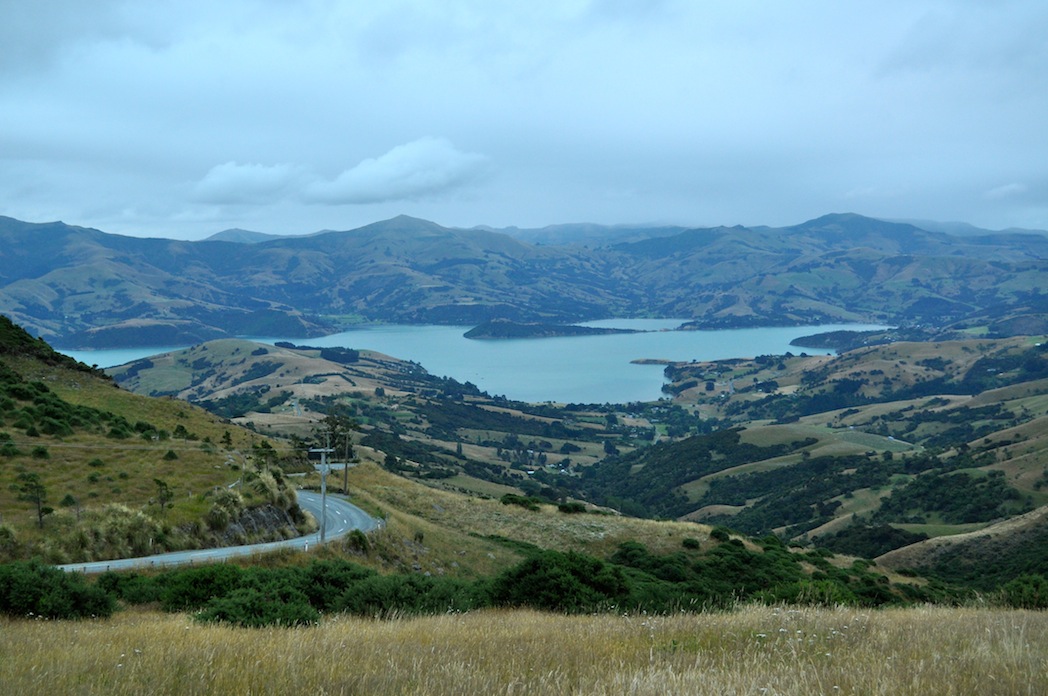
Following a warming cup of coffee we headed back to Christchurch, not by a direct route but by a scenic one.  We climbed up our of the crater and took a road that skirted around the rim, giving us stunning views down to Akaroa on one side and similarly stunning views down to bays set between lava flows on the ocean side.  They were tantalisingly beautiful so we took the opportunity to drive down to Le Bon Bay for a picnic lunch on the beach.  It was 10km down to Le Bon Bay through a beautiful valley with lava flow ridges down each side.  At the end of the valley, behind the beach, is a small community living in an idyllic setting.  To make it even better the sun came out, rewarding me for my optimism of earlier in the day.  The beach was deserted and we had it all to ourselves, and a few optimistic gulls that thought we might give them a crumb or two.  There was one who was particularly aggressive towards it fellow gulls and would do anything to keep them at bay.  If food was on offer he was going to get it first.

After a relaxing and entertaining lunch we continued with our drive to Christchurch.  Our accommodation in a house in the suburb of Papanue is superb in every respect.  We were made to feel very welcome and the facilities are outstanding and really good value for money.  Half way up the stairs there is a large case on its side.  It has fallen over so many times during quakes that it now cannot fall further.  There are very few ornaments in the house, all having fallen from their shelves during the big quake or one of the thousands of aftershocks Christchurch has experienced since.

Kate Richardson came to pick us up at 5.30 and take us to their house.  Kate and her family emigrated from Worcester two years ago and their house fell victim to the earthquake, so are in temporary accommodation until their house can be rebuilt.
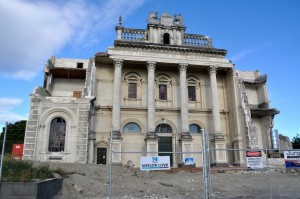
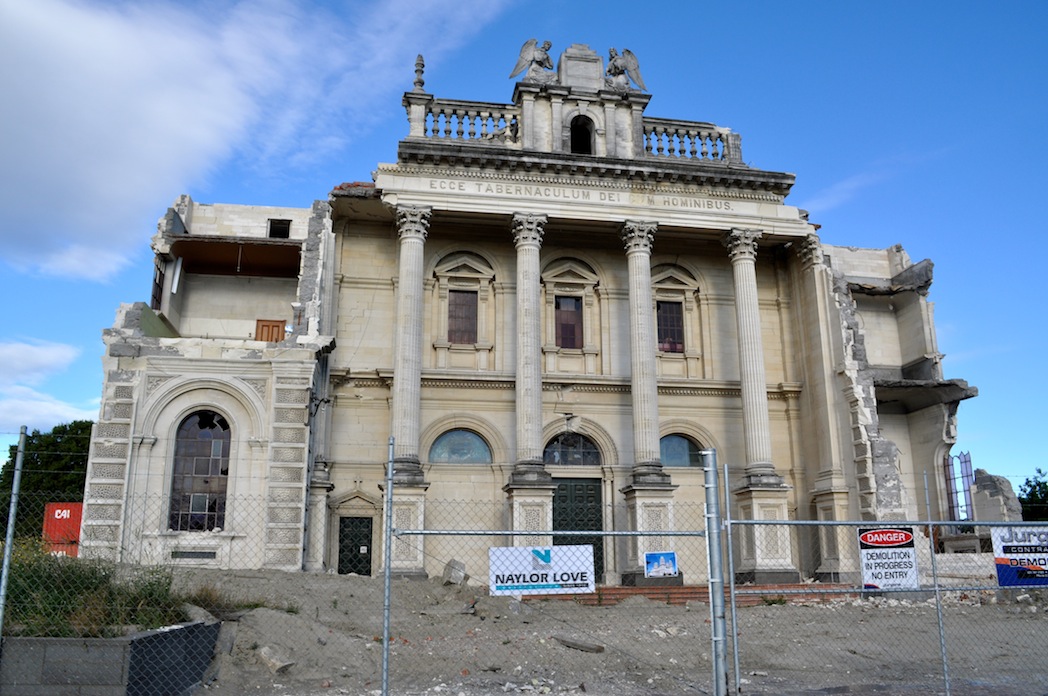
The damaged Catholic Cathedral in Christchurch

After meeting them we were taken on a tour of Christchurch, starting with their house down the road.  Remarkably, it can be rebuilt and made earthquake proof.  The city centre is a scene of devastation.  Much of it is fenced off and out of bounds as the whole of the centre is being demolished, block by block.  Many people have not been able to return to their properties to retrieve their possessions as the buildings are too dangerous to enter.  Stone built buildings faired worst as they are too rigid and lack the flexibility of wooden and modern structures.  Hence, churches, including the Catholic and Anglican cathedrals came off really badly.  We could not get any where near the Anglican cathedral where the spire came crashing down.  Many buildings were fenced off and the fallen masonry still lay on the ground as it had fallen a year ago.  The whole experience really brought home the devastating effect that an earthquake has on a community and the infrastructure.

Following a very pleasant evening, sitting around the garden table, eating a lovely meal and catching up on each other’s news, Angela and I strolled back to our lodgings for the night, well satisfied with our day.

Angela’s Bit

Naturally I had some misgivings about our sea trip but in retrospect I am thrilled to have done it and more than a little proud that I swam and sailed in 12ft swells and wasn’t seasick!  The dolphins were very cute, small and beautifully coloured in tones of blue/grey.

Back in Christchurch we settled into another immaculate and well equipped B & B, before being scooped up and taken on a guided tour by the Richardson Family who moved here from Worc. 2 years ago. Their house was badly damaged in the quake a year ago so they are in rented accommodation nearby.  They drove us into the city and the devastation is shocking.  They have had 10,000 quakes, 20 of which have been significant!!! But they are philosophical about it and still happy with their lot.  We had dinner with them and were made very welcome.  Kate (who I taught when she was 7 is now 21 and going off to Uni in Auckland soon)

South Island

A dull damp morning greeted us as we tip-toed around the house, not wishing to disturb Kay or baby Sara.  Final bit of packing done, making decisions about what to take and what to leave with Ben was all a bit of a nightmare.  We are bound to have made a wrong decision at some point in the next three weeks.  Ben arrived and we loaded the car, said our goodbyes to our hosts and headed into town.  There wasn’t a lot we could do in the short time we had left in Wellington and with the weather not being at its best.  We met Kelly for coffee and then Ben took us to the airport.  Next time we shall see them it will be the eve of their wedding.

The flight down to Christchurch took 35 minutes and the weather was not dissimilar to that in Wellington.  The movement through the airport was quick and simple and the girl on the Avis desk was very efficient and helpful.  We collected our Toyota Corolla and headed off to the supermarket before steering in the direction of Banks Peninsular.  The 75km took just over an hour on empty, if a little windy, roads.  The landscape here looked far more parched than in Wellington.  As you approach Akaroa you climb up from the Canterbury Plain, over the rim of the old volcanic crater and drop down to the sea, which now fills it.  We had nothing booked and the first place we enquired at in Barry’s bay was full.  However, the owner was very helpful, phoned a neighbour and cleared the way for us to have a full self-contained cottage for the night for 100$.  It is stunning and the view from our bedroom down to Akaroa and the sea is to die for.

Akaroa

Akaroa was originally a massive volcano 60km off the mainland.  It was so high it was covered with snow all year.  6 million years ago there was a huge explosion taking the top off the mountain and exposing the crater to the sea, which allowed the sea to flood in to the crater. Steep sides rise out of the water surrounding the sea inlet.  In the evening we drove up to the crater edge to look down the outside of the crater to the blue Pacific Ocean.  It really is a beautiful part of the world and there are very few people about.

When we arrived, I managed to book a three-hour trip out to see the dolphins and to swim with them.  A very exciting prospect, which we are both looking forward to.

Angela’s Bit

Our farewell to Kelly was in the very modern City Library, where you can look from the Café balcony into the whole of the ground floor where all the books are stored.

We walked under the iconic Fern Ball.

Five hours later we were welcomed at Twin Gullies Roost.  Doug & Victoria Hamilton have an idyllic 8 acre smallholding/B&B.  We settle willingly into our Victorian brass bed, until there is ominous rumbling and vibrating at 10.30.  I am ready to crawl under the bed, but John says it’s just the water tank refilling!  Now we know it WAS an earthquake of 4.5!!


Zealandia

Before humans came to New Zealand it was a perfect environment for birds and animals; they lived in harmony and because there was very little predation the way in which they evolved differed from other parts of the world.  Birds became flightless and nested on the ground.  The first settlers inadvertently brought in rats and other rodents, which preyed on the endemic and innocent creatures.  Later, when Europeans began to settle in New Zealand, they brought all sorts of creatures with them, most by design rather than by mistake.  Cats, dogs, squirrels, goats, possums and a lot more caused some species to become extinct and others to live in danger of doing so.  Massive deforestation occurred for agriculture and the goats ate everything in their path.  Birds, like the sparrow and starling were brought over from Europe to keep pests at bay from eating crops but have now become pests in themselves.  Alien plants were introduced, which are so prolific in the environment New Zealand provides they have strangled some local species.

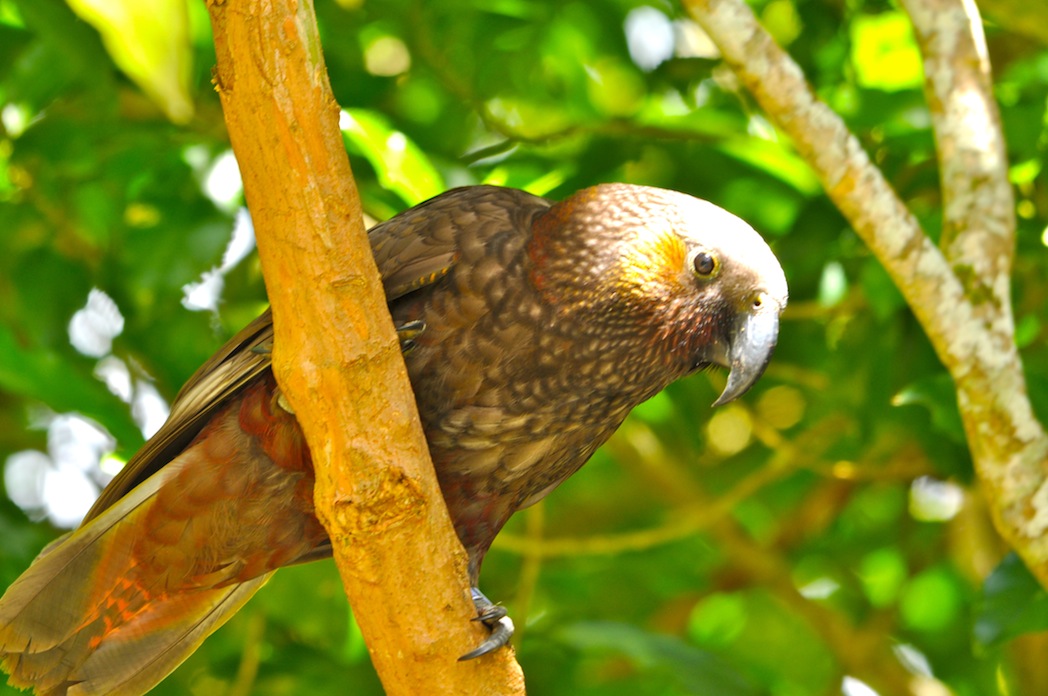
Kaka

Zealandia, or Karori Wildlife Sanctuary as it was formerly known, aims to establish an environment as close to that that existed before humans entered the fray.  To achieve this they have built an 8.6km fence all the way round the sanctuary, which is rodent proof.  To make sure they have everything covered there are poison traps for any rodents surviving within the sanctuary, or who manage to get through the strict security. It provides a natural safe haven for over 30 species of native birds and reptiles The result is that birds and reptiles, which were on the brink, are increasing in numbers because eggs are not under threat on the nest, are hatching and the young being allowed to grow to adulthood.  Judging by what we saw today, it is working.  The remarkable thing is that this is all happening within the city of Wellington and not in some remote rural area.  It is the world’s first urban sanctuary and has a 500 year plan to restore the valley to its pre-human state.


On entry to Zealandia we visited the exhibition, which, like Te Papa, was really well presented and interesting.  I would have liked more time there but we needed to walk to the Kaka feeders where one of the wardens would give a talk about the Kaka.  The Kaka is a large, less than colourful, parrot, but has an endearing personality, like most parrots.  In order to get there we had to walk along a lake shore surrounded by steeply wooded hillsides.  Predictably, when we got there, there were not too many kakas visibly evident but they could be heard in the surrounding trees.  There were too many small, noisy children for the kakas to feel comfortable.  All the birds we did see were juveniles.  The talk was interesting and showed just how successful the programme is with 33 chicks hatching this year.

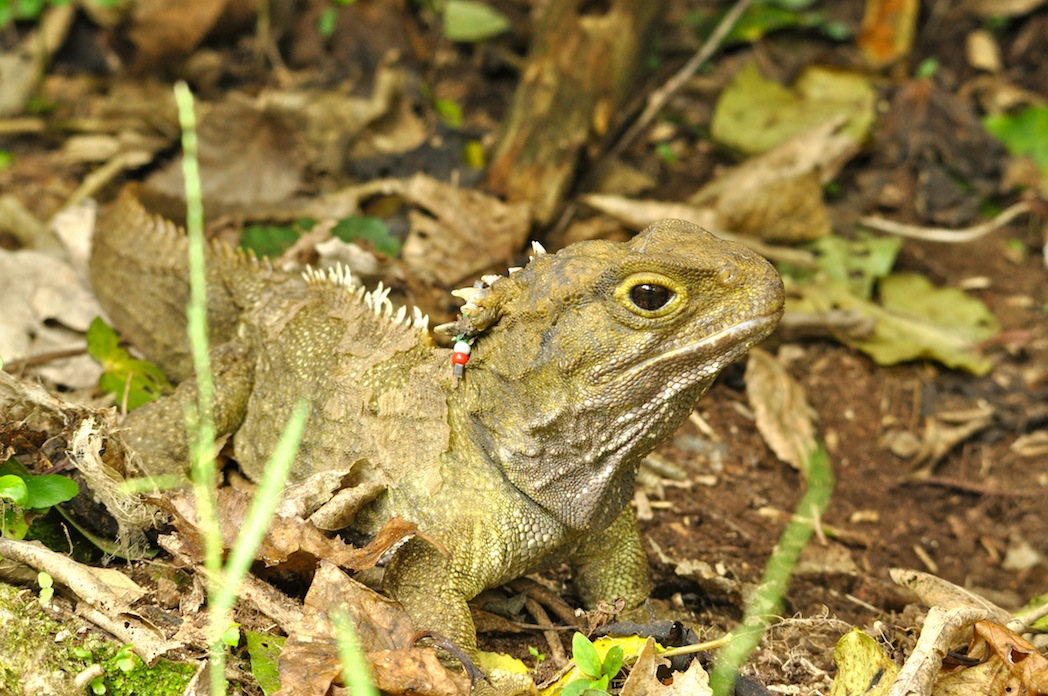
A Tuatara

From there we walked further into the sanctuary before taking a different route to listen to a short talk on the tuatara, a lizard that lives in burrows and has been a victim of rodent attacks in the past.  The adult grows up to about 18 inches and is quite solidly built.

Away from the crowds the kaka came to their feeding stations and performed for the camera.  Very satisfying.

I was keen to go and do some bird photography so I left Angela and Ben to do their own thing while I delved further into the sanctuary.  The further in you went the quieter it became, largely because the paths became less accessible.  There were some hides, which I thought would provide me with the photos I wanted but it was soon clear that I they were not near the path I was walking on.  However, I did come across a feeding station for the hihi and the bellbird, both about the size of a sparrow.  There were several of them and the hihi was particularly beautiful with yellow flashes on each side and on the wings.  As much as I tried I could not get a picture of them; they were far too quick.  They were not particularly afraid of me but would not sit still long enough for me to focus the camera.  Frustrated, I moved on.  Next I came across a small group of about half a dozen saddlebacks, blackbird sized and predominantly black with a red saddle across the back, a red rump and red flanges on either side of the beak.  They darted about among the branches and while I did get a couple of shots, I was again disappointed with the results.  A black robin then teased me by sitting on a low branch at the side of the path, posing, until the camera was set and then off he flew!

I eventually did find some hides so set up ready.  Absolutely nothing came into view and I had to give up.  I decided bird photography spoiled a good walk.

I was already late for meeting up with Angela and Ben, so I headed off back towards the centre where I knew they would be.  The journey was not without it distractions with more kaka in the trees close to the path, more tuatara sitting in amongst the bushes and pied shags on logs in the lake.

By the time I met up with Angela and Ben it was 3.00pm and I was starving.  My lunch was waiting for me.  Thank you.

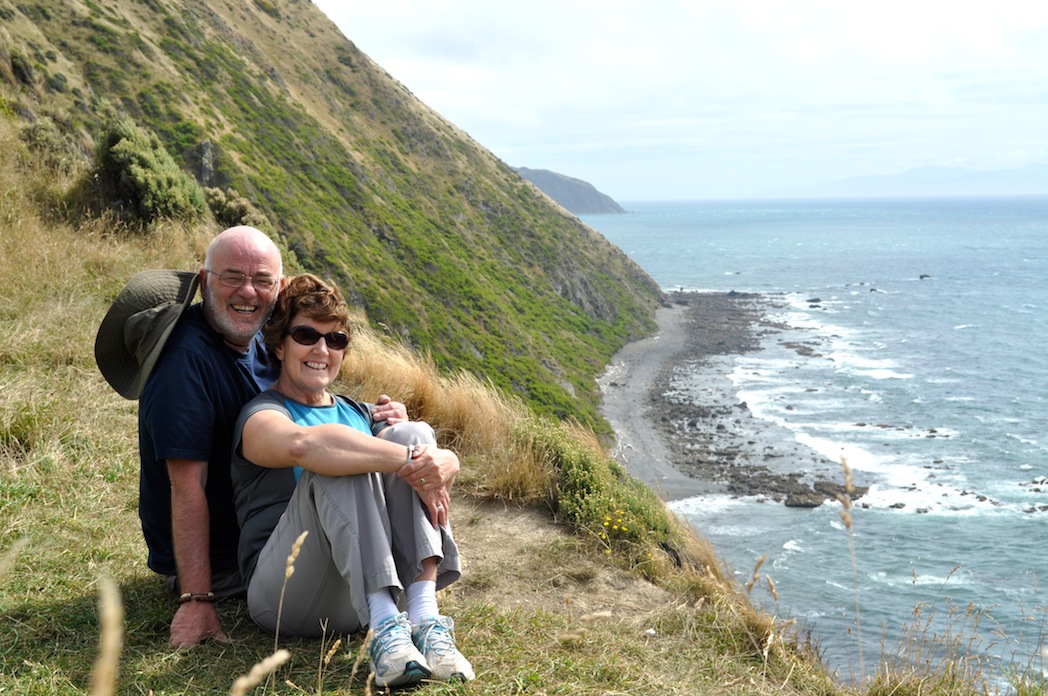
We then drove out to Makara Bay, a stony beach with a very pleasant path leading up to the cliff tops where we had extensive views of the north coast of South Island.  Afterwards we met Kelly coming out of work and bought fish and chips to take to share with Kay, our host, who had returned from a few days with her family.

Angela’s bit

Started the day with a visit to a walk-in hairdresser.  A young shaven-headed Greek Cypriot guy did the business.  I am happier to have a more manageable head in the Welly wind!

Zealandia was enjoyable in the sunshine and Ben was an enthusiastic and informative guide.  He says he has already started to write a documentary about birds.

We ended the day eating take-away fish and chips New Zealand style ……..sitting on the floor around a coffee table eating with our fingers.  Even 1 yr old Sara tucked in too!