Unexpected turn of events

Sometimes things do not always go according to plan. It is never without good reason but in the business of adventure travel one has to be adaptable. At the time it is always hugely disappointing but at the end of the day you stand by your decisions.

In 2005, while climbing Mera Peak, the Sherpas, who have much more experience than ourselves regarding the conditions, deemed the crevasses in the glacier too dangerous. In 2006, an attempt on Menthok Peak in Ladakh was thwarted by bad weather and a particularly dangerous looking cornice, which proved the wisdom of our decision to abort by collapsing into the gully we would have been climbing at the time. Ladakh has provided more than its fair share of problems over the years with collapsed moraines releasing a glacial lake, cloud bursts causing devastating landslides, killing hundreds. All these have to be managed with the safety of the group or individuals of paramount importance.

Sometimes, it is only the individual that has to accept change. Over the years one or two have had to return to lower altitudes or even the UK. To experience it is to understand the emotional impact this has on the individual. It has happened to me more times than I care to remember. In 2003 it was a damaged ankle, in 2011 pneumonia and now, in 2013 a chest infection initially brought out from the UK but made worse by heavy breathing while exerting at altitude and yak dung burning stoves in lodges. Long periods of coughing in the night were producing a slight pinking of my sputum, a classic indication of the early stages of pulmonary edema. I really had no choice in the matter.  If I went higher it will inevitably get worse, making a descent lengthier and more difficult.  Common sense dictates the actions you take but it does not make it any easier, even more so when you are the group leader. There is no easy way to tell them that you are leaving. You hope, above all hopes, that nothing really changes for them, that they still have an experience of a lifetime. What has made this particularly difficult is that I was having a special shared experience with Stephen, whom I rarely see as be lives on the other side of the world.
The two dots in the centre of the picture are Karma and me leaving Phortse

The two dots in the centre of the picture are Karma and me leaving Phortse

Having made the decision, I informed Tanka that I had no option but to go down.  He appointed Karma to walk down with me.  After an emotional announcement and parting, the group headed on up the hill, while I retraced our steps of the previous day and headed for Namche.  There was no real alternative to having to drop 200 metres to Phortse Tenga to then climb steeply the 350 metres up to Mong.  The reward was a long rest at the top.  The rest of the journey to Namche was relatively easy with a long, gentle downhill section to the point where you turn into Khumjung, only we continued to traverse the hillside all the way to Namche and the Camp de Base Lodge.  Karma was very patient, carrying my kitbag on his back and his own rucksack at the front.  He made it all look so easy.

In Namche I had a little wander to pass away the time and finished up in one of the bakeries for a bite to eat and a proper coffee.

Setting out from Namche at 7.45am it took just an hour to reach the foot of the hill that took so much effort to climb a few days previously. another hour saw Karma and me drinking coffee with Ang Darki and Nima in their lodge at Monjo, just yards outside the Sagarmatha National Park. It began to occur to me that we could go all the way to Lukla, thus giving Karma a good chance to meet up with the group while they were still high.
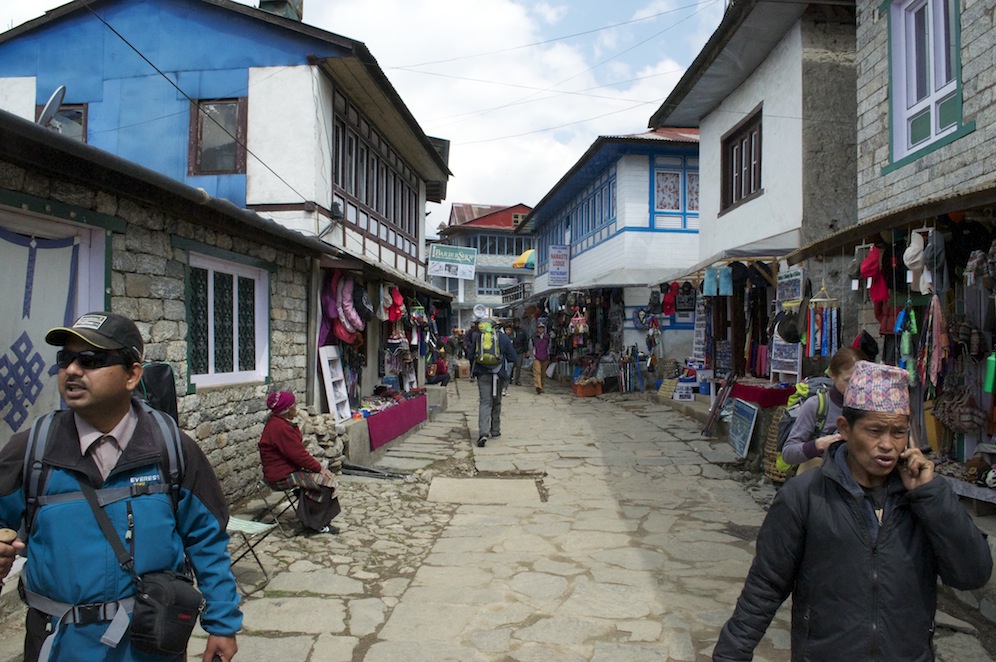
Main street, Lukla

Main street, Lukla

Stopping for an early lunch at Phakding meant we still had plenty of time for the final leg of the journey to Lukla. I was coping well with anything downhill or on the flat but struggled with my breathing on anything that resembled uphill. Karma predicted that it would take about four hours to walk to Lukla from Phakding but we actually did it in two and a half. The upside of completing the walk today is that I no longer need to put further stress on my chest. The down side is that instead of spending five days in Lukla, I now have six days to kill. How best to use this time? There is certainly not enough here to keep me occupied and boredom might feature fairly quickly. It occurred to me that I might best use my time by returning to Kathmandu on Tuesday in order to fulfil my duties for the charity with Saptagandaki and Tashi Waldorf, so that I can return to Lukla on Friday or Saturday to meet the group. The benefit of this is that my time with the group before their return to the UK and my time with Hira after they have gone will not be interrupted by other pressures. It all depends whether I can get a seat for a flight from Kathmandu to Lukla at a very busy time of year. Fingers crossed.

Khumjung to Phortse

I went to bed at 8.00pm convinced I was about to be sick. I went to sleep and had a pretty good night achieving 10 hours without too much interruption. When I woke at 6.00am I had the same sicky feeling I had gone to bed with. I had little motivation for the walk ahead and was not looking forward to it at all. Others were feeling the same without being ill and I could only attribute it to the lack of variety in our diet and the reliance on the potato, cheese and eggs with no room for anything fresh. I talked to Tanka while the rest of the group set off for the gompa. We agreed to simplify the diet with rice, dal and vegetables.

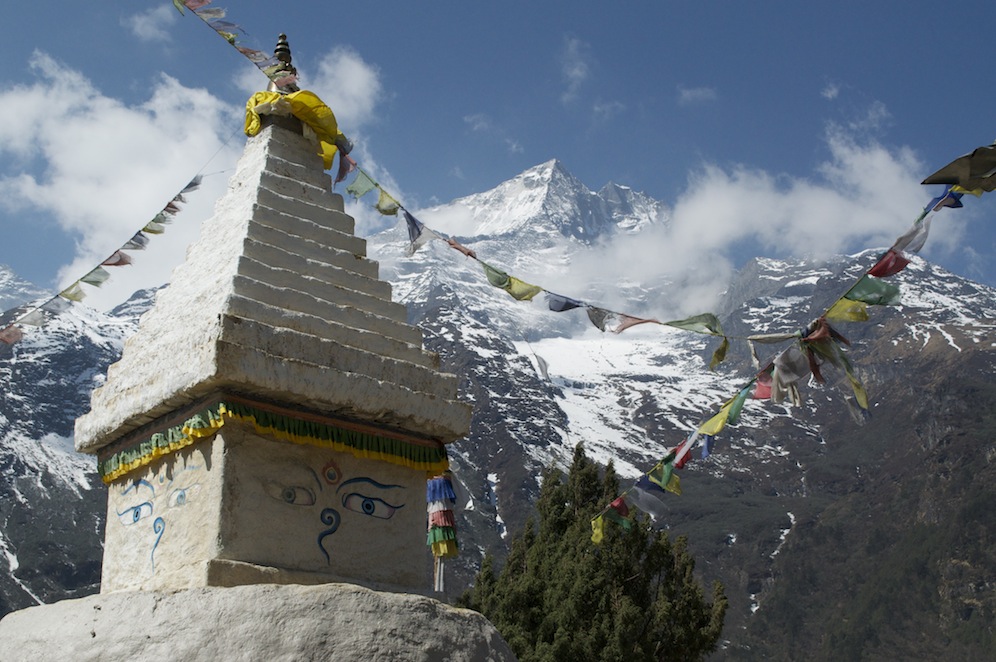
Prayer tablets of Khumjung Gompa

Prayer tablets of Khumjung Gompa

I caught up with the group at the gompa and waited for the key holder to arrive to open the cabinet containing the yeti scalp. There has been tight security since someone stole it a few years ago and got as far as Lukla before they were apprehended. Still the key holder would not open it until I had paid a donation.

We made enquiries about the deaf and dumb artist, Pemba, but nobody seemed to know what or who we were talking about. Sadly we had to give up and make a start on our day’s journey to Phortse. It would not surprise me if he has gone to live in America.Walking through a labyrinth of narrow stone wall tracks between potato fields awaiting their seedlings, we left Khumjung

As soon as we had left the village the track began to climb steeply up a series of steps hugging the cliff face. Since I last walked this track a hand rail has been installed in places suggesting that health and safety is creeping into Nepali society. At the top or the track it turned a corner out of the hanging valley that is home to Khumjung and Kunde into the main valley, all be it several hundred metres above the river below.

Mong

Mong

Before us the track climbed steadily up to Mong where there is a cluster of tea houses around a chorten. Despite taking it slowly we reached it at 10.30 and as this was our designated lunch stop we had plenty of time to relax and enjoy the stunning views of Tamserku and Kantega towering over us and Ama Dablam’s dramatic shape a little further away.I was, by now, feeling much better and more positive about the trek. Although I couldn’t eat all my lunch, it was a very welcome change of diet, also much appreciated by the rest of the group.

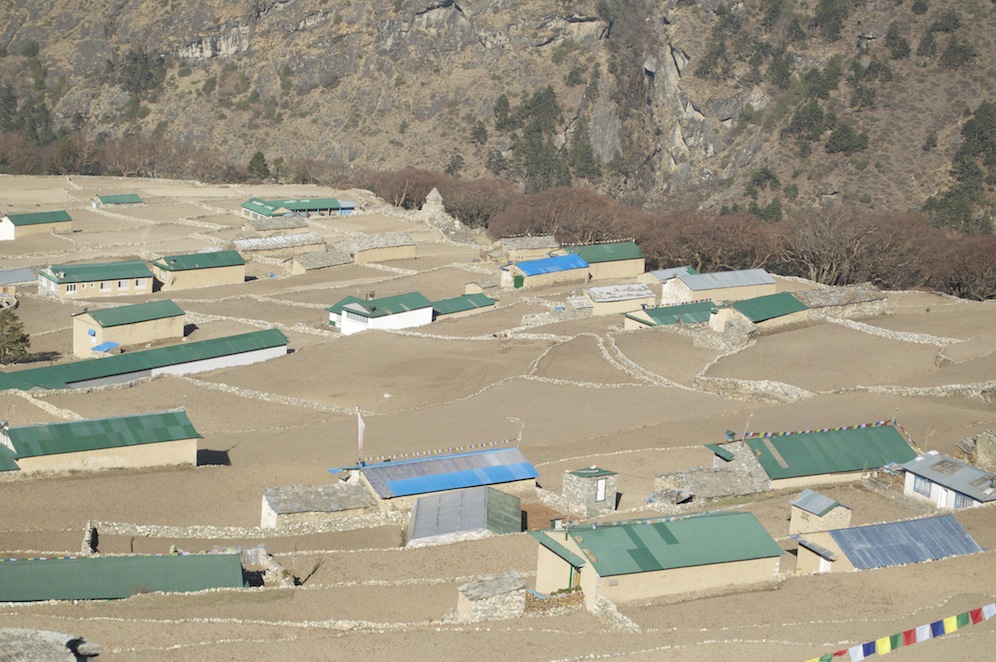
Phortse

Phortse

After lunch we dropped down 350m to Phortse Tenga where we crossed the river for the 200m climb up to Phortse. It is quite a windy spot but the sun is still warm out of the wind. We are surrounded by huge mountains, to the east those already mentioned and to the south the wall of mountains which make up the southern side of the Gokyo Valley. I am looking forward to watching the change of light as the day draws to an end.

Namche to Khumjung via Thami

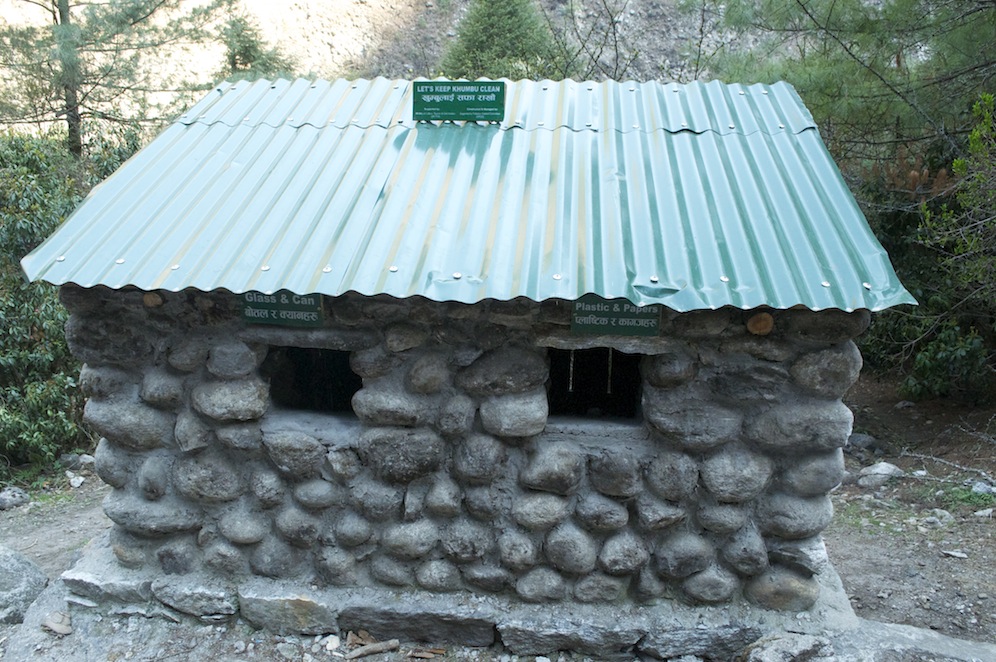
One of the new, successful rubbish bins

One of the new, successful rubbish bins

The Everest Trek was always known as ‘The Pink Tissue Trail’ but not any more. It is almost litter free. Every so often there are stone built waste bins segregated according to type – tin cans, plastic bottles and general waste. It is not only good to see a scheme in place but to see it working so well.

There are other differences. Virtually all of Nepal has mobile coverage and everybody has a mobile phone. Porters, as soon as they put their loads down, pull their phones out of their pockets and start communicating. Young people are plugged into their music and, as a result, there are fewer opportunities to say ‘Namaste’.

Porters in the Thami Valley

Porters in the Thami Valley

Namche has grown enormously and there is a chorus of hammers hitting stone from 6.00am to 7.00pm as yet more lodges fill in the odd vacant plots of land. In front of our lodge, Camp de Base, work is in progress building a new lodge surrounding and incorporating an existing lodge.  To one side huge lumps of rock, clearly needing to be disposed of for building work to commence, were being split and disposed of.  Under normal circumstances this would be a relatively simple task for a piece of heavy machinery to achieve.  Hear in Namche it is far from normal.  There is no heavy machinery, only young men armed with hammers and chisels.  The amount of effort these young men use is phenomenal, yet, somehow, they achieve their aim and the obstructing rock gets smaller until such time as it is no longer an obstruction.  At the end of each day there is noticeable progress, fine testament to the skill, determination and perseverance of the workforce. The broken lumps are carried to the other half of the building site where construction is taking place.  There, an army of stone dressers are chipping away, creating square edged building blocks, which, as soon as they are ready, are cemented into place.  Again the growth rate of the building is rapid and proves what can be achieved if there are enough people to working on it despite the lack of equipment.  What is happening in front of the Camp de Base Lodge is being mirrored in two or three other places in Namche.  More and more land is disappearing under buildings.  There is now very little room for camp grounds as, increasingly, people prefer to stay in lodges. This is in many respects a much more comfortable option but there is certainly less variety in diet with virtually no fresh vegetables and fruit.  At the start of the trek I made comment on how good the food was and how efficient the service.  Now that we have stayed in a number of lodges it is apparent that the menus are virtually the same with a ‘heavy’ reliance on potatoes, eggs and cheese.  Already I am beginning to tire of what is available and on offer and am experiencing early cravings for something fresh.

Internet connection is available in most of the lodges. The 21st C has reached the Khumbu. It is good to know that they still light stoves with dried yak dung.

Helicopters fly overhead constantly re supplying the increasing needs of the region but, sadly, denying many porters of work.

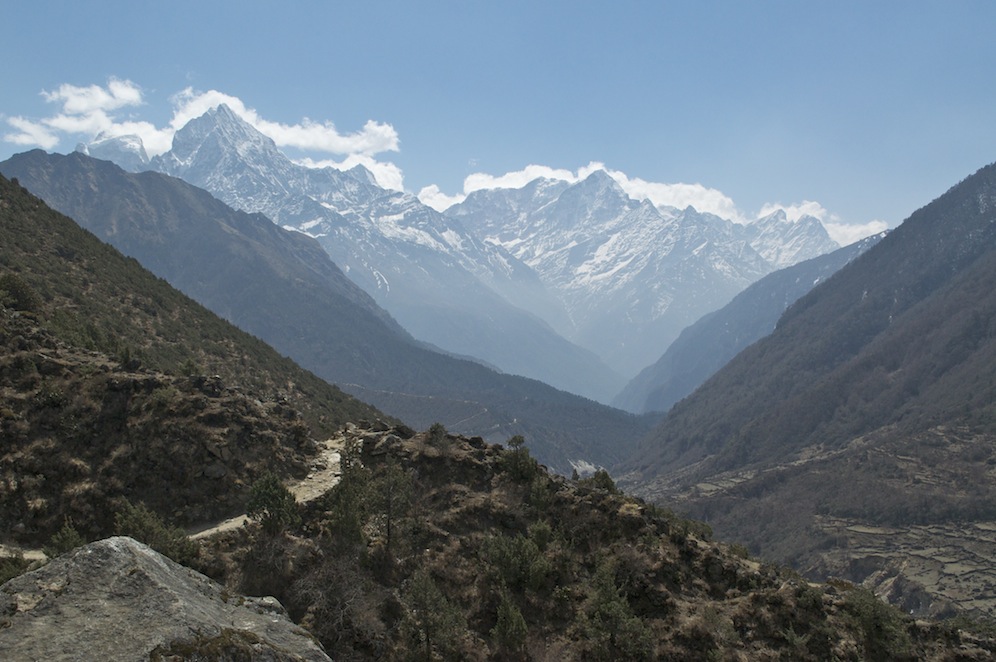
Looking back along the Thami Valley

Looking back along the Thami Valley

Leaving Namche, we headed into the Thame valley walking through forests of pine. The trail was generally uphill but at a relatively gentle gradient. We passed through the village of Thamo where Ang Rita Sherpa has a house, although he now lives in America. His claim to fame is that he has summited Everest 14 times. At the next village we stopped at a lodge for tea. There we were introduced to Dawa Nuru Sherpa who has climbed Everest 12 times and will shortly be joining an American expedition for his thirteenth. He looked about 35 but was in fact 49.

The beautiful Thami Valley

The beautiful Thami Valley

Dropping down to the Dhud Khosi we crossed the river and climbed up to the village of Thame. This valley and the villages within are much as the Khumbu was when I first came in 1993. We settled into our lodge run by the wife of Kami Temba Sherpa, the doctor at Kunde hospital. Later in the afternoon we climbed up to the monastery and watched the light change on the surrounding spectacular mountains. In the distance, to the east was the towering bulk of Cho Oyu, the world’s sixth highest mountain.

The following morning we retraced our steps. The going was good and we covered the ground well. Instead of returning all the way to Namche we took a detour up to Shyangboche airstrip and on to Kunde for lunch.

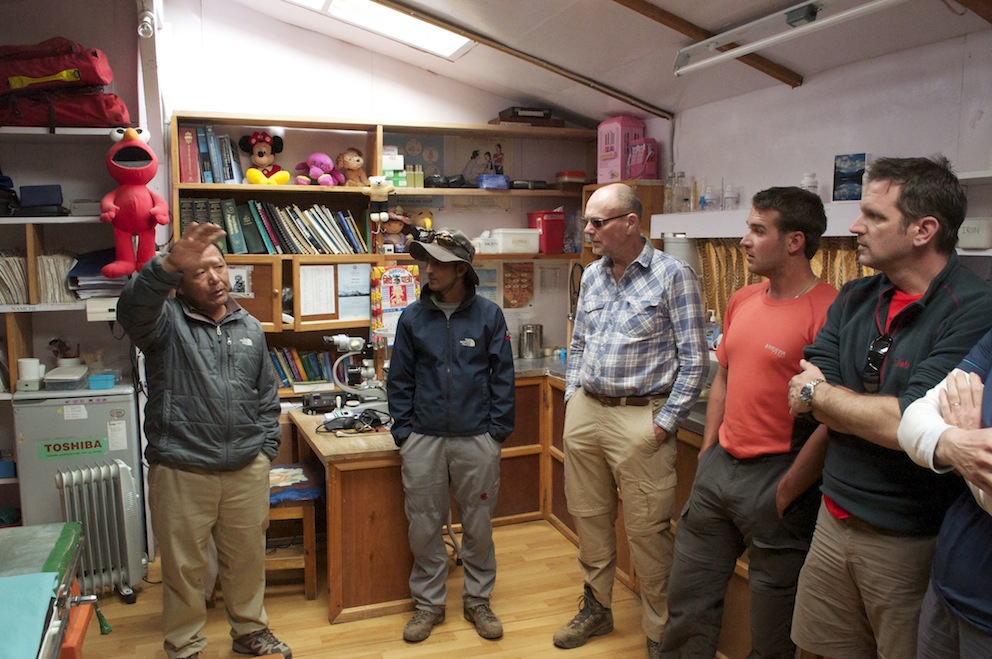
Dr Kami Temba explains the work of Kunde Hospital

Dr Kami Temba explains the work of Kunde Hospital

After lunch most of us went up to Kunde hospital to have a look, to meet Dr Kami and for him to tell them something of the work of the hospital. We had to wait a while while he treated some rather elderly Americans. He was very welcoming and warmly received us. He is a great ambassador for the achievements of the Himalayan Trust, a former student of a Hillary school who then went on to become a doctor after learning the skills as an assistant at Kunde Hospital.

From Kunde it was just a short walk to Khumjung and our lodge for the night opposite Khumjung School. Not only did the lodge have hot showers, it also had a washing machine in the front porch.  This really is progress.  Fraser decided to do his washing, paid his money and then spent ages trying to understand how the machine worked.  It was clearly a latest model as it kept giving out verbal instructions.  What it failed to tell him was that the machine was not plumbed in!  After much effort, reading of the handbook, support from the lodge proprietor who poured water into the machine, Fraser ended up with wet, not necessarily very clean, clothes. That evening a shield of wet clothes separated us from the yak dung burning stove.

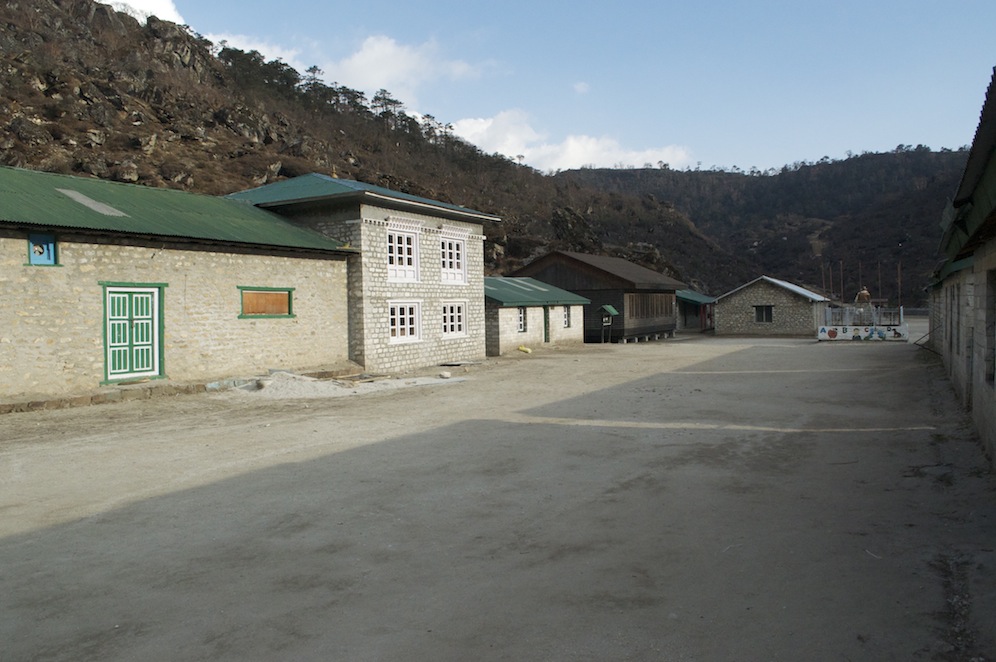
Khumjung School.  The building on the immediate left is the one we helped repair in 1996.

Khumjung School. The building on the immediate left is the one we helped repair in 1996.

Ignoring the temptation to do some washing, I had a very welcome hot shower and   popped over to the school to see Mohendra, the head, but he wasn’t there and it looked very much as though the school was on holiday. There were a number of children playing football and volley ball in the school grounds so I had a wander around to see how it had changed.  There are so many more classrooms and facilities, largely as a result of international fundraising from a variety of countries.

During the evening the temperature dropped but we had the luxury of sitting in the lodge with a yak dung burning stove chucking out a lot of heat while we watched Fraser’s washing dry.

Everest Base Camp 2013 – First few days


High rise, multi-laned Abu Dhabi

High rise, multi-laned Abu Dhabi

The flights with Etihad were good although the seven hours at Abu Dhabi were a bit of a pain.  Some of us took the bus into town to have a look to see what it was like.  Superb service along wide, fast roads.  We were dropped off at the bus station but that, we discovered after much wandering, was actually not very close to the heart of the city.  There are some fantastic pieces of architecture but the roads are all 8 lane highways which take an age to cross.  You can only cross half at a time so much time was spent standing in the middle of the road as cars, none of which were small, sped past at 60 miles an hour.  We eventually finished up in a Philipino bakery for bread rolls and coffee before heading back to the airport.  While we waited for a bus we were pestered to use a taxi at a greatly inflated price.  We waited for the bus which came on time and sped us back to the airport along the wide highway fringed with well manicured flower beds amongst sculpted stones.

Somehow between being given my onward boarding card at Heathrow and returning to Abu Dhabi airport the two halves of the boarding card became separated, rendering it not acceptable to security as I tried to go through passport control.  So, while the rest of the group went back into the terminal to sample the delights there, I queued for an hour at check-in to get a new boarding card.  What a delightful way to kill time.Eventually making it back into departures I met up with Mary Lowe who would be flying with us on the second leg of our journey.  I am not sure I would bother going into Abu Dabi again, if the occasion arose, although if we could have got into the centre or by the water’s edge it might have been more interesting.

Arriving in Kathmandu at 7.30pm it took an age for us to get our visas but the luggage was only just through by the time we were through.  Outside we were met by Hira and Bishnu and taken to our hotel, Hotel Tibet ….ternation… not all the letters were there.  I woke Stephen and Nathan to come and greet us and to have a beer while we waited for some food to be produced.  We waited a long time.  Stephen was clearly very tired from his week of travelling the globe.

The following morning I ventured up to the roof top restaurant for breakfast and a meeting with Gael Robertson who conducted the inspection of Happy Home for us.  It was an interesting conversation and further convinced me that we had made the right decision, although it would appear that Bishwa is beginning to take on board some of the suggestions I have made.

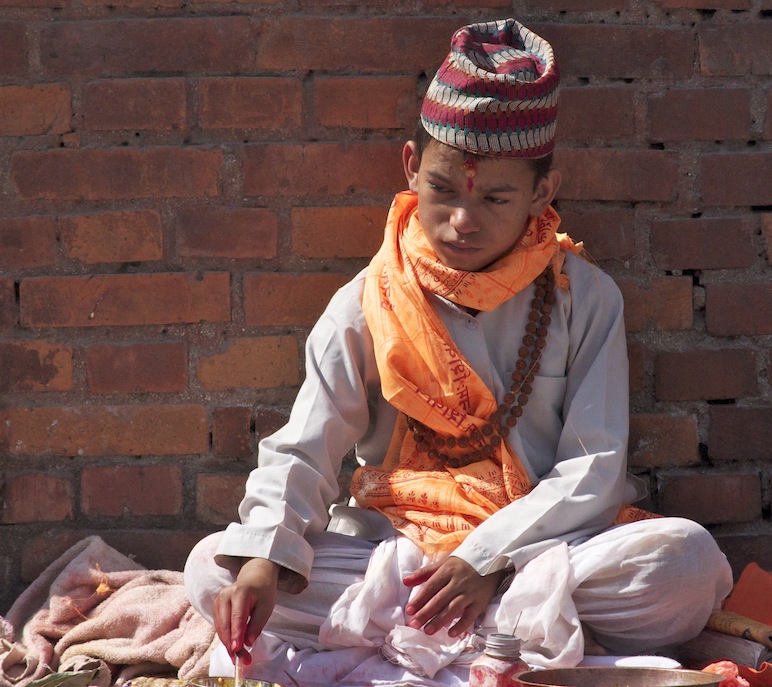
Young boy mixing tikka dyes

Young boy mixing tikka dyes at Pashupatinath

After breakfast we went to Pashupatinath to watch a few cremations and to generally soak up the atmosphere, before heading off to Swayambunath, the Monkey Temple, which was heaving with Hindu worshippers, remarkable in that it is a Buddhist site with Hindu attachments.  Leaving Swayambunath we went to Durbar Square.  Here I was able to have some new experiences for some of the palaces, which had previously been closed to the public, were now open.

Our morning tour over we went to the Organic Cafe, adjacent to the Third Eye, for lunch.  Here we met Hira again and he and I had an opportunity to discuss and plan my few days after the group has returned to the UK.  After lunch I took those who were buying sleeping bags and down jackets to Shonas before heading back to the hotel with Stephen and Nathan to meet up with Jeannie, Laura and Anna.  We sat on a roof terrace drinking beer and hearing of their stories from Nepal.  They were very excited to see us and they had plenty to say.  Tshewang joined us for a while and I was able to give him the funds he was expecting and hoping for.  The girls stayed for dinner.  The service in the restaurant was poor and we waited for an hour and a half for our food to come.  We are not staying here when we return to Kathmandu.  The hotel lacks character, doesn’t have a garden, has extremely poor restaurant service and there is nowhere near to hand where we can eat if we tire of poor service.  Jeannie has decided to give up the idea of being a doctor and wants Stephen to teach her to fly!!!  Having put the girls into a taxi I went back to the dining room to join Fraser, Simon and Nigel and continued there until midnight.

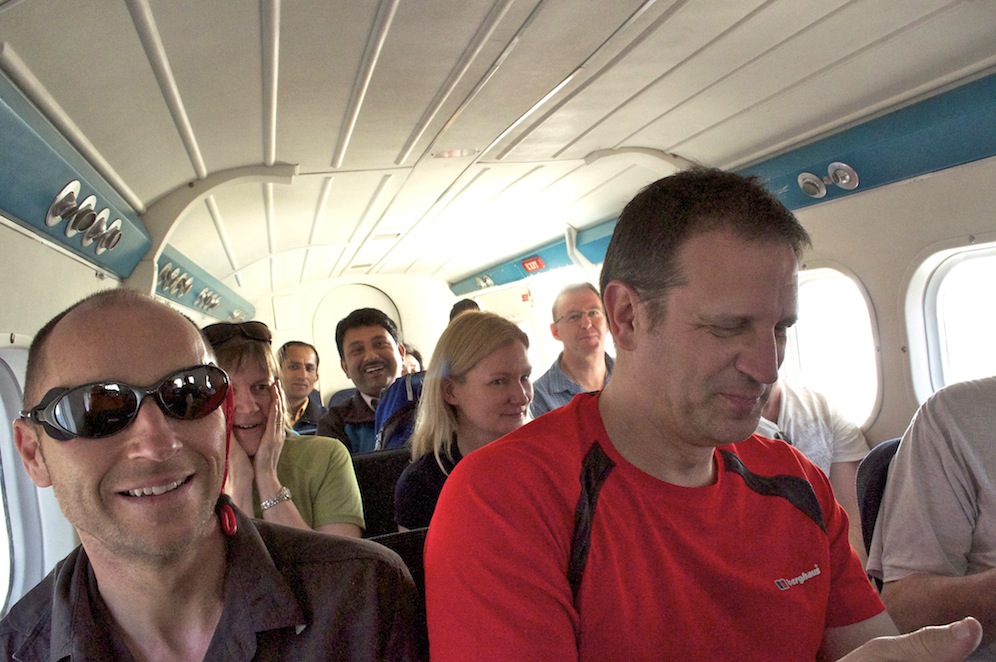
Mixed emotions on the flight to Lukla

Mixed emotions on the flight to Lukla

The following morning we had an early start for our flight to Lukla.  Leaving the hotel at 6.00 we were surprised how organised and relatively quiet the airport was. The domestic departures is usually very chaotic.  Not so today.  We were all on the same flight.  Stephen and Nathan sat in the front two seats so they could take over if disaster loomed.  It was a very smooth flight but they were both impressed and Stephen kept saying he wanted a job in Nepal.  Leaving the airport we went to Paradise Lodge.  Pasang, who runs the lodge, was my first Sirdar 20 years years ago.  He doesn’t really run the lodge, Dawa, his wife does that.  She is a very strong woman who has recruited a team of young, local people to work for her.  They work incredibly long hours but Dawa is like a mother to them and they are incredibly devoted to her.  Dawa gives them skills, discipline and a brilliant work ethic which sets them up for life and probably gives them the start to adult life which will help them achieve success. Mary Lowe is staying here, having floan up the previous day, and she joined us while we waited for our kit to be sorted.  Once that was done we headed up (actually we drop a couple of hundred metres) the valley to Phakding where we were staying for our first night.  Previously I have only ever camped but in the ten years since my last visit to this region there has been a huge amount of development.  Not only did I have a room to myself but I also had en suite facilities.  The food was good and the service was excellent.

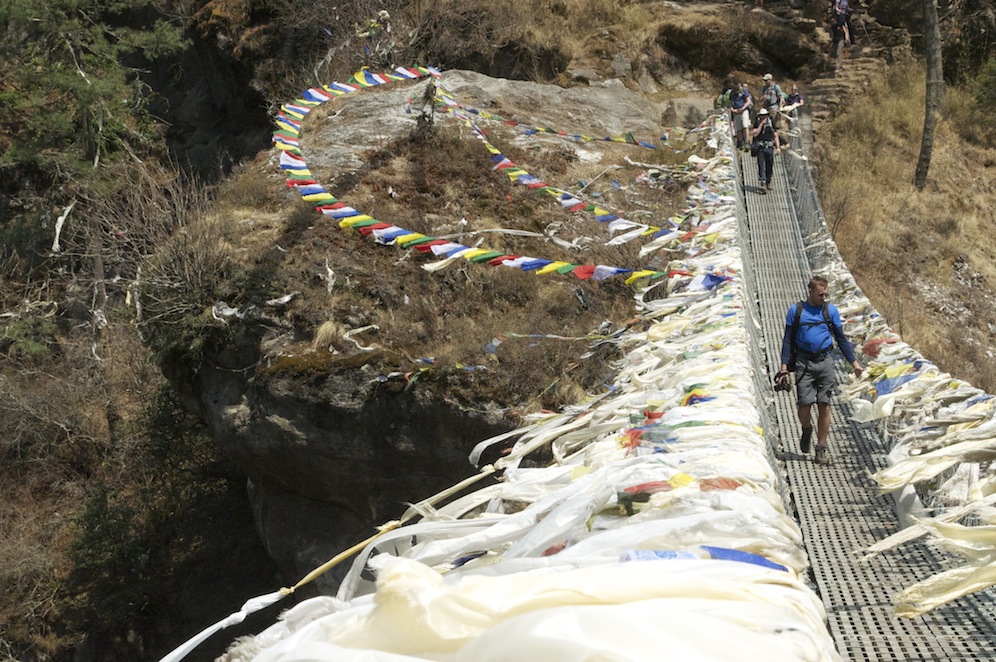
The bridge at the foot of Namche Hill

The bridge at the foot of Namche Hill

The next morning we continued up the valley towards Namche.  Robert was ill and found the going hard.  We stopped at the lodge just before the entrance to the national park run by Ang Darki.  She remembered me despite there being a ten year gap since my previous visit.  She gave me a handful of fruit as we left.  Ahead of us was the dreaded Namche Hill but before we reached it we stopped in Jorsale for lunch.  The hill does not get any easier but we did it, even Robert who managed pretty well to keep up with the rest of us.

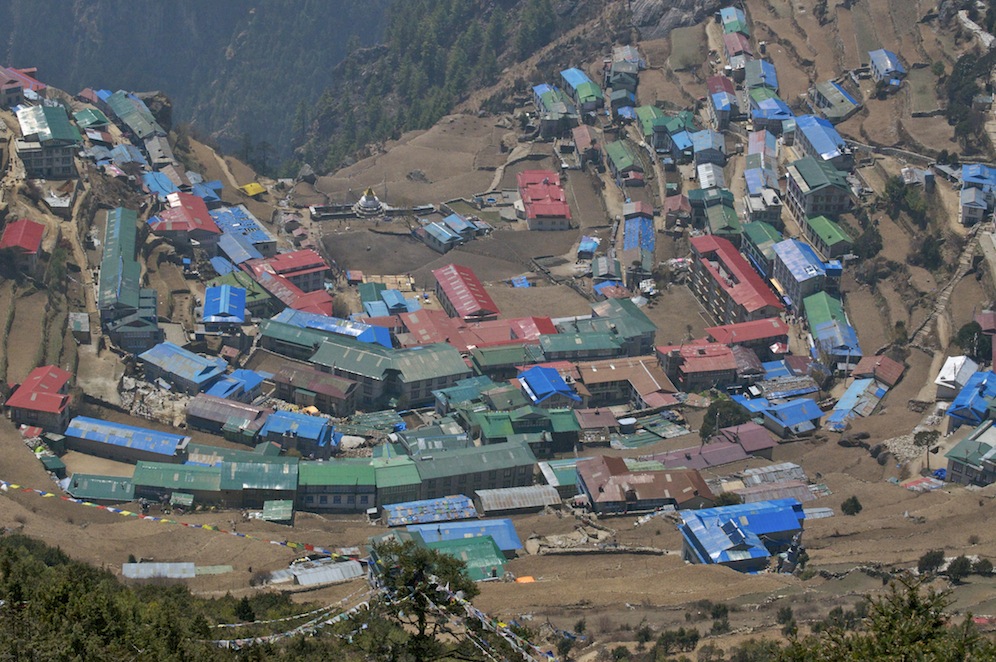
Ever growing Namche Bazaar

Ever growing Namche Bazaar

Namche has grown enormously since my last visit, with hardly a square inch of land left that has not been developed.  There are many more large lodges and virtually all the camping ground has given over to building.  There is the constant noise of hammers hitting chisels as stone is either being broken up or dressed.  Again our lodge provided us with en suite facilities, including hot showers.  How much has changed in just a few years.
I had been expecting to have disturbed nights on this trek with barking dogs but in both Phakding and Namche none were to be heard and long nights of sleep were achieved.

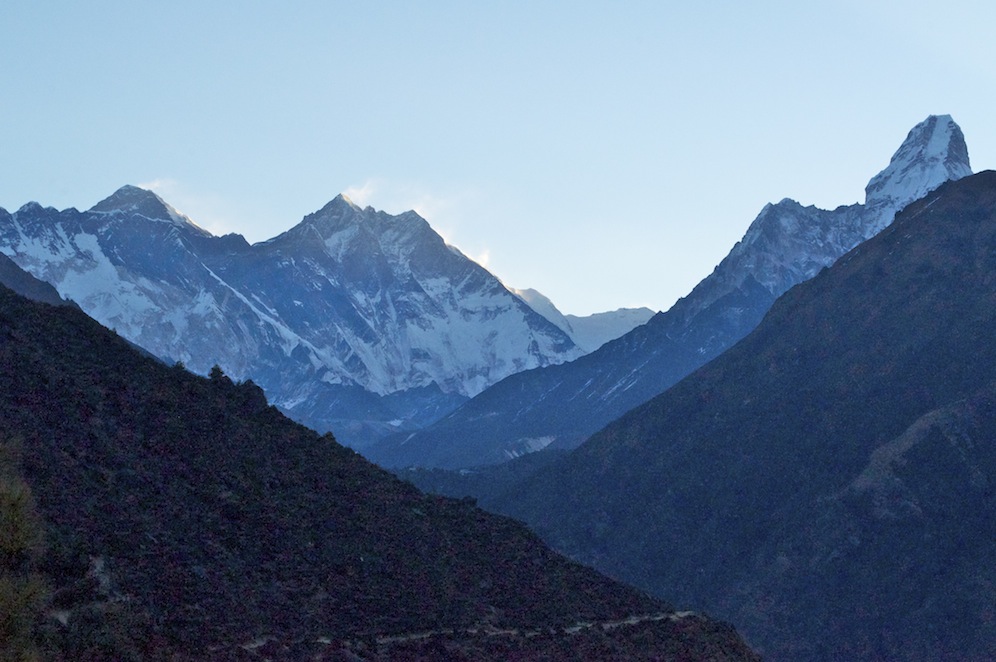
Early morning light on Everest, Lhotse and Ama Dablam

Early morning light on Everest, Lhotse and Ama Dablam

After a good, quiet night’s sleep we got up at 5.15 to go to the National Park headquaters to watch the sun rise.  Spectacular views. Considering how many people were staying in Namche it was remarkably quiet on the knoll as we watched the sun rise, bringing Everest and her neighbours into view and casting a yellow light on the peaks to our east. There can only have been three or four other people to share this spectacular experience.  Their loss was our gain.

Imposing Thamserku towering above Namche

Imposing Thamserku towering above Namche

Following breakfast we then climbed up the steep ridge to Shyangboche air strip (the highest in the world) before continuing to the Everest View Hotel for coffee and chips on the terrace, looking at the view of Everest, and others, up the Khumbu.  Stephen and Nathan were fascinated by the airstrip, which is in the process of being lengthened, so, at the moment, only helicopters can use it.  There has been a lot of helicopter activity with loads being transported up to base camp etc.  Stephen fancies flying helicopters!  Then it was back down for lunch and a free afternoon.
The walking does not get any easier but when it is over the rewards are fantastic.

Myanmar (Burma)

For those of you still interested in going to Burma, don’t give up on me yet.  I am travelling there in November to see for myself and to come up with a much more cost effective itinerary for either 2014 or 2015