Indonesia – Java mountain trekking

Flying from Medan, we left Sumatra, and flew to Jakarta for a brief stop over before connecting with a flight to Surabaya, Indonesia’s second largest city.  Following a meal in a restaurant not too far from the airport we drove by coach to Malang, a journey of about two hours.  While most of the group slept in the coach, I had the disadvantage of sitting at the front and could observe what was happening in front of me.  Not only did the driver seem to drive extremely quickly but some of his manoeuvres were frightening.  I am used to differing standards of driving throughout the world and normally I am not affected by them, largely because most of the time everything is so much slower than in the UK.  This driver was fast and the vast majority of the journey was through an urban sprawl with vehicles, motorcyclists and pedestrians often doing the unexpected.  There was no room for error.  Strangely, the vast majority of the time we were undertaking rather than overtaking, because lorries tend to occupy the outside lane.  However, it seemed that it did not matter which side you overtook vehicles by but our driver relied very heavily on other drivers not changing their minds. I was happy to arrive at our overnight hotel in Malang in one piece.

Despite the lateness of the hour we had to sort our kit for the next day, ensuring that we only took what was necessary for the trek and left all unnecessary kit in our kitbags to be held in store once we reached the starting point of the trek at Ranu Pane. It was just as well that we did sort out our kit as Freddy came to my room to confess that he had been rather foolish and left his boots in Tangkahan, almost a thousand miles away in Sumatra. Emma confessed to not having sleeping bag.  There is always a solution to any problem and it did not take long for Freddy to occupy my boots, filling the extra space with a second pair of socks, while I used my ageing trainers and Emma, like the rest of us would be supplied with a sleeping bag more suited to the mountain environment that our thin jungle bags.

Not the safest way to take your child

Not the safest way to take your child

As Malang was waking up the next morning we set off in a convoy of land cruisers for the final leg of our journey to the mountains. Nearly everybody has a motor bike and the roads were already becoming crowded as they jostled for position. The risks some people take with those closest to them is remarkable and there does not seem to be an authority to ensure that unnecessary risks are not taken.

Leaving Malang we began to climb.  Emerging out of the haze in the distance ahead of us were conical shaped mountains and one, in particular, which seemed much higher than all the rest, Mt. Semeru. As we drew nearer and gained height the mountains began to show themselves more clearly.  Semeru gave off a puff of smoke as it gave a volcanic cough, something it does about every half hour.  It looked impressive with steep slopes leading up to the crater rim.  What was closer was equally impressive.
The precipitous intensive market gardening around Ranu Pani

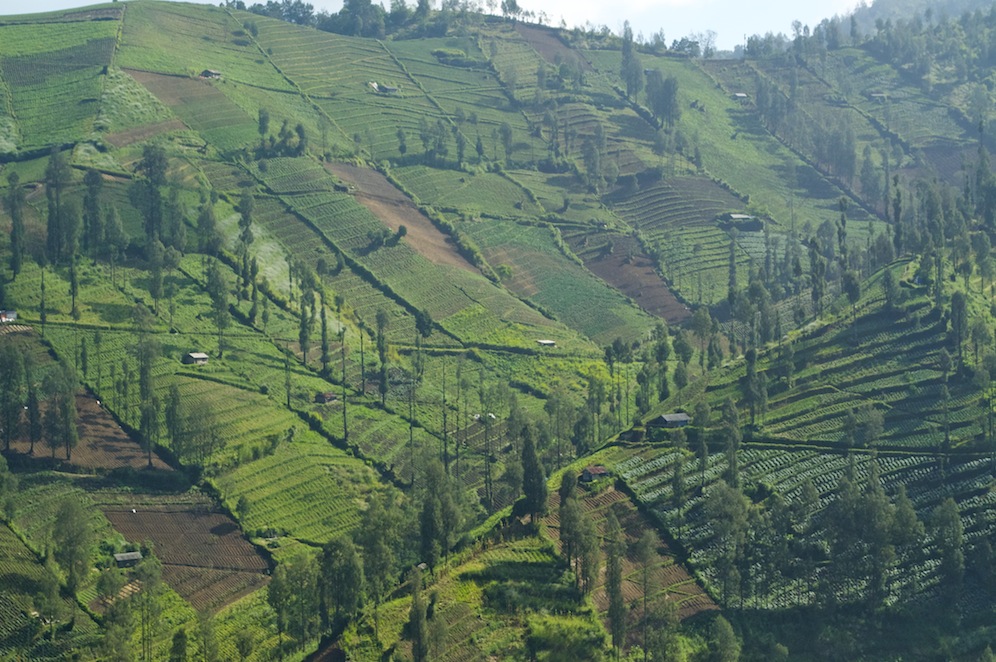
The precipitous intensive market gardening around Ranu Pani

We were entering a huge caldera with the ancient crater rim rising steeply for several hundred feet.  The natural vegetation was lush suggesting that the volcanic remains are very fertile. That clearly became so when we saw the type of intensive market gardening that takes place on the slopes higher up.  Not content with just one crop per field, the soil has the capacity to cope with three!  Potatoes occupy the mounds striping the fields but between each mound cabbages are growing and all around the edge onions. The slopes are so steep that no machinery can work on the land, it all has to be done by hand.  Drainage and soil creep must be an issue but there was no evidence of a problem as people worked on the precipitous fields.

Ranu Pane is a large village centred around a small lake (Pane – water) and which relies on agriculture and tourism for its prosperity.  During the high season as many as 500 tourists a day can trek to Semeru, Java’s highest mountain at 3676m.  In amongst all the farm houses are homestays and guest houses catering for this mass influx of people. At other times of year the houses lay empty.

On arrival we met our new crew and made final preparations for our trek to our camp at Ranu Kumbolo on the shore of a small crater lake.  As we left the clouds rolled in giving an atmospheric feel to the place. The trees dripped on to us and lichen hung down from the branches; we were in a typical cloud forest.  The path was easy and had been paved for the first few kilometres but even when the paving ran out the path was easy, only gradually gaining height.  Every so often there were shelters for trekkers and crew to rest in on their 13km walk to Ranu Kumbolo. I was really disappointed to see lots of rubbish strewn about these areas, sweet papers, food wrappings and plastic water bottles.  We had seen nothing of this nature in the jungle.  Why was this area any different?
Camp by the lake at Ranu Kumbola

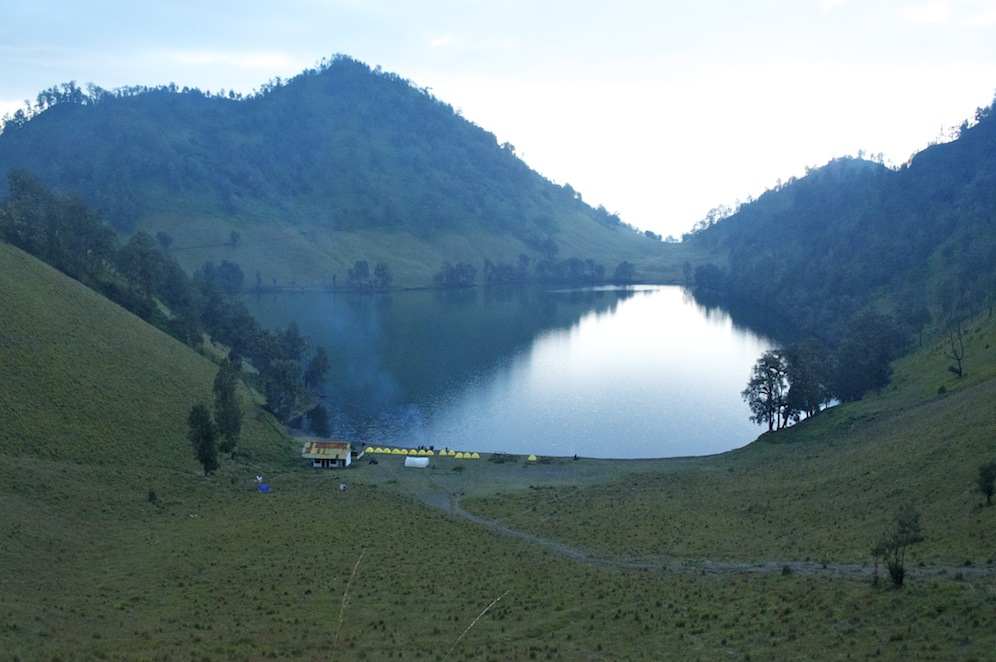
Camp by the lake at Ranu Kumbola

The clouds still rolled in and we were almost on top of the lake when it appeared through the mist. It is not a huge stretch of water but it took us a while to walk round to the other side where camp was situated on the shore.  A line of tents a few metres back from the water’s edge was our camp for the night.  As te sun came out it looked an idyllic spot.  A couple of huts nearby denoted the kitchen area and accommodation for the crew.  As we approached the camping area the litter increased and by the time we reached the tents there was an unacceptable level of waste.  What a disappointment.  Worse was to come when we discovered that there were no toilet facilities and that in the grass, among the trees and along the lake shore to either side of camp was a disgusting mix of human excrement and toilet tissue!

Lunch was eventually produced and while it was very tasty there was not enough of it, lots of rice but very little chicken or vegetable and we had to ration everybody to make sure that it was shared out equally. This was the norm for every meal on trek.
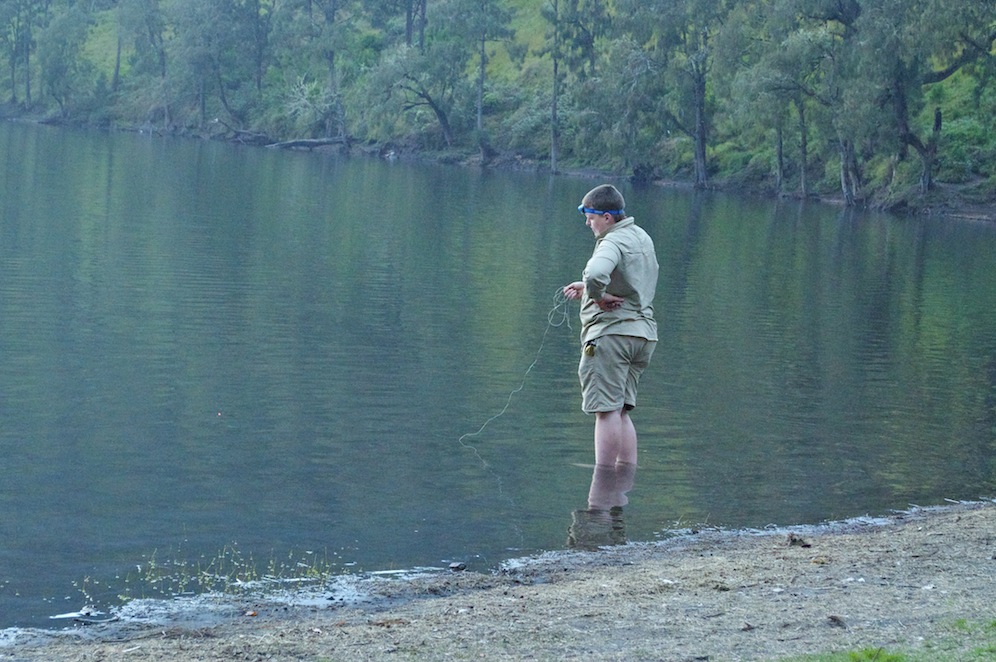
Tom patiently catching nothing

Tom patiently catching nothing

In the afternoon a group went off in search of fire wood so we could have a camp fire and cook the fish that Tom was going to catch with his makeshift line and hook.  I took myself off for a little explore and to see if I could have a look at Semeru.  Unfortunately the cloud kept it veiled from my gaze.  By the time I returned the fire was burning and Tom was still creating his fishing line.  Some of the porters were fishing with similarly makeshift lines, but, unlike Tom, they kept catching fish.

The following morning I woke early to watch the sun rise from the other side of the lake.  The water was as still as could be, mirror like, but we did not get the early morning colours I was hoping for.
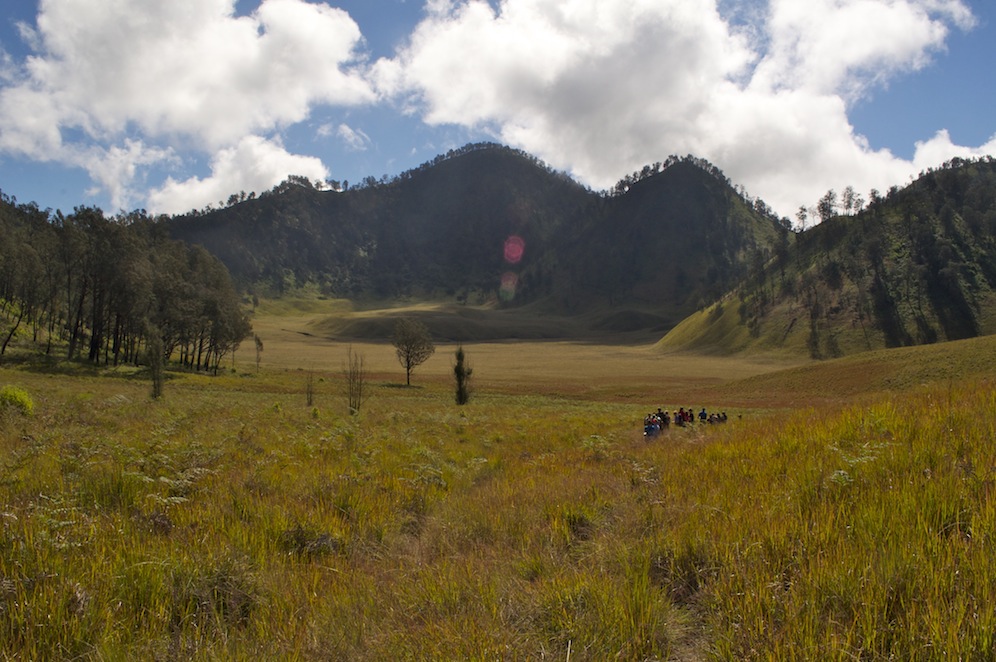
The savannah grasslands

The savannah grasslands

Today’s walk was only a matter of a three hour trek to Kalimati, the base camp for Semeru, so there was no rush.  Before heading in that direction we went to explore the savannah of a nearby valley.  It was spectacularly beautiful with a richness of colour to the grasses.  It felt as though we should have been watching wildebeest and giraffe ambling across the scene.

After this short detour we headed off towards Kalimati, leaving our crater lake valley to cross a pass into another grassy crater area.  There was still no view of Semeru.  On the other side of the crater we began to climb up through some thin woodland to the opposite edge of the old crater.  Many trees were severely charred from a fire which ripped through the area three years previously.  While the larger trees were surviving all the smaller ones had perished.  Nature was beginning to repair the damage but nothing would hide the charring effect.
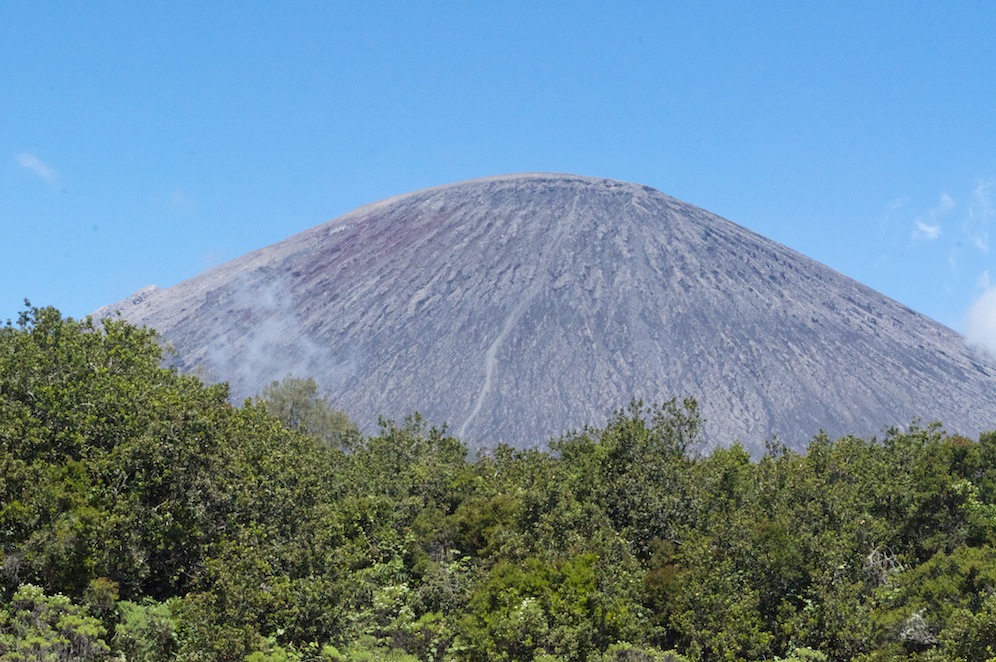
Our first view of Seramu.  You can clearly see the route up the scree slope to the summit.

Our first view of Seramu. You can clearly see the route up the scree slope to the summit.

Reaching the crater rim we got our first clear view of Semeru, a text book example of a cone shaped volcano.  Semeru gives off a puff of smoke approximately every thirty minutes but it is still regarded as a very active volcano.  At Ranu Kumbolo there are several memorials to people who have become victims of Semeru. In 1981 250 people we killed in an eruption and the last major event was in 2002 when two Pyroclastic flows travelled 2.5km down the mountain.  Looking at the mountain you couldn’t help but think that getting to the top was going to take a few hours of hard work.

The path dropped down slightly to Kalimati and camp.  If I thought Ranu Kumbolo was a litter strewn mess, Kalimati was ten times worse. There was rubbish everywhere and although some had been gathered into piles, nothing had been done to dispose of it.  It was left to rot and attract flies, making the environment unpleasant.  The afternoon was spent, away from camp, relaxing in the sunshine and conserving our energy for the early start for the summit. We met and chatted to some Malaysians who had been to the summit earlier in the day and they talked to us of seeing the sun rise in the east while also watching the full moon set in the west. They spoke eloquentyly about stunning 360 degree views etc. etc. We hoped for the same.

We were due to be woken at midnight, have a drink and a bite to eat before heading off for the summit at 1.00am.  Sadly we were not very impressed with our leader and his crew. Communication had been minimal and there was no desire on their part to become involved with us.  We hardly ever saw our leader and he had chosen not to come to the mess tent for the pre summit briefing the evening before.  Needless to say the wake up call never happened and eventually a voice asked if we were ready at 12.50am. Needless to say it all became a bit of a rush and we finally left at 1.30am.  This put me in a bad mood and I was not happy.  I was also not happy with the conditions. High clouds were scudding across the sky at 50mph and a bank of much lower cloud, a front, was heading in our direction. I felt uneasy about the conditions and felt thewre should be some discussion with our leader who should also be able to read the conditions. Unfortunately, he did not want to enter into any discussion. Jim and I discovered that if we asked him the same question twice we got completely different answers each time. I began to question his suitability for the job and to wonder just how well he knew this mountain.

The first half of the climb took us through the forest, climbing steeply.  The going was quite tough and I was now in the wrong frame of mind for this.  I felt sure that some of the group would be suffering, both physically and mentally, but I am full of admiration for them as they stuck to the task very well.  In the upper part of the forest it began to rain as the cloud thickened and then cleared again temporarily.  We set out from camp with six guides to help with the ascent but by the time we reached the edge of the forest three, including our leader, had disappeared. It was a hard slog up the loose scree and the effort required to prevent feet from slipping back made it all the more tiring.  Soon the heavy bank of thick cloud shrouded the mountain and visibility became very poor.  It started to rain heavily and some began to struggle in the worsening conditions.  Still the spirit was there and nobody showed any inclination to turn back, not until they were told that it was another two hours to the summit.  Hearts sank and it was at that point that the decision was made to abandon the summit bid and return to camp. The descent down the scree slope proved interesting as the rain came down heavier and heavier.  Thunder rumbled around the summit and by the time the forest was reached the path was a river of mud and water, making the steep descent slippery and treacherous.  Remarkably, our chief guide re-appeared in the forest but was completely detached from the group and gave no help at all. By the time everybody reached camp they were completely soaked and bedraggled. It was cold and miserable.  To make matters worse half the camp was flooded and before we could get into the tents we had to move them.  Again, the crew were no help at all and our leader disappeared into his own tent rather than helping or instructing others to help.  Now, not only was everything we were wearing soaked but also the rest of our kit.  If we were to feel any comfort at all we needed to get off the mountain and down to Ranu Pane in one day rather than two. To make matters worse the guides who told us it was another two hours to the summit confessed that we were, in fact, only twenty minutes from the summit, well within reach and the capability of the group.  The only positive we could take from that is that the conditions would have been far worse when higher up on the mountain. The prospect of camping on the lake shore at Ranu Kumbolo held no joy, particularly as our water for cooking and drinks was taken from the lake and the heavy rain would have washed a lot of the human waste into the lake.

The rain continued to pour very heavily and what was once a path was now a fast flowing stream. Having taken tea to everybody in their tents, I sheltered in one of the huts and watched, with horror, as some of the crew threw rubbish into the fast flowing water for it to be carried off.  They were even taking bags of rubbish off the rubbish pile and sending them down.  Inevitably these would get stuck somewhere and the litter problem, instead of being solved, would just become more widespread. The national park has a lot to do to both redress the problem and educate the local guides and crews to respect the environment in which they work. I would not want to return and could not recommend anybody else coming to this area until something concrete is done to both clean up and protect the environment. It is a stunningly beautiful area and deserves to be cared for.

We waited for the rain to ease but it kept coming in pulses so we made the decision that the longer we stayed at Kalimati the colder and more miserable we would become. Moving would keep us warm, so Jim took the first group who were ready and set off for Ranu Kumbolo.  I followed with a second group a few minutes later. The paths were flooded but it did not really matter as our feet were already soaked.  As soon as we climbed up from Kalimati and dropped into another part of the caldera the rain eased, suggesting that the worst of it was around Semeru itself.  The path was very slippery in places and every-so-often one or other of us would slip and fall. This was where there was a marked difference between this crew and the one we had had for the jungle trek. On our walk out from Semeru, whenever anybody slipped and fell the crew would watch and then walk by.  There was never a helping hand or support or guidance of any kind.  Such a contrast.

Following lunch at Ranu Kumbolo we headed back to Ranu Pane, but not by the route we had come in by. Our guide told us that there had been a landslide and that it was dangerous.  The alternative route took us into the savannah grasslands and a long, treacherous climb over the rim of the caldera. The path was so slippery we would have been better off with crampons, and there were signs of landslips on the more exposed parts of the path. Meeting other trekkers who had used our original route, I leasrned that there had not been a landslide and that the path was safe.

The group became fragmented and I found myself, along with a guide, walking with four tiring girls.  It had been a long day.  They had been up and walking for the best part of fourteen hours in less than comfortable circumstances. While resting, our guide just disappeared and we never saw him again. As a result, we took a wrong turning and walked for an unnecessary extra hour as we approached Ranu Pani.

By the time we reached the lodge where we started I was furious. Most of our crew had disappeared home and nobody knew where the key was to release our kitbags from a store room. Our discomfort had to be endured further. In the meantime we looked at some lakeside rooms and decided we would stay there for the night. The accommodation was in quite pleasant, lakeside houses, and we chose one for the girls and an adjacent one for the boys.  As soon as we were able to release our kitbags we were able to feel a lot more comfortable.
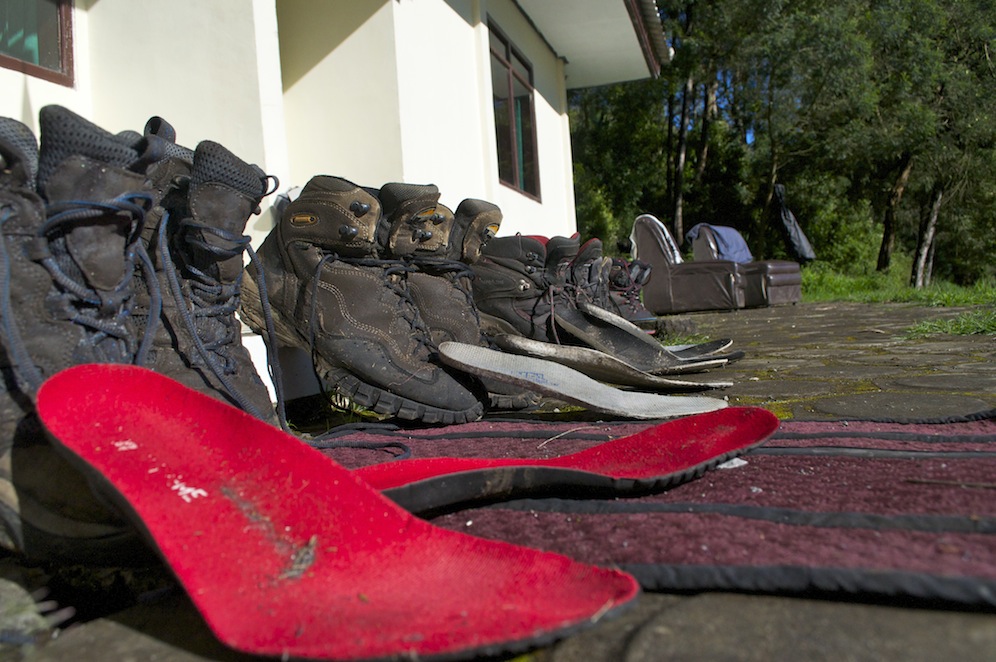
Boots drying in the early morning sunshine

Boots drying in the early morning sunshine

The following morning the sun was shining. We struck very unlucky with our Semeru ascent day, but in some respects, experiencing the conditions we did, actually made the day more memorable. Jim and I were up early and began to sort out our wet kit, hanging it in the sunshine to dry.  We also collected everybody’s boots a lined them up on the terrace overlooking the lake. Steam soon started to rise from them and the clothes above.

Gradually the students began to emerge and sort their kit.  We were not leaving until after lunch so there was a fair chance that most of it would dry, providing the weather remained favourable. The students appreciated the opportunity to relax.
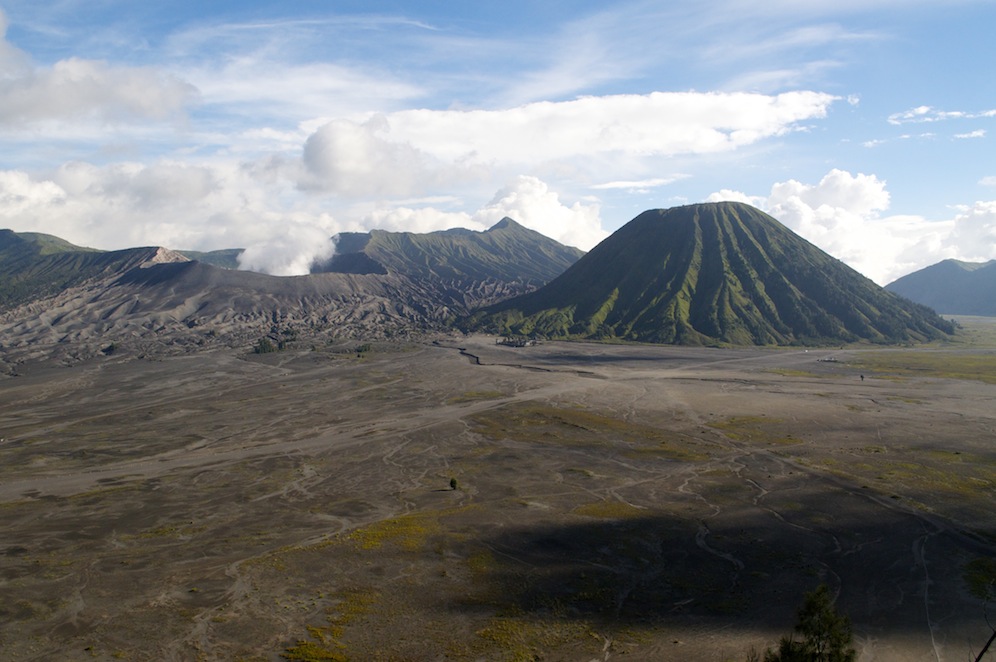
The view from our hotel.  Bromo is the lower smoking peak on the left.

The view from our hotel. Bromo is the lower smoking peak on the left.

I can’t say I wasn’t disappointed to leave Ranu Pane.  We left behind most of the crew but still had our leader and a couple of his most senior assistants.  During the short journey to Bromo I tried to strike up a conversation with them but they seemed reluctant to get involved. Driving up a savannah type valley we rounded a corner and entered a barren desert like area of volcanic dust, the result of Bromo’s last major eruption in 2010. Passing spectacular volcanic scenery we climbed out of the valley to our hotel on the edge of Bromo village. This was luxury after our experiences of camping on Semeru and we were having some time to enjoy it. The view from the hotel was stunning and I felt sure that this was going to be the highlight of our time on Java.

The following morning we got up at 3.00am for a 3.30am start, travelling in land cruisers, to a view point for the sunrise. As we left our rooms there was a strong smell of sulphur in the air.  There were headlights all over the valley and the hillside opposite as just about every tourist in the region seemed to be going to the view point. The congestion of vehicles near the top meant we had to walk the last few hundred metres, passing a host of small trinket stalls and cafes. The viewing platform was crowded and there was a buzz of anticipation as the sky in the east began to lighten. It reminded me of the occasion when I was staying in Darjeeling and went up Tiger Hill to watch the sunrise over Kangchenjunga. It was a similar atmosphere.
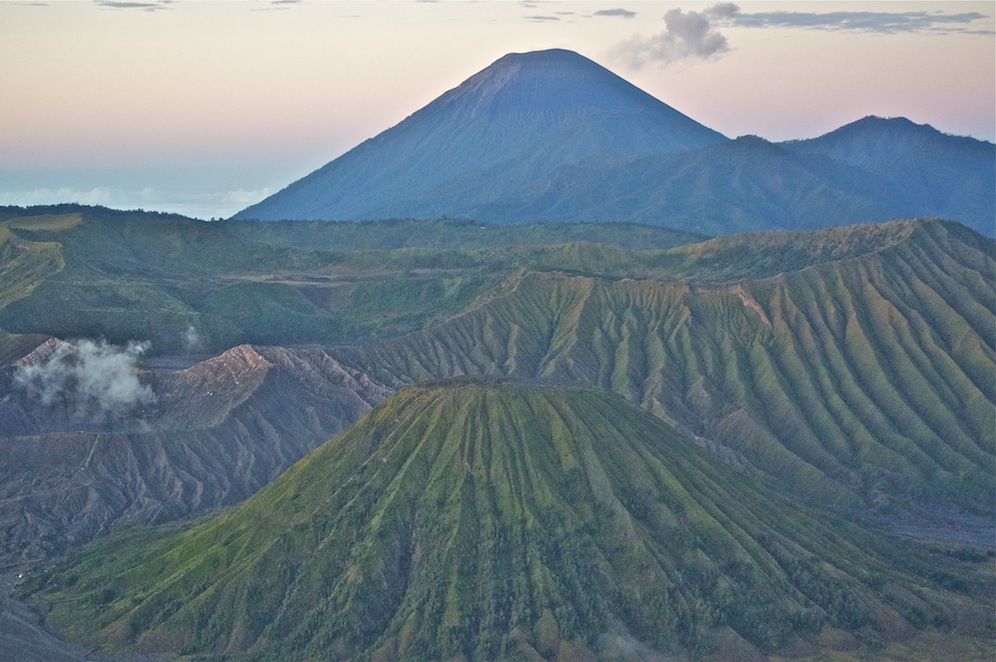
The view at sunrise with Bromo smoking in the foreground and Semeru sending out a puff of smoke in the background.

The view at sunrise with Bromo smoking in the foreground and Semeru sending out a puff of smoke in the background.

Gradually the sun rose casting a beautiful light on the volcanoes in front of us. Bromo was smoking constantly but there were occasional puffs of smoke from the towering summit of Semeru in the distance.  It was stunning, such a moonscape. Once the sun was up everybody began to leave. Knowing it would be chaos as the hundreds of land cruisers sorted themselves out, we went into a small cafe for tea, coffee and banana fritters.

Perfect light

Perfect light

While there I decided to pop back up towards the viewing platform to use the toilet.  While there I took the opportunity to go up to the platform for one last look.  It was deserted, yet the light was better than it had been earlier and it was a great photo opportunity.  The occasion was enhanced by the fact that I was alone and only I could see this view.
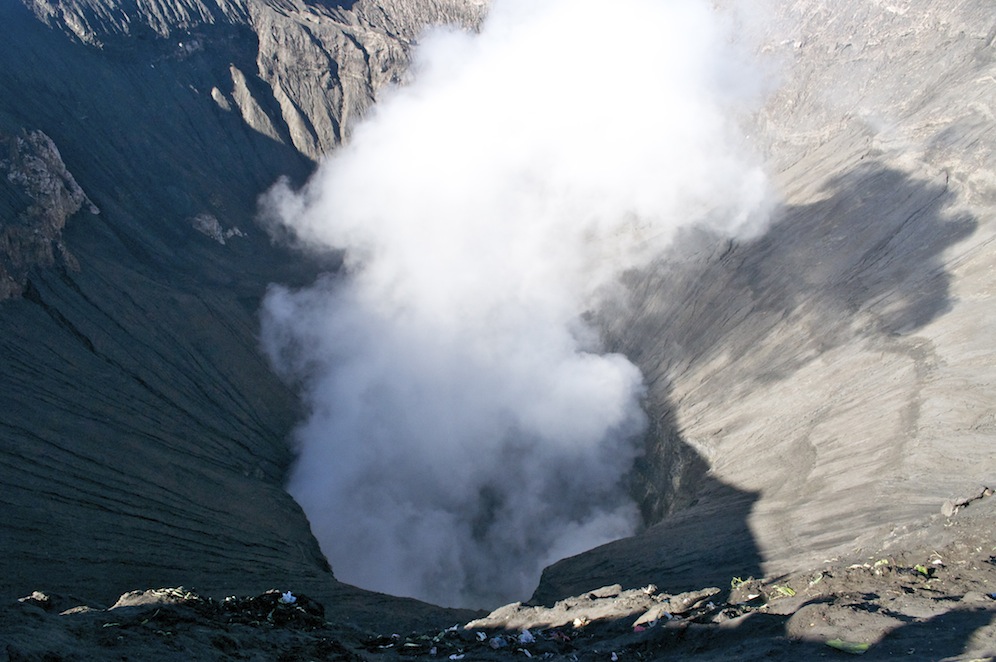
Looking into Bromo's smoking crater

Looking into Bromo’s smoking crater

Eventually we returned to our vehicles and descended the hill to the valley below. The valley was still shrouded in early morning mist giving it an even more pre-historic look. The vehicles were now taking us across the valley to the foot of Bromo. It appeared that most people had done the same.  There were many horses by the vehicle park all wanting to take people to the foot of the staircase leading up to the crater edge.  Staircase? Yes, they have built a staircase to make life easier, particularly, I guess, for the many Hindus who come here offering gifts to the gods. Standing on the rim of the volcano we looked into the smoking crater.  The whole of the rim, the steep slope up to the rim and the even steeper slope down into the crater was covered in the remains of offerings, food wrapped in banana leaves, flowers etc.  Men were inside the crater, precariously moving to pick up the litter and coins thrown in as offerings. The offerings, while numerous and distracting, I could understand but what I found unacceptable were the plastic bags that they were carried in.  How can you hold a place in such high regard but not treat it with the respect it deserves?
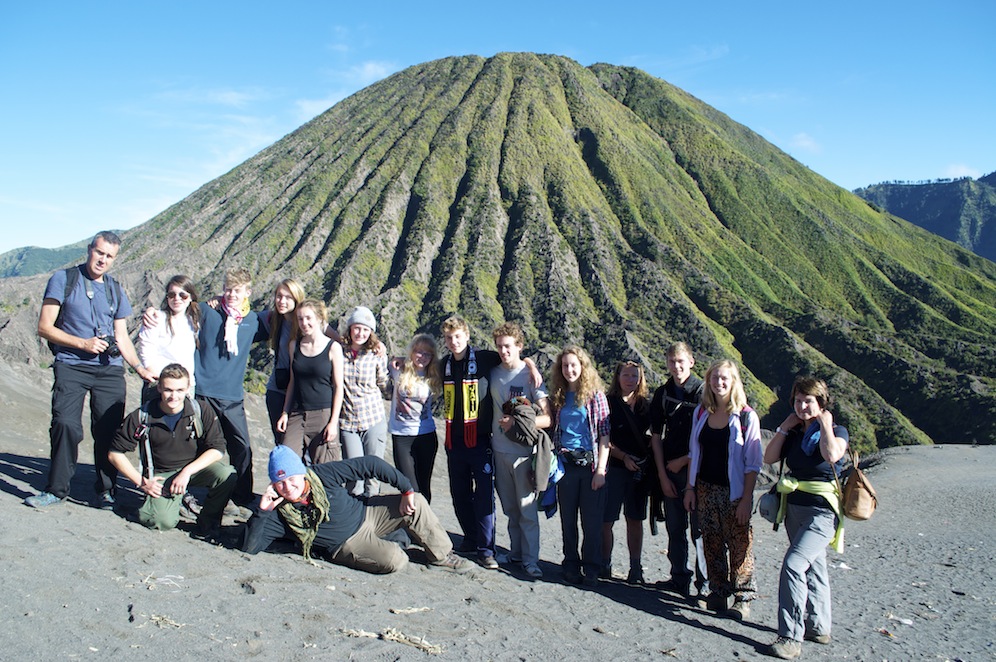
Members of the group in front of the perfect conical peak

Members of the group in front of the perfect conical peak

As fascinating as Bromo was, I was disappointed that we could not see molten lava bubbling away.  I was possibly more impressed with the adjacent peak, a perfect cone scoured by channels and ridges all the way round. It was perfect and the vegetation that was colonising it was vivid. I learned that while we were there there was a BBC film crew filming in the crater.

It had been a fabulous morning. We returned to the hotel for breakfast before minibuses arrived to transport us back to the airport at Surabaya for a flight to Bali and the beginning of phase three of our Indonesian adventure.

Indonesia – The Jungle

Sandra

Sandra

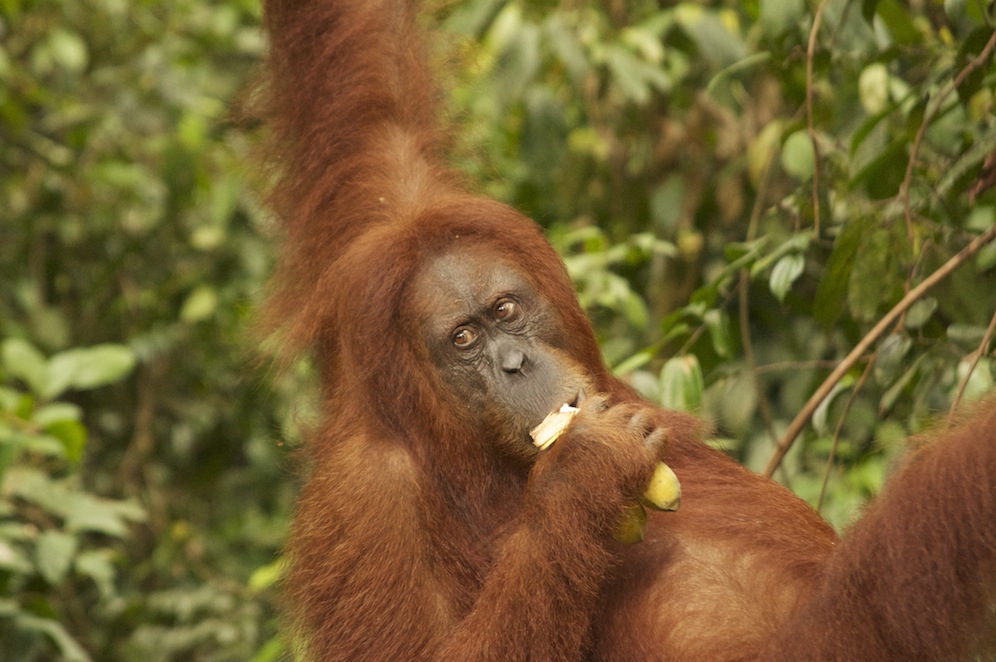
Our first encounter with the jungle came in the afternoon when we visited feeding time at the Orangutan Rehabilitation Centre, a half our walk from Bukit Lawang.  Twice daily food is provided from a feeding platform to supplement the food the orangutans can get for themselves in the jungle.  Having been here in 2010 I was hoping for a real spectacle for the group as I had then. It was not to be.  Only one, Sandra, turned up.  Initially I was disappointed but I soon realised that the lack of animals meant that they were finding sufficient food for themselves and did not need to rely upon handouts.  This is the time of year when most fruits are ripening and there is plenty of food available in the jungle. This occasion merely whetted our appetite for what was to follow during our trek.

The following morning we left Bukit Lawang for our trek through the Gunung Leusar National Park.  Passing through the grounds of the Eco Lodge where Angela and I stayed in 2010, we climbed steadily through a small rubber plantation run by local people rather than a large corporation.  Each tree had a spiralling cut of varied width near the foot of the tree.  A leaf created the spout for the white elastic sap to drain into a half coconut shell reservoir tied below the cut.  It is hard to believe that this method of collection could ever produce enough rubber to satisfy the needs of the world.  Sumatra does have some very large rubber plantations but the method of collection is the same and must be labour intensive in terms of collection, although I have never seen anybody collecting the rubber harvest.

Inquisitive and fearless

Inquisitive and fearless

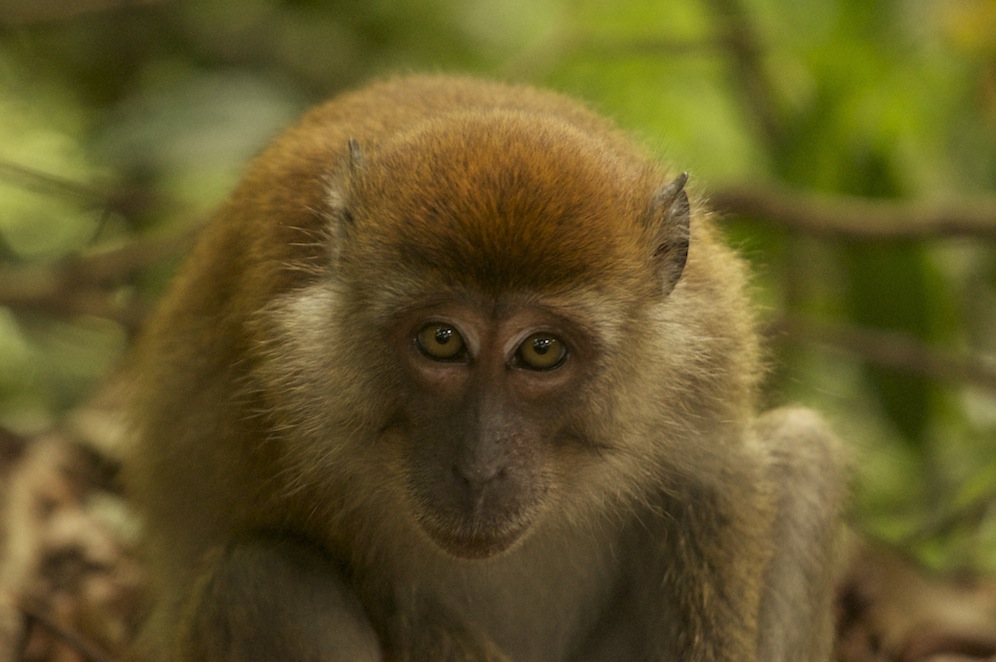
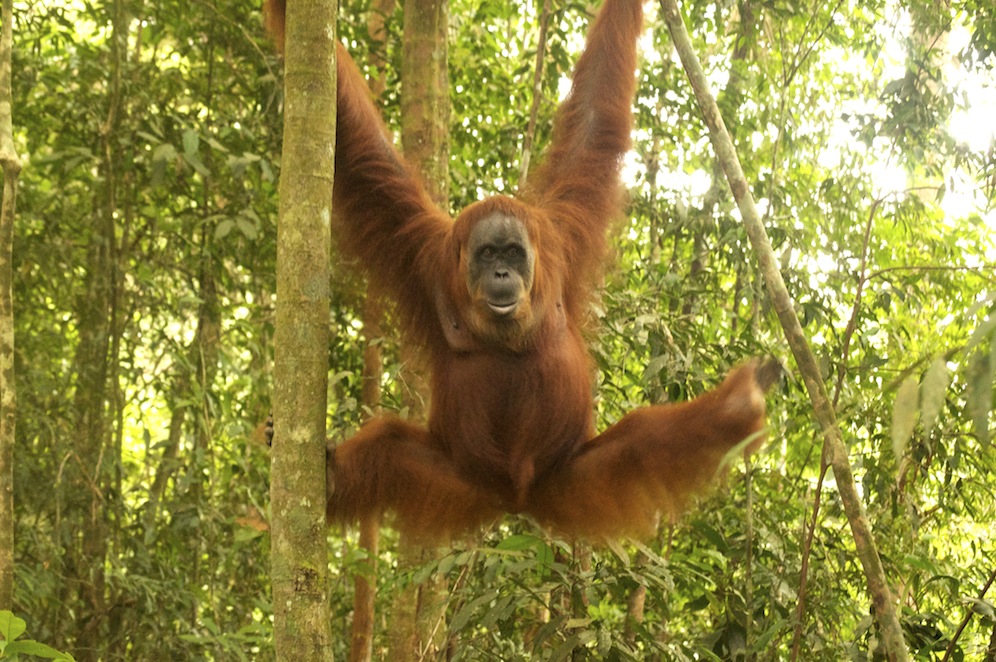
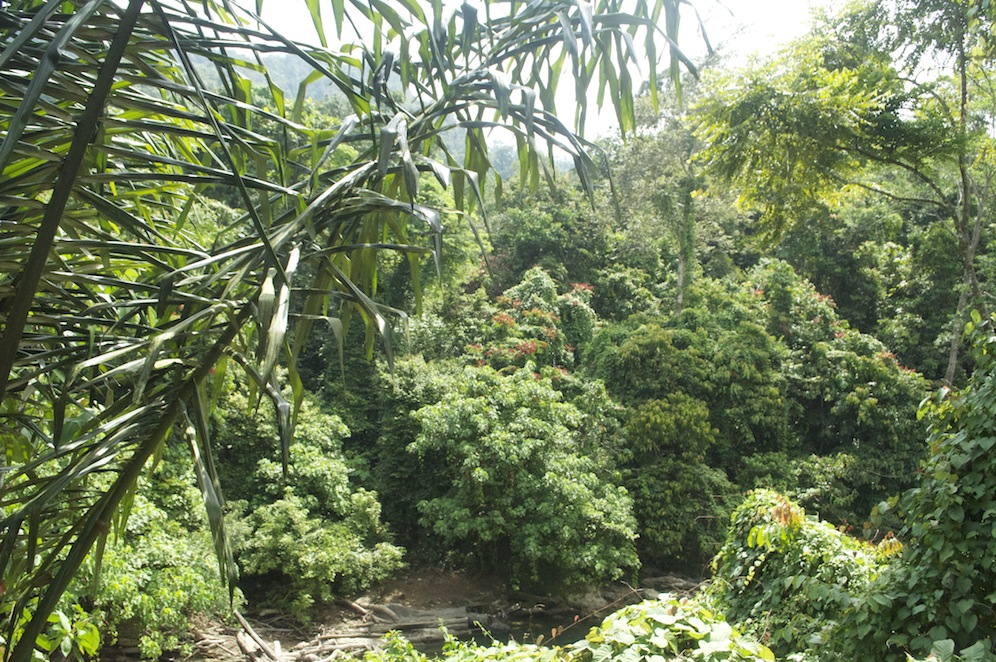
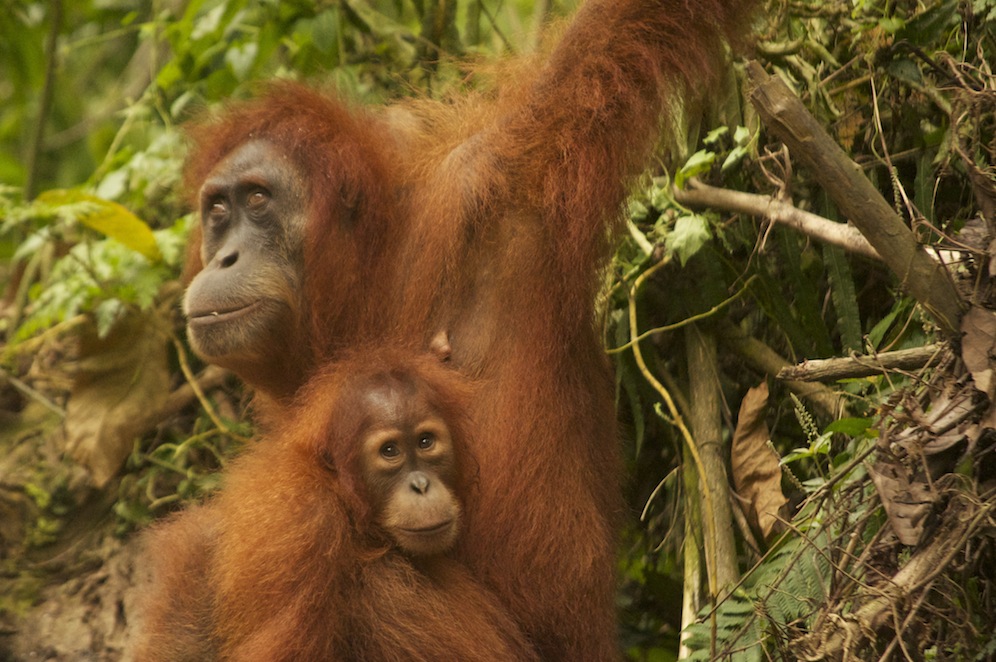
The boundary between the plantation and the national park could not be more definite.  Suddenly the vegetation is very thick and the foliage is very varied.  The heat became more intense, as did the cacophony from the invisible insects.  It was not long before we saw larger animals, firstly a rustling through the tops of the trees.  A female orangutan hung languidly in a path side tree with a baby clinging to her fur while a troupe of inquisitive monkeys descended from their tree-top playground to watch us from the side of the path.  There was absolutely no fear in them. Soon, at a safer distance, a couple of Thomas Leaf Monkeys came to see who was invading their jungle. The orangutan seemed gentle and relaxed and we were able to get quite close without it or us feeling threatened in any way.

Our slightly agitated lone male

Our slightly agitated lone male

Shortly afterwards we came across a lone male, much larger than the females, and much more able to inflict some damage.  They can be a bit aggressive and this one, having spotted Tango, our cuddly toy orangutan ‘wally award’, became agitated as he believed we had stolen a baby. Surya, one of our guides, took it off Fred and put him in his pack to defuse the situation.  It took our lone male a while to settle down, with much thrashing of branches and angry gestures before calm returned to the jungle.  Orangutans have two dominant emotions, jealousy and revenge.  We did not want to incur either.

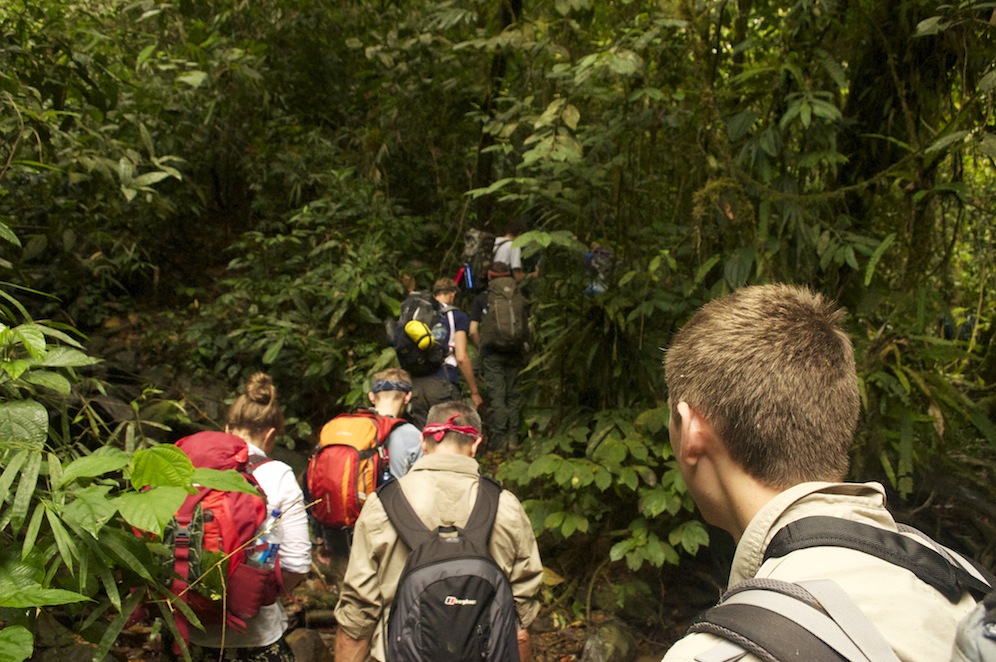
The foliage is dense, the paths narrow and progress slow at times

The foliage is dense, the paths narrow and progress slow at times

The trail climbed steeply and descended steeply; there are no gentle slopes in the jungle.  Between the ascents and the descents there were lovely ridge sections, but, because of the density of the trees, there were not far reaching views, just more trees.  The paths are narrow and the further we delved into the jungle they appeared to be less used.  At times, our guides drew their long jungle knives and hacked a way through the foliage for us to follow.  Some of the trees are huge, reaching 150 feet and more into the canopy and beyond.  We could hear birdsong among the insect noise but they were impossible to see amongst the foliage.  Most seem to inhabit the canopy and not venture beneath.  We heard Hornbills and on a couple of occasions caught a glimpse of this huge bird flying above the canopy.

DSC_0268The variety of foliage was diverse with some plants having smooth, shiny leaves, some velvety and others with vicious  spikes which tore at the skin if you brushed past them.  Similarly, some of the stems of young trees were dangerous to touch and care had to be taken when using them to pull you up the steep slopes or to defend against gravity on the descents.  Underfoot it was interesting.  There was an enormous amount of leaf debris and fallen trees to negotiate.  Using a pole, it often sank a foot or more into the soft leaf bedding and the soft soil below.  The steep slopes were often quite treacherously slippery but there was always a helping hand from the crew over the more difficult sections.

The heat was indescribable.  Soon after starting walking the sweat began to poor and after a while my shirt was completely soaked and gaining weight.  Every-so-often I would have to divest myself of my shirt and ring it out, each time extracting a good half pint of sweat.  I can honestly say that I have never sweated so much in my life, but I can also say that the heat and humidity was not as debilitating as I had expected and, certainly, as the the days wore on you became more accustomed to it and also more accepting.

Towards the end of the first day, while on the final steep descent into camp, I went over on my ankle and wrenched the tendons and ligaments. I thought and hoped at first that it was just a temporary setback but as dizziness clouded my brain I knew it was a little more serious.  Wanto and Surya insisted I rest and took my boot and sock off.  Surya took some oil from his pack and thoroughly massaged my ankle.  Eventually I felt able to continue the short distance into camp but the descent was difficult.  I accepted the helping hands that Wanto, Surya and Eyan offered and made it into camp.  If I put my foot down straight I was fine but that was not easy on such a steep, uneven and often slippery surface.  While I was able to continue with the trek I remained cautious and particularly nervous of downhill sections.

The first riverside camp

The first riverside camp

Camp was a series of wooden framed shelters with sheets of polythene tied to them.  There were two sleeping shelters and two cooking shelters beside a small river.  Each sleeping shelter had a line of thin mats for us to lie on.  From the frame above we were able to fix our mosquito nets and there we would sleep, probably not needing any extra warmth from our jungle sleeping bags.  All cooking in the kitchen tents was done on wood fires.  Clearly these chaps knew what they were doing for the food they produced for the twenty one of us and themselves was outstanding. The river was a God send as everybody took advantage of it to cool down after the day’s trek.

Not a foggy day - just a steamed up camera

Not a foggy day – just a steamed up camera

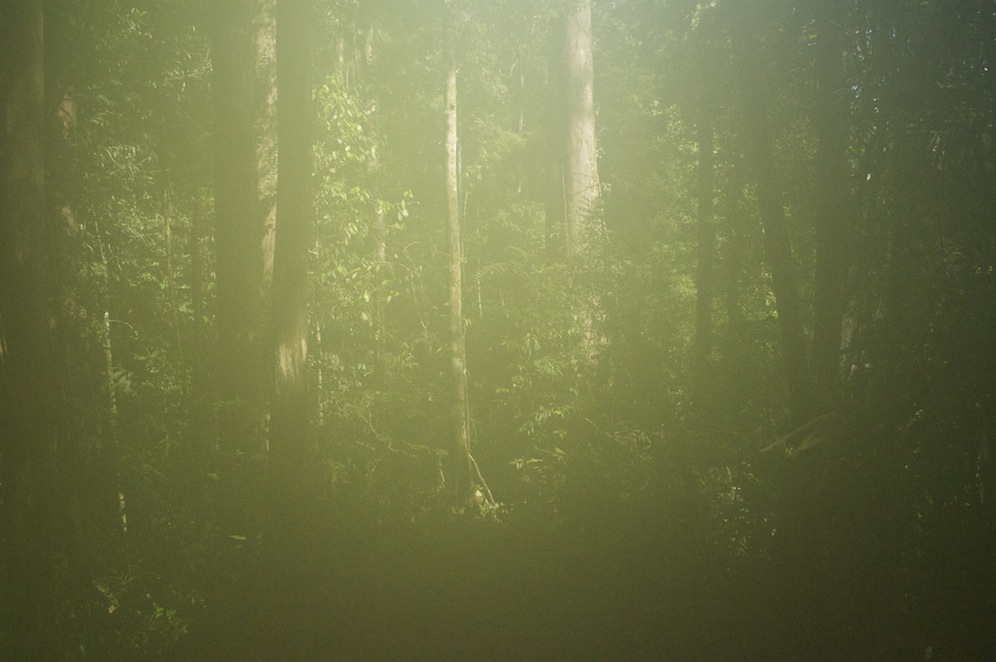
Photography proved to be more complicated than I expected.  Because it was so hot and I was sweating so much, every time I put the camera to my eye my glasses steamed up and I could see nothing; frustrating when trying to multi photograph orangutans.  Humidity inevitably got into the camera, steaming up the lenses and the mirrors, requiring me to take  the lens off and wipe all the pertinent surfaces only for them to immediately steam up again.  One or two clips of video start clear but gradually mist up adding to frustration and atmosphere in equal measure.

That first night in the jungle we ate dinner by the water’s edge, a superb feast, with an orchestra of insects to entertain us throughout.  It was Helen’s 29th birthday and instead of the usual pineapple and watermelon pudding the crew produced a chocolate cake they had carried through the jungle, alight with candles.  Ahmed Tarzan presented it dressed in a leaf skirt and crown with mud smeared on his face and torso.  We sang several versions of “Happy Birthday” before Helen cut and distributed the cake.  The rest of the evening we chatted to the crew, Tarzan providing some entertainment, and relaxed.

If we thought the jungle was noisy in the day time, the level of noise was nothing compared to that at night. There seemed to be a competition amongst all the insect species as to who could make the most noise.  The noise combined with the sticky heat made it very difficult to drop off to sleep but it eventually occurred.  Inevitably during the night I needed to vacate the shelter and find a bush.  As I turned to return to the shelter I almost stepped on a black/grey snake about three feet long and no thicker than my middle finger.  Stepping over it it slithered away into the undergrowth.  It seemed less concerned about me than me of it.  Back in the shelter I had to wait for sleep to over come me, the noise and the heat, rather than forcing it to happen.

The next morning saw us walking up stream for about forty minutes before climbing steeply from the riverbed for and hour or so to a ridge.  the ascent was pretty steep and required many a pull-up from a path side sapling. Once up on the ridge it was much the same as the previous day with occasional encounters with animals and a lot of trees.

Pudding laid out on a bed of leaves with flowers and Sock Monkey

Pudding laid out on a bed of leaves with flowers and Sock Monkey

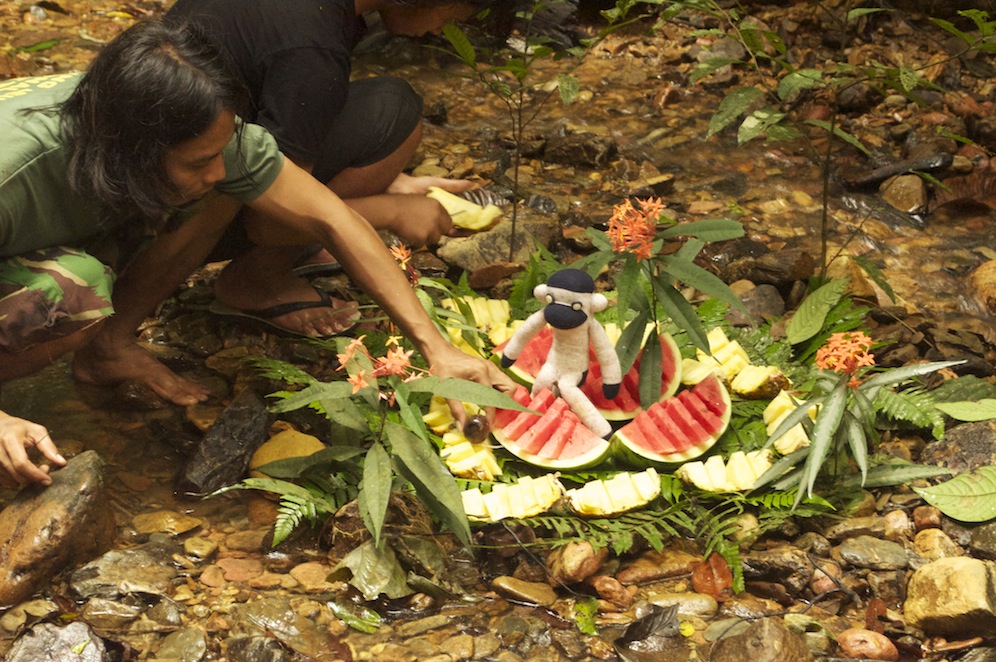
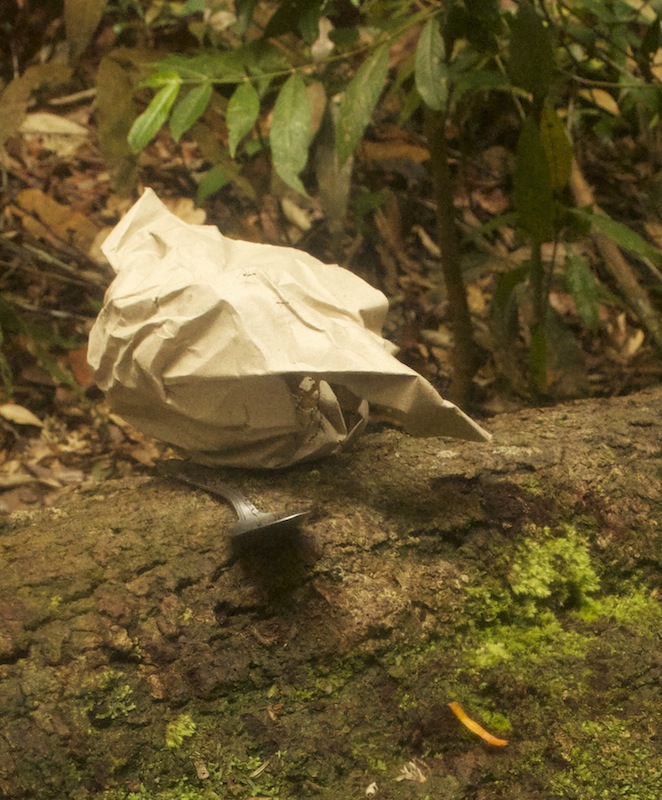
Lunch proved to be as good as all the other meals despite the manner in which it was served and we ate it.  Each morning the kitchen staff would cook noodles, vegetables, eggs etc. and pack them in banana leaves and then in brown, almost grease proof, paper.  These packages would be carried by the crew and at the appropriate time and place we would sit to be handed our own lunch package, which remarkably, still contained some warmth from the cooking.  Once eaten, all rubbish was collected and there would be no trace of evidence of us having eaten there, except for the few stray noodles or bits of vegetable being carried away by armies of ants.  Pudding was always fresh pineapple and watermelon, beautifully presented on a carpet of palm leaves with flowers to decorate.

Mother and youngster

Mother and youngster

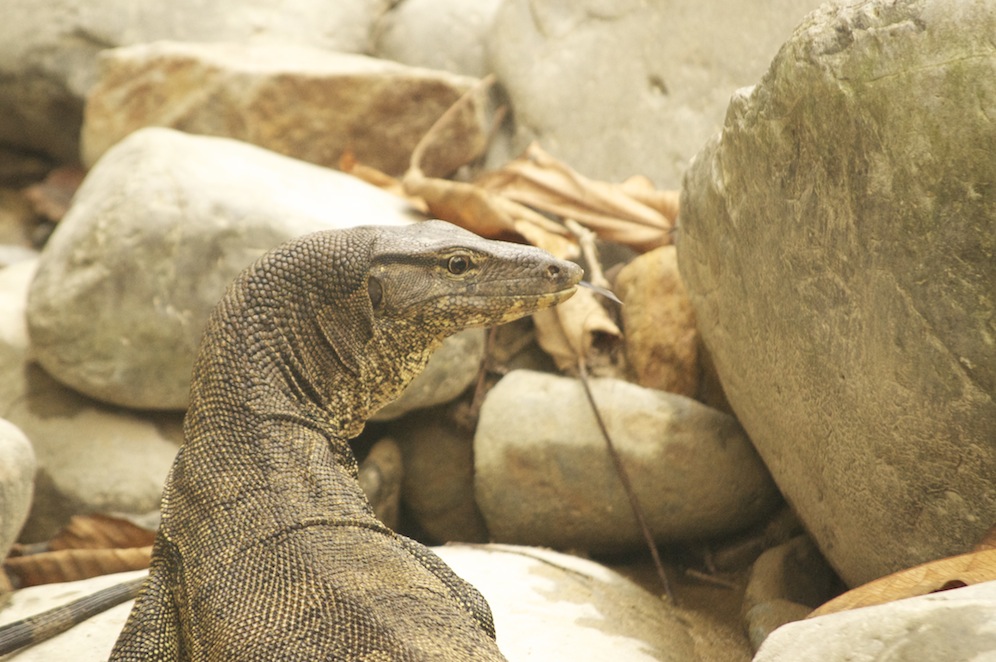
That evening we dropped down to another riverside camp, this time the river being significantly larger and giving greater opportunity for swimming and water play.  Just before we reached camp we came across a Monitor Lizard and another, very sociable orangutan with a youngster.  We found ourselves moving back as the adult and then the youngster joined us at ground level and kept approaching us.  It was not that we feared her but wanted to maintain the statutory distance from them.  Later, when another group arrived at a nearby camp, we saw the mother orangutan walking hand in hand with some of the people.  While it must have been an immensely pleasurable experience and I could not help wishing I could hold an orangutan’s hand, I also felt that these people had broken the rules of the jungle, however willing the orangutan had been for contact.

DSC_0203

As we relaxed and swam in the river there was animal activity all around us. Another monitor lizard came down to the rocks at the water’s edge in search of titbits, its flicking tongue delving into nooks and crannies.  Remarkably he seemed to find quite a feast.

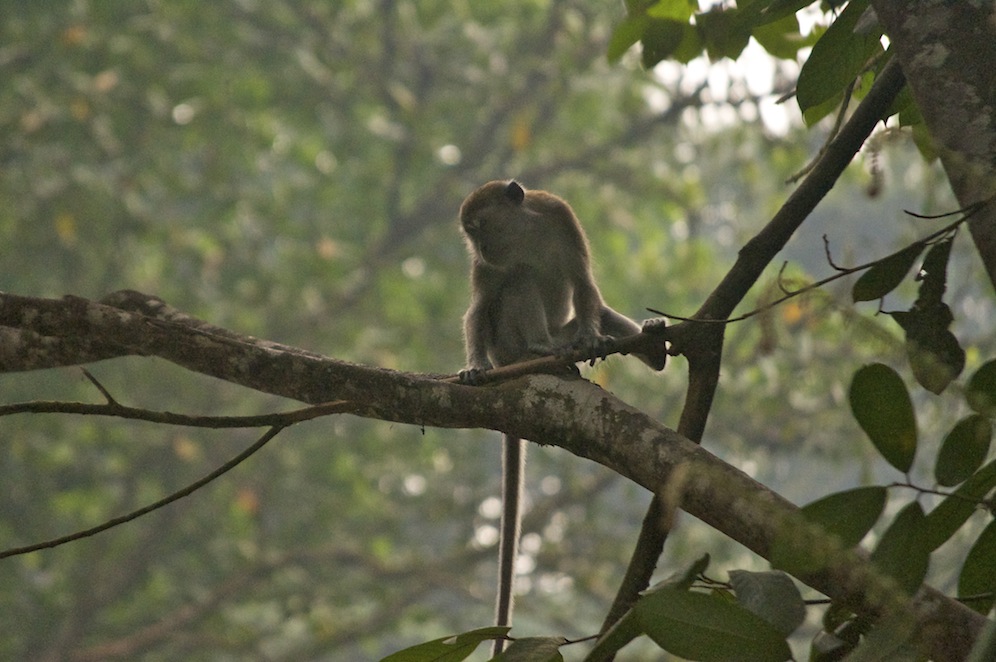
This was followed shortly afterwards with a troupe of monkeys travelling upstream on the other side of the river.  There must have been about fifty of them from dominant males to babies clinging to their mother’s chest.  They were clearly on the lookout for some mischief and with a couple of groups camping nearby there was also clearly fun to be had.

Just checking out camp

Just checking out camp

Soon, there was a rustling in the trees above our camp as another monkey was playing in the branches and watching us. Was this just a lone monkey or a scout for the troupe we had recently seen, or indeed another troupe whose territory covered our side of the river?  We soon found out when a whole swathe of movement rushed through the trees as a similar sized troupe passed over our heads.  Their fun and games was a joy to watch as they chased each other, leaping from tree to tree and achieving impossibly daring treetop crossings, grasping at the flimsiest of twigs to prevent them falling to the ground below. It took several minutes for the spectacle to pass over our heads but we did wonder whether they would return during the night to steal our drying clothing draped around camp.

With all our clothing still hanging around camp but hardly any drier than they were when first hung because of the humidity, we prepared to continue with our trek.  As we delved further into the jungle we saw less and less wildlife – no more orangutans, monkeys or lizards, just a lot of dense foliage and a mass of insect life.

Under attack. Note the piece of carrot being carried at the foot of the picture.

Under attack. Note the piece of carrot being carried at the foot of the picture.

Our main animal interest came from armies of ants carrying off the remains of Magda’s lunch.  The team work was incredible and it did not matter how large the debris was there were always enough ants to manage the task.  We even set them challenges by giving them increasingly large pieces of watermelon.  Nothing was too difficult for them and when a large ant almost an inch long tried to cash in on the food crop it was very severely chastised and chased off.

We also had problems with bees on this part of the journey with a number of girls being stung several times as they disturbed a bee’s nest in a tree they flicked past.  It was my turn to do the same the next day receiving about eight stings to my face and neck.

The terrain was much the same with more steep ascents taking us up to above 800m above see level, long ridges and steep descents.  On this third night we did not have the luxury of a river to cool down in as camp was in a cleft just below the ridge line.  It was such a tight spot that we all had to huddle into one shelter while the crew and the kitchen shared another.

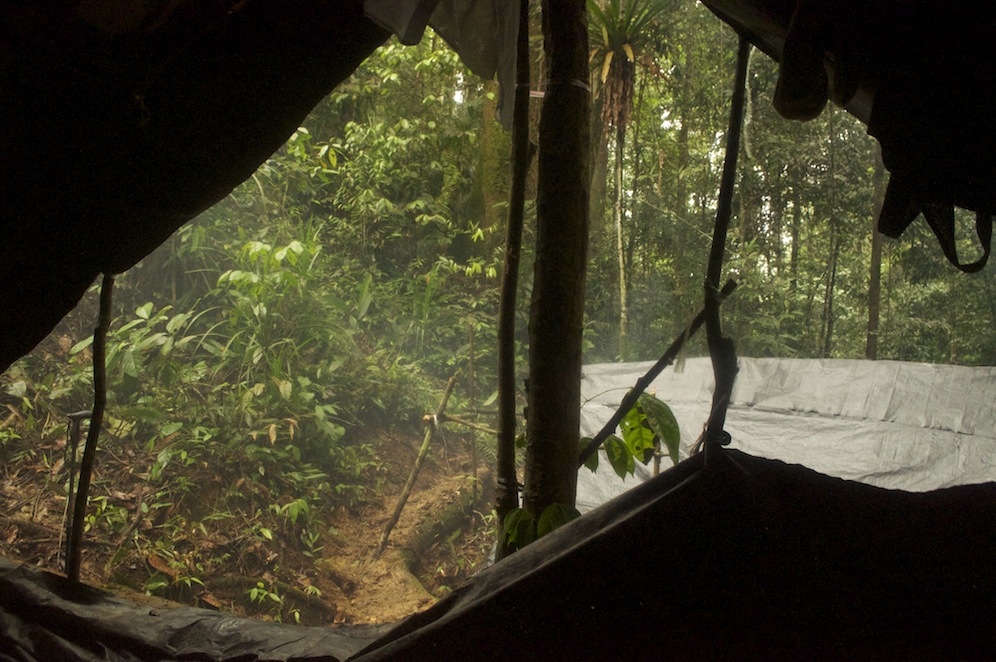
Looking out at the rain from our shelter

Looking out at the rain from our shelter

Very shortly after arriving at camp we experienced our first tropical rain.  The rain hammered on to the polythene shelter and even larger drops from the overhanging trees thudded on to our canopy.  The track outside became a treacherous skid pan of mud and visits to the toilet became hazardous.  Keeping the mud out of the shelter became a challenge. In the distance thunder rumbled and as darkness came we could see flashes of light through the canopy of trees. The enterprising crew erected a hand rail around camp and towards the toilet area as well a cutting lengths of wood to put across the muddy path to try to give us some traction.  The rain continued into the evening but lost a lot of its force as night approached.

By morning the rain had been replaced with sunshine and the path beyond camp was remarkably dry considering.  The dampness really affected the camera and it took a while for that to dry out.

The walk today, instead of taking us further into the jungle it brought us to the edge and another river, which formed the boundary between it and palm oil plantations on the other side.  We managed to reach camp in good time and had plenty of time to play in the river. Our shelters for the night were stilted buildings in a small clearing by the river.  The clearing was only made recently and I imagined that if I came back in a couple of years there would be a proper lodge here with gardens, vegetables growing for the kitchen and a road from the other side of the river.  As it is at the moment the facilities are very basic but it proved a lovely spot to spend our last night of jungle trekking.  The river fulfilled its purpose as a place to swim and play, to wash clothes, bodies and hair, and had there not been some very persistent biting insects just above the surface of the water it would have been perfect.

With some of the crew

With some of the crew

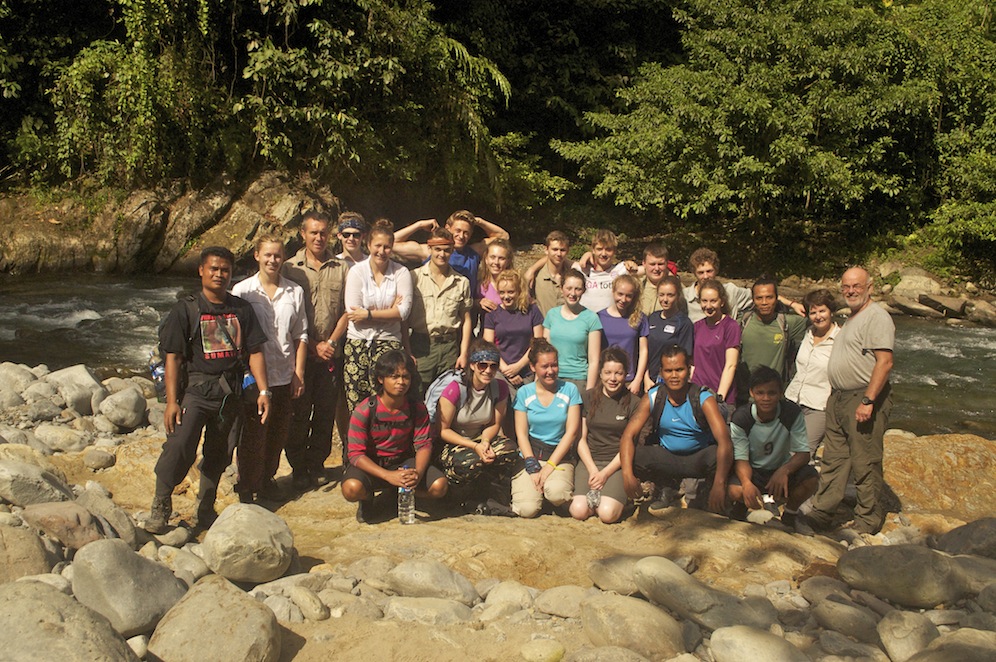
After dinner it was party time; the singing and the games went on for some time. There was a special bond between us and the crew, who very obviously enjoyed what they did, who’s knowledge and understanding of the jungle was better than anyone’s, who felt immense pride in their jungle environment and were determined to protect it and maintain its pristine condition.  We had walked 50 – 60km over the four days we were in the jungle and it had been a privilege to be there to share the experience and to learn from the enthusiasm of our guides.

Travelling in luxury to Tangkahan

Travelling in luxury to Tangkahan

The following morning we crossed the river and walked briefly through the palm oil plantation to a waiting lorry to take us to Tangkahan, a small resort on a river skirting the edge of the jungle.  We were spending a couple of nights here to conclude our Sumatran jungle experience with elephants and river tubing. The hotel was fairly basic but ideally positioned for what we were doing.  The highlight was the restaurant which was built on stilts from the cliff above the river with views straight down into the water from the balustrade.

When we were told that we would not be able to ride the elephants as they were already pre-booked. I was pleased.  Bathing elephants is a much more memorable and personal experience and by not riding them we were saving a considerable amount of money each. It took a while to convince the group but the events which followed needed no further convincing from me.

River play

River play

We followed the elephants, including a baby, down to the river where they first had a play without human interference. The baby was not too keen to enter the water and had to be coaxed to take the plunge.  There was one male elephant and several females.  The male and an affectionate and playful female had a wonderful romp in the water, intertwining trunks, sitting on each other, kicking each other and having a really good time.

A kiss for Honey

A kiss for Honey

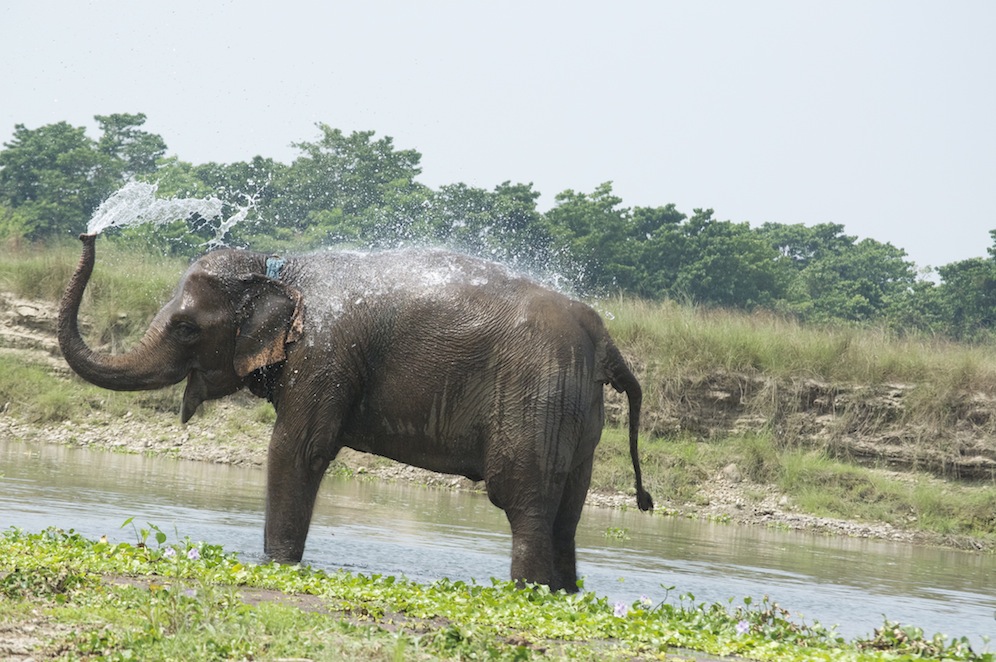
Eventually the group was able to mix with the elephants and armed with scrubbing brushes set about giving them a good scrub. By way of thanks the elephants were given the opportunity to wash their human partners.  Taking a trunk full of water they showered their group and also gave some a full facial assault. Then the elephants kissed their human counterparts on the cheek with the end of their trunks.  It was all a bit of a performance but the elephants seemed to enjoy it as much as the humans.

As soon as we had finished with the elephants we took possession of our lorry and bus inner tubes and set off down stream, allowing the speed of flow to carry us peacefully through the landscape.  Occasionally the water became a little lively but these interludes were only short-lived. Whenever there was something of interest we would pull into the bank and explore up a small tributary where we would find a waterfall to walk through.  Remarkably, there was no shock factor with the water temperature; it was always very pleasant. On another occasion we ventured up a small side valley to dip our feet into a hot thermal pool in a cleft in the rocks.  The hot water spilled out into the river, adding to the warmth of the water.  There was a slight smell of sulphur in the area which was a little off-putting.  There was also a rock jutting out into the middle of the river from which we could jump safely off in to deep water.

Tom enjoying the waterfall

Tom enjoying the waterfall

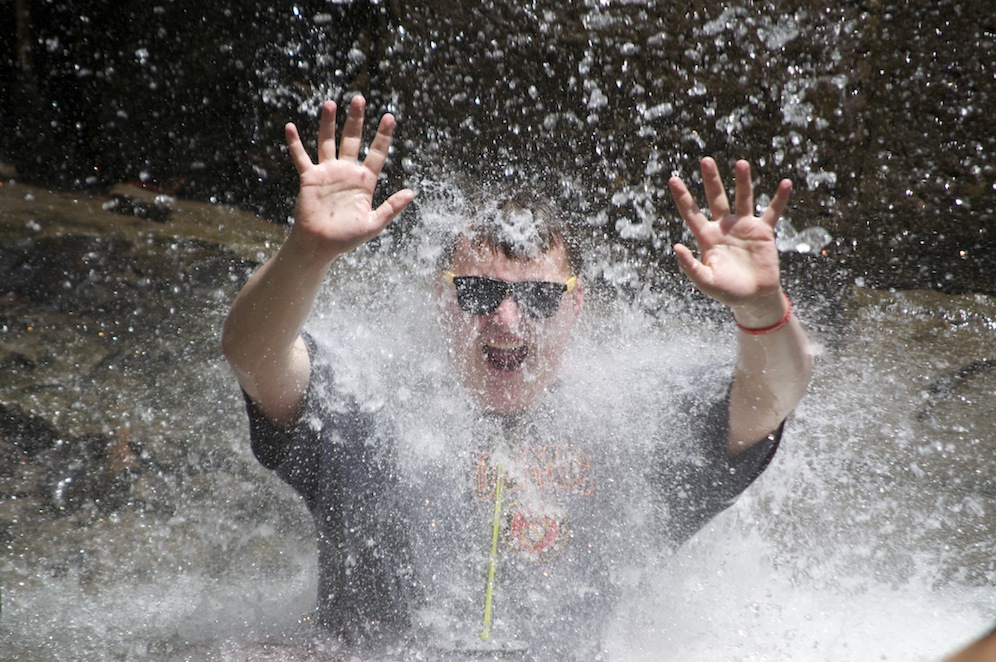
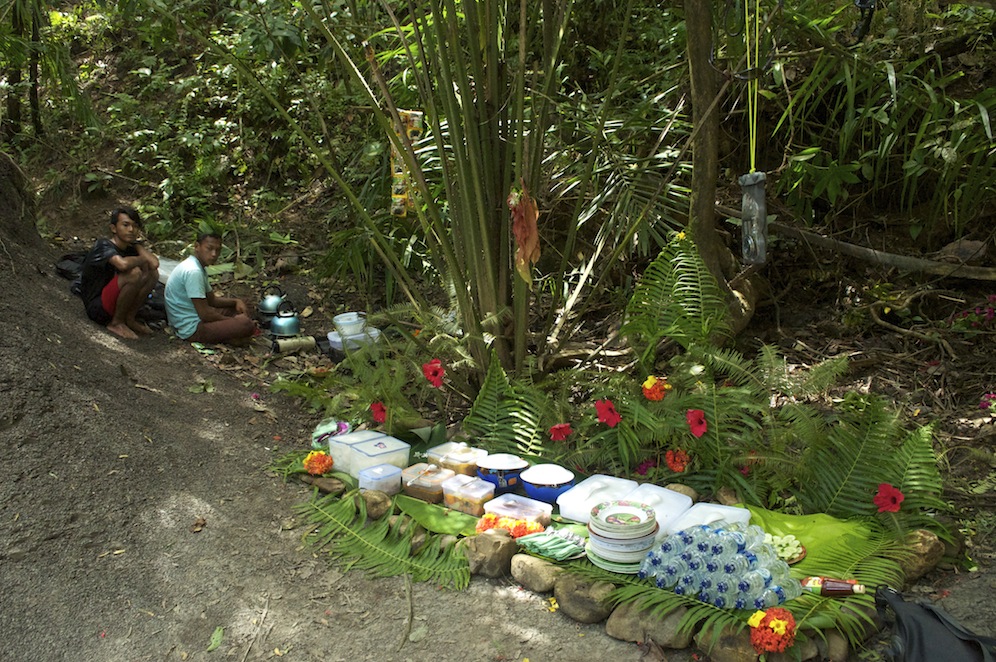
For lunch we went up yet another side tributary to a pool with a forty foot waterfall.  Here we would have lunch but before that there was plenty of time for playing in the pool, lying underneath the waterfall for a pummelling massage.  The crew, all very young men, set out a fantastic spread for lunch and it was all so very well presented.  These young men have been given the green light to provide a service from the tourist authorities.

10 out of 10 for presentation and taste

10 out of 10 for presentation and taste

Not only are they the river guides but they also provide the lunch, the logistical transport support and some of them seemed to be involved with the running of the Green Lodge in Tangkahan, where we were staying.  When our laundry was returned, it was they who returned it. Based on their performance and the attention to detail they had shown us, they will go far. Everything is done with a smile on their faces and they would be an inspiration to any young people looking for direction into adulthood.

After lunch it was another short spell of drifting down stream until we reached our rendezvous with the transport to return us to Green Lodge.  This brought to an end our Sumatran jungle adventure.  The next day we would spend travelling to our next adventure on the island of Java.


Indonesia – Getting There

With news reports of man eating tigers in the Gunung Leuser National Park, the closure of Heathrow and hundreds of prisoners escaping from Medan jail we travelled along the M4 not knowing whether we were going to get away or not, nor what might happen when we arrive in Sumatra.  As it turned out our passage through check-in and security was as smooth as I have ever known it.  The check-in staff knew nothing of the runway closures, or of the fire which caused it all in the first place.

The A380 is a huge plane with 471 passengers and a multitude of crew.  I worked out, based on what we had paid for our tickets, that had all 471 passengers paid the same fare  the income from this flight would be in excess of half a million pounds!  Many would have paid more so my guesstimate is conservative.  With two floors running the length of the plane you are, perhaps, not aware that everything you can see on your level is replicated above.  the service was good and the food excellent.  Twelve and a half hours is a long time to be cooped up in a plane, no matter how large it is.  Fortunately, I was sitting in row 62, the back row, so it was easy for me to get up and stretch my legs. However, the strange thing about this flight was that it was dark when we took off, the window blinds were kept down until the point of landing in Singapore when it was getting dark for the next night.  In effect we were getting two nights together without a day between.

Our time in Singapore was reduced to about an hour before our short flight to Medan.  Wanto and Sam met us on arrival in Medan.  By the time I had sorted out changing money all the students were through immigration, the bags collected off the carousel and we were heading for the waiting bus.  It was about 28C and very humid.  Before we left Medan we went to a restaurant where they were waiting to provide us with our first taste of Indonesia. Either all the prisoners had been recaptured or were as far away from Medan as possible, we saw none of them. Just the tigers to liven up our jungle trek to come!

By the time we left the restaurant the hour was quite late but this meant that the roads were not crowded and the expected four hour journey was covered in two.  We arrived at the Rindu Alam Hotel in Bukit Lawang at midnight.  The rooms were fairly basic with less than adequate air conditioning.  Remarkably I slept quite well and overslept!

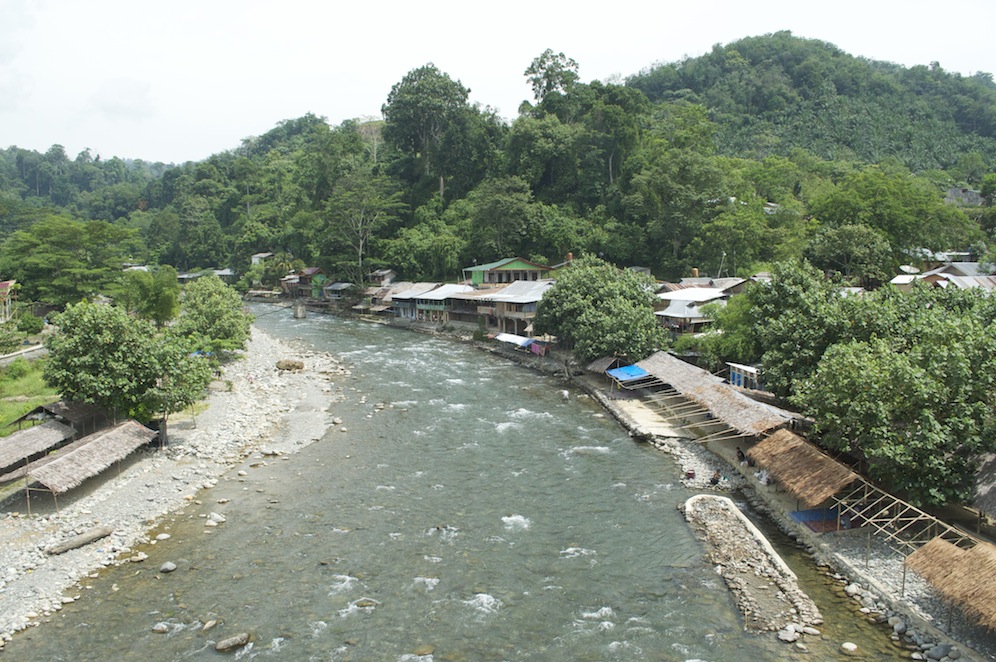
Bukit Lawang

Bukit Lawang

We decided not to visit the orangutans in the morning but to use the time to acclimatise ourselves, organise personal money and to acquaint ourselves with Bukit Lawing, a village where all life seems to revolve around the banks of the Borhorok River.  It was quiet and relaxed and where ever we went we were met with friendly faces and smiles.

A Quick dash to Chitwan

After a quiet, groupless night in the hotel, Hira and Bishnu came to pick me up at 7.00am for the drive down to Chitwan, a hot, jungle environment in the south of Nepal bordering India.

Once out of the Kathmandu valley the journey became more civilised. There are a great many slow moving lorries on the road and overtaking on the winding road can be a little scary at times. Our driver was pretty careful but he always had to be prepared for the unexpected from every other driver. Many of the houses at the side of the road had been bulldozed and there were piles of debris where once houses and businesses had stood.  Apparently, they had all been built illegally and, as a result, had been destroyed.  Unfortunately the piles of rubble and timber are less attractive than the buildings had been and your eyes are automatically drawn to the unsightly mess rather than the more attractive scenes beyond.  It just seems typical of Nepal; no job ever seems to get finished!

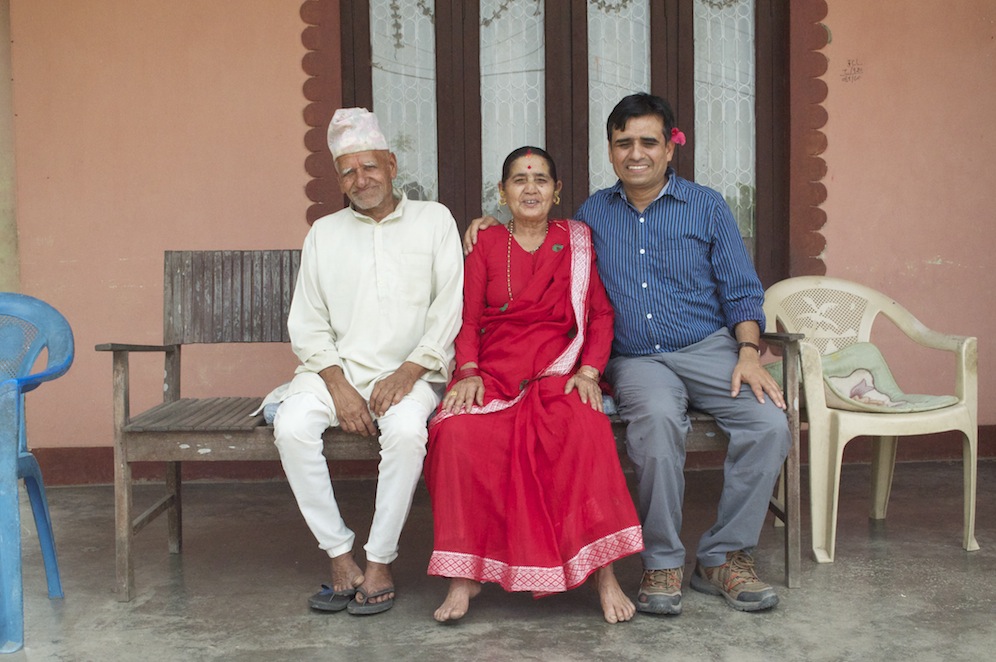
Hira with his parents

Hira with his parents

We reached the Chitwan in about four and a half hours and our first port of call was Hira’s parents, living in their little farmhouse. Hira is the first generation not to be a peasant farmer and the contrast between him, a city dweller, and his parents, particularly his father, was remarkable. The very simple house is surrounded by fields of rice and maize, a tranquil agricultural scene. Birdsong is all around us. Just to one side of the house is a byre with buffalo and a couple of cows. A large hayrick is beside that. The water supply comes from underground via a hand pump and adjacent to that is a digester of animal and human waste which provides all the necessary gas for cooking. It is incredibly basic living which has a charm of its own to the casual visitor.

I was made very welcome, given coke and a plate of mixed fruit, although keeping the flies off the fruit became a real challenge.

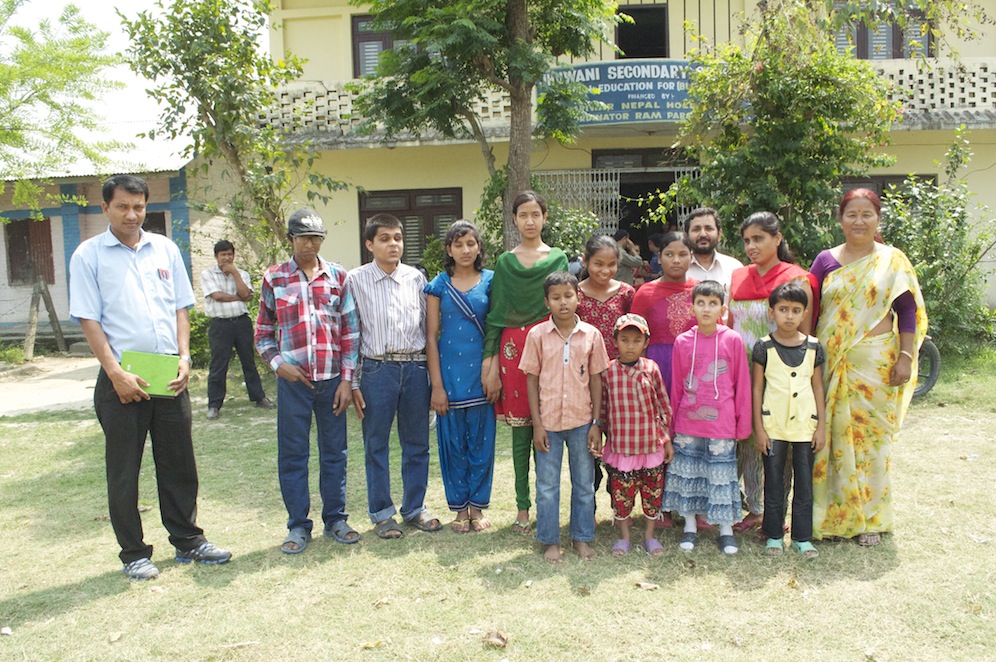
Leaving his parents we went to visit the school where Hira was educated as a boy. Certain government schools are selected to cater for and integrate children with disability. This particular school has 27 blind or visually impaired students of variable ages. Hira’s idea is that those involved in the teaching and caring for the blind need practical support rather than financial support. The head teacher may contradict that but we are not looking to give financial aid.

Some of the blind and visually impaired students at  Shree Jhuwani School

Some of the blind and visually impaired students at Shree Jhuwani School

I was met by various people, teachers, village committee and others. There were so many of them I wasn’t really sure who was who. School does not open for another three days but about half the blind children were there. The teaching facilities are limited and the place looks untidy and unkempt.  The facilities in the senior section of the school seemed to be better and more building work was going on.

As we were about to leave I met a Dutchman who has been involved with supporting the blind in the area for a number of years. Adjacent to the primary school there is an almost finished new build which will become a learning and resource centre for blind people in the community. It has a conference room with special computers, a further computer room, a music room, a couple if craft rooms and a couple of bedrooms. This is for adult blind people to come to learn but I really hope these facilities will be available to the blind children in the school as they far exceed anything the school has to offer.

It was an interesting visit, with potential, but I am not making any promises.

A female one horned white rhino

A female one horned white rhino

Potential business side of the trip complete, it was now time to enjoy myself. Settling in to the Rhino Lodge in a pleasant resort type village just outside the park, my first activity was an elephant ride. Normally you share this experience with three other people but now it was just me and my mahout. Also, normally, these rides last about one and a half hours but on this occasion, because I had expressed a desire to see a tiger, we were out for two and a half. We still didn’t see any tigers but we saw a variety of dear, rhino and lots of birds.
I had just enough time for a cold beer before I was off to a Tharu cultural evening in a purpose built theatre in the village. It was an impressive display but lacked the intimacy of other shows I had seen.

There was virtually nobody else staying in the lodge so I returned for a solo dinner, Hira and Bishnu were spending the night with Hira’s parents, before heading off to bed.
At 4.30am a dash of a different type occurred as I felt ill. Was it my meal last night or something else? I began to think it was the result of my time on the elephant with the heat of the sun beating down on my head and neck. By breakfast I was not feeling too bad and continued with the activities planned for me.

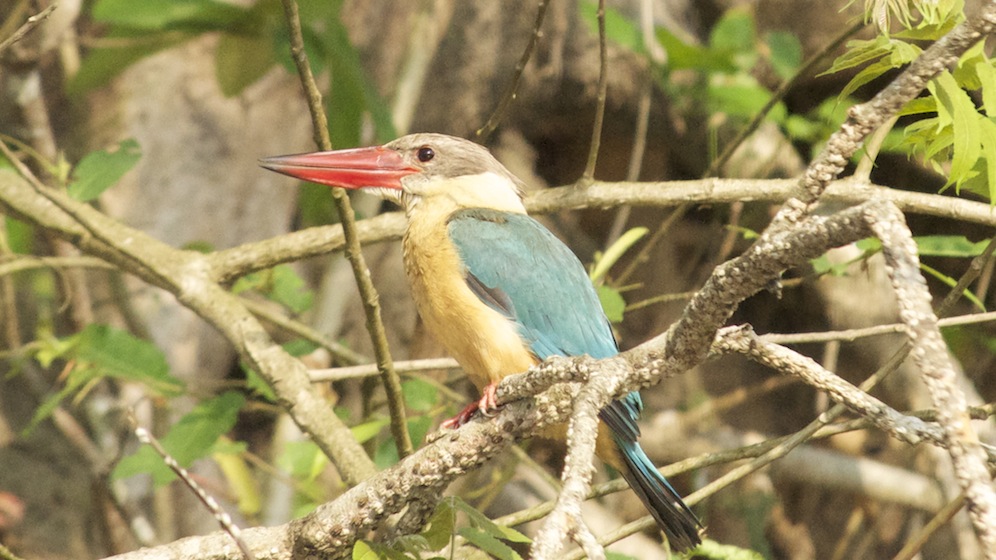
A Stork Kingfisher

A Stork Kingfisher

Going down to the river my guide and I took a dugout canoe along the river. Along the banks were many vividly coloured kingfishers and other fish eating birds, crocodiles with their snouts and eyes appearing just above the surface of the water. As we passed they would disappear under the surface in true Hollywood movie fashion. At one point we came across a large male rhino on the river bank. Here we had to be cautious. If we continued it might decide to charge into the river and attack the canoe. So we waited along with another canoe that joined us and one coming towards us until the rhino lost interest and turned his back on us.

Reaching our disembarkation point we went for a jungle walk to a lake favoured by rhino, tiger and all animals seeking a drink. Sadly nothing was at the water’s edge when we reached it but we did see plenty of deer, wild boar, birds and signs of rhino and cat activity.

The walk led us to the elephant breeding centre where there are mothers with babies of varying ages as well as expectant mothers. Whilst these animals are well cared for it was sad to see them shackled by one leg to a thick wooden post.  One or two of the young elephants were rocking backwards and forwards in a very repetitive way, very similar to children in one or two orphanages I have visited over the years.  I really did not want to linger here too long.

Elephant bath time

Elephant bath time

Returning to the lodge I was looking forward to bathing with the elephants but I found the sun oppressive. When it came to bathing with them I wandered down to take some pictures but soon had had enough and returned to the lodge to prepare for the journey back to Kathmandu. Hira had plans for visits on the return journey but because of my fragility we decided to go straight back to Kathmandu. It was not a comfortable journey but quite swift and I was in bed by 4.30. I intended having just a couple of hours rest but it turned into fifteen hours. Feeling much better this morning , if not a little fragile in the abdominal region, which is still not right. I will be very careful with what I eat today as I don’t want this when travelling tomorrow. Fingers crossed, not for the first time this trip.

Last few days with the group

Having had one of the best night’s sleep of the trip we had a fairly leisurely  breakfast before strolling over to the airport. We discovered that although we were due out on the second wave of Tara flights, we had been bumped on to the third phase. As the morning progresses in Lukla the chances of flying out diminish dramatically as the wind tends to increase, making it significantly more dangerous. To try to ensure our departure, Hira, in Kathmandu, chartered a Sita Air plane to do the job.

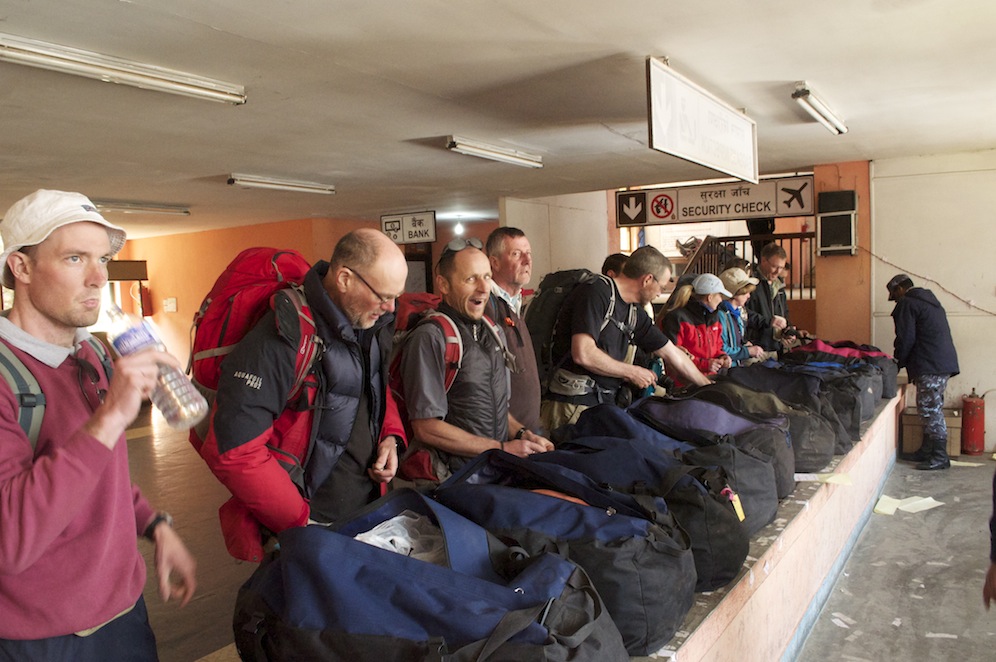
Security check at Lukla Airport with Robert looking particularly nervous

Security check at Lukla Airport with Robert looking particularly nervous

Having gone through all the check in and security processes in the expectation of leaving, originally, at 8.30, we found ourselves still waiting at 10.00 with increasing wind. As the group lined up for security, bags opened for scrutiny, Robert started to worry about his two dried yak dung patties he was hoping to take home as a present for his youngest son!  He managed to get them through, but will it be the same at Heathrow when the yak dung smelling dog, specifically employed for such occasions sniffs him out.  Hopes for our flight out rose as we saw our Sita Air flight approach Lukla, but then fade again as it aborted its landing attempt, banked and returned to Kathmandu. It became clear that there would be no further flights today.

As we walked back to the Paradise Lodge, I bumped into Colin Scott and his family who had been out on Mera Peak. Colin is part of the MEF and is one the organising committee with me for the 60th Anniversary of the First Ascent of Everest. It is such a small world. Only the day before, as we sat in Starbucks, Lukla, I had said I wondered how long I would have to sit there before I saw somebody I knew. Not that long, apparently.

Back at Paradise Lodge we had coffee, pre-ordered lunch and waited to see what the outcome of Tanka ‘s many phone calls was. Eventually, it became very clear that our only chance of getting out in reasonable time was to pay the necessary to charter a couple of helicopters. If we chose to stay another night in Lukla, priority for flights the next day would go to that day’s ticket holders and we would be fitted in, if possible, after they had all gone. The likelihood is that conditions would again interfere and we would find ourselves trapped further in Lukla, jeopardising return international flights. Explaining the situation, the options and the extra $300 cost per person, we put it to a vote. Everybody chose the immediate option of getting helicopters out asap.

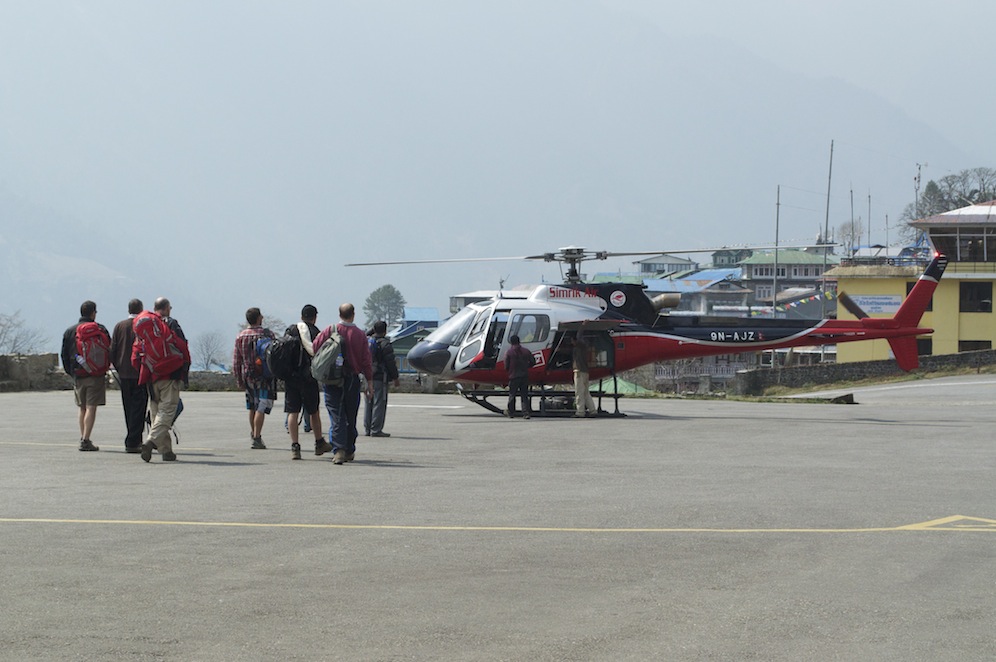
More phone calls followed and lunch was served. No sooner had some finished their food than the call came for the first six to go quickly to the airport. The helicopters can take a maximum of six passengers. Very soon afterwards a helicopter landed on the apron, the six climbed aboard and off it went.

The rest of us, knowing there would be some time before it was out turn enjoyed our leisurely yak sizzler before, ourselves heading over to the airport.

The group approaching their escape to Kathmandu

The group approaching their escape to Kathmandu

Unlike this morning, the place was deserted of security etc. and we sat on the edge of the apron and waited. It took a long time for the second helicopter to arrive, but eventually it did and the second six were quickly ushered aboard and it was off. That just left me with Tanka and Bishnu, who were not planning to return until there was a more cost effective way for them. Others turned up on the apron wanting to get on a flight and it was not much longer for the next helicopter to arrive. I managed to squeeze in the front seat, next to the pilot, with a young lad next to me. It was very cramped but If I could have turned round, I think I would have found it even more cramped in the seats behind.

Helicopters are like bees; in theory they should not be able to fly. This one appeared to be very flimsy. It did give fantastic 180 degree visibility, which you do not get in an aeroplane. Alternatively, it does not go as high as a plane so there were no white peak mountain vistas, just fascinating glimpses, from above, of Nepali rural life. The entire flight took about forty five minutes. The constant vibration seemed to transfer to my chest, which started me coughing. Maybe this is exactly what I needed to clear my chest.

I was soon transported across the airport to be met by Hira’s brother and the second half of the group who had only landed a matter of a few minutes before me.

The Hotel Tibet has an impressive reception area and the rooms are good. There is an adequate outdoor seating area/bar/dining and a pleasant roof garden and bar offering a mixture of sun and shade with pleasant air flow. Sadly the bar and snacks are not available until after 2.00pm. What is lacking are some of the little things that we come to expect, a variety of complimentary soaps and shampoos in the bathroom, a switched on, as well as a well stocked mini bar, free wifi instead of the expensive and irksome system they have in place at the moment.  Remarkably, everybody, despite having a fairly inactive day, was feeling tired and, as a group, we chose to stay in the hotel in the evening and sample the restaurant fare. It proved to be a good decision, like the one we had made earlier with regard to getting back to Kathmandu.

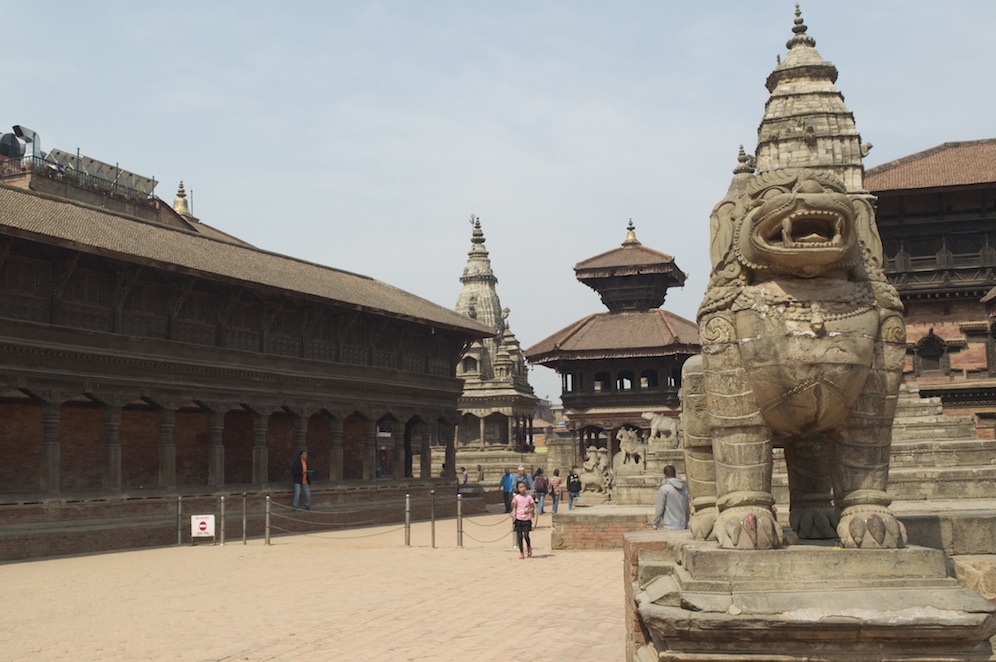
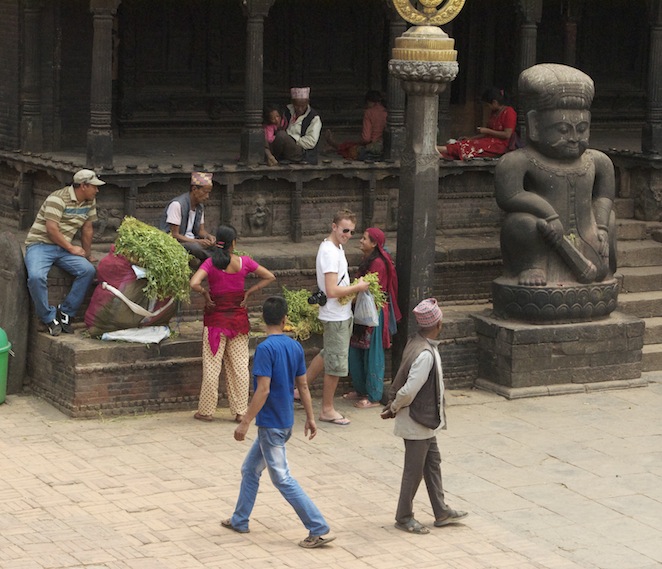
The quiet Durbar Square, Bhaktapur

The quiet Durbar Square, Bhaktapur

The following morning, feeling somewhat refreshed, ten of us were collected at the hotel and taken to Bhaktapur for a half day tour with our guide, Ramesh.  I love Bhaktapur. It is so much more pleasant than Kathmandu in that the pace of life is much slower. The people seem more content, happier, with ready smiles whether they are drawing water from a well, selling peas on the vine or pleasantly trying to persuade you to buy a silk purse or a necklace. There isn’t the pressure that Kathmandu seems to impose on everybody. It is great place to sit and people watch.

The chariot now lying idle.

The chariot now lying idle.

Ramesh took us the the various temples and gave us a brief résumé of them. I don’t think anybody particularly wanted long, historical details. Having covered the most important temples we we able to concentrate on the more interesting human activity that Bhaktapur is renowned for. Sitting in a small square was the chariot used during the new year celebrations. It is a huge rickety wooden construction built almost in the style of a temple. Crowds of young men clamber aboard as others pull it through the streets. It is such a precarious construction and with the uneven streets it rattles between the houses, often clipping overhanging roofs and causing damage to both buildings and riders, if they are unfortunate enough to be in the wrong place at the wrong time. Used only yesterday, there were two fatalities when participants fell off the chariot and  were crushed by its giant wheels. Two fatalities is two too many but there have been times in the past when there have been many more.

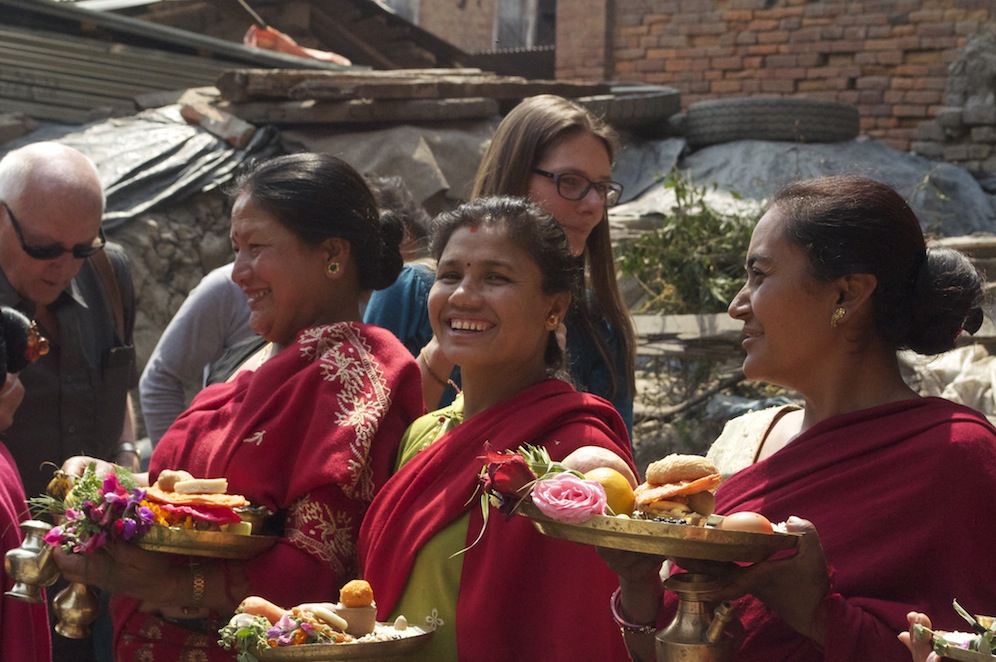
Newari women waiting with their gifts

Newari women waiting with their gifts

We soon found ourselves in the square renowned for its pottery. Whenever I have been there in the past there has been a great deal of activity related to that craft. This year there was none because of the continuing new year celebrations. In one corner of the square there was a gathering of people with a lot of music coming from two or three different musical groups who seemed intent on drowning out the opposition. There was a fabulously happy atmosphere about the gathering as the red saried women presented their sweet gifts to the shrine held aloft on the shoulders of giggling men.  Tourists mingled with the groups and you were never given the feeling that you were in the way or imposing yourself upon their event. So much more relaxed than Kathmandu.

The paper factory

The paper factory

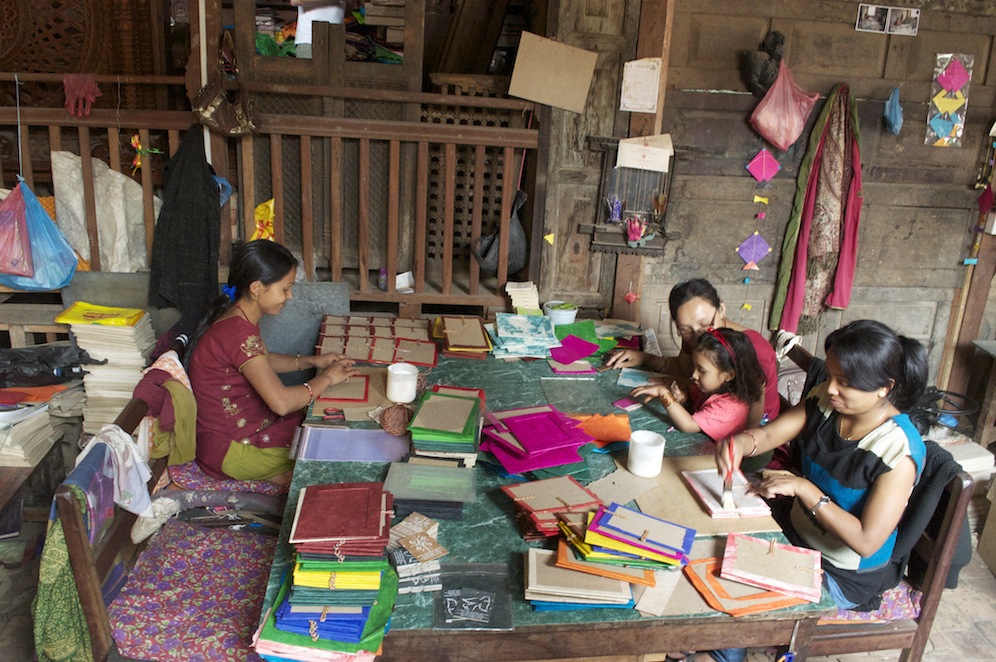
Moving on we went to see the peacock window before visiting a paper making factory. This gave us an insight, not only to the skills involved in making paper but also into the working conditions.  The building was a labyrinth of staircases and small working areas but the space was crammed with paper and paper products in various stages of production and finished products showcasing the wide range of products on sale.  The workers seemed happy and relaxed and one or two mothers had their children with them, presumably because the schools were on holiday and not because they were employing child labour.

Stephen buying his peas on the vine

Stephen buying his peas on the vine

It was time for coffee, so we went to the Peacock Cafe, overlooking a square where we spent the best part of an hour people watching from our balcony tables. From here we could watch the women drawing water from the well. Soon after we assumed our lofty lookout a young girl arrived with a large bundle of peas on the vine wrapped in a cloth. She sat on the base stone of a temple and, for a long time, nothing happened. Then, like bees round a honey pot, she was surrounded by people eager to buy her crop. Stephen popped down and bought some. Soon her crop way gone and another woman took over with a similar bundle. For the rest of our time in Bhaktapur, shopkeepers sat in their shop doorways eating peas from the pod.

Our last visit in Bhaktapur was to a wood carving centre. Because it was still festival time no carving was being done but we could look at samples of their work.

Slowly we ambled back to the bus which returned us to the hotel for a late lunch.
In the afternoon I took Stephen and Nathan into Thamel for some last minute shopping.

In the evening we went to the Nepali Kitchen for a traditional Nepalese meal with cultural dancing.

Today had been one of those nothing days waiting to go home. The boys left after breakfast for their flight to Kuala Lumpa, not an enjoyable experience saying goodbye at the best of times but especially when the next time I see Stephen will be some way in the future. I popped into Thamel but had no real reason to be there, so returned to the hotel and spent the rest of the day on the roof terrace.
The group has now gone so it is very quiet. A large part of me wishes I had left with the group but tomorrow is going to be another day with plenty to interest and excite.