Citadel

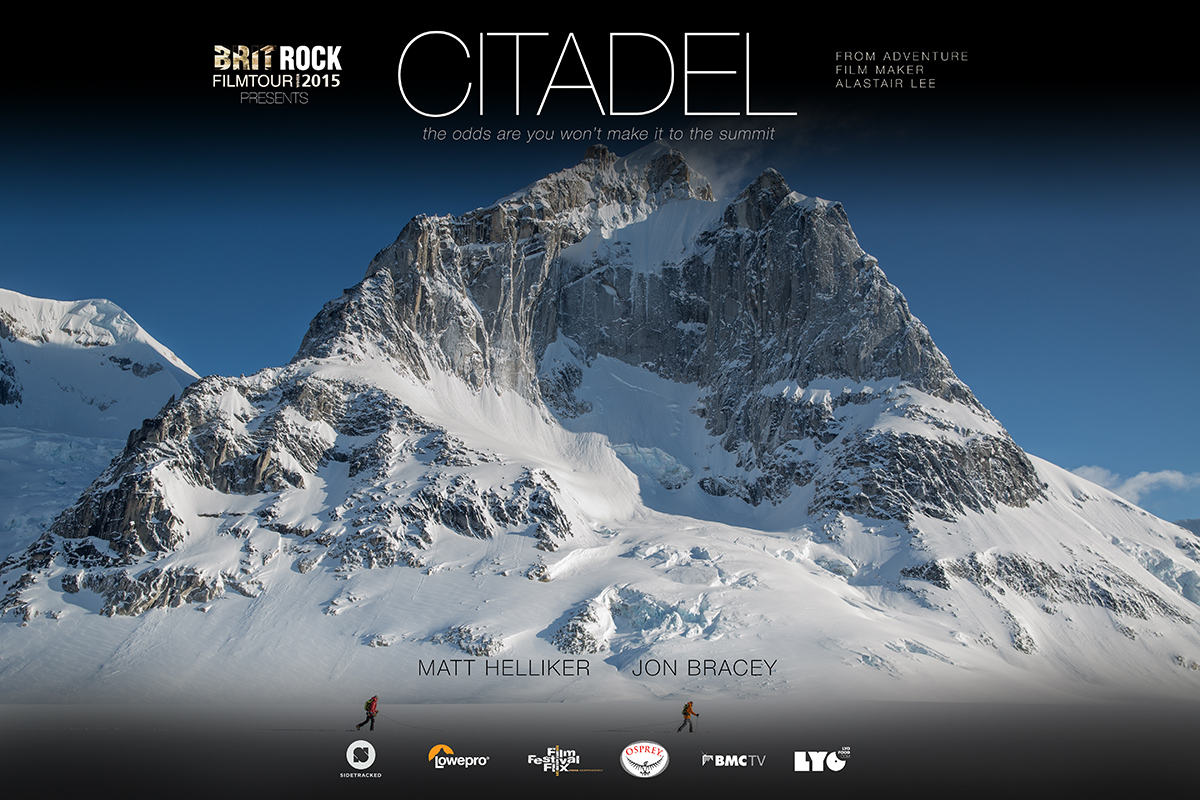
Citadel_landscape_poster_lrWhen you know a leading character in an event it seriously heightens the interest. I have always been drawn towards mountain expedition stories but ‘Citadel’, the latest offering from Alastair Lee and Posing Productions, is of particular interest. It is the story of Matt Helliker and Jon Bracey’s attempt to climb the previously unclimbed north-west ridge of Citadel, a stunningly beautiful mountain in the remote Neocola Mountains of Alaska. My interest? Jon Bracey. Today Jon is a muscularly toned climber with features carved out of the rock on which he climbs. I remember him being a relatively short, reserved, yet still very fit teenager who would bury his head in a climbing magazine at every opportunity. I would like to think that by taking him on a school expedition to the Himalaya in 1993, when he was an impressionable 17 years old, I opened his mind to big mountains and, in some way, influenced the route he has taken in life.

The film opens with some stunning aerial footage homing in on the Citadel. As it does so you gradually become aware of people, invisible, somewhere on the mountain. Those first indistinct human voices grow as the camera zooms in on Matt and Jon, ant like, camped on the top of a steep snow slope. The scale and the technical difficulty of the climb is incomprehensible.

With the introduction over the climbers talk of the reality of climbing, the risks and the losses, before taking us back to their respective homes in the Alps, Matt to his constant drive for fitness, while Jon has two young children keeping him on his toes. The balance of family, paid work as a top guide, and doing what you love is difficult but Jon seems to have got it right.

Returning to the Citadel, where the optimism of fellow climbers with knowledge of the mountain, is not flowing, Matt and Jon  are flown in with the unseen camera team and deposited on the glacier. Base Camp is established and then they have to sit out a storm and wait for the mountain to accept them on to its upper slopes. When the weather finally clears the mountain does not make life easy for them; soft, loose snow reveals almost flawless rock beneath it and the going is slow. Close ups of crampon tips grasping at the smallest of niches sets our hearts racing. With only three days of food in their packs they cannot afford to linger too long and they are already under pressure.

At the end of the first, long day (fourteen hours of climbing) they cut a small ledge in the snow to camp for the night. This was where we were first introduced to them on the mountain. The following morning this proved to be almost their high point, for now, the granite was flawless and impossible to climb without screwing bolts into the rock, something which purists Matt and Jon refuse to do. Sticking firmly to their principles they concede defeat, the mountain has beaten them, and they retreat to base camp to decide their next move.

The north-west ridge might have beaten them but there was still a chance they could bag the also unclimbed north ridge, tackling it lightweight in one day. Setting out early, Matt had to cope with stomach issues but, together, they put their heads down and climbed the route at a phenomenal pace, advertising just what fit and exceptionally capable climbers they are.

Alastair Lee has produced a superbly crafted film with stunning mountain shots and a clear narrative running throughout. He is, by far, the best mountain film maker in the country. If you love mountain films, make sure you see this one. It will be showing at King’s School, Worcester, Thursday 4th Feb. 2016 at 7.00pm.

As for Matt and Jon. Well done, guys. I am particularly proud of what you have achieved, Jon.


Winter Walking

There have been very few good winter walking days so far this winter; December was far too warm and a washout. 2016, so far, has seen some improvement but we are still being deprived of cold, crisp, clear days. Now, in mid January, the temperatures have dropped and there is some snow on the upper slopes in Wales but the ground is so saturated, we need a long spell of cold weather to turn the hills from a mud lark to an ice rink.

January 6th held some promise, although the temperatures were still unseasonably high. The promise of sunshine and clear skies tempted me and son, Stephen, to head over to Storey Arms, not to venture up the pedestrian motorway to Pen-y-Fan, but to venture west to explore the area around Fan Frynych and the Graig Cerrig Gleisiad National Nature Reserve.

The route from Storey Arms followed the Beacons Way/Taff Trail gently down hill to the Youth Hostel at Llwyn-y-celyn where we climbed up to the busy A470, crossed it with care, and headed into new territory for us both. The sun was shining, the sky was clear and there was very little wind. The day could not have been better. It was going to be a while before we reached the summit and the ridge but I was already looking forward to the views we would be getting of the main peaks of the Brecon Beacons and of the dramatic cliffs we would be walking around.

After an initial, short climb, we followed a wall, heading north to walk round a spur, climbing very gently as we went. On reaching the line of the ridge we were given a choice of either climbing up the ridge to the summit or traversing around in order to approach from a totally different angle. Had we taken the climbing option the walk would have been over too soon so we chose the longer traverse where we then contoured around the north-western side of the range. This took us into a delightfully remote valley, which climbed steeply from its head to hills that just begged for exploration.

Lunch

Lunch

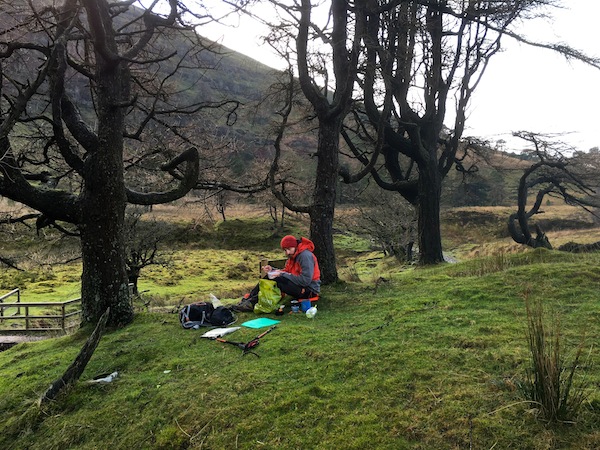
Swinging round we stopped for lunch on a small mound between the junction of two streams. Three trees grew from it. It was just in the shade but, because it was a mound it was relatively dry compared with the ground that surrounded it. It was an ideal opportunity to try out a couple of new pieces of kit, a steripen for water purification and a fast acting compact stove. Taking water from the stream, we purified it and then boiled it up to make cups of mushroom soup, which, if we were honest, was pretty tasteless. I forgot to pack a spoon so most of the powder stuck to the bottom and did not dissolve, so I might be doing the soup a bit of an injustice.

The route up from lunch

The route up from lunch

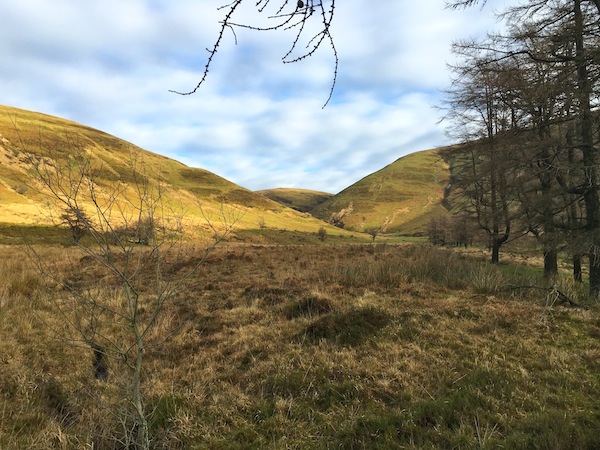
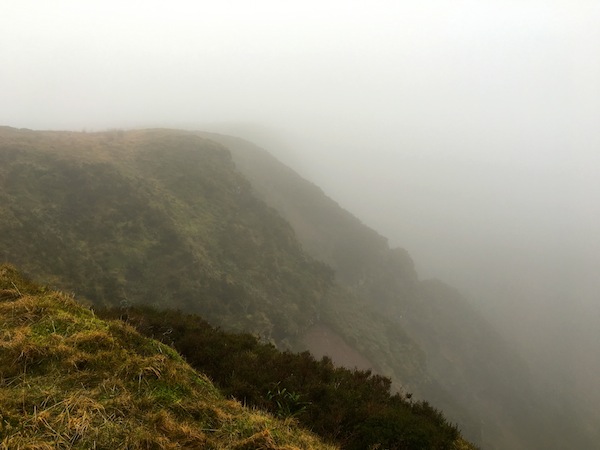
It soon got cold in the shade, so, fed and watered, we started the climb up a beautiful valley. Soon the path became a little ambiguous as the valley narrowed to nothing more than a tumbling stream cut into the hillside. Eventually, we climbed up from the stream, heading for the ridge where we knew there was another path. As we did so the cloud descended and our view was obliterated. However, it did not matter as we knew fairly accurately where we were and so long as we maintained higher ground ahead of us we had not reached the path. The ground was by now levelling out and when we did reach the path we headed for the trig point marking the summit of Fan Frynych (629m). We were nearly on top of the trig point when we spotted it, it being painted white and was standing proud against a background of white mist. There was no chance to enjoy the views I had been so looking forward to.

Hidden drama

Hidden drama

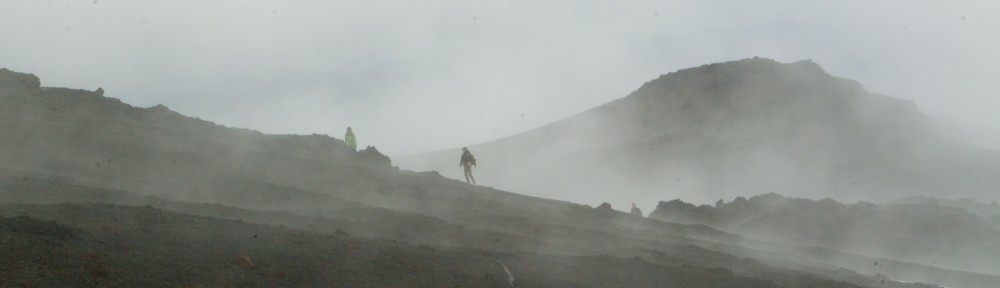
From the summit we picked up the path which would take us around the top of the cliffs of Craig Cerrig-gleisiad, again a dramatic viewpoint obliterated by the hanging mist. As we traversed the cliffs we began to hear the noise of traffic, indicating that we were getting closer to the road. Just as the ground begins to fall away steeply, we picked up a tenuous path heading south. It did eventually become a more convincing path as we continued to traverse around the hill, descending gradually towards the car park.

All day we had been slipping and sliding in the mud without falling. How typical that, about a hundred metres from the car park, my feet suddenly disappeared beneath me and I planted myself on the wet ground. We had not seen anybody all day; we had had these hills to ourselves. The one time when there was an audience of people milling around in the car park, I should make a fool of myself! It had been a super walk, the more so because I shared it with Stephen.

The forecast predicted for the 16th January for the Black Mountains looked fantastic, with a huge yellow ball shining out from the app on my phone. Forecasters on TV spoke very positively about the 16th being a very sunny, if cold day. With all that confidence I set out from home for the Black Mountains to have a look at a route I have planned for a group next month. It would also give me the opportunity to check one or two bits for the Crickhowell Walking Festival in early March.

Having cleared the ice from the car I set off just as the sun was rising, a huge orange/red ball rising in the east casting long shadows of vehicles across the motorway. In the distance the white tops of the Black Mountains came into view. By the time that I arrived at the Queens Head, walker’s car park, on the Llanthony road near Cwmyoy the sun was casting its warm glow over the lower, snow free hillsides. Despite the warmth of the look the temperature was still hovering around zero. The bonus for me was that, having had three days of cooler temperatures the muddy ground that we have had to endure so far this winter was now solid.

Cwmyoy

Cwmyoy

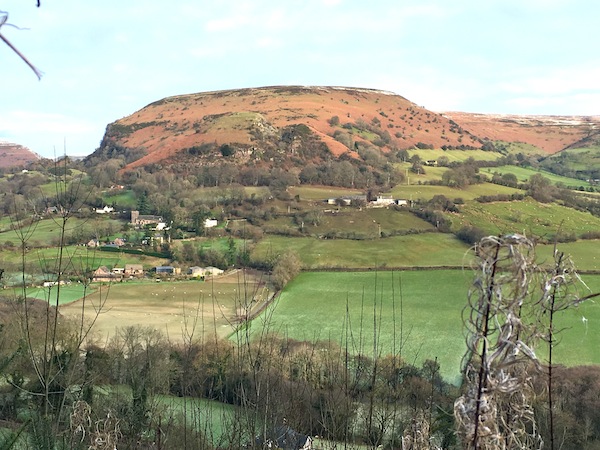
Climbing up the wrong side of the valley through Llanthony Woods I was given super views of the small village of Cwmyoy tucked neatly under a rocky outcrop, slightly detached from the main ridge. The fact that it is slightly detached might have some baring on the state of the church in the village. Having climbed so far to a point almost level with the village on the other side of the valley, I took a forest track that led to the floor of the valley, crossed the Afon Honddu, which was carrying plenty of water in it, before climbing up a couple of fields to the village.

Inside Cwmyoy Church

Inside Cwmyoy Church

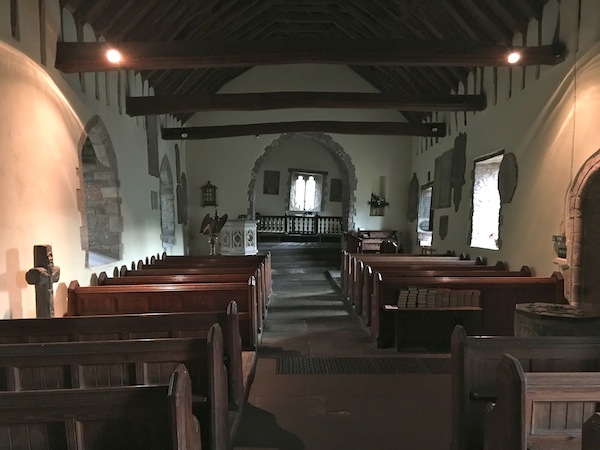
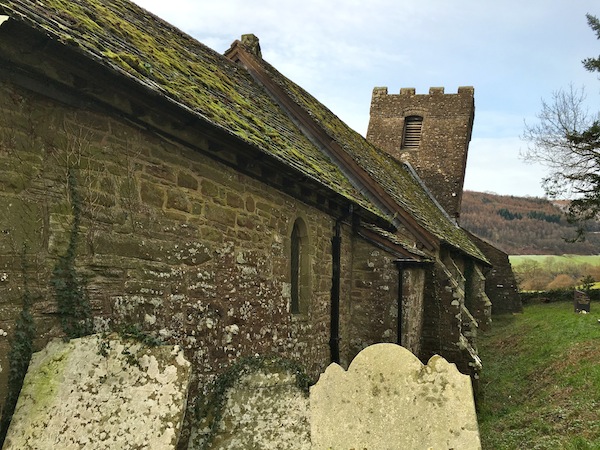
Anybody passing through the village has to visit the church. I have seen some crooked churches over the years but this has to be one of the best. There are no straight surfaces in this church, no parallel lines. While beams tend to lean one way, windows lean the other. It is a truly remarkable building. Indeed, the church of St Martin is unique, no part of it being square or at right angles with any other part.This is the result of being built on ground where subsidence has occurred in debris left by glaciation of the valley. Above the church, on the skyline, is a great gash on the side of the mountain caused by a landslide and it is this feature which gives the church and village its name Cwmyoy.

Local tradition says the landslide was caused by a terrible earthquake during Christ’s crucifixion, when there was darkness over the whole land.

IMG_1645Only further adding to the importance of Cwmyoy church is the 13th century carved stone representation of Christ on the Cross.  This rare medieval survival is thought to be one of the crosses from along the Pilgrim’s Way to St. David’s.  It was found on a nearby farm in 1871 and taken first to the Vicarage garden and then to the church.  It has had a chequered history, being stolen from the church in 1967 and only returned after it was recognised by a member of staff from the British Museum who spotted it for sale in an antique shop.  Today the cross is secured to the floor of the church, where it is intended that it will remain, and because the Church is located along the modern route of the Cistercian Way, the cross can be visited by a modern generation of travellers.

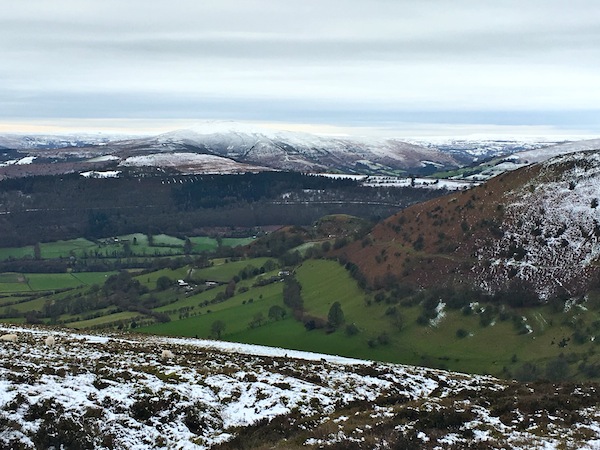
Leaving Cwmyoy behind, I climbed up and around the right hand side of the spur, following a path up on to Hatterall Hill. For a while this took me along the boundary between pastureland and open hillside. The pastureland was still remarkably green despite the livestock on it. I was also surprised to see just how many sheep were out grazing high up on the open hills, despite the sudden drop in temperatures over recent days and the lying snow. As I climbed higher I began to encounter snow. I left the marked path and made my way along sheep and pony tracks through the snow covered heather, aiming for the summit ridge. Navigation was not an issue as I knew that once I hit the ridge top I would stumble across Offa’s Dyke Path, which at this point also was part of the Beacon’s Way.

IMG_1646By now the promised sunshine was no longer there, replaced with rather heavy, watery clouds intent on sprinkling me with light snow.Out of the shelter of the hill, it was also significantly colder, but still very pleasant. I was not alone, and occasionally met others on the path. The one common factor of us all was our disappointment that the promised sunshine had not lasted as long as predicted.

Descending from the trig point on Hatterall Hill was easy, now following the Beacons Way as Offa had veered off to the east. As I descended further, back down to the river, the luxury of frozen ground was gone and I found myself wallowing in mud yet again, particularly through Strawberry Cottage Woods, soon after which I found myself back at the Queen’s Head and the car. It proved an enjoyable four hour walk, which can be lengthened quite easily to suit.


Christmas & New Year Activities

With Christmas Day behind us we were able to enjoy brief encounters with the outside world on the few occasions when the weather cheered up. Sometimes we just got on with it despite the weather.

Boxing Day “Steam-up”

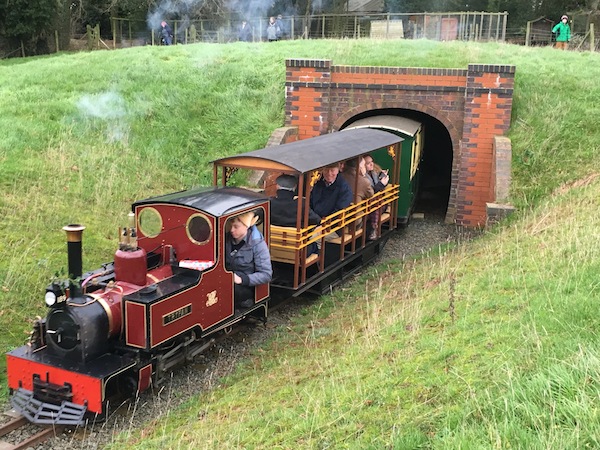
IMG_1564On Boxing Day Michael and Helen Whitehouse hosted a “steam-up” at their home in the beautiful Worcestershire countryside. This is an annual event, which I always look forward to, and is one of the highlights of Christmas.  It is aways in aid of charity and this year it was in aid of the Himalayan Trust UK. People arrive to park their cars in the lane below the paddock adjoining the Whitehouse garden. Passing through the gate into the field you wait on the station for the train to collect you to take you on a circuitous route with many recognizable railway features, even if they are scaled down, up to the house where there is another station. There we are provided with mulled wine, coffee and delicious mince pies and the chance to meet with people whom you last met at the same occasion a year ago.

The weather was an improvement in progress but as it was dull and damp early on many people decided not to to venture out. For those that did, the weather improved, the sun began to shine and they all generously donated into the collecting pot for the Himalayan Trust UK. I just love it!

May Hill

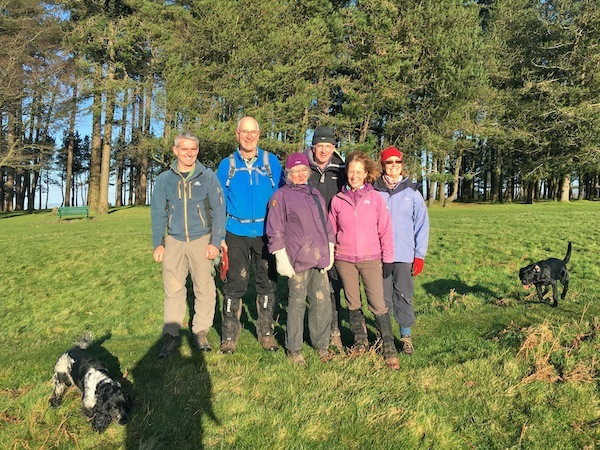
The 29th December proved to be the best day of the holidays with clear skies and bright sunshine. It was still unseasonably warm. It was a good day to meet up with a few friends, Sandie, Simon, David, Annie, Tudor and three dogs on May Hill Common for a short walk over May Hill and back through Newent Woods before retiring to the Glass House Inn for a long, relaxed, sociable lunch.

IMG_1569Like those we were with, I had never walked in the area, although I have driven past it on many occasions en route to Wales. A gentle climb took us towards the top of the hill, passing a herd of docile Belted Galloways with their distinctive black and white markings. The most notable thing about May Hill is the clump of trees on the top, visible from many points along the Malvern Hills and from the more easterly summits of the Black Mountains. These were planted in 1887 to commemorate Queen Victoria’s Golden Jubilee. From this vantage point we looked down on to the flooded Severn Valley, looking more like a lake than a river.

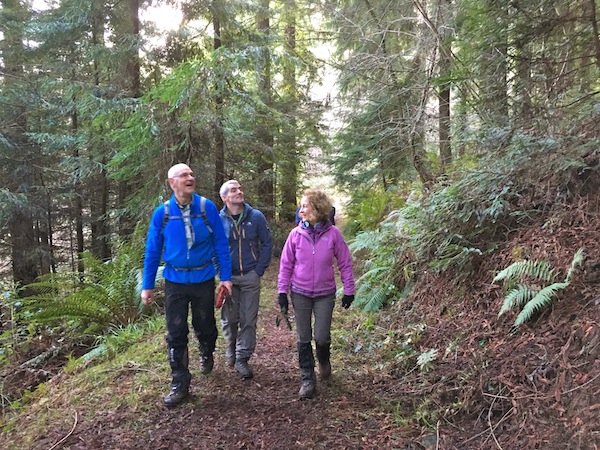
IMG_1570Descending the southern ridge of May Hill we returned through Newent Woods, home to some spectacular Redwoods standing tall and straight in the lea of the hill. This returned us to our cars park on the common. It was not a long walk but it opened my eyes to the possibility of investigating the potential for adding a few miles to it so that it could be included in the next round of day walks.

I can highly recommend the The Glass House Inn if you don’t mind being watched by a plethora of stuffed animals hanging from every beam and staring out from every wall. You constantly feel you are being watched, but it adds interest to the place. There is a good choice of beers and the food is excellent, even if we had to wait a little too long for it to appear. That did not matter as we had plenty to talk about while we waited.

New Year Ramble on the Malvern Hills

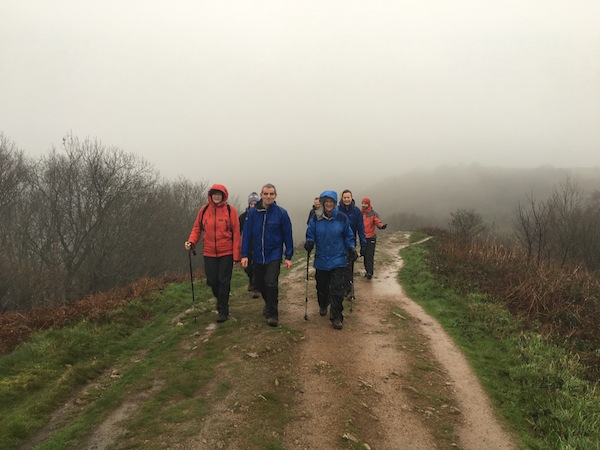
Over the years the New Year Ramble on the southern end of the Malvern Hills has generally had a good turn out. We have had exceptionally mild walks, some damp ones and the occasional one with snow, heavy frost and clear blue skies. The forecast for this year was to be particularly damp and from about 24 hours before the walk the excuses started to arrive by text message or email. Those, for whom it meant a significant journey were the first to pull out, and I can understand their unwillingness to get wet and then to have to travel uncomfortably home for a couple of hours. That said, my stalwart supporter (or should that read “stalker”), Claire, travelled up without complaint from Bristol.

On the morning of the walk the text messages increased and there seemed to be an alphabetical connection. Everybody whose name began with an “A” suddenly couldn’t make it, including my wife, Angela. Where’s the support when you need it? Then there was ‘car trouble!’ I thought I had heard the end of lame excuses when I left teaching. No more, ‘I did my homework but the dog ate it!’ One of the best was a letter from a mum asking if her son could be excused from abseiling in case he got his ears wet! This was turning out to be nearly as good.

Having been accused of being Captain Fairweather two years ago by David Thomas, I was particularly upset when he pulled out. He had clearly looked out of the window and decided he was not going to bother.  I feel I have earned my Captain Anyweather stripes again.

IMG_1571A hardy bunch met me at the car park, including Libby, not dressed for walking but wanting to know what time we would be finishing so she and Ellie could meet us in the bar of the Malvern Hills Hotel afterwards. There were eight of us brave enough, or stupid enough to venture out. I decided that we would curtail the walk to last a couple of hours or so, so that we would know we had been for a walk. Once we got going it was not too bad, a little exposed on the tops but on the west side, out of the wind, it was quite pleasant, sufficiently so that we added an extra few minutes to the walk by visiting the obelisk. The hills were sodden with so much recent rain it was mucky underfoot. There were no views from on high as we had our heads in the cloud. But the company was good and all those that languished in bed do not know what they missed.

Himalayan Club Malvern Rambler

If we thought it was wet for the first Malvern Rambler, the next day was so much more so. Again text messages came flooding in from Sixth Formers bogged down with revision, feeling under the weather or still travelling home from far flung places. To be honest, I did not blame anyone for not wanting to turn out on a day like this. The rain fell by the bucket load. Driving to Malvern the River Severn was now Lake Severn with the flood plain doing what it should do in such circumstances.

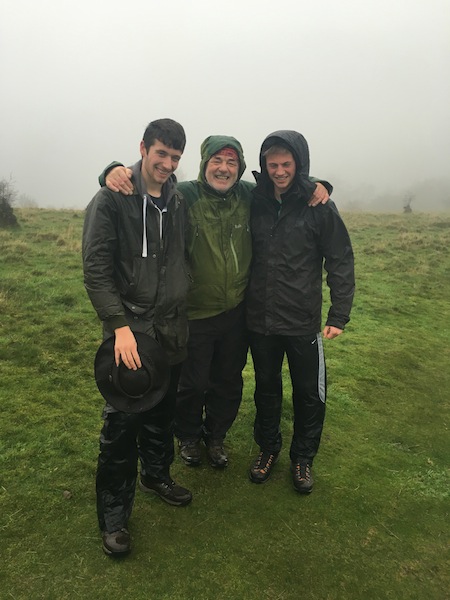
Will, me and Dom

Will, me and Dom

The car park at the foot of the Herefordshire Beacon was, predictably, almost empty and part of me hoped nobody would show up. When you have a group of 25 you are working with, somebody is guaranteed to turn up, and, true to form, two did, Will and Dominik. Dominik even brought his mother and little sister along. I can understand Will, he is a country lad, well used to getting wet. Dominik had just bought some new boots (we met in Cotswold Outdoor after the first Malvern Rambler) so needed to test them. I admired both for their spirit but also Dom’s mother and sister, neither of whom needed to be there.

We did the same walk as the previous day, only this time there was no let up in the ferocity of the rain. Funnily enough, we hardly saw another soul out on the hills. Despite the conditions, it was actually a very pleasant walk and I had ample opportunity to answer any questions the boys had about their upcoming trip to Kyrgyzstan in the summer.

By the time we got back to the car park, I felt that we were so wet we did not need to linger over coffee of hot chocolate; we just wanted to get home and get out of our wet gear. However, despite the extremely wet conditions, I was glad we did it.


Cotswold Circular Walk from Bourton-on-the-Water

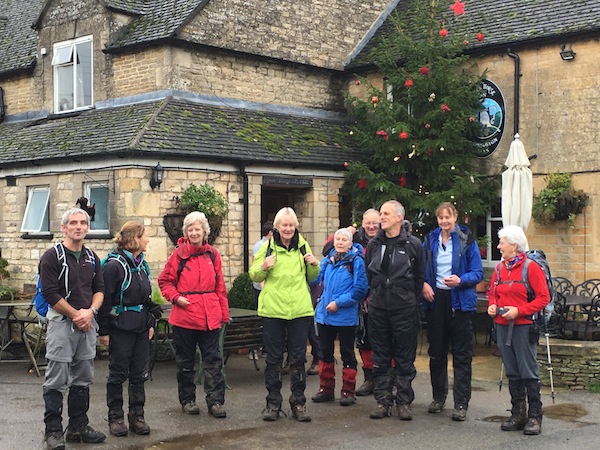
It was a damp, misty morning with the windscreen wipers on intermittent as we drove to Bourton-on-the-Water. It had been a damp and unseasonably mild December spell, which would undoubtedly make the route chosen for the day soggy, muddy and slippery underfoot. I had walked the route only six days earlier, but since then rather more rain had fallen making it even more slippery.

There were twelve of us gathered in the car park adjacent to Birdland in Bourton. The rain had ceased but the atmosphere was still very damp. As we donned our boots and sorted ourselves out, hoots of derision came from the other side of the leylandii hedge from numerous exotic birds.

Setting off we walked through the centre of the village and out the other side. What a difference a few months make. In the summer you can hardly move for tourists in Bourton, visiting Birdland, model village, dragonfly maze, motor museum and a whole range of expensive shops and cafes. Today, the streets were quiet and we were able to walk through beside the shallow River Windrush with the village Christmas tree firmly planted in the middle and decorated with lights.

Leaving the village we entered a field via a very muddy gateway that had us clinging to the fence in an effort to avoid the worst of it. The route followed the Windrush but, thankfully, up from the water itself where the ground was significantly more waterlogged. The path was relatively level with just a few undulations through riverside copses but the nature of the walk changed little as we generally stuck to following the fairly shallow valley.

The Black Horse Inn, Naunton

The Black Horse Inn, Naunton

Eventually we climbed out of the valley at the point where the Windrush Way joins with the Cotswold Diamond Way. Although we were walking the opposite way, it was instantly recognisable from when we walked the latter in 2013. Reaching the top of the hill by the golf course the village of Naunton came into view, nestling in the next valley, looking hazy in the damp atmosphere. Smoke drifted lazily in vertical columns from Cotswold stone cottages in the windless conditions. Entering the village, the path came out almost opposite the Black Horse Inn, for which we made a beeline, looking forward to nothing more than coffee and hot chocolate. When I ordered the locals sitting round the bar chortled as the young barman hated fighting with the coffee machine. Not all those round the bar were drinking beer or wine as the occupant of one of the stools was a spaniel, clearly at home in the pub, as were several other dogs content to get under our feet as we trooped in to enjoy our drinks.

We were now about half way round our circular route and we left the village by following the Wardens Way up a sloping field through woodland and on up and over three very muddy fields with young crops in. It did not help that this was a bridleway and horses had churned up the path making it even more precarious. As we climbed we entered a world of mist and at one point the front of the group was invisible to the back until my phone alerted me to the fact and we waited to allow them to catch up. It seemed a good opportunity to stop for lunch, too wet to sit down but there was at least a good wall for us to lean on.

The Church in Upper Slaughter

The Church in Upper Slaughter

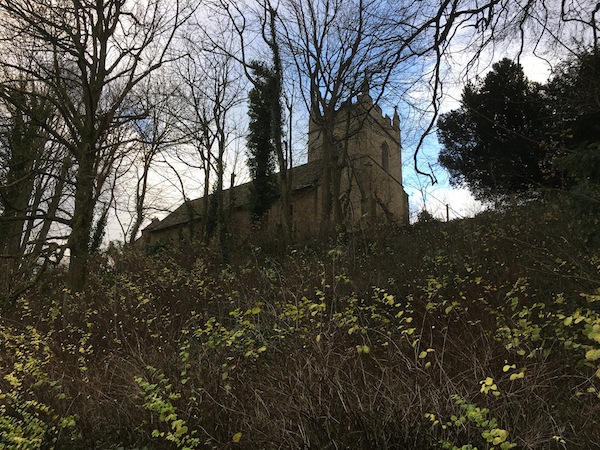
We were making good progress, fascinated by the content of hundreds of tubes with newly planted trees and shrubs as we descended to Upper Slaughter, the first of two very attractive villages, oozing Cotswold charm with yellow stone cottages and the odd superior country hotel, Eyford House, formerly the Manor House and voted the nation’s favourite house by Country Life in 2011. The church stands imposingly on a hill.

The mill and sluice in Lower Slaughter

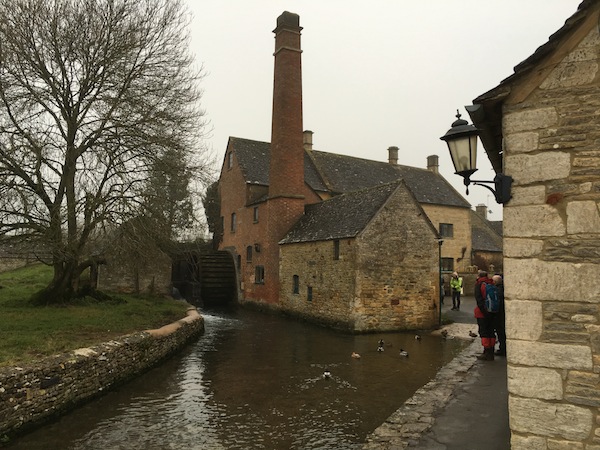
The mill and sluice in Lower Slaughter

A mile further on we came to, what I consider to be even more beautiful, Lower Slaughter with its water mill, now a museum, superior gift shop and café, with the river running gently through the village, home to many well fed ducks. Like Upper Slaughter, Lower Slaughter boasts an even more spectacular Manor House, again converted into a very smart hotel. On this occasion it was closed to the public as it had been completely taken over by a private event. Not that we were considering dirtying its carpets with our muddy boots. Even the country house inn was too smart for us, so we just passed through.

By now we could hear the traffic on the busy road bypassing Bourton and it was not long before we were walking the pavements back to the car park, now much busier with tourists, even at this time of year. It was a pleasant walk despite the slippery paths in places, despite the lack of views, despite the dampness in the air (at least it did not rain) but because of the good company, walking with a group of like-minded friends. It was 11 miles of conversation and catching up.

Nepal’s fuel crisis will push almost a million people into poverty

Taken from the Himalayan Times

Jhor, December 11

With a large cone-shaped bamboo basket strapped to her back, Nirmala Bhandari treks two hours every day from her village to a protected forest in the hills, heaving it back filled with enough firewood to cook food for her three children. Despite knowing timber collection in this forest is illegal and wood stoves cause deadly indoor pollution, the 35-year-old widow says she has no choice since a shortage of cooking gas hit Nepal more than two months ago. “My children and I spent three days outside a fuel shop for cooking gas but did not get any,” she said in a village in Jhor, 12 km from Kathmandu. “If there is a problem collecting wood then I may have to feed them only alternate meals,” said Bhandari, explaining that guards at the Shivapuri National Park have already warned her to stop hacking off tree branches in the fast-depleting forests.

Bhandari’s family is among hundreds of thousands in the impoverished Himalayan nation crippled by a shortage of basic commodities after Nepal adopted a new constitution, sparking protests by the Madhesi minority, who say it marginalises them.

Since September, 50 people have died in protests at border points with India, where demonstrators have blocked trucks carrying everything from petrol to medicines from entering the landlocked nation, still reeling from two deadly earthquakes.

The crisis has prompted the United Nations to express deep concern over what it said is a ‘critical’ shortage of lifesaving medicines and fuel, and warns this could put at least three million children at risk of illness in the coming winter months. Experts say this economic and humanitarian crisis is likely to have a much wider and longer-term impact. “The fuel shortage will push more than 800,000 people below the poverty line. This is our estimate based on the study of the losses faced by agriculture, industry and service sectors,” said Trilochan Pangeni, a spokesman for Nepal’s central bank. “These people are wage earners, marginalised and low-income people. We have derived this figure after a detailed and close study in all these sectors. This will hit the economy badly.”

Fuel queues, fixed meals

In streets of the capital Kathmandu, the crisis is evident. Thousands of residents line up with empty gas cylinders outside fuel depots every day only to be told that the elusive tankers have not arrived from across the Indian border.

With authorities imposing a ration on fuel, motorists line up in queues stretching more than two kilometres outside petrol stations. On the black market, petrol and diesel smuggled in jerry cans from India sells up to five times the normal price. The cost of commodities, like cooking oil have soared amid fears inflation could hit double digits by the end of the year.

Even ready-to-eat items like noodles have disappeared from the shop shelves.

The fuel shortage has led to buses cutting down services, forcing commuters to sit on roofs. Taxis are no longer an option for many, as they can’t afford paying six times the normal fare. Tour operators say the country’s key economic pillar, tourism, is already suffering. On average, 800,000 tourists visit Nepal annually, contributing four per cent to the GDP. Domestic airlines have reduced the number of flights, and hotels are offering only fixed menus to beat the fuel shortage. “How can you expect tourists to come when you don’t have fuel even to cook a full course meal for them?” said Jiban Ghimire of the tour operating group Shangri-la Nepal Trek.

Large and small businesses alike have been badly hit. Federation of Nepalese Chambers of Commerce and Industry says more than 2,200 industries producing food items, plastic goods, edible oil, iron ores and cement have closed down, throwing 220,000 workers out of work.

In an empty restaurant on the outskirts of Kathmandu, owner Rupesh Shrestha says he has been forced to give leave to 25 of his 30 employees because they have no gas to cook with. “Only five of us manage to serve a few of our regular customers who come. We use firewood to cook as there is no cooking gas. I don’t know when the situation will improve,” he said.

Wedged between China and India, Nepal is recovering from a decade-long conflict between Maoist rebels and government forces, which ended in 2006. Years of political instability have slowed development efforts and two deadly earthquakes in April and May this year, have further hampered efforts to lift 25 per cent of the country’s 28 million people out of poverty.

Under these circumstances, central bank Spokesman Pangeni says it is the most vulnerable who are hardest hit. “They are hotel workers forced to stay on leave because hotels have cut down on services due to fuel shortage. Transport workers have lost jobs, rickshaw pullers are out of work,” he told the Thomson Reuters Foundation. “Tens of thousands of people who were self-employed in small pavement businesses like tea and coffee shops, cake shops, street vendors are out of work. These people have no income.”

Surgeries postponed, vaccines low

The government of Prime Minister Khadga Prasad Sharma Oli has offered to amend the three-month-old charter to address some of the key concerns of the ethnic Madhesi protesters. Several rounds of negotiations between the government and protest leaders have failed amid differences over how to change the internal boundaries of newly created federal states. Protesters say the entire southern plain region, Nepal’s bread-basket, must not be split into more than two federal provinces. They now form part of six of the seven provinces dominated by hill dwellers.

Many in Nepal blame India for supporting the Madhesis, who share close familial, cultural and linguistic ties with India, by refusing to divert oil tankers to other border points where there are no protesters. New Delhi denies the charges saying Nepal should instead resolve its constitutional crisis through talks and create a safe passage for tankers and trucks to roll into the country.

Nepal received 1,000 tonnes of fuel from China to beat immediate shortage and is negotiating regular imports with Beijing, ending a decades-old Indian monopoly over fuel supply. Authorities are also distributing wood to residents and is turning to Saudi Arabia and Bangladesh for fuel supplies.

A power cut for nine hours every day has added to the worsening plight of residents who had switched to induction cookers that run on electricity. Many power plants as well as development projects have ground to a halt due to the fuel crisis. Even transporting relief materials like warm clothes and blankets to quake victims has been impossible, said aid agencies.

The blockade is also taking a toll on Nepal’s health sector, as 60 per cent of the country’s total drug requirements are imported from India. Pharmacists say antibiotics and drugs for illnesses such as blood pressure, diabetes, heart and kidney problems, mental illnesses as well as syringes and blood bags are critically low. Hospitals in Kathmandu have begun delaying surgeries because of a lack of equipment and medicines. “If it continues for a couple more weeks, patients could start dying,” said Mukti Ram Shrestha of the Nepal Medical Association, an umbrella body of doctors across the country.

Humanitarian agencies warned this week that with health care facilities lacking over half of their total essential requirements, the humanitarian implications were ‘grave’.

A statement signed by four UN agencies and other aid groups said the most vulnerable, including pregnant women, the elderly, children and people with chronic conditions such as diabetes and cardiovascular disease were already being affected. “Disruptions to public health programmes, including routine immunisation, will have an extremely serious and lasting impact on the health of children,” said the statement from agencies such as the World Health Organisation, Britain’s Department for International Development and the German Development Cooperation.

“Access to life-saving emergency services, including surgery, intensive care and blood transfusion, as well as referrals of complicated cases, have been severely impacted.”

The rising dependence on wood will also increase more indoor pollution and result in a spike in cases of pneumonia. But for women like Bhandari, with three mouths to feed, using firewood is her only option. “For now, my priority is to somehow cook meals and feed my children. Everything else comes after that,” she said.