Hue

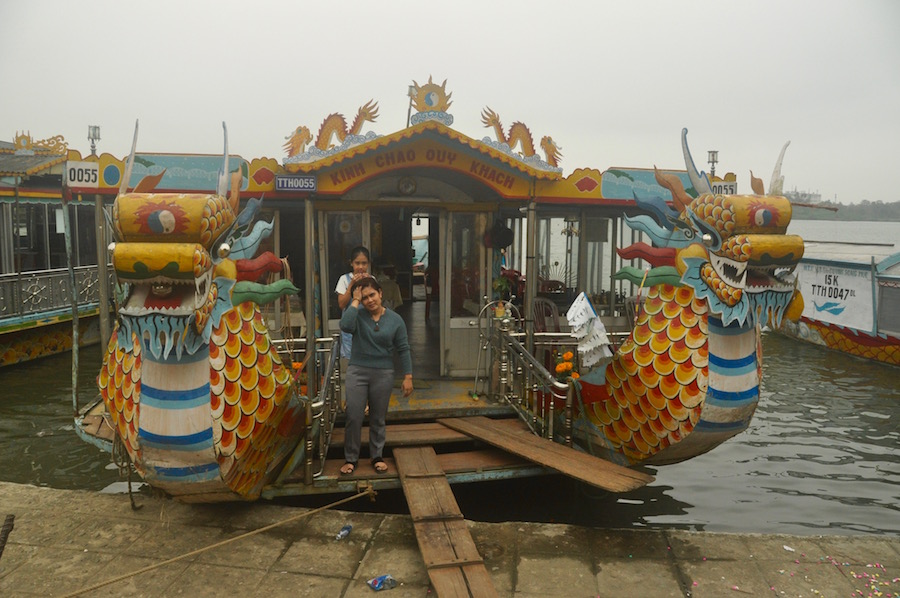
After a fourteen hour, overnight, train journey south, we arrived in Hue about half way down the length of Vietnam. We were met at the station by our new guide, Mr Tuong, and taken immediately to a restaurant for breakfast. Following breakfast, we walked down to the Perfume River, where there was a line of dragon headed boats moored along the bank. They were very crudely made with tin cut to a template and fixed together. The smiling faces of a couple and their two children assured us as to which boat we should step on to. As soon as we were all aboard, we were off, down river. The Perfume River gets its name from the fact that during the autumn the blossom from fruit orchards up stream falls into the river, flows downstream, and as it does so gives off a perfume like aroma. This was not the case as we travelled down the river, which was a muddy brown, like so many rivers in Vietnam.

In the centre of the main cabin of our boat was a stall selling a wide range of gifts from ethnic clothing to jewellery, to paper crafts etc. The women in the group spent much of the journey satisfying their urges for some retail therapy, having been largely deprived of such opportunities so far during the trip. While they were engaged in that activity, the men took turns to pilot the boat. Anything was preferable to having the boat captain’s three year old daughter steering the boat.
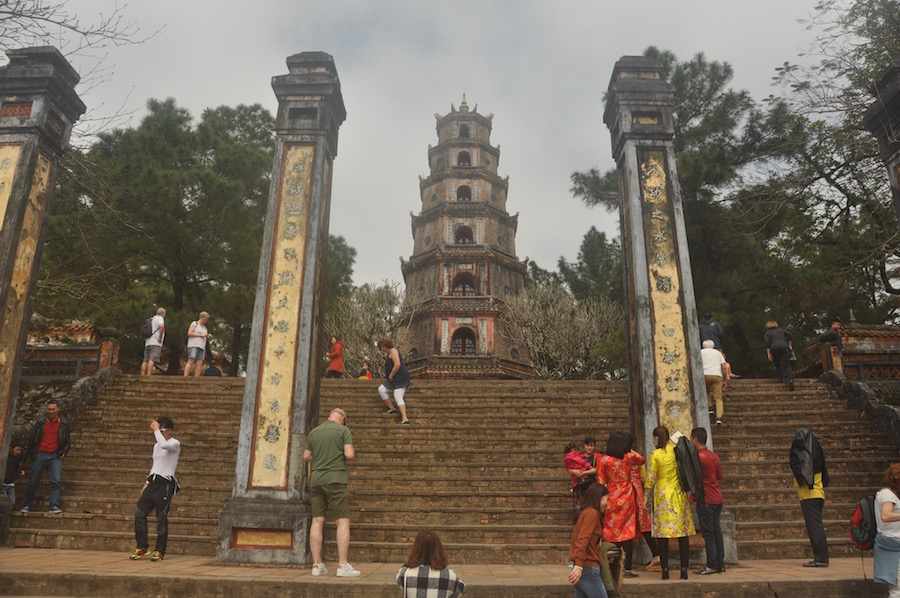
After some time we berthed to visit Thien Mu Pagoda, a seven tiered pagoda built in 1601. It has a prominent position, perched on a hill overlooking a bend on the north shore of the river. It also, clearly, has some significance with the local population, because there were many Vietnamese families, very smartly dressed, enjoying an outing during the Tet Festival. It was a time for family portraits, for children to be photographed at their best, creating lasting memories.
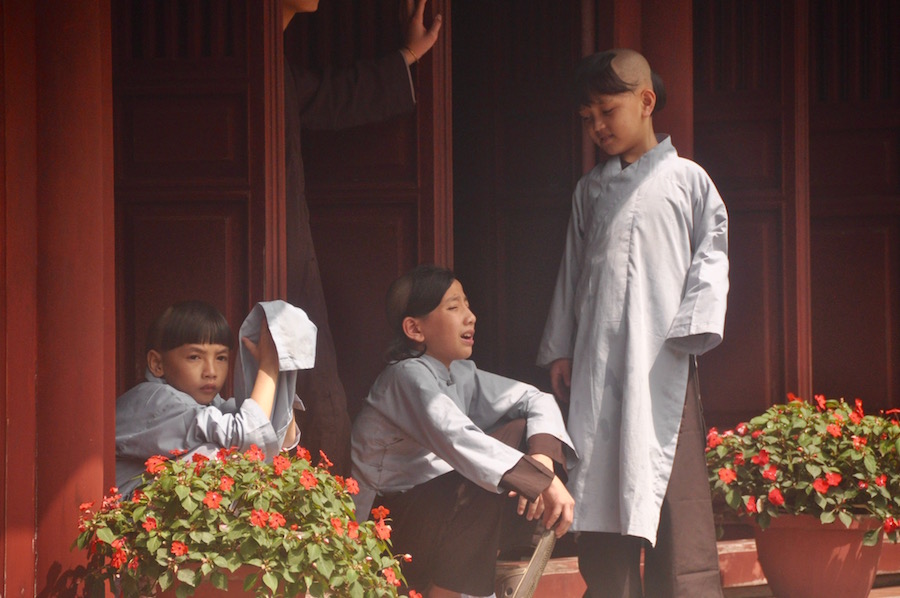
Beyond the fearsome guardians of the Pagoda, two giants with large, almost real, beards, the site opens out into a lawn area with a temple housing Buddha. Behind is a further lawn area with ornamental ponds, and beyond that pine forest. The temple is home to a particular sect of monks who wear brown or grey habits but stand out from other monks because of their very strange hair style. While the bulk of their head is shaved, a patch is allowed to grow untouched, often from one side of their head.
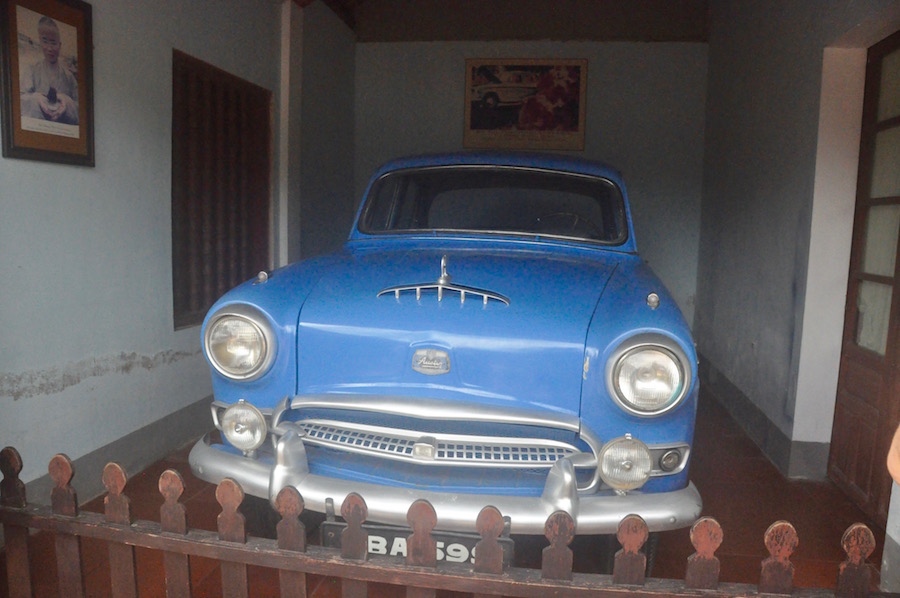
The car driven by Thieh Quang Duc

The most internationally famous monk from Thien Mu is the Venerable Thieh Quang Duc who drove to Saigon in 1963, got out of his car and sat in the cross- legged lotus position on the ground and meditated while fellow monks doused him in petrol and set fire to his body. The ritual suicide in protest against the anti-Buddhist regime of President Diem captured news headlines around the world. The car that he used to drive to Saigon is on display to one side of the complex.
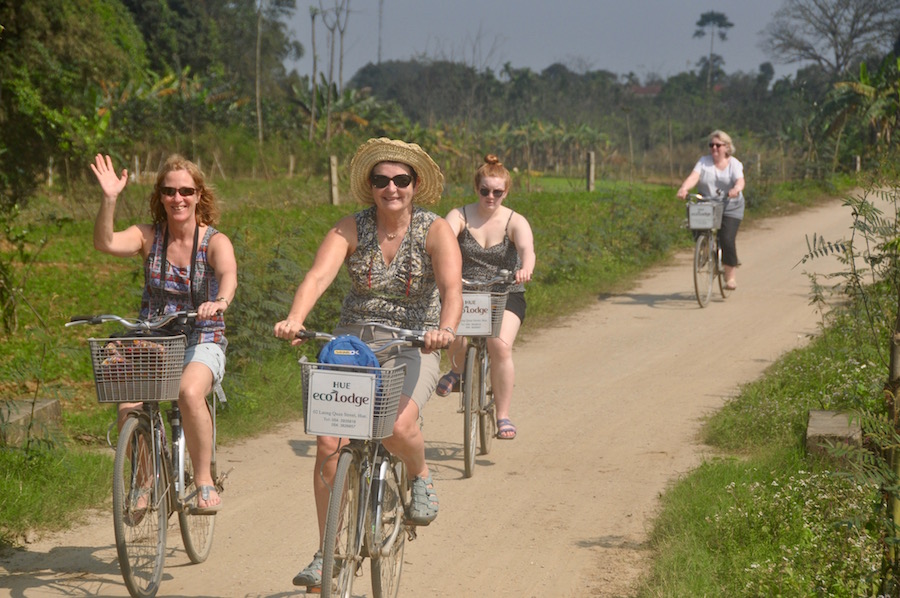
Returning to our boat, we continued our journey while the women continued their shopping. Eventually coming ashore on the south bank, we disembarked to find some bicycles waiting for us. We had to ride these in order to reach our accommodation for the night at Hue Ecolodge. This was a fabulous place, set in its own spacious grounds with trees and shrubs. The rooms were all individual bungalows, beautifully furnished. Not only did they have an en suite but also a private cobbled yard which also had a shower in it.
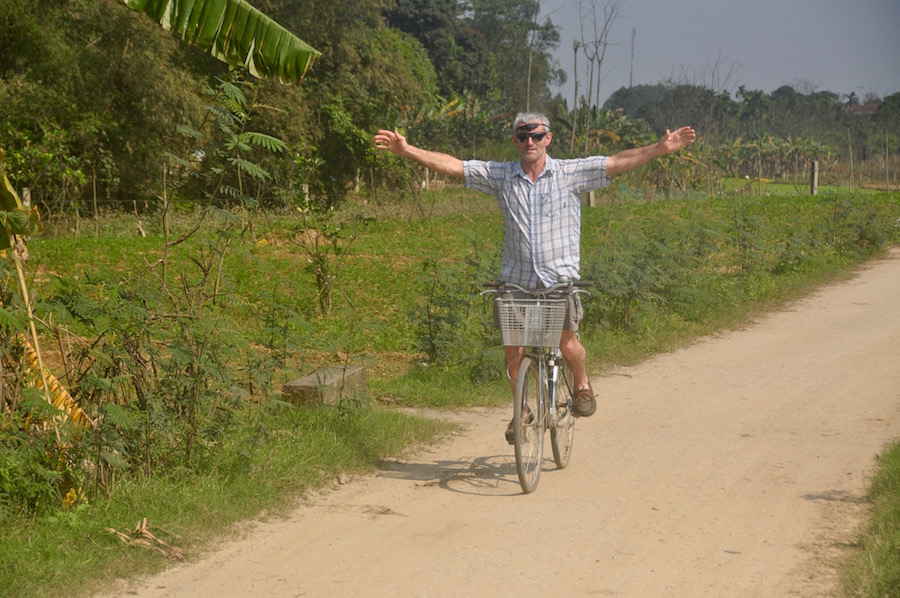
Simon showing off!

After freshening up, we again took to the bikes for a ride around the village. These bikes were not perfect by any stretch of the imagination. The seats were all fairly low and not in the most comfortable position for riding. They had seen some use. Nevertheless, we enjoyed, not only the exercise, but also seeing village life, which always seems to take place outside. Most people were enjoying being at home, with families, for the festival.

Returning to where we first met our bikes by the river, we were directed to an open dining area all laid out for a cookery lesson. We should have visited a market during our river trip earlier in the day, but because of the Tet Festival, the market was not open. Hence, our hosts had acquired all the ingredients we needed for our cookery session.
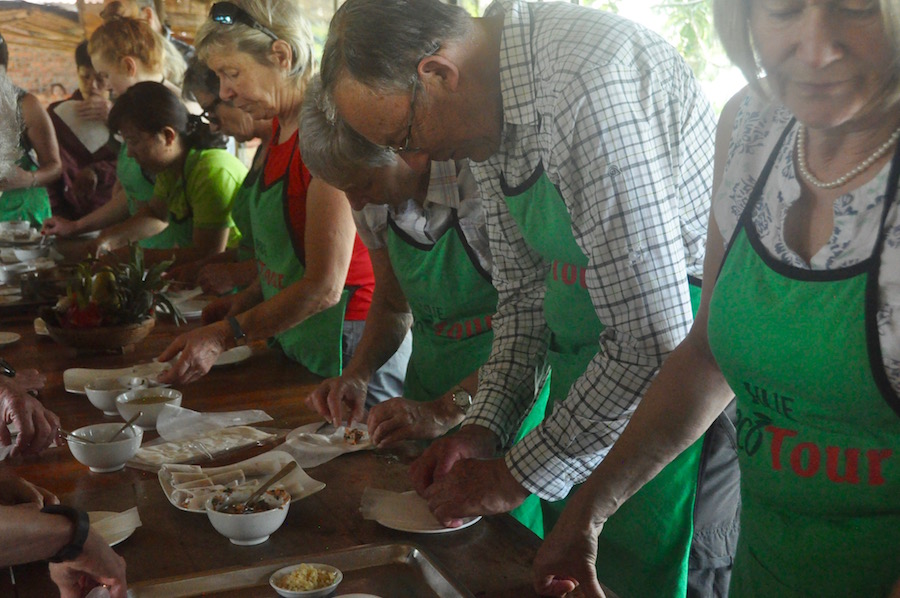
Donning pinafores we learnt how to mix the ingredients for spring rolls and the technique for rolling them. Then we set about making our own. Some, and I won’t name names, even made this simple task a competition to make the fastest, the best shaped etc. When we had exhausted all the materials, the freshly made spring rolls were whisked away and we learnt how to mix the ingredients for a second dish.

By now it was mid afternoon, and we had not yet had any lunch. Thankfully, the spring rolls were returned to the table, cooked, along with a great many more dishes, which we enjoyed.
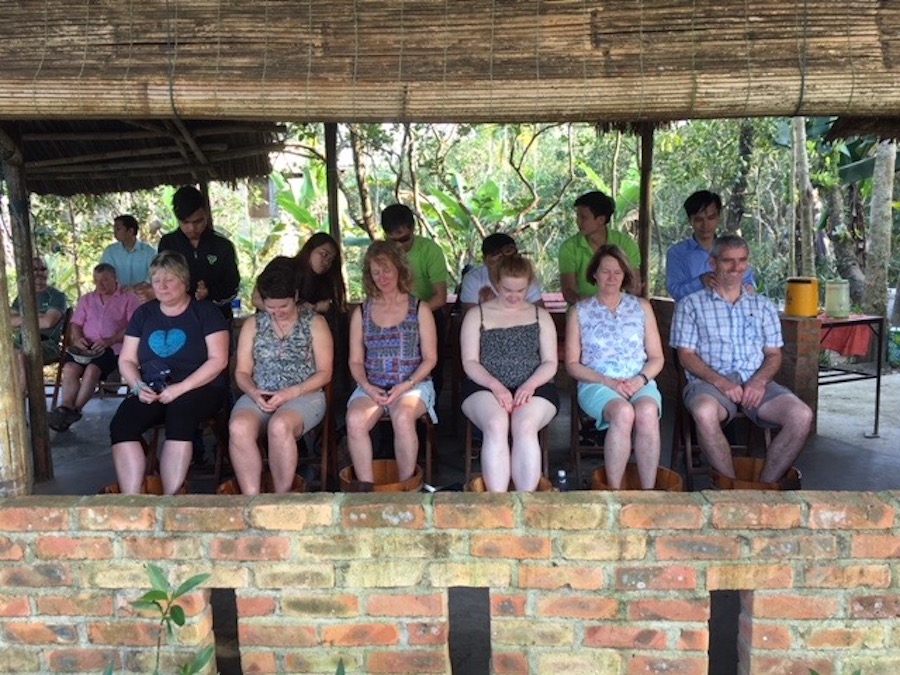
After lunch we were joined by some blind and visually impaired young people who gave us head and shoulder massages followed by lower leg and foot massages. Just what we needed before we headed back to the lodge on our bikes. There we took full advantage of the tranquillity of our surroundings, either by the pool or in the comfort of our air-conditioned rooms.

The following morning we had to leave this wonderful place. We could have done with at least another night there. Our itinerary dictated that we had to leave, so we boarded the waiting coach.
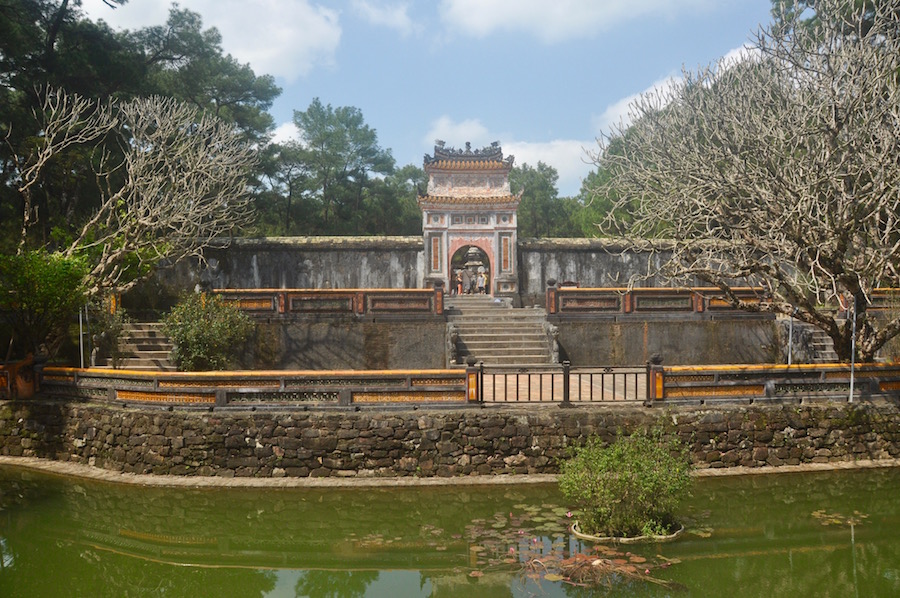
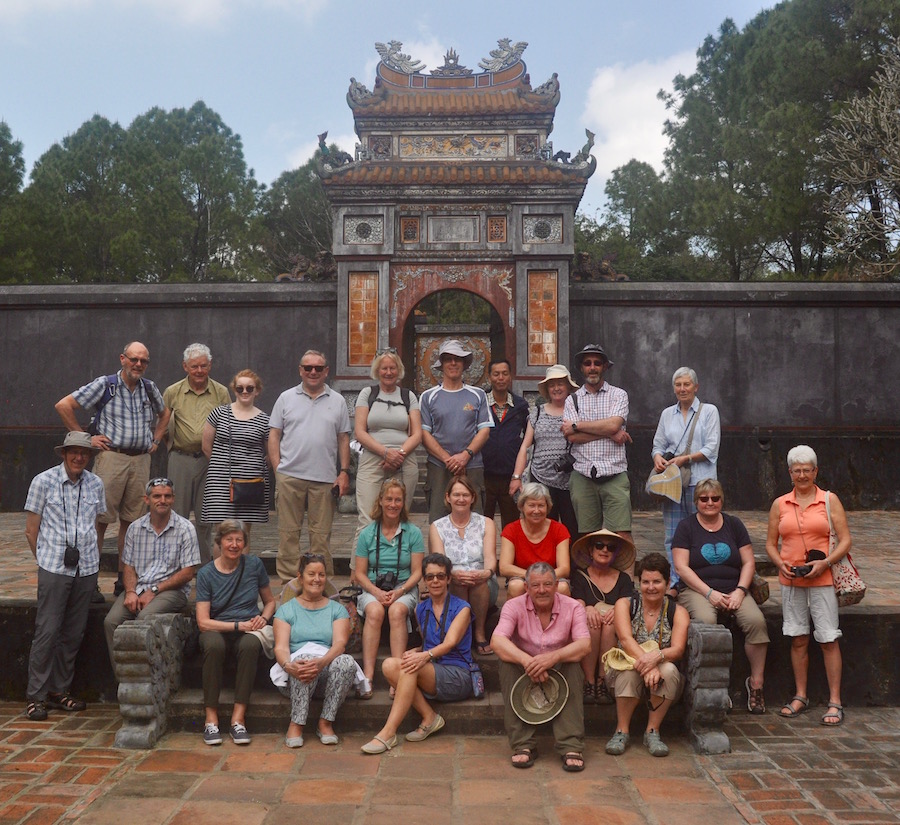
Our first destination was Tu Duc’s tomb. The story surrounding Tu Duc is far more interesting than the actual place, which, in places, is quite run down despite it being one of the most popular and impressive of the royal mausoleums.  Renovations are taking place.

The tomb, constructed between 1864 and 1867.  Emperor Tu Duc designed it himself to use before and after his death. From the entrance, a path leads to Luu Khiem Lake. The tiny island to the right, Tinh Khiem, is where Tu Duc used to hunt small game. Across the water to the left is Xung Khiem Pavilion, where he would sit with his concubines, composing or reciting poetry. Hoa Khiem Temple is where Tu Duc and his wife, Empress Hoang Le Thien Anh, were worshipped. The larger throne was for the empress; Tu Duc was only 153cm tall. Around the lake shore is the Honour Courtyard. A guard of elephants, horses and diminutive mandarins (even shorter than the emperor) protect the route to the Stele Pavilion, which shelters a 20-tonne stone tablet. The tomb, enclosed by a wall, is on the far side of a tiny lagoon. It’s a drab monument and the emperor was never interred here although the paving slabs are uneven in places as a result of people trying to find where he lies with his treasure. Where his remains were buried is not known. To keep it secret from grave robbers, all 200 servants who buried the king were beheaded. Tu Duc lived a life of imperial luxury and carnal excess: he had 104 wives and countless concubines, though no offspring.
Moving on, we headed for the Forbidden Citadel, stopping briefly to watch the making of scented joss sticks at the side of the road.
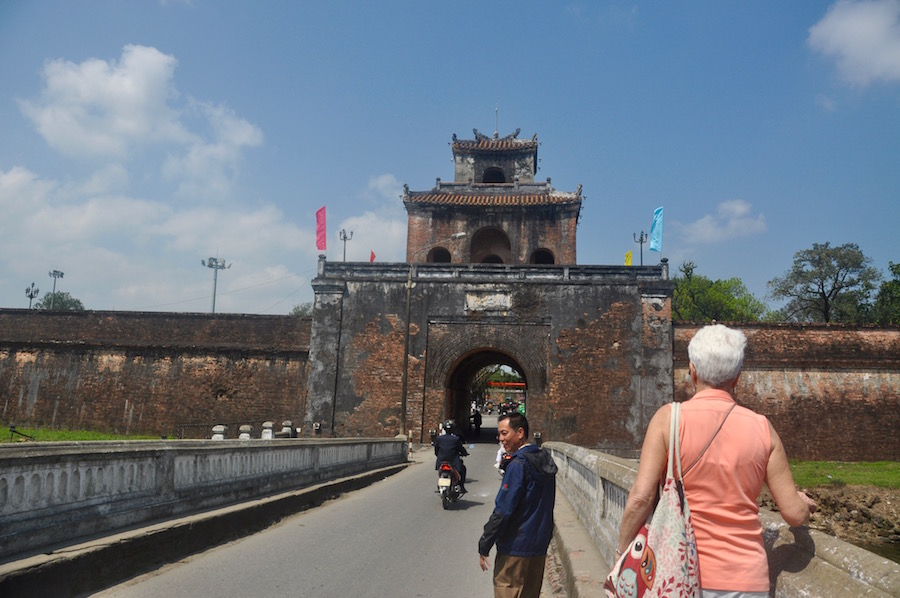
Approaching the Citadel

The Forbidden Citadel is a walled fort surrounded by a moat. It was built in the early 19th Century. Behind the walls was the Purple City, the former home of the royal family, at a time when Hue was the capital from 1802 to 1945. Modelled on the bigger Forbidden Citadel of Beijing, there were a number of palaces for each of the royal family, Nugyen Dynasty. It must have been fantastic in its heyday. Today it looks very sad, with only about ten of the original 160 buildings surviving.
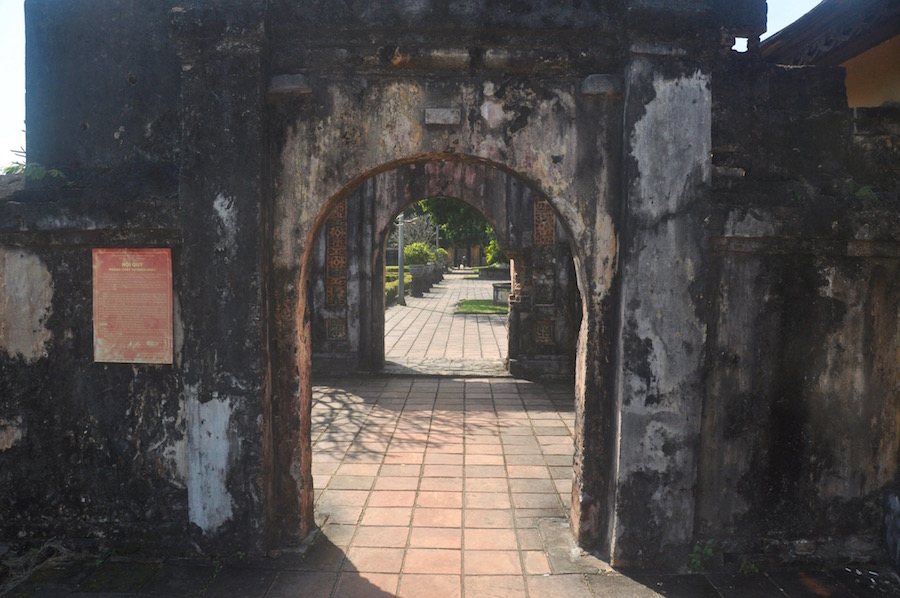
During the Vietnam War the Citadel was occupied by the Viet Cong, taking advantage of its strong walls, upon which they mounted many guns. The Americans were ordered not to damage such an important remnant of Vietnamese history, but the more casualties they received from the soldiers within the protective walls, the less caring they became. In the end the American attacked with force, bombing indiscriminately, killing many Viet Cong and destroying the vast majority of the palaces. For much of the area, there only remains charred walls, with weeds growing from cracks. The ground still bears the scars with bomb craters. It was sad to see it in such a state and I could not help but feel anger towards America and what it had done to this country, to these happy, smiling people, and for what?
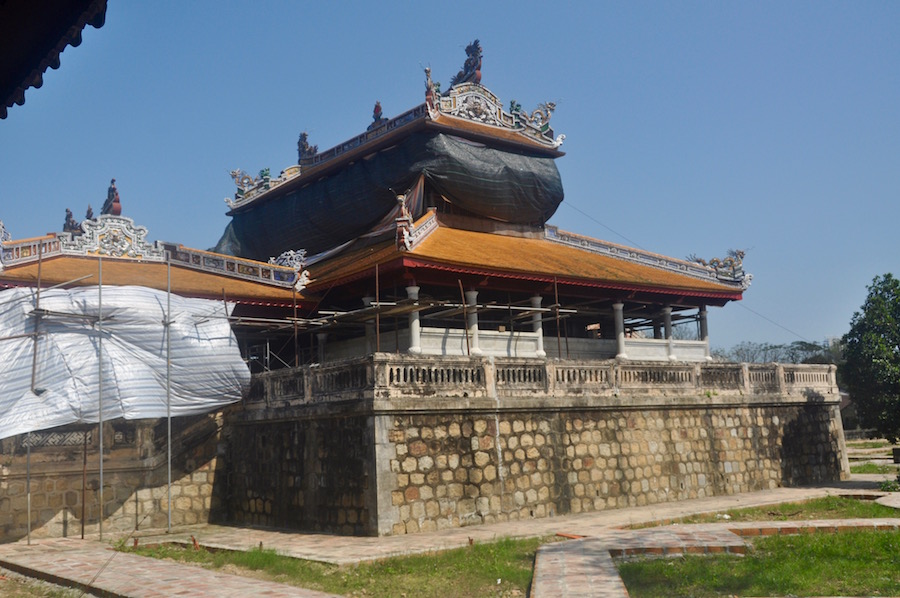
Renovation work

Work is taking place to restore some of the buildings, but it is an impossible job with very limited financial resources. It will take for ever.

Leaving the Citadel behind we were taken to the airport in time to catch our flight to Ho Chi Minh (Saigon) and the next stage of our Vietnam adventure. We said goodbye to our guide, who’s English and diction had not been anywhere near as good as Mr T’s, and, as a result, his ability to enthuse fell short of expectation. When you have two very different guides, it makes you realise just how important they are in giving you the best possible experience.

Ninh Binh, Tam Coc & Halong Bay

Ninh Binh and karst scenery

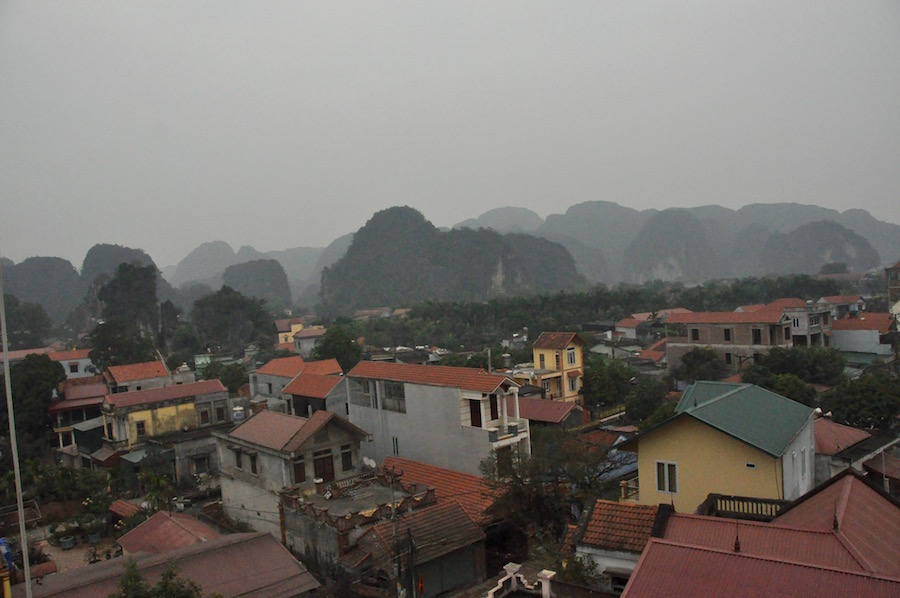
The drive to Ninh Binh became more interesting the closer we got. Having left the mountains behind us we travelled through a very flat landscape of expansive paddy fields, big enough for machinery to plough and prepare rather than bent double men and women. Great sluggish rivers cut their way through the flat landscape. At various points along their length, large barges were moored, home for the Tet Festival. Normally these barges ply their way up and down stream carrying a wide variety of cargoes, but mainly sand and limestone for building purposes. Then, out of the haze, enormous towers of vertical rock emerged. There were no preparatory hills gradually increasing in size, just great lumps of limestone karst scenery. As soon as it appeared, it disappeared again, making way for more flat, watery paddy fields. Again, the karst scenery reappeared and by the time we reached Ninh Binh, the town was surrounded by these strange outcrops. The view from our room on the 7th floor of the hotel looked out on to the building below, dwarfed by the towering blocks of limestone. That night we ate in at the Nam Hoa Hotel.

Phat Diem

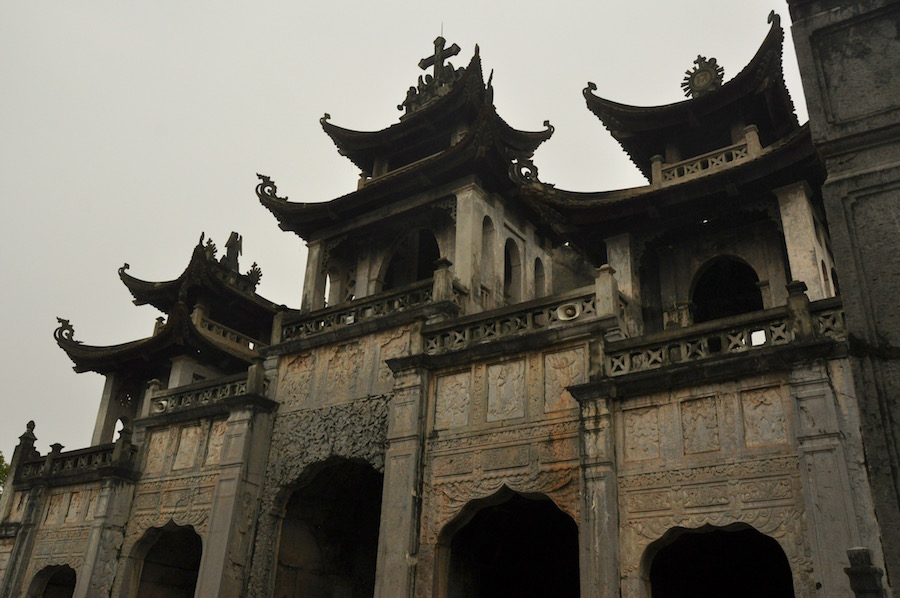
The following morning Mr T took us, on our bus, to visit Phat Diem Cathedral. This area of Vietnam has quite a significant Catholic population and the landscape, en route to Phat Diem, is littered with churches. The landscape was now very flat with massive paddy fields disappearing as far as the eye could see, all fed by a network of canals. Much of this area had once been submerged but with the careful management of a canal system the land was reclaimed. Thousands of tons of limestone had to be transported to create a firm foundation for the cathedral, built in the late 1800s. The stone for the construction had to be transported some 120 miles along with timber from hundreds of ironwood trees. Although it is a cathedral, upturned pagoda styled roofs were placed on top of the towers, giving it a unique appearance.
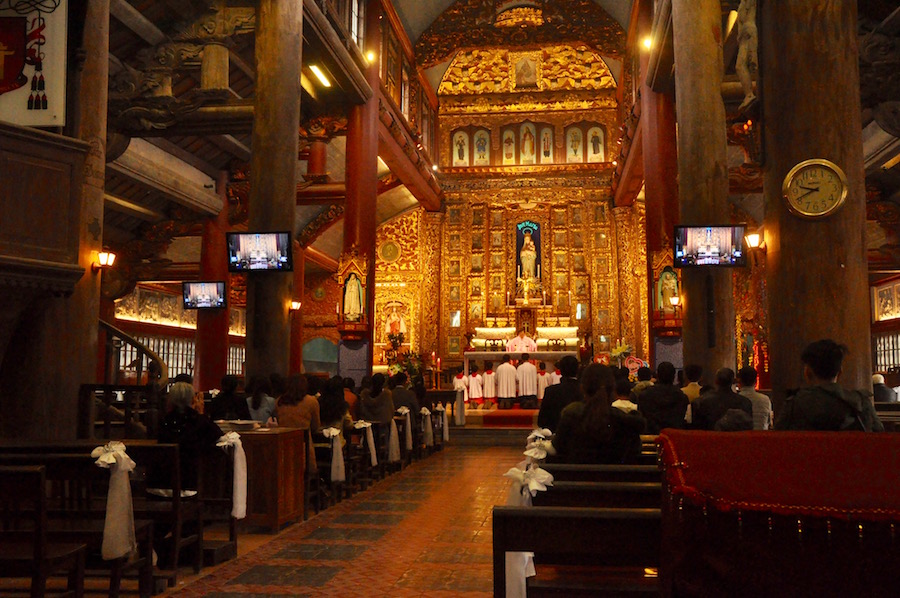
Before we entered the Cathedral we could hear singing. A wedding was taking place. The atmosphere inside was relaxed and the singing beautiful. Obviously, we kept a respectful distance from the ceremony but nobody seemed to mind us being there and taking photographs.  All along the nave, huge ironwood pillars supported the wooden vaulted ceiling. The area behind the altar was ornately gold the centre piece being a statue of Mary and baby Jesus with a blue neon halo and ‘Ave Maria’ above her head. It was all slightly gaudy.
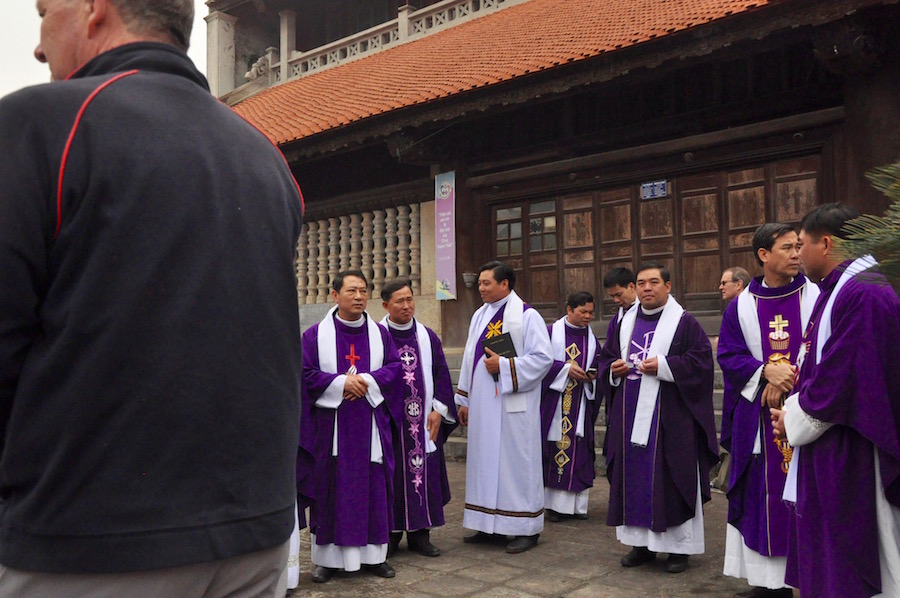
From outside, more singing could be heard, and now it was competing with the wedding ceremony. There was a funeral taking place. It seemed strange that there should be two completely different services competing with each other. Walking by the funeral, it looked as if it might be that of a priest as there were so many frocked clergy participating.
Heading back towards the limestone karst scenery we next visited Dinh and Le Temples, a large complex of temples celebrating the kings of the Dinh and Le Dynasties of the 10th Century when Hoa Lu was the capital of Vietnam for a period of 41 years. Mr T gave us the low down on its history but there was far too much to take in and absorb.  The temples are all that remains of a much larger complex known as the Citadel.

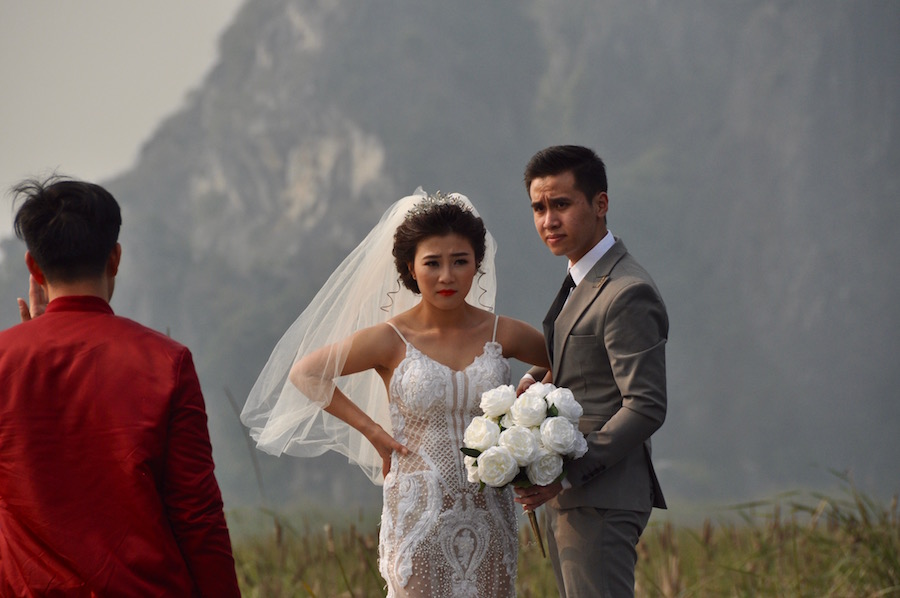
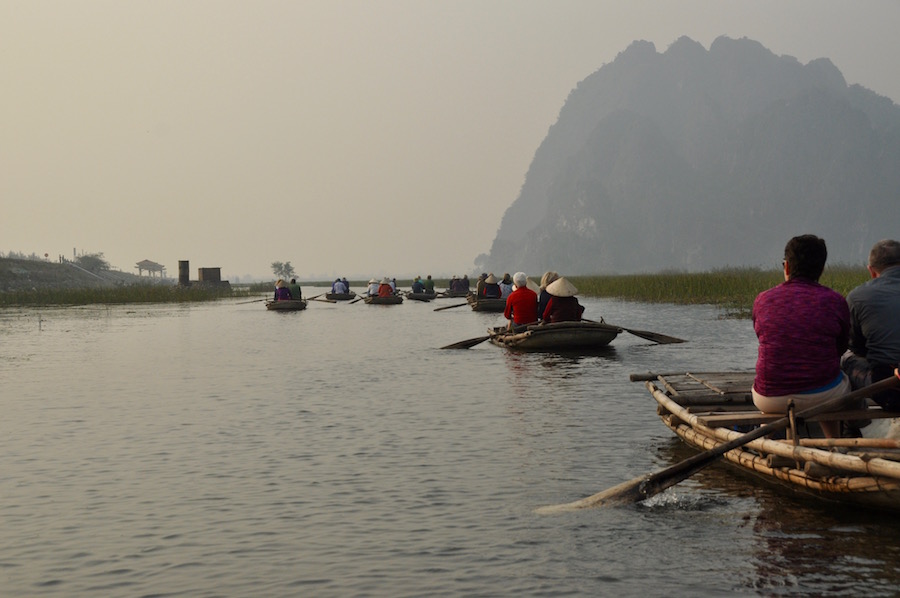
After lunch we headed down to an area known as Tam Coc (Halong Bay on Land) for a boat trip. Waiting on the water were a number of sampans, largely paddled by women, to take us on a journey through the quiet waters with limestone cliffs rising vertically above them. Initially, we paddled through channels among reeds. As we did so, we came across a bride and her groom, in full wedding gear, standing on a sampan while a photographer on another sampan took their pictures.

It was such a peaceful way of travelling with just the rhythmic sound of the paddles rippling the water. Egrets perched in colonies on the branches of trees by the water’s edge. We followed the line of a limestone cliff to its end and then turned a corner so that we now had cliffs on both sides. The scenery was so dramatic in every direction. Our eyes were drawn to the rocky cliffs surrounding us for we knew there were monkeys in the area and we were keen to spot some.

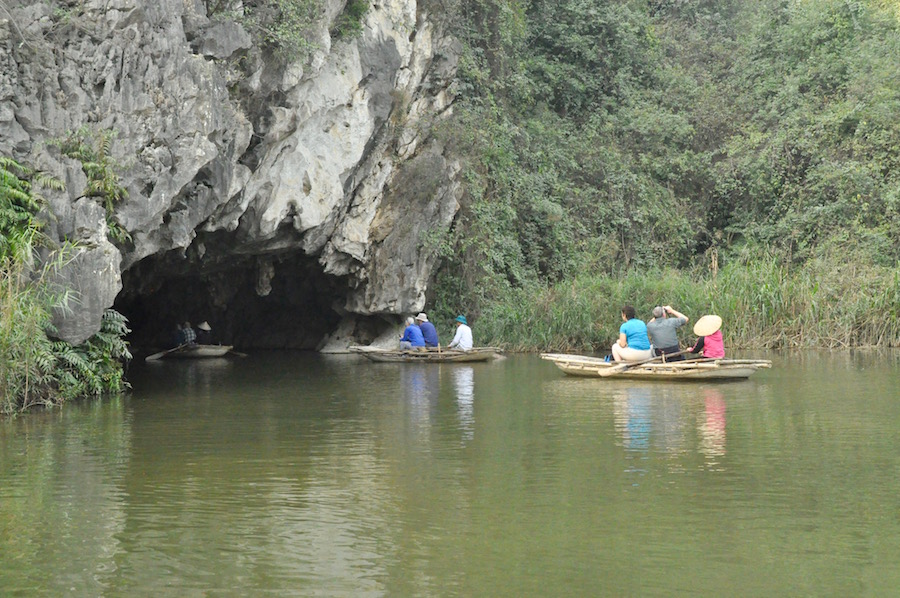
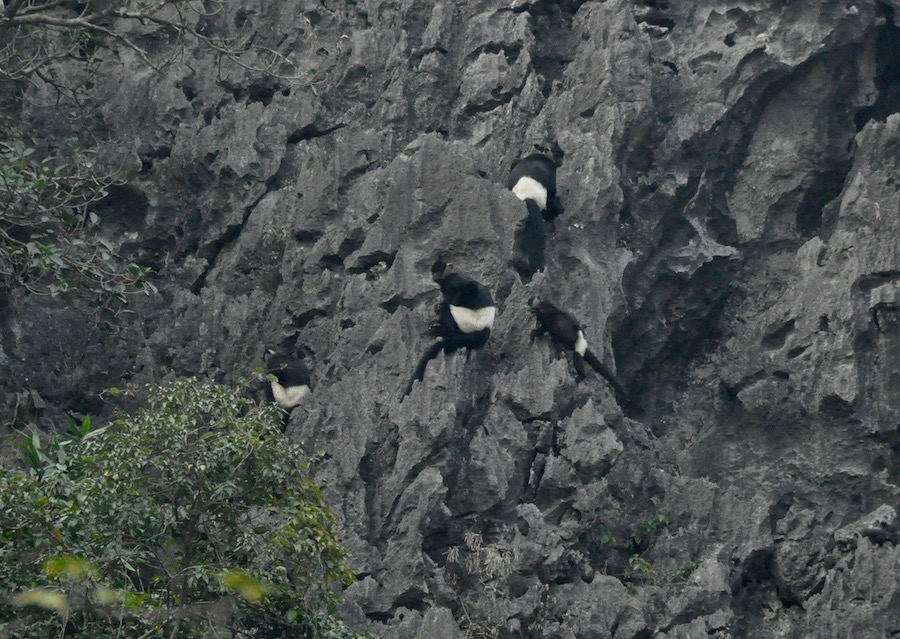
Further on we came to a low cave that just allowed us access to its darker corners before the roof became too low. Emerging from the cave we looked up and there we spotted some large black monkeys with, what looked like, white nappies around their bottoms. They were Delacour’s Langurs, a seriously endangered species. There are only about 250 left in the world and during the course of our observation, we saw about 12. They have extremely long tails which help give them balance as the nimbly run across the limestone cliffs.

The reason there are so few left in the world is that they have been hunted vigorously for meat and for their bones and organs for medicine. Vietnam has a reputation for not looking after its wild life but it is beginning to realise that if it does not look after what it has got it will lose them for ever. Rangers are employed by the national parks to oversee their protection. Unfortunately, its close proximity to China means that there is always going to be a market, and if the rewards are great enough there is always someone willing take the risk. We really enjoyed watching them watching us. Hopefully, they will survive and begin to flourish in protected areas.

Sampan driver

Tearing ourselves away, we began to head back. The lady paddling our sampan complained of sore hands, so I offered to take over. Carefully swapping places with her, I took the oars. The action is the opposite to what we normally do in a rowing boat. You face the way you are going, so instead of pulling the oars through the water, you push them. Believe it or not, that is quite a difficult concept for your brain to appreciate and you make little or no progress through the water. When I did begin to get the hang of it I started going round in circles. I think it is fair to say, that I did not get the hang of it. It seemed only right and proper to hand the oars back to the expert and let her guide us back to the jetty.

It was a brilliant trip, so much more so because we had seen the Delacour’s Langur.

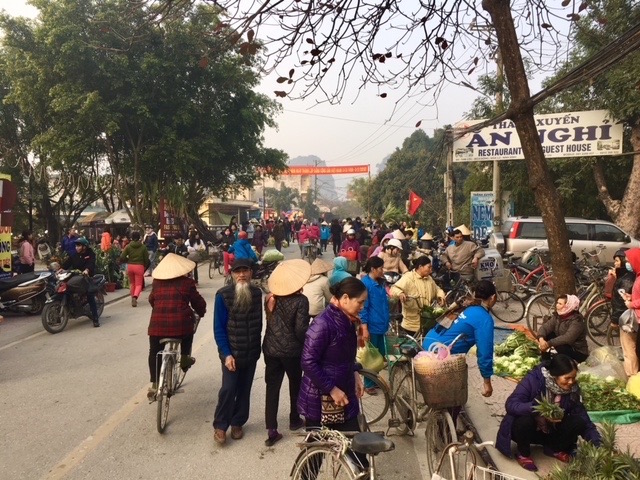
The next day we left Ninh Binh and headed towards Halong Bay. However, before we left, there was just time to enjoy the hustle and bustle of the early morning market that took place in the street either side of our hotel. It started very early, long before we were up and about. although we could hear them from our rooms. You could sense the excitement of the upcoming Tet Festival, very similar to the excitement that takes place in our own shopping streets in the lead up to Christmas.

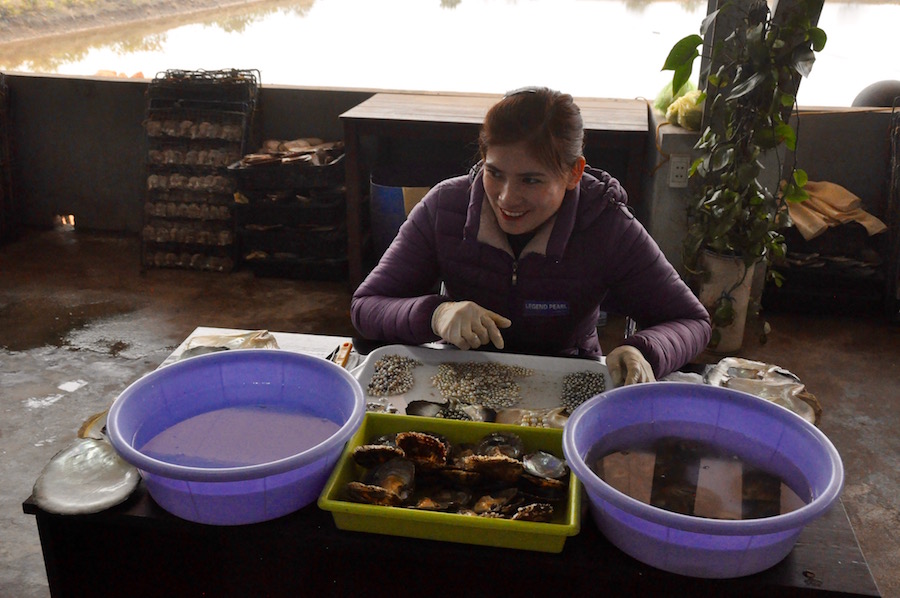
Extracting pearls from oysters

I was really looking forward to Halong Bay as it had been on my wish list for many years. Before we boarded our boat we had to visit a pearl emporium where we were shown how the irritation was placed in the flesh of the oyster in order for a pearl to form. We also observed how the pearl was taken out. I was amazed to learn that a single oyster could go through the pearl producing process three times. Having watched the process, we were then ushered into the shop. That is when I switched off. It was large, very well staffed with sales people everywhere. Unfortunately, pearls leave me cold and the prices asked added to my lack of enthusiasm. I didn’t really need this distraction, this delay. I wanted to get on the water and sail among the towering pillars of Halong Bay.

In order to get to the jetty, we had to drive across a causeway which led to an area of development, with several hotels in various stages of completion. A lot of money is being invested in developing this area, although some of the sites appeared to have ground to a halt before they were finished.

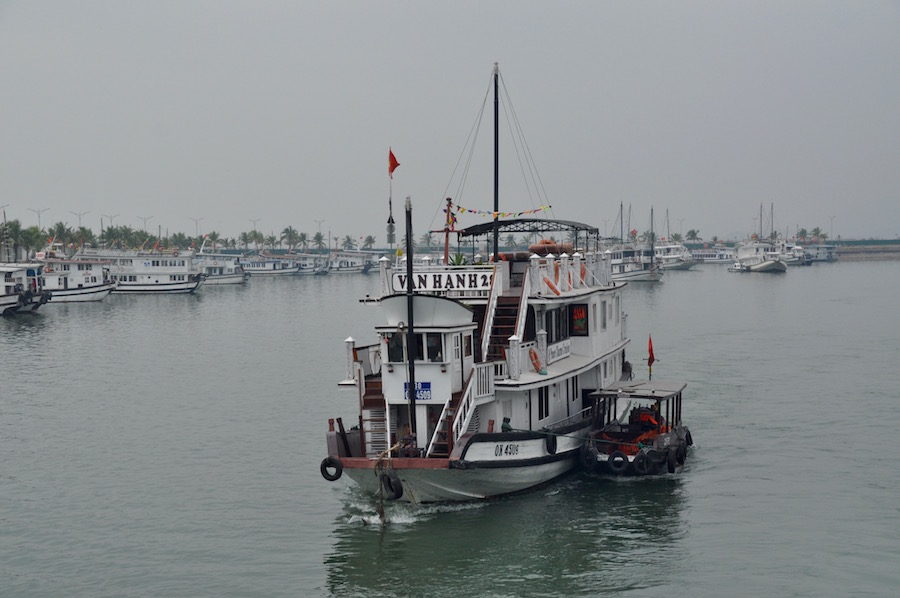
Heading out to Halong Bay

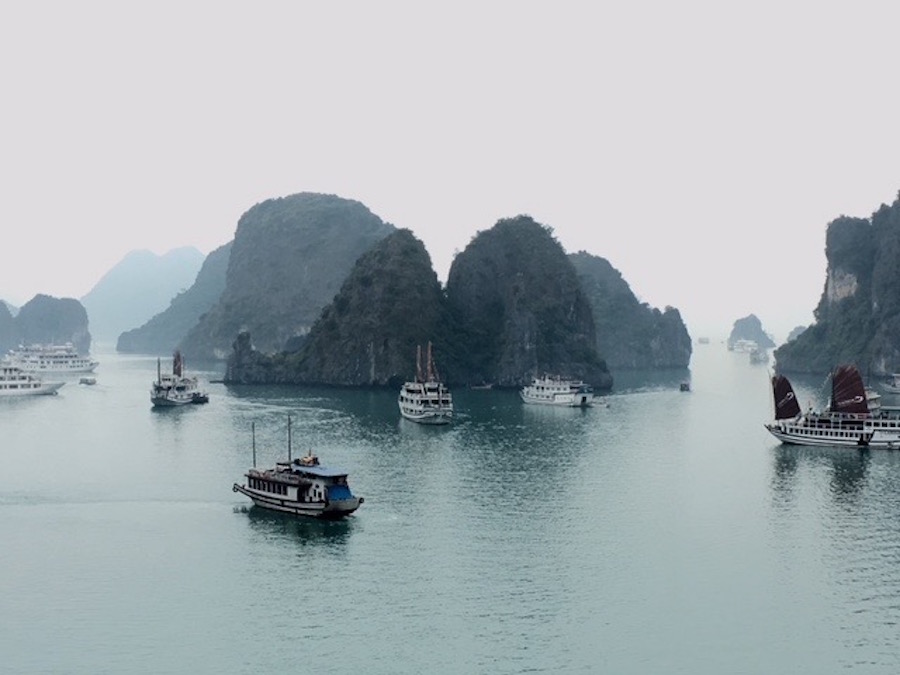
On the water were hundreds of white painted junks of all sizes. Some were more luxurious than others. They were all white. This is a relatively recent innovation for before the junks were all natural, wood coloured. They look OK white but as white boats the paintwork needs to be touched up regularly, or they begin to look tatty. If you look closely the quality of paint work is not particularly good. Most people prefer them as they were. There are a number of theories as to why the decision was made to paint them. Some say it was to create job opportunities, others that had seen white cruise liners and were inspired. A local paint manufacturer wanted to boost his sales so persuaded the authorities, probably with an incentive, to change the laws. One of the problems with nothing but white boasts that they are difficult to see in a sea mist, and Halong Bay has its fair share of foggy days.

We were to have two junks, with half the group sleeping on each. Tenders took us and our luggage out to our junks moored in the middle of the harbour. As soon as we were aboard the tenders were moored up to the junk and off we went.

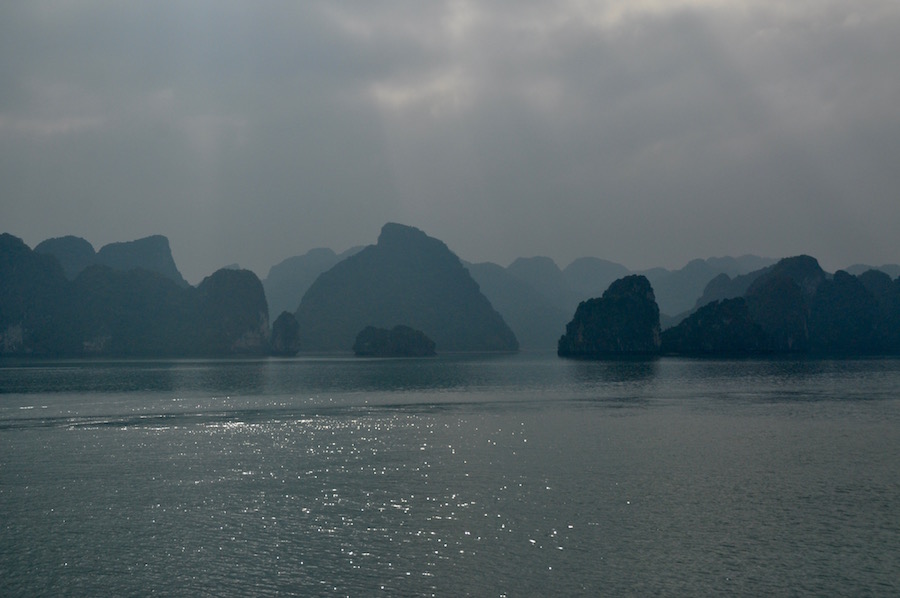
As soon as we were out of the harbour a gourmet lunch of fresh fish and prawns was served. Outside, towers of rock rose vertically out of the sea, and the further we went the better it got.  As good as the food was it was impossible to concentrate on it as the scenery unfolded outside. Soon the meal was over, and we were able to go up on deck and take in the amazing scene. Sadly, it remained cloudy and we did not get the blue sky reflected in the water. Instead, we got dark, brooding, moody pillars of rock rising threateningly out of dark waters. It was so atmospheric.

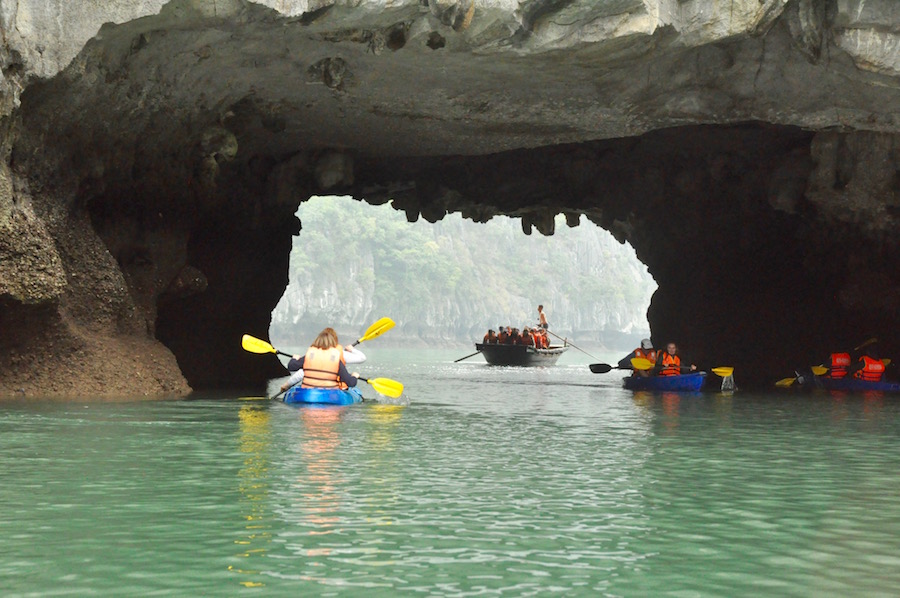
The entrance to Luon Cave

Weaving our way through narrow passages of water, we were not alone. There were many more junks on the water heading out to our eventual destination, a mooring area across the water from Titov Island. Once we were moored we boarded our tender to take us to a landing stage before the entrance to Luon Cave. here, we had a choice of either hiring two-man canoes or being taken there on a large sampan. Most of us chose the canoe option.

Now I have done a fair bit of canoeing in my time and I like to think I know what I am doing. But these were not Canadian or sit in canoes; they were sit on ones. Deciding to take the rear seat I gently eased myself on to my canoe. Unfortunately, I misjudged my positioning and planted my backside on the edge of the small back support. This tipped me back and the stern of the canoe under water with my backside following. I wasn’t worried about my own self-being but I was concerned that my wallet, with passport, was getting a good soaking, along with my camera that had succumbed to gravity. My pride was a little dented as I found it impossible to haul myself back up. It took some effort from me and those helping me to haul me up, while everybody else around me was laughing far too heartily. Having assumed the right position, Angela then nimbly took her seat and we paddled off out of the public glare. Once away from the jetty I could check that my camera still worked. It did. Phew!

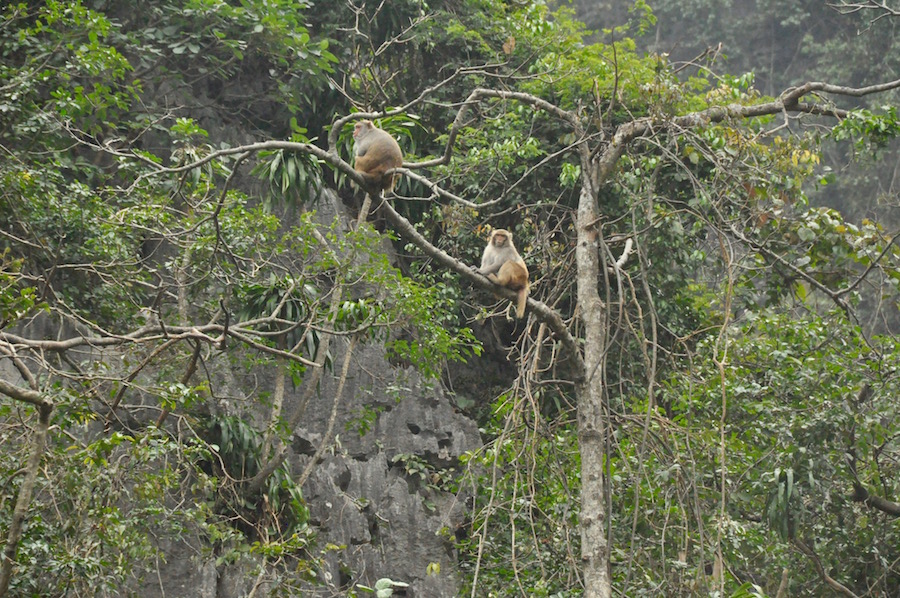
Golden Monkeys

Luon Cave is a low arch leading into a hidden lagoon of enormous proportion. Once through, you are faced with a circle of vertical, or near vertical rock and vegetation, which enhanced, yet muted, the voices of the people paddling around. We paddled fairly close to the cliffs in the hope of seeing some of the golden monkeys that are reputed to live around the lagoon. We were just about to leave, when we saw some, so we paddled across to take a closer look as they sat in a tree watching us watch them.

When we returned to the jetty I was accosted by an American lady who thanked me for giving her the best laugh ever and a lasting memory of me floundering half in and half out of Halong Bay. My pleasure!

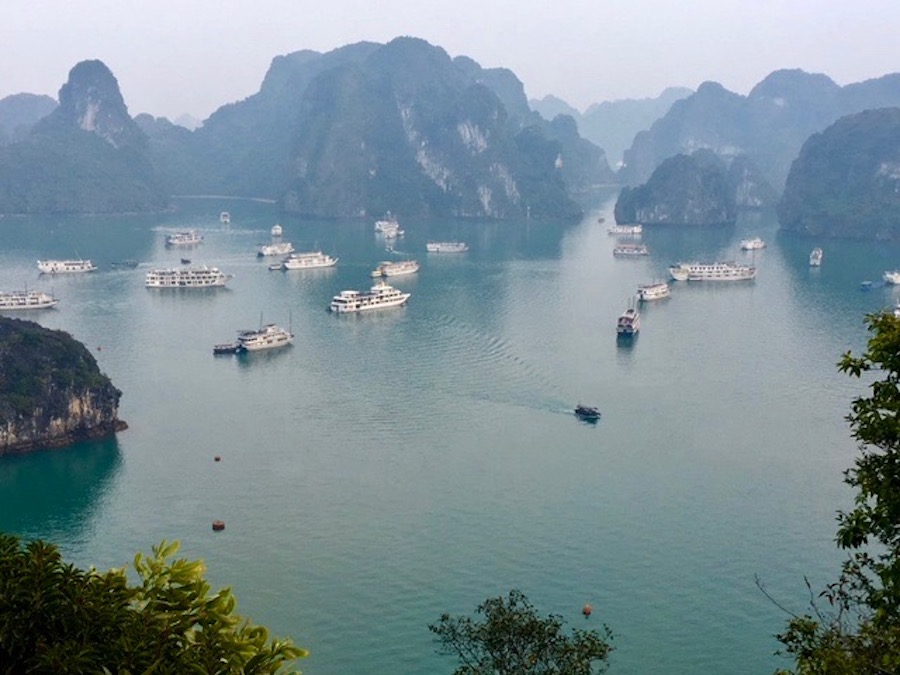
View from the top of Titov Island

From the jetty our tender took us across to Titov Island where we were able to take the steps up to the summit for a panoramic view, or not. Despite feeling very uncomfortable in the trouser department, I decided to climb the 420 steps for the view. It was well worth it as it gave a fabulous impression of the vastness of Halong Bay and just a fraction of its 1600 islands. It was stunning and I could have spent more time up there just absorbing every detail of the view.

Back on our boat I spread my money out on a towel, my passport, dried my camera and discovered that my battery power banks no longer functioned. It could have been worse.

That night we had an absolutely fabulous meal that included oysters, giant prawns, fish and a lot more besides, with the lights of various boats shimmering across the water. Afterwards it was great to sit up on deck with a beer in hand and look across to the other boats and listen to their laughter as others, like us, enjoyed being in Halong Bay.

I am lost for words!

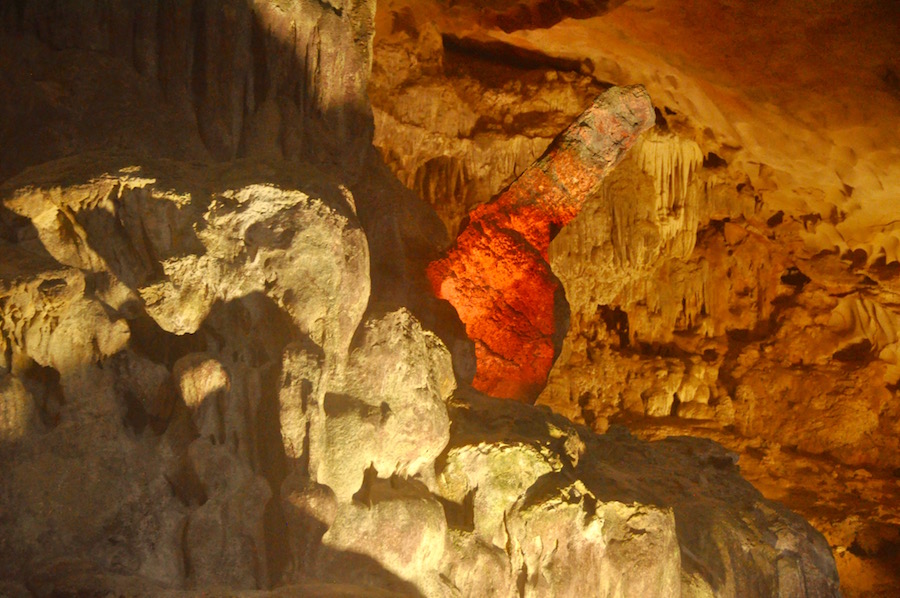
The next morning, after breakfast, our tender took us across to the jetty on Bo Hon Island to visit a cave system called Hang Sung Sot (Surprise Cave). Climbing the initial flight of steps gave us yet another superb aerial view of the bay below. However, I don’t think I was prepared for the enormity of the cavern we entered. It was huge. It was broken down into three enormous chambers all suitably lit with the main features highlighted. The stalactites, if you release your imagination, form shapes resembling Buddha or a large tortoise. But by far the most famous, and the easiest to understand is the giant phallus standing proudly and glowing a dangerous shade of red. It is in serious need of some soothing cream. Funnily enough, when you walk on the other side of this feature it looks nothing like a giant penis.

Our time in Halong Bay was coming to an end. Once we had finished in the cave our tender took us back to our junks and we soon set off on the return journey to Halong City. It was still grey and murky but it did not diminish the splendour or the impact of the rocky pillars. It may have diminished their features but they were swathed in far more atmosphere.

Our bus was waiting to return us to Hanoi where we were to board the night train to Hue and embark on the next stage of our Indochina adventure.

Mr T

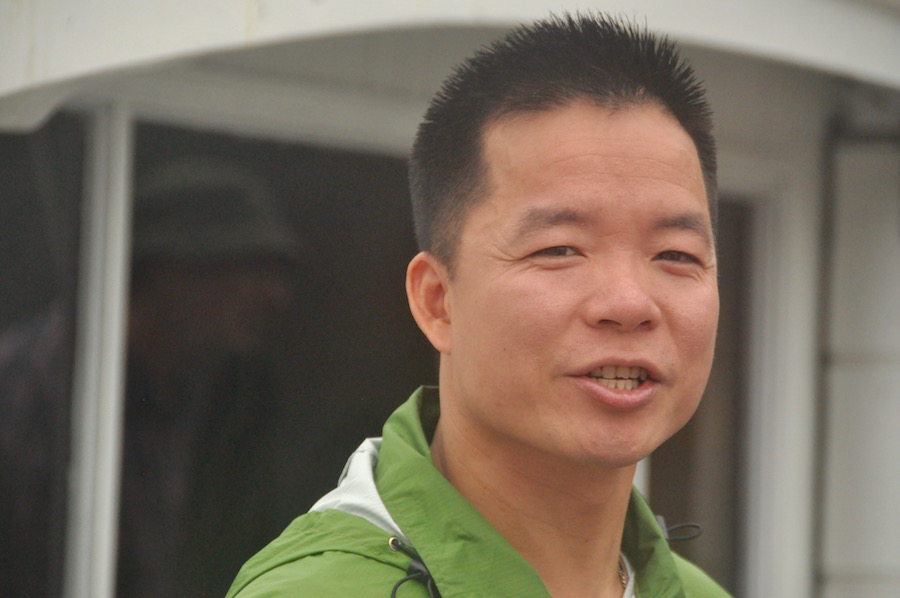
Sadly, it was also time for us to say our farewells to Mr T. I have had a great many guides over the years, but few have been better than Mr T. He endeared himself to the group with his attention to duty, giving us information that helped us to understand the intricate history of Vietnam, his jokes at the expense of the Chinese, his excellent organisation, his care and his smiley personality. There was visible emotion as he hugged each of us in turn. When he left us he was heading back home on his motorbike to join his wife and children, to celebrate Tet, before starting all over again with a new group. If I go back to Vietnam, and I certainly hope I do, I would like to think that Mr T and I could work together again.


North Vietnam – The Trek

Leaving Hanoi, slowly in the early morning traffic, we headed almost due west towards our trekking area. Although the trek was in the north, it was, in fact, 200km slightly south of due west of Hanoi. Gradually the flat land of Hanoi was replaced with impressive lumps of limestone. We were heading into areas inhabited by the Muong and White Thai ethnic groups.

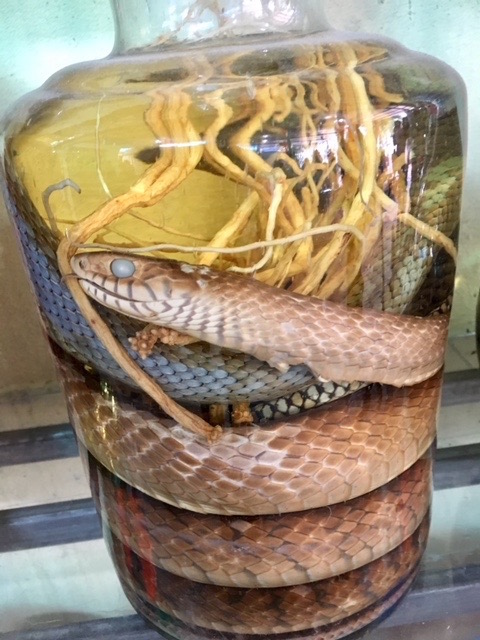
En route we stopped at a road restaurant for coffee. Vietnamese coffee is quite strong, and because they use condensed milk, very sweet. In one corner a number of men were smoking a bamboo pipe through a bucket of water. We were alerted to it by a strange gurgling sound. On a shelf there were some interesting bottles of fermenting liquid. The largest contained a snake and some roots, while a second had a number of lizards and a third, birds. It looked revolting and not something I would be prepared to knowingly try. We were learning quite quickly that the Vietnamese eat a lot of things that we would not consider as edible. If they don’t eat them, animals, as far as the Vietnamese are concerned, have medicinal properties. It seems no animal is safe. The fact that we did not see any wild animals in the countryside from the bus or during our trek suggests that there might mot be very much. We similarly saw few birds.

Roadside services

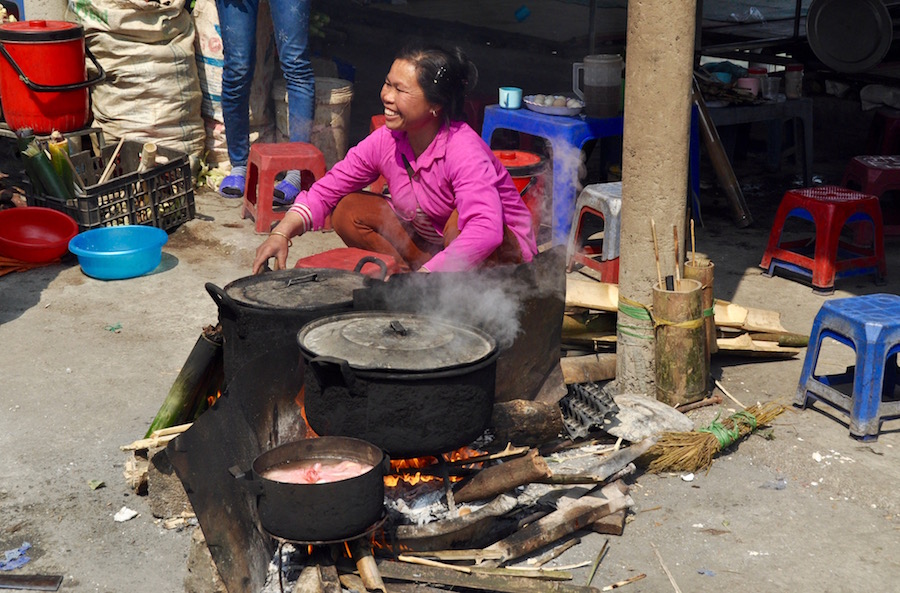
Continuing our journey, we again stopped near the top of a hill where there were a number of roadside stalls. This was the Vietnamese equivalent of a service station. Only this one had some rather unusual items. Each stall had its own wood fire with blackened pots bubbling away on them. Tubes of bamboo were stuffed with banana leaf packets of rice and placed around the edge of the fire along with skewers of meaty morsels. Tucked away in quiet corners were piglets contained in tight fitting bamboo cages. Their fate was probably not very far away.

Village crafts

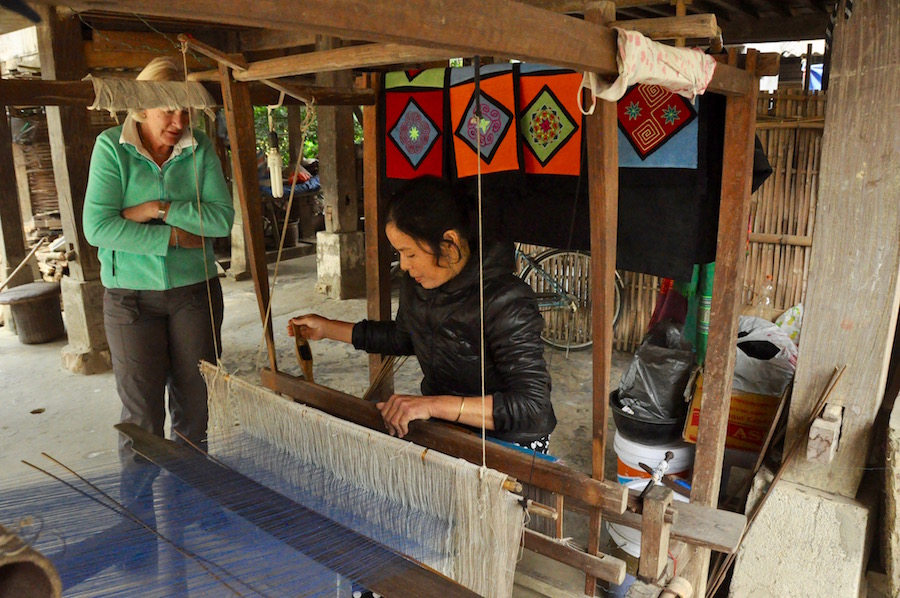
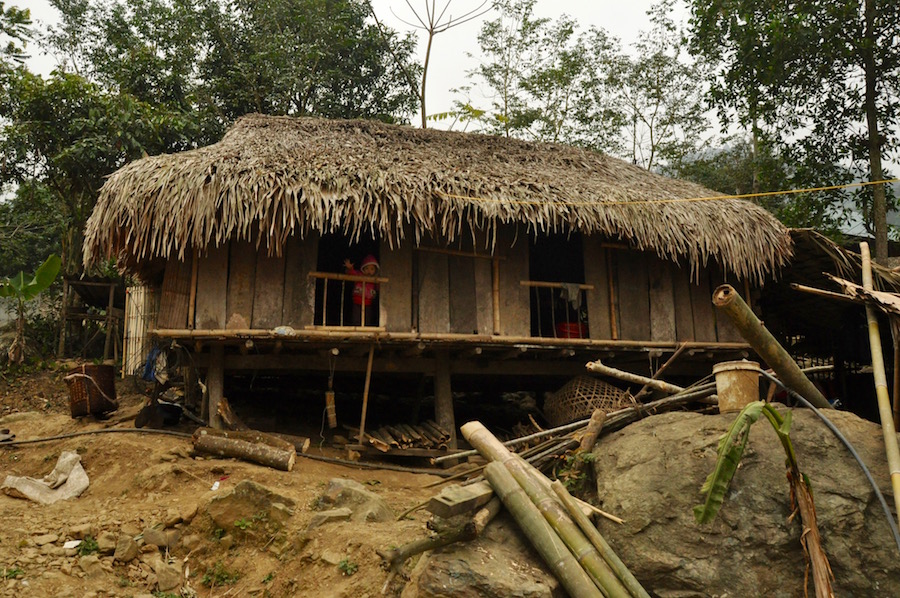
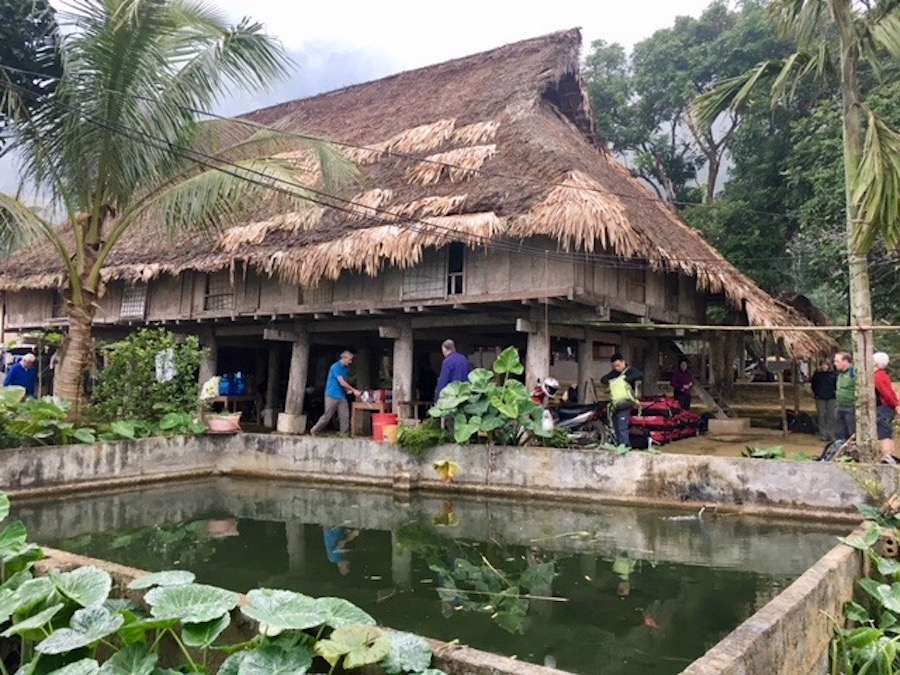
On reaching the model village of Mai Chau we alighted from the bus for lunch. All the houses are on stilts, a traditional building style in this part of Vietnam. All life in the day time takes place under the main body of the house between the posts that hold the structure up. Our dining area was in just such a place. Taking time to wander and explore the village, many of the houses had a loom making scarves and cloths of all sizes. Each house was also a shop where they sold their goods. All around the village were lush fields of vegetables and banana trees, some of which we enjoyed for lunch.

After lunch we had a little time to sort our kit out before it was transferred on to motorbikes, the mode of transport for our kit for the next few days.  A short bus ride took us to Quan Hoa, which was the starting point for our trek. As well as Mr T we also had a local guide who spoke very little English but ensured that we did not stray from the route.

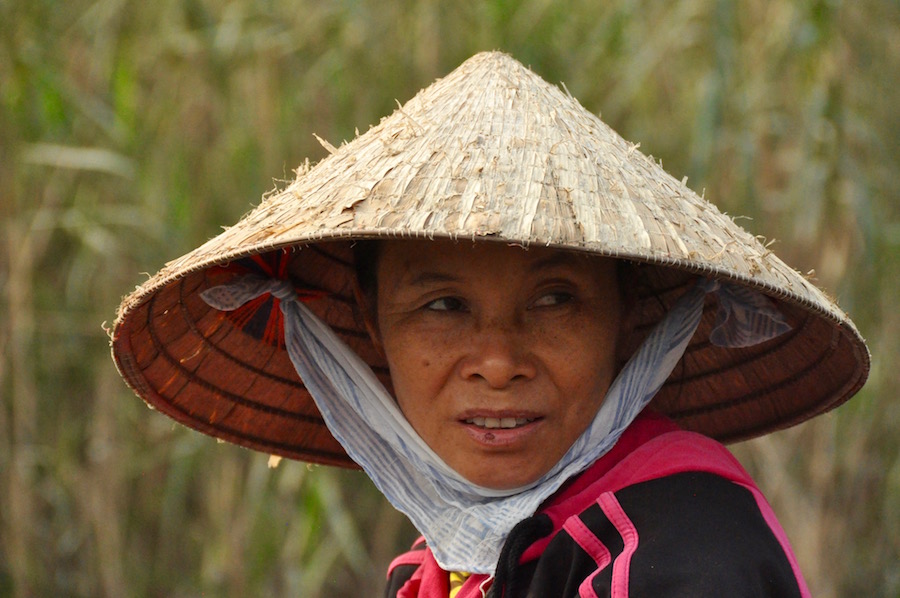
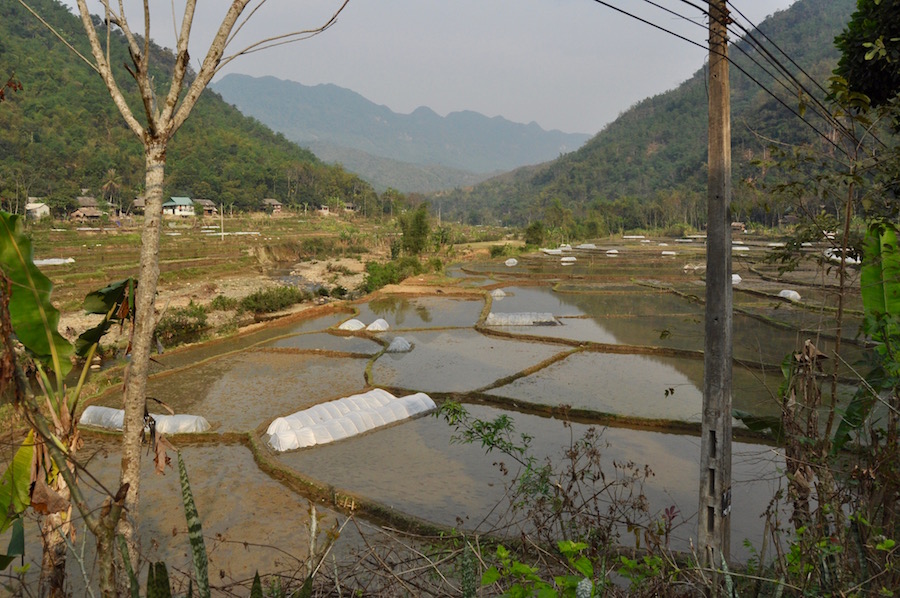
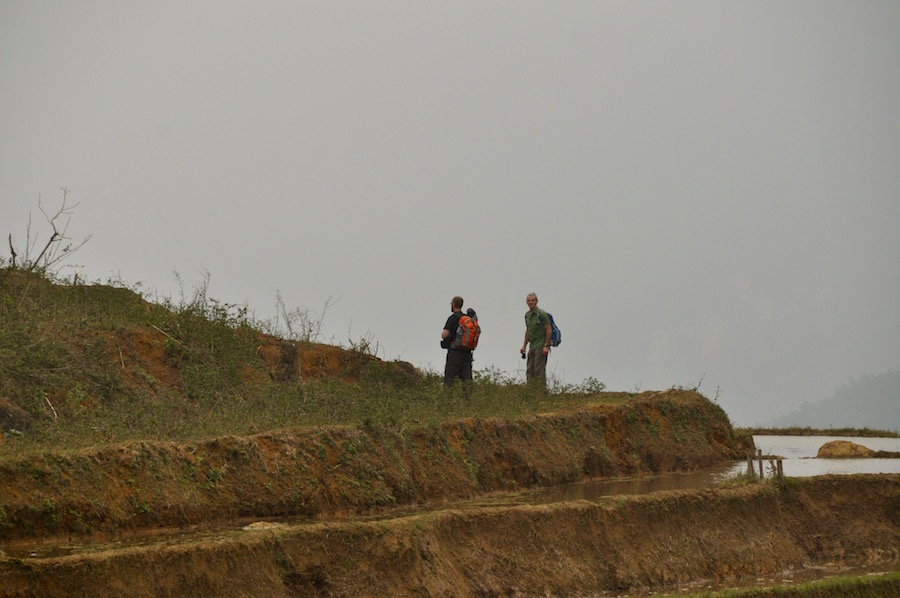
The walk was easy going, largely up a wide track that took vehicles. To our left the land rose quite steeply with plenty of trees and clumps of giant bamboo. To our left there were flooded paddy fields being prepared for the next sowing. In the corners of some of the paddies were cloches of young, fresh rice plants, waiting to be sown. There is very little mechanical assistance in this area; the individual paddies are far too small to allow that. Water buffalo pull a wooden plough back and forth to prepare the ground beneath the water, the walls are repaired by hand and, when the time comes for planting out it is all done by hand, largely by women bent double for hours on end. All the time these tasks require them to be knee deep in mud and cold water. This is a twice yearly occurrence as the climate allows two crops a year. Occasionally we saw someone wearing wellingtons, but on the whole, they were bare foot.

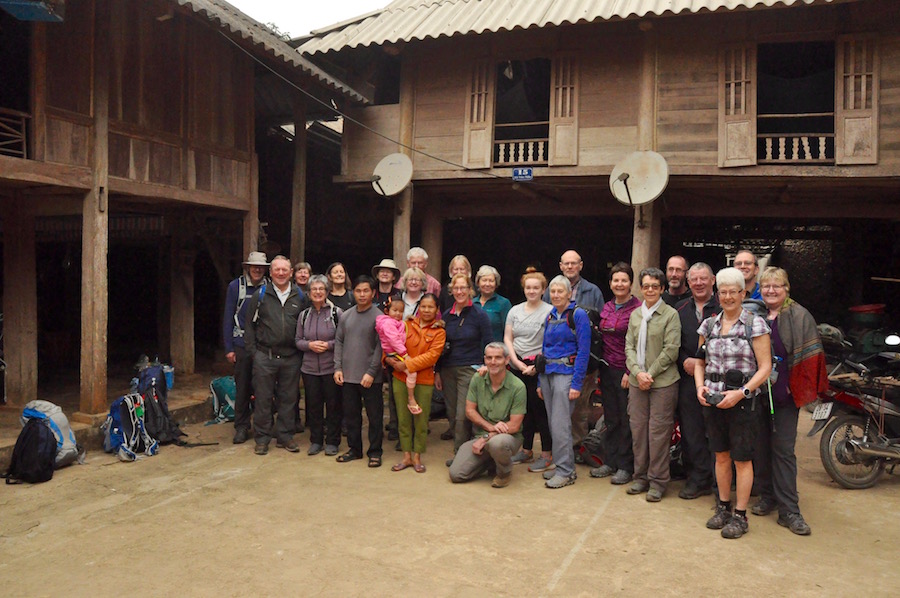
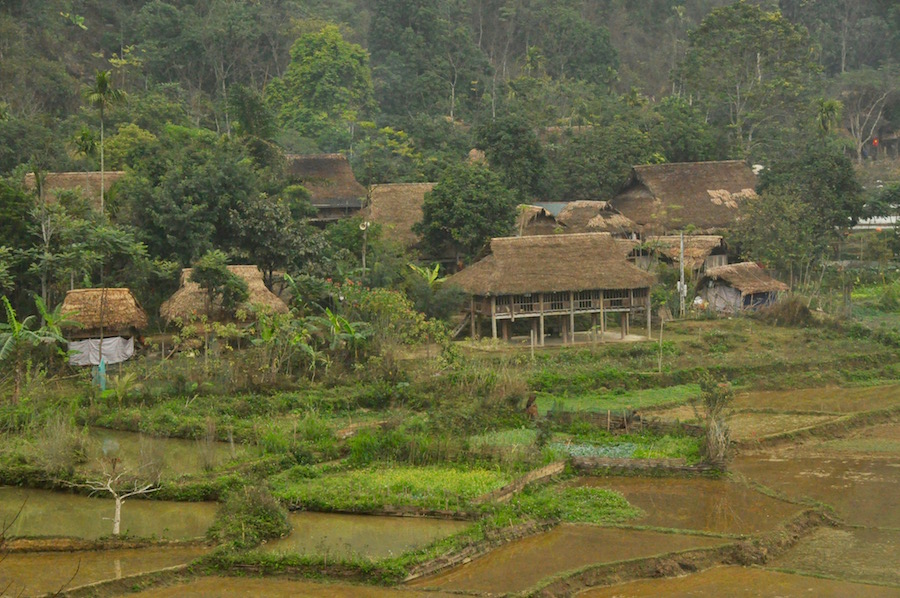
We eventually arrived in the village of Ban Hang where our homestay was. It was, again, a lovely village of stilted houses, all well-kept and cared for. They are quite large structures. They needed to be to cater for 23 of us. However, we could not enjoy the privacy of private rooms, there only being two large sleeping areas, so we split into a boys’ room and a girls’ room, for decencies sake. On the floor we had a sleeping mattress with a pillow and blankets to supplement our sleeping bags. Hanging above each mattress was a mosquito net, just in case. It was all rather comfortable and friendly.

The family, in whose house we were staying, made us very welcome. They provided us with excellent food, yet again, and plenty of beer. However, once dinner was done and enough beer had been consumed, there was nothing much else to do other than go to bed early, and, perhaps, get to sleep before the snoring took off. Whilst there was some snoring, it seemed not to be too disturbing and I am sure that being in our beds for at least 10 hours guaranteed us sufficient hours of sleep and rest.

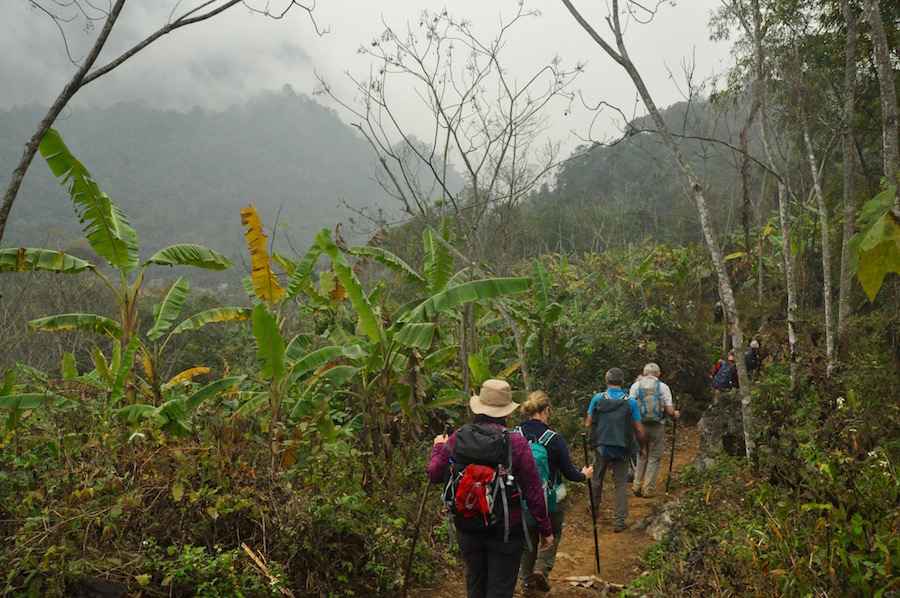
The following morning after much hand shaking with our hosts we set off. It was cloudy again and the steep forested slopes all around us looked as if they were steaming. We soon left the road and walked along footpaths, through villages, skirting along the edges of paddy fields, crossing streams and climbing small hills. Mr T would stop us to show us points of interest in villages. Little did we know, until he showed us, that many of the houses have coffins stored beneath them ready for the day when a householder should die. They were usually in houses where there were elderly people. This forward planning is not such a macabre idea. Without it, a corpse may lie waiting for many days for a coffin to be delivered from a town some distance away. Strangely, it is probably very reassuring for the eventual recipient, to know that all their affairs, once they have gone, are taken care of.

Simon and Mike enjoying the stroll

Traditionally, the deceased is buried, in their roughly hewn wooden coffin and left for three years. They are then exhumed, the bones collected and cleaned, before they are placed in an earthenware cask for a second burial, often in an adjacent paddy field to the home where they once lived. Once they are buried for the second time a proper headstone and memorial can be erected. Sometimes, we saw a cluster of such memorials where generations of the same family have been interred adjacent to each other.

Nearly every house we came across had a pond with many large fish in. Some were carp while others were Tilapia. All were a ready source of food, just like the chickens that ran around the houses and the piglets housed in pens.

Mr T preparing the picnic lunch

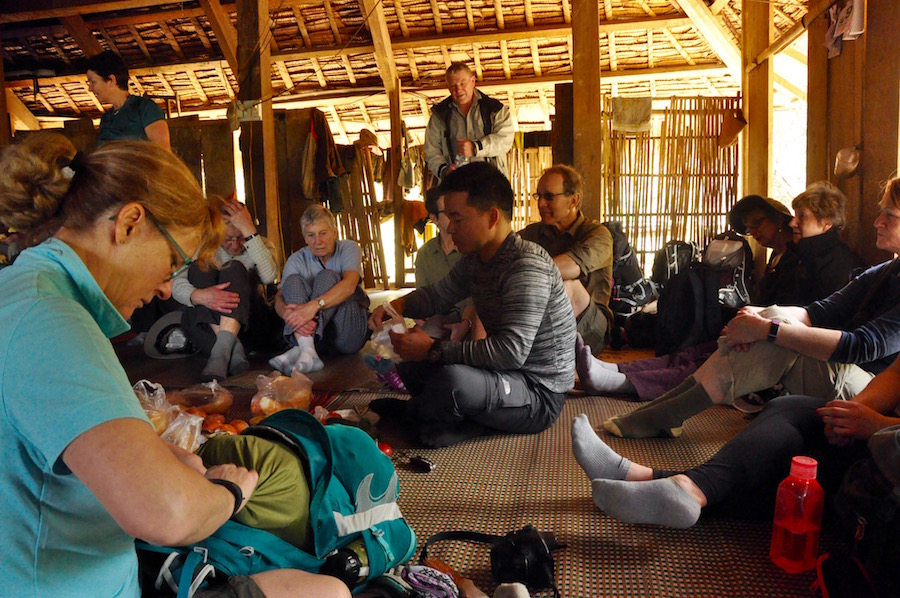
We were due to have a picnic lunch on this second day of trek, in a house along the route. Unfortunately, when we arrived, there was nobody home, so our guide went in search of a house that was occupied to ask if we could have our lunch in their house. Needless to say, we were made most welcome and after removing our footwear were invited up into their main room, which covered almost the entire building. In one corner of the room there was an open fire upon which the family cooked. The smoke from it drifted up into the roof space and escaped through a series of vents in the bamboo lattice roof, but not before darkening the strips of bamboo with a layer of soot. It was a great place to eat our lunch, to observe a family at home and to enjoy the several young puppies that wanted to chew on our shoes at the foot of the stairs.

The family were rewarded for their hospitality with, not only a payment, but with any leftover food from our picnic. A real bonus when you have a young family to feed.

In the afternoon it was more of the same until we reached our homestay in Kho Muong village overlooking a landscape of paddy fields fringed by limestone cliffs. To begin with there was some confusion over the accommodation where we thought we would all have to cram into one room. Fortunately, the men were moved to the new house next door where we had plenty of room to spread out.

The following morning the conversation tended to focus on the erratic and loud snoring. Those closest to the perpetrator began to plot against him. Our attention was also drawn to Mike’s head, which had violently come into contact with a beam as he returned from the toilet in the night. Thankfully, his daughter Carol, a nurse, tended to his split head but nothing could repair his dented pride.

We had had some rain in the night and as we set off there was still a dampness in the air. It had made the path, largely made up of clay, very slippery. Mr T cut us all staffs to help us stay upright. As most of the walk in the morning was downhill they became essential. At one point I was walking near the back of the group when there was a cry from ahead and a call for help. Pauline had become a victim of the slippery path and fallen about fifteen feet down the slope through all the undergrowth. Or had she been pushed by Angie? There were no witnesses. Mr T ran back from ahead and was able to rescue Pauline and bring her back to the path. Fortunately, Pauline was unhurt and seemed remarkably calm considering what had just happened to her.

On the outskirts of a small town we came across some young boys playing football. Hovering to watch, they passed the ball to me for a shot at goal. I was hopelessly off target. Shamed by my performance, I tried again, for the ball to be saved. Another attempt missed, a fourth saved yet again. With my head hanging in shame – I could not even score against a seven year old barefoot goalkeeper – I sloped off.

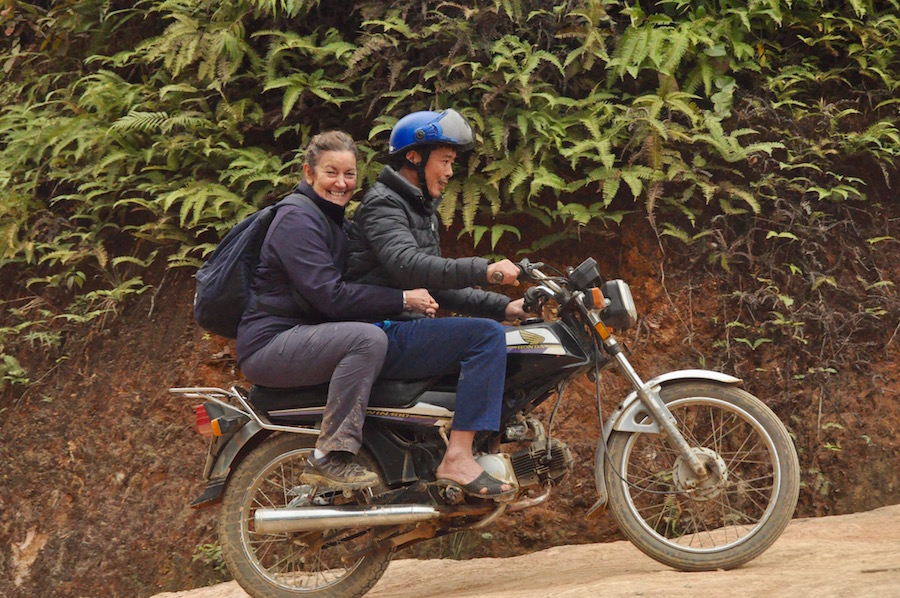
After lunch we continued our journey following the valley along a newly laid concrete road, so new the concrete was still very wet. After an hour or so we veered off the road to start the climb up to Hieu Village. At this point a few took advantage of a motorbike ride up the hill to the village. The remainder of us enjoyed the walk running parallel to a series of small waterfalls until we reached our delightful homestay in a really beautiful area of thatched, stilted houses, fish ponds, palm trees and happy, smiling faces.

After a surprisingly quiet night (I think the fear of what might happen had put the snorer off) we set off back to the town of Pho Doan where he had lunch the day before, but by a different route. As we descended into the town the street was lined with colourful stalls, on either side, selling all items for the Tet Festival. Friendly faces greeted us from every stall.

Shortly after arriving, the convoy of motorbikes, carrying our kit bags arrived. After a few more minutes the bus arrived, the kit loaded, our goodbyes said to our guide and the motorbike team, and we were on the bus and off on the next stage of our Vietnam adventure, Ninh Binh, Tam Coc and Halong Bay.

The trekking had been really enjoyable and far too short. The rural communities might not have a great deal, and their work might be hard, but they don’t have many of the hang-ups that city dwellers have. There is a peace and serenity about them as they tend to their paddy fields, their chickens and pigs. My only disappointment is that we did not see the sun during our trek, we did not see the hills at their best, but we did see enough to lure me back at some point in the future.

North Vietnam – Hanoi

As the aircraft descended towards Hanoi it scythed it’s way through the murky mist gradually revealing a grey landscape below. I suspect that the murky mist is a combination of normal atmospherics and pollution. Time would tell.

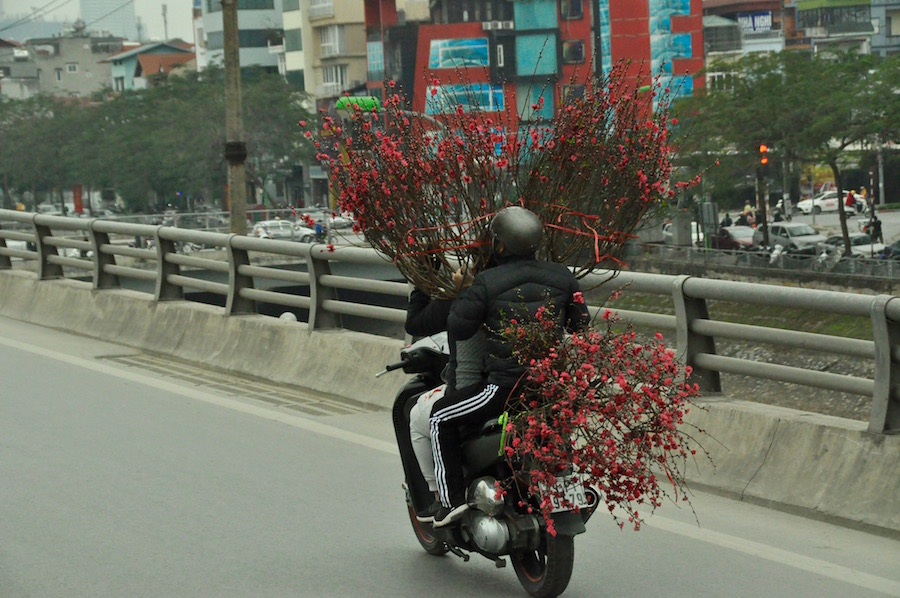
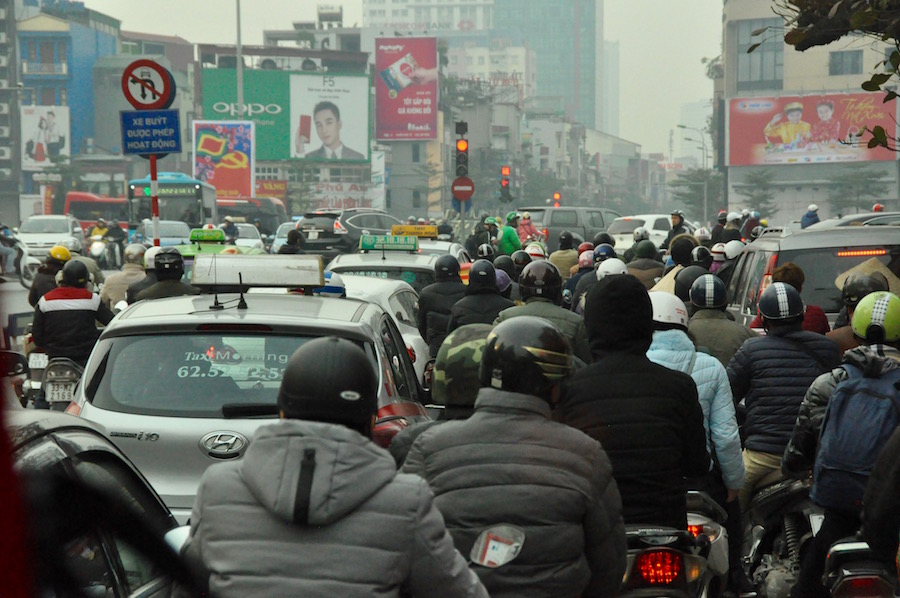
The flight had gone so smoothly it was a disappointment that we then faced a two-hour delay while our visas were sorted. Despite the fact that we had all completed the forms correctly, they seemed to be more concerned as to who was actually meeting us on the other side of passport control. After a lengthy phone call to the Asia Aventura office they began to process our passports and eventually let us proceed to passport control and to our luggage waiting on the other side where we were also met by our guide, Thanh, better known as “T”. It was now plain sailing to the hotel, although the closer we got to the town centre the more congested the traffic became, particularly with motorcycles, of which there were thousands. The population of Hanoi is 8 million and there are reportedly 7 million motorbikes. As the Tet Festival (Vietnamese New Year) was approaching some motorcyclists were precariously carrying large branches of cherry blossom or potted orange trees.

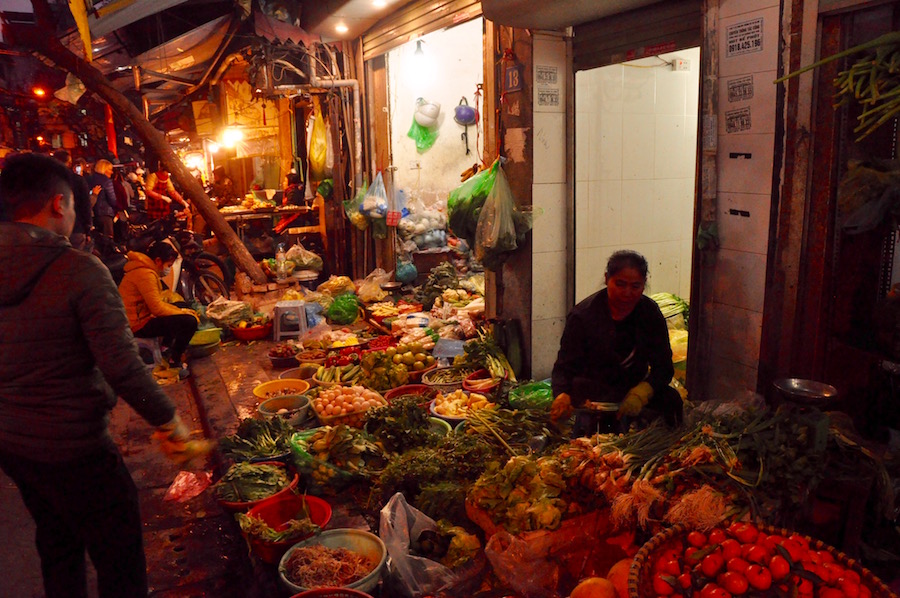
Having settled into the Hanoi Emotion Hotel, a very narrow, eleven floor hotel, we went into the old quarter for dinner. It was a fascinating walk through narrow streets alive with activity; so many interesting sights, sounds and smells. Groups sat on children’s plastic stools eating noodles produced by pavement cafes. There were some stunning displays of flowers, all ready for the Tet Festival.

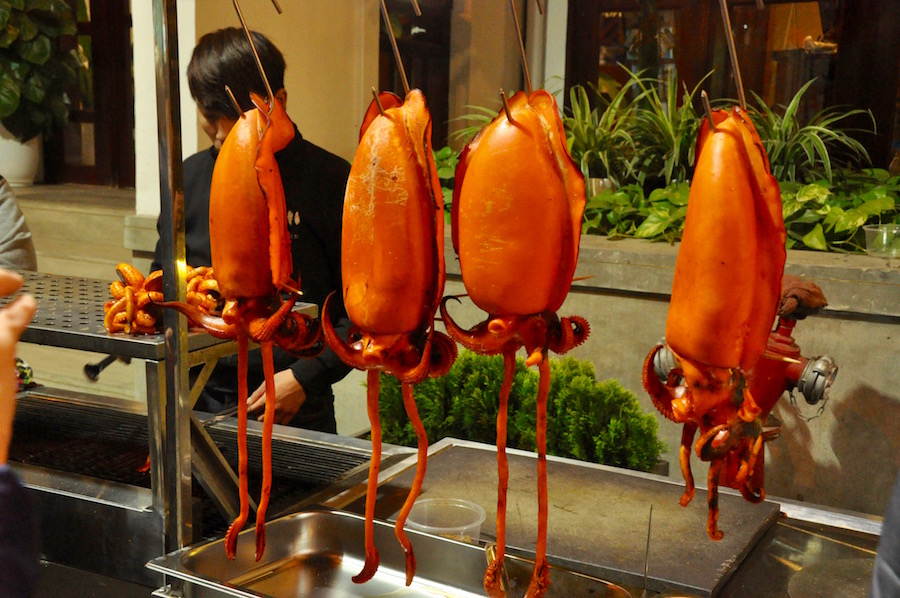
Octopus?

There were also some interesting items of food for sale, including some very lurid, orange octopus and some weird and wonderful fruit. Where there was not a colourful stall of some description blocking the pavement, motorcycles were parked, forcing us all the time to walk in the road. Remarkably, we did not come into contact with any traffic. Similarly, if we needed to cross a wider road we simply walked at a steady and regular pace, confident that the traffic would work its way around us. If we tried to run or to change our pace we would be introducing unpredictability into the operation and an accident would be much more likely.

After the first of many good multi-course meals we headed back to the hotel, through the same streets that were still very much alive with activity.

You would have thought that when staying in the heart of the capital city you would be woken by the hum of early morning traffic. That was not the case. It was preceded by cockerels crowing across the city to each other.

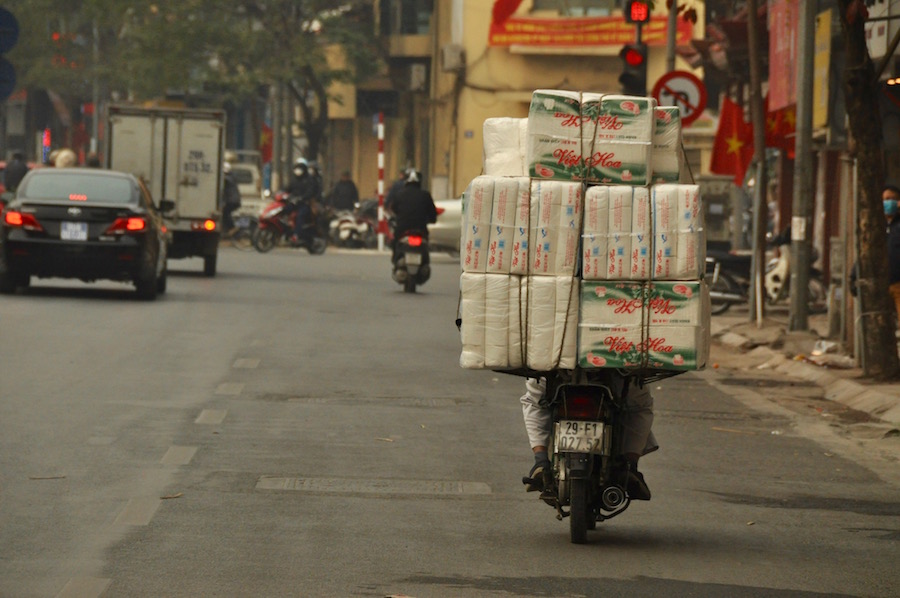
After breakfast Mr T met us for the start of our Hanoi city tour. The streets surrounding our hotel were too narrow for the bus to pick us up, so we walked a short distance to a main thoroughfare. Now, in full light of day, we could see the true impact that the motorbike has on the roads of Hanoi. At every traffic light there was a sea of motorbikes of all shapes and sizes. Some were carrying impossibly large loads, piled high and wide behind the driver. Others carried long items that jutted out in front by several feet and trailed behind by even more. It made the journey interesting looking for the most bizarre load or the bike with the most riders. Five was a maximum, but it did not stop us looking for six!

The entrance gate to the Temple of Literature

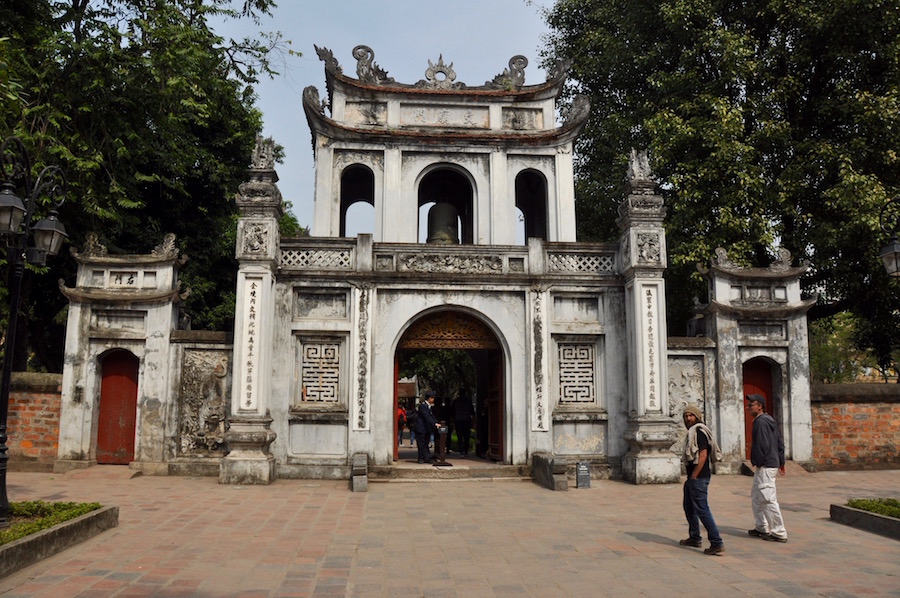
Dragging ourselves away from motorbike watching we visited the Temple of Literature dedicated to Confucious. Built in 1070 it is the site of Vietnam’s first university. There is a lake in the grounds beautifully described as the ‘Well of Heavenly Clarity’. It is a site of traditional architecture, stone carvings, Buddhist temples, bonsai trees and tat. Many of the stalls were selling really tatty items aimed at the Tet Festival. We made a point of trying to find the most grotesque, cheap and nasty Tet tat.

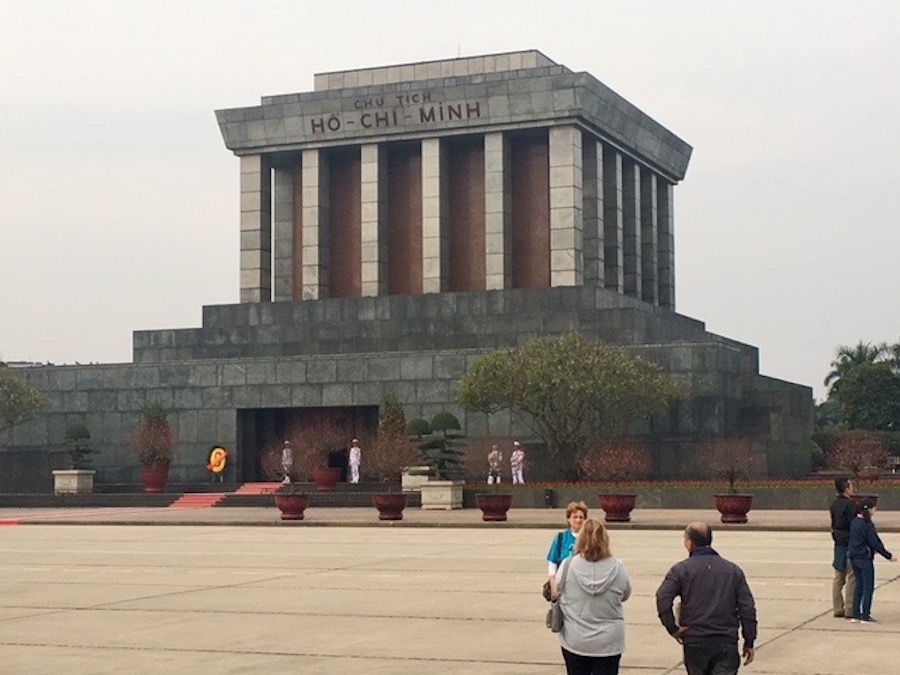
Heading back into the traffic, we next visited the mausoleum to Ho Chi Minh, a huge marble pillared edifice surrounded by old colonial French architecture and a modern parliament building. This is a place of huge significance for the Vietnamese as “Uncle Ho”, as he is affectionately known, was the founder of modern Vietnam, unifying the north and south after some bitter and bloody wars.

The Vietnam War was really the first war to be shown daily on television news bulletins and I remember, as a teenager, feeling bitter towards him, only because of the way he was portrayed by the media in the west. My reading leading up to this trip, and what I was learning as the trip unfolded gave me a very different perspective of Ho Chi Minh.

Ho Chi Minh’s Mausoleum

A long, circuitous walk past guards in white uniforms, eventually brought us to the steps leading into the mausoleum. Respectful behaviour was expected at all times with no talking, no hands in pockets, no inappropriate dress and no photos. The steps eventually led into the heart of the mausoleum where Ho’s body lay like a wax dummy. Having given due respect, we emerged into the hazy sunshine to a huge parade ground in front of the building. We were not allowed to stand directly in front of the building; there was an invisible line beyond which we could not go beyond. As we stood there listening to T, people would regularly wander into the ‘no-go’ area, to be ushered back, without ceremony, by the guards on duty.

Ho Chi Minh, was a simple man, who probably would not appreciate all the fuss. He preferred not to live in the Presidential Palace, a huge ochre coloured French colonial building, preferring the simple stilt house with the bare minimum of furniture.

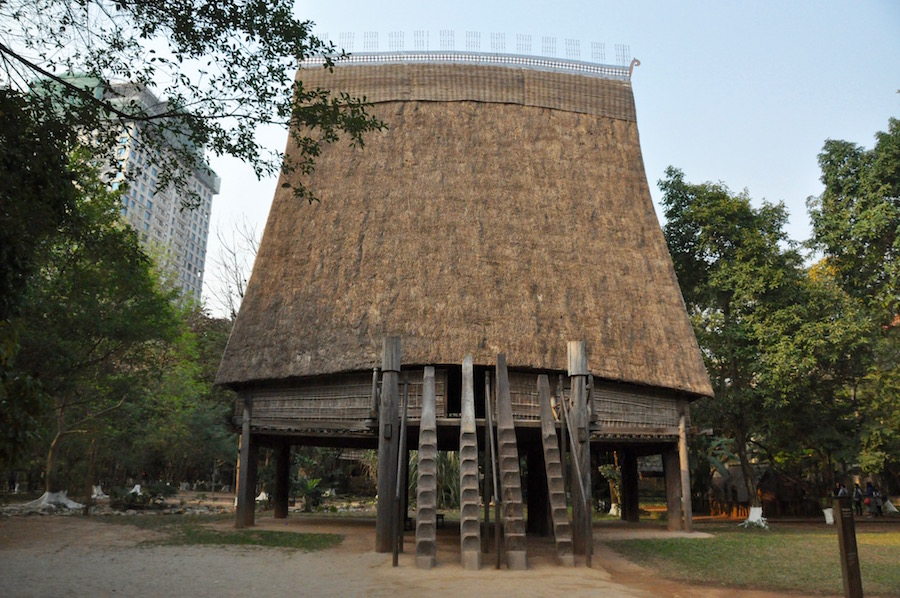
A traditional tribal house at the Museum of Ethnology

Lunch was taken in a parkland restaurant adjacent to the Museum of Ethnology. It was a very special restaurant where those working there were all pupils of Hoa Sua School, run by retired Vietnamese teachers. The school is a none profit organisation that takes young people from difficult circumstances and gives them vocational training in catering and hospitality. So far 7000 young people have benefited from the training and have been able to secure work in restaurants and hotels, an opportunity that otherwise would not have been available to them. The meal was excellent.

After lunch we went into the museum to try to get to grips with the tribal history of the Muong, the White Thai, the Black Thai, the Khmer and the other minority tribes of Vietnam. It was fascinating but, also, confusing as there was too much information to absorb.

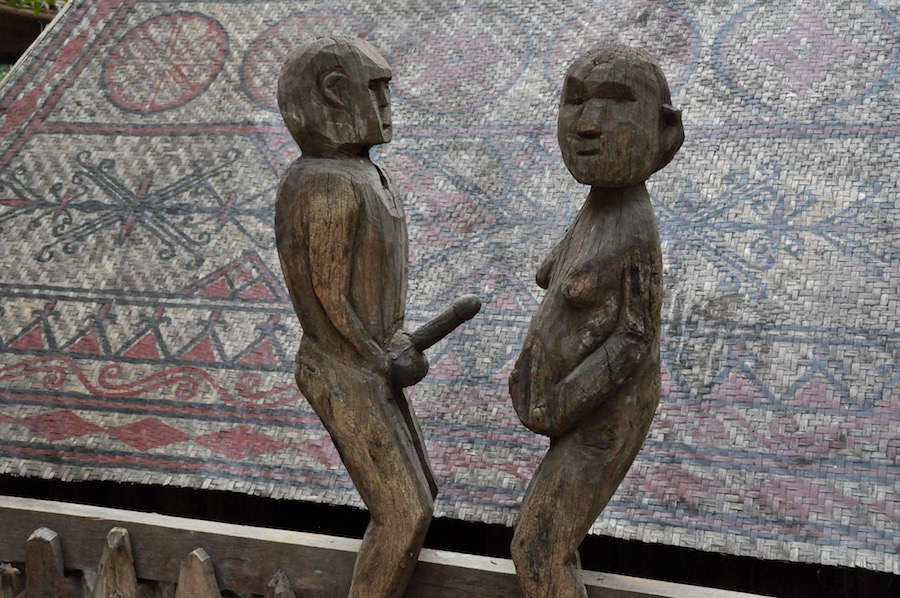
Outside, and probably far more impressive were, reconstructions of tribal houses. These were large and provided homes for extended families. While there were two very impressive traditional stilt buildings, a long house and a very tall house, the building that took most of our attention was the burial chamber with its collection of sexually explicit wooden statues all around it. They left nothing to the imagination!

Time was getting on and we were due to watch a water puppet show at 5.00pm. Unfortunately, we hit the road at the wrong time as it became gridlocked with thousands of motorbikes. We arrived at the theatre on the edge of the old town fifteen minutes late, so we had to creep in. For many in the group it was a welcome relief to sit down in a darkened room after such a full-on day, and it was not long before eyelids began to droop.

Our introduction to Hanoi had been quite short but packed with as much as we could cope with in the time. The following morning we were due to leave. A shame, really, as I think Hanoi deserves a little more time, to enjoy its traffic chaos, the atmosphere of the Old Town, the colours, the tastes, the smells and the forever cheerful faces that greeted us. I have seen enough of Hanoi for me to want to return to absorb all that it has to offer.

Sapperton and the Source of the Thames

St. Kenelm’s Church, Sapperton

28th January 2018, and the warmest day of the year, so far. Fourteen of us met at the unique church in the centre of the village. Built in the usual cross shape it has four distinct areas, which are largely separated from each other. Whilst the stonework is relatively plain and austere, the ends of the pews are beautifully carved with figures of men and women. These did not originate in the church but came from the banqueting hall from the 1st Earl of Bathurst’s manor house when it was demolished in 1730. One of the transepts has floor to ceiling wood panelling. Both transepts also have intricately carved memorials, the most elaborate to the Poole family who were the earlier owners of Sapperton Manor. (What a shame Kevin and Gerry were not with us!)

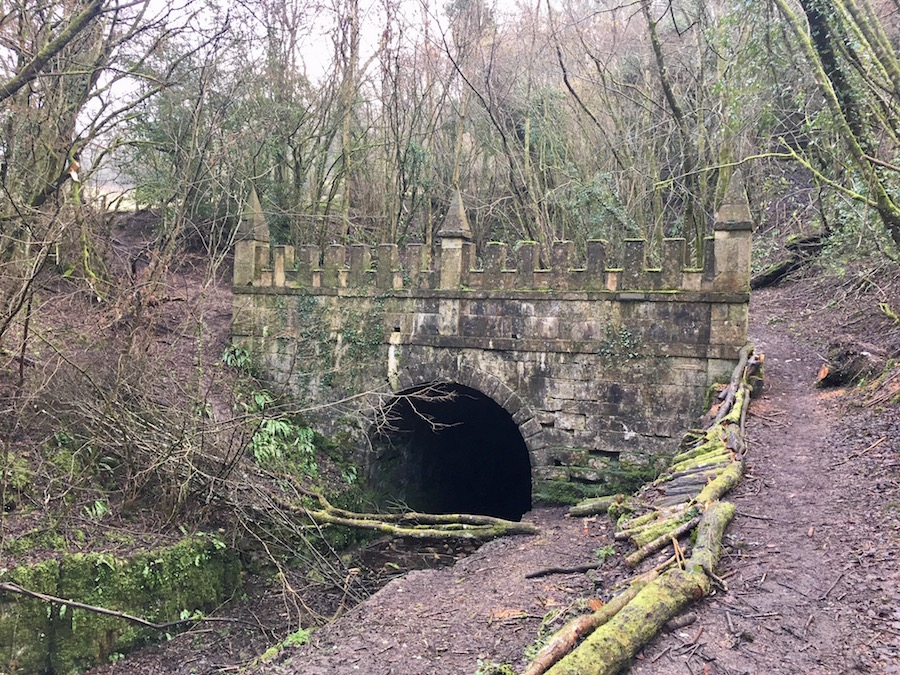
Entrance to Sapperton Tunnel at Sapperton

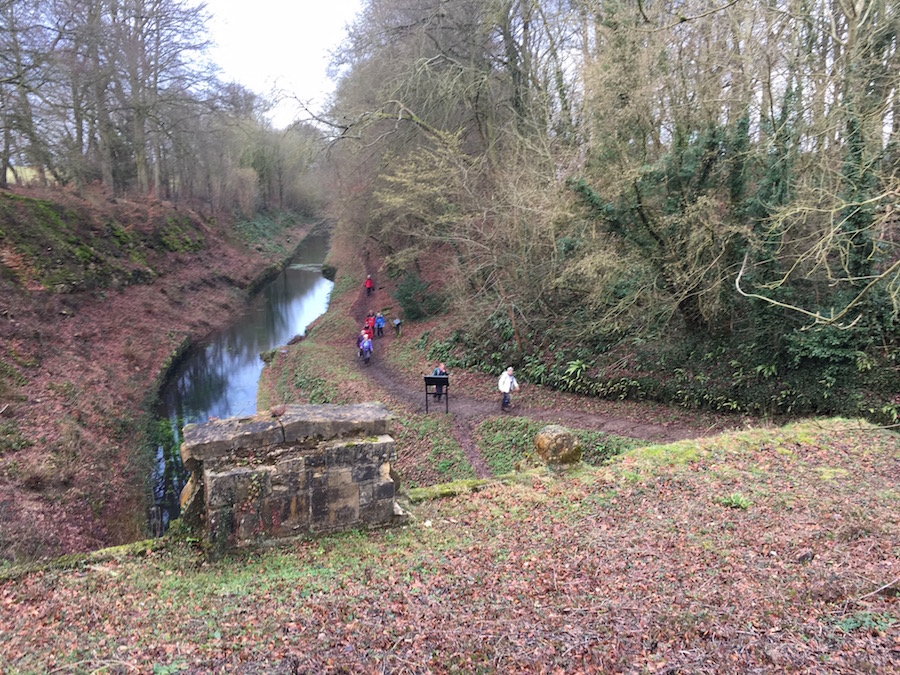
Leaving the village, we soon came upon the turreted portal for the Danewood end of the Sapperton Tunnel on the Cotswold Canal that linked the River Severn with the River Thames. The tunnel is 3.5km long and we would be seeing the other end some hours later during our walk.

The tunnel was built between 1874 and 1879 and must have been a magnificent piece of civil engineering in its day. It still is, although the canal has fallen into disrepair, with little or no water, overgrown with trees and shrubs, and, unfortunately, in a couple of places, a dumping ground for unwanted rubbish. Nevertheless, as we walked on the towpath with the canal basin on our right and the River Frome just a few yards to our left, there was a sense of history.

Standing alongside the canal is the the Daneway Inn, built originally as a barracks for the many navvies employed to build the tunnel. It was converted into a public house in 1807, and started that phase of its life as the Bricklayers Arms. As we were only 20 minutes into our walk by the time we reached the Daneway, it was far too soon to consider stopping for any form of refreshment.

Eventually, we left the old canal towpath and climbed steeply on a vague track, made slippery by recent rain, up through decaying woodland to cross the Great Western Railway line linking Worcester with London, and continuing the climb up to a lane. We had just done the bulk of the day’s climbing.

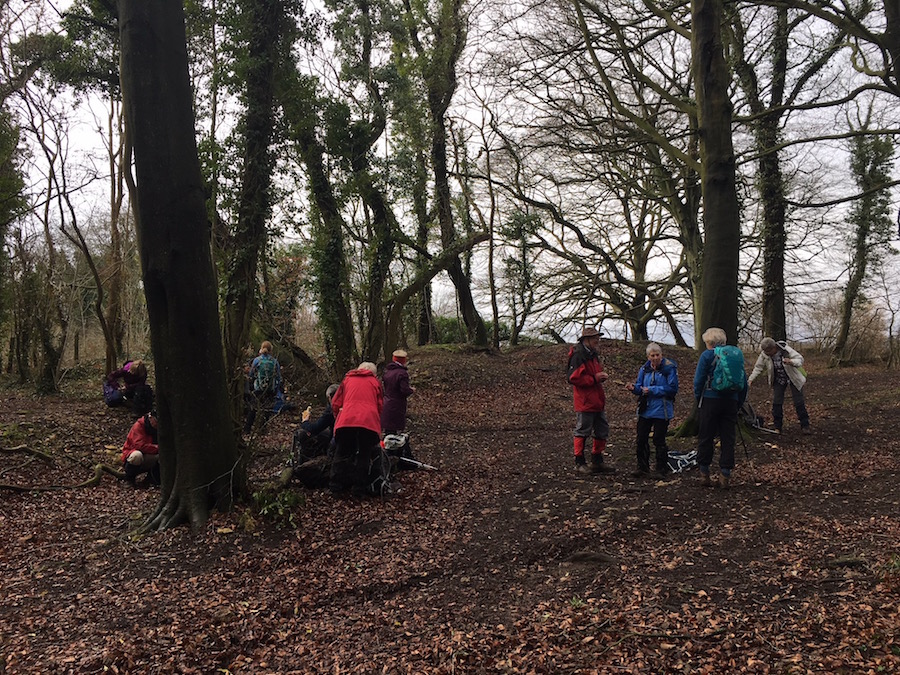
Taking a quick break in the beech woodland

The next section of the walk took us over another feat of engineering achievement, a railway tunnel. As we walked through a woodland, largely of beech trees, we were walking directly above the railway. Looming out of the trees we came across an enormous brick ventilation shaft, the purpose of which, when it was built, was to allow the smoke from steam engines an escape route. Now they released diesel fumes.

We crossed the busy A419 to follow a rutted and muddy track for about a mile until we reached a junction with the Macmillan Way, which we then followed. It was a welcome relief to be out of the woodland with far reaching views over the surrounding countryside. It may have beed the warmest day of the year so far but there was still a brisk breeze which meant that taking lunch might be a chilly affair. Luckily there was a hedge that gave us some protection.

Passing through the hamlet of Tarlton, a cluster of large, opulent Cotswold houses, we soon reach the Tunnel House Inn. Like the Daneway, this too was originally built to house navvies building the tunnel. Many accidents with huge losses of life occurred during the five years it took for the tunnel to be built, and on several occasions it was used as a mortuary. Once the tunnel was completed it became a place where the leggers resided to leg barges through the 3.5km of tunnel. To do the work well they required several pints of beer, so it was turned into an inn satisfying the needs of the leggers.

Probably the finest canal tunnel portal in the country

Just below the now modern inn serving excellent food and drink and catering for a great many visitors, is the other end of the tunnel. This portal is even more spectacular than that at the Sapperton end, with built-in niches for statues, although there are no statues there. This section has crystal clear water in it with water plants of a very vivid green. Above us a bat flew around, brought out of its tunnel dwelling by the rising temperatures.

We now followed the canal again passing under Skew Bridge carrying the railway over the canal. The brickwork for this bridge was fascinating and caused some conversation as to how the builders managed to build something diagonally across the canal but with the sides parallel.

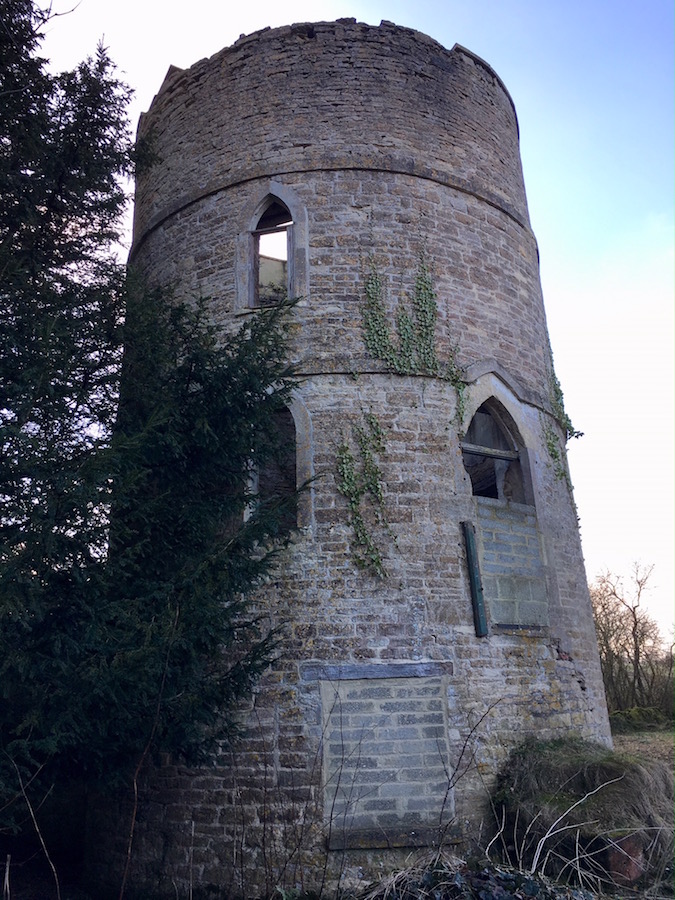
A little further on we came to a three storey round house at a point where the canal narrows but where there wasn’t a lock. In any case the level of the canal floor was the same either side. This again became the focus point of our conversation, wondering what its function had been during its heyday. Initially, we decided it was a toll house for the nearby tunnel, which seemed reasonable, and I would have been  happy with that. In fact, it was a lengthman’s cottage. A lengthman was a worker who looked after the maintenance of the canal. On the ground floor there was stabling for horses, the heavy machinery of the canal system, and the roof was inverted to collect rain water. Although the floors and roof are gone, it is still structurally sound and would make a great “Grand Designs” project for somebody, if the estate of the Earl of Bathurst was prepared to sell it.

The Source of the Thames

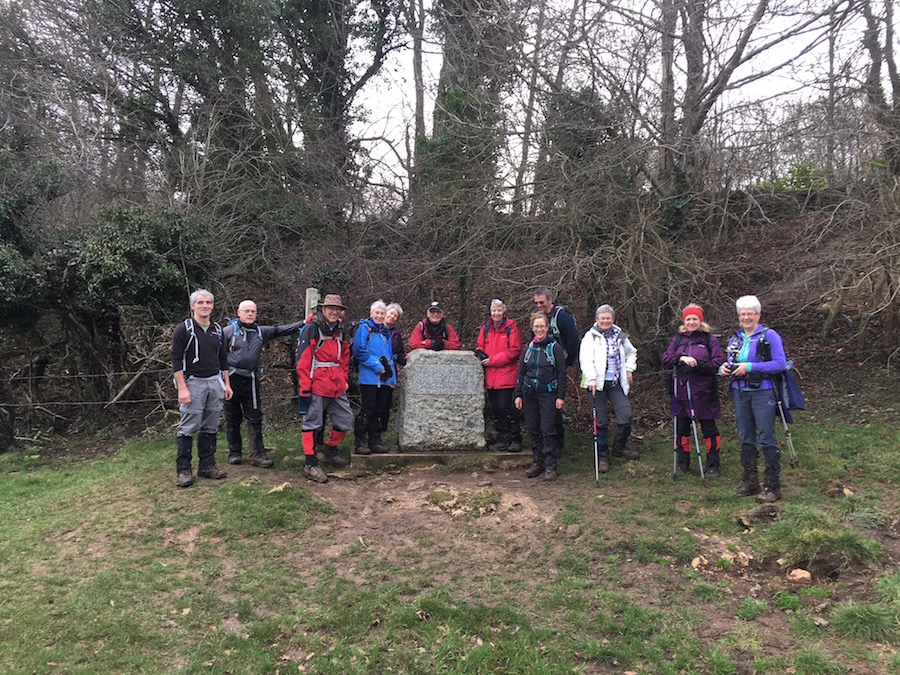
We eventually reached a bridge where we diverted from the canal to head across the edge of some fields to the source of the Thames. If you were expecting something really dramatic, you were going to be disappointed. The spot is marked by an inscribed stone, although the inscription is impossible to read, lost in the natural markings of the stone. There is a small stone filled depression in front of the stone but there is a distinct lack of water. A finger post points to the Thames Barrier, 184 miles away. Had we followed the direction of the finger post for about a mile, somebody reassured us that we would see a flowing stream.

Returning the same way to the Tunnel House Inn, we then proceeded to walk through woodland above the tunnel. All along the route there were little mounds. These are the spoil heaps from the tunnel construction. Over the 3.5km distance a line was drawn across the surface of the land. At twenty six points along the distance shafts were dug of varying length according to the undulations in the terrain. They varied in depth from 30 – 200 feet. From the bottom of each shaft, navvies dug horizontal tunnels following the surface line so that, eventually, each shaft was joined to the next, forming the tunnel. Without any mechanical tools it must have been gruelling, back-breaking work where there was enormous risk. It is hard to imagine, but what a incredible piece of engineering. The fact that, after 230 years, all but about 500 yards of the tunnel is either in good shape or needs minor restoration, is testament to the workmanship of those remarkable navvies.

After 11.3 miles we were back at Sapperton enjoying a post walk drink in the garden of the Bell Inn, a thriving village pub and restaurant. Despite most of the route being muddy, it was a good day out and a real pleasure to get some fresh air and exercise with friends.