Kathmandu to Taplejung

Kathmandu is changing. As we emerged from the haze above the city new estates of small, orderly houses are replacing the chaotic distribution of buildings and there are many more taller buildings, even in the last two years since my last visit.

No other planes sat on the apron and because we were all organised with our paperwork, I was able to walk straight up to the desk for my visa. Never before have I had such a smooth transition through the airport on arrival. Even the luggage came through quite quickly and we were out meeting Rajendra and Ujjwal much sooner than I expected. Even the front of the airport looked different with some efforts taken to create some order into the way people are managed as they emerge from their journey.

Life Story Guesthouse

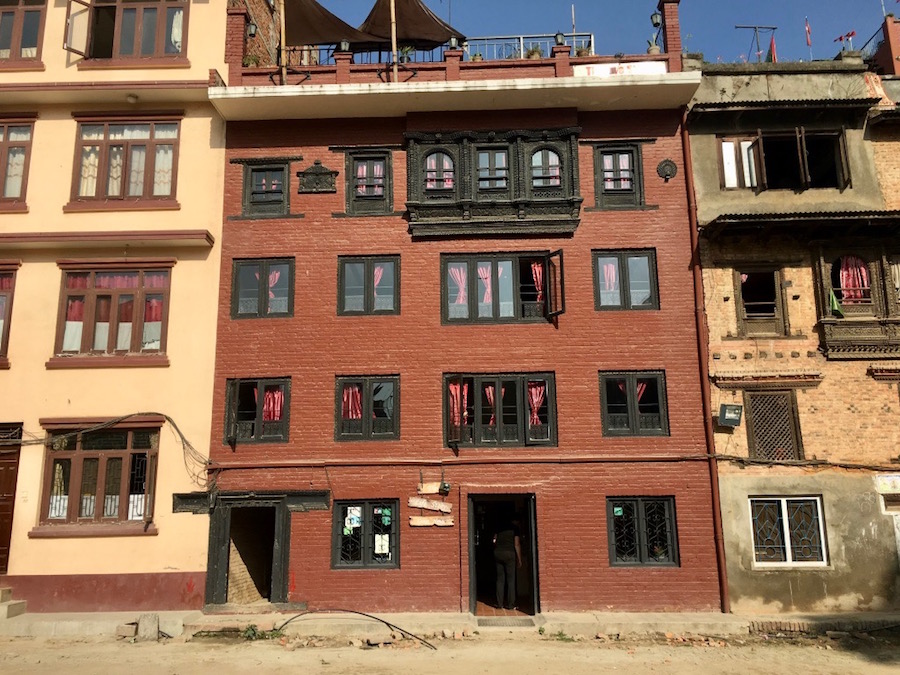
The Life Story Nepal Guest House is an old Newari house that has been lovingly restored and turned into a boutique hotel. It belongs to a Ukranian and a Belorussian. The ceilings are low and the stairs steep and narrow. Rubber has been placed on those beams most likely to cause injury. The rooms overlook a square with similar houses around its perimeter and also a temple. Various religious icons and statuary adorn the square and there is a communal well where people come to collect their daily water supply. Another open balconied building acted as a function centre where there was much music and merriment emerging, filling the square and bouncing back off the walls. Black crows perched noisily and menacingly on the rooftops while pigeons cooed on the ground, picking their way amongst the sleeping dogs.

That evening we walked up to Patan Durbar Square, now still in the throes of major restoration following the 2015 earthquakes, and beyond to Swotha where we planned to have our evening meal.

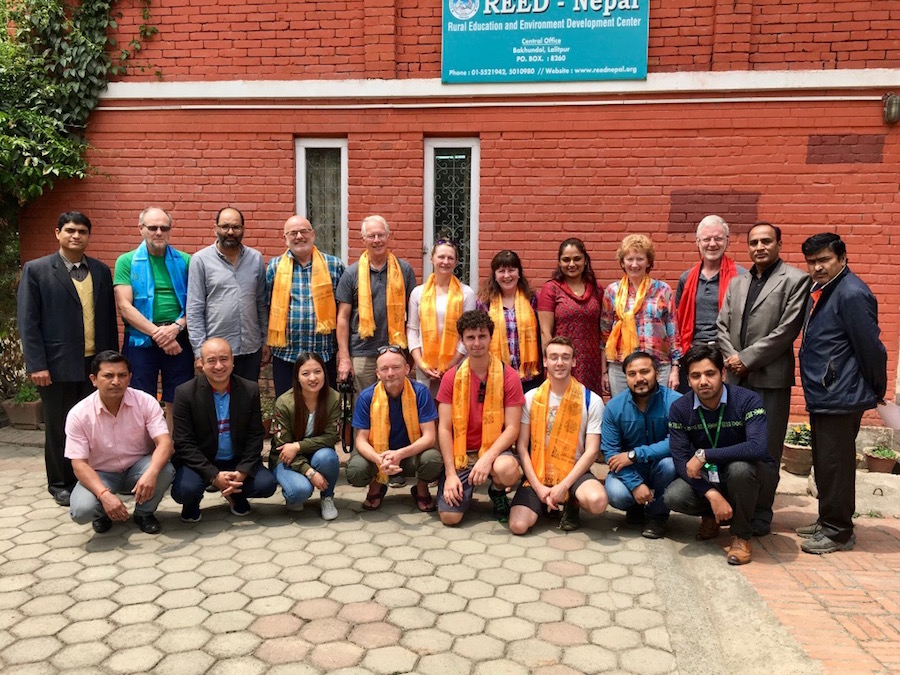
At the REED office with staff

The following morning, a combination of body clock misalignment, bright sunshine, temple bells, barking dogs and cawing crows ensured that I woke up quite early. After a good rooftop breakfast we walked the short distance to the REED office where we met all the staff. They had prepared a couple of presentations for the group on the work of their organisation and on possible future developments of their programmes in schools of the Taplejung District, in the far NE of Nepal.

After lunch we took taxis into Thamel, a journey that took considerably longer than it should for the distance because of the gridlocked roads. Travel in the city is getting more and more congested despite road widening and improvements that have occurred in recent years.

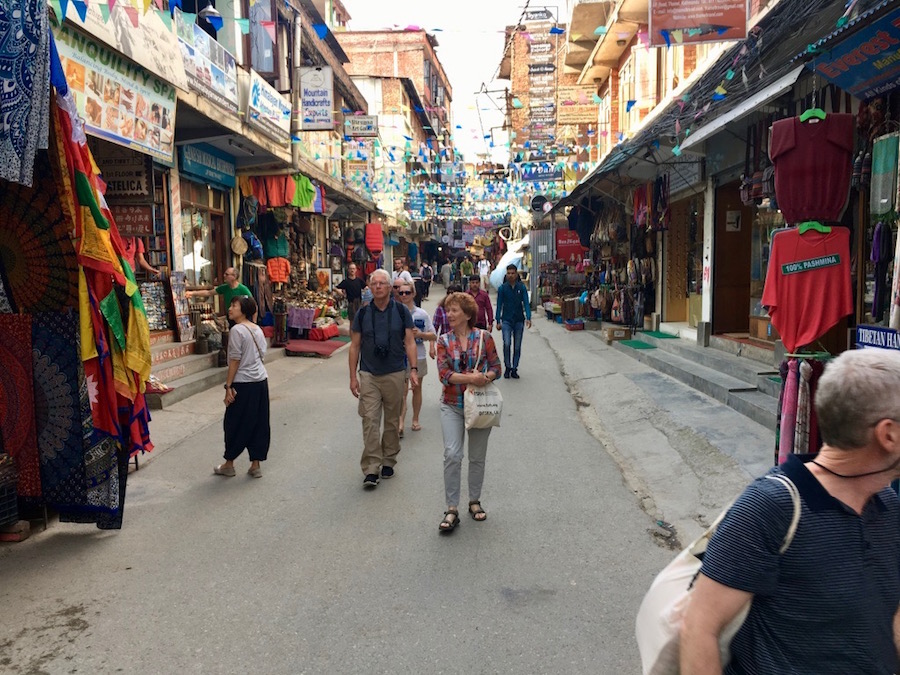
Wandering the streets of Thamel in safety

In Thamel we visited Shona’s to buy some kit and then went to Northfield Cafe for a beer. The roads in the heart of Thamel are now pedestrianised, making it much safer and more pleasant to walk around. The site next door to the Northfield Cafe that used to be the wonderful Pilgrims book store, sadly burnt to the ground a few years ago, is now a new shopping mall, with plush, brightly lit shops, so out of character with old Thamel, but now, gradually, becoming the norm.  Even the Northfield Cafe has undergone change, extended its area and tidied itself up a bit.

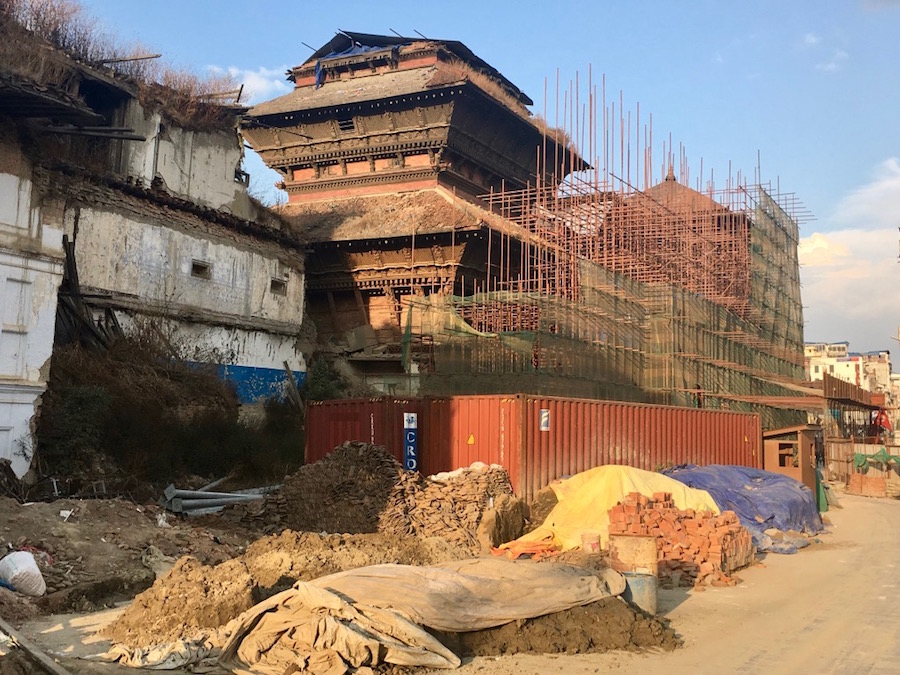
Repairing the damage

Knowing our time in Kathmandu was limited at either end of this trip, I suggested that we walk down to Durbar Square. There are several in the group for whom this is their first visit and it would be a shame not to make the most of their time.

It now costs NRs1000 to visit and as soon as we approached the kiosk we were pounced upon by guides who were reluctant to accept, “No thank you,” as an answer. We were also pounced upon to buy all sorts of tat by street vendors. Fending them off spoils the occasion.

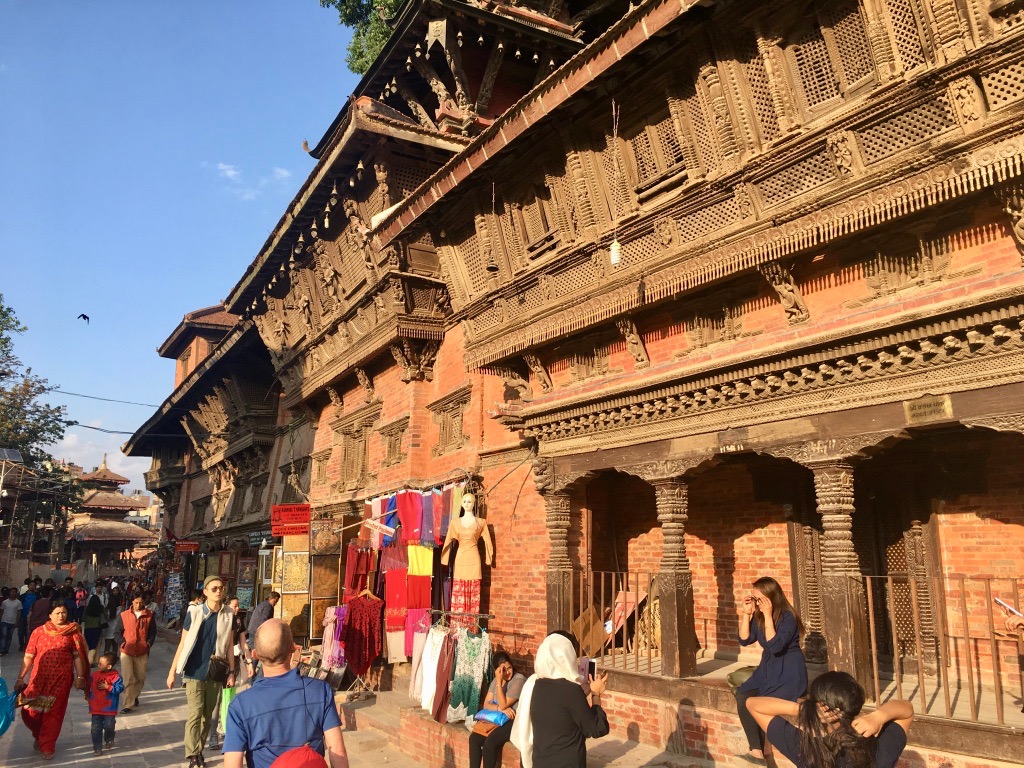
The late afternoon sunlight was superb, highlighting the carved wood of the pagodas.
As we walked closer to the square the damage from the earthquake became more devastating. Many of the remaining pagodas are propped up while others are being rebuilt from the ground up. The old royal palace is sheathed in scaffolding and sheets that hide the full impact of the quake. Kumari’s palace was remarkably undamaged while everything around it collapsed. With the help of a guide who, although turned down by us, continued to follow and chip in, we managed to time our visit with a balcony appearance of The Living Goddess, Kumari. This particular living goddess is three years old and has been in residence since last October. As she nervously looked down upon us you could not help but think that this young girl’s life has been manipulated. For what? A life apart from reality through her most important years and then not able to adjust into normality once she has fulfilled her role.

The taxi back to Patan was interesting as none of the drivers really knew where they were going and as the guest house is not accessible by vehicle, they had not heard of it. Eventually, we made it back.

That night we ventured out to a traditional Newari restaurant for a rooftop terrace meal while watching distant lightening light up the night sky.

In the night the Arna beer, a new brand in my experience, gave me a beer induced headache.

In the morning I was up and going quite early and left Tim purring gently. When I returned at 7.00 to make sure he was up and going, he was still sleeping. Waking him, I busied myself with a bit of last minute sorting if kit before visiting the bathroom. When I emerged, Tim had gone up to the roof for breakfast, locking me in the room. It took an age to attract attention. I tried shouting up from my open window, whistling and phoning various members of the group, none of whom answered. Eventually, one of the staff heard me and got Tim to release me from my prison. I will take my revenge but I will not rush. I will bide my time and keep him on edge for as long as I can.

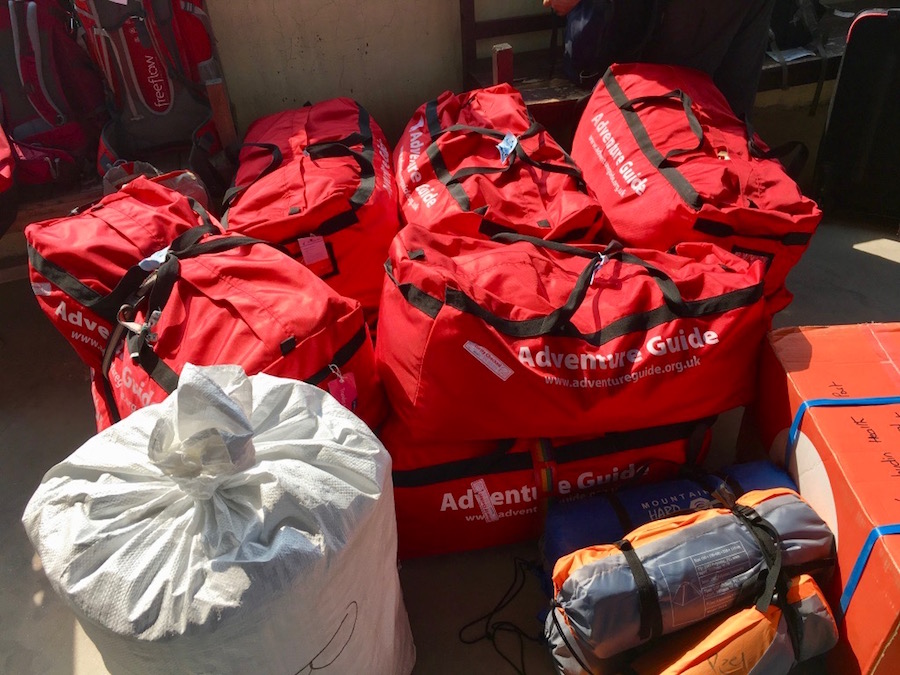
The new Adventure Guide kit bags

Predictably our flight to Bhadrapur was delayed. It would not be Nepal if it was on time. By the time we left Kathmandu we we three and a half hours behind schedule having spent two and a half hours in the departure lounge, thirty minutes sitting on a bus outside departures and a further thirty minutes sitting in the plane awaiting instructions to take off. By the time we were in the air the cloud had built up sufficiently over the high peaks that they were rendered invisible. Such a shame as this is probably the only opportunity people will have to see them.

On arrival in Bhadrapur the thirty degree heat hit us as we emerged from the plane. It probably then took us a further thirty to forty minutes to load the kit on to the roof of our two land cruisers before we could begin to eat into our journey up to Taplejung. After about an hour we stopped at a restaurant for some late lunch (it was now 4.00pm). We had resigned ourselves to accepting that this would be our only meal and that what we had would suffice for both lunch and dinner.

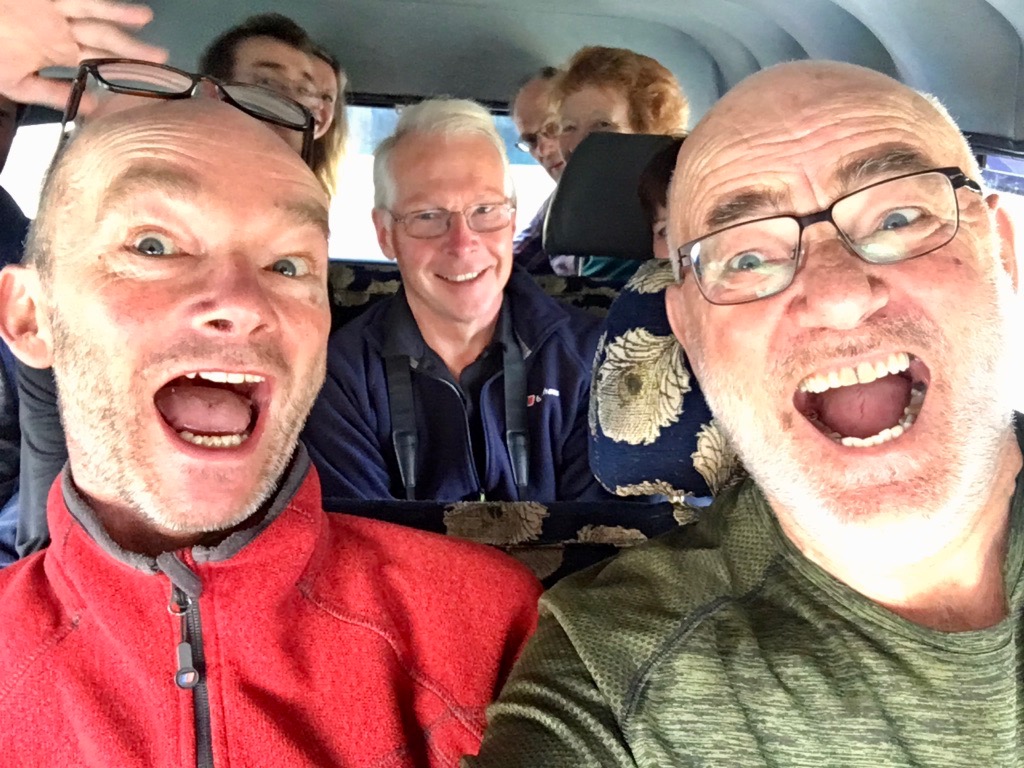
All crammed into one land cruiser

Once we left the plains of the south we began a series of climbs and descents on largely a series of hairpin bends. Distances covered are not huge but when managing to achieve an average of about 30km per hour it becomes a long haul.

Soon after starting the climb the light began to fade but it stayed light just long enough for us to appreciate we were travelling through tea country, the centre of which is Ilam, a town that seemed to take an age to reach.

After some time I was asked if we wanted to eat but nobody seemed interested in another long stop; we just wanted to reach our destination. However, in my decision making, I did not take into account the drivers or the Nepalis accompanying us. So, we stopped at Phidim a little before 10.00pm where they were fortunate enough to find somewhere open where they could get some dal bhat while we just had tea and biscuits. It was New Year’s Eve after all and we did have some rather jubilant Nepalis celebrating the fact on the next tables.

The last leg of the journey, two and a half hours to Taplejung, was more of the same. At one point our headlights picked out two rather scrawny wolves scurrying across the road.  We came across large sections of road where there had been huge landslides during last year’s monsoon. One must have been at least a kilometre across and will have inevitably cut Taplejung off from the rest of the world for some considerable time. No wonder the rebuild programme in schools and the supply of materials for the water project were delayed.

We eventually arrived at our hotel, the Mewa Khola Resort Hotel, at 1.30 in the morning. Construction of it was completed when we were here two years ago and is probably the best hotel in Taplejung, certainly better than any I had stayed in previously. The beds are very hard but at least I did not have to share it with Tim, just the room.

Bright sunshine greeted us a few hours later. After breakfast Tim, Kate, Ian and myself popped into town to sort out Nepali mobile phones. Thankfully we had Dinesh with us to make the purchases much smoother than they might otherwise have been.

While I returned to the hotel the others went on further and visited the hospital. I remember it as being a very dismal and dark place, scruffy in the extreme. From there comments it seems to be much better. The staff they spoke to were enthusiastic and were committed to their work, unlike the District Medical Officer I had previously met, who really did not want to be there.

From there they visited the courthouse, and although they could not go in, they could go into the gardens which overlook the prison, provided they did not take any photos. They had one of the warders talk to them and they learned there were 109 inmates, largely serving time for either murder or rape. One can only assume that these were acts of violence induced by the consumption of alcohol.

The restaurant I was hoping to go to for lunch had been burnt down, a common occurrence it would seem in Taplejung, so we ate in our own hotel and had some very tasty paneer moms, although they took at least an hour and a half to materialise after ordering.

Tomorrow we start our trek to Yamphudin. Looking forward to it.

A Memorable Two Days in Scotland

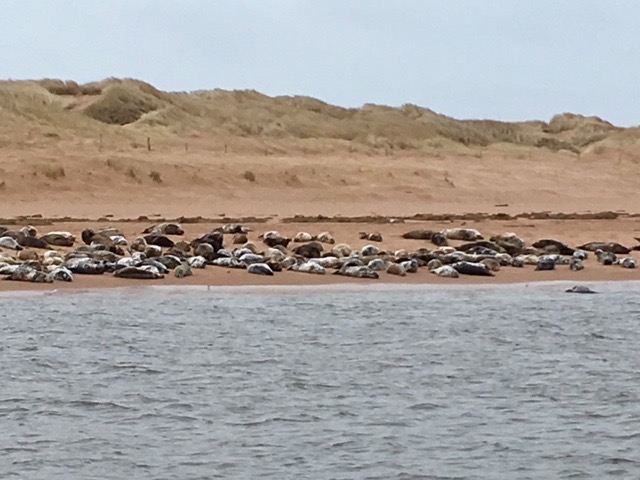
An opportunity arose for me to take a quick trip up to Aberdeen to visit my son for two days. Knowing that a drive would eat into the little time we had together, and be costly, I chose to fly up from Birmingham. By taking the early Saturday morning flight I would be in Aberdeen by 10.00am, leaving the rest of the day available for whatever activities we chose to do. Unfortunately the weather was not very kind to us, and knowing this, Stephen had booked us in for a distillery tour at 1.00. In the meantime we headed out to the mouth of the River Ythan to the north of the city. Leaving the car, we walked over the sand dunes on the south side of the estuary and dropped down to the beach. A brisk wind came at us from the North Sea. Across the estuary, on the opposite shore, were hundreds of seals, a huge colony made up of large, black males, a great many paler females and lots of pups in varying stages of development. Squabbles broke out on the crowded beach as the occupants protected their space or just because they felt grumpy. Great seal groans boomed across the water from the males as they used their noise to control their females and to warn off other, nearby males.

In the water, heads bobbed up and down and some seals came close to our shore to have a look at us. When we looked back the dived noisily to reappear a little further along the shore to watch us as we walked by. They are a very curious species and their huge eyes and long lashes melt any heart.

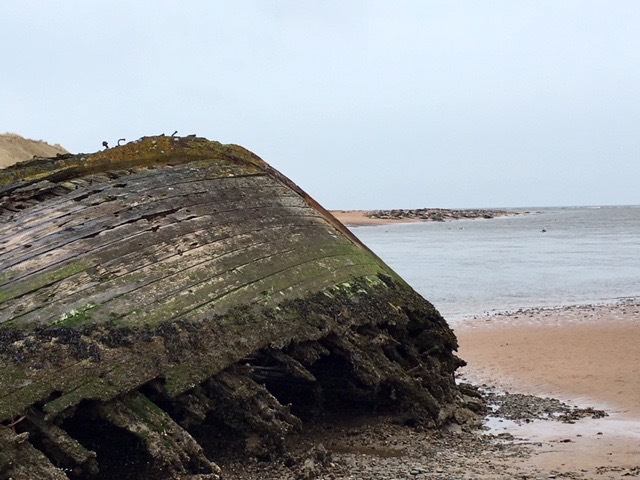
We walked out to the end of the estuary, only to turn back the way we had come. The seals followed us, curious. Going further up the estuary we came to part of an upturned wooden hull embedded in the sand with clusters of tiny mussels around its base. How long had it been there? Quite a while by the looks of it.

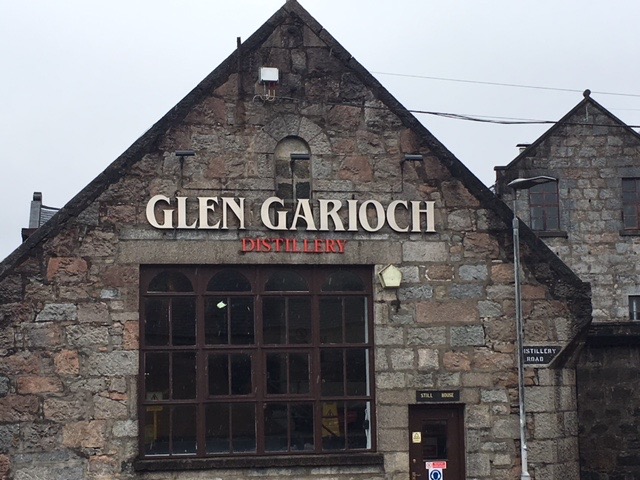
Returning to the car we grabbed a bite of early lunch before going to the Glen Garioch Distillery at Oldmeldrum, one of the oldest operating distilleries in Scotland. Production of whisky has been carried out on this site since 1797. The tour was a pleasurable experience but, as so often happens these days, there is very little activity to see, especially at the weekend. There is nobody working anywhere in the distillery other than the guides, and the process is so automated that there are very few workers, full stop. There was nothing happening in the malting area, and certainly no heat, which would have been appreciated on such a chilly day. No mashing was taking place and all the vats and apparatus were empty and spotlessly clean. We were told it was all ready for starting the process all over again on Monday morning. We did not get the smell of fermentation or the rich fragrances from the distillery.

Once the tour was over we returned to the shop where they tempted us to buy some by giving us small samplers. As Stephen was driving, he was given some to take home. My samples were lovely, although I preferred mine without the addition of water, but as I only had hand luggage I really didn’t have the capacity for extra weight or bulk.

By now it was raining properly, so we headed into Aberdeen, to the Queen Vic to watch Ireland beat Scotland and France beat England in the Six Nation Rugby. It was an interesting experience for when the England match was playing there was not a single Frenchman in the pub but nearly everybody was willing France to win.

Afterwards, we slunk out to find somewhere to eat before heading back to Stephen’s house in Cults. An early night was in order after the early start of the morning, but also, there was promise of some good weather in the morning.

The weather was indeed good the following morning, very good. So, where to go?

Leaving snow-free Aberdeen behind, we headed west towards the mountains. As we did so the snow began to appear and accumulate the further we ventured into the mountains. By the time we arrived in Braemar the snow was piled high at the sides of the road where the snowplough had cleared a way.

Armed with crampons and ice axe we were prepared for anything.

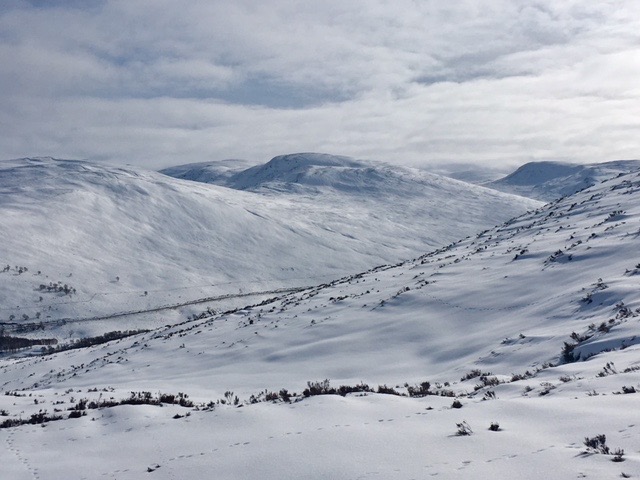
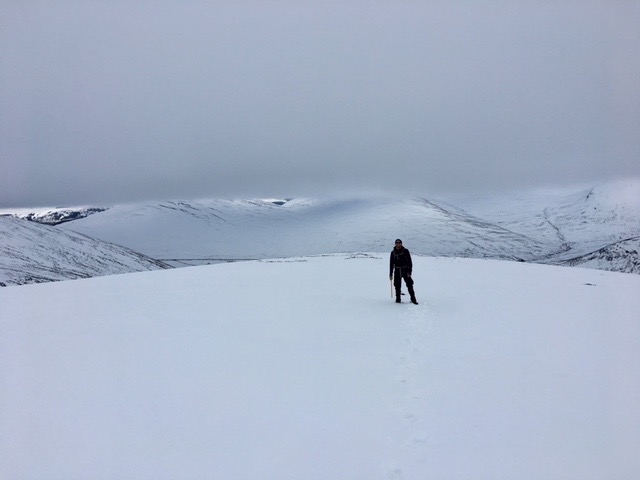
We soon started to climb through thin woodland. The snow was about a foot deep and made the going quite tough. The skies were clear and there was not a breath of wind. The exertion of the climb soon had us sweating and wishing there was some slight movement of air.

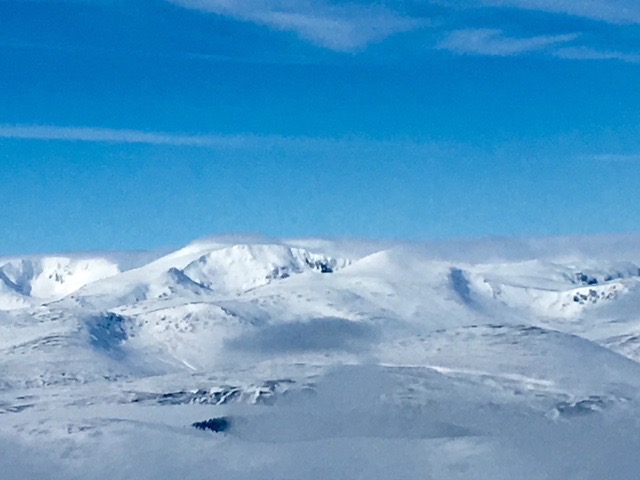
After some time we rose above the trees on to the open hillside and the white vista opened out all around us. The climb ahead looked steady but there was no sign of the path hidden beneath the deep snow. The only telltale sign of where we should go was a single set of footprints snaking away from us towards the summit at present still hidden from view. Placing my boots into the deep depressions of our predecessor, we climbed at a steady pace, stopping occasionally to appreciate our surroundings and the expansive view across to the Cairngorms.

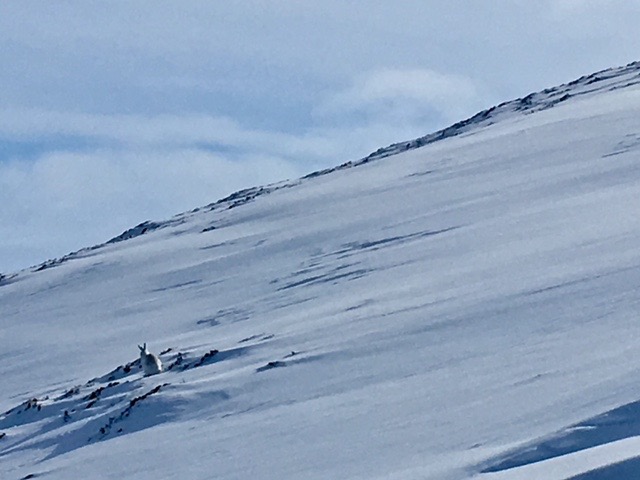
Most of the time we were walking with our heads down following the footsteps. Imagine our delight when we looked up and saw a beautiful white hare sitting on the snow a short distance from us. After a while he bounded off up the hill with such ease, to then rest while watching us plod up through the snow.

As we neared the summit the gradient eased and so did the snow as much of it had been blown off by the wind.

On the summit, if you ignore the radio mast and accompanying shed, there is a full 360 degree vista across a sea of white mountains. The mast had wonderful snow sculptures within its framework and the building had drifts all the way up to the roof on the windward side. But now there was no wind, not a breath of it. We sat on rocks enjoying our lunch in warm sunshine listening to lumps of snow falling off the radio mast behind us. It was too nice to rush. With the summit to ourselves except for two others who followed us up, there was no desire to leave. So rarely do you have perfectly still days in Scotland, particularly when there is so much snow about, it was an experience to savour. Capercaillie clucked all around us but we’re not always easy to see despite the fact that they were black. When they were among the rocks they were well camouflaged; it was only when they were on snow that they stood out clearly.

We had to leave at some point in time, so when we had absorbed enough of the view, we set off following a rough land rover track that was there to service the radio station. The going was easy until we dropped off the summit ridge into deeper snow, and now we did not have footprints to follow. The track was easier to see as the surface of the snow was smooth, but it was also deeper, making it tough going. For a while we left the track and tried a more direct route down the hill but that proved, after some time to be more tiring with a less predictable surface under the snow. Now we were seeing more and more hare and capercaillie on this more remote and quieter side of the mountain. The tracks in the snow left by the hare were amazing. The distance between each pair of rear prints was enormous, easily nine or ten feet apart.

The descent was taking much longer than expected. We could see our target, the old military road that traversed the mountain back to Braemar, but it didn’t seem to be getting any closer. We had seen the best of the day, for cloud now hung about the summits.

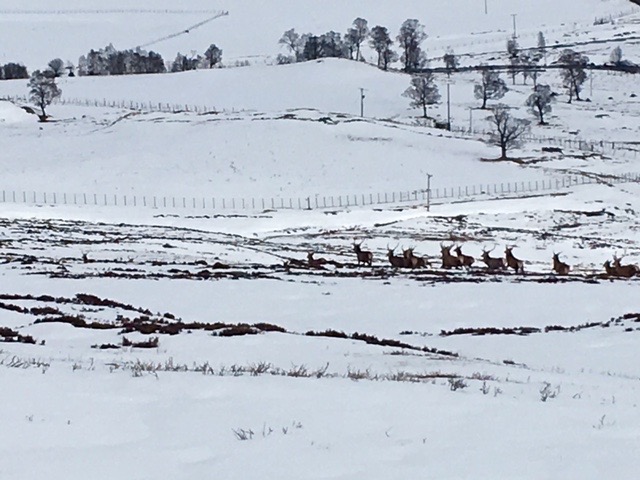
As we we nearing the bottom, the track traversed round a small bluff. We must have been noisier than we thought because suddenly there were about 100 deer running across the track in front of us and off up the hill to our left.

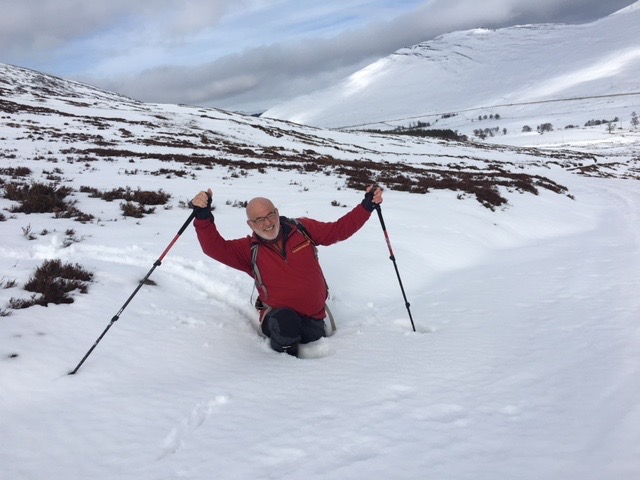
Eventually we reached the old military road, and that is where I encountered the deepest snow. As I stepped on to it from the rough ground beside it, one leg disappeared up to my waist. I had stepped into a roadside ditch. It was a bit of a struggle to pull my leg out without the other sinking into the soft snow to join it. Having freed myself the road was fairly flat but still covered in deep snow until we came to the first farm. Now the road was clear and it was an easy walk back into Braemar.

We had been out on the hill for almost 6 hours. We had not been cold at all, apart from my feet, because my boots seemed to have lost their ability to keep the wet out. We hadn’t needed crampons or ice axe; the conditions had been perfect.

In Braemar we visited The Bothy Cafe for a deserved cup of tea and piece of cake. We had had a super day’s walk, one to remember for a long time to come. As we drove back to Aberdeen we reflected on the day with a great deal of satisfaction.

The following morning, I was up early to catch my flight to Birmingham and was home soon after 9.00am. After such a successful weekend, I can see me doing it again, quite soon.

Laos – Luang Prabang

If Hanoi and Ho Chi Minh City in Vietnam are considered to be fairly frenetic and Siem Reap is fairly placid, then Luang Prabang in Laos is positively horizontal in a laidback kind of way.

We were met at the airport by Phai, pronounced pie, our guide for this part of the trip, and taken on a short journey into Luang Prabang. For the first time we were transported in two minibuses, instead of a larger coach, separating at least half the group from the guide. Our hotel, Villa Saykham, was in the heart of Luang Prabang. The reception area was not particularly welcoming but once we passed through to the garden and the rooms, which were on two levels, it looked a lot better.

Once we had settled we ventured out to see if we could find somewhere to eat. We went thinking that we might have to split up as it would be unlikely that anywhere at a busy time of evening would be able to accommodate 21hungry people. It was also important that we changed some money, for Laos, unlike Cambodia, preferred the use of its own currency rather than dollars, and charged a tax whenever dollars were used.

Eventually, I found a restaurant and popped in to see if they could accommodate us, but as it was quite busy I was not holding out much hope. Remarkably they could. That would never happen in the UK.

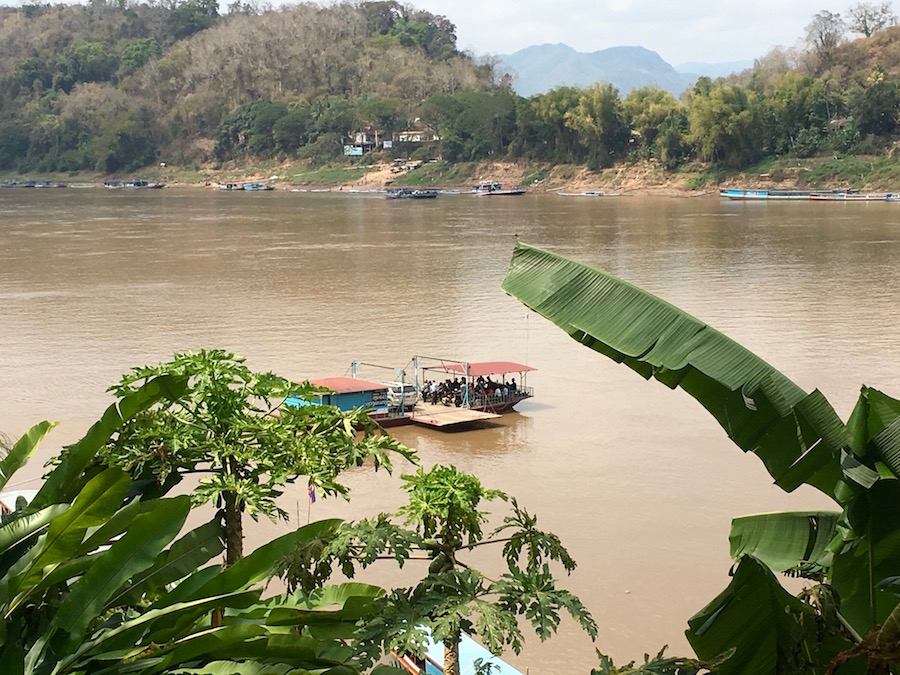
The Mekong River at Luang Prabang

The bulk of the town of Luang Prabang, which reminds me a little of a traditional French hill/riverside village, is sandwiched between the mighty Mekong River and the looping tributary, Nam Khan River. It means that everything is very close and easily accessible. Many of the buildings are built to the French villa design with lots of timber, balconies and pantile roofs. There was an air of affluence about the place and that was displayed best by the vehicles that people drove. There were no old cars, or even small cars. Everybody seemed to be driving new large pick-ups and people carriers.

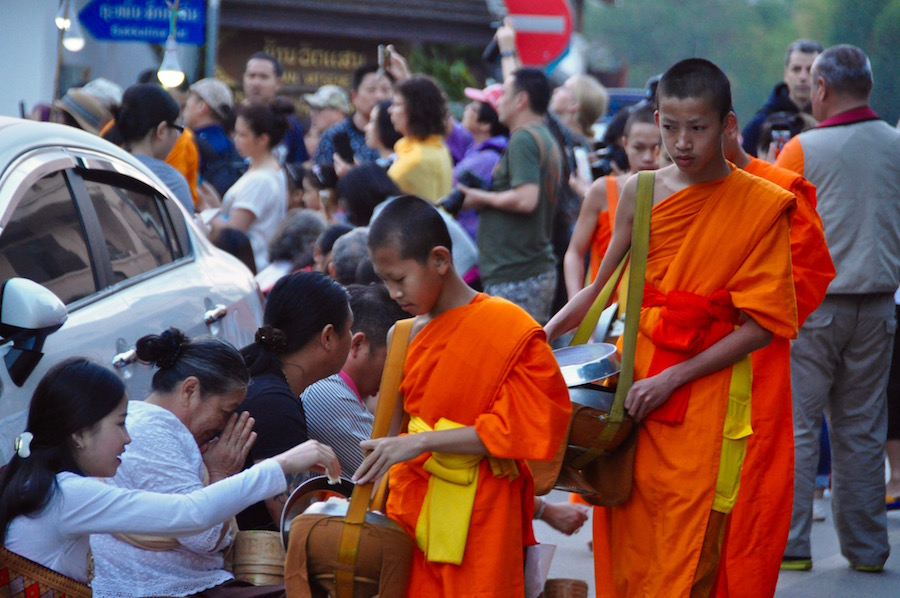
The following morning, I got up early when I heard the monastery bell ringing a couple of houses down from our hotel. At 6.00am the monks walk in a silent line receiving alms from the local people. They in turn distribute some of the food given to them to children kneeling down on mats along the route. They all have cardboard boxes or plastic bags to receive the gifts. Roads are closed off for the spectacle and tourists have to abide by certain rules. They must not get too close, they must be quiet during the procession and must wear appropriate clothes so that their knees and shoulders are covered. While some kept a respectable distance from the monks, there were some who took liberties with the gentle nature of the monks, pointing cameras in their faces, walking alongside them as if they were trying to get a reaction from them, and at the same time spoiling it for those keeping a respectable distance for their photographs.

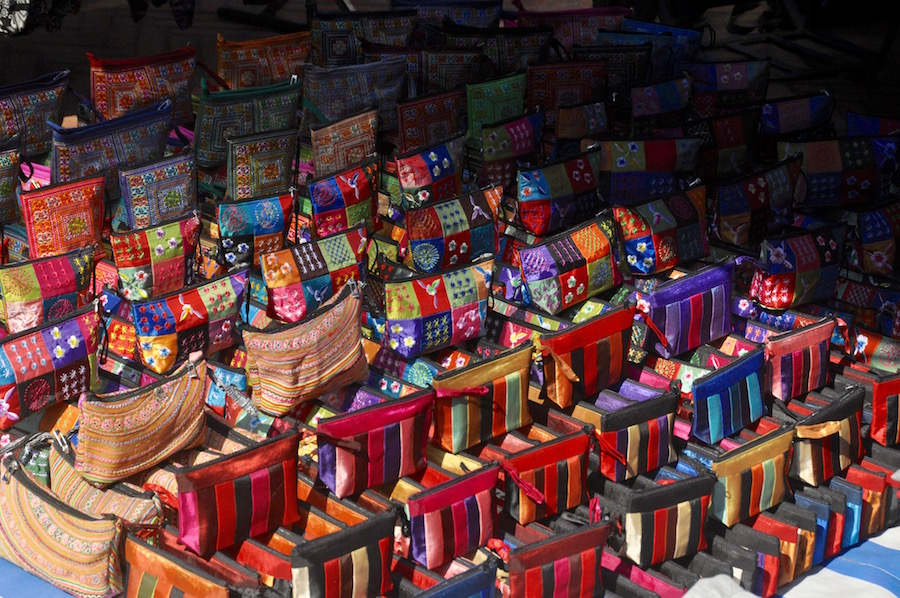
Breakfast was taken in the garden, after which Phai came to collect us for our day’s activities. The two minibuses transported us round the corner to visit the National Museum, housed in the former royal palace. It would have been quicker to walk, and a lot more interesting, as the main street was a colourful market with stalls on either side displaying their goods immaculately. I would have appreciated more time to walk among the stalls, enjoying a little bit of banter with the stallholders, rather than always bypassing them, which I felt was a little rude.

As interesting as the museum was, I was more interested in the human stories surrounding the royal family. Inevitably Laos was affected by the chaos of Indochina, was invaded by Vietnam and subjected to constant bombing by the Americans. This created a great deal of instability in the country and the communists gained strength. On Dec. 2nd 1975 King Savang Vatthana was forced to abdicate and he and other members of the royal family were arrested and sent to special re-education camps, where most eventually died. Some did manage to escape before they were arrested and ended up living in France. The royal family were not the only ones to suffer in this way. Between 30,000 and 40,000 were sent to these camps. Phai would not say much about this so I could not find out what format the re-education took, but I can assume it was no holiday camp!

After we had finished our tour the minibuses took us round the corner to the Mekong River where a very long boat was waiting for us. Again, it would have been easier to walk the short distance to the river.

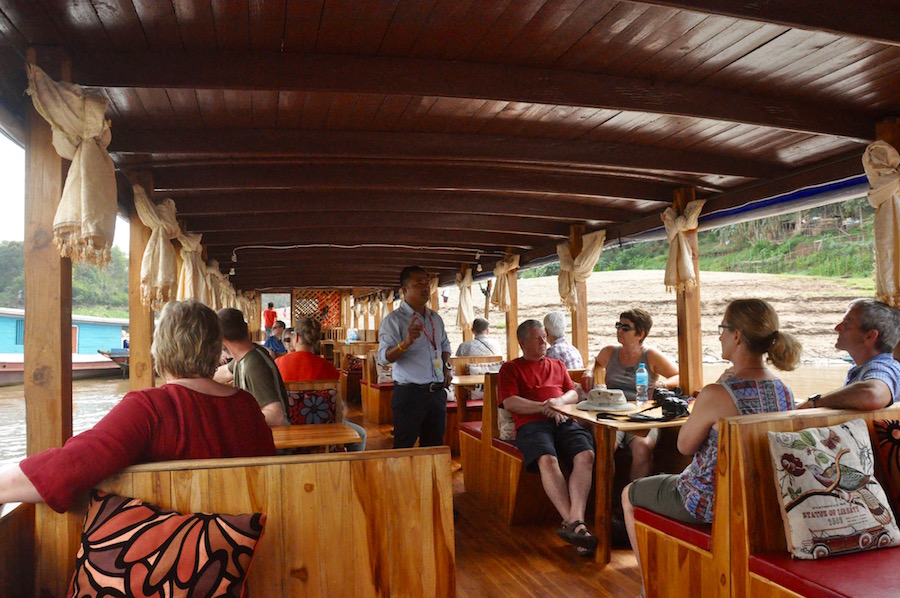
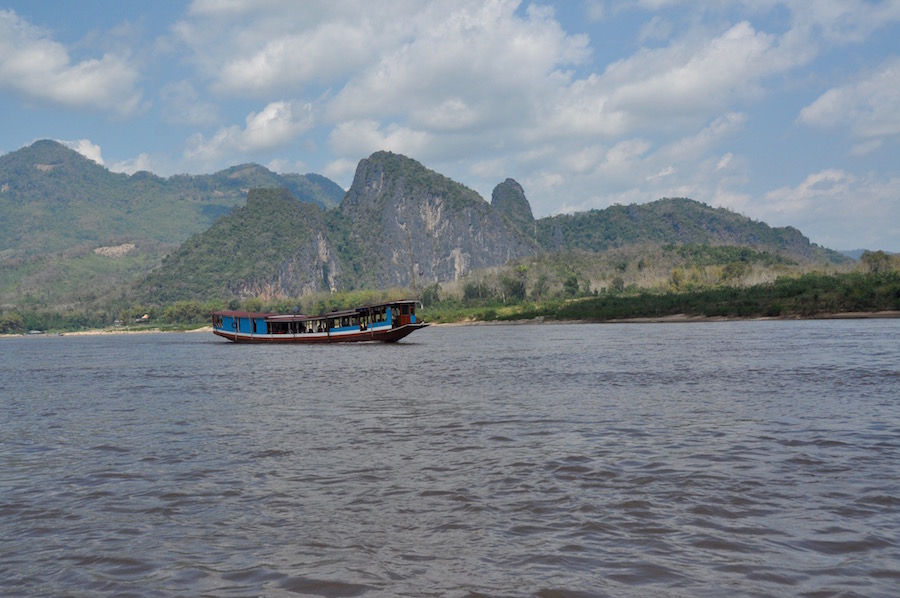
Once aboard we set off on a two-and-a-half-hour cruise up river. It was very spaciously comfortable with tables and chairs, coffee, a fore deck and an aft deck, and a driver who looked to be only a teenager. It was a brilliant way to experience the Mekong, one of those iconic rivers that came up in many a school geography lesson in the 60s. Here I was taking a ride on the Mekong – another pinch me moment.

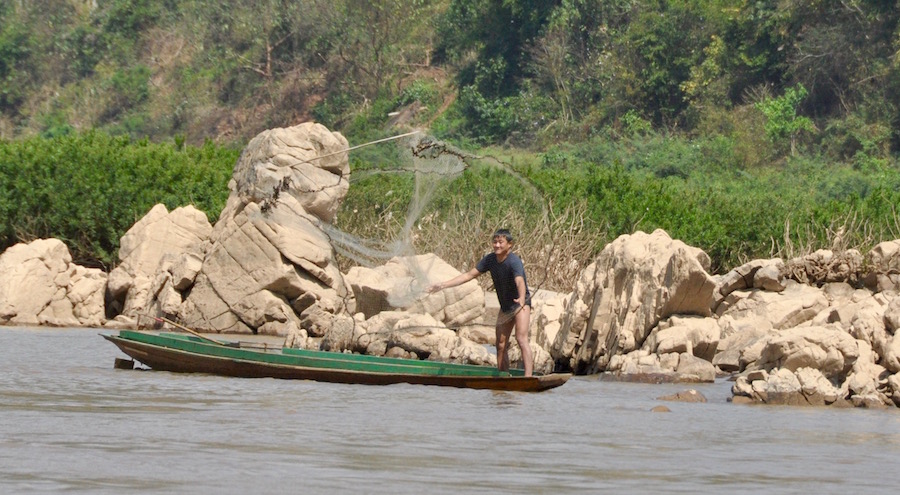
The flow on the river was quite fast but, fortunately, there was plenty of power in our boat’s engine, allowing us to scythe our way up stream. There was not a great deal of traffic on the river but there was plenty to see. On the banks fishermen’s shelters, stilted, thatched, open-sided structures, where they could sort their catch, mend their nets, store their canoes or just chill out when the day’s work is done. These are temporary structures, for during the rainy season the water levels are much higher, and the tiered, sandy beaches are under water. Naked children played in the shallows, cattle came down for a drink. On the river, monks travelled in a canoe near the shore, fishermen plied their way up, down and across looking for somewhere to cast their nets. Others stood, well balanced, in their canoes and deftly cast their nets in the hope of lifting it full of fish.

All the time a stunning landscape rose up from the river, of shapely mountains that just begged to be explored. Most were forested, but as we ventured further upstream they became more dramatic with large rocky outcrops more reminiscent of the karst scenery we had seen in Vietnam. The guide book suggests that the outline of the ridge looks like a vast green eagle taking off. I didn’t see it at the time and, having studied my photographs of the ridge, I still don’t see it. I was really enjoying this trip.

As we approached our destination Phai asked if we wanted to visit the Pak Ou Caves first or have lunch and then go to the caves. It seemed sensible to go to the caves first.

Disembarking, we climbed a few steep steps up to a platform ledge, which was more like an overhang than a cave. Near the top of the steps, about forty feet above the level of the river was a mark on the rock above our head that showed the level the water reached in 2008.

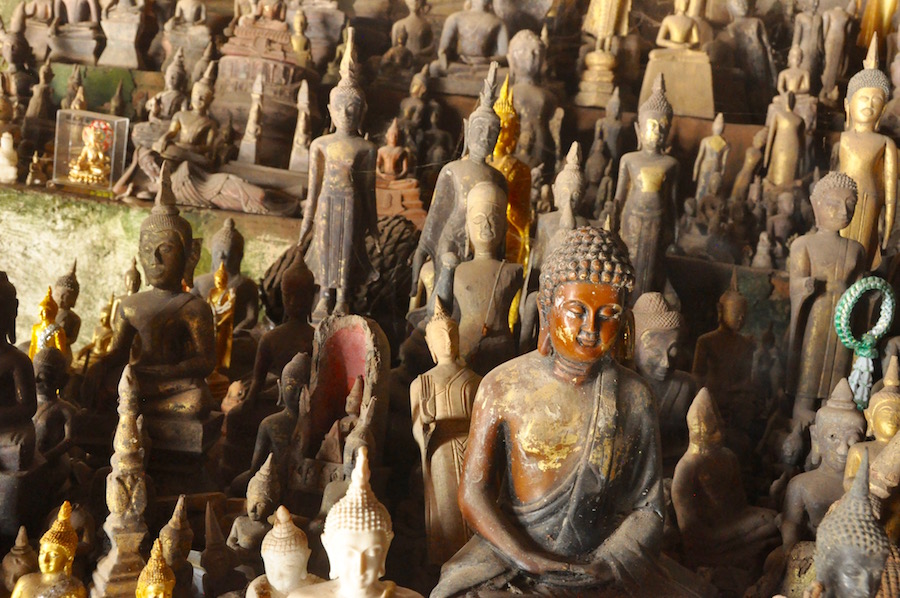
The Pak Ou Caves are home to hundreds of Buddhas of every shape and size. They sit, perched, on any ledge that will house them. Some were quite roughly crafted while others were elaborate and ornate. Venturing up another set of stone steps, we went to see the higher cave. This cave was quite dark, so I illuminated my way with my phone. It was disappointing as there were not many statues within. I had been to a similar site in Sri Lanka twelve months earlier, which was far more dramatic, with a great many more statues of Buddha.

Looking out across the river, a number of elephants roamed around on the opposite shore, brought down by their mahouts and some tourists for a bath in the river.

We climbed aboard our boat, which took us across to the other side, upstream of the elephants to a riverside restaurant perched high, overlooking the Mekong and also the tributary, Ou River, that cuts deep into the limestone cliff it skirts by. It was a stunning location for lunch and we felt very privileged to be there.

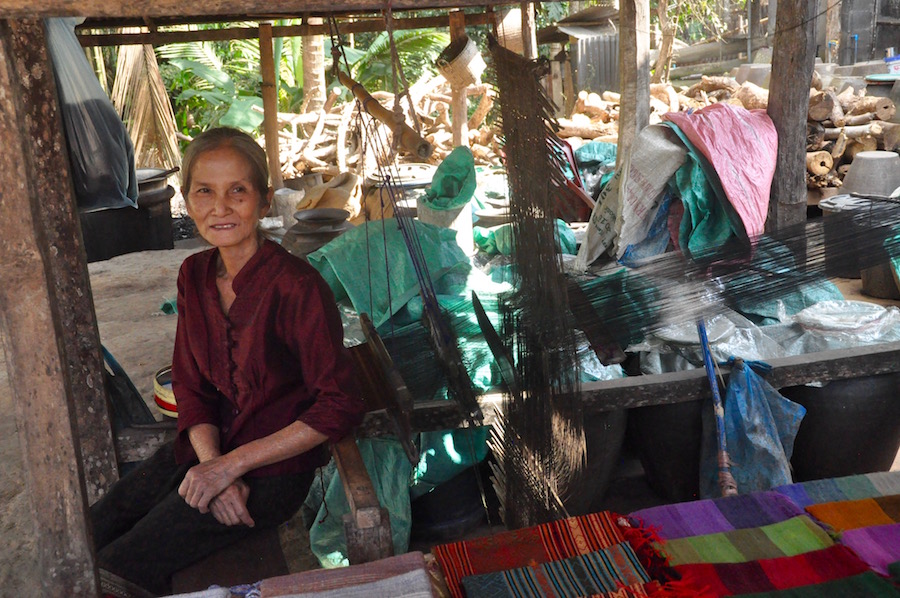
After lunch we took a diagonal route back across the river to the village of Ban Xang Hay. I guess this is a model village set up to serve tourists. It is clean and tidy, and every house has a loom producing brightly coloured cloths and scarves. One or two houses have stills producing some very strong Lao whisky made with rice. We tried some and as I did not go blind I parted with a couple of dollars and bought a small bottle to take home. It may be a false village, but it had a very nice atmosphere. The people were very welcoming, friendly without being at all pushy to sell their produce.

Having satisfied our urge to spend some money, to have some banter with the local people, although their English was quite limited, we returned to our boat and sped our way downstream back to Luang Prabang. It was a really enjoyable outing.

Once back I trawled the streets to find a restaurant for that night and also for our last night before we returned home. After some difficulty, I found one that could cater for us, Tamarind, and I found quite a special one for our last night party.

The next morning, I rose early again to watch the monks process through the streets. The same children were out with their cardboard boxes. If anything, the behaviour of some onlookers was even worse. It is only a matter of time before somebody says, “enough is enough.”

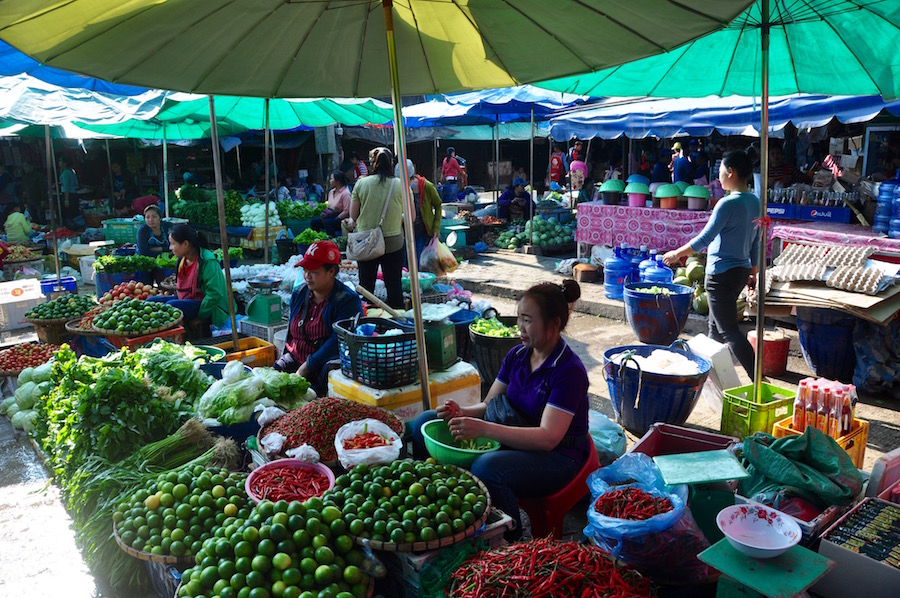
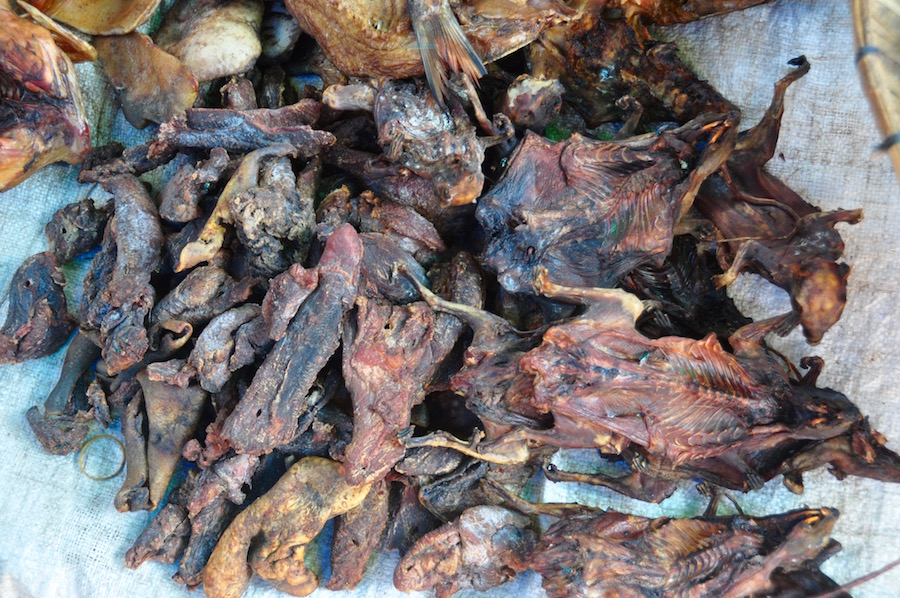
Our minibuses, later that morning, collected us and first took us to Talad Phosy market. Here, there were stalls of fresh produce, homeware, fish and meat. It is the place that all locals go to for their shopping. There was an abundance of vegetables, many of which were unfamiliar to me, brought in from outlying villages. They were beautifully displayed, and the women sat amongst them and chatted constantly with their neighbours while waiting for a customer. Other stalls had large bowls of rice piled like cones of varying shades of off-white, depending on the varieties of rice for sale. Perhaps, the most interesting, but totally un appetising, were the dried rats and squirrels that clearly have an appeal for the locals. There’s no meat on them, so what their value is, I fail to understand.

Squirrels!

The fish and meat stalls were far less attractive to look at but were, nonetheless, interesting to view, if you had the stomach for it. Great galvanised bowls were crammed with live fish, which, one by one, were taken out, hit on the head and gutted. Water flowed everywhere. The meat was no better, with huge carcases being cut up into smaller cuts of meat. I like meat but I’m not sure that I want its processing on public view. What we were seeing were things that take place behind the scenes back home.

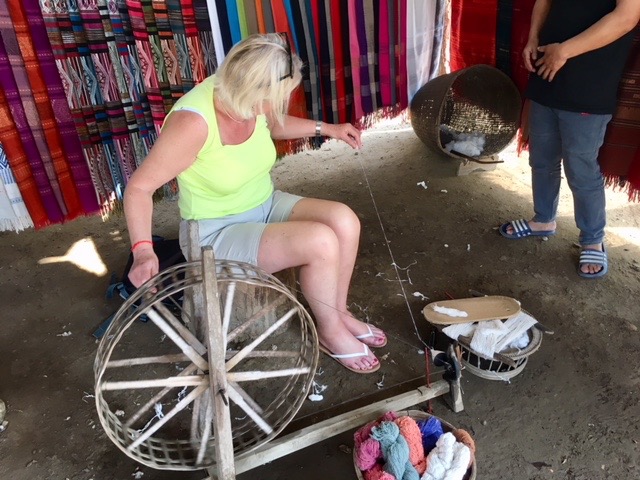
Ann having a go

Next on our journey, we visited a roadside cotton weaver. There we saw the cotton seeds gently crushed to produce a little ball of cotton. This was then processed on a very basic, homemade bit of kit into a thread for weaving. The visit was the prelude to crossing the road to walk around a narrow path through the village. All the way around were stalls and at each stall there were children dressed in brightly coloured local ethnic costume trying to sell us their produce. It was horrible, so unlike the village we visited by the river yesterday. These children were being exploited by their parents and every stall we passed a child would say, “Two for a dollar.” None of us stopped to look or showed any interest in what they were selling and I, for one, kept my camera away.

Towards the end of the village we came across music and chanting. Curious, I peered in through the open door to see a shaman in black robes standing on a plank of wood, bouncing ritualistically in front of a makeshift altar while he performed an exorcism. He seemed to be in a trance and had to be supported to stop him from falling over. It made me feel slightly uncomfortable that I was watching but, at the same time, curious.

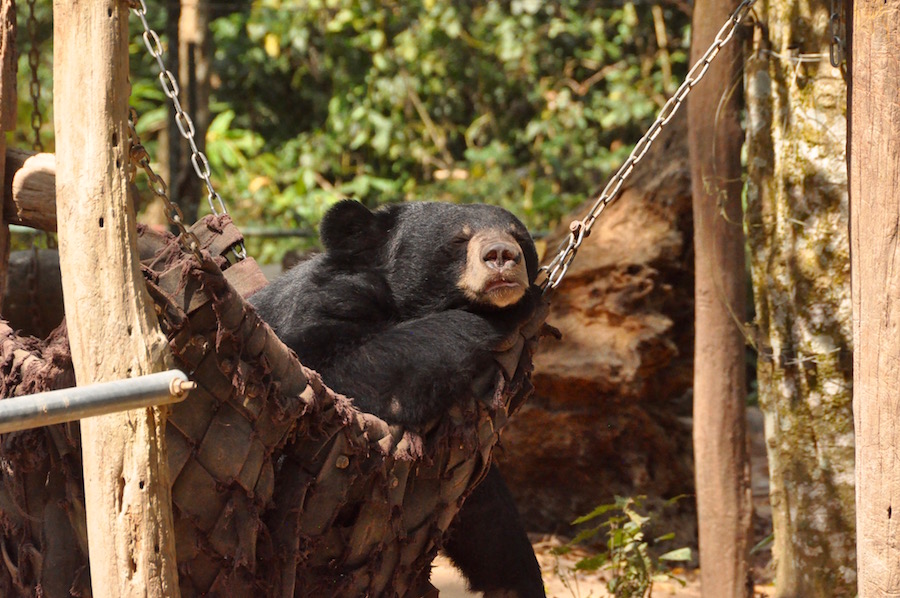
How relaxed are you?

Our main destination of the day were the Tat Kuang Si Waterfalls, a series of falls with attractive pools below each one. Before we reached the falls, we walked through the Tat Kuang Si Bear Reserve, a sanctuary for bears rescued from poachers. There were about eight on show in their large enclosure and they all looked well cared for. It was fascinating watching them from such a close position and the see how they interacted with each other.

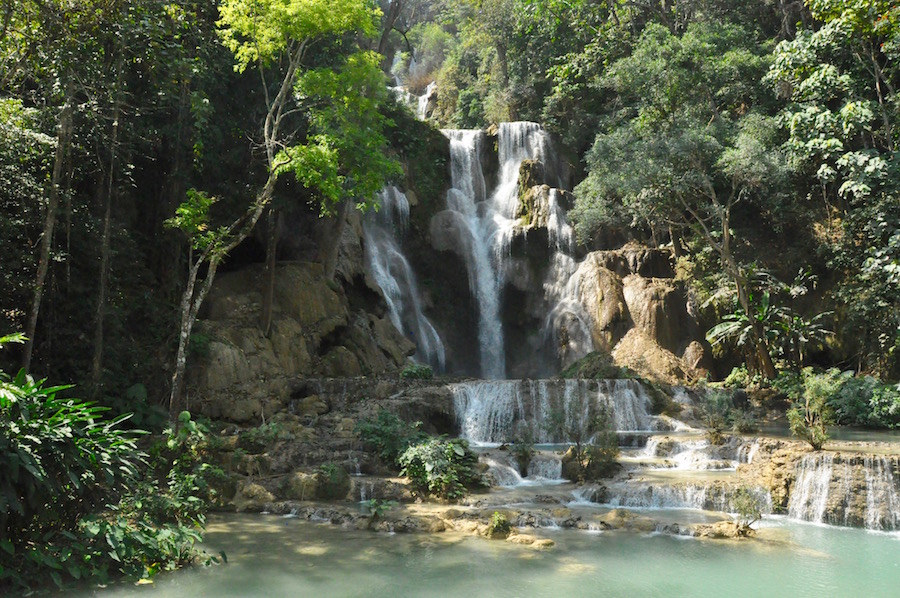
Continuing, we came to the first fall with its azure, blue pool surrounded by mature trees. Each fall we came to led to another pool above and another fall. There must have been about a dozen small waterfalls culminating in an impressive 25m fall at the top. The pools looked very attractive and there were several brave souls who were not put off by the cold water. Although I had my kit with me, I decided quite early on that I wasn’t going to venture into the water. I was put off by the crowds. This is clearly a very popular spot. It must be, for once you have been on the Mekong and visited a few temples, there is not a lot else in Luang Prabang, so everybody comes to the falls.

A picnic lunch was brought to us but it was not the best meal we had on this trip.

On the way back to Luang Prabang, we called in to an elephant sanctuary. Again, I have reservations about the welfare of the elephants, the length of time they spend chained to a post. I don’t like to see them repetitively swaying as it can be a sign that they are unhappy. There was a very friendly baby elephant but I’m sure it was more interested in the food people could give it rather than the person themselves.

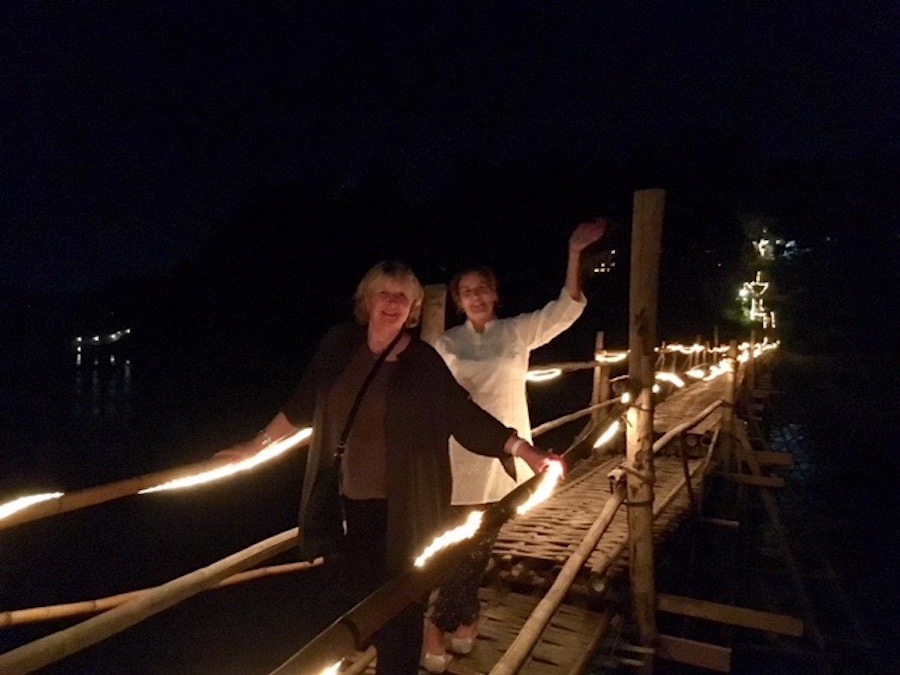
Ellie & Angela on the bamboo bridge

That evening we went out to Dyen Sabai, a restaurant overlooking the Nam Khan River, on the opposite side to the main town. In order to get there, we had to pay 5000 Riel each to cross a bamboo bridge over the river. A little tube of lights illuminates the bridge at night. The charge is made to give them the resources to build a new bridge each year flowing the rainy season, during which the turbulent waters of the river carry the bridge away. Seated on a terrace above the river we had a fabulous meal, a fitting last night’s celebration.

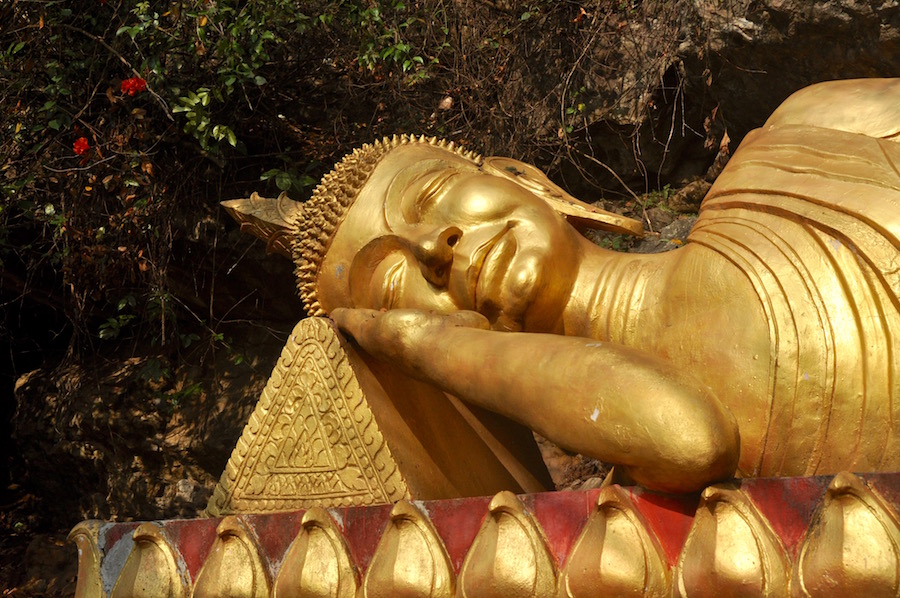
Reclining Buddha

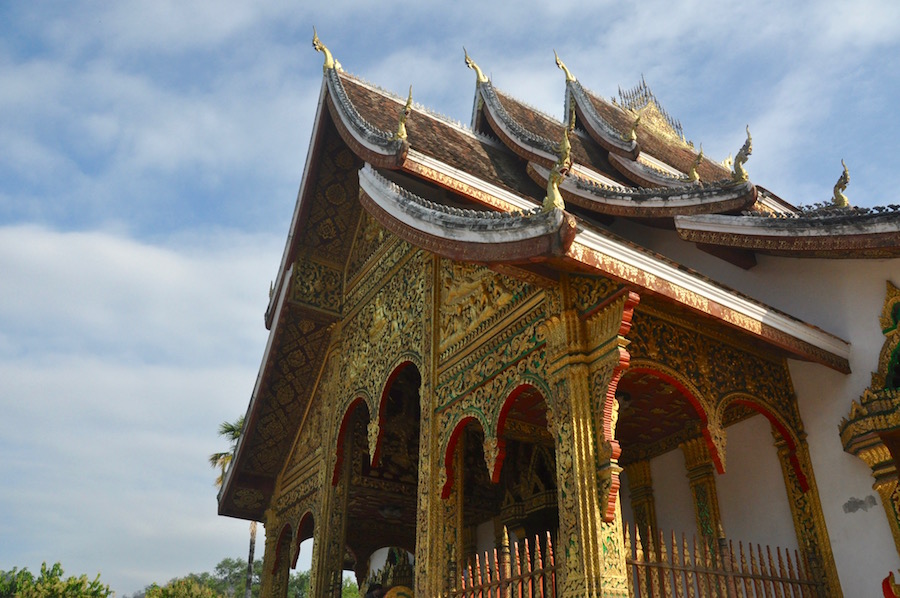
Our last day was upon us. Phai met us after breakfast. The minibuses took us round the corner so that we could climb Phousi Hill, offering an excellent vantage point overlooking the town. Climbing the 329 steps to the top, we then had to wait for the Chinese to finish taking their multiple posed pictures before we could get a look in. At the top is the stupa of That Chomsi. There is also the remnant of an anti-aircraft gun, left over from the war. Descending by a different route, we then visited the temples of Wat Visoun, Wat Aham and Wat Xiengthong. While these were very attractive our minds were already beginning to focus on the journey ahead and I, for one, don’t think I got the most out of the visits. Phai was not that animated in his delivery of information, which did not help to maintain interest.

After returning to the hotel for a final clean up, we went to lunch in a lovely terraced restaurant overlooking the Mekong, prior to going to the airport for our flight to Hanoi and onward connection to the UK.

Laos is a lovely country and I can contemplate returning with a view to doing some trekking in the very attractive mountains, perhaps combining it with a trek in North Vietnam. I will have to look into it. We had crammed in a great deal in our three weeks but had really only scratched the surface of all three countries. There is a lot more to see and do, I am sure.

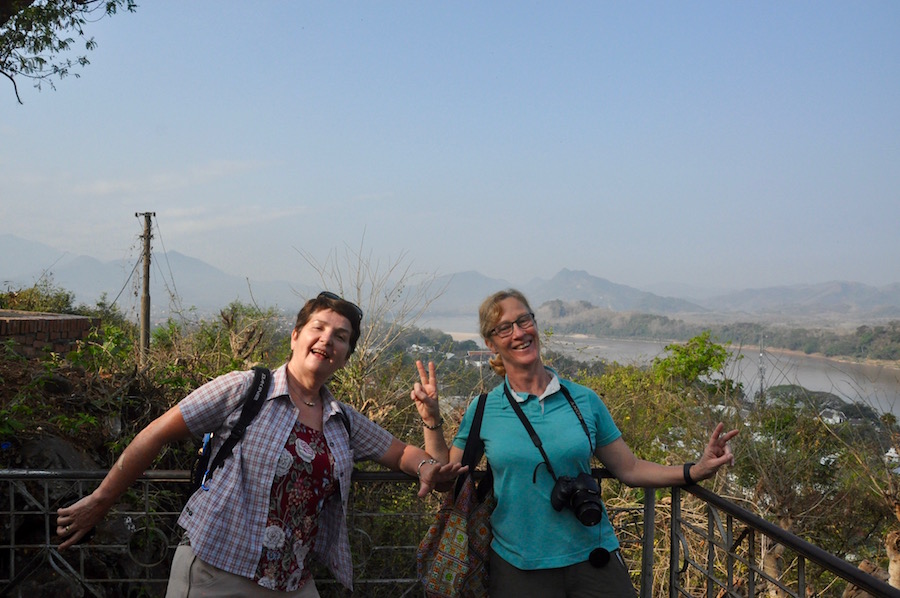
Mags and Sandie having learnt how to pose from the experts!

We had been well looked after throughout by our guides and I was also very impressed with the way everything ran smoothly. We had had few, if any issues. The group behaved itself! Only Pauline gave us a bit of a scare when she slipped off the path during the trek. Mike banged his head and also broke his camera when he stumbled in the cave at Halong Bay. How he kept his calm in such circumstances is remarkable. I know I would not have been happy if I had broken my camera. I cannot speak highly enough about the organisation of Asia Aventura and would recommend them to anybody planning to visit Indochina. If I do go back one day, I will definitely be getting in touch with them.

Thank you to all those who made this trip so successful and thank you to the twenty-two friends who came on it, for their excellent company and good cheer. Memories to treasure!

Cambodia, Siem Reap and Angkor Wat

The journey from Vietnam to Cambodia passed without any hitches. Acquiring our entry visas was much more straight forward than it had been entering Vietnam. We came out of the airport to be met by Sophey, our Siem Reap guide. The drive from the airport towards the town revealed a much drier landscape to those we had seen in Vietnam. The fields were covered largely with a post-harvest stubble. On the way to our hotel we stopped off by a large hotel complex to pick up our entrance pass for the many historical sites we were to visit. Sophey recommended we do this now rather than in the morning when the queues can be very long and slow. He was right, we sailed through.

We were staying in the Central Boutique Hotel in the heart of Siem Reap, a town that has grown around the world’s desire to see Angkor Wat. The town was established by the French in the early part of the 20thC, but fell into decline during the 1960s when Cambodia became unwillingly embroiled in the Vietnam War, before experiencing its own civil war, more years of persecution at the hands of Pol Pot and then years of political instability as it tried to rescue and rebuild itself. It wasn’t really until the new millennium that tourism began to return and Siem Reap was able to grow and develop for an increasingly buoyant tourist trade.

We knew we had arrived in a warm country for the reception, bar and restaurant area of the hotel was open at the sides to the elements. Pools of carp separated one area from another. Everything centred on to well-tended gardens with flowering shrubs that attracted butterflies. Two pools were hidden in the gardens. It was hot!

Later that afternoon Sophey collected us to take us to a massage centre where we were to be treated to a massage of our choice – full body, head, neck and shoulders or lower leg and foot. Couples were ushered into rooms together while in others men were grouped together and women were similarly grouped. Wearing loose fitting pyjamas I was pummelled, pulled and twisted for an hour. It was the most incredible massage and I felt so good afterwards. It seems everybody benefited from the experience.

Following the massage, we went off to a family house for dinner. There we met the whole family who cooked and served us a delightful meal while sitting on cushions around a low table.

I slept really well that night and I can only attribute that to the effects of the massage. Perhaps, I might have to have another before I leave Cambodia.

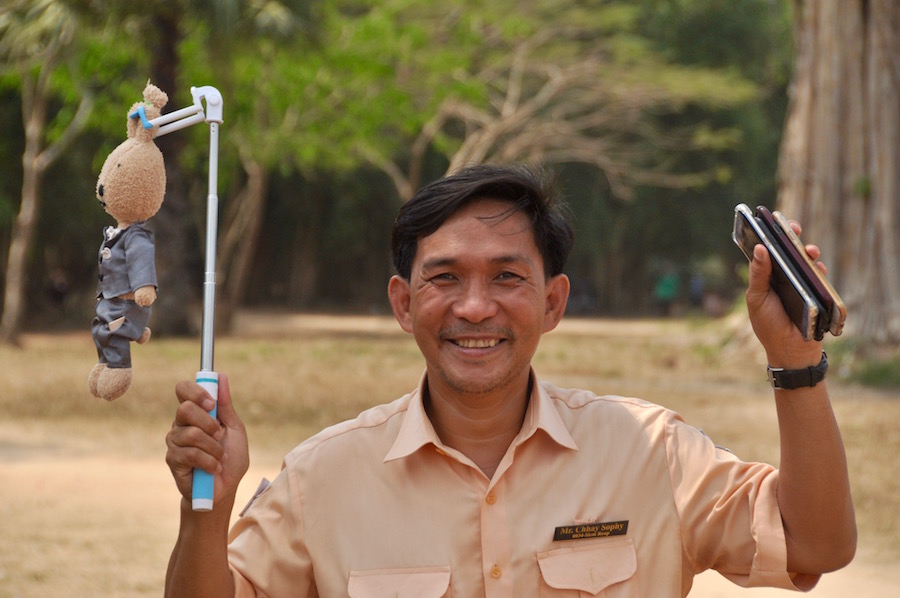
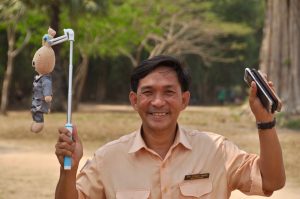
The next morning Sophey came to meet us at the hotel for our day of temple bagging. He carried with him a selfie stick with a rabbit dangling from it. “Follow the rabbit.” Initially, we were due to go to Angkor Wat first, but he assured us that it would be very busy, particularly with lots of Chinese groups who would spoil it for us. He advised us that if we left it until after 11.30am it would be much quieter as the Chinese all go off for lunch from then until about 2.00pm. We bowed to his superior knowledge and his suggestion to visit Banteay Samre Temple first.

The history of these many temples is quite complex and difficult to take in when you are there. You are more consumed by the sheer beauty of them that the stories surrounding them get forgotten. They all stem from about 800AD when a huge building project came about. They were not only temples but also homes to many people that came under their jurisdiction. Angkor Wat, was for example, the world’s first mega city, probably having a population in excess of one million, although that has not yet been ascertained to be true. Initially, they were built as Hindu temples, but the emphasis of religion changed with peoples’ desires and they went through a phase of being Buddhist, returning to Hinduism and in the 14thC returning again to Buddhism.
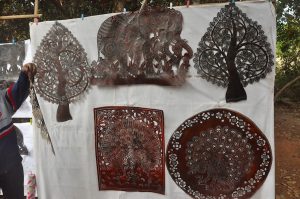
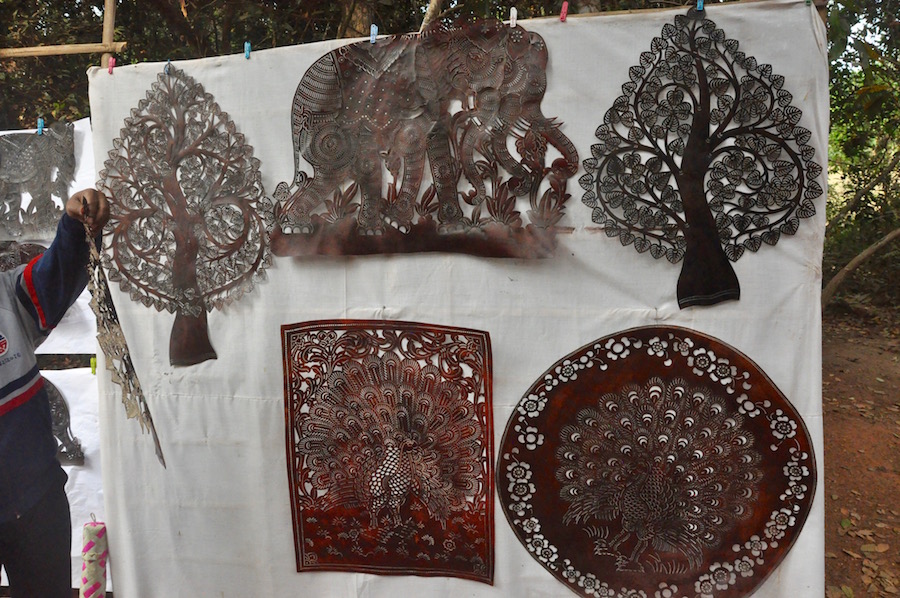
We approached Banteay Samre via a wide track with trees on either side. There were the occasional stalls selling beautiful leather cut-out pictures of trees and elephants. I would have liked to give them more attention, but I felt confident that we would see more examples at a more appropriate time to buy. Likewise, with some beautiful paintings also for sale. Also, on this walk to the temple we came across a small musical group sitting on a dais playing lovely music. They were all victims of conflict and had one form of disability or another. Their disability did not stop them making beautiful music.
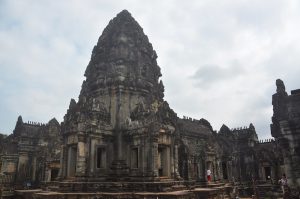
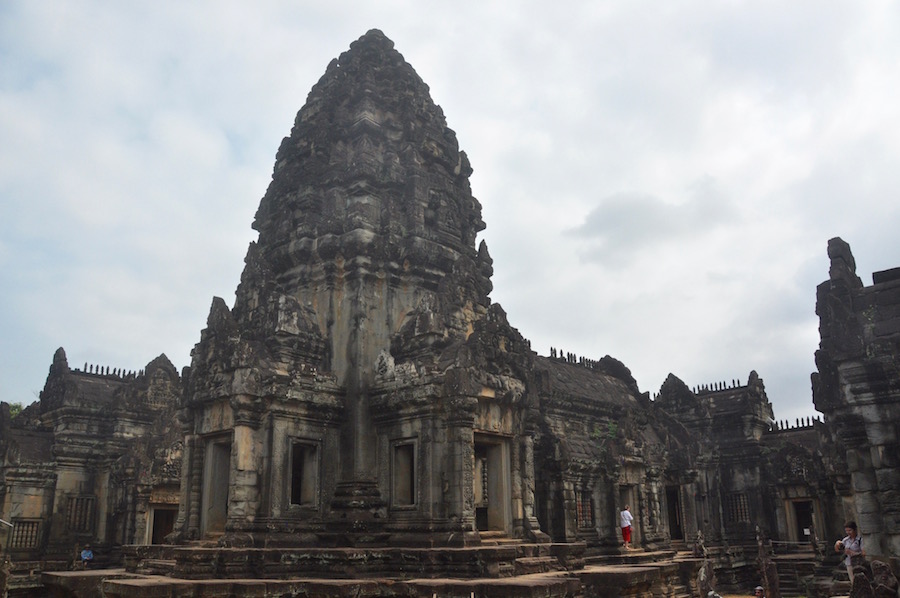
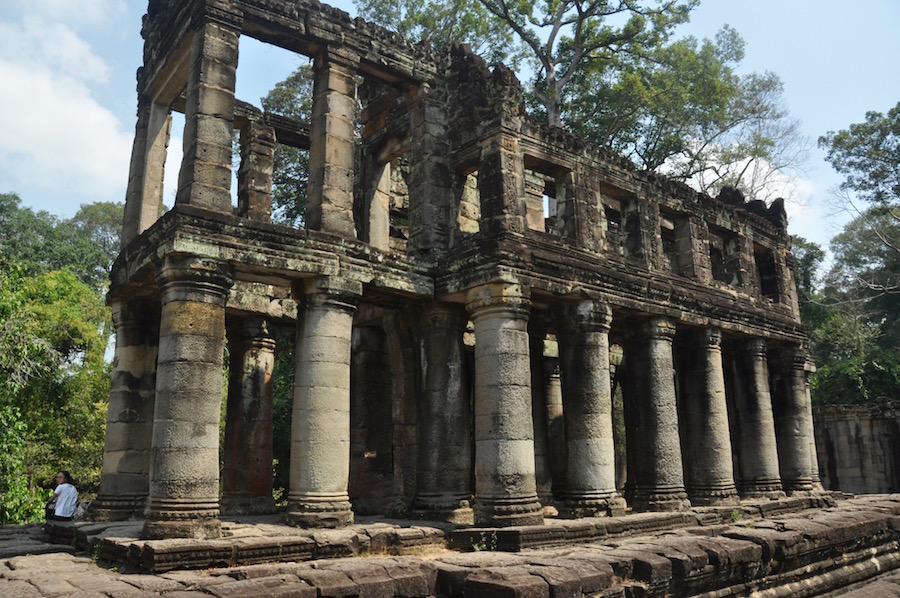
The temple is named after the Samre, an ancient ethnic tribe closely related to the Khmers. Banteay is the Khmer word for citadel. On reaching the temple we discovered that it is not one of the larger ones, but a tightly compact temple with a single tower in the middle. Around the tower is an inner wall with doorways on each side. Then a grassed area, which was probably a moat, before an outer wall with matching doorways. The grey stonework is intricately carved and fearsome beasts stand on guard protecting it from unwanted visitors, or they would if they had not, largely, been decapitated, or had their faces removed by looters. I was particularly fascinated by the carved, circular pillars that covered the windows. They were very intricate and were so well done that it was hard to believe they had not been shaped by machine. We were lucky as we virtually had the whole place to ourselves; there were very few other visitors.
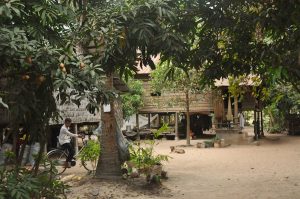
The area behind the stalls was clean and tidy

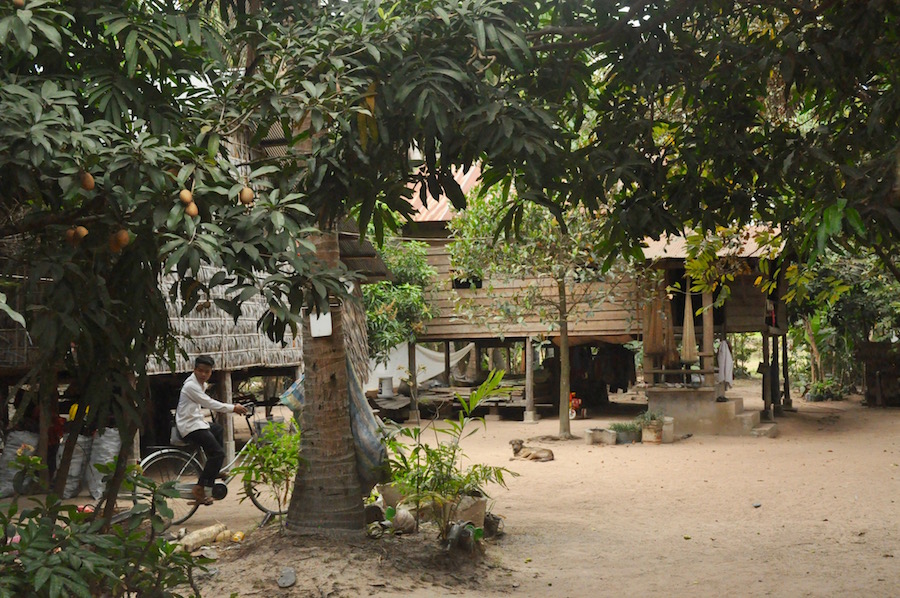
Leaving Banteay Samre, we headed off to our next temple, but before doing so we stopped at a small roadside market place to watch the women there turning sugar cane into a sweet, gooey toffee by heating it in a wok over a wood fire. When it was ready they would pour the liquid sugar into moulds made out of thin strips of bamboo so that it would set in sweet sized pieces. Sophey talked us through the process. We had a little time to explore the stalls that sold a wide range of foodie and craft products. Behind the stalls were tidy wooden houses on stilts with fruit trees in between. The dusty earth had been swept, giving it a cared for look and made it look very attractive.
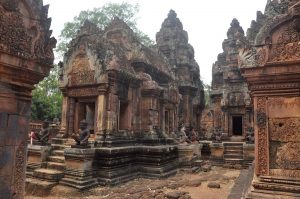
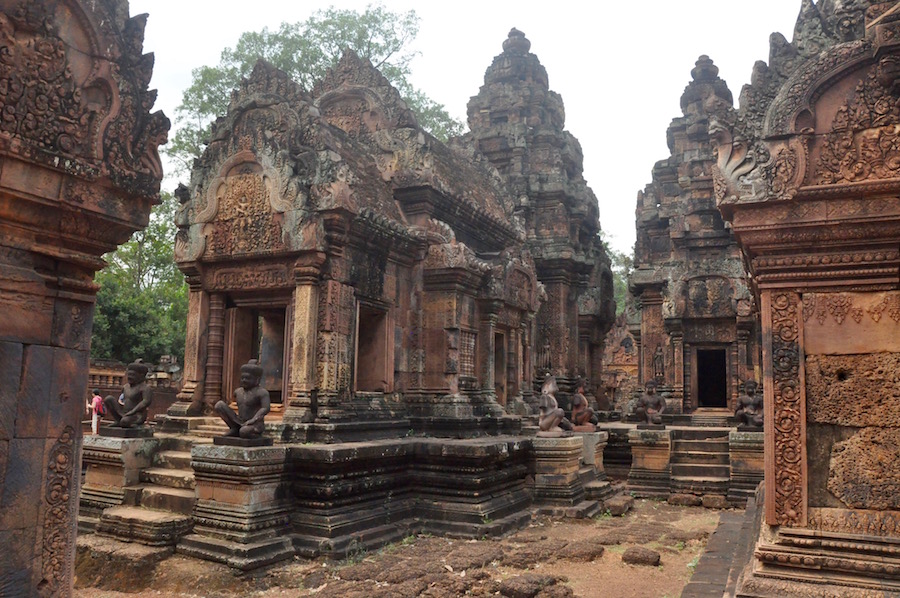
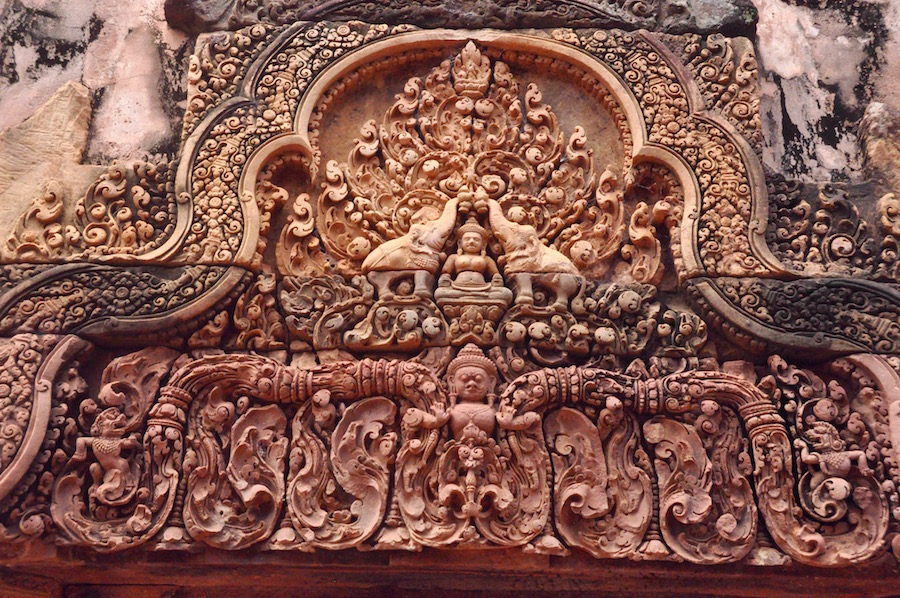
Banteay Srei Temple, which translates to citadel of women or citadel of beauty, is dedicated to the Hindu God, Shiva. It is largely built out of red sandstone, and, as such, lends itself to lots of intricate stone carving. The detail and complexity of the stone carving is phenomenal. It also struck me as having much more detail in its structure, not being limited to just one, single tower in the middle. There were three, although they were not as large as the single tower at Banteay Samre.  In fact, everything about this temple seemed to be on a slightly smaller scale, and that might have something to do with the fact that it celebrated women.
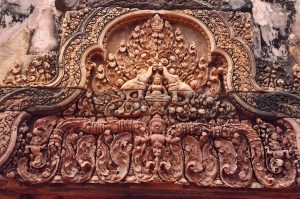
Most of the carvings were still very intact, including the guards around the central part of the temple. I found this temple more attractive and interesting.

We had spent longer at these two temples than, perhaps, Sophey had intended, so he made a suggested change to the day’s plans. If we were to have lunch and then go to Angkor Wat we would encounter the afternoon crowds. His alternative suggestion was that we went out to Tonle Sap Lake on a boat trip to visit the floating village. That is what we chose to do.
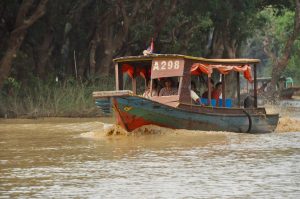
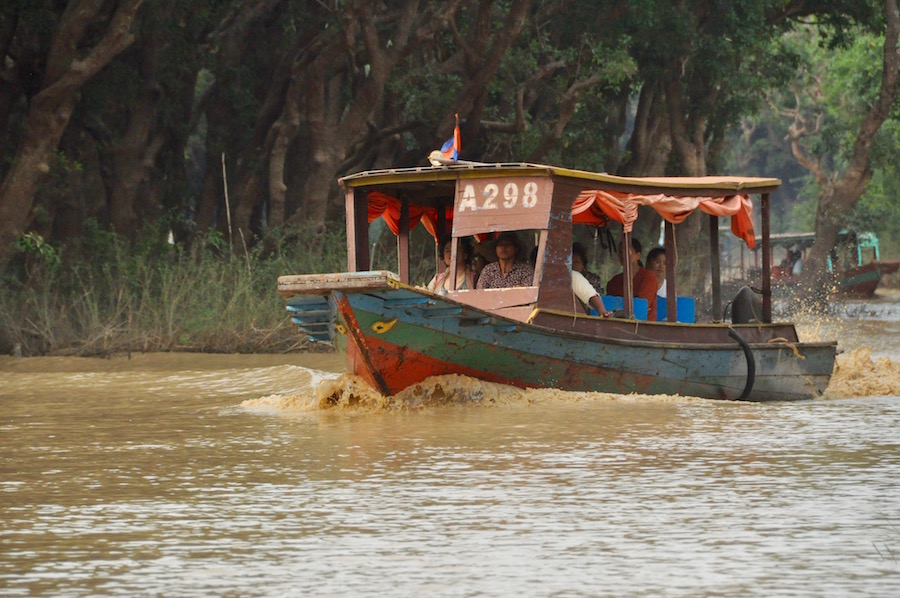
Driving out to a narrow finger of the lake we came across hundreds of boats beached at the water’s edge. The water level was lower than normal, and all the boats were too far out of the water to be any use. We continued to drive further along the finger of water until we came to some boats that that had sufficient water to get going, although it proved to be less than straight forward. The lake at this point is incredibly muddy and the propeller, on the end of a long rod, churned up lots of brown water.
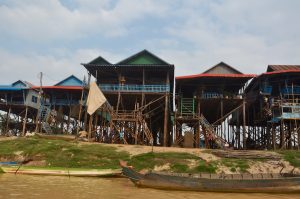
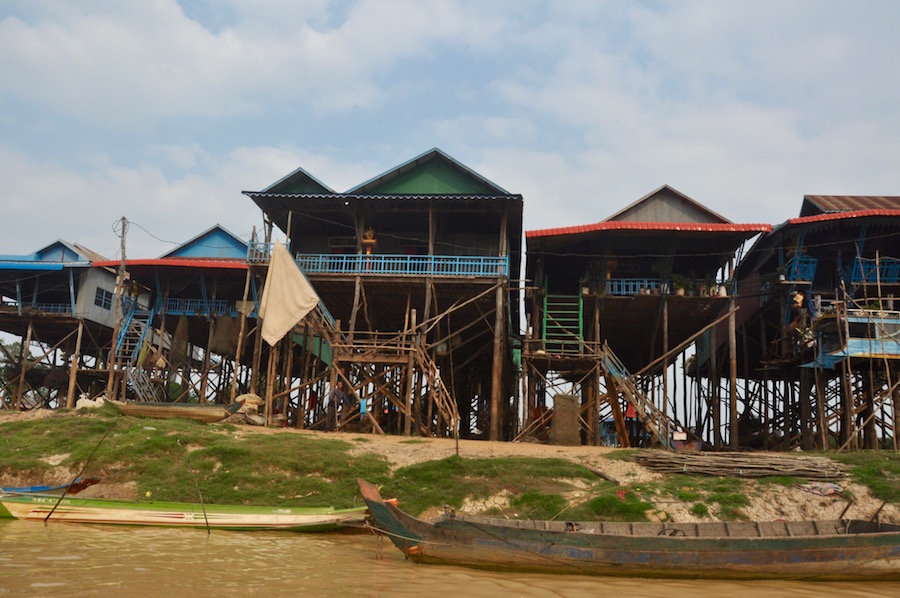
Once we were under way the channel of water weaved its way through a stilted village. The houses were at least 15 feet above ground level. During the rainy season the water comes a long way up the wooden stilts. There was a confusion of wooden stilts and posts. All along the bank were fishing boats with men mending their nets or fixing their boats before their next excursion on to the lake. It was quite a large village and it went on for some considerable distance.

Eventually, the finger of water opened out and we were on a vast expanse of water. The opposite shore was a long way beyond the horizon. Dotted about on the lake were floating houses anchored to the lake bed. Boats bobbed about around them. Elsewhere fishing boats went about their business.
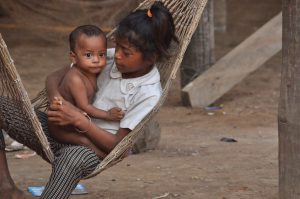
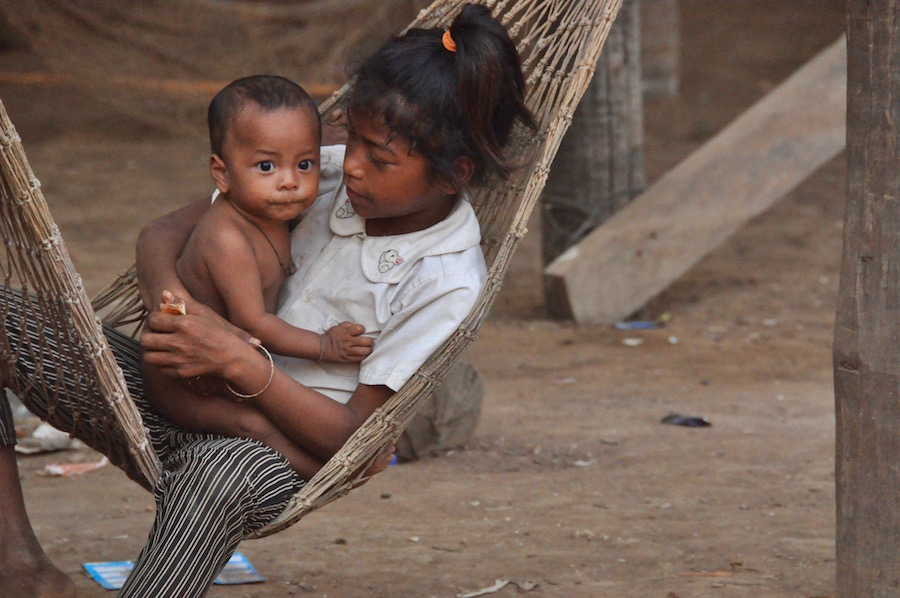
It was not long before we turned around and headed back but instead of going back to where we started the boat dropped us off on the lake side of the village so that we could walk through and see life from the street. And all life is on the street, or, if not on the street, then hanging from balconies or under the houses. Women and children waved to us as we passed while the men were more reserved. Barbecues cooking skewers of meat and fish sent an aroma around the village. Tiny prawns dried on plastic sheets at the side of the road. Hammocks swung gently as villagers relaxed in the late afternoon sun. Children played cheerfully.
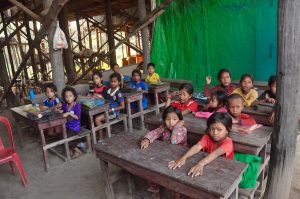
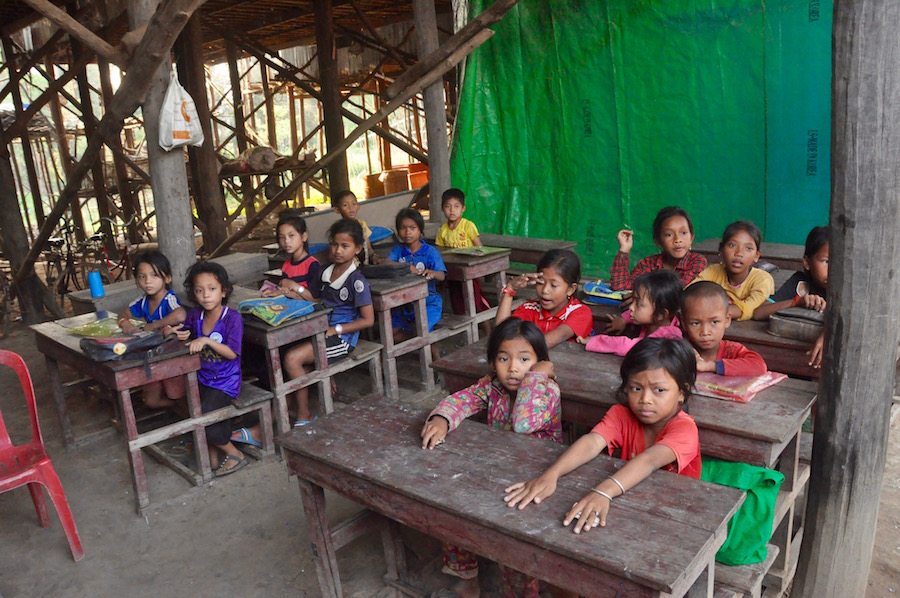
About half way down the village I was accosted to buy a packet of exercise books and pencils. The money would go to support the school, which I discovered was taking place underneath one of the houses. Having bought the books and pencils, I now presented them to the teacher. I wonder how many times they have been bought and presented to the teacher? The class that was taking place was an English lesson and the children were learning their colours through recitation and repetition. I was desperate to get involved. They were learning their colours without any reference to objects of those colours. Unfortunately, they looked a little shocked when I tried to get involved as if they were not used to animated teaching. I learnt that this is an extra school that takes place after the end of the normal school day, a time where children can learn English, to, hopefully, give them a head start in life.

Eventually, aware that the rest of the group were waiting for me at the end of the village, I dragged myself away, but would have loved to have had more time to get involved, to roll my sleeves up, and give the children a lesson they wouldn’t forget.

At the end of the village a new temple stood proudly. We had been told how poor this community was and how their lives depended so heavily on good fishing, boat building and repairs, agriculture, and tourism. They not only live on the edge of the lake but also on the edge of economic survival. How the temple was funded I don’t know, but I expect the fact that there is a community of monks, that the funding came from elsewhere.
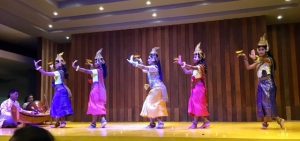
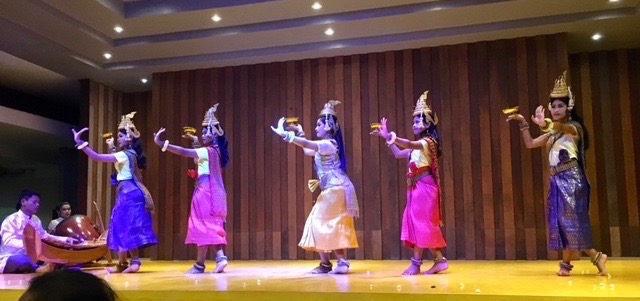
The bus was waiting for us as we left the village and took us back to Siem Reap. After a quick tidy up we were taken to a restaurant theatre for dinner and a cultural show. Both were excellent. It was remarkable how the female dancers could naturally bend their fingers the wrong way. The male dancers were very athletic. It was an enjoyable end to a very full day.

Another hot, sunny morning greeted us for our last full day in Siem Reap. Today was going to be another full day of temples, with potentially the best to come. Sophey greeted us after breakfast and we headed for the bus to take us to Ta Prohm. However, on the way we exchanged our large bus for a much smaller one that could take us to the various sites. Stone gateways straddle the roads around Angkor Wat that are too narrow for large buses. It was a bit of a tight squeeze.
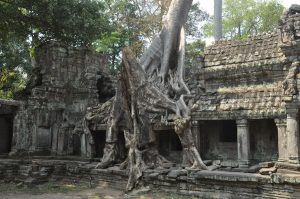
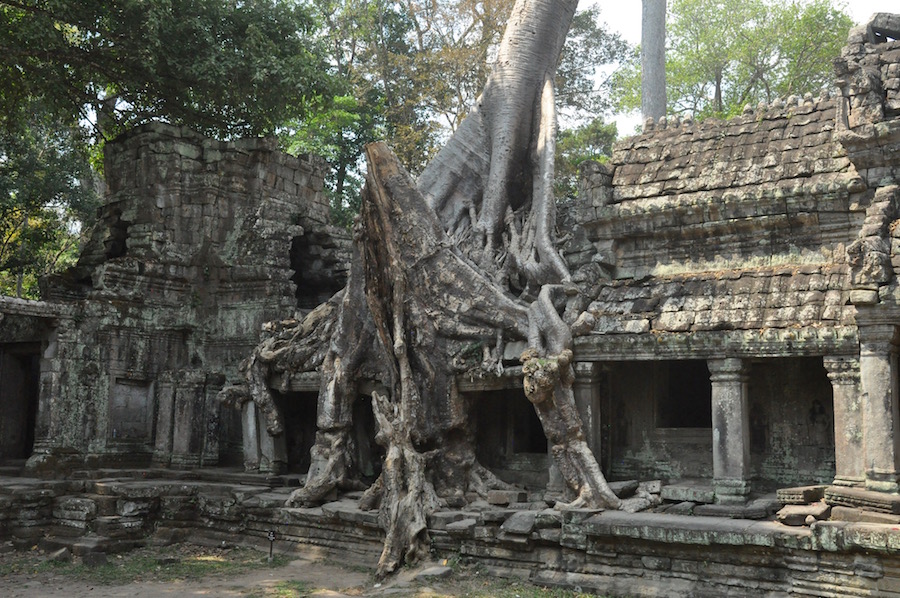
Unlike a lot of the temples, Ta Prohm has been left very much as it was found, with large trees growing out of the ruins, spreading their roots, serpent like, between and around the stones. Some restoration work is going on but the trees are, largely remaining untouched.

This temple, understandably, was busier than those we visited yesterday. Unfortunately, the majority of visitors were Chinese and they made no bones about making their presence felt. They were noisy, pushed their way around, took control of photographic high spots by having numerous selfies and portraits taken. They were just impossible. I watched one woman walk around the whole temple looking at it through the screen of her tablet. Not once did she look up. Perhaps, if she had, she wouldn’t have bumped into so many people, walked in front of people taking photos and been generally anti-social.
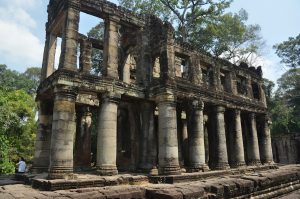
I was absolutely fascinated by this temple and could have stayed there much longer to absorb the atmosphere, to appreciate the artistic shapes that the roots created. It was truly wonderful. These capoc trees help to hold the monument together, while at the same time destroying it. The roots weave their way into cracks and crevices, gradually forcing the stones apart, but, at the same time, acting as the glue that holds them in place. Unfortunately trees do not live forever, and when they die they gradually disintegrate and the walls they supported also crumble.
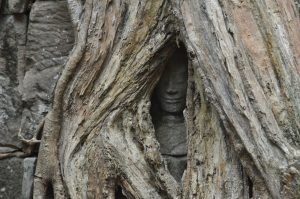
In amongst the mayhem of roots there were some wonderful examples of sculpted stone, displaying an incredible amount of detail that has managed to survive over 1000 years of weather eroding it. There was clearly a very high level of skill among the stone masons of the period. These were not just single stone block carving but multi-block carvings. Behind the carved facade you could see the joints in the blocks behind.

By the time we were ready to leave Ta Prohm, it was time to capitalise on the Chinese going to lunch, giving us an opportunity to view Angkor Wat without too many people. With Angkor Wat, as with all the temples we visited, we approached from one direction and left by another.
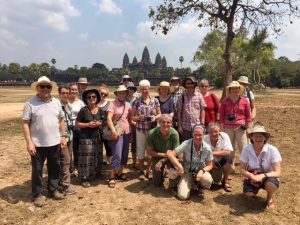
The walk in towards Angkor Wat is quite long, giving us plenty of time to appreciate it as we draw closer. Initially, we had to walk across the narrowest part of the moat on a modern pontoon that led us to the gates of the outer wall. Once through the wall we got a clear view of the temple in all its glory. Sophey was brilliant and kept taking us to 5* photographic points so that we would get the best shots. He was also brilliant in his timing, as this, the largest of all the monuments, was fairly deserted. It meant we could relax and enjoy our visit without having to fight crowds.
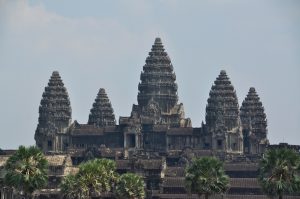
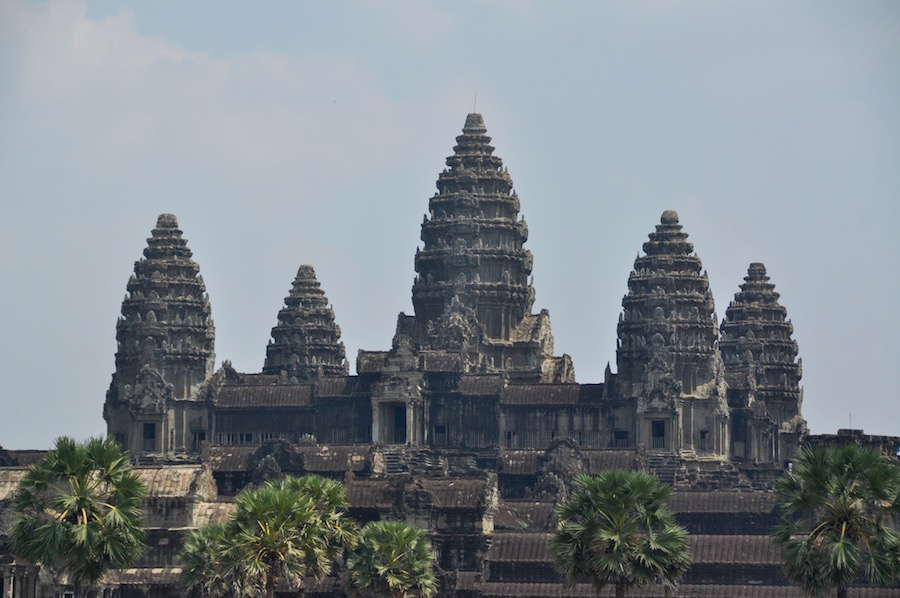
Angkor Wat is the earthly representation of Mt. Meru, the home of the ancient Hindu gods. However, it gradually converted to Buddhism towards the end of the 12thC.  But it is not just a temple, it is a city of symmetry, built on an enormous scale and is believed to be the world’s largest religious building. The whole complex is surrounded by a huge moat 200m wide. The temple holds great significance to the people of Cambodia – it is a national symbol and the source of national pride. It must be for it features on the flag. Unlike other sites in the area, Angkor Wat has remained in constant use and has, therefore, not succumbed to the ravages of time and nature.
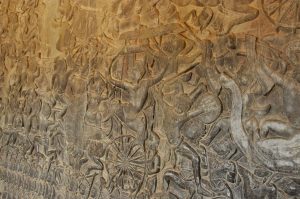
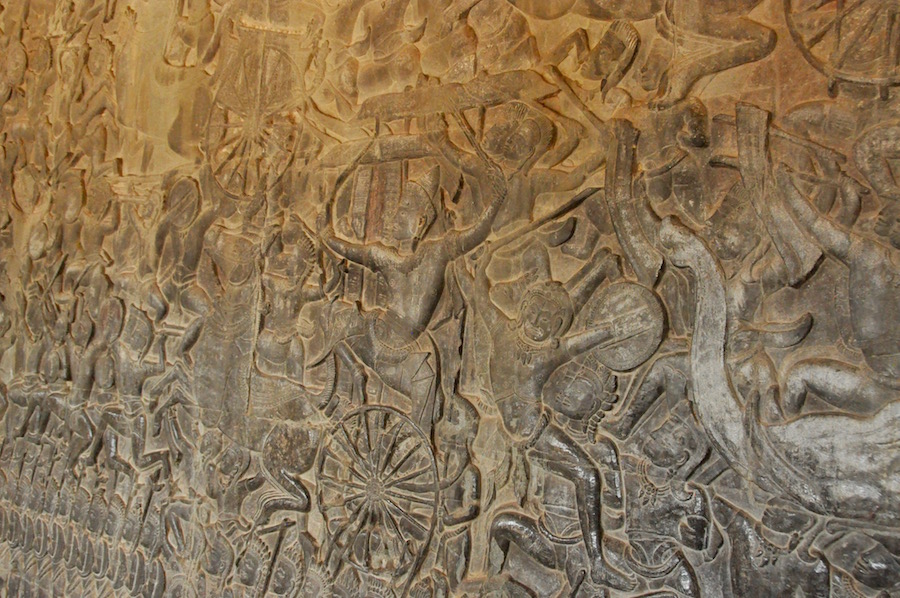
Climbing the steps to the main building, we reached a cloistered corridor or gallery. On the wall were bas-reliefs of ancient stories. These went all the way round the whole structure, each side being 187 metres long. They make the Bayeux Tapestry look like a bit of stitching, they are so complex and detailed.

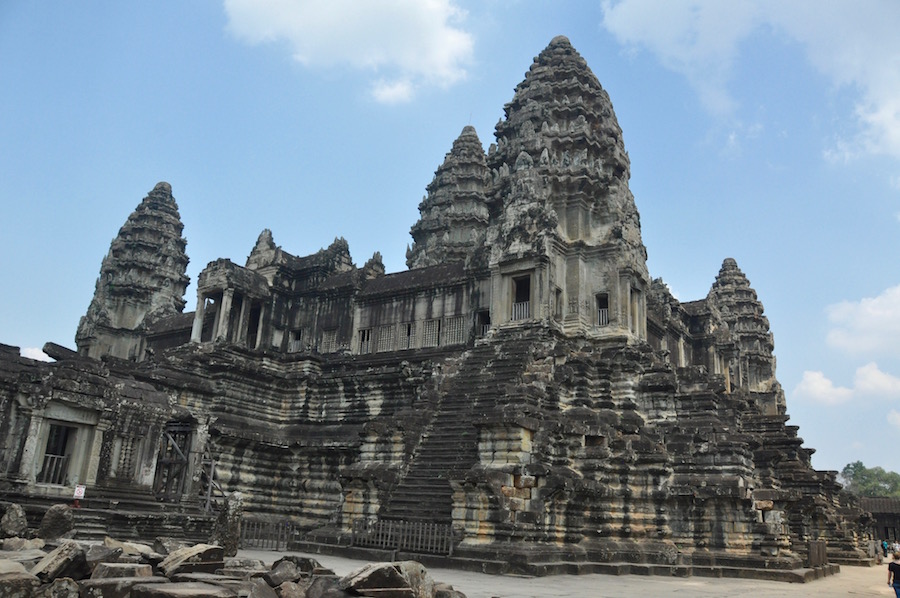
Having marvelled at the bas-reliefs, we entered the next level of the temple, a series of square courtyards with deep pools in the middle, although they were now empty of water. By one of the empty pools a boy monk was offering blessings to visitors.

Then we entered the inner courtyard that surrounded the five towers that represent Mt. Meru. Very steep steps led up to higher galleries but these were closed off to visitors. I can imagine that when it is crowded these could be dangerous.
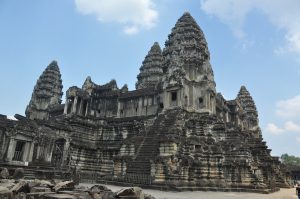
It was truly magnificent, but there was something missing for me. It did not have the fascination of Ta Prohm with its twisted roots intertwining themselves around the stone. It was too perfect. It is its perfection that makes it such an attraction, though. There is nothing quite like it anywhere in the world. It is a tribute to the architectural skills and the visionary of the people who lived in Cambodia at that time, not unlike the architectural skills and vision that was required to build our own cathedrals at around the same time. I suppose the difference is that with Angkor Wat we did not have to use our imagination; it was all there in front of us, whereas, because all the other temples had been in various stages of decay, we had had to be a little more creative in our thoughts.

It was brilliant and was one of those iconic ‘pinch me’ moments, just to make sure it was real.

By now we were starving, so we took a break for lunch before continuing our temple tour.
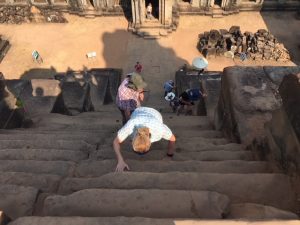
Taking great care

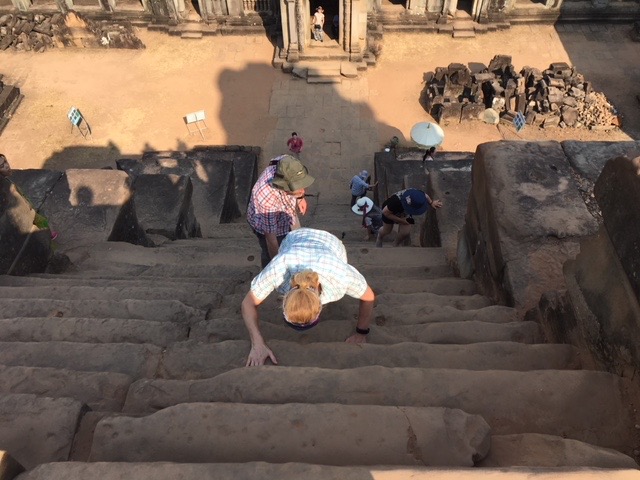
The next major temple we were to visit was Angkor Thom but before we did that we stopped briefly at Ta Keo. Not everybody came to see this temple; they were put off by the steep steps, and, indeed, they were incredibly steep and had to be approached with an equal amount of care in going both up and down.

Ta Keo is an unfinished temple. It is built in the ‘mountain’ temple style with several layers approached, as I said before, by steep flights of stairs. Nobody really knows why it was unfinished. It was struck by lightening, which may have been taken as a sign from the gods. Alternatively, it may be because Jayavarman V, who commissioned it, died.
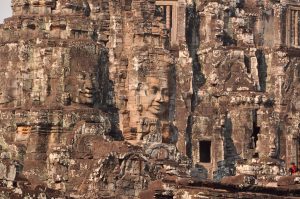
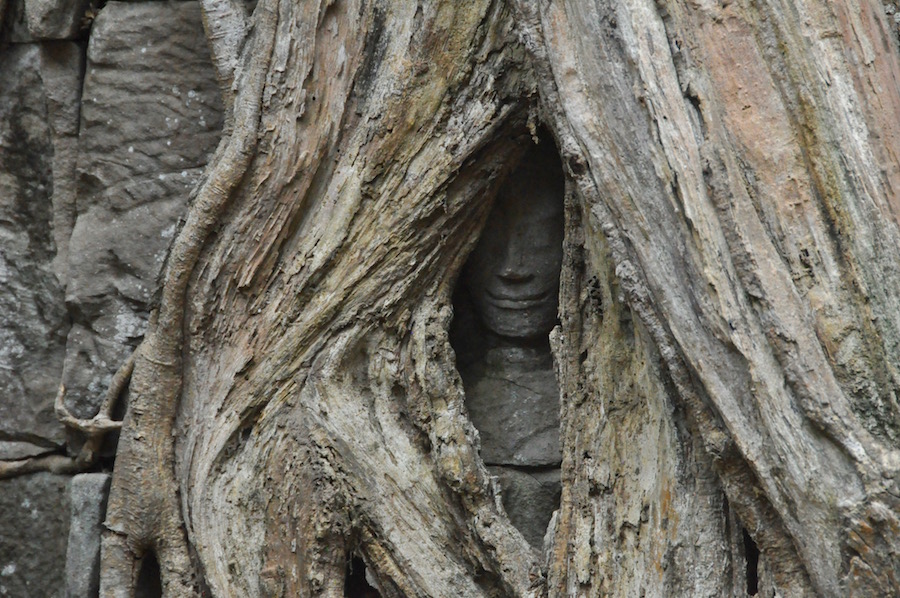
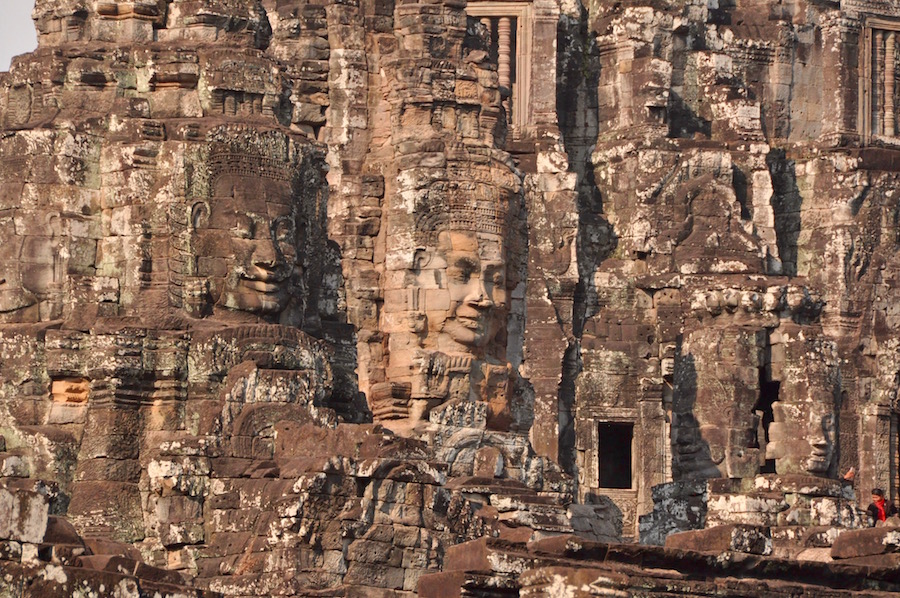
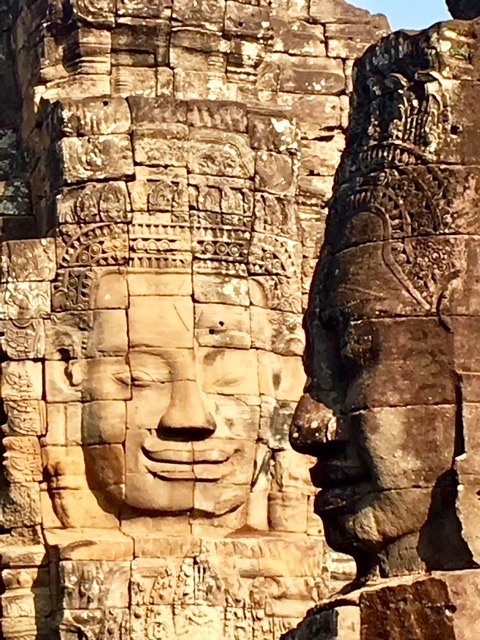
We moved on to Angkor Thom, and from one of Sophey’s 5* photo stops from the edge of the temple area we took photos. As we did so we began to notice a face carved in the stone, then another and another, until we had spotted lots of them. They were incredible. I couldn’t help think that the Reverend Awdry had been here and was inspired by the faces to write his Thomas the Tank Engine stories.

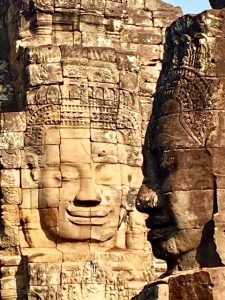
The Bayon Temple at its heart is a complex collection of 54 towers with an amazing collection of 216 demure, smiling faces. As we clambered among the towers and turned corners a stone, smiling face would appear before us. It was beautiful. It was quite crowded on the narrow walkways and on the steep steps leading up and down.
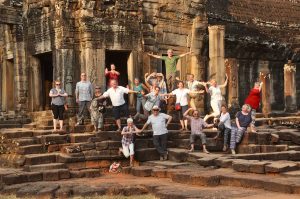
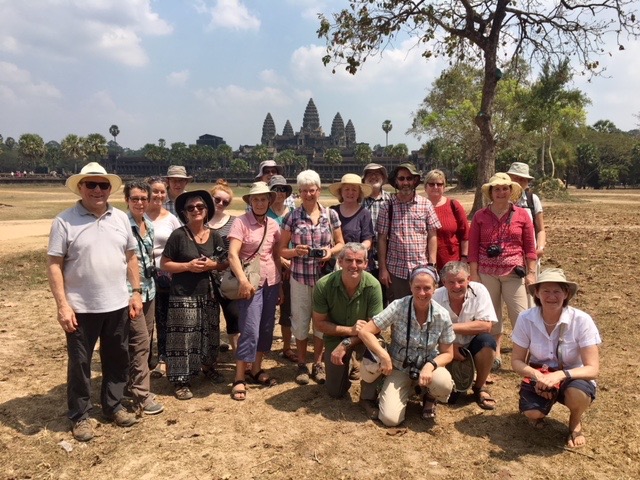
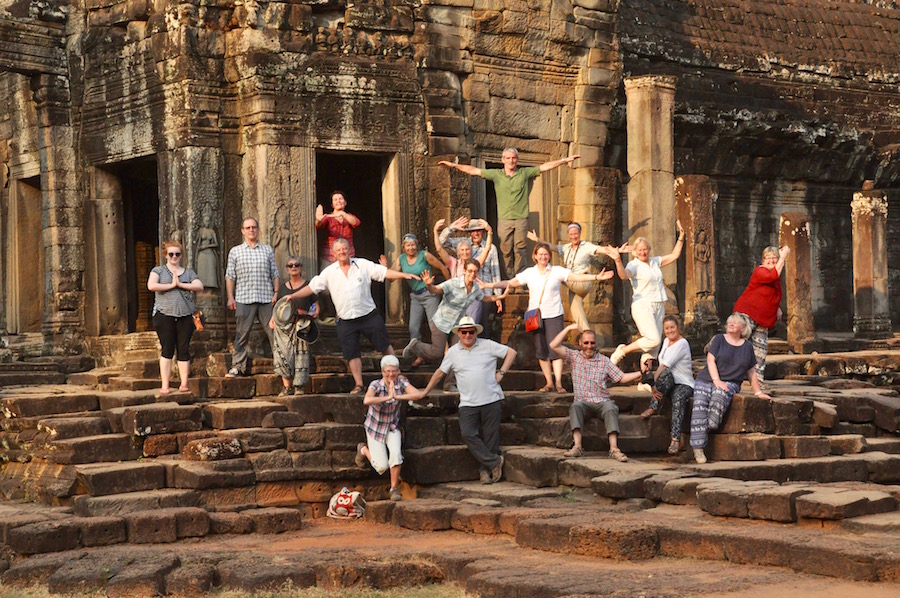
Back at our meeting point, while waiting for a couple of lost members, I organised a group photo among the ruins where each person had to strike a pose.  Am I learning from the Chinese how to monopolise an area? However, we were not interfering with anybody else and their enjoyment of the site as we were in a quiet corner. It was enough just to sit there in the cool shade, looking up at the confusion of stone towers, picking out face after face. The colours of the stone were picked out by the sunshine and contrasted well with those in the shade.
As we left we came across a number of monkeys, including a newly born one playing on one of the walls. They were very endearing and so preoccupied with looking after the baby, they did not worry about us being so close.

On our way back to the coach we walked by another temple and along the terrace of elephants. By now my flip flopped feet were not only filthy but quite tired, having walked a lot throughout the day. I was ready to go back to the hotel and flop.

Having cleaned up, I decided to go and enjoy another massage before I left Cambodia. While it was not quite as good as the one I had had previously, I thought it was well worth the US$5 I paid for it.

That evening, we ate in the hotel for the sake of simplicity.
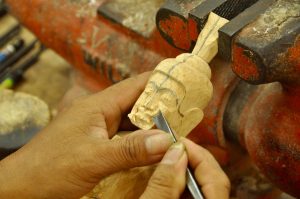
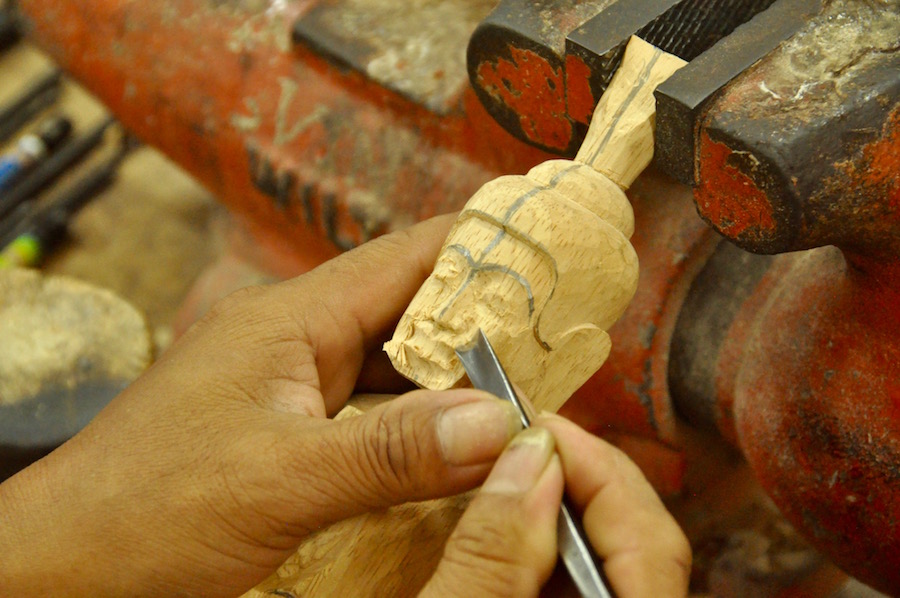
After a leisurely breakfast we were taken to a craft workshop that housed a number of different crafts under one roof. There was coloured grass weaving, candle making, herb and spice blending, wood carving, stone sculpting, painting, jewellery making, metal crafts and lacquer work. It is a great idea having all of these under one roof, as you would expect it to keep the prices down. Looking around in the shop, I’m not sure that this was the case. It was all very beautiful, but I was very conscious that we had no capacity within our luggage to take anything home.
After lunch Sophey took us to the airport for our flight to Luang Prabang and the last phase of our trip. Sophey had been a brilliant guide. He knew exactly how to adjust the itinerary so that we got the best of our short time in Cambodia. He was knowledgeable and his good command of English allowed him to share his knowledge. He made all the difference and I would hope, that if I returned, I would be able to team up with him again.
 

Ho Chi Minh City and South Vietnam

The plane touched down at Tan Son Nhat International Airport during the evening, with the city illuminated in the distance. Having collected our luggage, we emerged into the busy concourse of Arrivals to be met by Da Lat, our guide for this section of our trip. As we drove towards the city Da Lat talked to us about Ho Chi Minh City, giving us a little background information. His English was good but his accent, which was a little clipped, took a while for us to adjust to. He had certain mannerisms which, in an English person might have been annoying but coming from Da Lat was endearing. He started many of his sentences with, ”You know….”

Bitexco Financial Tower

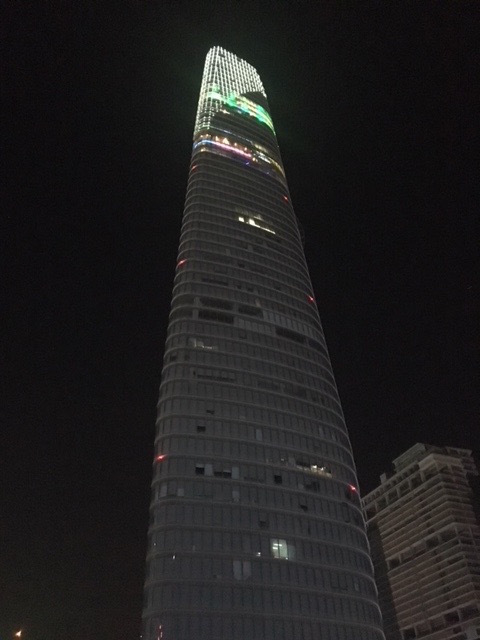
We went straight to the hotel, Au Lac, in the heart of the city, which was heaving with people enjoying the new year festivities. On reaching the hotel, it was difficult to get to the front door through the wall of parked motorcycles on the pavement.  Once inside, we checked in and then went about the process of trying to order food from the bar on the roof. Considering we were the only ones eating, it was amazing that it could take 90 minutes for them to produce a pizza. Adjacent to the bar there was an open rooftop pool overshadowed by a very futuristic 68 storey building with a disc sticking out near the top which acted as a helicopter pad. Ho Chi Minh is not like Hanoi or Hue. It is a modern city with tower blocks, multinational firms, McDonald’s, neon lights and an atmosphere of much greater wealth than other cities in Vietnam.
The following morning, long before dawn, I was surprised to be woken by crowing cockrels. I thought they would have disappeared as quickly as the tower blocks replaced the much simpler, older buildings. Then I discovered where the early morning chorus was coming from; below our window was an area that had not yet been bulldozed to make way for the next tower block. It was an example of old Saigon with simple housing, small shacks for shops and enclosed yards where the cockrels lived.

Central Post Office

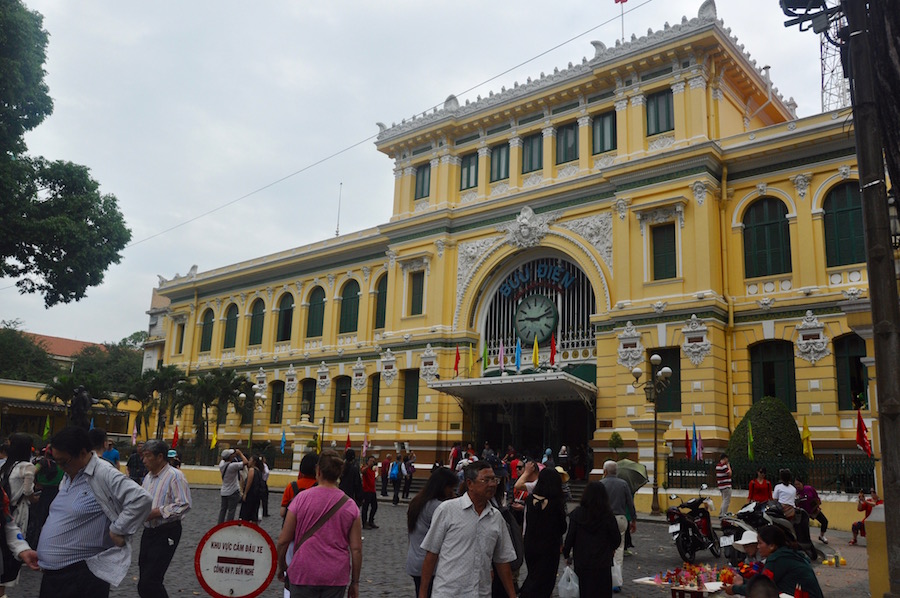
After breakfast we were met by Da Lat and taken to visit remnants of French occupation, Notre Dame Cathedral and the Central Post Office, both fine examples of French architecture. They were adjacent to each other, so the visit was quite simple. It was made simpler by the fact that we were not allowed into the cathedral because it was a Sunday and services were taking place. The square in front of the cathedral was busy, but the square in front of the post office was even busier. And it was no quieter inside. It still functions as a post office but has a lot more inside besides. Designed by Gustave Eiffel it is the epitome of everything French. Back outside, there was a wide range of stalls vying to attract tourists to part with their money. The cards that opened up into very intricate 3D pictures were incredibly complex and beautiful, but I resisted.

It was a place for posers, not just Chinese tourists who have to have their photograph taken in front of every iconic building or monument, but for chic looking people in their best outfits behaving like catwalk models. Slick men sitting on flashy motorcycles, far too powerful for the streets of Saigon. It was a great place for people watching.

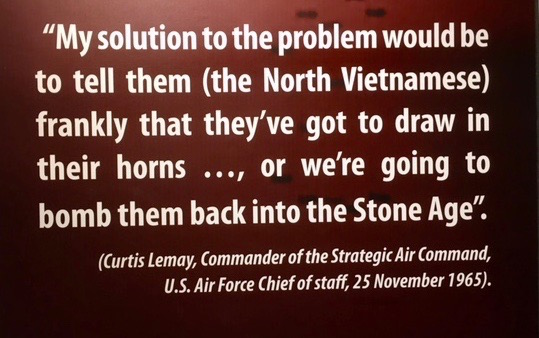
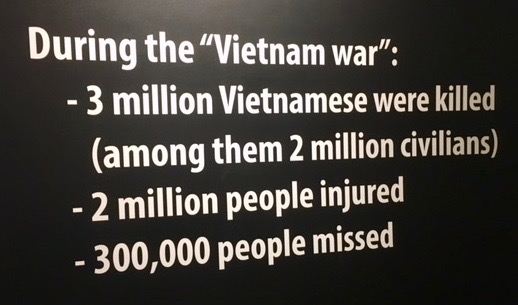
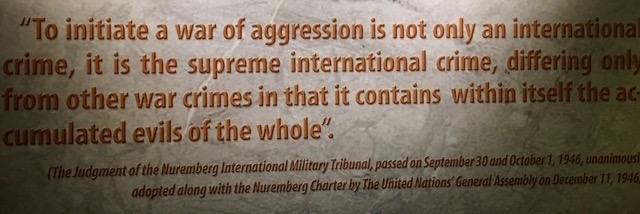
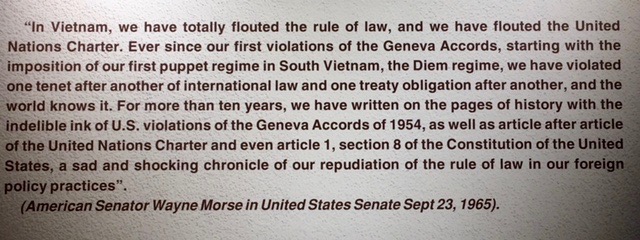
Dragging ourselves away from people watching, we next visited the War Museum. Outside were aircraft and armoured vehicles used by the Americans, but I had no interest in them as they tend to leave me cold. I was more interested in the human impact of the war and the stories of those, on both sides. This proved to be a harrowing, graphic presentation, largely through pictures and words, that really brought home the evils of war. The Vietnam War was really the first war that we remember as we grew up. It was played out on the news, but what we saw then was very much the perspective of the American offensive against the evil communist hordes known as the Viet Cong. While there was evil on both sides, what the Americans did was horrendous. Perhaps the museum can be described as being biased towards the Vietnamese, but many of the pictures and accounts were provided by the Americans.

I don’t think the Americans really knew who the enemy were, so they tended to kill indiscriminately and as everybody looked the same, the majority of those killed were, in fact, innocent civilians; they just happened to be in the wrong place at the wrong time. Also, we were led to believe that President Diem of South Vietnam, whom the Americans were supporting, was a good and fair president. He was, in fact, a puppet and a despot surrounded by puppets and despots who ordered despicable things to be done to their own people, particularly the Buddhists whom they persecuted.

There were so many harrowing images, but one in particular stands out. A North Vietnamese had been captured and was being subjected to waterboarding. His head is covered in a sack, and water is being poured on to his face. Holding the prisoner down is a blond American soldier sitting on the victim’s torso. While he is doing this, he is smoking and there is a huge smile across his face. It is hard to believe that one human being could do that to another; it is even harder to believe that it could be enjoyed.

Another section of the museum focused of the American use of Agent Orange. It was a mixture of toxic herbicides that they used to kill off forests where they believed the North Vietnamese to be hiding, to destroy crops so they could starve the population into submission. In a ten-year period from 1961 to 1971 they sprayed 20,000,000 gallons of it in large areas of Vietnam, Cambodia and Laos. While the consequences of that were devastating at the time, the legacy continues to do vast amounts of harm. In Vietnam alone, there a two million people who are affected, as it causes cancer, interferes with DNA causing horrendous birth defects, and also causes severe psychological and neurological disorders. But the Americans have not got away with it for those that worked with this deadly agent, and their descendants, are suffering from the same disorders. The photos of disfigurement at birth are the stuff of nightmares.

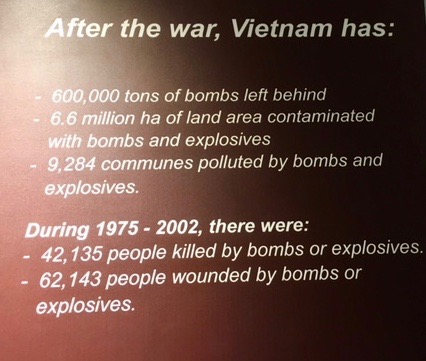
Many of the statistics associated with this war are mind boggling. They dropped more bombs during this war than all the allied forces combined in the Second World War, there are 80,000 unexploded bombs over the border in Laos and every year 300 people are killed and maimed when they accidentally detonate an unexploded device. The nightmare goes on!

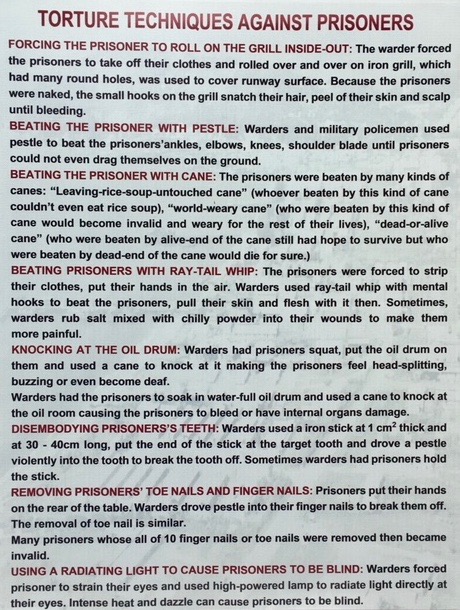
Finally, I visited the annex outside that displayed some of the methods used in dealing with prisoners. The treatment of prisoners was inhumane and the methods used to torture and execute them were barbaric. I’m afraid the French did not come out of it very well for they were using the guillotine up until 1960. The photographs of posters below highlight just how low the perpetrators of these acts became. It makes excruciatingly painful reading. I cannot imagine how the prisoners felt!


I came away feeling angry, angry with the Americans for all of their barbarism. It is not behaviour befitting the most influential nation on earth. I was angry that this had taken place in my lifetime. I was angry that I did not know enough about the war and I was angry that nobody seems to have learned any lessons from what happened in Vietnam, especially the Americans who continue to bully the world. There must have been evil on both sides in the conflict, but the Americans, on the basis of this visit appeared to be incredibly evil. There was only so much I could take and I was pleased when we climbed aboard our air-conditioned bus and it took us away.

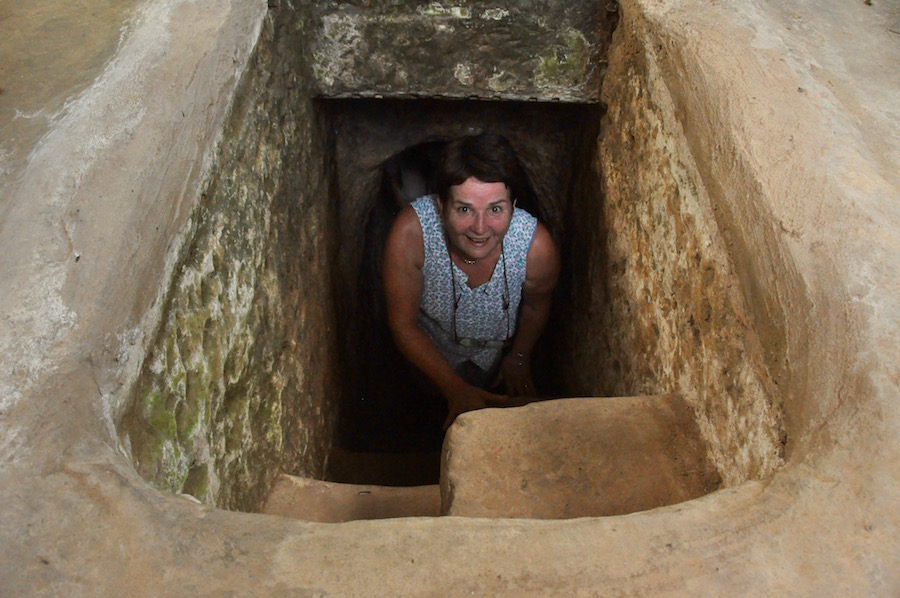
After another sumptuous lunch we drove out to Cu Chi to visit the tunnels dug by the Viet Cong during the war. Perhaps, after visiting the tunnels, I might have a more balanced opinion about the war. This complex of tunnels is 300 km long. There were three levels of tunnel, the shallowest being 3 metres below the surface. These were connected by down shafts to tunnels 6 metres below and a lower level of between 8 – 10 metres. There were underground hospitals and schools and many people remained underground for long periods.

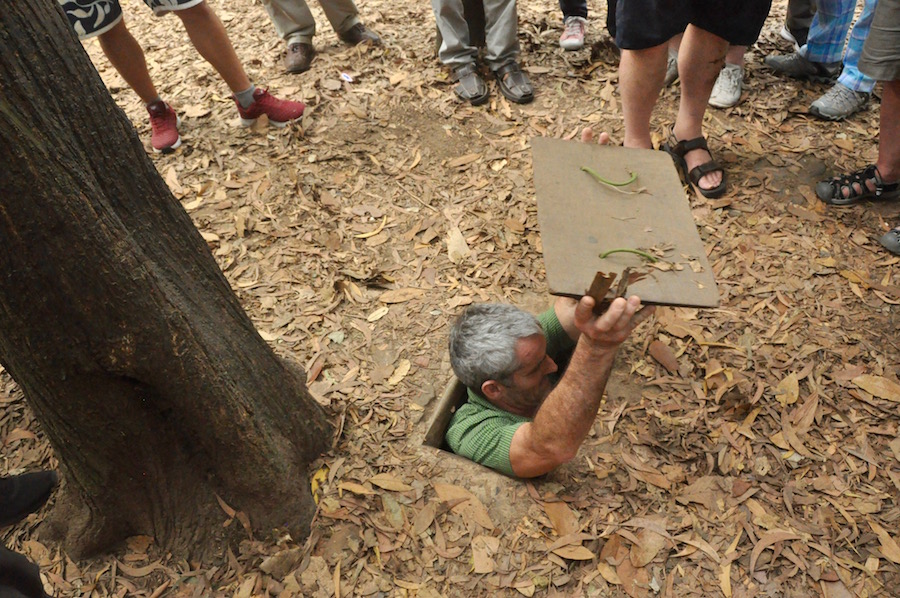
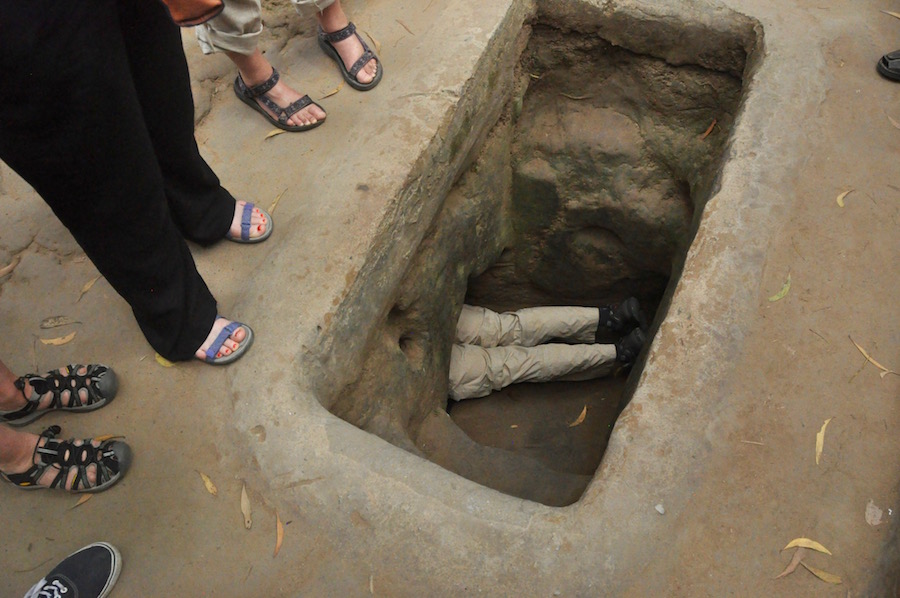
On arrival we were taken into the jungle. Once inside, we paused and were asked if we could find the entrance. Scouring the ground, we looked for any give away signs but there were none. What we should have done was start to kick around the dry leaves covering the forest floor. When this was done for us it revealed the tiniest of wooden trap doors, little more than 15 inches by 9 inches. The guide then demonstrated how the Viet Cong disappeared underground and made themselves invisible. Demonstration over, we were invited to have a go. I decided there was no point in me trying as I would not be able to get my bulk nimbly in, or, if I did, out. Others tried, but only the thinner members of the group, and they made it look so easy. You have to remember that the Vietnamese are structurally much smaller than we are, but that does not get away from the fact that they were living in incredibly claustrophobic conditions.

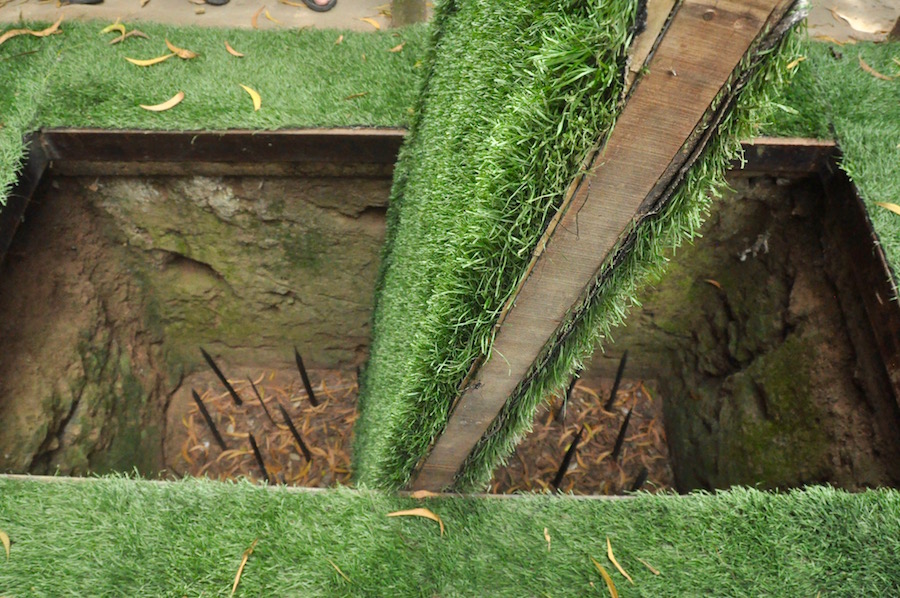
Moving on through the forest we came across examples of traps they set for patrolling Americans. They were evil and the thought of falling into one or being caught in one sent a chill down the spine. Despite their horror they were ingenious. We saw termite hills that were useful to the Viet Cong for they hid air tubes supplying air to the tunnels below. They were also able to use then as look outs so that they could monitor the movements of the Americans without being seen. When the opportunity arose, they would sneak out from the tunnels, ambush the enemy or attack from behind and then quickly disappear underground.

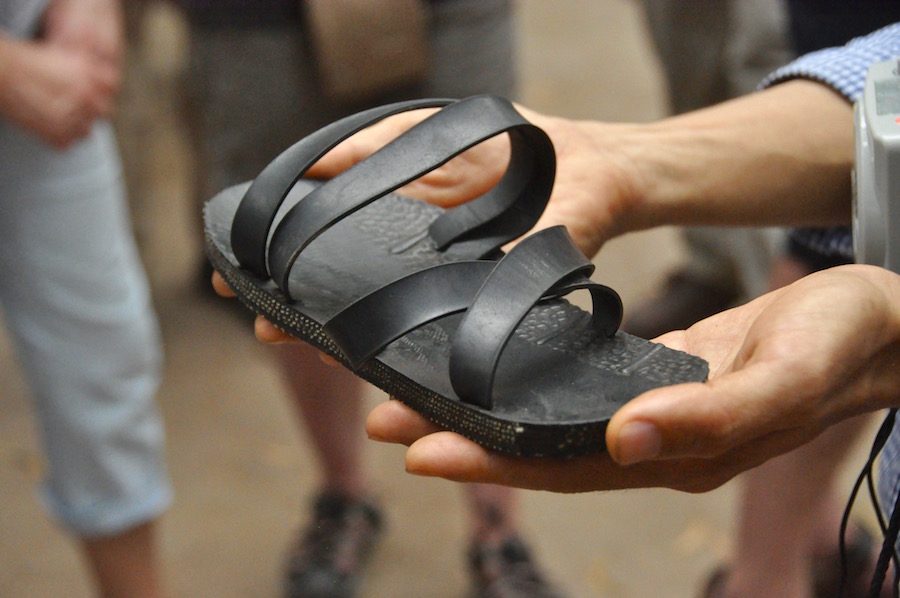
One intriguing thing we learnt was that in dusty earth it was easy to leave footprints displaying your movements. To confuse the enemy, the Viet Cong made flip flops out of old rubber tyres, but they made the front and back exactly the same. The foot print left behind would not indicate what the direction of travel was, thus adding to the confusion. Brilliant and so simple. In fact, many of the strategies of the Viet Cong were simple and it was a situation of ‘brain’ v ‘brawn’.

The brawn knew the tunnels were there and did everything they could. They bombed them, but, while a heavy bomb might cause some damage to a tunnel near the surface, they had difficulty penetrating those deeper underground. They tried flooding the tunnels but, because they were on different levels the water always found the lowest levels but, again this had been thought about and the tunnels all had outlets into the river so that any water poured in flowed out again. The Americans tried gassing them, but the tunnel system was so complex, and the ventilation was so effective, it did little harm. The Americans were out thought every time.

There are tunnels that have been enlarged so that tourists can go down and get a feel for what it was like. Taking advantage, I crawled around on my hands and knees and still found it very uncomfortable. It was not pleasant, but I appreciated the opportunity to find out what it was like.

Unlike the visit to the museum, when I emerged angry, when I emerged from the tunnels I found I was full of admiration for the Viet Cong. There was no way they were ever going to beat the Americans in a traditional war, they were up against far too much fire power and dirty tactics. But by taking themselves underground, it was alien to the way the Americans fought, and they were not able to overcome their enemy.

It was a political and military shambles brought about by American paranoia of communism, which, on the battle field, was going nowhere, forcing them to withdraw before they were eventually beaten. Withdrawal was a means to saving face internationally on the world stage, and at home with their own people who had no appetite for war. Personally, I think they came away with an awful lot of egg on their faces and it was well deserved.

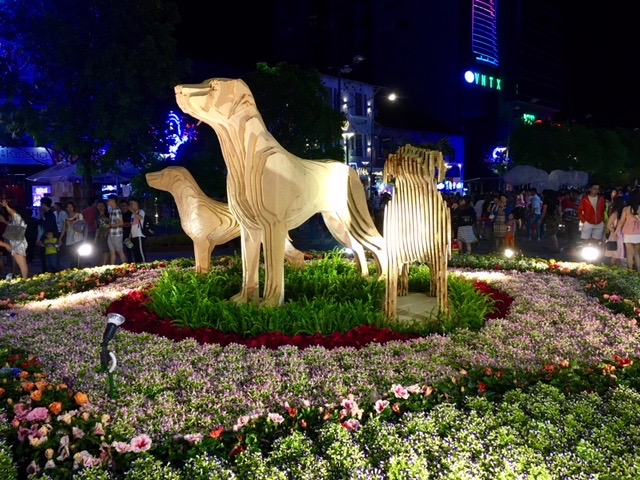
That night we decided we would do our own thing for eating. A number of us went to a restaurant on the top floor of the Palace Hotel. We walked there through the throng of New Year revellers enjoying everything that was on offer. The hotel was on the main thoroughfare where the celebrations were taking place, Nguyen Hue. This is normally busy with traffic but for the duration of the Tet Festival it was closed to traffic and brightly decorated with huge beds of flowers and other colourful lights and statues of dogs, as it is to be the Year of the Dog. It was a terrific atmosphere and we were able to look down upon it as we ate our meal.

By the time we had finished and were heading back to the hotel, there was no abatement in the street level activity; the crowds still ambled, and despite the hour, there were many children. They had a lot more stamina than me.

On our last full day in Vietnam we left the city and headed out to Ben Tre River, a tributary of the Mekong. There a boat was waiting for us to take us on a cruise, stopping off at various points along the way to give us an insight into delta life.

Despite it only being one of the many channels of the Mekong River, it was still a very significant river and a watery highway for trade. Every so often there were fish traps along the bank, presumably set to catch fish at high tide, although Da Lat was not very confident that they were very efficient and that the fishermen found it hard to change their ways and move away from tradition.

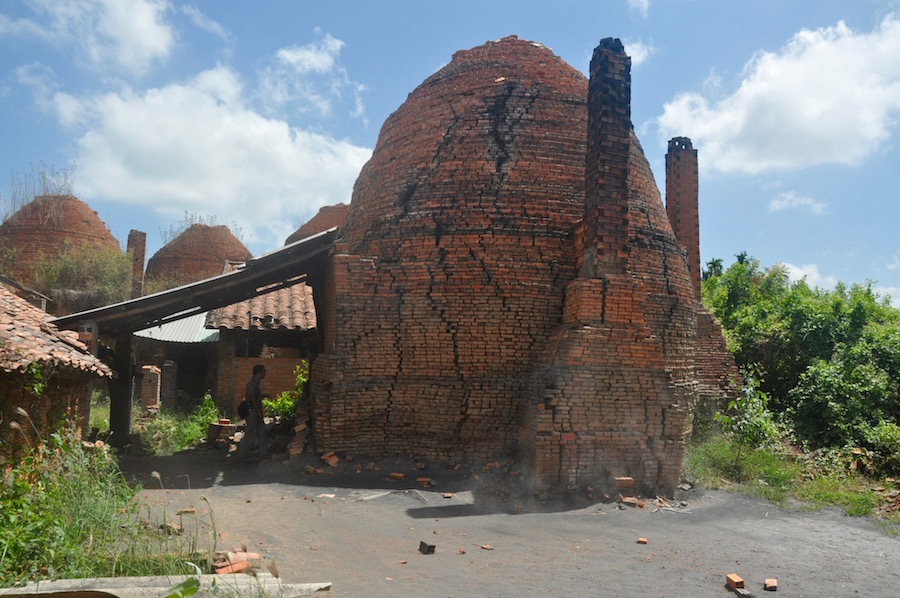
Our first stop was at a brick works. We were led to believe that this was the traditional way of making bricks, and so it was, but it looked very much as if it had not been in action for some time. The kilns were the most interesting part of the visit. These were upturned bottle shaped brick structures that were filled up to the brim with raw bricks. The stacker had to climb out of the chimney at the top to escape. When full, the kiln can hold as many as 12,000 bricks. The process then requires a fire to burn for thirty days in order to harden the bricks. The main fuel for the fire is rice husks. What alerted me initially to the fact that this was now a museum rather than a working brick factory is that there were no huge stockpiles of rice husks, just remnants of where they had been. Nevertheless, it was very interesting and worth the visit.

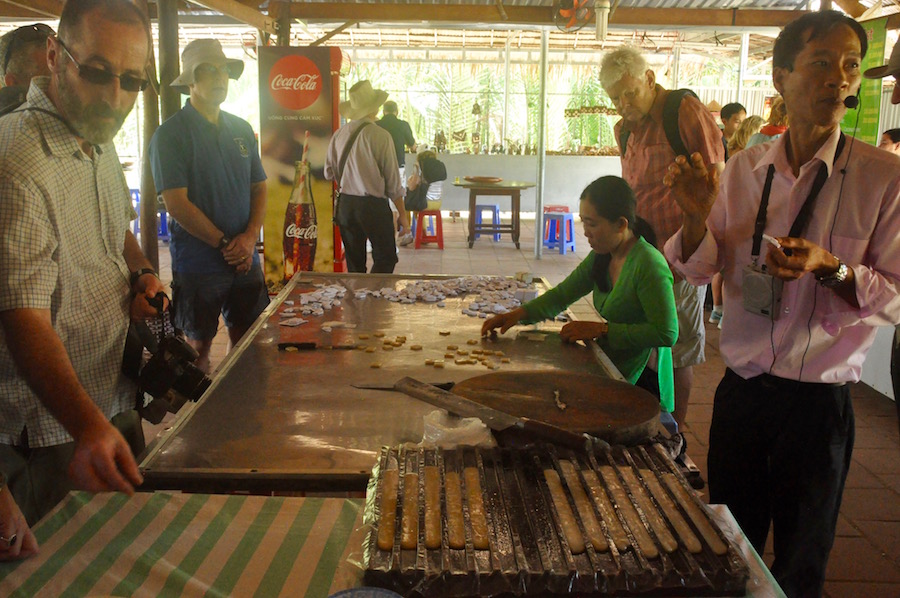
Back on the boat we were presented with a coconut each with a cleft cut into it with a straw allowing us to drink the delicious coconut milk. This was the prelude for our next visit to a coconut processing cottage industry. Here a heavily tattooed man deftly cut the coconut out of the husk for us to try. Again, it was delicious. The edible part of the coconut, not eaten by visiting tourists is then made into flavoured coconut sweets using palm sugar. All very sweet and sickly.

Returning to our boat we soon turned into a smaller tributary with palms rising from the muddy waters. Fishermen plied up and down the river in their canoes, casting or pulling their nets, while others stood chest deep in the water.

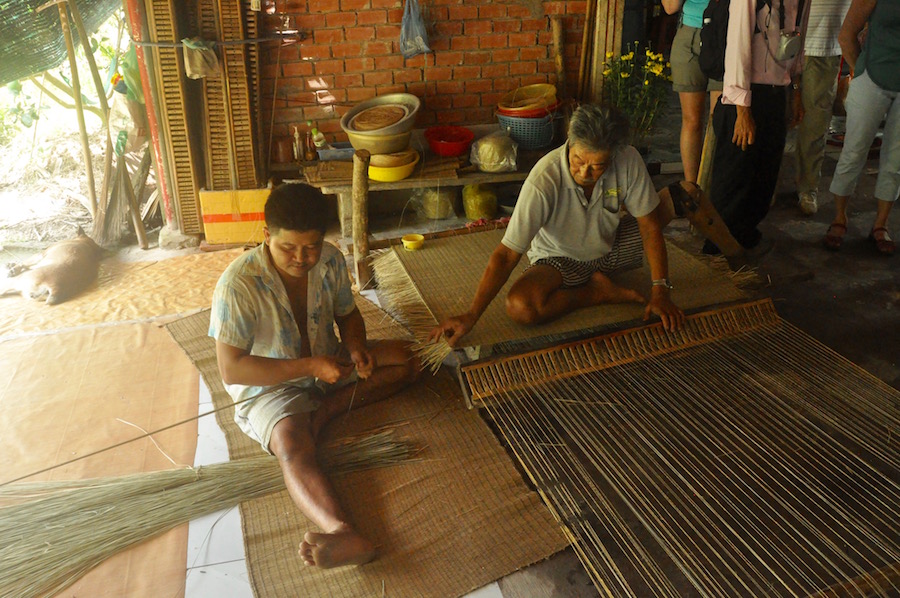
Leaving our boat, yet again, we visited a weaving workshop. Here two men operating a loom, making a reed mat. As one separated the strings, another fed in a reed using a hook with a rod, which had to be withdrawn before the strings were separated the other way. The speed, dexterity, coordination and team work was to be admired. The man operating the loom had a wooden leg and was either a casualty of the war or a casualty of an encounter with explosives since the war.

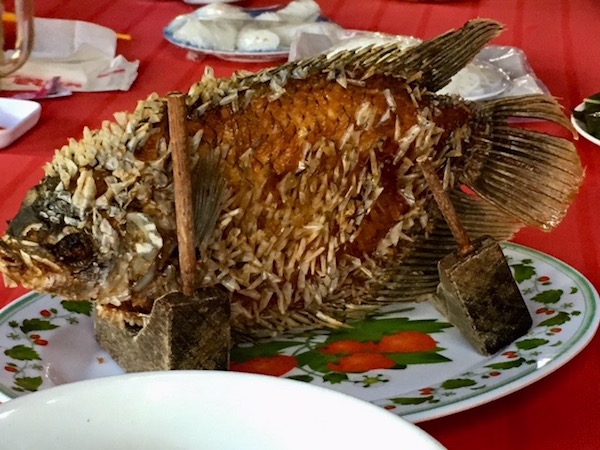
Instead of getting back into the boat, tuk-tuks took us on a journey through the delta community, along narrow tracks to a family run restaurant, which I think was specifically set up for groups like ours. I cannot imagine anybody else would find this place. Like all the meals we ate on this trip, it was excellent, but the centrepiece, a deep-fried fish held on a stand was the best. We just had to dig into it with our forks and take the meat, which fell off the bone easily, and pop it straight into our mouths. While we ate, large butterflies flitted from flower to flower beside us.

After the meal we walked a little way along the concreted track through the village. Being in the delta, these paths, had they not been concreted, would have been treacherous in the wet. We walked down to a bridge where there were a number of sampans waiting for us to take us back to our boat. I love this quiet method of travel along these waterways as they give us much greater opportunity to see much more. Unfortunately, the journey was over all too soon.

Once we returned to our bus we had, what should have been a ninety-minute journey back into Ho Chi Minh City. Instead, it turned into a bit of an epic because of traffic returning after the Tet Festival. The dual carriageway was a sea of motorcycles. We were going nowhere fast, until the police closed the lanes to traffic coming towards us so that they could clear some of the queue going towards the city. We saw some interesting sights and continued our search for six on a motorbike.

That evening we ventured out to a restaurant, Hoa Tuc, housed in an old opium factory, for our last meal in Vietnam. It came as a recommendation from OV, Ben Wall, who used to teach in the city. Good choice, thanks, Ben. The festivities in Nguyen Hue were again in full swing when we walked to the restaurant but by the time we were heading back to the hotel, the clear up operation was in full swing. The Tet Festival was over for another year.

The following morning, I just had time for a stroll around the markets near the hotel before we headed off to the airport for our flight to Siem Reap. Nguyen Hue was back to normal and you would not have known that anything had been taking place there.

Our Vietnam adventure had drawn to a close. It had been an excellent two weeks and we had seen and done so much. I really enjoyed the north and there were aspects of the middle that I enjoyed. I also really enjoyed being in Ho Chi Minh City for the climax of the Tet Festival. The people, everywhere we went were friendly, welcoming and always offering us a smiling face. I cannot imagine not coming back. I am very grateful to Asia Aventura for their excellent organisation and to the guides who, on the whole, gave us added value. Love you, Vietnam!