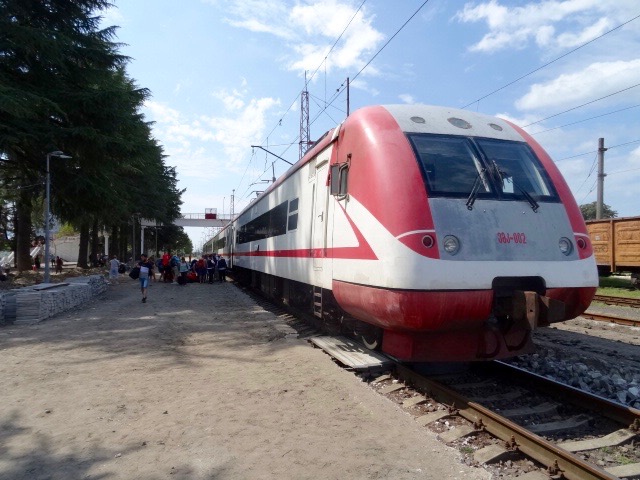
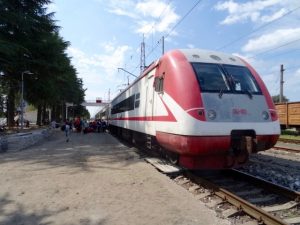
 In the morning we were up early to catch the train to Zugdidi. When we saw a double decker pull into the station we were hopeful, but it was not to be. Instead, we had a rather old train with patched up paint work. We were booked to occupy the first nineteen seats which meant we were facing backwards but did have the option to stand and look over the driver’s head at the track in front. It was not the most enjoyable of journeys, despite my earlier excitement, partly because any views to either side were partly obscured by condensation on the windows, between the double glazing. David’s seat was permanently in the reclining position and none of the tray tables were horizontal. As a result, a fair bit of sleeping went on. The only excitement came at the very end of the journey as we approached Zugdidi. There were a number of cattle on the track who responded to the hoot of the horn, but as we came towards a crossing, just before the station, a number of cars took their chance to get across before us. Just when you thought the persistent use of the horn had done its job, a car ambled across in front of the train. I was standing behind the drivers and I could only just see the roof of the car. With brakes applied, both drivers stood up and gesticulated. It was a very close shave.
Alighting from the train we enjoyed some traditional Georgian cheese bread before getting into two minibuses for the four-hour journey to Becho.
It was not long before we left the relatively flat countryside around Zugdidi, on the Black Sea coastal plain, that we started to climb into the Caucasus Mountains.
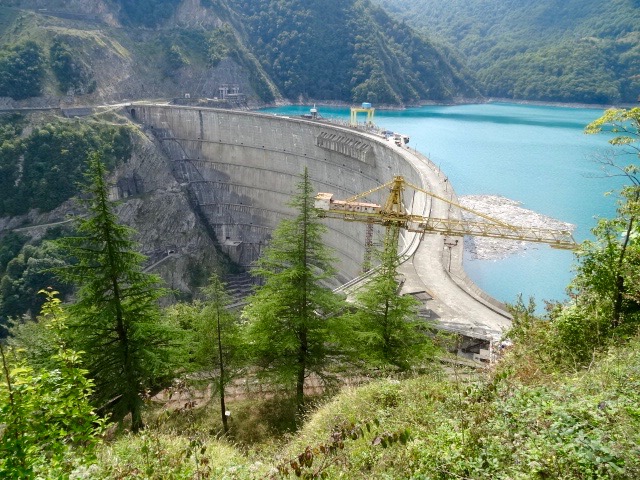
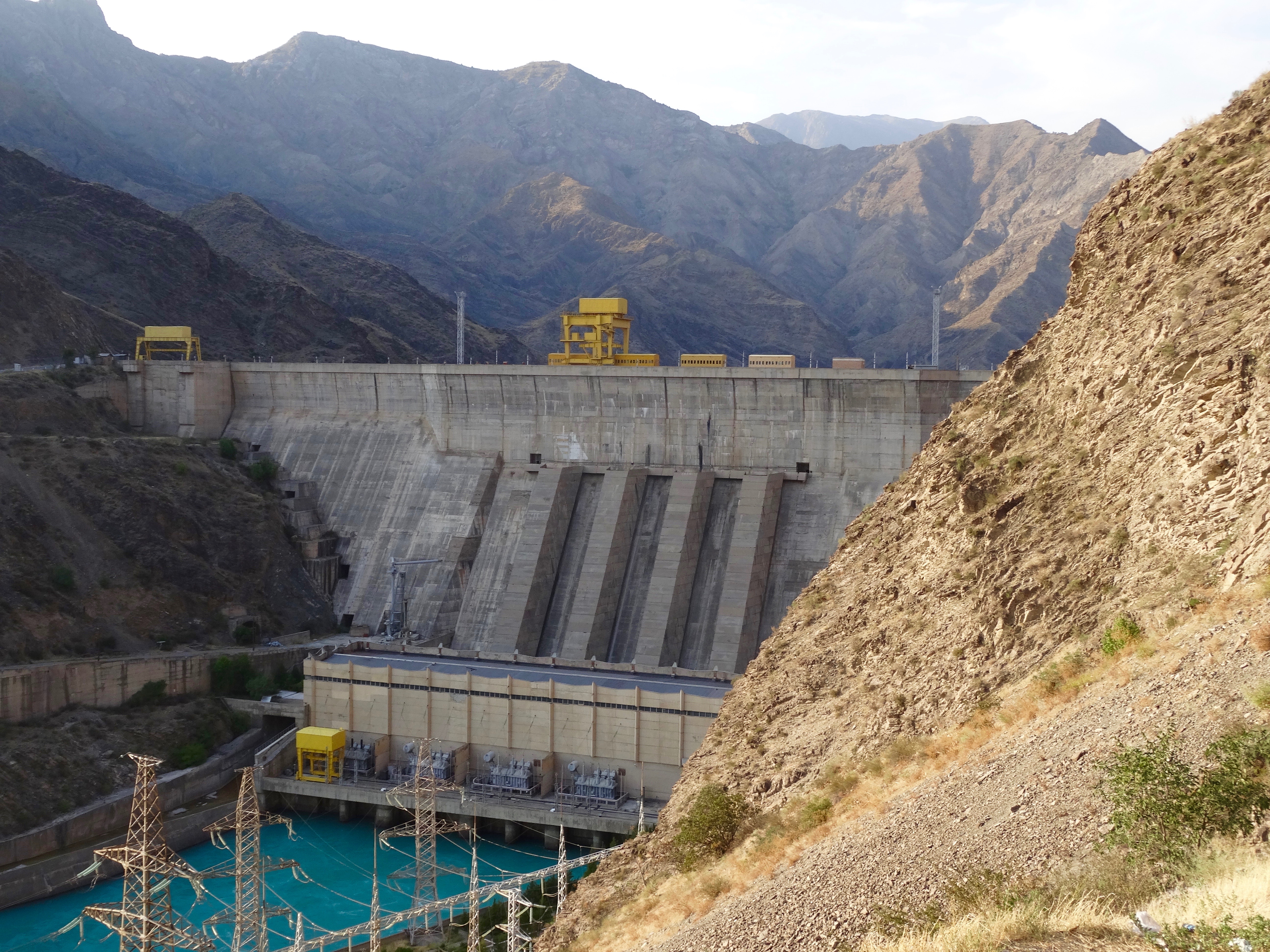
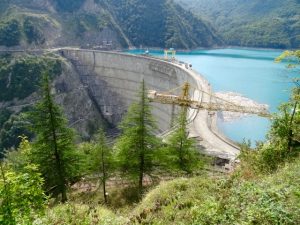 After about an hour we stopped to visit a massive Enguri Dam, holding back a 25km lake, part of a hydro-electric scheme. The scale of the dam is enormous, being 60m thick at its base, tapering to 10m thick at the top. It is a staggering 240m high. Alex told us that there are grand plans to turn it into a World Heritage Site by creating a whole range of extra-curricular uses for it. They plan to put a glass lift down the face of the dam, a long zip wire across it, to stage concerts at its base, using the natural amphitheatre of its shape to improve sound quality, to project images upon the huge face of the dam, provide boat trips, and much more. I think it will be great to make a feature of such a functional piece of engineering. Good luck to them. With all the timber that had accumulated behind the dam they could include raft building in their long list of activities.
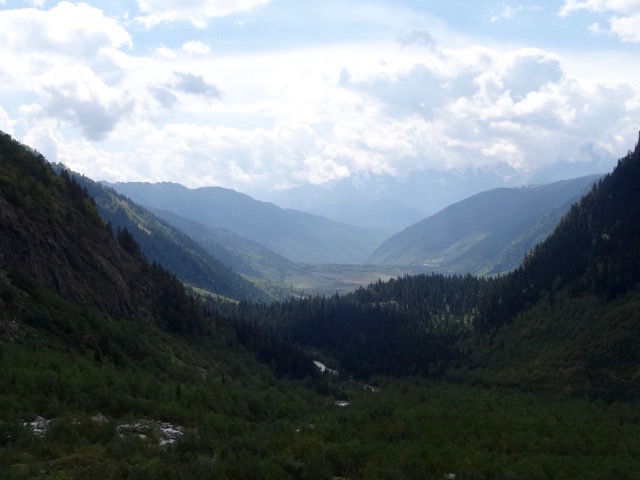
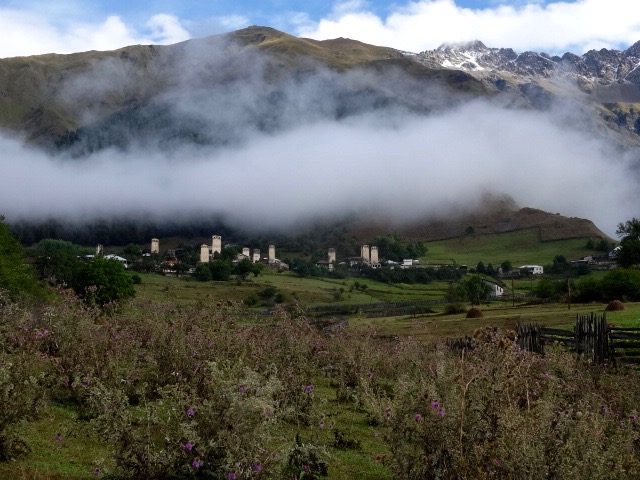
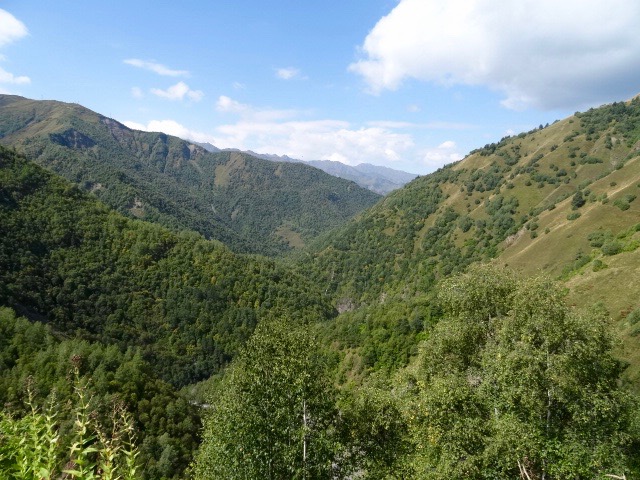
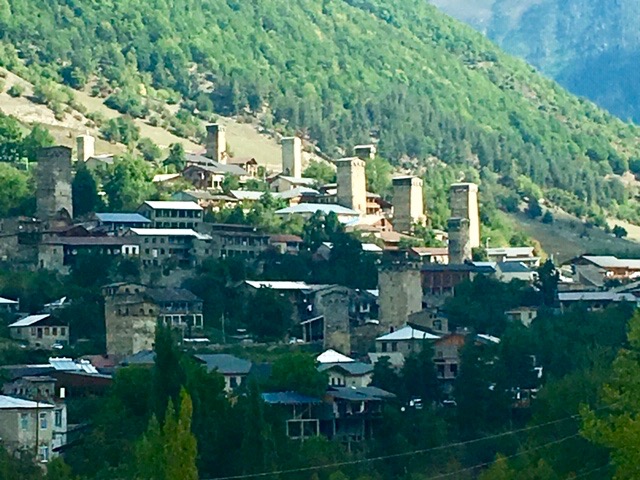
The scenery continued to become more impressive the further we travelled and the deeper we travelled into Svaneti. We began to see the occasional watch tower.
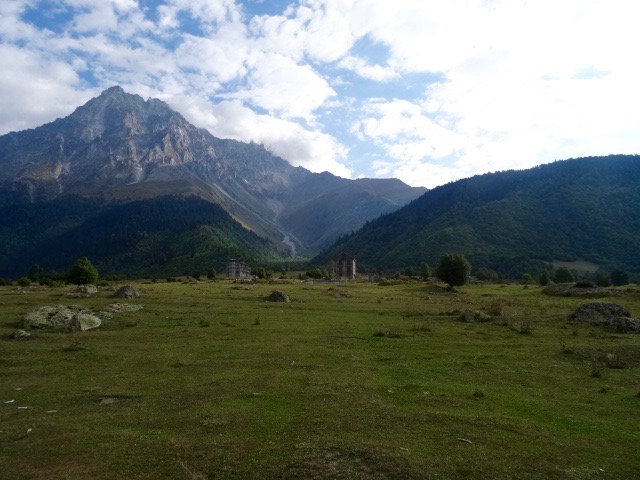
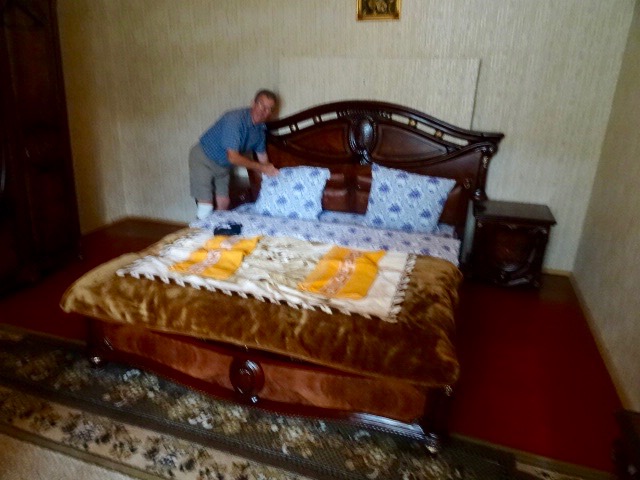
Turning off the main road, we had reached Becho, which is a community of villages rather than just one village. We were staying in the village of Mazeri, the last settlement leading to the head of the valley and Mt. Ushba. In my mind’s eye I was expecting basic, rustic accommodation. I had brought a lightweight sleeping bag with me in case I was unsure about the cleanliness of the bedding. I had brought a trekking towel for the occasional wash and a head torch for night forays to an outside loo, running the gauntlet of large guard dogs. None of these items were necessary, a clean en suite room with everything provided awaiting us. The accommodation was excellent.
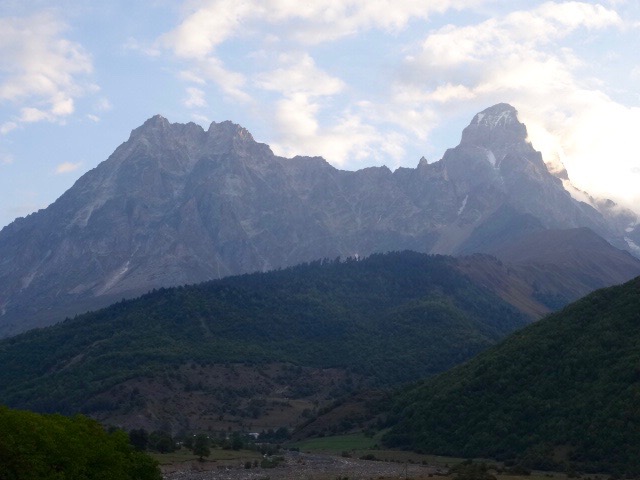
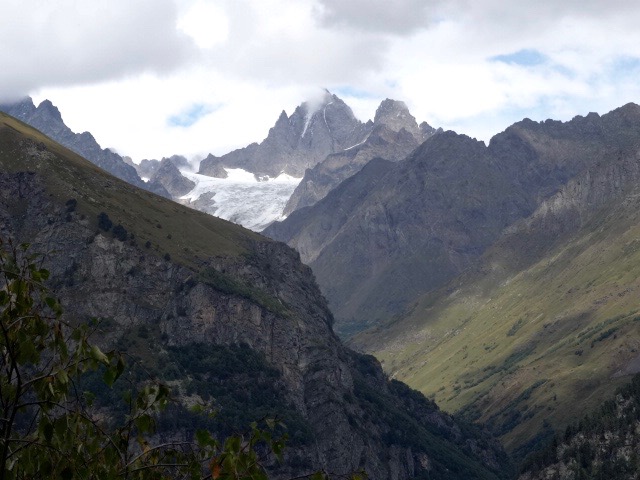
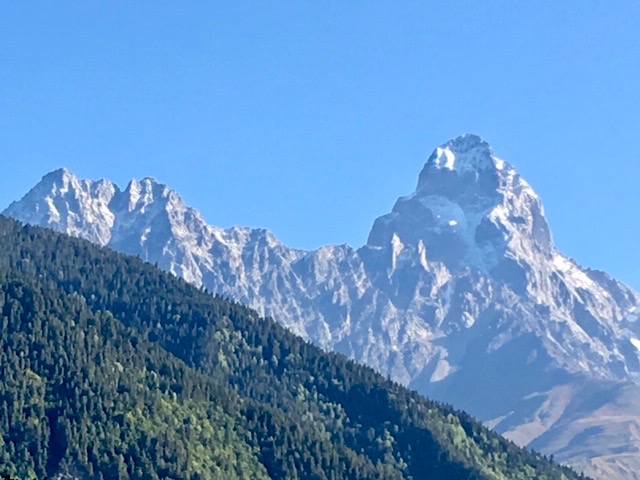
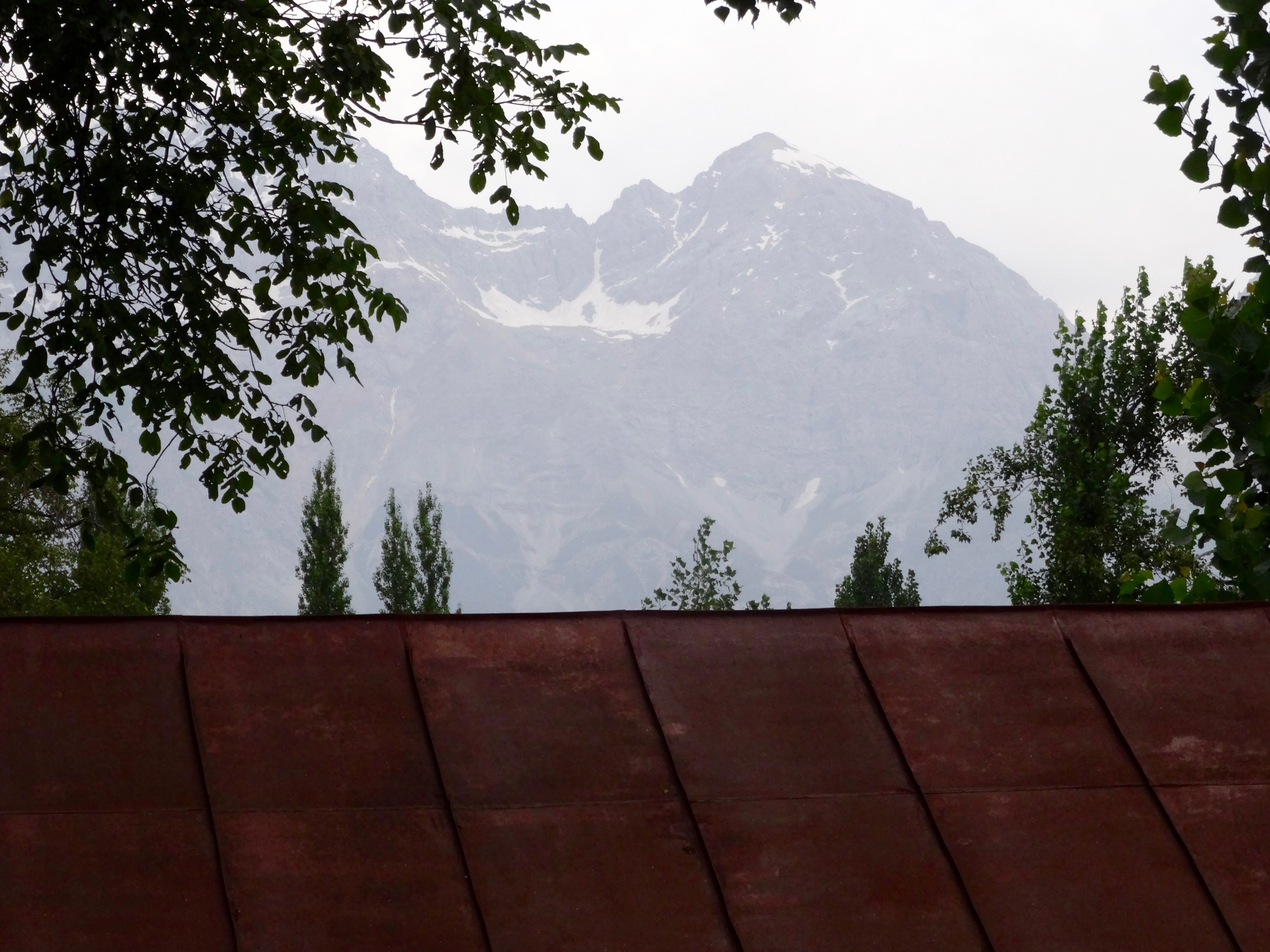
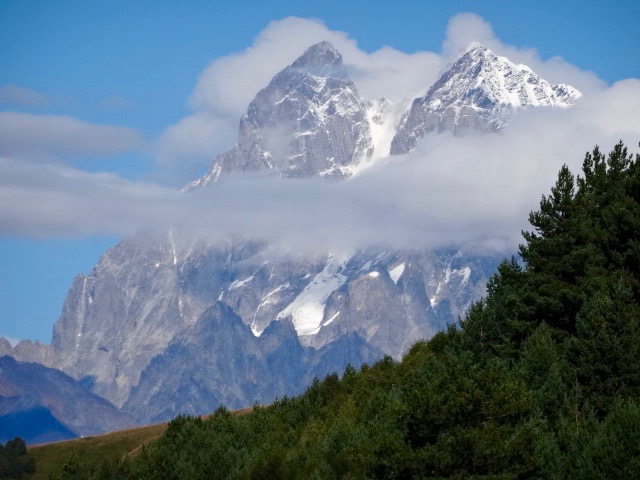
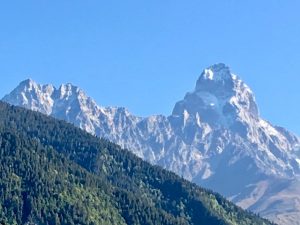
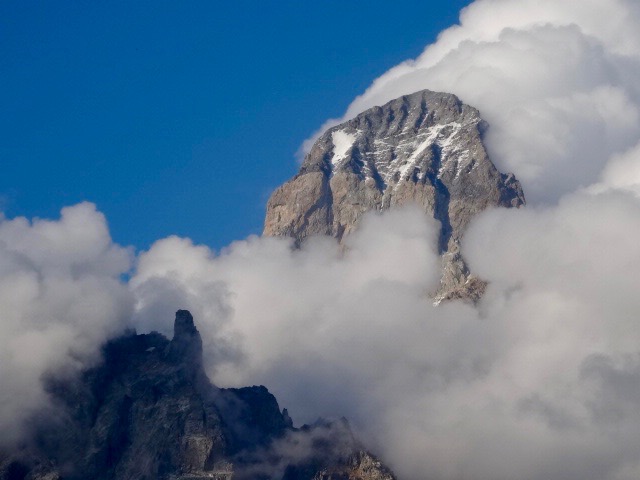 The icing on the cake was the outstanding view of Mt. Ushba dominating the head of the valley. Cloud was playing around it’s rocky summit, hiding it in part, but it was none the less impressive.
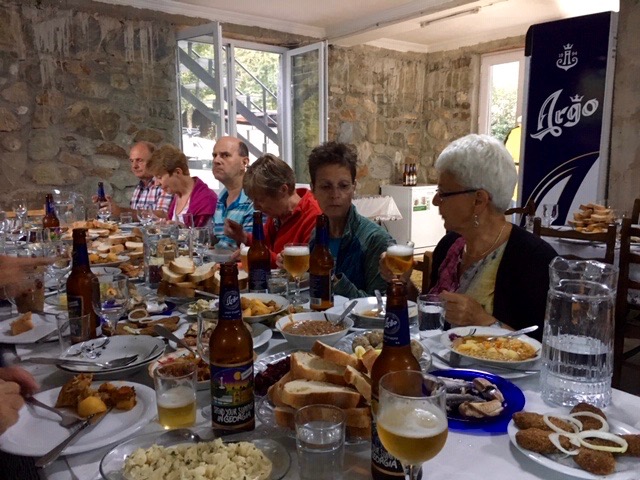
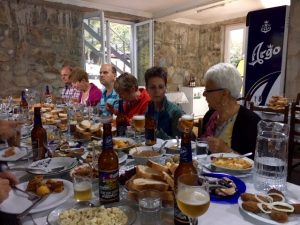 If the accommodation was good, the food was even better. When we went down to dinner at 7.00pm, the table was groaning with food. There was hardly a spare patch on the table for my bottle of “Spend your summer in Georgia” beer. The highlight of the meal for me, was not the range of hot dishes, which were actually not hot, but the tomatoes, which were huge and utterly delicious!
With nothing much to do after dinner, most of us drifted off to bed and managed to squeeze in about ten hours of sleep!
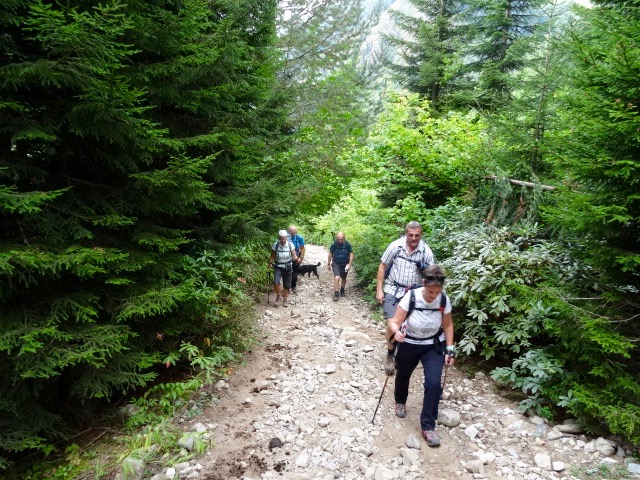
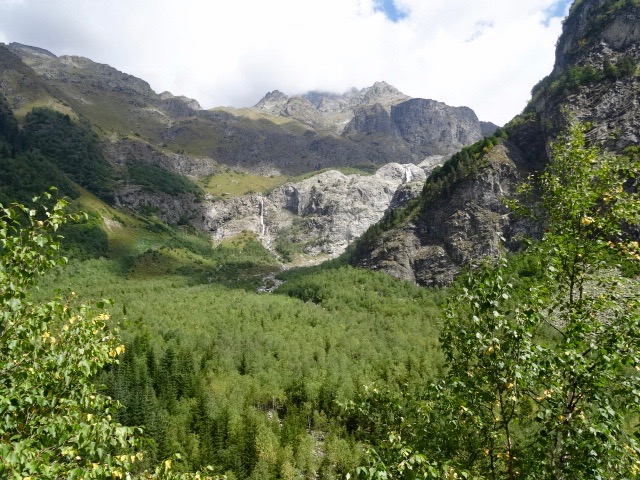
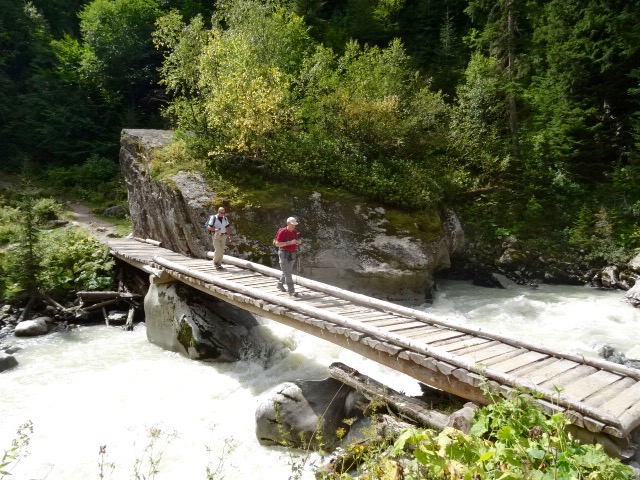
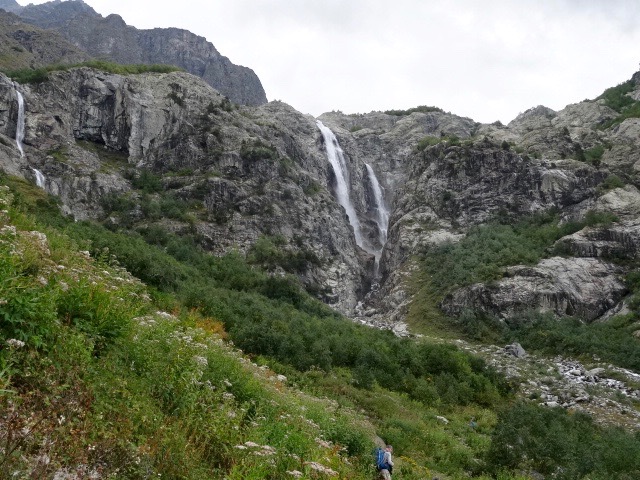
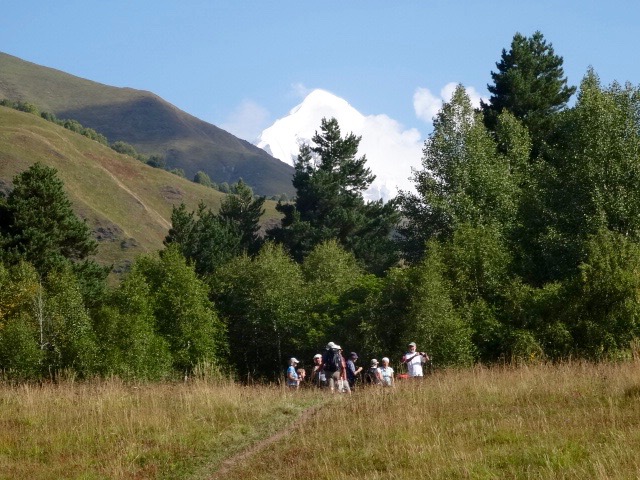
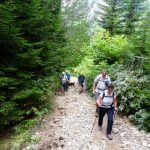
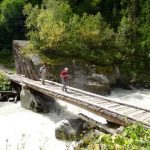
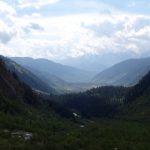
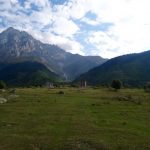
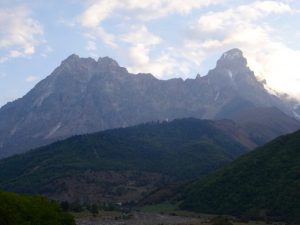 The following morning Mt. Ushba, clear of cloud, stood proudly overlooking the Becho Valley. After a very bread orientated breakfast, we set off on an introductory walk up the valley to visit a couple of waterfalls. This was an easy walk and gave us an opportunity to stretch our legs and for Alex to assess our walking abilities. It was a well-walked trail through beautiful woodland, never far from the tumbling, turbulent water of the Daira River. It was quite warm and humid, but we took it at a fairly leisurely pace.
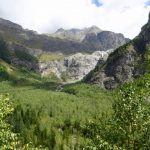
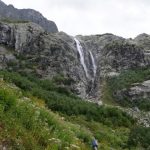
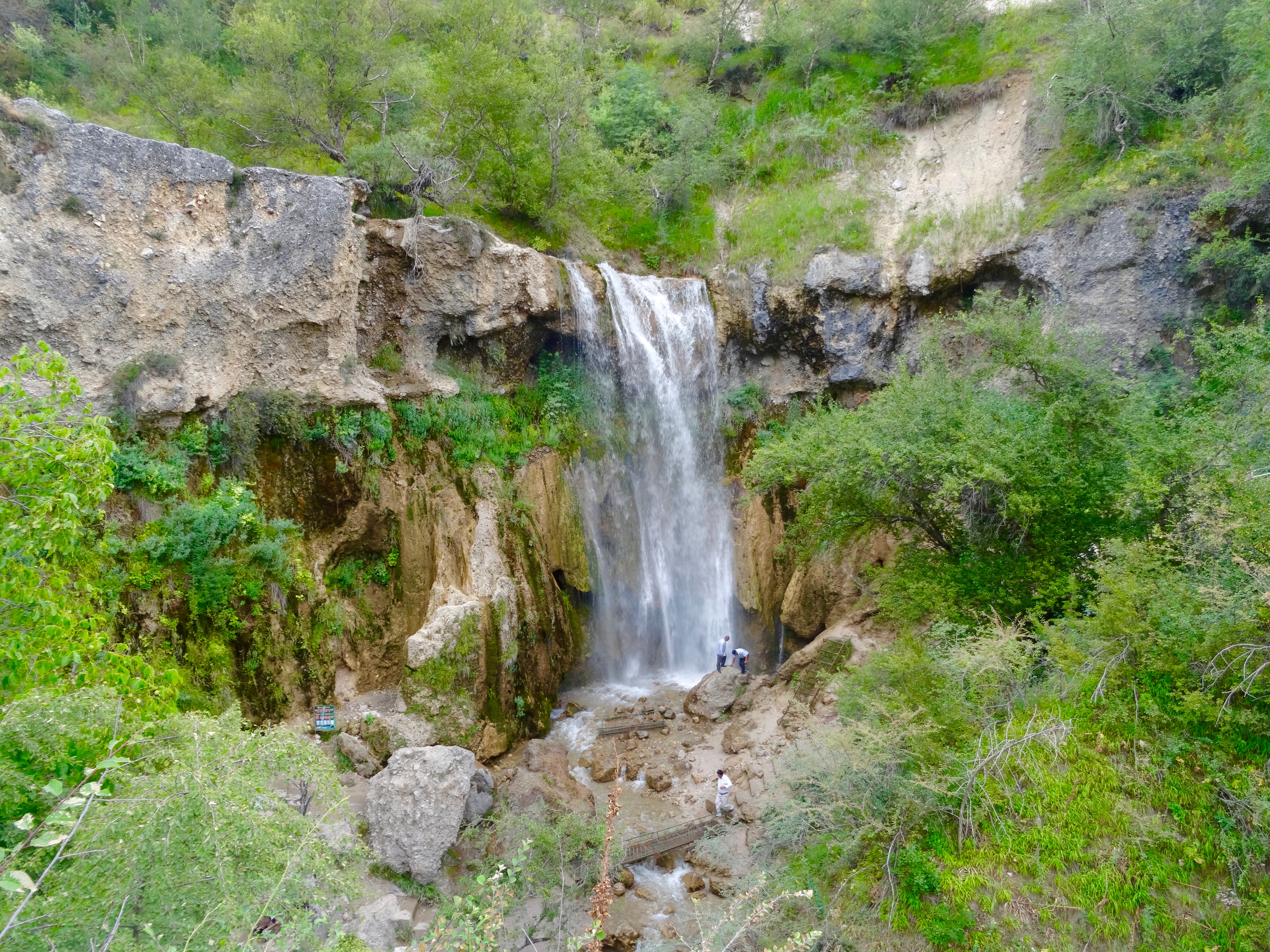
There were two waterfalls, which tumble over a rock wall that once proved to be a barrier to the erosive energy of a glacier. The ice, unable to make much of an impact on the band of rock, bypassed it, creating an impressive wall for the Daira River to fall over. The right-hand fall, with a greater volume of water, is the much more impressive.
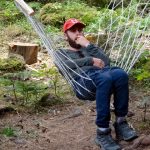
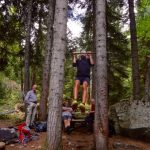
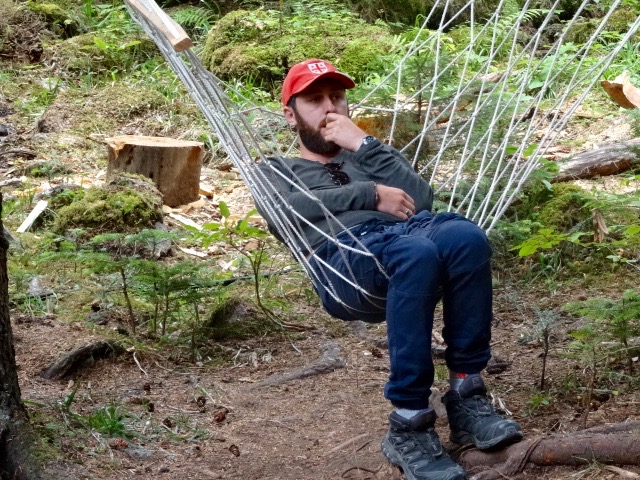
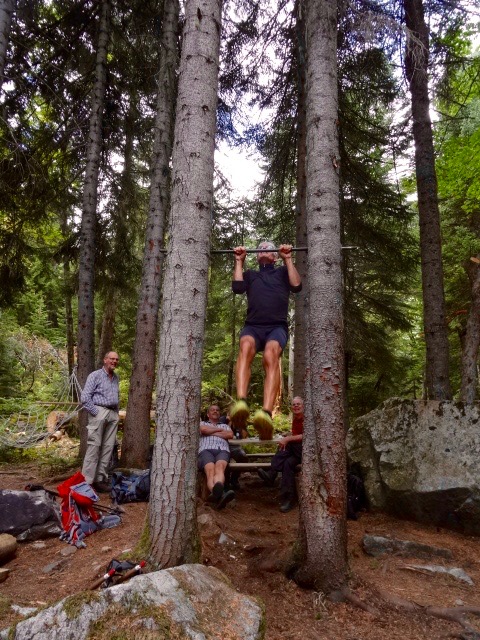
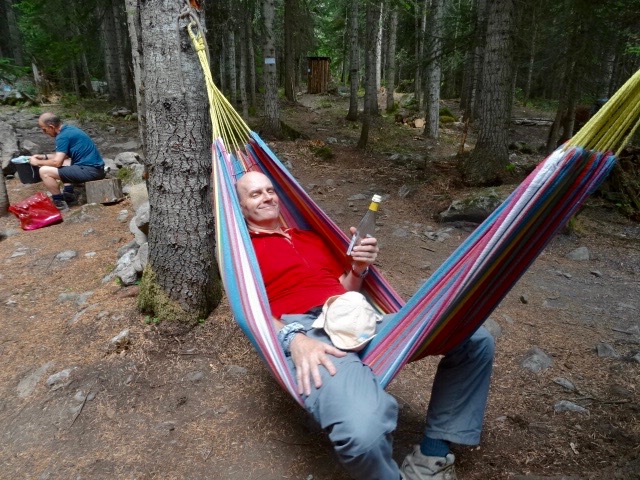
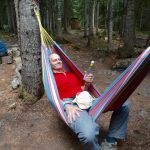 Returning by the same route, we stopped off at a woodland café for our picnic lunch sitting at rustic tables or reclining in one of the hammocks that hung between trees. There was even a pull-up bar between two trees so that the more macho of the group could prove their physical prowess. I had a go but the ten pull-ups I did were so fast I was just a blur to the onlookers. If only!
 Vehicles were there to meet us at the end of the walk and transport us to Mestia, the capital of the Svaneti region. Our accommodation was again excellent with more sumptuous food. The timing of our travels was perfect; as soon as we arrived and settled in, it began to rain. Thunder rumbled overhead, but we were comfortable, dry and enjoying a beer.
After another ten hours in the horizontal position and an excellent breakfast, with porridge, we headed off on our walk. However, before we got very far we visited the History and Ethnography Museum. This is a beautifully presented display of church treasures, manuscripts, jewellery, weaponry, musical instruments and historical photographs. I found the manuscripts by far the most fascinating, for no other reason than many of them date back to the 10th century.
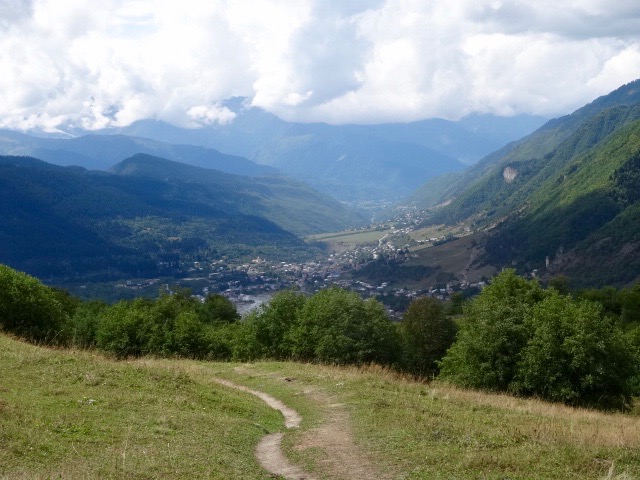
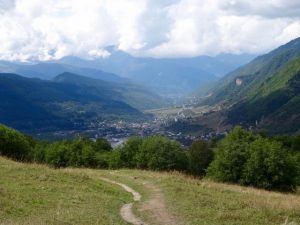 From the museum we steadily climbed above the town and overlooked the smart airport that now services Svaneti with small passenger craft, although we did not see any while we were there. It is obviously the way forward, bringing in more tourists on a short flight rather than the protracted train and road journey, that we did. You do get the feeling that with improved infrastructure and many new accommodation opportunities, the people of Svaneti are preparing for ever more tourists.
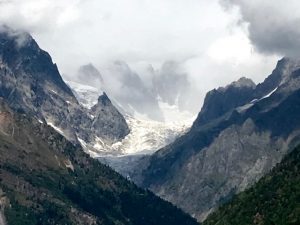 The clear skies of the morning were disappearing as more and more clouds began to bubble up, slowly obscuring the highest peaks and the glaciers in between. We still got tantalising views towards the highest peaks, but I found I wanted more, I wanted the full wow factor that I just knew was hiding from us. By the time we had eaten lunch at the top of the pass, looking down into the Mulakhi Valley, another community of several villages, we had to resort to our waterproofs as it began to rain, while thunder rattled around the mountain tops.
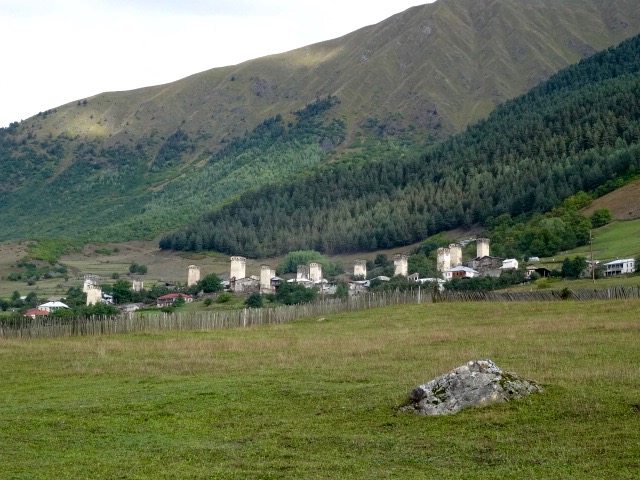
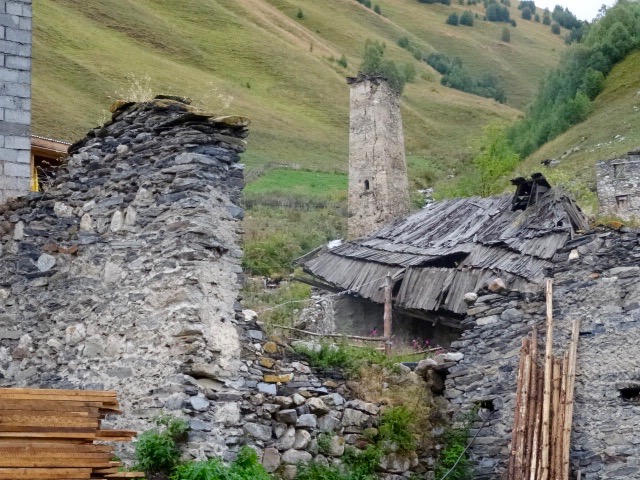
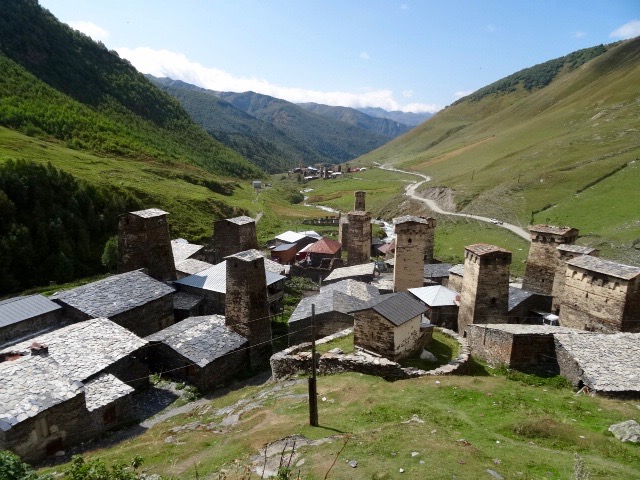
We were now seeing many more towers and they were proving to be quite remarkable.
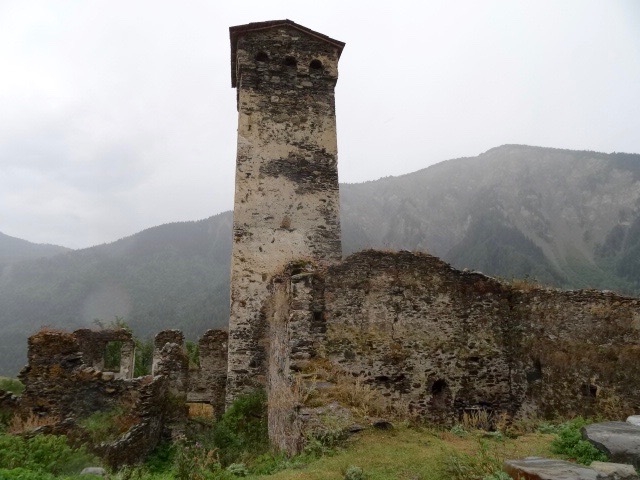
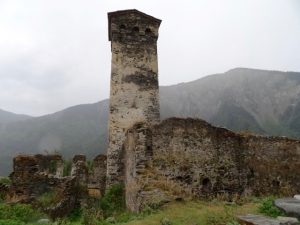 Svaneti has a very turbulent local history. For centuries, different clans would clash over cattle stealing. But it did not end there. Wives and young women were also targeted, so to protect themselves from their enemies they built watch towers where they could store their possessions and their wives and children while the men fought. Most of the towers were built between the 6th and the 13th centuries, but some date back even further. They are in remarkably good condition, despite their age.
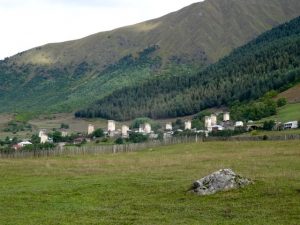 The blood feuds that occurred all those centuries ago intensified in the 1990s with the departure of the Russians. Today, there are very few instances of feuding, the result of Svaneti opening up to the rest of the world and accepting the 21st Century, of mediators stepping in whenever two families seem to be heading for a clash. How centuries of tradition can disappear or remain hidden in such a short time, is remarkable. All we knew was that many of the people we were meeting on our travels would have experienced feuds, either personally or from a distance. If only we could have talked to them about it and they could have felt comfortable enough to open up about it to us. It would be great if the museum in Mestia could get some first-hand accounts before they are forgotten.
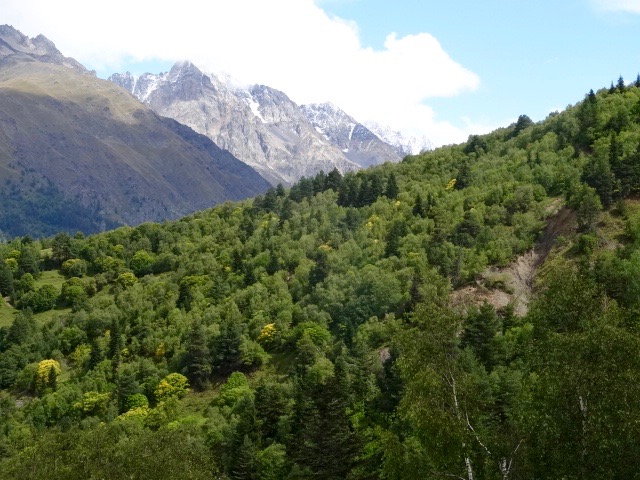
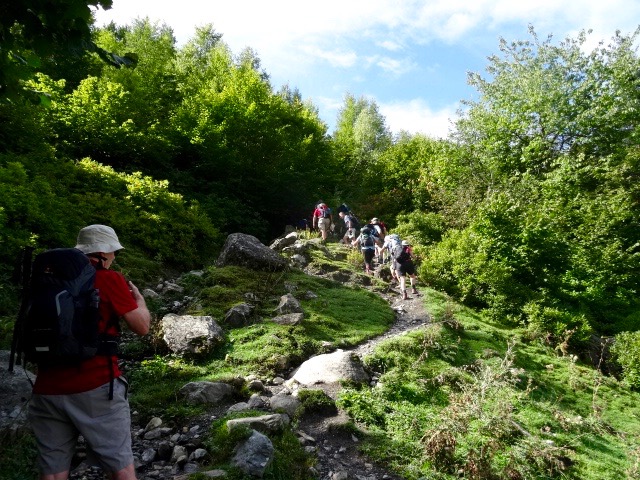
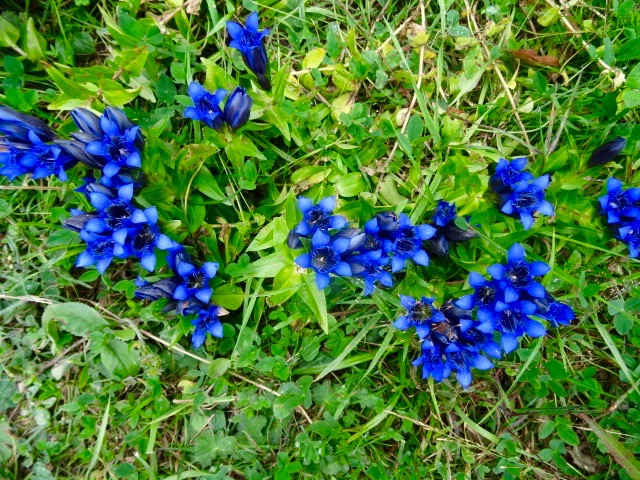
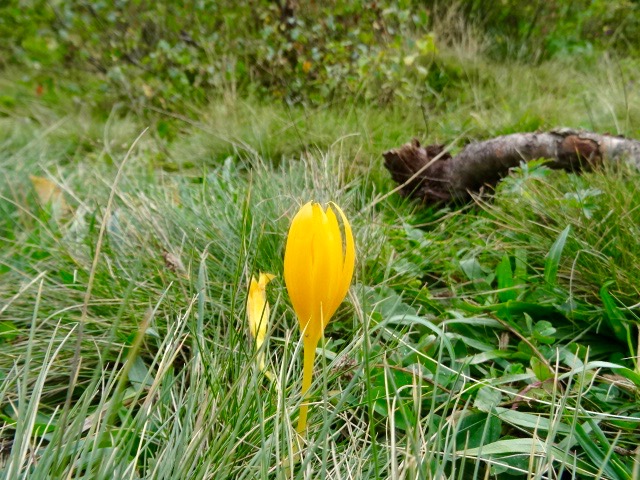
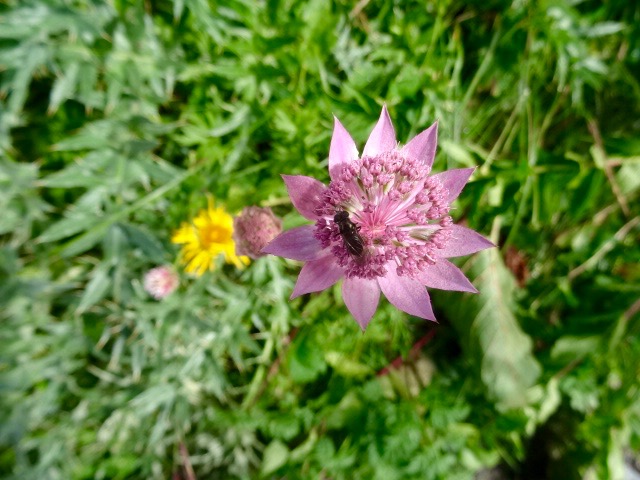
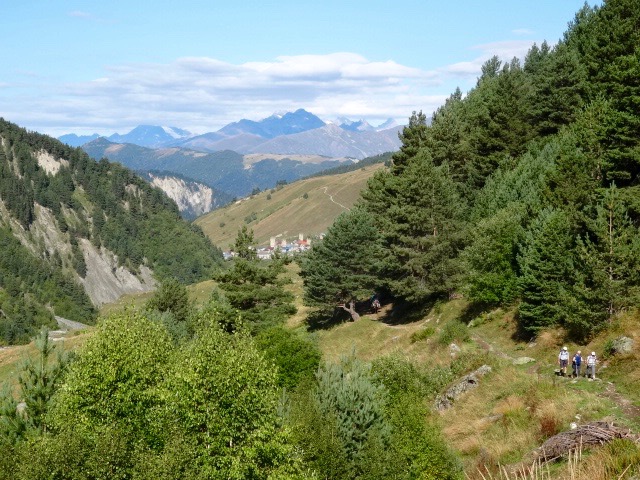
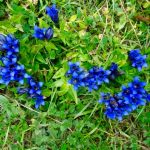
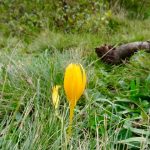
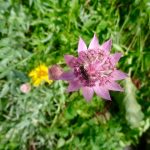
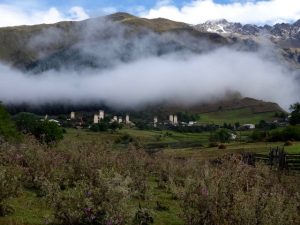 The following morning, the rain had passed, leaving trails of dragon’s breath across the slopes. Much of the humidity had gone and the conditions for walking were much better. Today, the walk was much more significant, with an ascent of about 1000m, up through forests to the ski slopes near the top of the ridge. It was a beautiful walk through the rain refreshed trees and across meadows, still ablaze with some vibrantly coloured flowers, gentian and yellow crocus. Emerging from the trees we hit the ski runs, pristine with their winter cover of snow, but now stony scars on the hills, where the runs have been manufactured at the expense of all else.
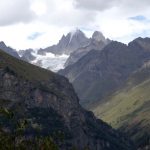
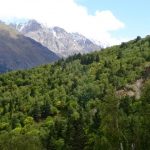
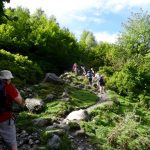
At the top we took some time out at a little kiosk café where Fraser treated himself to some red wine. It was revolting, and, when he couldn’t persuade anyone else to drink it, he was forced to throw it away. Georgian wine, we were learning, was good, but on this occasion, Fraser found that not always to be the case.
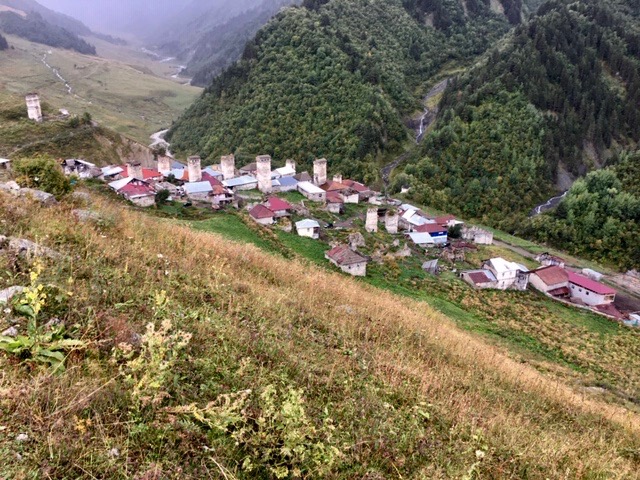
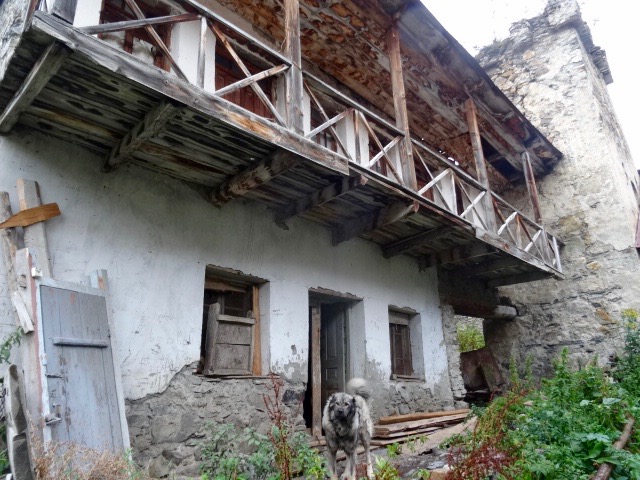
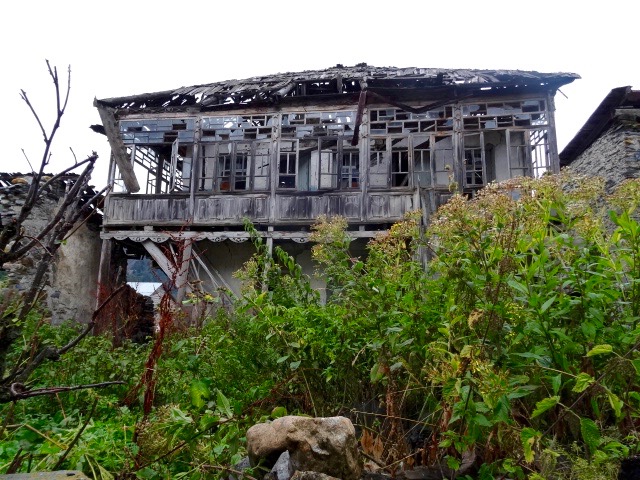
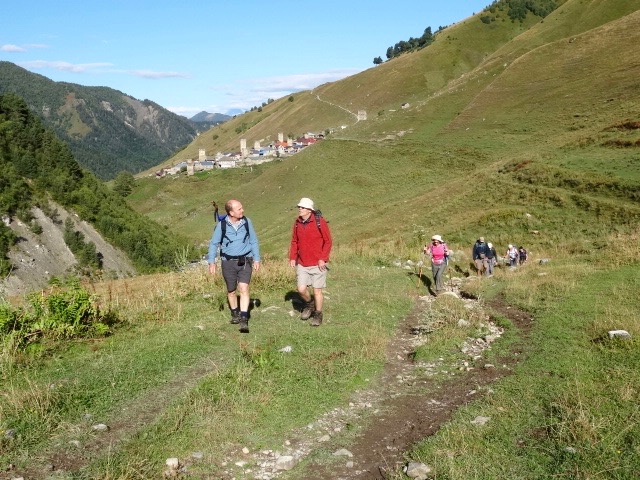
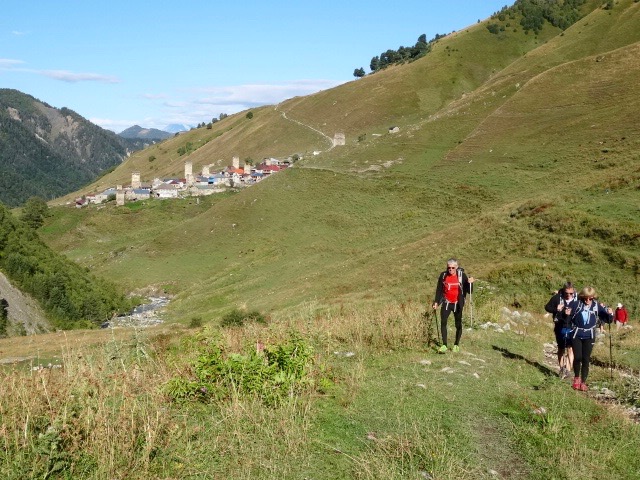
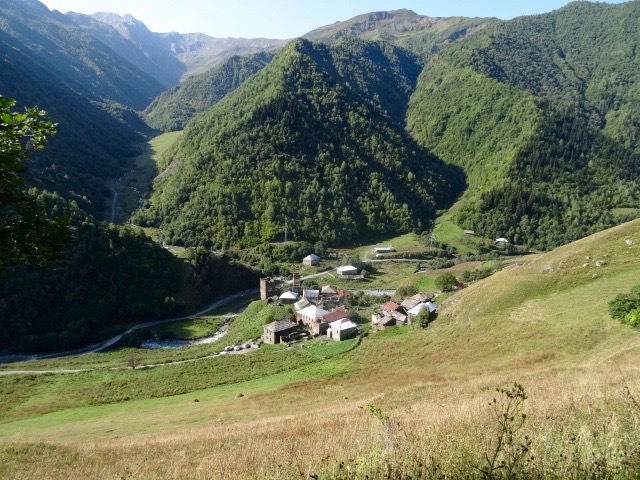
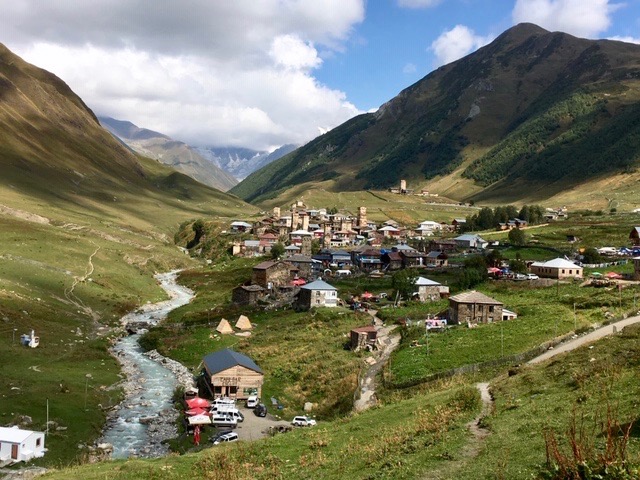
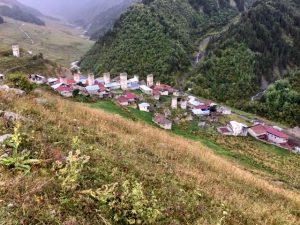 The descent brought the now expected afternoon shower before we finally descended into Adishi, which looked charming from our lofty approach, with its array of towers, old houses and farm buildings. On arrival in the village, we realised that we had stepped back in time. The paths through it were strewn with animal excrement, many of the houses were dilapidated and beyond repair. It looked as bad as any village I had seen in other parts of the world.
The accommodation was more basic with no en suite facilities, but it was comfortable, if a little crowded. At least Ian and I had comfortable beds, while David and Mike seemed to have old hospital type beds that sank uncomfortably in the middle.
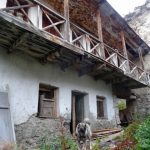
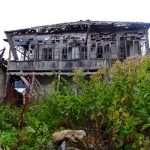
 Despite everything, Adishi is on the up. Five years ago, only three families lived in the village. Now there are twenty. There must have been close on two hundred tourists sleeping there the night we were there, all bringing much needed income to the community. They are talking about rebuilding the school. I think, in a few years from now, Adishi will have made significant changes and will hardly be recognisable.
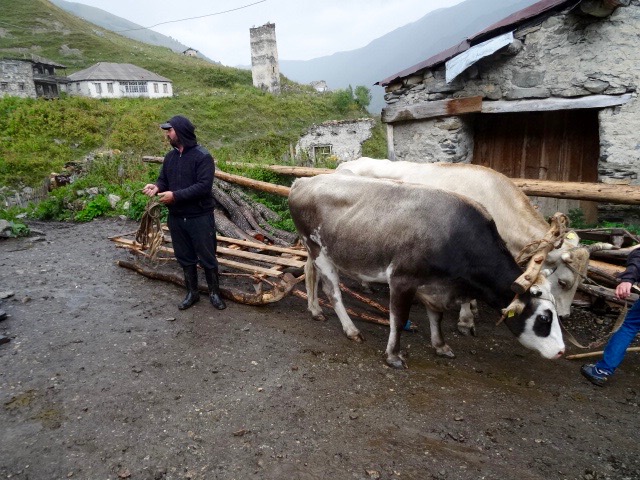
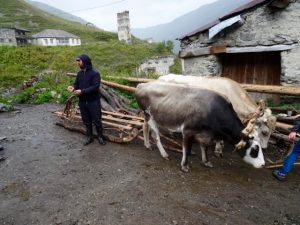 However, wandering around the village with David later in the afternoon, I somehow hoped it would not change too much. Watching an oxen towing a large wooden sledge over the stony ground is unique to this region. It would be a sad day if this ancient form of transport was replaced with a quad bike! Despite the cow shit on the paths and the dilapidated nature of the village, it has a charm that would be lost with over-enthusiastic development.
As with all mornings, we woke to a cloudless sky. From Adishi, we were taking our longest walk of the whole trek and climbing another pass into the next valley.
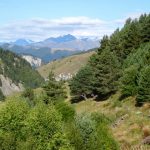
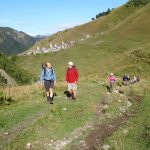
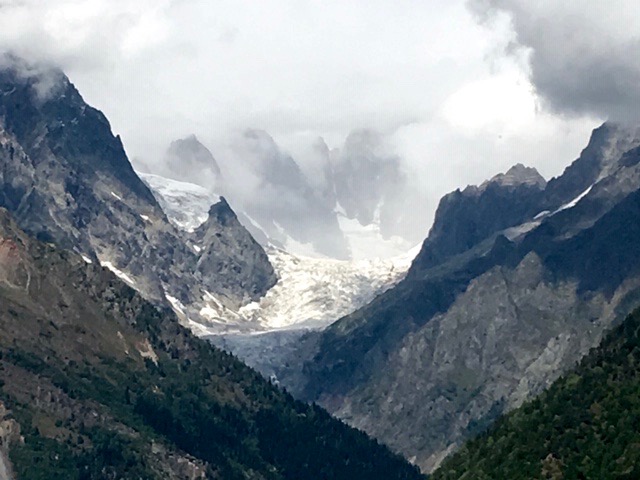
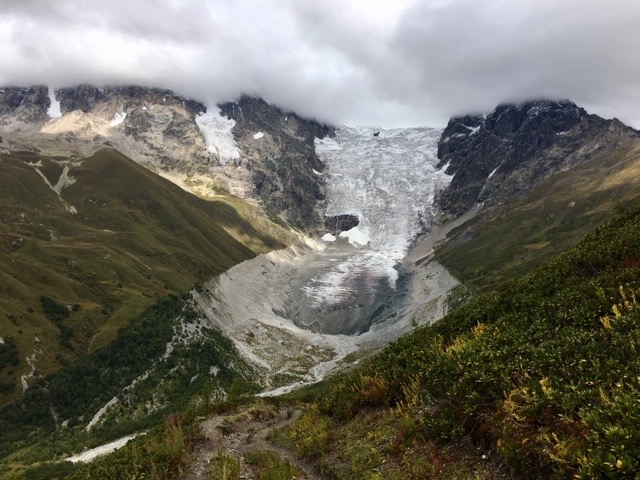
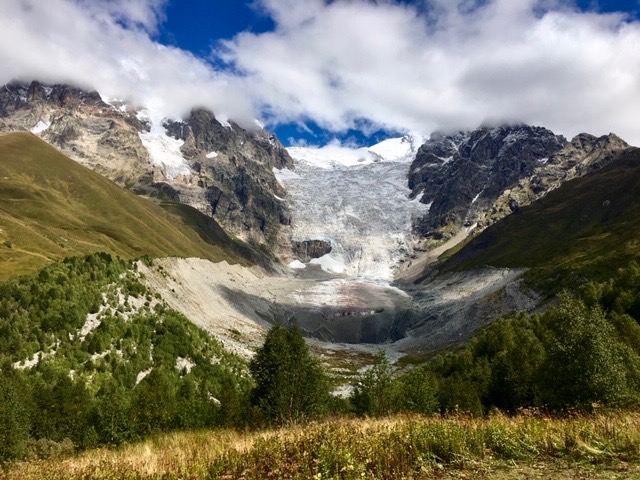
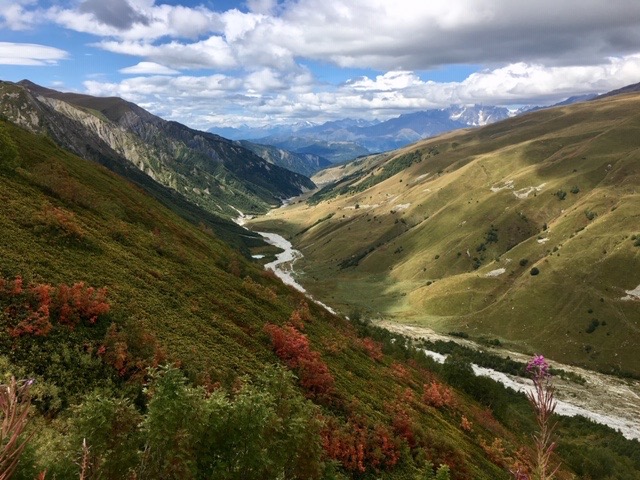
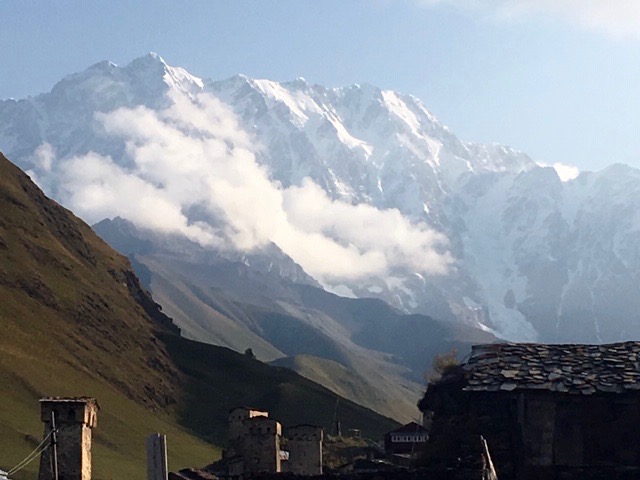
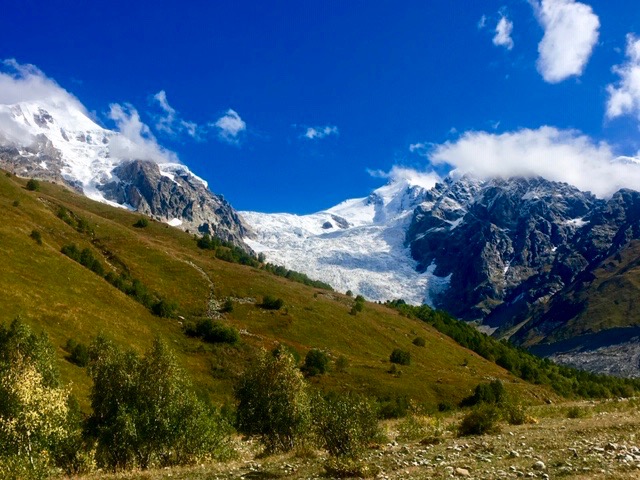
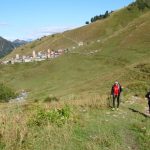 After the best breakfast so far, we headed up the valley from Adishi, climbing gently as we went. In the clear air, the views began to open out before and behind. Looking back at Adishi, we were amazed to see Mt Ushba again, with its spectacular rocky pinnacles piercing the sky. It is such a beautiful mountain. Ahead of us Tetnuldi and Shkhara were beginning to show themselves above lower ridges. Also coming into view was the spectacular Adishi Glacier.

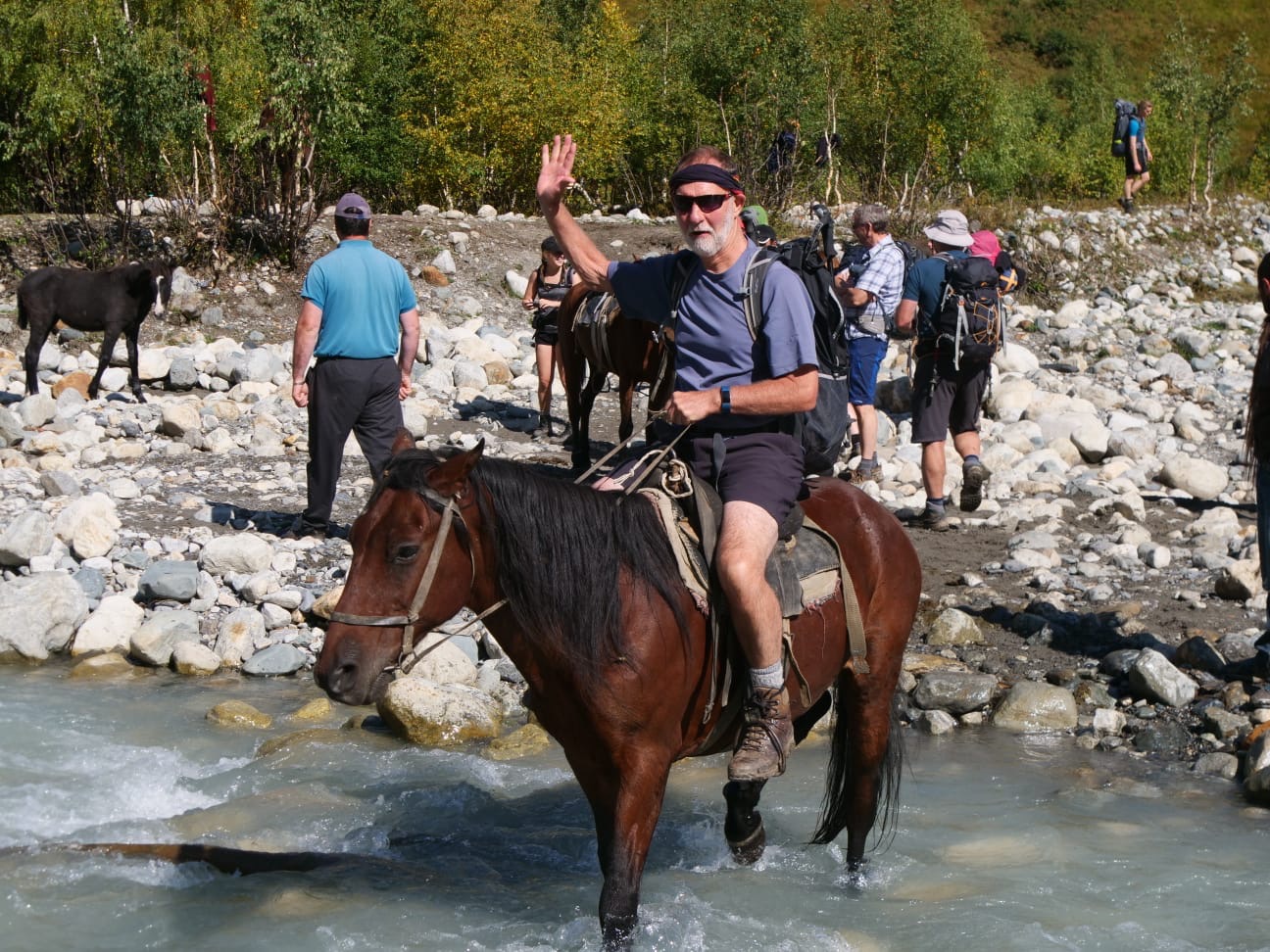
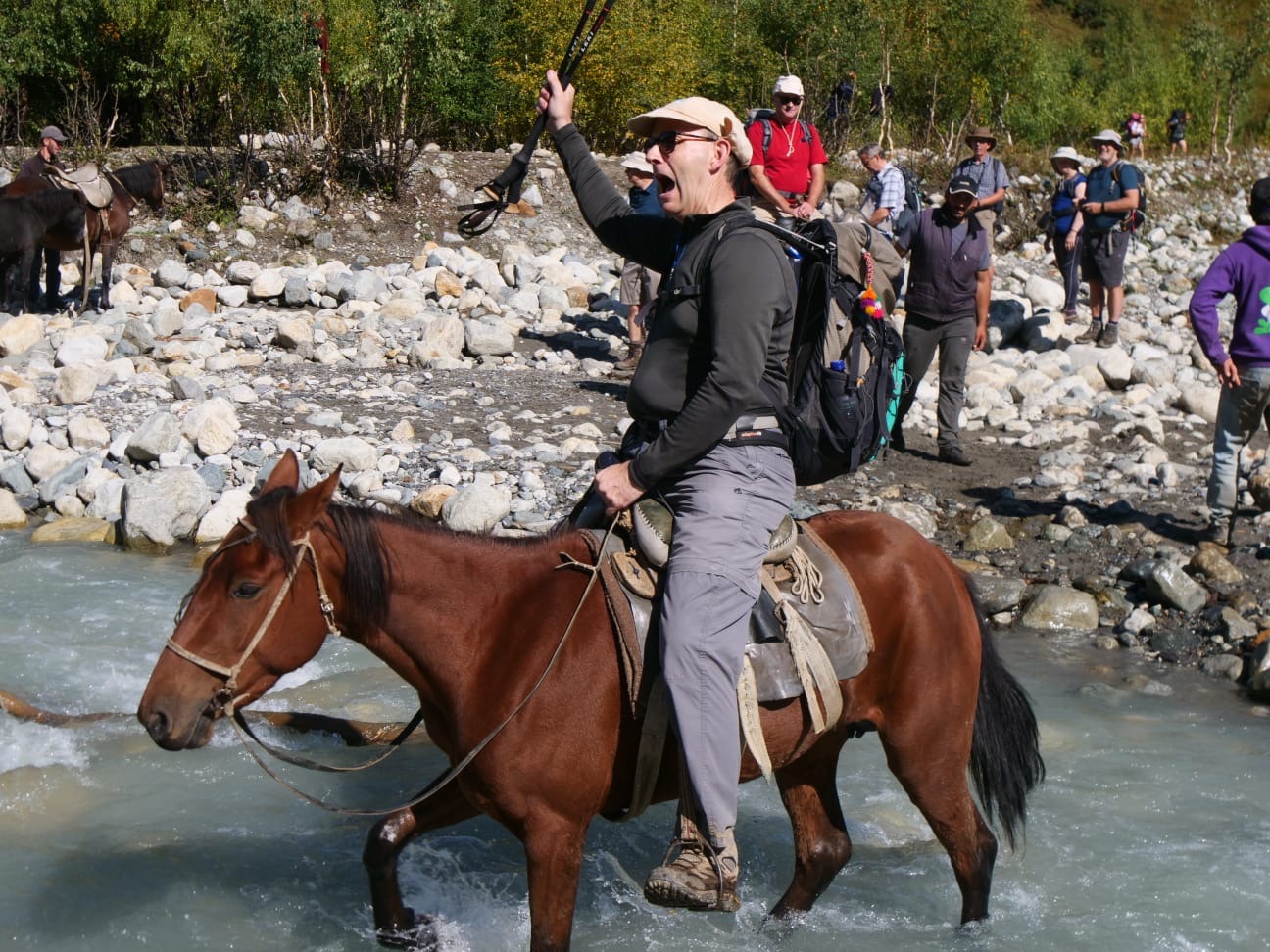
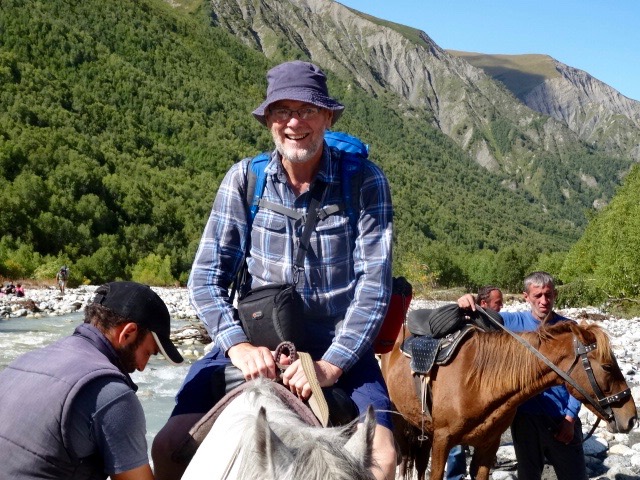
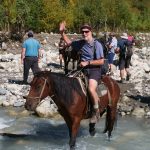
 Near the head of the valley we had a river to cross. In most circumstances, in most countries, we would have been expected to remove our boots and socks, put sandals on and cross on foot. Not here. Here we were provided with horses to carry us the 20m or so across the calf deep water. The horses knew exactly what they had to do, take on rider, walk across river, deposit rider, walk back a little downstream, take on rider etc. etc.
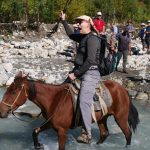
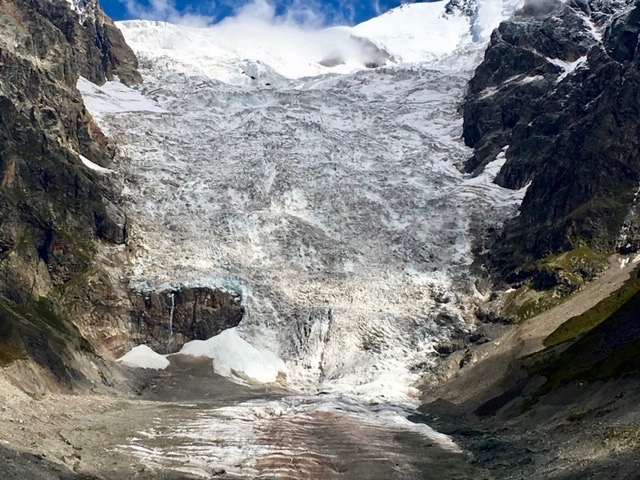
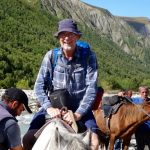 The bank on the other side was densely vegetated with fairly dwarfish trees. The main body of thr group set off before everybody was resdy and for those left behind there was a little confusion as to where the route went through the densely packed trees. We eventually worked it out and soon caught up with the rest of the group at a super vantage point for looking across at the glacier. Every so often, there would be a crack and the sound of falling ice, but by the time we had reacted, it was too late, the sound reaching us long after the event, despite the glacier being relatively close to our vantage point.
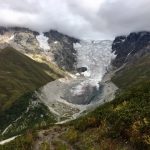
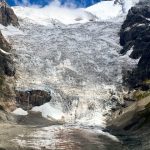
 We continued to climb, gradually emerging from the trees, which revealed more and more impressive views of the glacier. Traditionally, the cloud was beginning to envelope the summits, which slightly diminished the awe and wonder of the view, but only slightly.
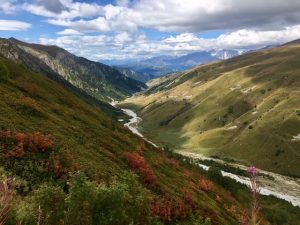 Now that we were above the trees the whole hillside was covered with dwarf rhododendrons as far as the eye could see. Occasionally, another species of shrub protruded from the canopy, but it was predominantly nothing but rhododendrons. I can only imagine the blaze of colour in the spring when they are in full bloom. A good reason to come back in June at some point in the future.
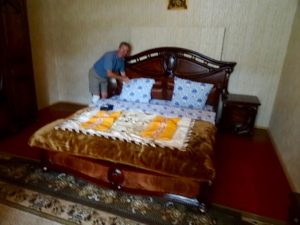 Reaching the top, we sat on the crest of the ridge and enjoyed our picnic lunch in very enjoyable surroundings. Then came the long descent, steepish to begin with, but then easing, all the way to Iphrari and our guesthouse, that, despite being described as basic (because of the shared bathroom), was lavishly furnished with some wonderful antiques, and a few oddities. At the top of the staircase, a large black panther and a large leopard guarded the landing. They were fine in the cold light of day, but made one start in the middle of the night as you stumbled your way to the loo.
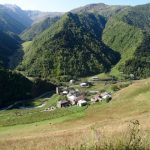 After two relatively difficult days with significant ascents, the walk up to Ushguli was easy. We started with a descent to Davberi and then climbed briefly up to some meadows, which in spring would have been a mass of colour. Then we traversed along the hillside, eventually dropping down to the road shortly before arriving in Ushguli.
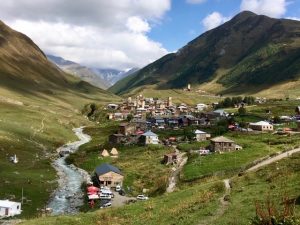 Like all the other areas we had visited, Ushguli is a collection of four villages. At around 2200m this is the highest permanent settlement in Europe. One of the villages, Chazhashi is a UNESCO World Heritage Site and some restoration of the buildings around the collection of towers has been carried out. Unfortunately, the four towers on the top of the small hill overlooking the site, were, with the exception of one, largely destroyed by the Russians who wanted the stone to build their cooperative farm nearby.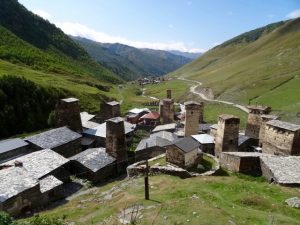
We were staying in the adjacent village of Chyibiani, which has seen a lot of development over recent years. Whilst it is important to be recognised as a World Heritage Site, it can also be the kiss of death for a community. We were fortunate in that we had taken five days to walk to Ushguli, but we are not the norm. Most people drive in on newly built roads. All need feeding. Most need accommodation. They all want souvenirs. Hence, new lodges have been built, new restaurants with lots of large red umbrellas on their terraces, all catering for the hundreds of people that arrive each day, because it is a World Heritage Site. There has to be a cultural and environmental cost. Give it a few more years, and it will be totally spoilt.
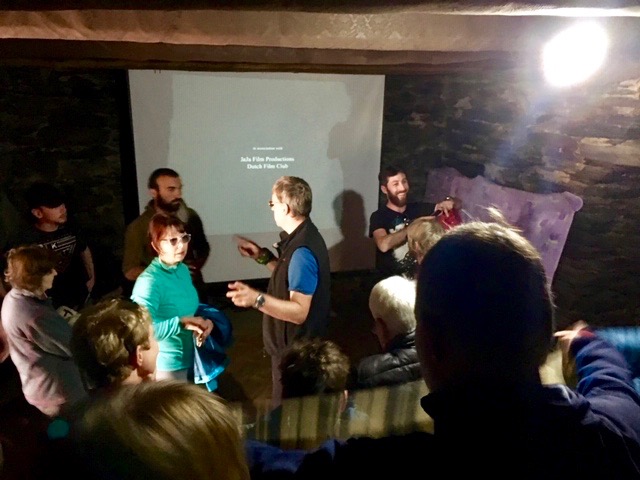
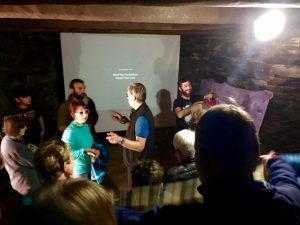 In the late afternoon we visited one of the towers, now converted into a cinema, to watch a film, Dede, the story of Svan life in the 1990s with vendettas, kidnap and murder. It was all filmed in Ushguli two years ago using local people as actors. One of the characters from the film showed us to our seats. Although much of the acting was wooden, it told the story graphically and posed more questions about the feuding families than it answered.
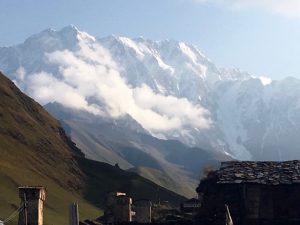 With just one more day of walking, following the Enguri River up to its source in the Shkhara Glacier flowing down from Georgia’s highest peak, Shkhara 5068m.
A number of the group had suffered during the week with a bug, which chose to affect me on this last day. I decided not to walk but to starve myself for long enough for the bug to clear through my system. It was probably one of the easier day’s walking, but I knew that I did not have the energy to enjoy it.
When everybody returned, we piled into our vehicles and drove to Mestia for our last night in Svaneti.
Our last day was a travel day, by coach, from Mestia to Zugdidi in the morning. In Zugdidi, we visited a super restaurant for lunch, but it was lunch with a twist. Alex had arranged for us to have a wine tasting during the meal. He chose three bottles, a white, a Qvevri and a red. It was all delicious, but what made it very special was that Alex knew everything there was to know about the processes and production.
Feeling satisfied we climbed aboard the coach for the last leg of the journey, another five or so hours, to Tbilisi. We eventually arrived soon after 8.00pm, twelve hours after leaving Mestia. It left us with little time to enjoy Tbilisi as we were flying early the next morning.
 This has been a fabulous trip with a brilliant group of people. Tbilisi is a beautiful city that I feel I must return to to give it justice. Svaneti is beautiful. The high peaks are dramatic and stunning. Culturally, it is fascinating. I’m not sure I would return to Svaneti, however, as I think it will spoil as more and more tourists invade it. I would like to explore the area around the peak Kazbegi, but in June when the meadows are in full bloom. Visit Georgia, our in country travel company ensured that our itinerary ran smoothly. They did us proud. However, one factor that made this trip so special was Alex. His knowledge, intellect and understanding was second to none. Thanks to Alex, we all had the best possible time.
Watch this space for June 2021, when I would like to return for another trip. Interested?
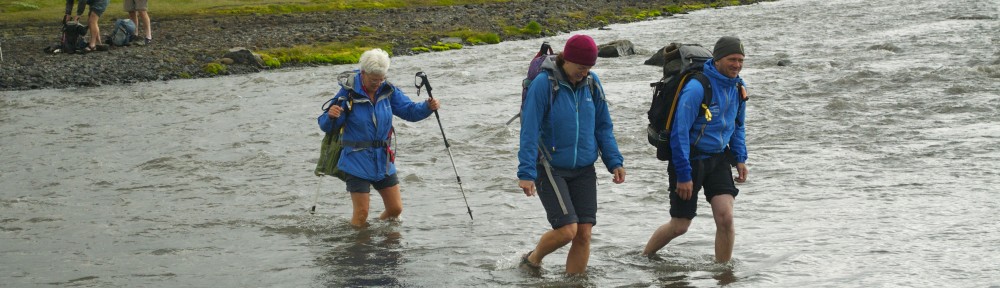
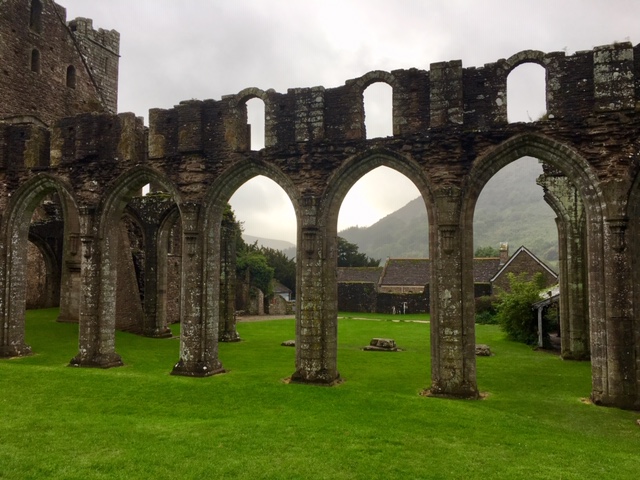 You may be forgiven for not turning up for this walk. A long spell of heavy rain and high winds battered the area throughout the night, with warnings of flooding on many rural roads. The forecast for the day was also very off-putting. So I was not surprised when there were only three of us gathering in the car park at Llanthony Priory at 10.00am.
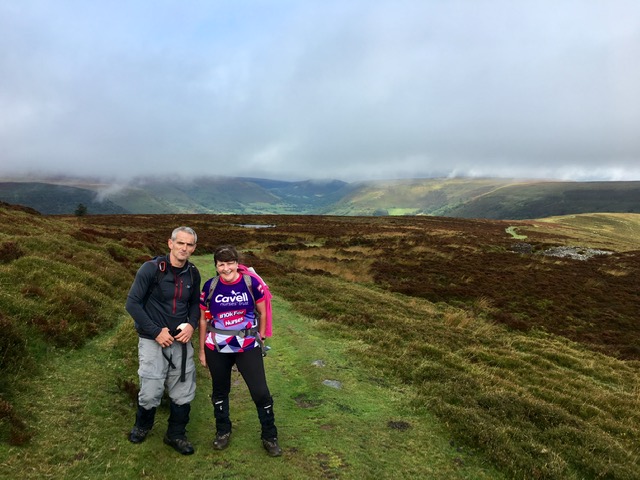 The cloud base was at about 600m and the varying shades of cloud and patchy light were much easier to appreciate in the flesh rather than via a camera. With the exception of two walkers who came towards us from the south, we had the whole ridge to ourselves, and the rain held off.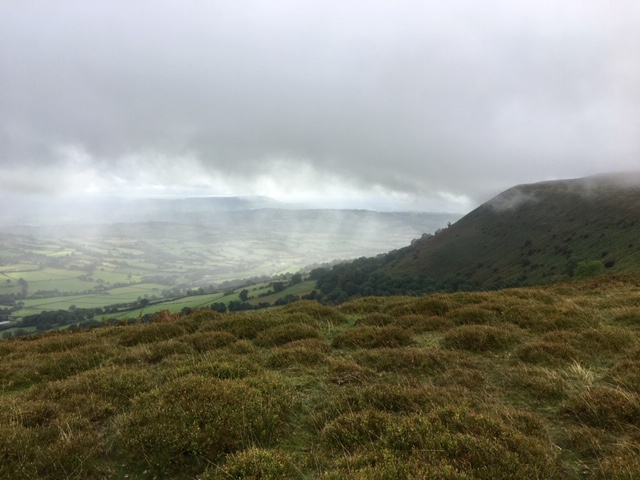
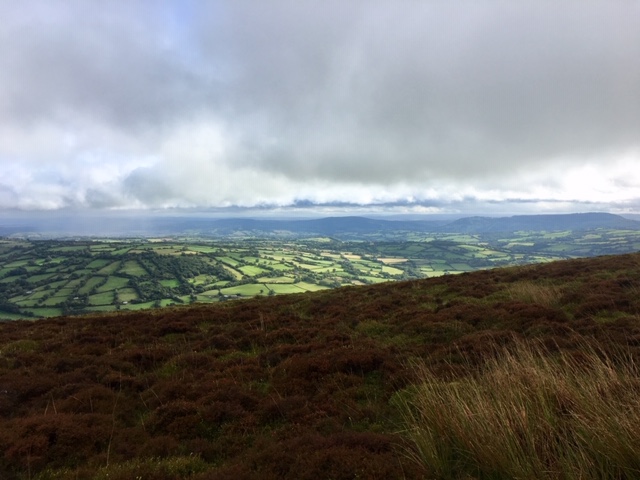
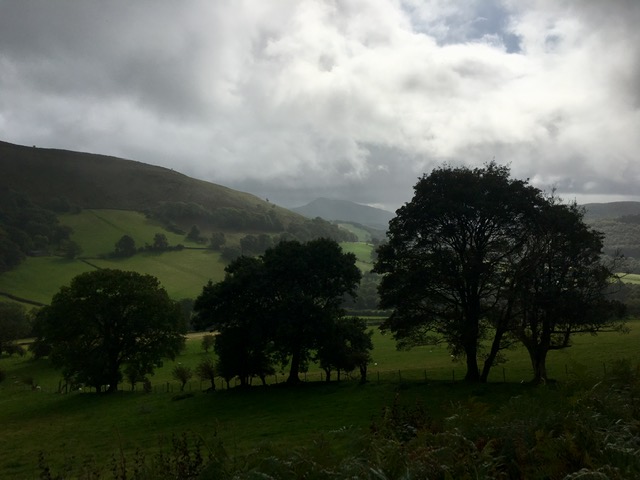
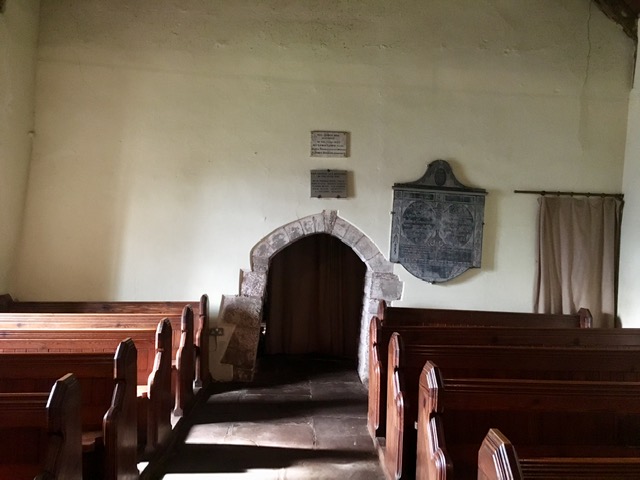
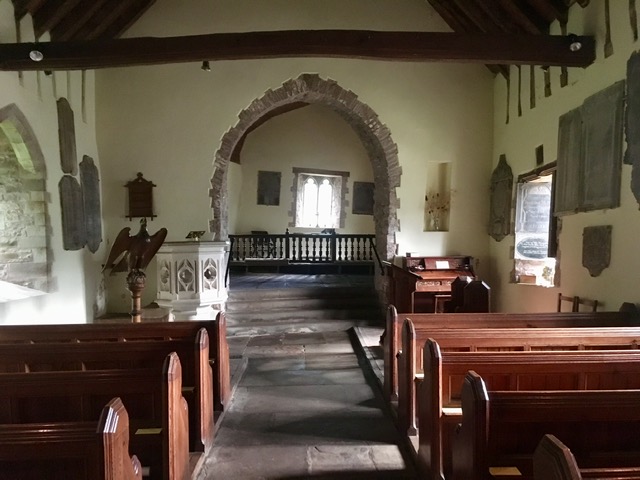
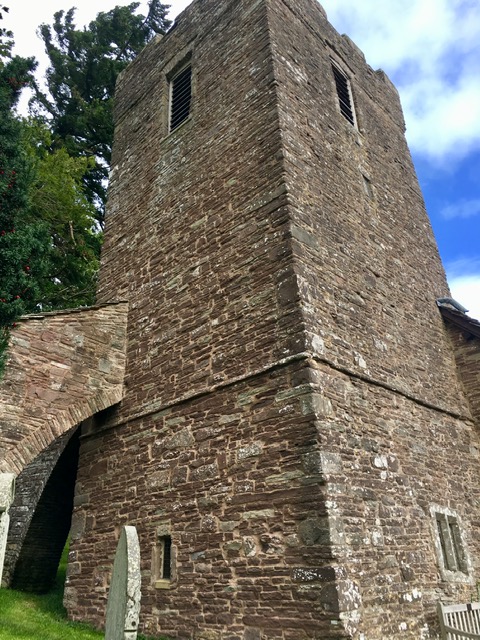
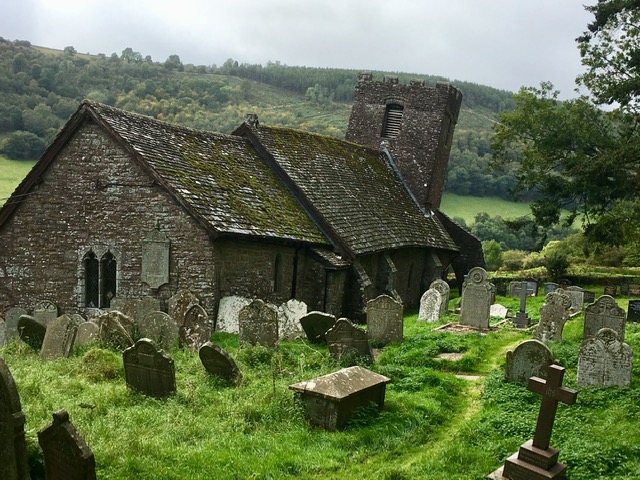 You can’t really do this walk without visiting the higgledy-piggledy Cwmyoy church, a victim of landslip and subsidence. Two large buttresses hold up the tower, which leans at a precarious angle. Like a double decker bus, how far can it lean before it falls over? Inside the church there are no horizontal surfaces. Pews slope down from the aisle in the middle. The window behind the altar slopes one way while the altar slopes the opposite way. Also, interestingly, there are no tell-tale cracks in the walls to suggest there is anything wrong. They must have done a great job patching up any imperfections.