The wind blew, the rain fell and we got wet. After five hours we ended up in the Skirrid Inn. Need I say more!?
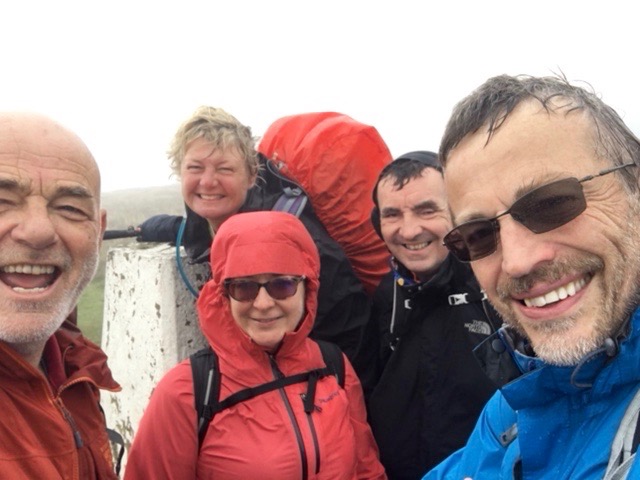


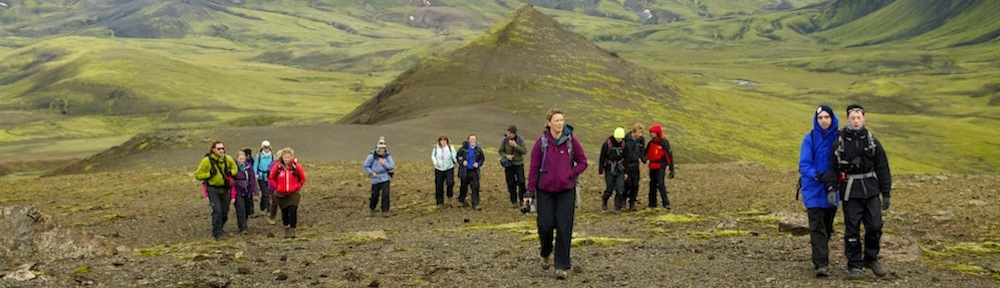
The wind blew, the rain fell and we got wet. After five hours we ended up in the Skirrid Inn. Need I say more!?
With the promise of settled weather for the week, and no rain, we left Upton to tackle the northern half of Offa’s Dyke. While the minibus went to Newcastle on Clun to pick up where we left off in June, I drove all the kit to Rhyd-y-Groes, near Welshpool, to set up camp. It was a hot day, and whether you were slogging up and down the steep hills just north of Newcastle, or putting up tents and shelters, you worked up a good sweat.
Meeting the group
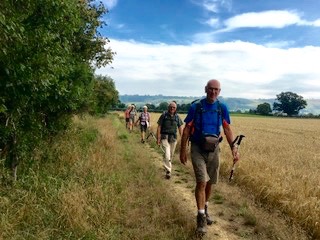
After four hours all was set up so I set out to meet the group coming towards me. Only they weren’t coming towards me. Five miles from camp they came upon Mellington Hall where they found they could enjoy a much deserved, delicious, afternoon tea. I was encouraged to join them but, as it would most likely take me at least an hour and a half to walk the distance from camp, it was never going to be likely. As it was, I met them about 10 minutes from Mellington Hall, and thus missed out on my much deserved treat. Perhaps, had I not stopped to talk to Bob, a lone walker, for a few minutes, I might just have made it. Instead, I returned to camp with the group, treatless!
Bob, or Rob, I was never quite sure which, was an interesting character. On my recommendation he had set up camp across the field from us. Being alone, we quickly invited him over for supper. While the food was most welcome, what he enjoyed most was the opportunity to communicate with people. Having been brought up in the area he was now walking through, he had spent most of his adult life working in schools in Scotland, largely in outdoor education. He seemed to be able to turn his hand to most things linked with the outdoors. In 1997 he attempted Everest from the north side but was forced to abandon his attempt because of bad weather. He had sailed across the Atlantic three times and the Pacific once, and soon after finishing Offa’s Dyke, he was flying down to New Zealand to continue with his sailing around the world. The nice thing about bumping into people on a trek like this is that they all have a story to tell, some rather more interesting than others.
The Vale of Montgomery
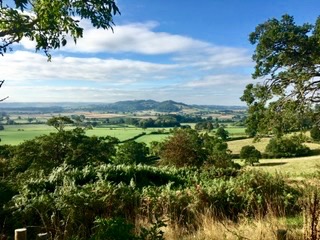
As we set off the next morning, Angela took Rob a bacon butty for breakfast. We climbed immediately up the hill from the Pound House and looked back at the Vale of Montgomery, the scene of one of the bloodiest battles of the First English Civil War in 1644. After the Royalist’s catastrophic defeat at Marston Moor, the Parliamentarians went on the offensive and captured Montgomery Castle. Wales had always been a Royalist stronghold so, in order to protect that loyalty a large Royalist Army was sent to the Welsh Marches to dislodge the Parliamentarians from Montgomery Castle and regain control. Unfortunately things did not go according to plan, the Royalists losing 500 men while the much smarter and capable Parliamentarians only lost 30.

The evolutionary shadow
A little later on we were walking along a stretch of the raised dyke with the sun in the east. The shadows cast caused some mirth when we realised that the evolution of man had not taken the course that we have all been taught. The shadows cast prove, beyond any doubt, that man evolved from tortoises and turtles. The photo clearly proves the theory. I wonder if you can identify the owners of the shadows? The one on the right is easy but do you recognise the fifth and sixth in line? They are a long way back in the evolutionary timescale!
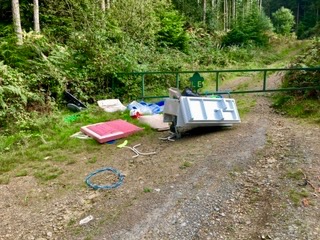 Later in the day we came across a scene that beggars belief. We walked up a steep track adjacent to some woodland. At the top we discovered a washing machine, a fridge and a mountain of other household detritus, dumped. The effort that they must have taken to dispose of their possessions in this way was far greater than if they had taken it to the tip. Some of it, particularly the children’s toys, were in reasonable condition and could easily have gone to a charity shop. What goes through people’s minds when they behave like this? They must have a completely different mindset to normal people!
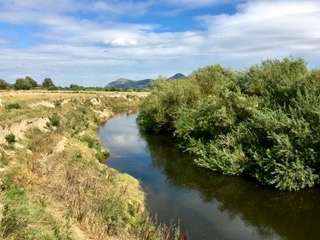
The River Severn
Having spent the early part of the day undulating over highland, we descended into the Severn Valley at Buttington and then spent the latter part following the river and the Severn Way. We stopped briefly in the Powis Arms Hotel where an unsavoury character behind the bar sullenly served us a drink. It is not a place I would rush back to.
The walking along the banks of the Severn (not that we saw very much of the river) was much easier but it also proved to be tedious. There was little or no variety, simply walking along the flood defences crossing field after field. It was a bit of a relief when we reached Rhyd-esgyn and Angela arrived to pick us up in the minibus.
Day three was damp. Hang on. At the beginning of the week we were promised settled dry weather. How could they get it so wrong? Angela took us back to the Rhyd-esgyn and we continued our trudge along the river. I have always had it in mind that I might, one day, like to walk the Severn Way, but this experience, if it has achieved anything, has told me not to waste my time. While parts of it may well be very interesting, there are large sections of it where it is not.
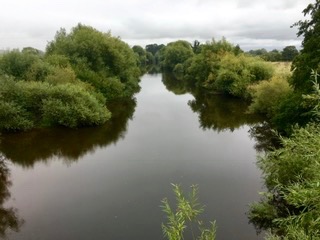
The River Vyrnwy
Leaving the River Severn behind, we picked up the Montgomery Canal near Four Crosses and followed it round, crossing the River Vyrnwy via a small aqueduct. The River Vyrnwy was much bigger than the Severn had been and looked significantly more interesting from the aqueduct.
Shortly afterwards we walked into Llanymynech where we found a cafe that served the best chocolate brownies, ever! While there the rain fell even heavier and before we left we had to don all of our wet weather gear for the climb out of the village. The climb, although steep, was interesting as it took us through an industrial, quarried landscape, with remnants of times gone by. As we climbed steeply up through the trees we began to realise that this was an old tramway, the means by which the stone was transported down the hill. Tunnels led through the hill from the Welsh side to the English side. Had the weather not been so horrible, we might have explored the area more thoroughly. As it was we just needed to keep going.
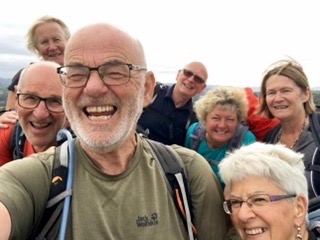
High point selfie
Because we had our heads down, we were making good progress. Our day’s target was Nantmawr but we were going to reach it in good time, so we decided that we would cut short the next day’s walk by going on to Trefonen. We stopped for lunch in Nantmawr, sitting in the parking space outside a house in the village. There was nowhere else suitable! At least it had by now stopped raining. Afterwards we continued to Trefonan, finishing in the carpark to the Barley Mow Inn and Offa’s Dyke Brewery. Unfortunately, neither were open, so we allowed Angela to take us back to camp.
We were covering the distances well and we had just one more day before we needed to move camp. It was a much better day again and, as we headed north, we were walking through some delightful countryside, a mixture of ridge, forest and pasture land.
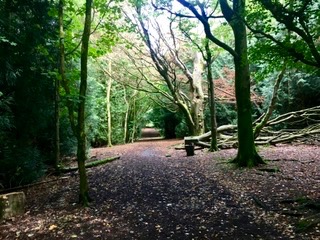
Ideal woodland for hiding in
At one point, while walking through the delightful woodland, we paused for a break. David, Claire and I were a little away from the rest of the group. They were all deep in conversation. I suggested we hide. The three of us took ourselves deeper into the woodland and waited to see if there was any reaction. There was absolutely none. They carried on without us, not a hint of concern in their conversation as they walked by us.
The walking was relatively easy, and because we had covered some of the distance the day before, we were able to finish at Pentre, where we joined the Llangollen Canal, reasonably early in the afternoon.
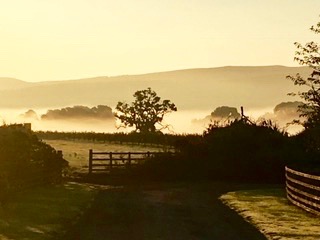 The following morning dawned as one of those perfect mornings. The sun was shining right from the start but with temperature inversion there was a mist clinging to the ground. A super way to start the day.
Before we could do anything we had to strike camp and pack everything away in the van for me to set up camp further north. Rhyd-y-Groes had served us well. It is a superb flat site, well maintained and the facilities were second to none. Helen Davies was welcoming and accommodating and we wanted for nothing.
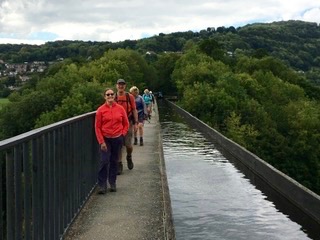 By 9.00am we were ready. I was not doing the full walk today, as I was going to set up camp, but neither Angela or I wanted to miss out on the opportunity to see and walk across the Froncysyllte Aqueduct, a World Heritage Site, carrying the Llangollen Canal over the River Dee a long way beneath. Here, the canal is very busy with narrow boats queuing at each end to take their turn. I thought there might be some form of control, but there appears to be none. It seemed to cause some anxiety to those wanting to cross. Walking across caused us no logistical problems, but the exposure, however safe you might be, left you feeling slightly giddy.
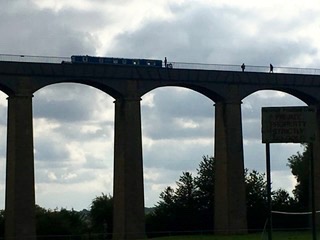 Having crossed, we enjoyed a coffee before Angela and I left the group to continue with their northward journey while we walked down to the road bridge over the Dee. This gave us an opportunity to look up at the aqueduct, which is probably even more spectacular than being on it. This led us back to our vehicles and on to Llyn Rhys Campsite where I spent the bulk of the remainder of the day setting up camp in readiness for the group to walk into after their hike, a hike that, I must admit, I wished I could have done. It took them over some wonderful moorland, affording panoramic views across North Wales to Snowdonia. They arrived in camp very satisfied with their day, and extremely grateful to see camp set up with kettles boiling and cake served.
The next day we started to walk along the chain of the Clwydian Range. Unfortunately, the weather had turned again and it was simply a matter of heads down and get it over and done with. There was a strong, cold wind blowing so there was little or no desire to stop along the route. There were also no photos as there was nothing to capture as our heads were in cloud most of the day.
I think it is fair to say that I can be quite competitive, not necessarily with other people but also against myself. During the course of the walk we had a long steady climb. I was in the lead but I sensed somebody was at my right shoulder. I thought it was Trevor, who, at 75 years of age, is incredibly fit. I was about to turn to him to tell him to act his age and slow down, when I discovered it was Celeste who was pushing me up the hill. I was not going to be beaten. As hard as I pushed myself, Celeste kept up the pace, although she was pole assisted while I was freestyle. I really could have done with a rest but I was not going to give in. Near the top, I paused to look round to see where the rest of the group were. Celeste also paused and was caught off guard when I sped up the last few metres to the top! Testosterone 1 Oestrogen 0. Later, Trevor took on the challenge with Celeste, and although he is almost 26 years her senior, he beat her to the top. Perhaps she was tired from trying to keep up with me earlier. Testosterone 2 Oestrogen 0. How satisfying is that? At least it kept us warm.
We were only grateful that our finish at Bwlch Penbarra coincided with Angela arriving with the minibus to whisk us back to camp before we became really chilled.
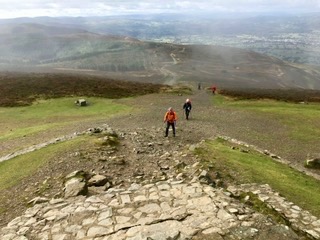
David and Trevor approaching the summit of Moel Famau
Cloud still hung about the tops and there was still a little rain in the air as we set off the next day from Penbarra to cover the northern half of the Clwydian Range. As the morning progressed the weather improved and we were treated to some far reaching views across to Snowdonia where we could identify the major peaks of Tryfan, the Gliders, Snowdon, and the Carneddau. Before we could see these magnificent views, we had to climb Moel Famau, at 554m, the highest point of our ridge walk. On the summit there is a partly built beacon, started in 1810 to celebrate the jubilee of George the Third. Poor foundations meant that it was never finished but renovation work was done in 1970 to restore it to its present state, without the tower that the original architects envisaged. There was still a cold wind blowing across the summits.
It was a delightful walk, only spoilt by the fact that I was having trouble with my left knee, and then my back. In the end, David forced some pain killers down me and I was able to continue, gingerly.
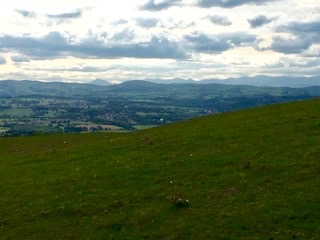
Snowdonia
The forecast for our last day was pretty diabolical, so we decided to capitalise on the good weather of the day and walk further than planned. Originally we planned to finish in Bodfari, leaving us with twelve miles to cover in the forecasted heavy rain. So, to reduce the misery, we decided to continue on to Rhuallt but not before we enjoyed copious cups of tea, chocolate brownies and ice cream is a very smart pub in Bodfari. The church bells next door were peeling out a very sombre tune, causing us to assume that there was a funeral. It was only as we were having our treats in the pub that very smart, brightly dressed people with button holes came in. It was a wedding.
The walk along to Ruallt was a bit harder than expected and took the daily distance up to 15 miles. It would not ensure that we would stay dry the next day but it would save us at least two hours of misery.
The last day was wet and it did not take very long for the rain to penetrate our waterproofs. The fact that we were moving kept us warm. I had anticipated that it was going to be a pretty easy walk as we were now on the coastal plain. Not so. Just when we thought we were close to the finish and we could see Prestatyn, there was a sting in the tail. The route took us steeply up to the top of the cliff, away from our final destination, presumably to give us outstanding panoramic views of Prestatyn, the North Wales coast and the masses of wind turbines about a mile off shore. But their was nothing to see as the climb took us up into the murky cloud. I think that is when I felt at my lowest on the whole of the trip. It seemed so pointless. On a good day, I am sure it would have been magnificent, but not on this day.
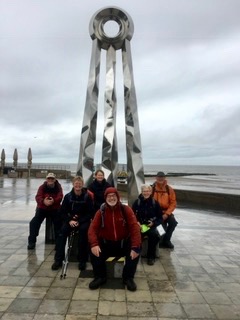
The End!
Eventually we dropped down into Prestatyn, which turned out to be a much pleasanter town than I was expecting. There we marched through the rain sodden streets to the end of Offa’s Dyke. We had covered, in the two legs, 177 miles of, largely, beautiful country.
Having completed the walk we went into a nearby cafe where we could get out of some of our wet outer clothes and drink some warming tea and coffee. The weather may not have done what it promised at the start, but, let’s face it, it would be boring if the sun shone all the time.
Over the two legs, we have had a lot of fun and I am extremely grateful to everyone for the enjoyment they brought to these trips. I am also extremely grateful for the support given me by David (even if he does get his distances wrong), Angela and Annie who tirelessly work to make camp and the logistics run smoothly.
Next year we are walking the Two Moors Way. If you haven’t booked already, I am afraid it is too late. We are full.
Having paddled the length of the River Wye last week and written about it, I felt I needed to have a different approach to this week’s two-day trip.
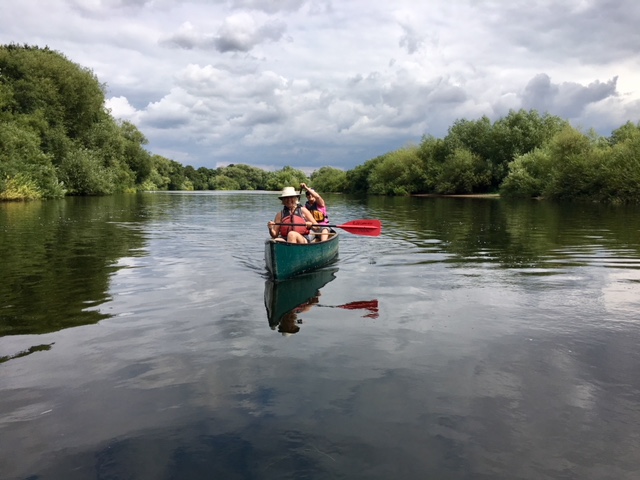
Chris & Angela
We were told the day before our trip that we would not be able to travel through the rapids at Symonds Yat as vital maintenance work was being done to the groynes that channel the water. Although the experience is short-lived, and underwhelming in the present conditions, I thought it necessary to add a little entertainment into the itinerary. I know how certain individuals within this particular group hunger for some excitement that enhances their experience and gives them something to talk about for months.
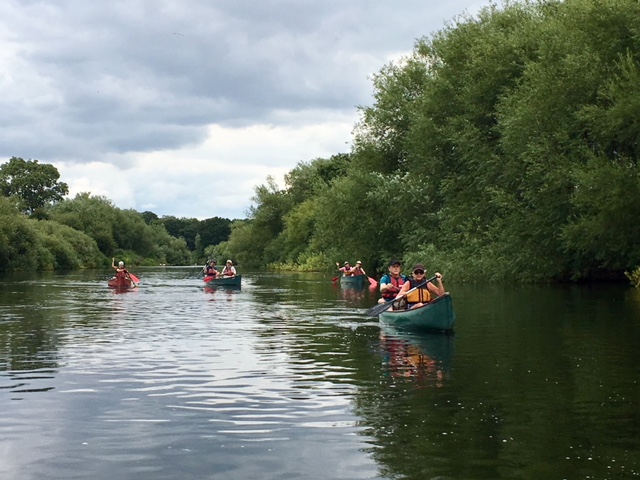
The whole team
The first incident took place at Kerne Bridge just before lunch. I was well aware of a problem on a sweeping, narrow stretch of fast flowing water that took you very close to the bank. It is where we had a spillage last week when a canoe hit a protruding tree stump just above the surface. I gathered the group by the bridge so that they could see the problem and advised them on how to approach it. That said, the protruding stump could not be seen. Then, one at a time each canoe went through the area of concern. Angela and Chris got their line wrong and hit the bank but managed to stay afloat and somehow bumbled through. Sitting nearby in his canoe was an instructor from another company. As I passed him I said, “Why is it always your wife who embarrasses you and gets it wrong.” With that I entered the fast water, knowing instinctively that I had got my line of entry wrong. There was no way I could bring my canoe round that sharply and I found myself in a web of willow branches and then I hit something more solid. The combination of a sudden stop and branches pushing against me, tipped me out if the canoe and turned it over. It all happened so quickly. I soon found the stump, it was now under the surface and my canoe was stuck on it. As I struggled to release it I discovered that I could only just put my feet on the riverbed and keep my head above water.
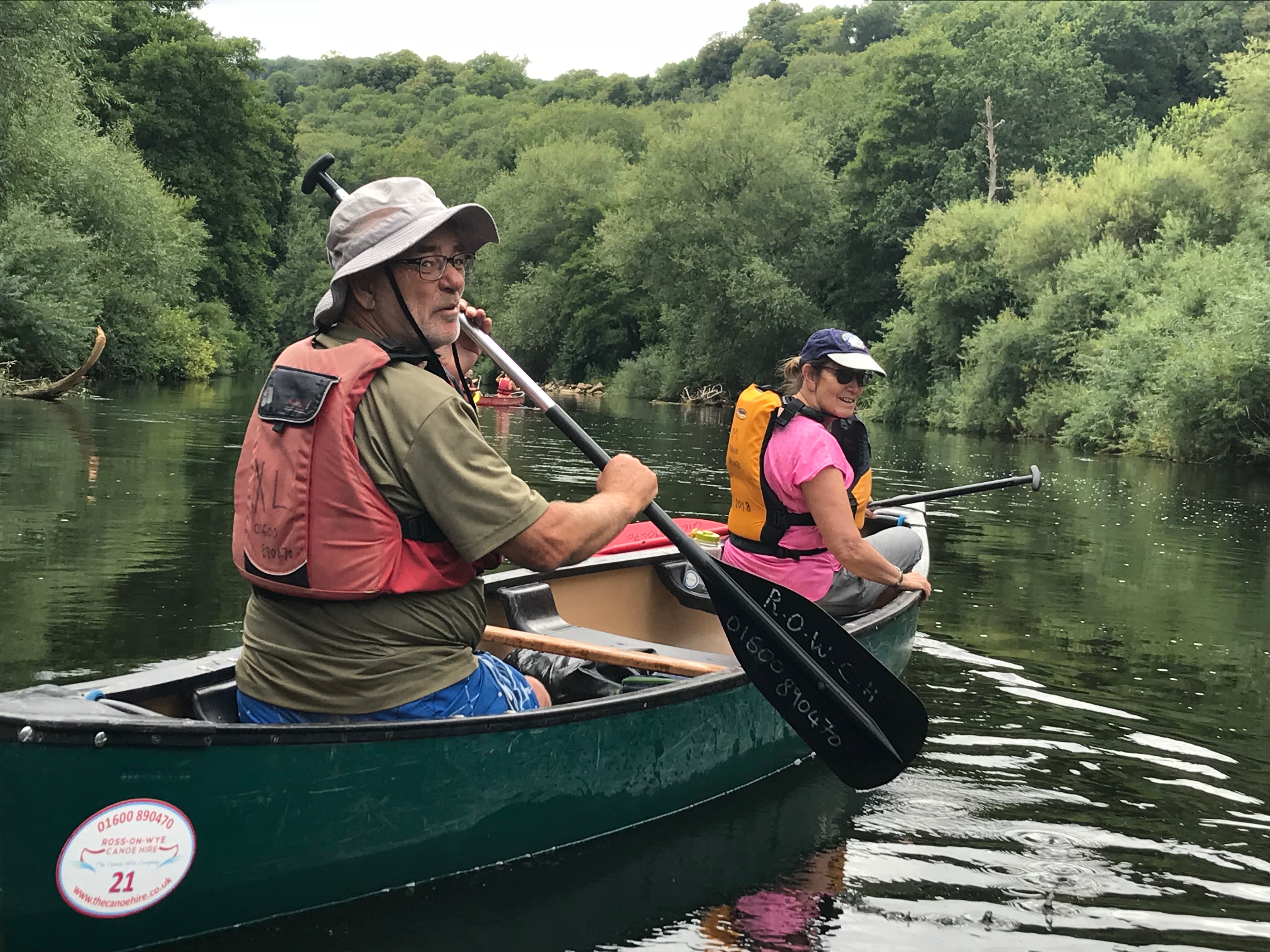
In drier times! (Photo Chris Woodcock)
Whilst all this was going on I was also aware that I was wearing a non-waterproof Fitbit on my wrist and my non-waterproof iPhone was tucked into the pocket of my life vest! The instructor who had watched my demise unfold came to my rescue and helped me release the canoe from the stump, empty it of water, turn it over and retrieve most of my kit, which remarkably had remained in the upturned canoe. Those ahead of me could see that I had come out of my canoe but were in no position to turn round and help. I was fine. Yes, I was wet but the water was not cold and I had retrieved everything from the river, except my Sigg bottle.
When I, a few minutes later, went for lunch at the Inn on the Wye, I discovered that both my Fitbit and phone were none the worse for their soaking. It was my first canoe capsize after several years of travelling down the Wye and everybody found it hugely amusing, including me.
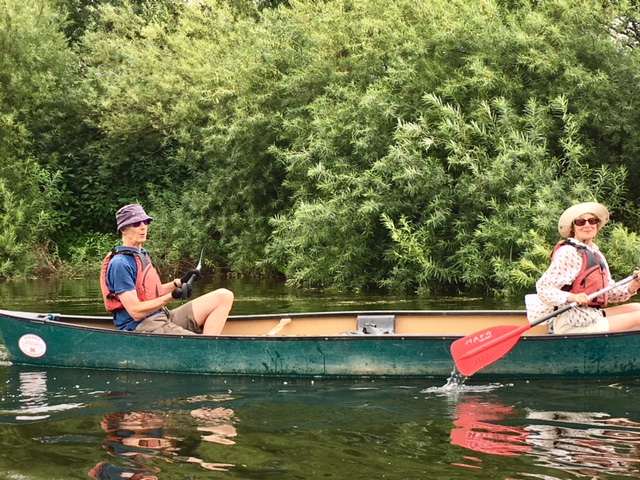
Tim’s long body is not suited to hours of sitting in a canoe
Nothing dramatic happened in the afternoon as we paddled through the gorge and around the huge loop into Symonds Yat. I say nothing, but Tim’s back was suffering so Angela and I hitched our canoe to theirs and towed them in for the last mile or so. Tim was very uncomfortable and he came to the sensible decision that he and Beryl would drop out of the second day. A shame, but much the best decision.
We had a lovely evening together in Ye Old Ferrie Inn, eating, drinking and catching up with a beautiful outlook on to the mirror flat river.
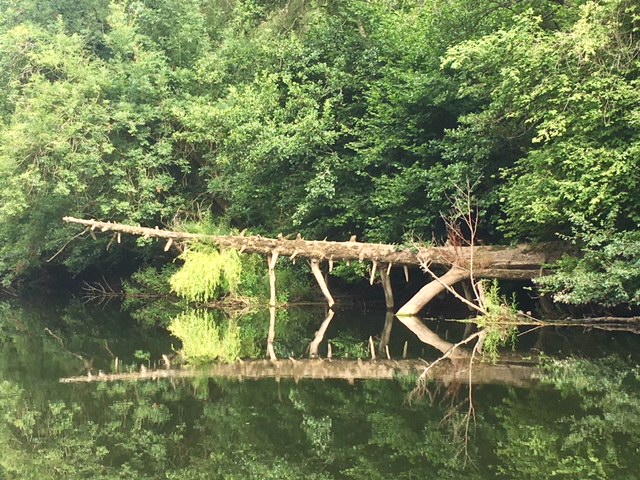 The following morning the river was still like a mirror and there was hardly any flow in it at all. A couple of kingfishers sat on the hand pulled ferry staring intently into the dark, still waters in an effort to find breakfast. Finding ours was much easier and much more tasty than raw, live fish. Ye Old Ferrie Inn had looked after us well.
Ross on Wye Canoe Hire picked us up from the inn and took us to Biblins on the down river side of the rapids where we launched for our 10 mile trip to Redbrook.
It was a lovely morning, generally cloudy but still quite warm. As we passed through the deeply forested gorge the trees on either side were reflected perfectly in the river. A two foot salmon leapt out of the water across our bows and very nearly ended up in our canoe.
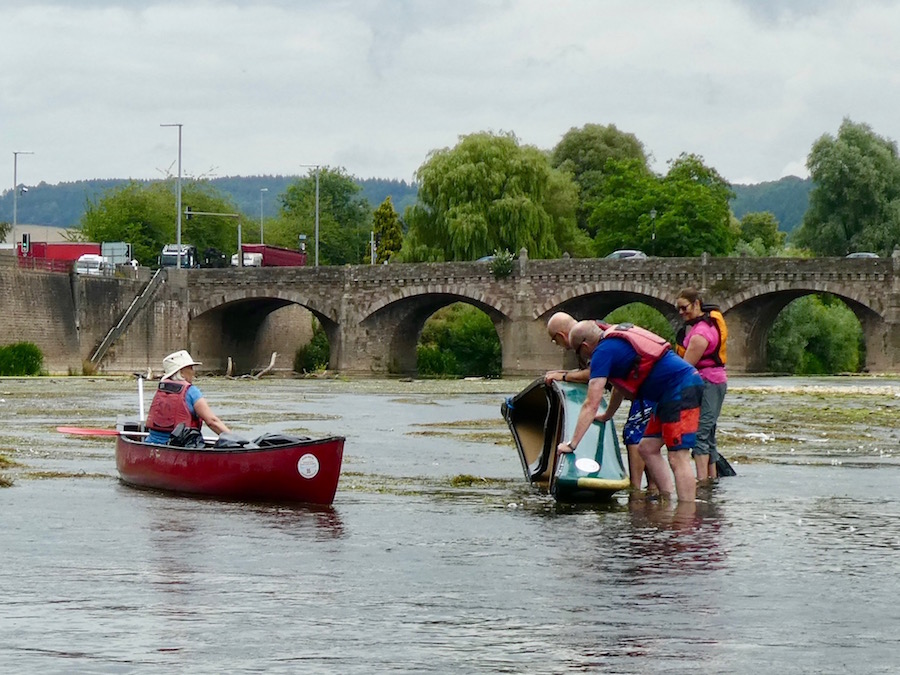
Picking up the pieces after the “Mayhem of Monmouth!” (Photo – Claire Cox)
All was going really well. We made excellent progress down to Monmouth, arriving at the boat club steps at midday, too early for lunch, particularly after the substantial breakfast we had eaten earlier. We continued, passing under Monmouth Bridge. Here the river is quite wide but much of its width is too shallow to navigate, even in a canoe. Angela and I were in the lead canoe and we headed for a narrow channel of fast flowing water tucked in against the left bank. We aimed for it but got too close into the bank and an overhanging willow tree. It was not my intention that we should explore the tree closely but the flow made it impossible for us to avoid it. In the middle of the foliage was a thick, cut off trunk, which stopped us dead in the water and tipped Angela over the side, quickly followed by me, with the canoe ending up upside down. It was so funny to see Angela with a bemused look on her face, her sunglasses askew, having been fully submerged. Our so-called friends in the canoes behind, as well as coming to our rescue, were highly amused by our spectacular exit from our canoe. While there were no pictures of the actual event, some were taken of the aftermath, I think by Claire. Again the watch and phone survived the dunking, although the phone seems to have developed a white line up one side of the screen. I have also, subsequently discovered, that if anybody rings me up, I can’t hear them. The perfect phone!
I think Angela will receive enormous amounts of sympathy but I am destined for a lifetime of stick! Well, if it makes them happy.
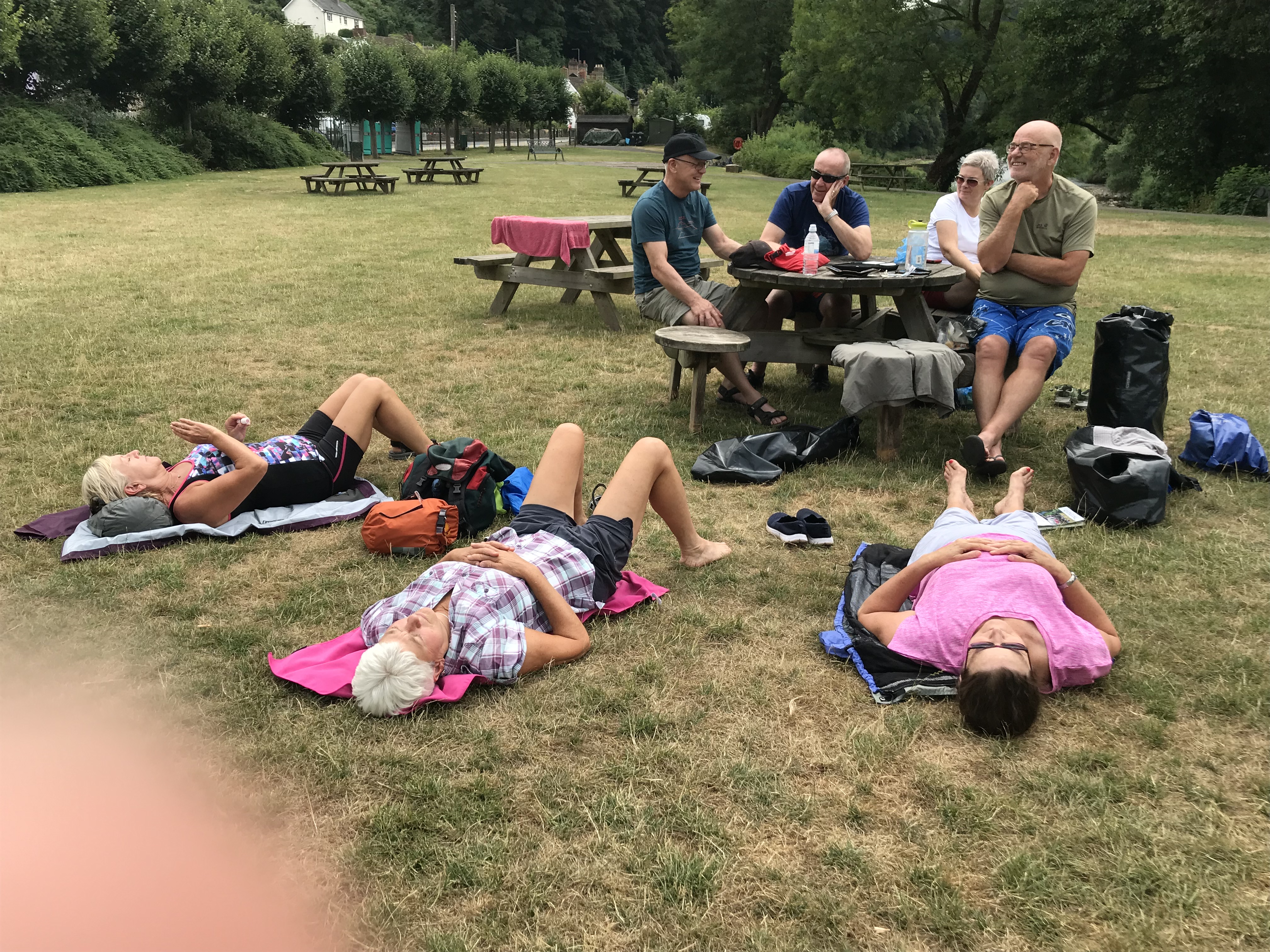
Finished (Photo by Chris Woodcock and it is her thumb!)
By the time we reached Redbrook we had dried off. Mark, from Ross on Wye Canoe Hire picked us up. He quickly learned of my demise and, like most who know me, was amused.
I have had two great trips in the last couple of weeks, made special by the people I have shared them with and by the excellent service provided by Mark and his team at Ross on Wye Canoe Hire. Thanks to all.
With the summer we are having it was never going to be easy, even after the wet spring we had had. Everybody involved in the Wye, from the guys at the canoe hire to the fishermen we encountered along the way, they all said they had never known the river so low. So low, in fact, that it was deemed impossible for us to launch at Hay. We would be much better launching five and a half miles up stream at Glasbury, making our first day, potentially, very long.
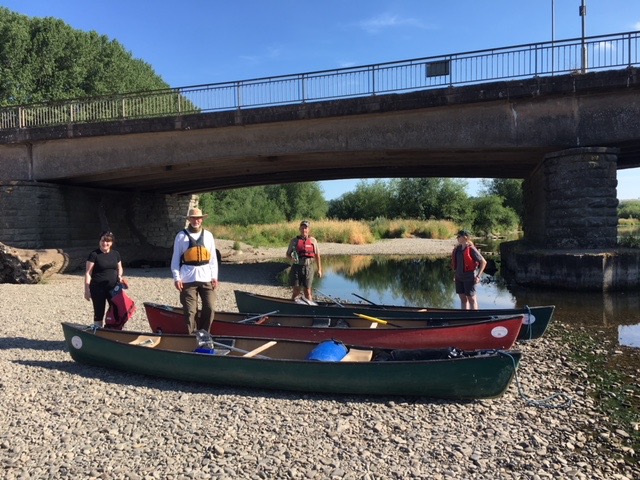
Ready for the off
Despite the signs telling people not to launch until 10am we made preparation. Apparently this rule is so that the salmon can rest! Unable to wait until 10 we embarked upon our 84 mile journey down the Wye. We did not come across any complaining salmon, but we did encounter a lot of shallows where all we could do was climb out and drag our canoes through into deeper water.
It took us two hours to reach our previously designated launch spot in Hay, and ironically, a guy from another company directed us down the channel which we understood to be impassible. It was entirely so but by now we were well used to wading through ankle deep water dragging a canoe. It meant that we had not only lengthened our distance by five and a half miles but by late morning we had still only reached our starting point with a full day of paddling still ahead of us.
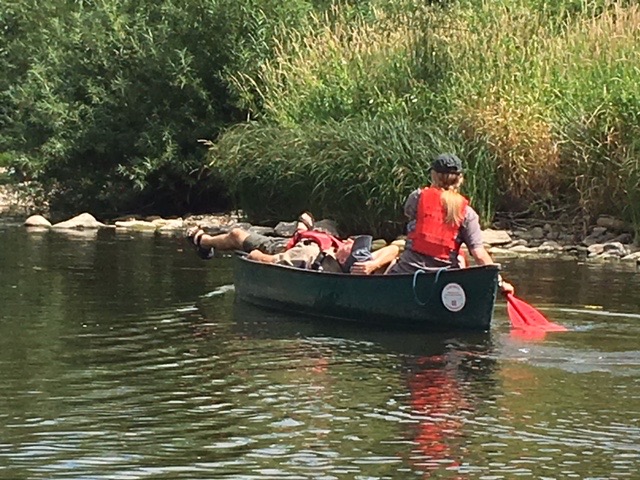
Nic taking it easy while Natasha does all the work
It was proving to be hard work, not just the dragging, but the river, where it was deep enough, was giving us no assistance whatsoever. There was no discernible flow and we had to work hard all the time. I found it particularly so as I was travelling solo. At least when travelling in pairs you can take a rest while your partner maintains some forward travel. That said, I was enjoying the additional challenge of propelling myself downstream.
The river was very quiet. There were no fishermen, they being dissuaded by the poor conditions of the river. There were plenty of heron but they were so timid by our presence on the water, that they flew off long before we drew level with them. There were very few kingfishers. Either that or our eyes had not yet adjusted to spotting them as they dart from bush to bush at the water’s edge. The good weather had brought people out, and just before Bredwardine we came across some naked sunbathers on the river bank, who plunged into the water as soon as we had passed.
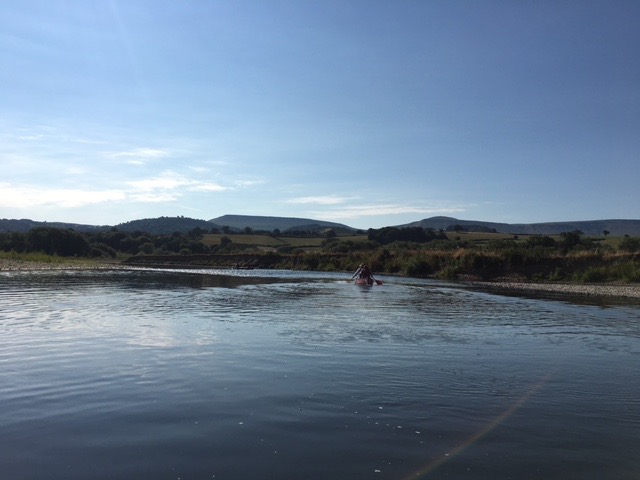
The Black Mountains
More often than not on a journey of this nature your horizon is the river bank. Occasionally, where it rises further you can see splendid houses with sweeping gardens down to the water’s edge. On this stretch of river the Black Mountains rise sufficiently high for them to be visible for much of the journey. Against a clear blue sky the summits of Hay Bluff and Twmpa stood out clear and proud.
Under normal conditions I would have expected to reach camp at Bycross by about 4.00pm but with the difficulties we had faced and the sluggishness of the river, we did not reach camp until 7.00pm. We had been on the water for about ten hours and covered about 23 miles. It was a tough introduction to paddling on the Wye for those who had not done it before.
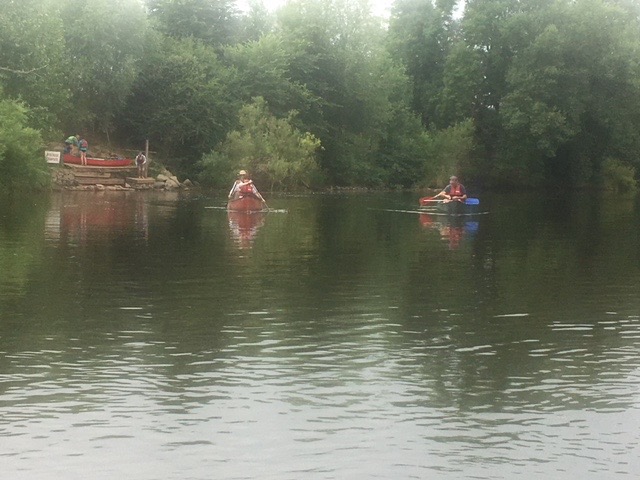
Leaving Bycross
As the second day was potentially our longest with 29 miles needing to be travelled to Hoarwithy, I was keen to make an early start. Despite getting up at 5.30am it was still two hours before we got on to the water. Nic had warned us that he was not a morning person. I discovered that the best way to get him going was to take him a cup of tea in bed.
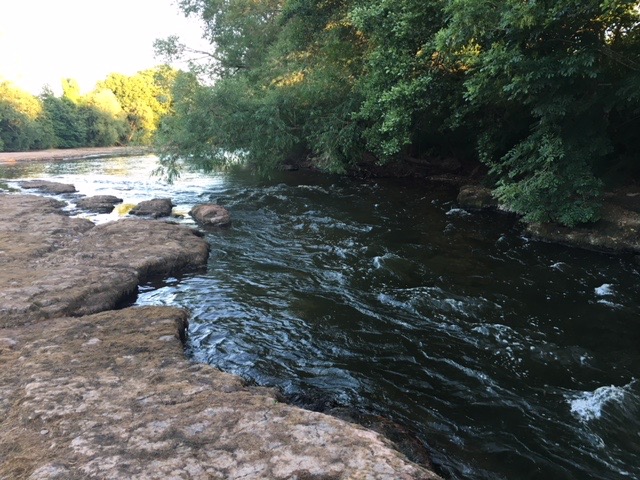
Monnington Falls
Immediately we were on the river we were faced with our first challenge, Monnington Falls. This is a section of fast flowing water, squeezed at times when water levels are low, into a narrow channel with a large area of bedrock exposed to one side. This proved to be straight forward but gave us a bit of momentum at the start of our day.
It was twelve miles to Hereford and we made reasonable time, arriving there by late morning. We had had less difficulty with rapids and there was slightly more flow to the river than yesterday.
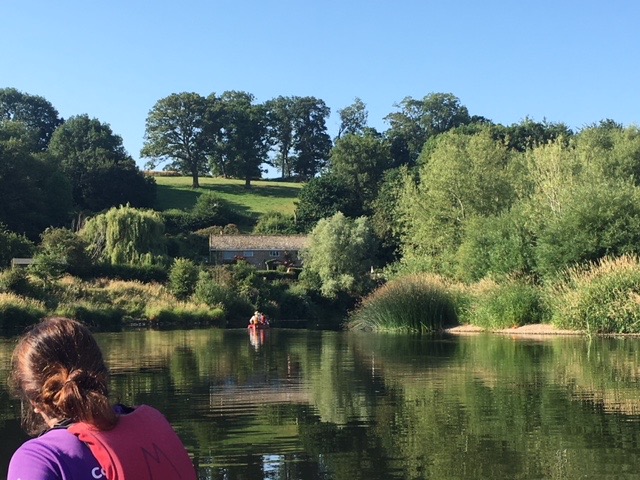
Idyllic riverside residence
We stopped on the steps to Hereford Rowing Club for a brew and a snack. I took a little time out to consult the guide book. I was already concerned that Hoarwithy was still some seventeen miles down stream and that in the heat of the afternoon it might be too far and too long a day on the river. There was an alternative, we could stop at Lucksall Caravan and Campsite about eight or nine miles beyond Hereford, if they could take us. It would mess up the booking I had made with the pub in Hoarwithy, but that could not be helped. It was important that everybody was enjoying the experience and not overwhelmed by it.
Leaving Hereford, we continued downstream, seeing very little of the city as we passed through it, just glimpses of the top of the cathedral tower, a few industrial sites well camouflaged by trees, and, on the outskirts, a number of large houses, which made the most of their riverside position but failed to enhance it with their rather gauche appearance.
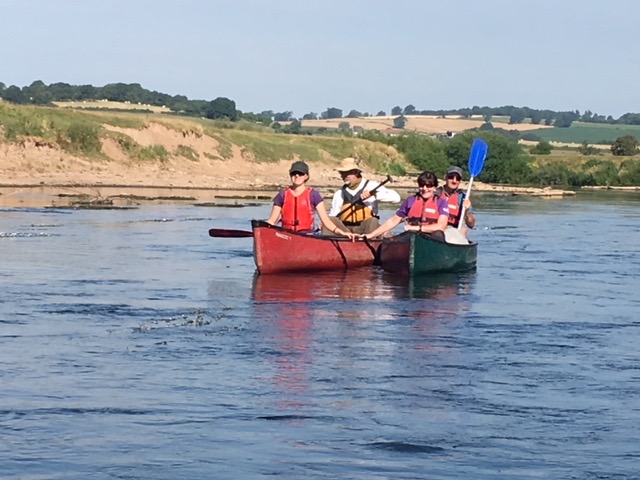 Passing the confluence of the River Lugg, which provided nothing more than a trickle to the dwindling waters of the Wye, we eventually reached Lucksall at 4.00pm, a much more acceptable finish time if they could take us. They could. Lucksall Caravan and Campsite is excellent. We had lovely flat pitches looking out across the river. The facilities are excellent and included a shop, bar and restaurant. Guess where we spent most of the evening.
The following morning we were greeted with yet another cloudless sky. Ducks had gathered around our tents, making enough noise to encourage us to get up, even Nic. Early morning steam rose from the glass-like surface of the river. It seemed a shame to destroy it with our ripples. But destroy it we did.
It took us three hours to reach Hoarwithy, which confirmed that it was the right decision to truncate our journey the day before. We stopped on the stony beach at the foot of the steps up to Tressick Farm campsite for a brew and some energising flapjack.
The journey from Hoarwithy to Ross takes in a stretch of the river where there are few views beyond the banks. There are no villages, only the remnants of old railway bridges and plenty of signs warning us against landing. Occasional herds of cows were standing knee deep in the water, cooling off. There were fishermen and in places, where there was only a narrow channel of navigable water, we had to encroach on their space. On the whole they were understanding and friendly.
We reached Ross at the now acceptable time of 4.00pm, giving us plenty of time to get ourselves organised before going out. We were sharing the field with a group of D of E expeditioners from Kelly College, in Devon. They were a delightful group of young people and seemed to be managing themselves much better than a group we had seen on a similar expedition further up stream.
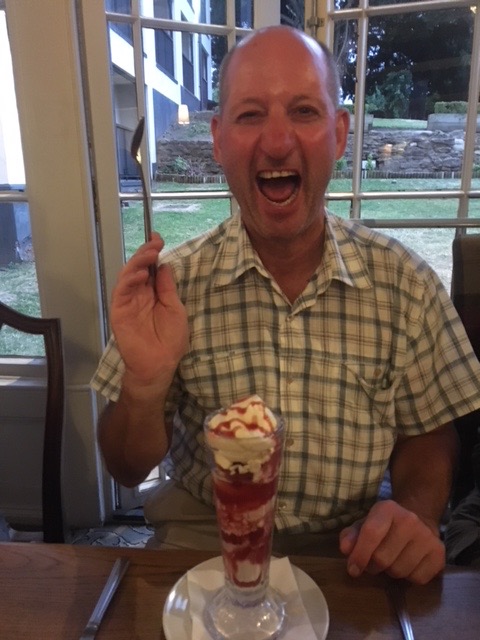
Nic quietly enjoying his sweet!
That night we treated ourselves to a meal at the Royal Hotel overlooking the river from a high vantage point. England v Croatia was on in the bar next door, allowing us to appreciate England’s demise in the World Cup.
Day four brought about a change. As I surfaced from my sleep, I was aware of spots of rain falling on my tent. Or was it an insect caught up between the layers of fabric? It was rain. After so long without it it was quite refreshing.
All was going well until we reached Kerne Bridge. We were managing to average 3.3mph. I reached the bridge and the rapids on the other side of it first, the other two canoes a little behind me. As I went through the first narrow, sweeping little rapid my canoe made glancing contact with a sawn off branch. The other two canoes came through together and while Peter and Ann-Marie passed the branch safely, Nic and Natasha were too close behind to be able to react quickly enough. They hit the branch full on, catapulting Nic into the water, closely followed by Natasha. I wish I had seen it. They needed to dry off and change delayed us a little.
We were now passing through the most beautiful and dramatic section of the river with steep, forested slopes and exposed crags of limestone, home to Peregrine Falcons. It is stunningly beautiful and it does not matter how many times you paddle this stretch, it’s beauty never diminishes.
We were also entering the busiest stretch of the river with a corporate group whom we saw on several occasions, others paddling towards us from Symonds Yat and, by the time we reached the popular beauty spot motor launches carrying day trippers up and down the river.
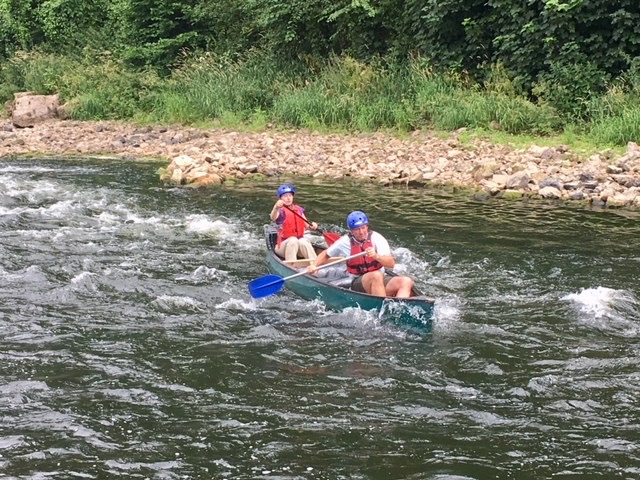
Nic and Natasha shooting the rapids
Having lunched at the Olde Ferrie Inn at Symonds Yat West, we approached the rapids. They were hardly any more challenging than some of the others we had encountered up stream, and we were certainly over and through in the blink of an eye.
Once through, we enjoyed the dark water with its overhanging woodland and dead tree trunks lurking like mythical monsters in the shallows on either side.
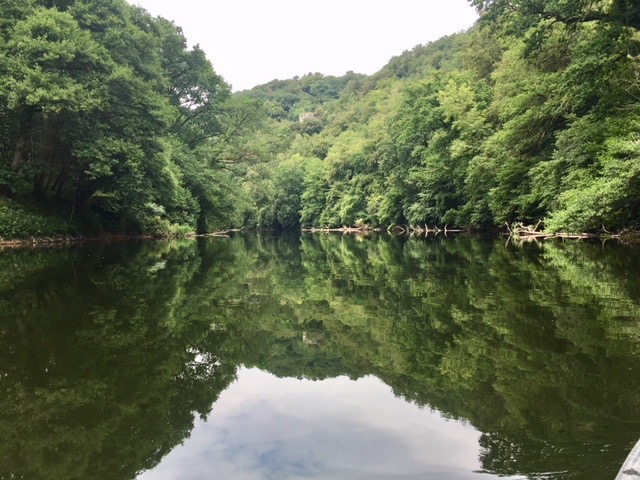
Quieter waters
The final straight up to Monmouth can be difficult with a prevailing wind coming straight at you, but there was no wind at all. The rain of the morning had been replaced with hot sunshine, and the run up to Monmouth was the easiest I have known. There we disembarked and loaded everything into the waiting minibus and the canoes on to the trailer.
It had been a fabulous four days in perfect conditions, apart from the lack of water, although that was not really an issue after the first day. It is a trip I could repeat again and again. I probably will!
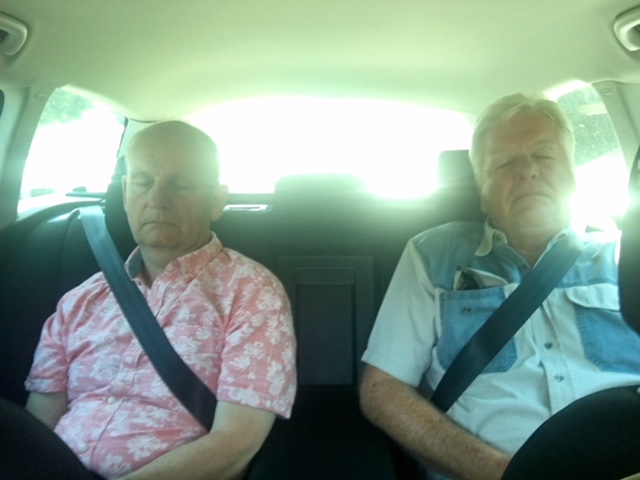
Tired already?!
Having filled ourselves with bacon butties, Rob, Ian, Stephen and I drove down to Llanmadoc on the north western corner of the Gower Peninsula. It was a beautiful morning of cloudless skies criss-crossed with many vapour trails.
It was my intention that we should park in the village car park for three days, but I noticed a rather old and faded sign warning that no overnight parking was permitted. I wanted to find out if this was still the case. Enquiries led me to the village community shop/cafe where I found the owner of the field. She was fairly brusque in he response and told me that under no circumstances could I or anybody else park there overnight. If she allowed it the council would be on her back immediately. Before I could ask my next question, another lady, volunteering in the shop, offered me her drive. What a kind and generous lady. I offered to make a donation to a charity of her choice but she said it was not necessary. She asked for my mobile number just in case she needed to contact me so I gave her my card. Arrangements sorted, we parked in the drive of The Old Rectory before returning to the cafe for a coffee. It was 11.30am by the time we set off for our walk.
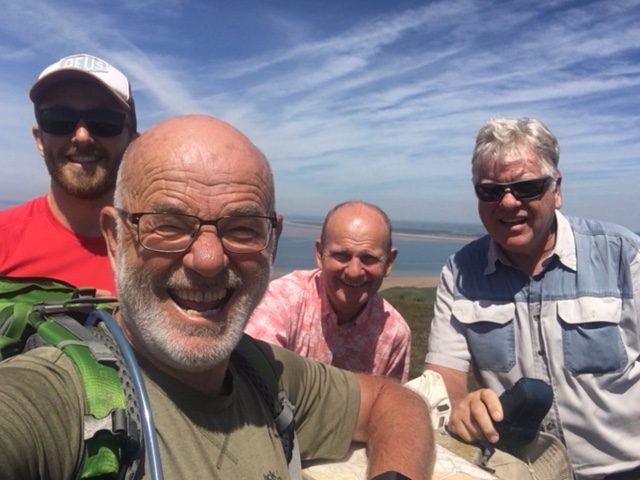
Trig point selfie
We immediately climbed out of the village on to the hillside above with a thick layer of fresh, green bracken either side of the path. Horseflies kept making little pin pricks in our arms and legs, which would then swell. Rob was affected most by them and his hands swelled badly, making his wedding ring very tight.
From the trig point at the top of Llanmadoc Hill we looked out over the grassy sand dunes immediately to the west and then nothing but a very placid sea. To the south we looked over the village of Llangennith towards our next hill, Rhossili Down.
We made our way into Llangennith and deliberated briefly as to whether we needed to take some refreshment. Having only been walking for an hour, we decided it was, perhaps a little soon, so we pressed on. It took us a while to pick our way, haphazardly across fields to the foot of Rhossili Down.
The climb up is steep, and it was noticeable that, with about 15kg on my back, it required a little more effort than normal. As we climbed the beauty of Rhossili Beach was gradually revealed. Beautiful, largely deserted, golden sands stretched out all the way up to the headland with Worms Head stretching, monster like, out to sea.
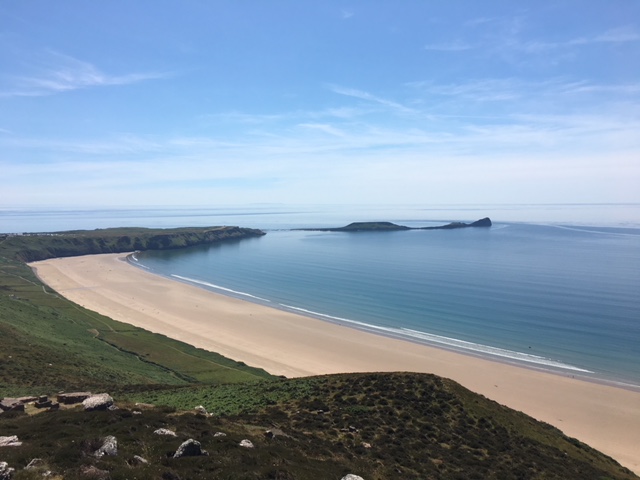
Worm’s Head and Rossili Beach from Rossili Down
At the top of the first climb we sat enjoying the view. For a long time a kestrel sat on a rock a little below us, unperturbed by our presence. Once it had flown Stephen sent his drone up to do some aerial video. All was going well until a Border Collie joined us and took exception to the drone, so much so, that Stephen guided it home and put it away. The collie belonged to a group who joined us at the summit cairn and, after the peace had been restored, sang gently and rhythmically. It was fascinating to listen to but I did not feel brave enough to enquire of them what they were doing.
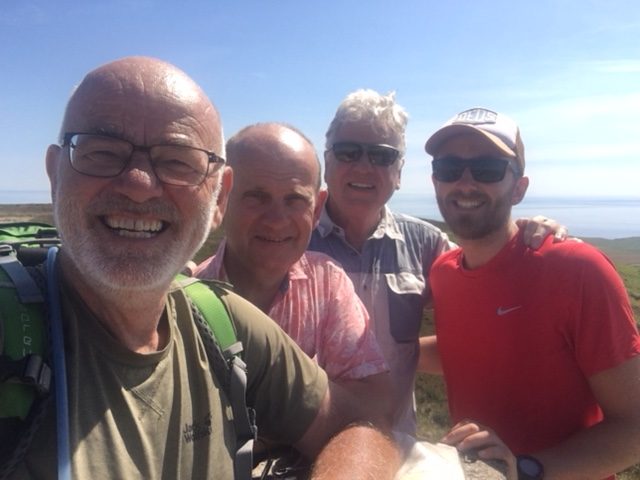
Another trig point selfie
Shortly afterwards we left them to their summit singing, passing the remnant foundations of a Second World War radar station, before climbing again to the trig point towards the southern end of the Down. Below the beach was a little busier as this end was accessible via a steep path from the car park. We were in no rush and were enjoying the moment when we were joined, once again, by our singers. This time I engaged them in conversation and learned that they were a group from ‘Dreaming the Land’, www.dreamingtheland.com. They were a non secular group on a pilgrimage, visiting ancient and interesting sites on the Gower Peninsula. Despite it being a bit hippie and alternative, I found their idea interesting and it added a new dimension to walking in beautiful countryside on a glorious summer’s day. They removed themselves from the conversation for a group improvised interlude, which, although being quite bizarre, seemed to be natural. I think I might have felt rather self conscious. We eventually parted company and we headed down to Rhossili where Ian decided he needed a pint. He suggested he would catch up but I insisted we were in this together – ‘all for one and one for all’. So we all had a pint.
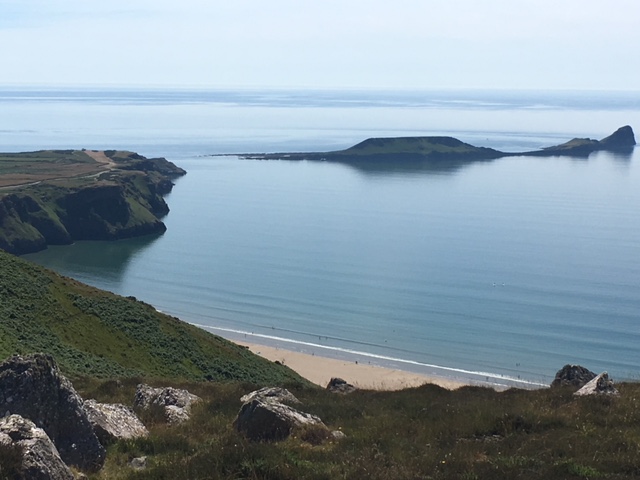
Worm’s Head from Rossili Down
Had circumstances been right we would have considered wild camping on Worm’s Head, but, as it was, the tide was in and the rocky causeway giving access was submerged. Even if we waited several hours the tide would be against us in the morning, delaying our progress around the coast. As we sat in front of the Coast Watch lookout post admiring the monster-like features of Worm’s Head, Geoff, one of the Coast Watch volunteers came over for a chat. He was one of the pioneering English surfers, originally from Essex but having lived on the Gower since the 1960s. He guessed that we were wanting to wild camp and suggested a quiet little cove, Ram’s Grove, an hour or so along the coast. “Just make sure you have enough water.” He was full of useful information. For example, if we ever do want to spend a night on the Head, visit the Coast Watch first and tell them. They will then let the Coast Guard know that you are night fishing and we won’t be disturbed. Then, when someone on the mainland dials 999 when they see torches, thinking people are stranded, the appropriate authorities will know that not to be the case. Otherwise they have to investigate, wasting a lot of time and money. He was a really friendly chap, but all the time he was talking to us he was watching, watching where people were going and what they were doing.
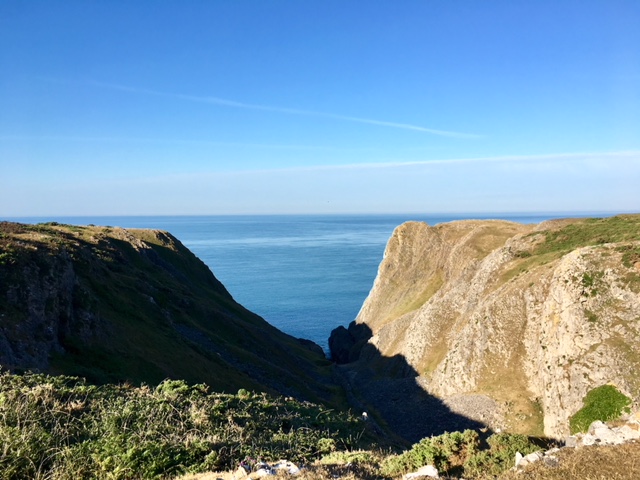
Ram’s Grove
Leaving friendly Geoff behind, we worked our way around the coast to Ram’s Grove. It is a deep v-shaped valley dropping steeply to a shingle beach. Just before we dropped down, Ian found an animal water trough with a pipe of fresh water feeding it, so we were able to fill all of our bottles etc.
Ian was quickly in the sea, soon followed by Stephen, cooling off. I went in up to the waist band of my trunks but could not bring myself to take that final plunge. The temperature contrast was too great.
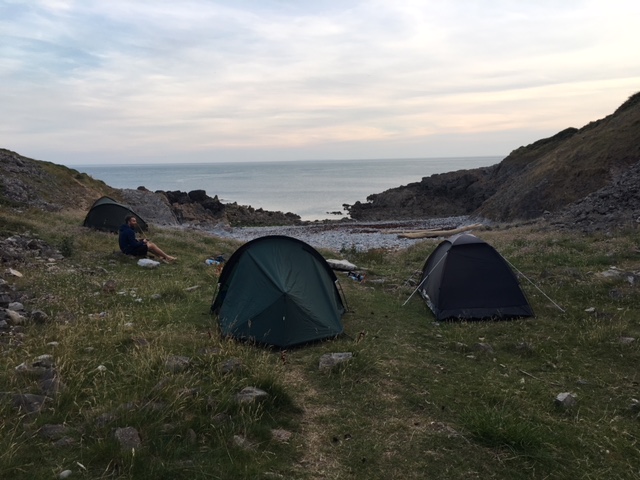
Our wild camp
We set up our tents on the four flattest patches of grass we could find, only pegging them down minimally as there was very little soil under the grass. Then we set about supper, a variety of pre-cooked meals that only needed to be heated in their sachets in boiling water for about five minutes. Very tasty and perfectly adequate.
After that there was not much to do. There was no sunset to watch as we were hemmed in by the steep valley sides. Stephen sent his drone up to film it and us in our secret little world.
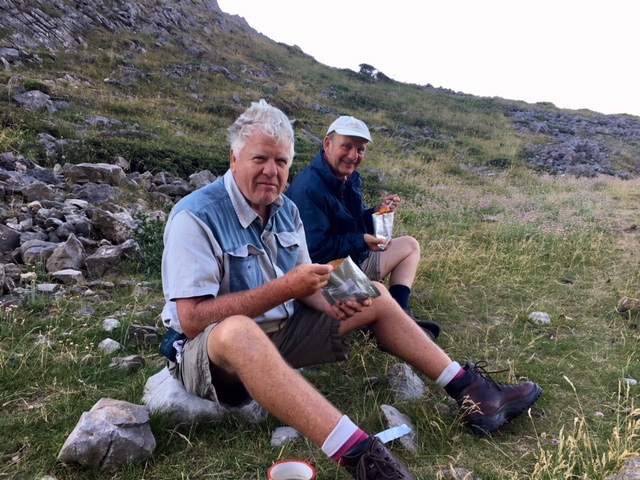
Rob and Ian enjoying their All Day Breakfast
Sleep was not too bad but I tended to alternate from hot and clammy to cold and clammy. The sheep that had been around us all night ensured that we did not linger in our tents by bleating loudly as soon as it was light. There was no point in lingering, and the more walking we could achieve in the relative cool of the morning, the less we would have to do in the stifling heat of the afternoon.
We climbed out of our valley at 7.00am and headed east to Port Eynon, just in time for the cafe opening, and a welcome coffee.
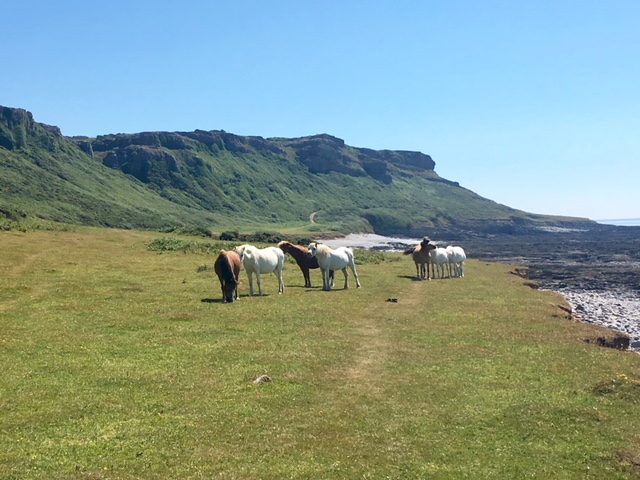 The walking became much easier from this point. The coast is less indented and the path follows a contour above the rocky coastline. We were able to make much better forward progress. I was walking a little ahead of the others and as I climbed up the path something caught my eye. There, just a couple of feet ahead of me, an adder slithered off the path where it was sunning itself into the undergrowth at the side. It was about a metre long and looked very healthy, with a good set of distinctive markings.
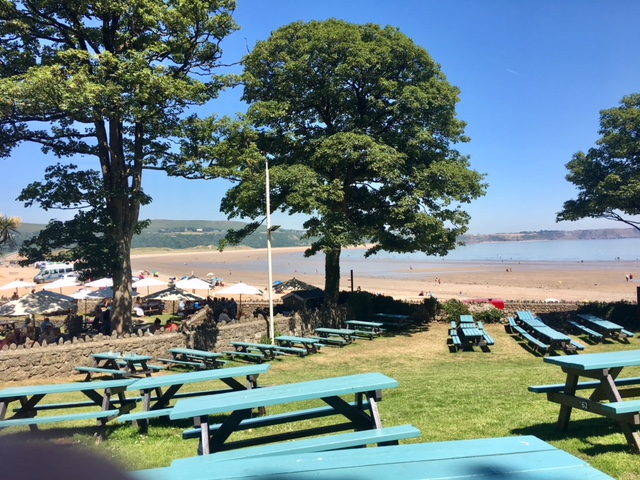
Our lunchtime view
As we rounded the headland towards Oxwich Bay a very large grey seal was luxuriating on a rock at the water’s edge, while another bobbed about in the sea nearby.
Once round the headland we were in lovely woodland, a welcome respite from the sun. There were some steep sections of up and down through the woods but we eventually emerged past the church to the Oxwich Bay Hotel, where we decided to have a long lunch.
After lunch, all we had to do was walk across the expansive bay along the beach to our campsite on the other side. It was a relief to be able to walk barefoot in the warm water lapping gently on the sand. In contrast, the hot, dry sand of the dunes we had to climb in order to reach our site, really burnt our feet.
I now have to make a confession. In my plan for this walk I had intended for us to camp at Three Cliffs Bay, but that campsite is not marked on the map. The only one marked is a little west of Three Cliffs at Nicholaston Farm. We stayed at the wrong site. In all honesty, I don’t think we had enough energy to go much further and the climb up to Three Cliffs Campsite was much steeper and longer. As it was, Nicholaston Farm had excellent facilities but not a great deal of flat land! There wasn’t much for us to choose for supper in the shop. We were restricted to buying the last two chicken curry pasties, a tin of beans and half a dozen eggs. It was a forty minute walk to the nearest pub and none of us fancied that.
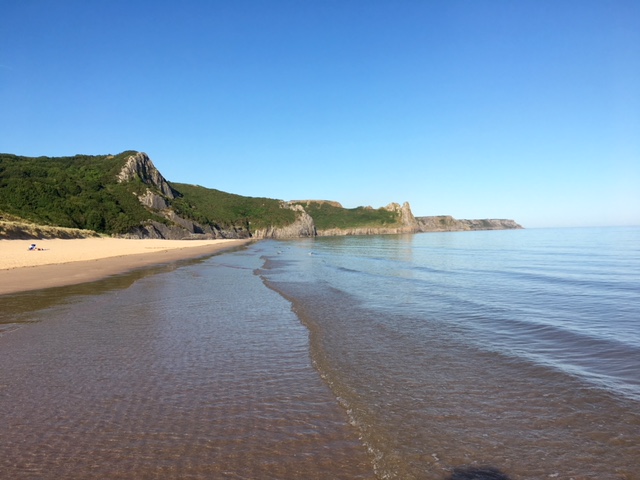
Looking towards Three Cliffs from Nicholaston
After we had set up camp, all, with the exception of Rob, went back down to the beach for a swim in the beautiful evening light. The water felt much warmer and I enjoyed swimming around, although there were a number of purple/blue jelly fish that concerned me. There were also some monster ones washed up at the water’s edge that I couldn’t determine whether they were dead or alive.
Back at camp we ate our mixed bag of food and I boiled the eggs for the next day’s lunch.
After a much better night’s sleep than I was expecting on a sloping pitch, we were again up early. This time it was cawing crows that were our morning call.
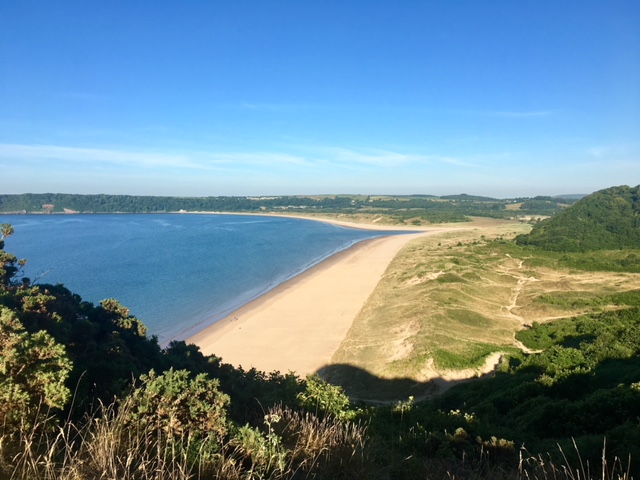
Looking across Oxwich Bay on our last day
We were again away by 7.00am. Unfortunately the tide was in so we could not go down to the beach to enjoy the full splendour of Three Cliffs Bay. We could only enjoy it from above and from the landward side.
The route took us across the golf course at Pennard Burrows just as a tournament was getting underway. Balls were flying everywhere and we had to stop occasionally and watch the action before continuing. This brought us into Southgate where we stopped at the cafe/shop at West Cliff. There we had a coffee, followed by another coffee, followed by a bacon buttie, or other similar delight. Why we needed it, I don’t know. We had had porridge a couple of hours earlier, before we left the campsite.
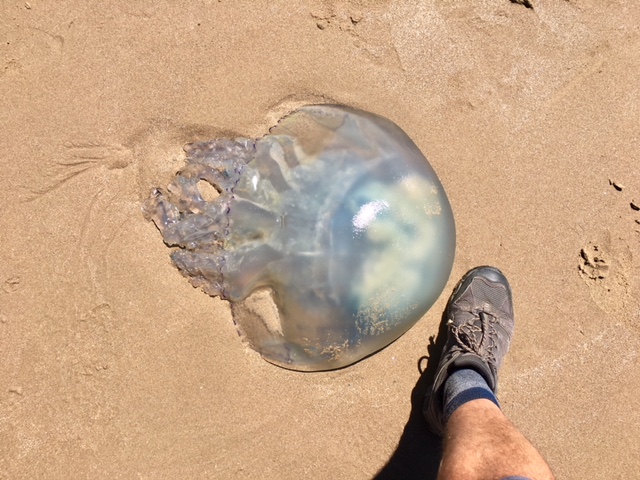
An unwelcome beach companion at Caswell Bay
The remainder of the walk alternated between clifftop walking descending to sandy bays and climbing again. We were seeing more people along this stretch of coast as we got nearer to Mumbles. We also saw aspects of coastal tourism that is so disappointing. Caswell Bay is a beautiful sandy beach. Monstrous flats have been built overlooking it and at the hub of the bay there are kiosks selling nothing but junk food and tat. There were queues of people willing to gorge themselves on this rubbish served in polystyrene containers. Yuk!
From Caswell Bay the path is laid to concrete and unforgiving on the feet, but, at least, progress was quick. Stephen and I went on ahead so that we could organise a taxi to take us back to Llanmadoc to pick up the car before returning to collect Ian and Rob from the pub on the pier later. It was getting hotter and hotter, with heat also radiating off the white concrete and parched verges.
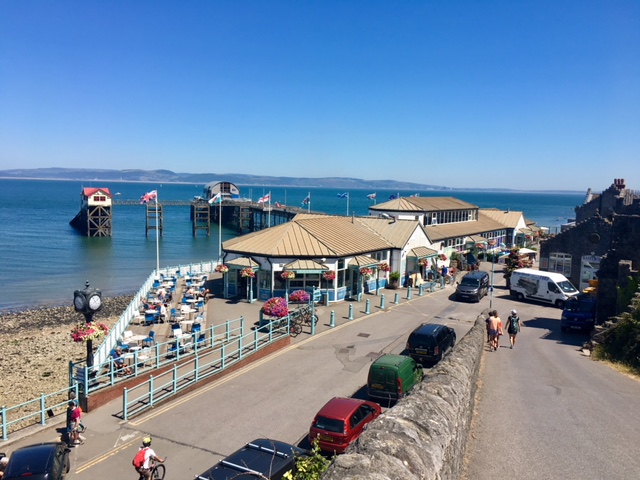
Mumbles Pier
We reached our destination, Mumbles Pier at 2.00pm, rang for a taxi, which arrived within five minutes. Sally, on who’s drive we had parked, asked me if I could promote the St Maddox Centre where her son worked. It caters largely for children but during the winter months it is quiet and would benefit from adult groups using it as well. It is worth a thought. More information can be found on www.stmadoc.co.uk. It might be something to consider and we would certainly see another side of the Gower’s nature in the winter.
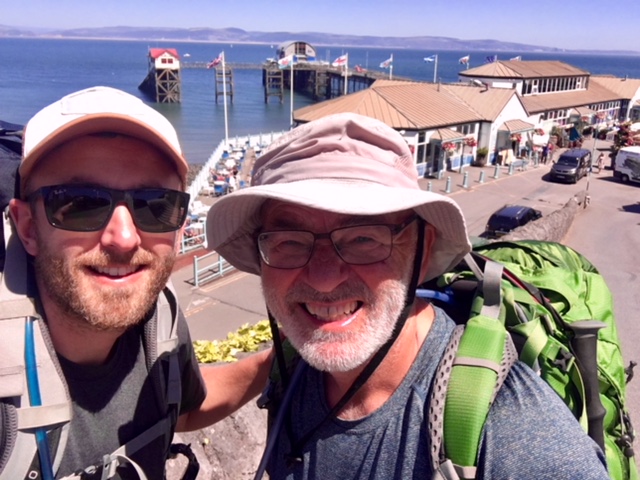
Precious time with Stephen
We had had three magnificent days, seeing the Gower Peninsula at its very best. The beaches are stunning and some of them are as good as anywhere in the world. I would be tempted to repeat this three day walk, but I know, what we have experienced can probably not be repeated. I am grateful to Ian, Rob and Stephen for their excellent company; we did a lot of laughing. The walk was also enhanced by the friendly and interesting people we met along the way, from Sally who rescued us at the start, to Angharad Wynne and her Dreaming the Land group, and Geoff, who inspired us to fulfil our desire to wild camp. We certainly have some memories to treasure.


