The trek to Toubkal

As Trevor Lloyd-Adams, Gordon Templeton and I sat in the Bridge bar and restaurant a young, east European waitress came over and asked if we were twins!  Okay, so none of us has much hair and we all wear glasses but, other than the fact that all three of us are male, that is where the similarity ends, I think.  Those who know us might have an opinion on the matter.

The flight to Casablanca with Royal Air Maroc was quite dull with no entertainment and very slow service.  By the time the trolley reached me there was no wine left.  The same happened to the rest of the group in the two rows behind.  Then, miraculously more wine was to be found for the remaining rows on the flight.  I began to wonder whether there was a special clause on our tickets.  Annoying as it was, it was not worth making a fuss.

Casablanca is becoming the hub for all flights into Morocco and on arrival we transferred into the ‘cathedral’ of domestic departures, a lofty building with an inverted glass spire hanging down from the ceiling.  There were a number of flights in preparation so the building was full, leaving only the floor for us late comers to sit on.  Suddenly all flights seemed to be called at once and while sun seekers flew on to Agadir, culture vultures to Rabat or Fez, we, and others heading for the mountains, boarded our plane for the twenty five minute flight to Marrakech.

By the time we had collected our luggage, purchased local currency, met our guide, Mohamed, and transferred to our hotel, Riad Moulay Said, in the heart of the city it was 12.30am.  Despite the late hour the streets were full of young men in party mood, Morocco having given Mozambique a 4 – 0 drubbing in a World Cup qualifier.

By 8.30 the following morning, having had breakfast and sorted our kit, we were climbing aboard two minibuses for the two hour drive to the start of our trek in the High Atlas Mountains. En route, we stopped in the last town before the road wound its way into the mountains, to buy enough water for the trek.  As soon as we stopped the street hawkers pounced upon us trying to sell jewellery or fossilised stones.  They hardly bothered me but some of the group, Calum in particular, seemed to attract them like a magnet.  Even when he bought stuff, they still concentrated on him, suggesting that he should buy more.

The final leg of the journey saw us climbing to the small ski resort of Oukaimeden (2700m). It sits in a bowl virtually surrounded on all sides by grassy slopes topped with rocky outcrops.  With the exception of flocks of sheep and goats the place is deserted with empty ski apartments, static chair lifts and closed shops and restaurants.  Not so long ago this was purely the domain of the seasonal shepherds, with their extremely basic stone summer dwellings dotted about the hillside. Towards the end of November the scene will look very different; all of the shepherds will have migrated with their flocks to the Sahara, the bowl will be full of fresh snow, the whine of the chairlifts will replace the bleating of the sheep and the skiers will bring a new vibrancy to Oukaimeden.

A laden mule with the, now green, ski area behind

As we waited for our kit to be sorted into mule loads, and the mules to be weighed down with all that they had to carry, the hawkers suddenly materialised and latched on to anybody who showed an interest, particularly Calum and Stuart, who weakened after much bargaining.
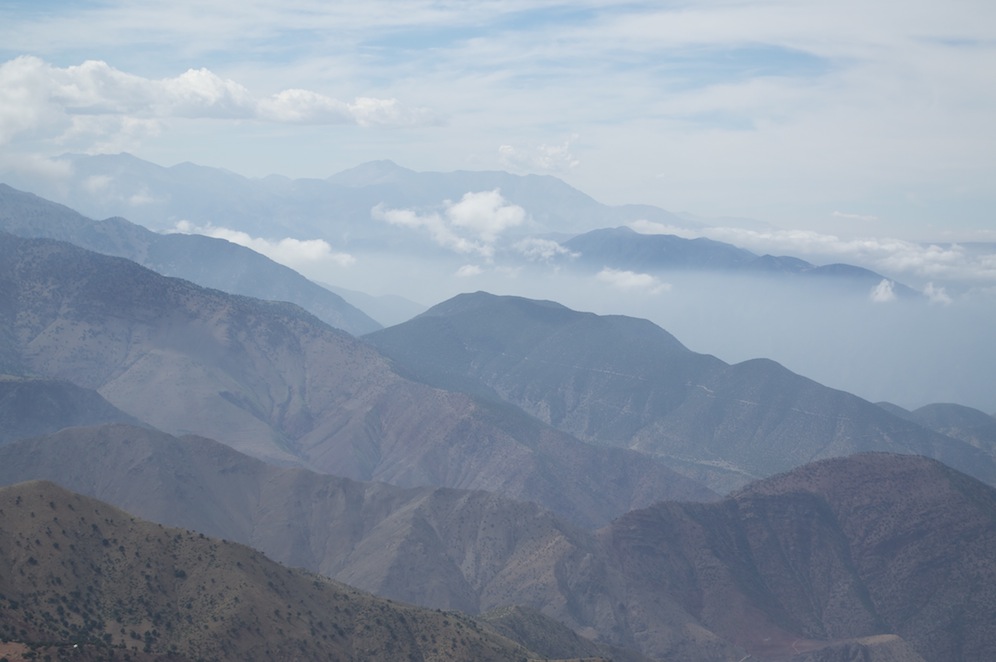
Layers of ridges descending from the High Atlas towards the coastal plains

The walk to camp was only forty minutes as the crow flies, or the laden mule plods, but we took a circuitous ramble around the edge of the valley to enjoy the views, giving the crew time to set up camp.  There was no pressure on us. We knew we did not have to go far but it was good to stretch the legs after the travelling.  From the ridge we could look across towards Toubkal, although we could not see it hiding behind its neighbours, and we were filled with excitement about being there in a few days.

Reaching camp by mid afternoon, we enjoyed a late lunch of finely chopped salad, olives, couscous, cheese and tinned fish, followed by fresh fruit.  All incredibly healthy.  The rest of the afternoon was spent exploring the area, poking our noses into the shepherd huts, which have absolutely no home comforts, and looking forward to the trek ahead. As the sun descended dramatically behind Oukaimeden, the temperature dropped significantly.  Day turned to night and a myriad of stars filled the skies above us.  None of us were late to bed.  I think it was a bit of a shock that Morocco, so close to the desert, could be so cold at night.  In the morning the bowl of washing water, left out overnight, was a frozen block.  It is easy to imagine why this is such a good ski area, for once the snow falls and settles in the bowl it will not go in a hurry.

The steep pull up to Jebel Oukaimeden

To help us acclimatise to the altitude on our first full day of trekking, we spent the morning climbing Jebel Oukaimeden (3260m) before returning to camp and lunch and then the onward trek.  This started steeply up to a ridge line, which we then followed up to the summit.  As we were approaching the summit the chair lift suddenly sprang into action and we imagined the hawkers using it to try to sell us some more jewellery.  Fortunately, it turned out to be a maintenance crew coming up to prepare things for the coming ski season.
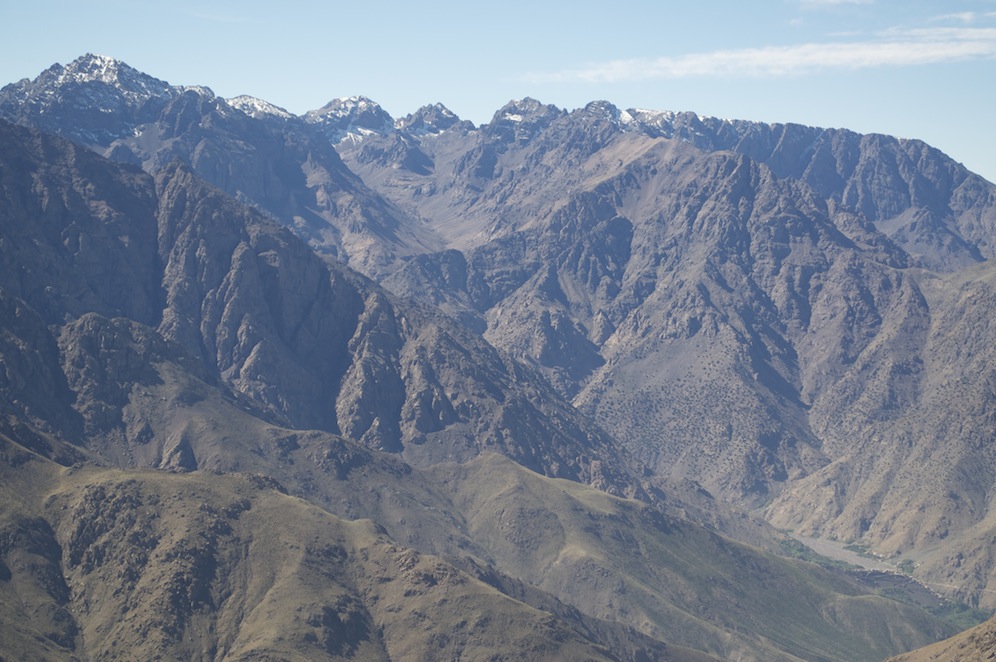
Our trekking area from the summit of Jebel Oukaimeden

From the summit we had superb views towards the higher peaks.  It was particularly interesting that we could virtually see all the route that we would be covering over the next few days, down towards Tacheddirt, our next camp, over the Tizi-n-Tamatert Col into the Mizane Valley leading all the way up towards the Neltner Refuge, our high camp for our attack on the summit of Toubkal, a few days hence.

Following another sumptuous lunch we began our afternoon trek to Tacheddirt as clouds began to roll in from the west, at first just enveloping the summits but eventually consuming all around us.  We climbed steadily up to the Tizi-n-Eddi Pass (3000m) where a large flock of goats grazed among the rocks.  There were clearly a number of boys looking after them and their shouts, whistles and songs could be heard echoing off the invisible crags around the top of the pass.  As we descended steeply down the other side, the clouds occasionally parted giving tantalising glimpses of a lush, green valley below.
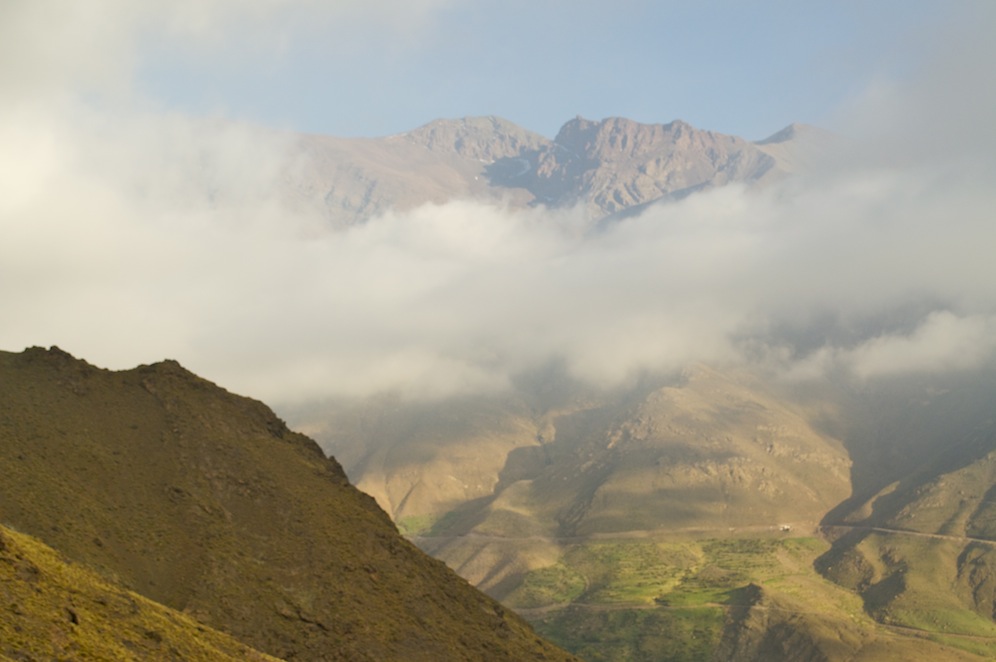
The descent was long varying between steep sections and traverses around crags.  We were now out of the ski area and the scenery was that much more dramatic.  As the afternoon progressed the clouds around the summits began to clear, leaving a skirt of cloud hugging the lower slopes.  The late afternoon sun kissed the rocky summits.  It was stunning.  By the time we reached Tacheddirt (2300m) the light was fading rapidly and we still had a mile or so to reach camp.  The villages in this valley do not allow camping within the village boundary; land is much to precious for farming, so we had to pass through the village to some non agricultural land.  Our long day had a sting in the tail as there was a steep climb up to our camp, now approached in the dark.

If it had been chilly overnight in Oukaimeden in was positive warm in Tacheddirt, such a contrast.  Before we left camp the following morning, Mohamed advised us not to take photographs of adults and to ask before taking any of children. This was because we were going to come into contact with local people during the morning as we walked through a number of villages hugging the hillside as we dropped down to the village of Ouanesekra before the ascent of Tizi-n-Tematert col.  The path took us through narrow village streets and followed irrigation channels feeding lush, green fields and orchards.
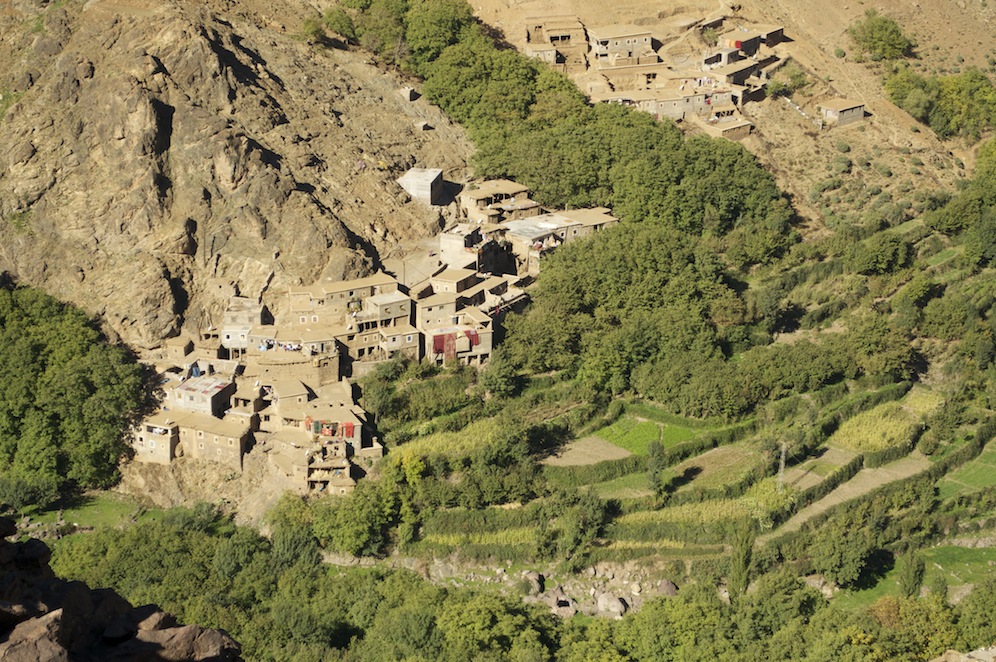
Ouanesekra

There were very few people about. Children were still walking to school but most of the adults were already at work in the fields or within the homes. There was a peaceful tranquility about the valley and it was a delightful walk.  As we approached Ouanesekra nestling at the foot of steep slopes in every direction, it was apparent that its peace will soon be spoiled by the road being created to link it with the rest of Morocco.  Whilst progress is necessary it seems a shame that such a beautiful place will lose its uniquely peaceful setting to motorised transport.

It was a steady climb up to the pass and there was the reward of an open cafe at the top, particularly welcome as it was such a hot morning with temperatures nudging into the early 30s and the sun beating down from a cloudless sky.  It was very crowded at the pass with a large group of students from King’s Canterbury.  Following a rest and a drink we began the steep descent into the Mizane Valley through a forest of pine trees.  In terms of modernisation, this valley is ahead of its neighbour over the pass.  Tourism has brought many benefits, including tarmac, and this is likely to be extended into the valley we had just left.  The path criss-crossed the road in several places.

Lunch

We eventually came to a shady glade where our crew were waiting to serve us lunch.  Considering the conditions they have to work in and the fact that they have to unload the mules each time, they do a remarkable job.  Not only is the quality of food excellent, the presentation is always a piece of art.  The meals are also incredibly healthy.

Following lunch we skirted around the hillside to the small, but busy town of Aroumd.  For me, we were now on familiar territory, having been here a few years previously.  In the Mizane Valley there are not the camping restrictions that we had encountered at Tacheddirt.  The Mizane Valley is the main route up to Toubkal so tourism plays an important part in the lives of the villagers.  There are many auberge, guest houses and gift shops as well as numerous places to camp.  Our camp was just on the edge of the village on the main route up to the mountain and under a canopy of walnut trees.

During the night the wind picked up.  The trees above swayed in the gusts while a door nearby banged at regular intervals.  Once awake, it was difficult to go back to sleep.
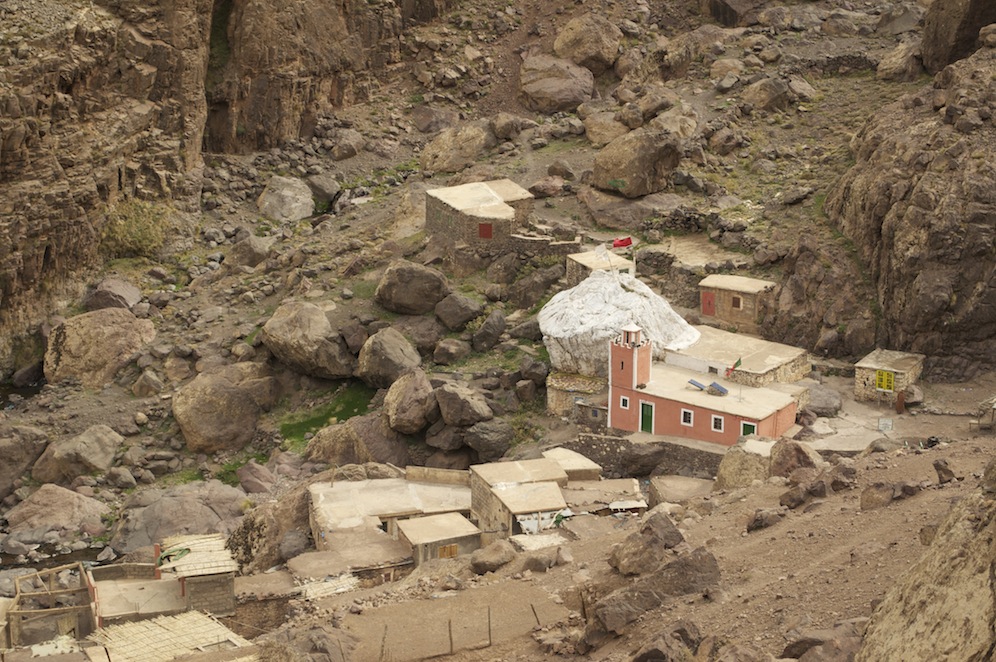
The shrine of Sidi Chamharouch

The gale was still blowing when we set off on our trek up to the Neltner Refuge.  This is a long and steady climb, firstly up to the shrine of Sidi Chamharouch nestling in the elbow of the valley, before continuing to the refuge at the head of the valley.  As it was so windy we chose not to lunch on the way up but to wait until we reached camp, allowing the crew a little more comfort and guaranteeing we have a dust free lunch.

The rest of the day was spent trying to keep out of the wind and turning our thoughts to the task ahead, the climbing of Toubkal.  There was some concern that conditions, should the wind not ease at all, would make the ascent both too difficult and potentially dangerous.  Originally, the plan was to leave camp at 4.00am but, because of the conditions, it was decided to delay this until 5.00am.  It was also decided that as one member of the team had a knee and back problem, I would take them back down to Aroumd.  The severity of the climb in the prevailing conditions was not appropriate.  As I had been to the summit before and also had a foot and back problem, it seemed a sensible decision.

Nearing the top of the long haul up to the ridge, taken on previous climb of Toubkal

At 5.00am the rest of the group left camp for the summit climb, 1000m of steep scree up to the ridge and the eventual pyramid on the summit.  The wind was still buffeting camp and would be significantly stronger as they gained height.  It is just as well that the start is in the dark; not being able to see the daunting first section has to be a bonus.

Sometimes the body, not only has difficulty adjusting to the altitude but also to the effort required at a time when it should be sleeping and resting.  Another member of the team began to have difficulty and was sick.  Then all the energy drains from the body and Mohamed sent her down with the crew member acting as a back marker.

Meanwhile the rest continued in an upward direction.  However, at about 8.15am, over three hours after leaving camp, three more decided that the effort of the climb and the extreme wind was too much for them.  Mohamed chose to leave them sheltering among some rocks, although it was impossible to escape the wind and the cold that it caused.  What they achieved in the conditions is incredible, particularly as two of them were trekking virgins.
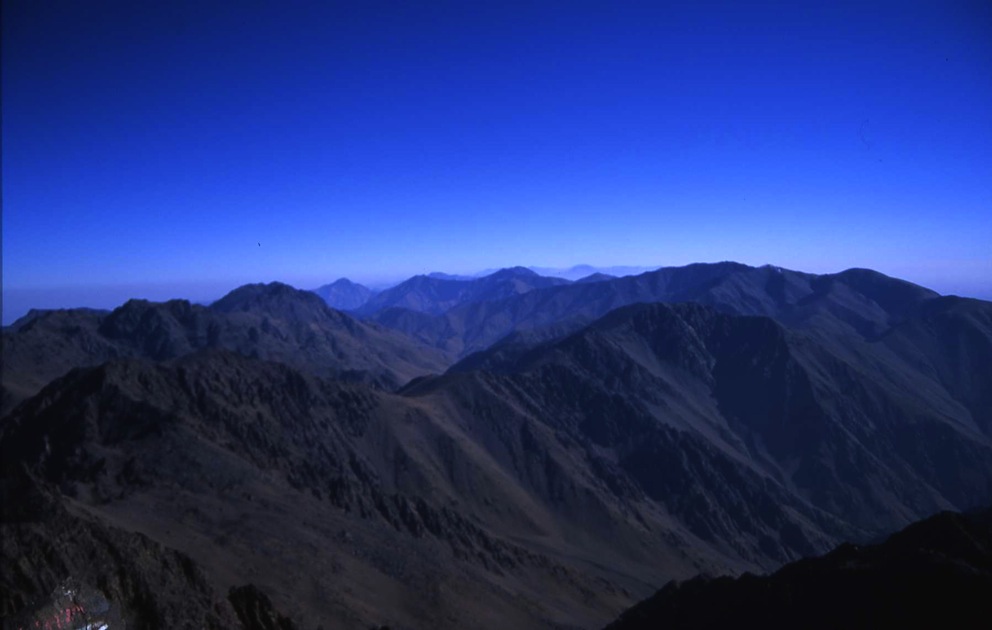
The view SE from the summit, taken on previous climb of Toubkal

The five remaining members of the team, including a third trekking virgin, continued to the summit, eventually reaching it.  Remarkably, there was very little wind, a place of peace and calm with all the mayhem taking place below.  Reaching the summit was only half the job done.  They now had to get down, picking up the three sheltering, who by now were extremely cold, and trek all the way down to Aroumd.  There was no chance to relax until they at least reached the refuge where they would join up with the sick member of the team who had come down earlier in the day.
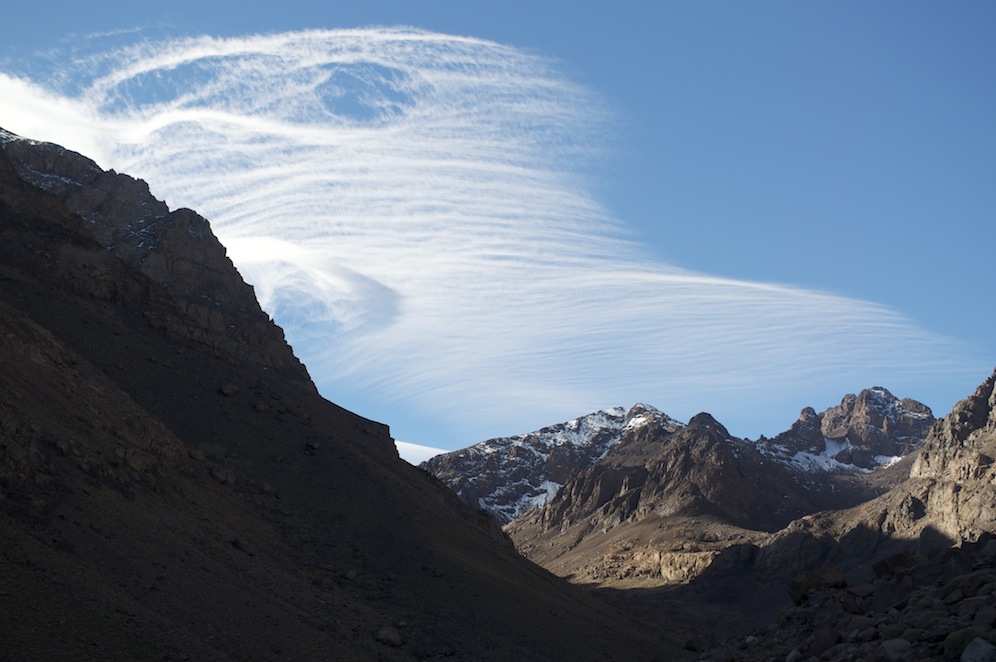
Clouds of change over Toubkal

Meanwhile, I was heading back down the valley when I looked back and saw a change in the weather just beginning to develop.  There was a fascinating cloud forming over the summit area.  While it looked innocuous, I instinctively knew it was a prelude to changing conditions.  What mattered was how quickly that change would take place. Would the rest of the group get off the mountain and would they get back to camp in time?

On reaching camp, a few tent sized platforms on the hillside up valley from Aroumd, at the same time as the crew and mules, we helped set up camp.  The wind seemed to be dying and while clouds gathered over the tops, the sun shone fiercely on us in camp while we worked.  Having eaten a late lunch, we rested, firstly on a rock, but once the sun had gone as the clouds formed, then in our tents.  The afternoon progressed into evening, the light began to fade, we became enveloped in cloud rising from the valley below and it began to rain.  We watched as people came down but none of them were part of our group.  Eventually, at 7.00pm, fourteen hours after leaving camp, they group returned, very tired but happy.  Their mood suggested they had all reached the summit but, despite only five having done so, I think they were all satisfied with their performances and achievements.

It rained all night in camp, snowed higher up, and the rain continued well into the morning. The snow line, we learned, was just above the shrine and on the upper slopes there could be anything up to a metre of snow.  It is highly unlikely that many more will succeed in reaching North Africa’s highest point this season. I wondered if the start of the ski season in Oukaimeden was being brought forward.

I have always said that these trips are a journey and that it is not about the summit but about the getting there and back that is important.  If you reach the summit it is a bonus but it must never be considered the be all and end all.  Any way, we had more of a journey to enjoy yet.  We still had Marrakech to come.


Training Dates for September

Long Mynd in Shropshire – Sunday 16th Sept.
Please can we meet at 10.00am at the second car park (beyond the cafe) in the Carding Mill Valley (Grid Ref. 441948 OS Explorer 217).  Once we are all met we will walk over the northern end of the Long Mynd to drop down via Darnford Brook to Ratlinghope.  We will probably have lunch in the valley before calling in at the Horseshoe Inn, Bridges, for a drink.  Refreshed, we will climb back up the Mynd to pick up the Shropshire Way before descending steeply into the Carding Mill Valley.  We should be back at the car park somewhere between 4.00 and 5.00pm.
Please indicate your intention to join this walk by dropping me an email.  Car sharing is recommended.  You probably need to allow an hour and a half for the journey from Worcester.
Brecon Beacons Circuit – Saturday 29th Sept
This takes in Pen y Fan, Cribyn and Fan y Big.
Please, again, meet at 10.00am at the car park at grid ref. 125248 OS Explorer OL12
It is generally a steep ascent to the summit of Pen y Fan, taking approx. 90 minutes.  We then follow the impressive ridge line to cribyn and Fan y Big before descending via Cefn Cyff.  However, before we reach the end of the spur we veer off piste into Cwm Cynwyn, to skirt round the northern spurs back to the car park, again between 4.00 and 5.00pm.  Before returning home we can pop into a pub on the outskirts of Brecon for a little refreshment.
Again, please indicate, via email, your availability.  Car sharing is again recommended and please allow two hours from Worcester.

Old Chapel Training 27th-31st Aug.

Having worked with a group for 18 months and brought their training to a conclusion with a fabulous trip to Turkey, I am inevitably concerned that a new group so soon may prove more difficult to work with. This last week I need not have worried for the Indonesia group are already a fantastic group of young people. I could not have asked for a more positive and responsive group.
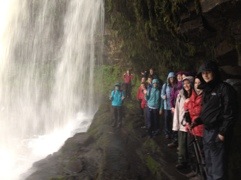
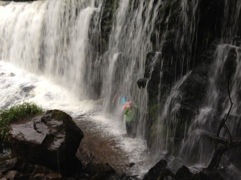
The week started wet, in fact very wet, so I decided they needed to get even wetter and took them to the series of waterfalls in the Dinas Gorge. As we drove over the Brecon Beacons from Crickhowell it became clear that the weather was much worse the further south and west we travelled. Parking the bus at Pen-y-Porth, we walked south along the Afon Mellte, bypassing some of the higher falls to first visit Sgwd yr Elra. Recent rain had made them quite impressive, particularly for the time of year. I don’t think I have ever seen the paths so waterlogged at any time of year as they were this week. Sgwd yr Elra has quite a large lip to it allowing us to walk behind it without getting too wet, other than from the fine spray.

20120901-160632.jpg
Briefly retracing our steps we next visited Sgwd y Pannwr before walking up stream to Sgwd Isaf Clun-gwyn, which you can also go behind but not without walking through the fall. This was optional for the group but I was pleased that some took the opportunity to take full advantage of the experience.

20120901-161238.jpg
It was a wonderful half day walk in some fairly horrible conditions.
The weather was much better the following day so the group was split into two for an orienteering exercise on the hills above the Old Chapel on the eastern side of the Grwyne Fechan Valley. This course involves a photograph being taken at each checkpoint. Points are awarded for originality and composition. Depending on how long the groups spend taking photographs the circular course can take anything from three to five hours. Both teams coped well with the clues, took some well thought out pictures and the final results were very close.
By the time they returned from the orienteering they needed to cool down so I took them on a river walk. This involves walking up stream in the Grwyne Fechan river for about 300m just below the Old Chapel. The recent rain meant that the river was running quite full and fast. To ensure that they all got properly wet they had to negotiate a number of obstacles in the river.
The next day was all about team development through problem solving. They had a number of exercises to achieve, often against the clock and with red herrings thrown in to confuse. Everybody had an opportunity to lead and all performed superbly well. Having been doing these for many years I can genuinely say they this group has performed better than any other I can recall. They completed the web in record time, also the Kingdom of the Blind exercise in a staggeringly quick time of 24 minutes. They were so fired up by it that they requested to do it again, changing the roles and still did it in a quick 34 minutes. I have known groups take as long as three hours! Every exercise they tackled they tackled with optimistic enthusiasm, calmness and determination. They gave the leaders the chance to lead, they listened to each other and they made decisions wisely. It was a joy to see them all working so well together. During the day they managed to break a number of records. Their achievements were made all the more remarkable by the foul weather we experienced most of the day.
Thursday was a full day out on the hills. The weather improved significantly and we focused our attention on the western edges of the Grwyne Fechan Valley, walking up McNamara’s Road to the col, south along the ridge to Pen Allt-mawr and Pen Cerrig-calch, before descending and heading back to the Old Chapel.
In the evening the group worked on an entertainment for each other and the staff. It never ceases to amaze me how readily they rise to the challenge and produce something worthwhile in such a short time.
The last day was spent working on more team building exercises before a short walk over Sugarloaf from Forest Coalpit to Mynyyd Llanwenarth and the Friday evening journey home.
I think we are going to have fun in Indonesia and they are going to get a great deal out of the experience. Roll on the next training exercise, a two day/one night orienteering exercise on the Malvern Hills.

Storms over Mt. Ararat

With the rain that has fallen on Ararat over the last few days you might have thought that the Ark would float once more, or at least be swept down the mountain in a torrent of water. On Monday, the day before our ascent of the mountain began, there was a huge storm with torrential rain. The water rushed down the mountain gathering force and momentum so that by the time it reached the bottom of the mountain it was a force to be reckoned with. Eli village took the full brunt of the surge. Fortunately the water took the easiest route, the road, and spared the houses. The road, however was completely destroyed. Our vehicles could no longer go to the normal start point for the climb 150m above the village but only to the village itself and that was not without difficulty.
Disembarking from our vehicles after the bumpy ride, we prepared ourselves for the 1300m ascent up to base camp. It is a relatively gentle slog, first up the dirt road and then a good path up to the camp. Parts of the dirt road proved more difficult than normal because of the boulders strewn across it and in one place a gash six to eight feet deep along the road and almost the full width of it.
I stayed at the back picking up stragglers who were struggling for a number of reasons. We seemed to always have one or two suffering with stomach problems after a couple of days in towns. It was not an unpleasant walk although looking up to the summit was daunting for some. It towers above you, getting steeper all the time. The snow line was considerably lower than my previous climb in 2010 and this added to the anxiety. Everybody realised that this was not going to be like anything they had done before; this was going to be serious.
The lower slopes of Ararat were much greener this year and there were several nomad camps dotted about. As we passed them hoards of children came to meet us trying to sell us scarves which they had made, and requesting, not always pleasantly, for sweets, pens or money. The girls tended to be quite reserved but the boys were much more aggressive and rude. With one group I had to give them a warning glare before they would back off.
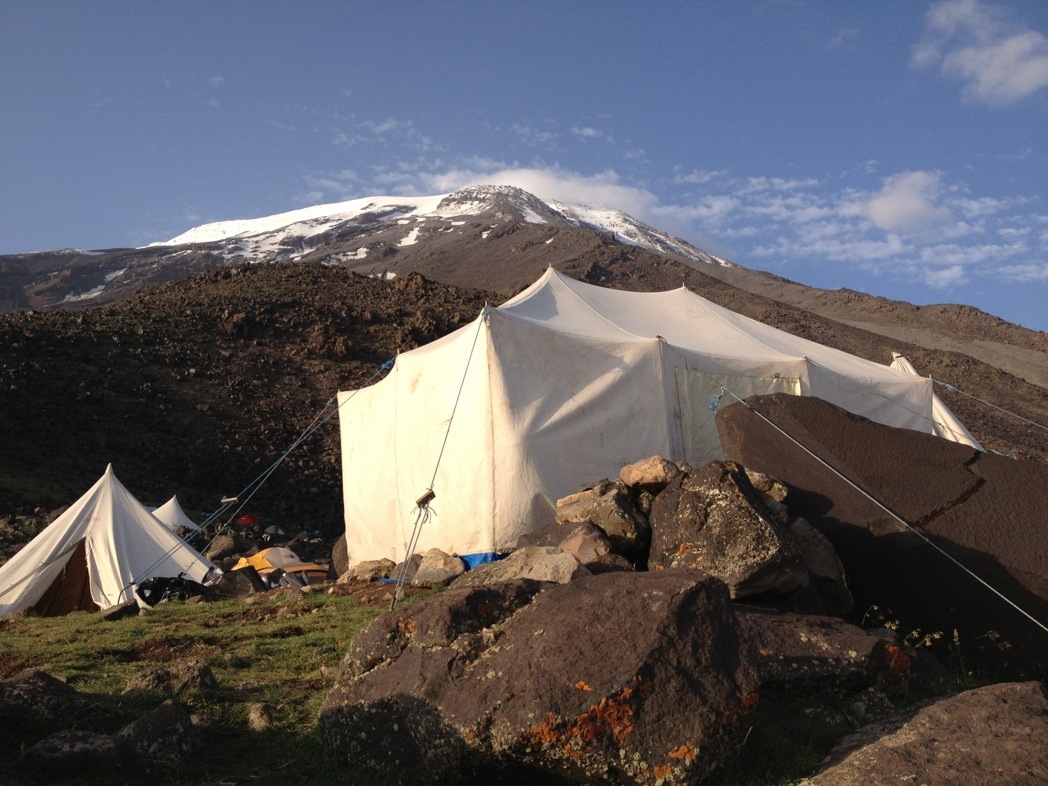
After four hours or so we reached camp, a crowded selection of tents pitched anywhere where there was a flat place or where one could be created. These tents tend to stay in situe throughout the climbing season and were beginning to show signs of wear and tear.

20120804-164231.jpg
Our second day on the mountain was an acclimatisation day with a walk up to 4000m and back to base camp. There were a number who were not very well so we gave them a rest day. They had already been up to 3700m in the Taurus Mountains; a rest would be far more beneficial. Our main concern was with one student who had been ill before leaving the UK and still had a lingering cough, a temperature and all the symptoms of a chest infection. Whilst we hoped to at least get him to high camp we realistically did not expect him to summit.
Leaving five of the group behind the rest of us set out to climb up to 4000m. Ildrum, our mountain guide set an excellent pace that allowed everybody to stay together. The pace was broken when Aliza felt dizzy and sick. I opted to take her back to camp. She would gain nothing by going higher and it was important that she was fit for summit day as it was her seventeenth birthday, one she will never forget if she is successful. The rest of the group were back in camp by lunch time and enjoyed their picnics in warm sunshine.
Things changed very rapidly. We soon found ourselves enveloped in cloud rising from below and the temperature dropped dramatically. The rain soon followed, gently to begin with and then torrentially with large hail stones. The thunder was constant and boomed just above our heads as it moved horizontally across the mountain. This really tested the tents and a number were found to let water in, mine included, which had puddles forming on the groundsheet. I have no idea where it was coming in but I noticed it in time to make sure that essentials such as sleeping bag remained dry.
The storm rumbled on for a couple of hours and then disappeared into the distance. The rain came and went several more times into the night but nothing as heavy as the first downpour. What effect would this have on the lower slopes?
Most of those who had been ill were improving and we had hopes for everybody except the one with the chest infection. I decided that I would go no higher than high camp but look after any who went no further or who returned early from the summit attempt. It was logical as I was the only member of the team to have been to the summit before and I did not want to deny anybody else the opportunity.
In the morning Jenny still had serious concerns about the chest infection and felt it unwise for him to go higher. Although I had prepared him for the news, it is never easy to hear but he took it well. I gave him the choice of staying put in base camp or going back down to Dogubayazit. He chose the latter so while the rest of the group prepared to go up to high camp and beyond, I and my patient prepared to descend. It was a motley crew we went down with, a Turkish woman from Istanbul, a Turkish man married to a Kazak Russian who cried all the way down because she felt she could have made it to the summit. She could hardly make it down from base camp, let alone climb up. There were also three Bulgarians, one a chain smoker, an overweight man constantly on his mobile and his wife. It took us over four hours to reach Eli and a lift back to the hotel. My patient seemed relieved to be off the mountain and can begin to get himself better without his body having to suffer the extremes of Mt. Ararat.
Meanwhile the rest of the group reached high camp safely and set off for the summit at 3.00am on Friday 3rd August. The cloud was down, it was windy and it was very cold. Only one student felt it necessary to turn back at 4760m suffering from altitude sickness and Omer took him back to high camp. The rest of the group went on to summit at 7.30am but sadly did not have any views. It remained very cold and after only ten minutes on the summit they started the long descent to base camp, all except Jenny, Paul and Omer who came all the way back to Dogubuyazit, Jenny and Paul because they have to be at work on Monday and Omer because he has to begin guiding another group arriving late on the 4th. It is a shame they cannot be with us to the very end and I am extremely grateful to them for making this an exceptional trip.
Twenty one students left Worcester on 14th July and eighteen reached the summit of Mt. Ararat (5137m) on the 3rd August. In addition six of the seven staff also reached the summit. Not a bad result.

Taurus Mountains (5)

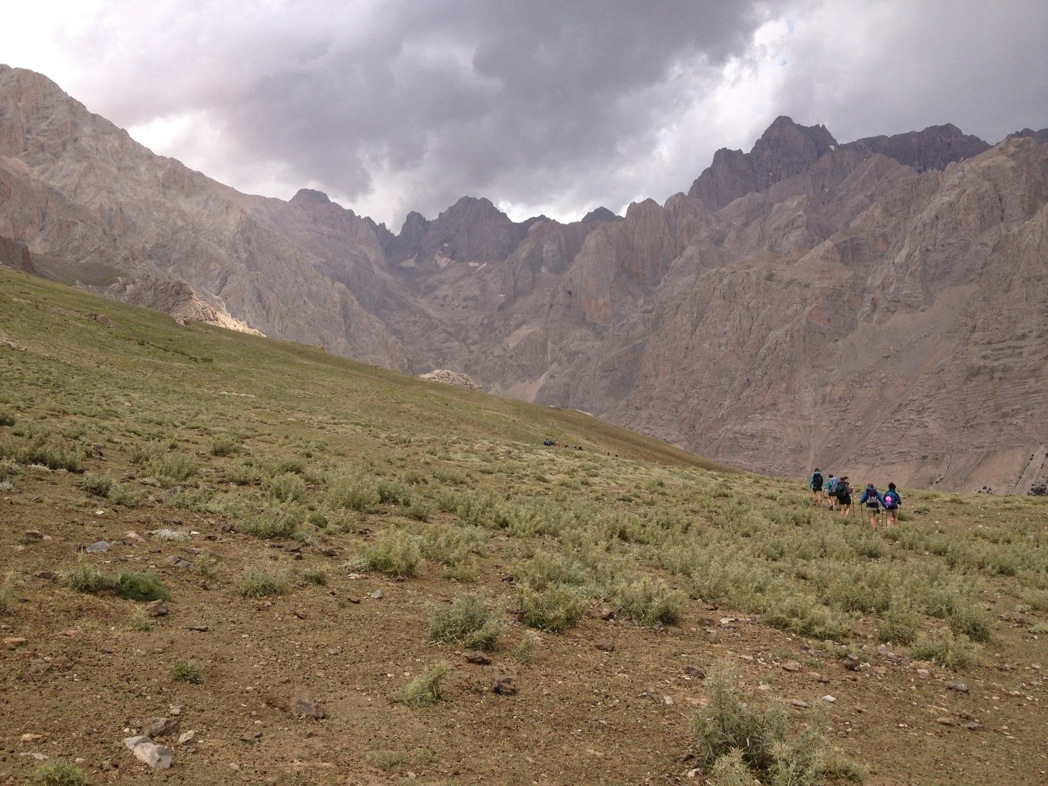
The next day we left our lush, green campsite at Sokulupinar and ascended the Tulu Valley. It was very humid and sweat poured from every pore. Kate was suffering badly with blisters, particularly when ascending, so I sent her back to camp with Louisa, who was suffering from the ice cream legacy, to hitch a lift in one of the support vehicles. It was important to get Kate’s feet sorted so that she could tackle Ararat without too much discomfort. With them heading back to Sokulupinar, we took a particularly steep path up to the high pastures above the Eznevit Valley. Having made the ascent the path contoured around the hill, making the walking much easier and more pleasurable. Stopping for lunch among a flock of grazing sheep and fussed by an unusually friendly dog we watched thunder clouds form over the surrounding peaks. There was no sign of the shepherd who was, presumably, sleeping among some nearby rocks. After lunch we descended, gradually at first and then steeply, into the Emli Valley. We were in the upper reaches of the valley surrounded by massive walls of mountain and brewing storm clouds.

20120804-094524.jpg
Heading down valley on a good path we entered a forest of conifer trees, not growing in plantation style, but randomly. They were not large, perhaps no more than about twenty feet, but it made a pleasant change to the tree free landscapes we had encountered over recent days. The perfume of the trees was noticeably very strong.
Thunder began to rumble around the mountain tops a large drops of rain began to fall from the sky. It did not turn out to be very much as we seemed to be walking away from it all the time.
Camp in the Emli Valley was in a meadow of long grass and flowers inhabited by a multitude of insects and butterflies, the quantity of like I had never seen before. The scenery was stunning with high, rocky walls rising from the valley floor in every direction. As evening drew near the clouds lifted and the sun came out. A perfect end to a perfect day.
The final day in the Taurus Mountains gave us the option of a day walk up to the Alaca Plateau on the southern slopes of the range or having a rest day in camp. The majority chose to have a rest day but those that did take the walking option came back inspired by their day out. I stayed in camp, not just because I was the only leader left, but because I needed to rest my foot. More importantly, I wanted to write the incident report on the student sent back to the UK while it was still fresh in my mind. It was a hot day but very pleasant lying on my bedroll in the shade of a tree in the middle of the field, writing my report. The students had a very relaxed time but were forced into frenzied activity when a brief storm, which had been brewing in the mountains for some time, suddenly let rip. Remarkably all the insects and butterflies suddenly disappeared just before the rain hit, only to reappear once it had stopped. Where do they all go? By evening the sunshine had returned and the day ended pleasantly. Those that had walked were very satisfied with their achievement, while those that rested really appreciated the opportunity to re-charge the batteries before our final challenge, Mt. Ararat, Turkey’s highest mountain.

20120804-100910.jpg