King’s/NCW Iceland 2015

The journey down to Heathrow was tortuous. For a start it was not a comfortable bus; the seat belt was so uncomfortably positioned it felt as though it was trying its hardest to break my collar bone. The driver was an odd character. With everybody on board, he said let’s go, only to then delay so that he could have his full fifteen minutes break. As he had only come from the depot two miles away, why did he need a break. We stopped for a toilet break at the first services we came to on the M4. Again he prevaricated as to whether this was a quickie or an official break. Thinking he wanted an official break we allowed fifteen minutes. Then he insisted we should be going but we were all waiting for him. Worse was to come when there were ninety minute delays on the M4 near Reading, the result of an accident. Google suggested taking the A34, A303, M3 to bypass the hold up and get to Heathrow in good time. This did not take into account a broken down vehicle on the slip road from the M3 on to the M25 and a further accident. It took three and a half hours to reach terminal 2, still leaving enough time but it is a frustration we could have done without.

Oscar met us on our arrival at Keflavik. As we came out of the terminal it felt remarkably cool. Snow still lay on the mountains in the distance. A bus drove us into Reykjavik over the barren volcanic landscape. As it did so it started to rain and continued to do so for the next three or four hours hours. Our hotel, CenterHotel Midgardur, is a former bank, converted into a smart boutique style hotel. It took a while to sort out the rooming detail, not for any other reason than the fact that we wanted to sort out the pairing. After the students had gone to sort themselves out in their rooms, we spoke at length with Oscar about the itinerary. He was concerned that, because of the snow, large parts of the highlands were closed. This also meant that the huts on the route were also closed. The support vehicles cannot do their job either. Until recently vehicles have been able to make use of snow bridges but they have now collapsed, making rivers impassable. There is still 4m of snow in the hills. The outcome is that we will make our way to Landmannalaugur, explore areas nearby before trekking the same route as we did last year. The only difference is that we would have to put two days into one, making it a 24km trek, which some of the students might find very challenging, particularly with so much snow around. If we feel this would be too much for any of them we have the chance to put them in the support vehicle.

There were one or two discrepancies with the detail of the early part of the itinerary. Caz and Russ had spent a long time getting it right only to find that Arctic Adventures had adjusted it back without letting us know. At least Oscar is accommodating and is happy to comply with our wishes.

In the evening we wandered down Laugavegur looking for somewhere to eat that could take 23 of us. We eventually found one that served burgers, ribs and chips. A good meal for a group of young people.

It is now past 10.30 and it it still bright outside. The sun has yet to set and it will not get properly dark so I hope the curtains do their job.

After a surprisingly good night’s sleep, I woke afresh and ready for the day. Reykjavik is renowned for its heavy partying on Friday and Saturday nights, with bars open until 6.00am. I heard nothing until I was awake after 6.30, when there was some drunken shouting outside the hotel.

Phil had had a less than good night, beginning to feel bloated and ill immediately after eating. He spent most of the night commuting between his bed and the bathroom, and, as a result felt unable to take part in any of the activities of the day.

I had a leisurely breakfast and gradually the group joined me, the bulk of them arriving at 8.00 as arranged. The spread was quite good but the best item was warm flapjack. It was really nice.

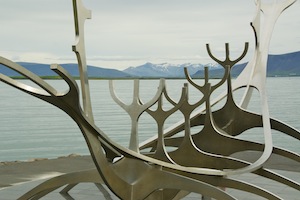
DSC_0010We spent the morning of exploring the best bits of Reykjavik, the church built to look like a Viking helmet with ever ascending columns of concrete rising to a capped tower. Everything about the church is plain and simple, both inside and out. Most of the group took the opportunity to take the lift to the top of the tower to get the aerial view of the multicoloured roofs below. I think this is the best view of the city showing the traditional with the functional and rather unimpressive modern, of which there is plenty being developed as Iceland’s climb out of recession continues to gather pace.

For a capital city it was remarkably quiet, even if it was a Saturday. There seemed to be no rush to get shops and cafes open and most of the people on the streets were tourists eager to get going. There was still the odd remnant of overindulgence staggering in the streets or sitting on a bench looking very sorry for themselves.
DSC_0014Down on the waterfront the sea was like a millpond hardly making a ripple as it lapped against the huge boulders which act as a sea defense. The hills across the water had a lot more snow on them than they should at this time of year, the height of the summer. In a few weeks time the first snows of next winter will fall long before that of last has gone. Behind the tranquil coastal scene the waterfront continues to be developed with new high rise apartment and office blocks, and the conversion of former warehouses and factories into hotels and residences, just to prove that Iceland is successfully climbing out of recession.
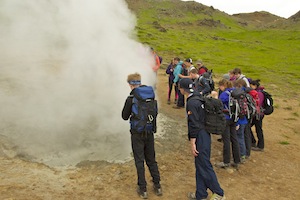
DSC_0019Returning to the hotel we made ready to leave for the hour long drive to the start of our walk to the hot springs. We visited them two years ago coming in from above. This year we were taking the slightly longer approach from the valley on the other side. This took us past a couple of interesting fumeroles but nothing like the number on our previous approach. We were plagued by small flies by the thousand. Although they did not sting, they got inside your glasses, in your mouth if you breathed through or up your nose if you breathed through that. It didn’t matter how you breathed you were going to ingest small black flies.
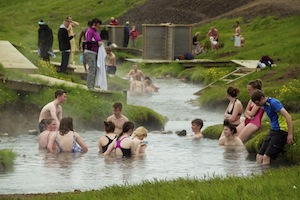
DSC_0032As were reached a high point that brought us into the hot spring valley, we saw steam rising from the stream snaking through the valley, flanked on either side by vivid green grass. Colourful flowers, yellows and vivid purples, broke up the green. All along the side of the stream duck boards had been laid to make it easier for bathers. Every so often shields had been erected to make the changing of clothes a much easier process. In places the stream had been dammed to create pools and steps led into them from the duckboards. I tried the water where we bathed before but it was much too hot so I went to a point just below where a cold stream flowed into the hot one. It was still plenty hot enough. We spent an enjoyable hour or so wallowing in hot water, making balls of the green weed flowing by and throwing it at each other, students unable to enjoy the experience without playing. The only one who did not seem to enjoy it was Josh who had to be persuaded to roll his trouser legs up and paddle reluctantly, detached from the group.

Returning to the bus we travelled the short distance to Hverageroi and the Hotel Ork, fully equipped with swimming pool, water slide and hot pools. Before and after dinner the students took full advantage of the pools, although the water slide lacked water, so was anything but slippery.
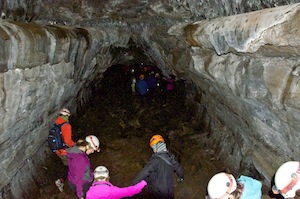
The walls may have been smooth but the floor was littered with large boulders

The walls may have been smooth but the floor was littered with large boulders

The following morning, with Phil feeling much better, we headed to Thingvellir, the site of the world’s first parliament and the place where the North American and European plates are separating to dramatic effect. However, we did not wait there very long as we were there to meet up with another Arctic Adventures vehicle where we were to receive our helmets and torches for caving. Travelling a short distance further, we reached the entrance to a 300m lava tube, Gjabakki cave. Kitted out with helmets and torches, we clambered into the tube over the rock strewn entrance. This was to prove to be the first real test for the visually impaired students and those guiding them. Firstly, those with visual impairment were as good as blind in the tube, resulting in the guides having to be very aware of the extra needs required to pass through  safely. It wasn’t just the entrance that was rock strewn; it was thus throughout its length, meaning there was no opportunity to relax. Unlike the floor, the walls were smooth, smoothed by molten lava rushing through while the outer crust cooled first and hardened. Subsequent collapsing of the roof resulted in large blocks littering the floor and making our passage through challenging. The rocks were cold to touch and rough on the hands. The tube was not straight, far from it, but it swept round in fluid arcs. It was really quite beautiful. At one point we sat on rocks and turned out our torches, guaranteeing that everybody was blind and equal. An opportunity to tell stories! I was really impressed by the way the King’s students rose to the guiding challenge, reassuring us that, when it mattered, they were more than up for the challenge. It also assured us that the impaired students were not going to be put off by a new experience, but were up to facing them with determination.
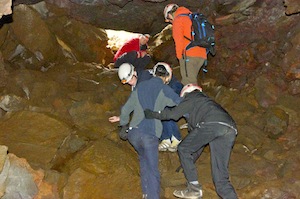
The guides had to be really vigilant

The guides had to be really vigilant

It must have taken us the best part of an hour to travel the 300m through the tube. Certainly the walk back to our bus over the surface took a lot less time.

This had been a fabulous experience and it confirmed what a good activity it was to include. We even felt that, irrespective of whether there is caving in any future itinerary, it might be worthwhile including in any training regime as it brought out the best in both groups of students.

Moving on, we drove to Drumbo, the rafting centre, for lunch before facing the challenges of the Hvita river.

Following a lunch of soup and bread, there was some delay while we waited for a group to join us. A group of Danish scouts were to be rafting with us (not in the same rafts but at the same time, as well as a third group. When they eventually arrived things began to happen quite quickly. I had decided not to raft this time, preferring to position myself to take some good photos and video, something that cannot be adequately done from the raft.
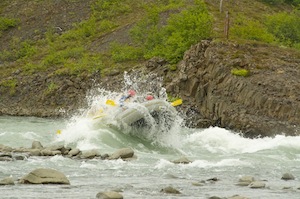
DSC_0073As they prepared and went through the safety procedures, I positioned my self on the river bank as close to the first, and most interesting, set of rapids. While I waited I was bombarded by a couple of terns who saw my presence as a threat. They provided a spectacular aerial show. Five bombing towards my head, screeching loudly as they did so, and pulling out of the dive at the last moment. On other occasions they would hover, making full use of their tail feathers to hold their position and intimidate me into retreat. Retreat I did not, so the terns moved away, regrouped, and set about removing me again.
By now the rafts were entering the water and the two rafts of Danish scouts passed through the rapids first ,giving me the chance to perfect my photography. Out two rafts were next so I got one videoed and the other by a series of dramatic stills,
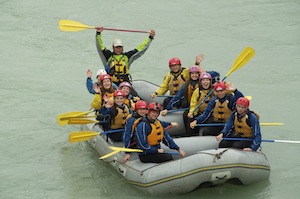
DSC_0091Then, it was quickly rush to the bus to get to the next photogenic opportunity, a road bridge over the river as they entered the gorge. This was to be quickly followed by the point where they beached their rafts, climbed the cliff and bravely jumped 7m into the cold water. But they didn’t stop. They continued through the gorge and out the other end. There had been talk beforehand that the river might be running too fast for this to be possible. Clearly, the raft captains had made an on the spot decision to avoid unnecessary risk. Practically, a wise decision but a missed photo opportunity.

Back in the bus, we made our way to the finishing point. There were no more rapids on this stretch of the river but it was the stretch where they played games, often resulting in people ending up in the river.

It was funny, as they came ashore, the number of people who, being so pleased to see me, wanted to give me a hug.
DSC_0138

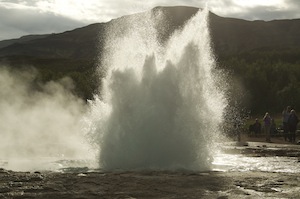
Geyser

Back at Drumbo we enjoyed barbecued lamb steaks with grossly undercooked jacket potatoes before visiting Geyser for its regular four minute eruptions. We chose to do this, and also visit Gullfoss while we were in the area rather than add many miles to our itinerary the next day and put us under unnecessary pressure. The geyser never fails to impress. It is not as high as some but it is very predictable, although, while we were there it managed to tease us twice with double eruptions, always just as we had turned our backs on it.
Gullfoss, never fails to amaze by the sheer volume of water falling over its various shelves, the noise it creates and the spray from it that fills the air.
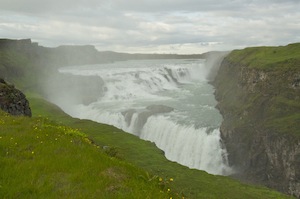
Gullfoss

Gullfoss

With these two items ticked off we headed for our overnight accommodation on a horse ranch just inland from the main ring road that circumnavigated the island. Here, we were in one large dormitory, with two rooms off for the staff, adjacent to the ménage. It was comfortable but there were not really enough facilities for such a large group as ours. It was comfortable enough and we had the added treat of a large, very hairy, goat sheltering from the rain in our porch, as well as lambs and piglets running around beneath us.
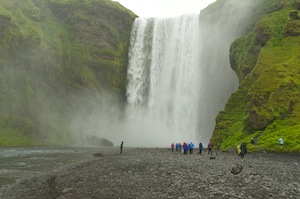
Skogarfoss

Skogarfoss

In the morning it was still damp and the forecast predicted it would get worse rather than better during the course of the day. Because we had taken the time to visit Geyser and Gullfoss the evening before our start to the day was a little more relaxed than it might have been. We were booked in for the Eyjafjallajokull film show for 10.00am, with a chance to visit Seljalandsfoss on the way. As it was we went straight to the film, a good insight into the events that led to the shutting down of much of the world’s airlines in 2010. Afterwards, we continued along the main road to look at Skogarfoss.
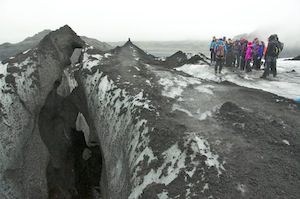
Enjoying the Solheimajokull Glacier

Enjoying the Solheimajokull Glacier

As the morning progressed I began to feel unwell and could summon little interest in the stunning waterfall in front of me. Skipping lunch, I decided that it was probably not a good idea to go with the group on to the Solheimajokull Glacier, preferring to lie down on the back seats of the bus and wait for what might happen. The weather deteriorated as well, and the group spent a very wet afternoon on the glacier. It got colder and colder as I dozed there until the inevitable happened. I began to feel a little better. Shortly afterwards the group returned from their venture on the glacier, excited by their experience even if they were all a little cold and wet.

On the journey back to our barn I concentrated really hard, keeping my eyes firmly focused in front of me. It worked, but as soon as I got to my room I had to rush out again to be ill.
While the rest of the group enjoyed lasagna and evening activity, I slept and, thankfully, was not ill again.

In the morning I felt much better, if not a little weak. Fortunately, it was an easy day, simply travelling by bus to the start of our trek.

This is where we veered away from our planned itinerary. There is so much snow in the highlands, up to 4m in places, that many routes are still closed. Where some routes might be accessible on foot, the roads for the support vehicles are closed, severely restricting where we could go. We had known about this problem since our arrival so it did not come as a shock to us. As far as the students were concerned it did not matter a great deal. For the staff, Caz and myself in particular, it meant covering the same ground as we covered last year. As it turned out it was so different from last year it was of no consequence.
Changing from our old, 1998, converted American school bus to a high wheel based four-wheel drive we headed into the mountains and Loomundur, the starting point for our trek. Siggi followed us in his land cruiser and trailer full of kit for the trek. Passing Helka, which I climbed last year, gave us some indication as to how different the conditions would be this year. Last year Hekla had just patches of snow, this it was completely covered and still very much inaccessible to the average walker, largely because vehicles could get nowhere near it making it a much more serious proposition to climb in a day.
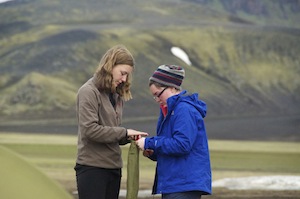
Working together

Working together

Arriving at the small group of huts that make up Loomundur, we set up camp on soft grass by the side of the river. It may be summer in Iceland but it felt more like winter. A chill wind blew across camp and the temperature was only a few degrees above freezing. I began to regret not having my down jacket. The fact that I had starved myself for 36 hours might have made me more susceptible to feeling the cold. I was not the only one who felt it. Yet despite the cold the students played cricket using a selfie stick for a bat. This caught the attention of a film camera man who started to capture this strange behaviour on film. Later, when we were eating, the camera came closer and we eventually learned that they were making a news documentary on tourism in Iceland. Clearly not enough happens in Iceland. Speaking to them they requested the opportunity to interview a couple of the students so we elected Tom from King’s and Amy from NCW. Tom is a lot taller than Amy so he bizarrely had to stand with his legs wide apart, like a giraffe going to drink, in order to make him more compatible with Amy on film. It looked very strange.
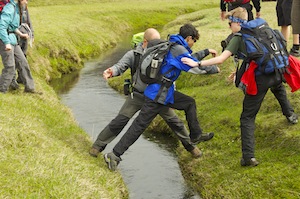
A helping hand

A helping hand

In the morning the sun shone, taking the edge off the chill. Once we got walking it would soon feel better. Our route was going to take us to Landmannalauger, the starting point for many doing the classic trek to Thorsmork. For the first 6km the route was flat but we often had to skirt round waterlogged ground. We had a river crossing fairly soon into the walk and there were many other water channels that had to be jumped. All around us the hills were covered in deep snow. It was fun looking for shapes that fired the imagination. One looked like a duck skiing on one very muscular leg while the other leg trailed behind. Another resembled a fierce cat attacking a defensive bear. There were many more to indulge the imagination.
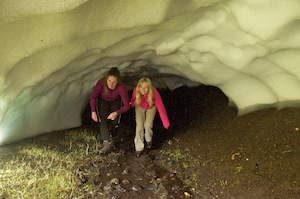
Emerging from the snow cave

Emerging from the snow cave

At one point we dropped into a gully full of deep snow. Snow caves had been carved into it by water making them fun places to explore. The face of the packed snow became a challenging playground for the students as they kicked their toes in to make steps. Some were more successful than others. These distractions slowed down progress but with virtually 24 hours of daylight there was no hurry to get into camp. It was great to enjoy these playgrounds in each others’ company and not worry about how long the journey was going to take.

The trek over to Landmannalaugar

The trek over to Landmannalaugar

After the flat we began to climb, so far avoiding snow but once we reached a high lunch spot we looked down on the route ahead and there was plenty of snow to cross. While some of it was energy sapping, some was also a lot of fun as we were able to toboggan on our backsides. It was incredibly beautiful. Walking across the snowfields made the going quite heavy and the occasional patches of volcanic rock gave some welcome relief before the next snowfield.
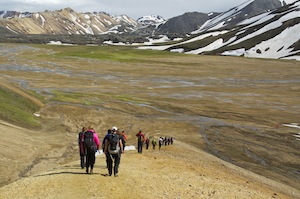
DSC_0317Coming to the crest of a hill we dropped down steeply to a flood plain where several mountain streams converge and are hemmed in on all sides. On three sides the hills sweep down to it. On the fourth side a lava field separates it from the main valley of Landmannalaugar. I remember looking across at this area last year and wishing we had time to explore it. Now I had my chance. There were several river crossings and more snow fields to cross before we reached the lava field. Staying in water shoes for the snowfields soon cooled the feet down to an uncomfortable level.
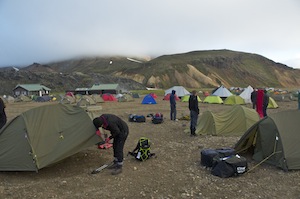
The tent city of Landmannalaugar

The tent city of Landmannalaugar

Having passed through the fascinating lava field with its fluid, tumbling rocks and deep clefts, we dropped in the tent city of Landmannalaugar. Before you can pitch a tent here you have to be as vigilant as possible and remove as many stones as you can, otherwise at least you could have an uncomfortable night, at most tear the floor of your tent or puncture your thermarest. However hard you try it will be impossible to remove them all. The next hurdle is to drive home the pegs far enough into the stoney earth to be able to hold the tent firm should the wind get up. Fortunately, there was little wind but we do know that it can be very windy here, as was the case two years ago when we watched a tent flying across the campsite with its owner chasing after it, in probably a lost cause.
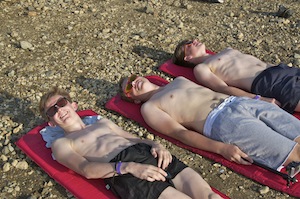
Making the most of the sunshine!

Making the most of the sunshine!

It was pleasantly warm and many of the students ventured into the hot pools, although they were not that reliably hot this year as a large amount of melt water was flowing into the stream diluting the effect of the thermal springs. They came out saying that when it was hot on the surface it was cold at lower depths and vice versa in other spots.

During the night I began to get stomach cramps with sweeping pains. I feared that the bug was back. Several trips to the loo in the night, which never got dark, seemed to sort me out, but I decided I would starve myself yet again and not do the walk to a crater rim that the group were doing that day. By the time they returned I was feeling much better and also much more positive about the days ahead.

For some reason I was awarded the “Puffin of Shame” in the evening, and given the responsibility of looking after it for the next 24 hours while everybody else in the group did their utmost to steal it from me. I honestly cannot remember why I was awarded it. Clearly it was for some trumped up reason. Having taken possession of it, I was going to look after it well.

Because of the conditions we were going to have to do what should be covered in two days, in one. The hut at Hragntinnusker was inaccessible to the support vehicle and was surrounded by deep snow. It was still only 24km but with a group such as this it would take most of the day and some of the walking would be difficult. We had concerns about two of the NCW students and their ability to cope and not slow down the rest of the group. They would travel round with Siggi in the vehicle and Caz would sacrifice her walk to accompany them. When spoken to one was relieved while the other was a little put out. I believe it was the right decision. I was now fully recovered and was looking forward to this section of one of the great walks of the world.

With the “Puffin of Shame” very firmly attached to my rucksack we set out at 8.00am. Immediately, we started the steady climb out of Landmannalaugar, soon hitting snow once we were through the lava field. It was a beautiful morning with plenty of sunshine. Sometimes I would go on ahead to film the group as they came through, while at other times I would drop behind to film them from below. This was particularly effective when the appeared in silhouette against the sky.
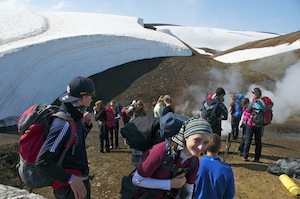
Meg has that look of satisfaction on her face that should tell me something has happened to the puffin

Meg has that look of satisfaction on her face that should tell me something has happened to the puffin

Many of the steep little valleys on the route were full of snow having the effect of levelling out the route and in some respects making it a lot easier. It was at one of these small valleys that disaster struck. In amongst all the snow there were some bubbling hot springs. I wanted my Gopro, which was attached to my rucksack, on the other side from the puffin. Trusting Tom, and saving me taking my rucksack off, I asked him to remove the Gopro. He claimed to be struggling and it took longer than it should. I thought I had all angles covered but his fumbling allowed Meg to release the puffin from my possession, without me knowing. I will clearly never trust Tom again and as for Meg!!! I never saw the puffin again until the issue of my care was brought up after dinner.
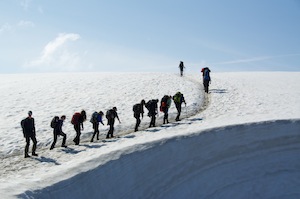
DSC_0357We were making good progress, although the higher we climbed the more snow we encountered. On the steeper sections we used the steps cut by those who had gone before us. It was much tougher on the flatter sections of snow where it was more difficult to get proper purchase on the soft snow and it got hotter and hotter as the sun radiated off it. The final push up to the highest point was long and hard, much too much for Josh, who got flashing lights in front of his eyes which made him feel dizzy. We can never be sure how this environment affects those with vision impairment. While he slumped in the snow we fed him fluid and high energy bars in case his fluid sugar levels had dipped. Thankfully, after half an hour or so he recovered sufficiently to carry on.
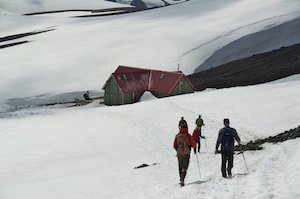
Approaching Hrafntinnusker hut

Approaching Hrafntinnusker hut

Once on the high point it was only a short drop to the hut for lunch, where we were booked to eat our packed lunch inside rather than on the crowded terrace outside where we would also cool down rather rapidly. Oskar and Danni also made us bowls of warming soup which was just the ticket.

To the side of the hut there is a valley with lots of thermal activity. This has had a fascinating effect on the vast quantities of snow filling the valley, sculpturing it into fantastic shapes. Stunning.

Around the hut were deep, circular pits in the snow from where tents had been pitched. I tried to suggest to the more gullible members of the group that they were created when people made hot tubs in the snow. Although not sure at first they did not fall for it.
After lunch with most of the uphill completed the going should be a little easier. But we now had a couple of miles trudging through deep, soft snow, so the going was not that easy. The heat coming off the snow, despite the fact that it was less sunny, was intense and I found myself sweating profusely.
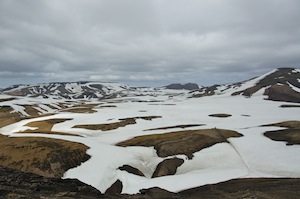
Looking back

Looking back

Eventually we climbed out of the snow on to a clear ridge. From there we could look back over in the direction from where we had come. Last year it was a scene of multi coloured rock – oranges, browns and blues with vivid patches of green where water nourished what little growth there was. This year it was so very different, a sea of white with only the occasional patch of colourful rock, now dulled by the brightness of the snow. There was hardly any green to be seen as the snow had only just cleared from those occasional patches, not giving any time for any growth.
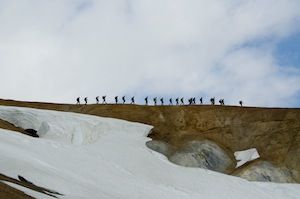
Some relief to be walking on firm ground

Some relief to be walking on firm ground

It was pleasant to walk along the snow clear ridge and feel some firmness under our feet. Gradually, ahead of us, the stunning view from the edge of the cliff unfolded. It has to be one of the best views I have ever had. It was really good to just sit there and take in the view, to absorb it in every detail. I couldn’t help but marvel at how different it was from when I sat in exactly the same spot twelve months previously. Then the volcanic ash was covered in lush, green mosses and there were barely any patches of snow. For whiteness we had to look at the ice cap to the south-east. Now, there were so many patches of snow and there was hardly any greenness to be seen, because the snow has covered the ash for so long, the mosses have not benefited from any sunlight to enable it to turn green. The lake at Alftavatn Is called swan lake. On the hillside above the lake one of the patches of snow caught my attention. It very much resembled a swan.
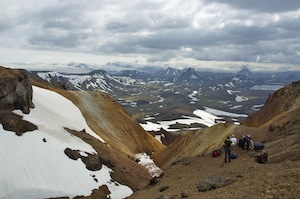
This year
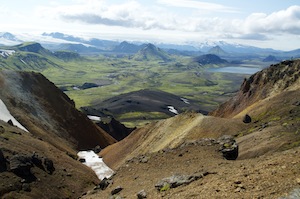
This year

Last year

Last year


Having spent at least half an hour soaking up this wonderful view we set of down the steep slope to become part of it. It was quite tricky for the visually impaired students so the guides had to be particularly helpful in their guiding. We had one more river crossing to do at the foot of the slope but, fortunately, a snow bridge meant we did not have to wade across it.Reaching camp we pitched our tents on stoney ground adjacent to the huts, although the students chose to pitch their’s some distance away where there was some greenery.

Arriving at camp we promised ourselves that we would not say too much to Caz about it being one of the best day’s walking we had ever had but by the time we saw her it was impossible to keep quiet and once started on how good it was it was very difficult to stop.

That night, after dinner I was charged with the crime of negligence and lack of care during my the period when I was responsible for looking after the puffin. The students had to choose my forfeit and Laura was very quick to suggest that the following evening I should sing ‘Head, shoulders, knees and toes’ in Icelandic with the actions. Lovely girl, Laura!
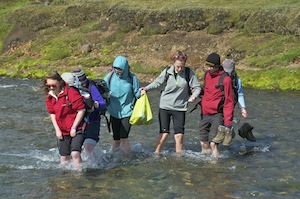
Our first river crossing of the day

Our first river crossing of the day

The following morning there was a great deal of early morning activity. An Iron Man race was taking place and where we were was to be one of the checkpoints, 24km into a 55km race from Landmannalaugar to Thorsmork, a journey we were taking three days over.
As we set off we kept looking back to see if the front runners were on their way. As we crossed over a ridge and began to descend to our first river crossing of the day, the leader came into view. He looked so strong as he powered his way along the mountain tracks. He passed us, dropped down to the river, crossed it with ease and then climbed up the other side to the next ridge, not once changing his remarkable pace or faltering. It was a full twenty minutes before the next contenders came through so, barring accidents, there was only going to be one winner. As each of the runners approached us from behind, we stepped aside and applauded. This slowed us down considerably but it was good to get their varied reactions to our support. None of them looked as fit and as determined as the leader and were out to compete for and against themselves and to enjoy it, if it is possible to enjoy a 55km run!
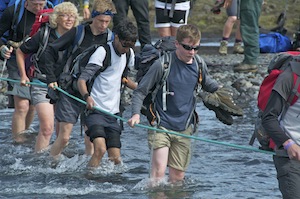
Cold concentration

Cold concentration

The event certainly made the next river crossing easier as stewards had put a rope across the river and were helping people across. It also marked the halfway point in the race where contestants had supplies of energy supplements, fresh socks and trainers.
We were now walking on the flat dirt road approaching the volcanic ash desert. The going was easier and we made good time, catching up on that lost watching the runners go through. By now they were all ahead of us and any who might have been behind us had been withdrawn if they hadn’t reached the halfway point within a certain time frame. As we left the road we came to a checkpoint clearing up. They were able to tell us that the chap we had seen long before any others had won and had broken his own record, covering the distance in 3 hours 59 minutes. Amazing!!
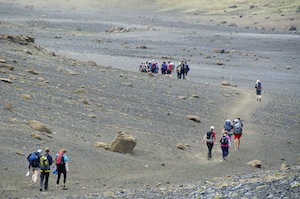
DSC_0426Now that we had left the road the track was more like walking along a sandy beach, only the sand was black volcanic sand. It got everywhere, particularly into our boots, requiring several stops to adjust boots and socks. The wind was beginning to pick up, blowing dust into the air so that it now penetrated our eyes, noses and mouths. By the time we reached camp at Emstrur it was blowing quite strongly and the Icelandic flag was straining to escape its attachment to a flag pole. This made putting up tents interesting, the more so because we were putting them up on loose, black sand, which gave no purchase to the pegs. Sand blew into the tents at every opportunity from which it got into everything. Not only was it windy but also quite cold.

After dinner I was required to sing my forfeit song. It went like this:

Höfuð, herðar, hné og tær

hné og tær

Höfuð, herðar, hné og tær

hné og tær

augu og eyru og munnur og nef

Höfuð, herðar, hné og tær

hné og tær
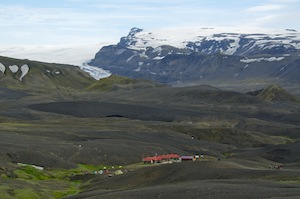
Emstrur

Emstrur

Throughout the night the tents were buffeted by the wind and taking them down in the morning required more than one person, just to make sure it did not blow away. Several poles snapped as the canvas strained to get away. In the mess tent the dust got everywhere and many of us would be having gritty sandwiches later in the day. Luckily, we were not camping again, as we were booked into the hut at Thorsmork, an much of the kit could either be left for other groups to collect or could stay in Siggi’s trailer.
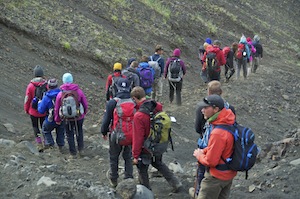
A steep descent to cross the canyon

A steep descent to cross the canyon

Despite the wind it was a lovely day and the students coped well with testing parts of the route. As the day progressed the wind died and the sun shone more readily. Much of the route involved walking through the volcanic sand but we eventually reached the first grass and trees we had seen for several days. Taking the opportunity to sit on grass for a lazy lunch in pleasantly warm sunshine it was not long before most of the group drifted off to sleep. It was very relaxing. It was with some reluctance that we stirred ourselves, booted up and donned our rucksacks for the last two ridges with a river crossing between, before we reached the beautiful valley of Thorsmork.

Nap time

Nap time

The days of activity and walking were beginning to have their effect on the group. They had been excellent at getting up in the mornings, being ready when we wanted them to be ready, but clearly tiredness was setting in. When we stopped for lunch, we stopped on the first grass we had seen for several days. The sun shone brightly and it was surprisingly warm, or possibly even hot! Having lunch, and in no rush to move on, virtually everybody in the group dozed off and had an afternoon nap. Bless them!
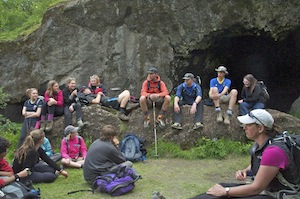
Story time with Danni

Story time with Danni

On our way to Basar, where our hut accommodation was and just before we dropped to the river in the Thorsmork valley, we stopped by a cave. Here Danni, who is a great believer in elves, and there are supposed to be a great many of them in Iceland, told the group a story that involved a farmer dying in the cave when he sheltered there from a storm. The students, always ready for a good story, sat mesmerised by it.

The next day the students had a voluntary walk led by Danni. All bar three went so, as two of them were from King’s, I volunteered to stay behind and keep an eye on them while Phil did the same for the one NCW student who stayed. They took no looking after at all and Phil and I spent the day chatting and reading.

That night we had the traditional barbecued legs of lamb. They were delicious.
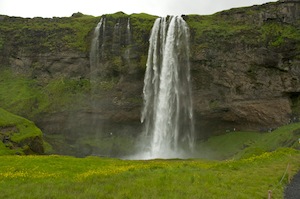
Seljalandsfoss

Seljalandsfoss

The next morning the bus was there to collect us and we were away by 9.00am. This four-wheel drive bus took us to Seljalandsfoss where we transferred on to a traditional coach, but not before we visited the falls, walked behind them and got wet from the spray. Thinking everybody was going to also visit another waterfall in a narrow cleft a few hundred metres up valley, I took Ellie and Catherine, only to discover that nobody else followed. It was well worth the diversion but made us late getting back to the bus.

Getting back to Reykjavik by 2.00pm we gave everybody the freedom to explore and shop. My priority was to get my washing done in preparation for my next Icelandic adventure, so I went to the Laundromat Cafe and enjoyed a beer while my washing was doing. While it was drying I visited the tourist information office and booked myself a day trip to the Westman Islands for the next day.
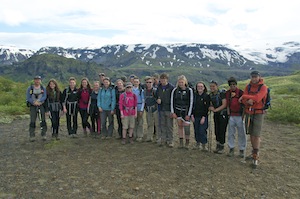
What a superb group of young people

What a superb group of young people

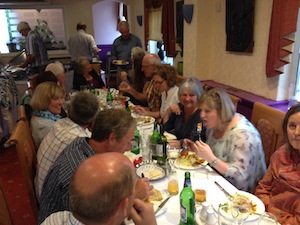
In the evening we all went out for a last meal together. As I would be leaving before them I said my farewells at the meal.

I was touched the following morning when many of the group got up early to say ‘Goodbye’. They have been a great bunch of young people who never cease to amaze and inspire me.


Pembrokeshire Coast Path

David Thomas, Simon Davis and I set off early on the 26th June to travel to Broadway and Creampots Camp Site, just a couple of miles inland from Broad Haven. Our objective was to set up camp prior to the rest of the group arriving. After all, I had advertised that by the time they arrive, the kettle would be on, the wine chilled and the dinner cooking. So, having lunched at the Galleon, a rather seedy looking pub that served good food, in Broad Haven, we set about the task of setting up camp. We had the whole, substantial field to ourselves, allowing us to spread out enough to satisfy Ros, our characterful campsite owner, and the fire regulation of placing the tents at least three metres apart. The conditions were perfect and, true to my word, camp was set up and all those bold statements in the advertising material were in place by the time the group arrived. We were not a large group, just eight in total but growing to nine by midweek. That night we ate a lovely beef goulash and celebrated Sandy Davis’ birthday with bubbly and cake, although the breeze meant that it was impossible to light the zillions of candles.

A damp start

A damp start

During the night rain drummed on the taught canvass of our tents, promising us at least a wet start to our Pembrokeshire Coast Path journey. It was still raining, not too heavily, as we drove to Newport, the starting point of the walk. It was sufficiently wet to have to don our waterproofs, to protect us from the wet vegetation on either side of the narrow path as much as anything. As we left Newport, with light rain still falling, we were approached by a local in shorts and wellies returning from a dog walk. As he passed he advised that we would have been better staying in bed. But he was wrong. Within an hour the rain had stopped, the clouds began to break up and the sun shone. Waterproofs were bundled, damp, into our rucksacks and we enjoyed pleasant walking conditions, sunshine, not too hot with a cooling sea breeze, for the rest of the day.

In places the path was very narrow and in need of a little maintenance to cut back the encroaching vegetation. For much of the time we were walking along a narrow channel, not quite wide enough to walk properly along and causing us to have to concentrate on each foot placement. The route was also very up and down, none of them being excessively long but collectively energy sapping. The steeper parts were stepped, not evenly, but with a varied drop, some of which were excessively high and particularly difficult when going down. It was hard to get a proper rhythm on them.

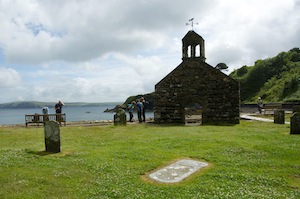
DSC_0015The coastline was dramatic throughout but I was particularly looking forward to walking around Dinas Head. It bulges out into the sea from a relatively narrow neck and is often referred to as Dinas Island. It is approached from the north via Cwm-yr-Eglwys (Valley of the Church). Following storms in 1850 and 1851the church was seriously damaged. The graveyard was breached by the sea and human remains began to appear. Another storm in 1859 rendered the church unusable and it was immediately abandoned. The sea continued to claim the church until all but west end was demolished in 1880. The sea continued to attack the remains and the graveyard, and, after a storm in 1979, a new sea wall was built to protect what was left. For us it was an attractive resting place. The sea was a placid as it could possibly be and it is hard to imagine the force that was necessary to do such devastating damage to a solidly built church.

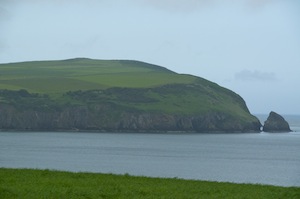
Dinas Head

Dinas Head

The east side of Dinas Head is protected from the prevailing winds allowing for a much wider variety of plants and trees to grow. The flowers that lined the way were in full bloom, something we saw throughout our journey along the coast path, and their perfume filled the air, particularly so on this this morning after being freshened up by the rain. Sheltered from the wind, it was much warmer travelling up to Pen y Fan (top of the hill) and the heat emanating from the vegetation was stifling at times.

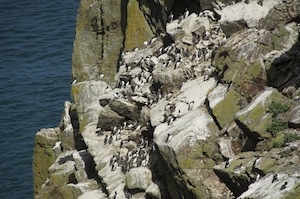
A colony of guillemots

A colony of guillemots

It wasn’t just plants that thrived on this sheltered side of Dinas Head, birds also. Stacks, now separated from the mainland, were safe havens for colonies of sea birds. Guillemots crowded on to precariously sloping ledges, jostling for position and producing a cacophony of noise. We were fascinated as to why some stacks were heavily populated while others were devoid of any bird life at all. I think there may be a number of factors which determine which stacks, cliffs and rocks are favourable to colonisation. Shelter from the elements must be a major influence. I also think the type, texture and angle of the rocks is important, accessibility to a reliable food source and protection from predators.

On reaching the top of the headland the wind was in our faces again and it was much fresher, and continued to be so all the way down the western side of the headland. The vegetation was much more limited, with largely grasses and brackens and no trees. The few trees that could withstand the elements were stunted and severely shaped by the prevailing winds.

Back on the north coast we looked out into Fishguard Bay and along the coast to Fishguard, and Goodwick from which the ferry now left for its crossing to Rosslare in Ireland. Stopping at Penrhyn Campsite we enjoyed a refreshing ice cream before completing the final leg of our day’s walk. It was warm and very sunny, stark contrast to the conditions we set out in, and the ups and downs were beginning to take their toll on our legs.

Lower Town

Lower Town

Passing through the attractive Lower Town, we followed the coast round, missing much of Fishguard  and meeting Angela who walked to meet us. Finally we reached our designated finish point and while Angela took David and John back to Newport to collect their cars the rest of us contemplated a drink. Seeing brown signs for the Ferry Boat Inn, we followed their direction, inland for quarter of a mile. On arrival we discovered it had changed from being an inn to a b&b with no bar! Trudging back to the finish point we popped into Tesco and bought bottles of beer having been confidently informed by Claire that she had a bottle opener. Salivating, we waited while she rummaged in her rucksack to produce her credit card size Swiss Army Knife, not with a bottle opener but with a pair of scissors. Desperation, or was it experience, enabled us to remove the caps and savour the nectar within, while we waited for our lift back to camp.

Although I had tweaked the itinerary in order to make the days more even, the second day was always going to be a tough one. Even with the new finish at Abercastle, we were still going to walk in excess of 16 miles with over 4,000 feet of ascent. At least the weather was in our favour. While the rest of the country was entering a heatwave that would see the highest July temperatures on record, we were blessed with sea breezes which kept temperatures down to a maximum of the low 20s. Stella, had a foot issue and, having only walked a few steps, decided not walk but to keep Angela company for the day.

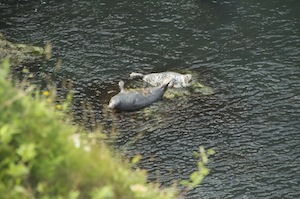
DSC_0043Zig-zagging our way through woodland, we climbed out of Goodwick to join the clifftop path which hugged the line of the coastal cliffs. The scenery was, again, spectacular with stacks and arches adding to the interest. Also adding to the interest were our first sightings of seals basking on rocks and playing together in the water. We heard them before we saw them, their deep, guttural barks alerting us to their presence. Despite the fact that we were 120 feet above them, they knew we were there and played to their audience, gamboling and rolling in the water, or simply treading water so they could see us more easily.

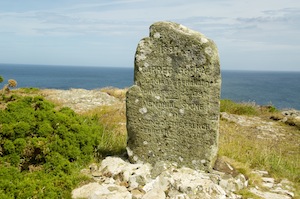
DSC_0051Dropping yet again to sea level we climbed back up through cooling woodland back to the clifftop and a memorial stone at Carreg Goffa, to mark the place where the last invasion of mainland Britain took place at Carregwastad Point on 22nd February 1797. The invasion by 1200 French soldiers, led by Colonel William Tate, an Irish American, resulted in the Battle of Fishguard. The invaders saw little success and surrendered three days later.

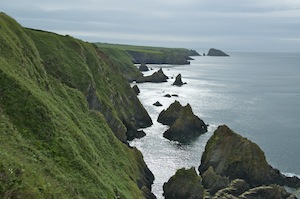
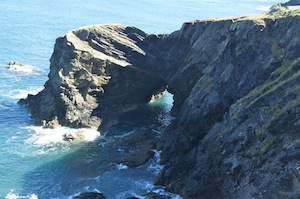
DSC_0067Following the coast we reached Strumble Head in time for lunch, sitting a short distance from the lighthouse flashing its powerful light as a warning to any passing ships. I was looking forward to rounding this headland as it would mean we would not be able to see Dinas Head again and that we were making progress. The coast was now at its most spectacular with some beautiful, inaccessible coves, dramatic cliffs and many jagged stacks constantly lapped by the sea. I couldn’t help feel how dramatic it would look in a storm.

Dramatic coastal scenery

Dramatic coastal scenery

The heat was beginning to take its toll and we were beginning to run out of water so we sent a message to Angela to meet us where a lane came down to meet the coast path and to bring water and other refreshments to give us a boost. It was so welcome. Claire, having stopped for a break, decided to call it a day and forgo the last three miles or so in favour of staying with Angela in the car.

Angela, Stella and Claire walked towards us as we approached Abercastle and the refreshments Angela gave us at the finish were unexpected but most welcome. While some went off to get the other car from the start, the remainder of us enjoyed some good beer and this time we did have a bottle opener!

We had now completed, probably, the two most arduous days of the trek. Day three was another beautiful day and while temperatures soured even higher in other parts of the UK, here they remained comfortable. The walk involved less up and down and had long stretches of relatively flat, clifftop walking. We were back to a full compliment of walkers.

Porth-gain's industrial past

Porth-gain’s industrial past

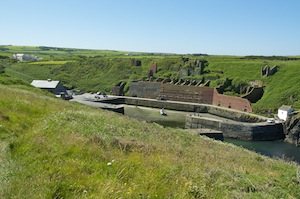
Leaving Abercastle, we continued westwards, bypassing Trefin and eventually came upon Porth-gain with its rich, but short, industrial past. Porth-gain harbour was used for almost one hundred years, until 1931 for the export of roadstone, slates and bricks. Alongside the harbour are the remains of the old brick works and the massive bins that held the crushed stone. Now it is quite a smart village with some of the old industrial buildings converted into smart restaurants and curio shops. We took advantage of the facilities to rehydrate and eat local ice cream.

Whitesands Bay

Whitesands Bay

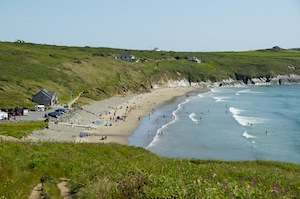
St David’s Head was getting ever closer. Looking back the way we had come we could again see the winking eye of Strumble Head lighthouse, now more than twenty miles away. The coast here was less indented and the inland scenery more interesting with the hills of Carnedd lleithr, Carn Llidi and Carn Hen rising to their impressive rocky outcrops. Rounding the headland we could see Whitesands Bay and the expansive beach that attracts many holiday makers on a good day. It is a bit of a Mecca for surfers, being exposed to the Atlantic swell and the opportunities that gives for riding the waves. Today there was little swell but it provided excellent conditions for novices to hone their skills.

It proved quite warm throughout the day and I had been dreaming of having a swim when we reached Whitesands. Going on to the beach, we released our feet from the confines of our boots and wandered down to the water’s edge. We did not go far and any thoughts of having a swim were quickly dispelled. The sea was not warm. This was confirmed when you took time to observe those that were in the sea, were all wearing wet suits.

After three days of walking we deserved a rest day so I arranged for the group to take the boat from Martin’s Haven for the short crossing to Skomer Island. Thankfully it was only a short crossing as I don’t think Simon would have been able to keep his breakfast had it been much longer. You only had to look at him to realise he was concentrating hard.

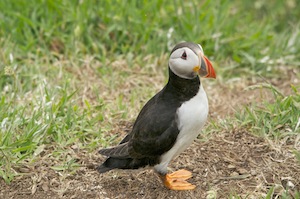
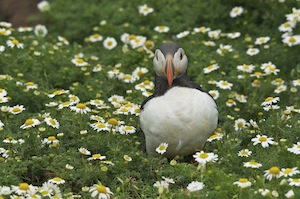
DSC_0131In parts of Britain this day was the hottest July day on record with temperatures above the mid thirties. On Skomer, we started out in sunshine but after only an hour there the sea mist rolled in and temperatures were suppressed. Although we could not see much of the cliff colonies and there was no chance of seeing seals, porpoises and dolphins we had such a wonderful time enjoying the clown-like antics of the puffins. Not only do they look like clowns, they act like them. They are such delightfully innocent birds and I could spend hours watching and enjoying their company. They seem to have little fear amongst humans, which makes them all the more attractive.

DSC_0169It was a calm day but the unseen noise of the sea on the exposed side of the island suggested that it was quite rough. I wish I could have seen it. I would love to see it during stormy conditions. I imagine it being a very dramatic place to be in a storm. I certainly want to go back and spend a night or two on the island, enjoying the birds after most of the tourists have gone home. Then we might be able to see something of the 316,000 Manx Shearwaters that emerge from their burrows at night.

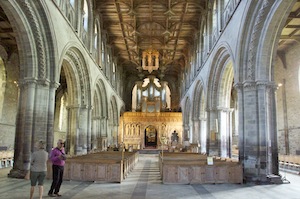
DSC_0185Before heading to Whitesands Bay for the resumption of our walk we spent a little time in St David’s, taking time to visit the cathedral. It is unique as a cathedral as it is build in a hollow and cannot be seen until you actually stand on the edge of the hollow, almost level with the top of the tower. Most cathedrals are built in prominent positions where they can be seen from some distance. At least, being built where it is, it is protected from the strong winds coming off the Atlantic. I have been to the cathedral a number of times but I don’t remember the pronounced slope of the nave, nor the angle of the supporting pillars either side of it. They lean out at quite a sharp angle.

The western end of the peninsula around St David’s was far less indented and good progress could be made. At St Justinians, path diversion signs redirected us around the construction of a new lifeboat station.

Ramsey Sound

Ramsey Sound

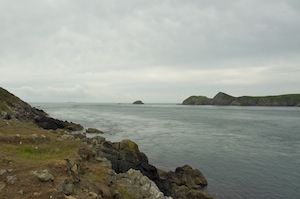
Our interest was now drawn to Ramsey Island, or more precisely to the stretch of water between it and the mainland. This stretch, where the tidal currents are squeezed, is renowned for its choppy water and strong currents. The rocks that jut out from the island at its narrowest point and adds spice to the flow are known as the Bitches of Ramsey Sound. We watched a launch make little progress against the flow despite having the engine running at full throttle. Suddenly, having fought its way through it is released by the currents and shoots forward.

At one point, just ahead of us we saw somebody take a tumble. Rushing to their aid we discovered an old lady half lying, half sitting uncomfortably among the rocks. I think what had happened was that she looked up when she saw us and lost her footing. Although she had not broken the skin she had raked her shin over a rock and her knees were also showing signs of bruising. Sending the rest of the group ahead to wait for us, David and I patched her up, made sure she had food and drink, and that she was not suffering from shock. She was very chatty and as I eventually helped her up to negotiate the rest of the rocky slope I asked her how old she was. Pauline was 81 and was on holiday from Leeds, walking the coast path and staying at youth hostels. What a game old bird. We watched her as she continued in her sprightly manner and then spoke to another female walker going in her direction to just keep an eye on her.

DSC_0214It had been the tendency throughout this walking week to have two lunch stops. Today was no exception and as we sat on a grassy bank at the side of the path, enjoying the sunshine and the opportunity to rest, we were joined, at first by one gull, waiting in the hope that we might throw it some scraps. Doing so, we were then joined by several other gulls who then proceeded to give us a fantastic aerial display as they jostled for food and position. It gave us an opportunity for some great action photos.

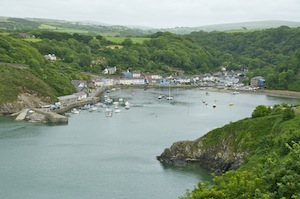
This southern section of the headland was again more indented, not with wide sweeping bays but with narrow inlets. It was to the largest of these inlets that we were heading for at Solva, a quaint village at the top of the inlet. Here, as it was my birthday, we relaxed at the pub, sitting in the sunshine, while waiting for our lifts to materialise. There was no rush, we had made reasonably good time and we had a good reason to stay for a drink or two.

Me and my cockerel!

Me and my cockerel!

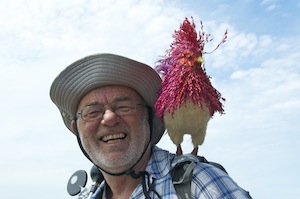
In the evening I was presented with my rucksack with a rear view mirror attached so that I could keep an eye on the group behind me, and a horn! I later found a former shop display cockerel in my sleeping bag, which I was instructed to wear on my shoulder for the next day’s walk. This created some fun on the walk as we would meet people who would look at me and not notice the cockerel. David would ask people who had just passed me if they had seen a man with a cockerel on his shoulder. They would look blankly and say ‘no’ to then have me pointed out. One man did say that he hadn’t seen a man with a cockerel on his shoulder but seen a cockerel with a man up its arse! When people did notice, they demanded an explanation.

Stonechat

Stonechat

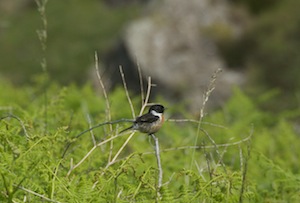
It was quite a long walk today all along the edge of St Bride’s Bay from Solva to St Brides. It was also a varied walk with fantastic clifftop stretches, long beaches at Newgale and Broadhaven. Throughout the walk we had been attracted to the wildlife, the occasional sightings of seals, the gulls soaring on thermal currents of air, the dogfights between peregrine falcons and gulls, kestrels, once so very common but now a rarity, the beautiful, vividly coloured flowers that attracted so many insects, butterflies in their thousands and the constant song of the stonechat, perched on the highest twig above the bracken, singing his heart out while he flitted from high twig to high twig to follow us for a while.

Monster!

Monster!

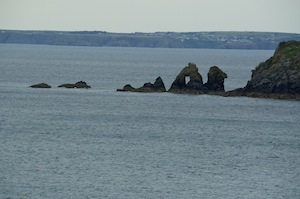
On reaching Little Haven, we met up with Angela, which gave those who had had enough a get out for the last five miles to St Brides. My cockerel had had enough so I detached him from my rucksack for the remainder of the walk. This just left four of us for this final stretch, through more varied terrain. We were again on a stretch of coast sheltered from the westerlies. Here trees grew and we walked for a while through mature, broad-leafed trees. Among them it was hot and humid and we were constantly pestered by flies wishing to drink our sweat. Eventually we emerged onto the fresher treeless cliff path. Out in the bay were some rocks with a natural arch passing through them. They gave the appearance of a sea monster wriggling its way through the water.

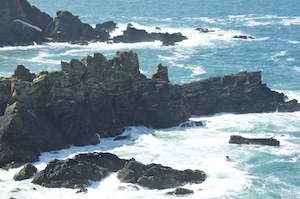
Dramatic coastline and waters

Dramatic coastline and waters

The final day saw us walking from St Brides round the peninsula to Martin’s Haven and then along the cliffs above the inaccessible Marloes Sands and then around the peninsula that is St Ann’s Head before finishing at Dale. There was more wind today and the sea on exposed coasts crashed over the rocks on the shore. A few large tankers were anchored off shore awaiting their opportunity to birth at nearby Milford Haven. The chimneys of Milford Haven could be seen for most of the day but despite it being Europe’s largest oil and gas terminal it does not seem to encroach too much on the rest of the beauty of the Pembrokeshire Coast Path. Obviously you cannot avoid seeing it but it did not, as far as we were concerned, detract from the beauty or enjoyment of the walk.

Cobbler's Hole

Cobbler’s Hole

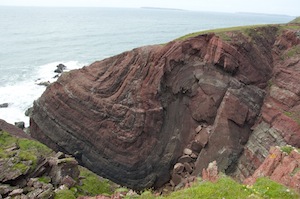
While some of the old lighthouse properties are now abandoned, the lighthouse itself has been turned into residences with outstanding views across the water. Rounding St Anne’s Head we detoured slightly to have a look at Cobbler’s Hole, a small inlet that displays the pressures forced upon rock way back in geological time and how it has been shaped.

We now only had a couple of bays to walk around before heading for Dale Point and then into Dale. There was a Pirate’s party taking place to raise money for children’s play equipment. There was a lively atmosphere, added to which were numerous sailors visiting for the weekend. The bay was littered with anchored yatchs and the Griffin, the pub we veered towards was busy. We sat on a balcony overlooking the activities and enjoyed a few beers in the sunshine.

In the evening we returned to the Griffin for a celebratory meal. It was not disappointing at all, but extremely good. We had had a good week with good walking, good weather, good company and good food. What more could you ask for in life? Oh yes, not to rain heavily when we struck camp the next morning!


Charity

Last weekend had a strong emphasis on charity. On Friday 19th I found myself walking the length of the Worcestershire Way (officially 31 miles of undulating Worcestershire countryside, but proved to be a mile longer according to GPS) for the annual St Richard’s Hospice challenge walk. John Woodcock had enticed me to join him in return for him coming to a dinner I was organising for the Nepal Earthquake Appeal. Thinking about it, I seem to have picked the short straw in this deal. Where is the hardship in eating a meal? Nevertheless, I agreed, on the understanding that I would not be seeking sponsorship at a time when I was wanting to encourage people to support the earthquake appeal; I would simply make a donation to St Richard’s.

I have often walked the Worcestershire Way, but over two days finishing the end of the first day at the Admiral Rodney pub in Berrow Green. Doing it in a day would seriously challenge my ability to walk past the Admiral Rodney and not go in to rehydrate on Butty Bach.

Gathering at St Richard’s at 4.45am in order to catch the bus provided to take us to Bewdley. Conversation, for the most part, was muted but there were one or two who were clearly more ‘morning’ people than others. It was quite a bright morning but there was a promise of heavy cloud developing in the morning, keeping temperatures down but without the chance of rain. Perfect conditions. The fact that it remained sunny all day, that it was quite warm and I was grateful to long stretches of walking in the shade and a hat when I wasn’t, goes to show that the forecasters for the 19th June got it very wrong.

IMG_0002There were 82 walkers in total. John and I had David Woodcock and Mike Brennen walking with us. We started walking at 5.45am and set ourselves a good pace. Navigation was never an issue, for not only is the route well waymarked, I have walked it so many times I know it with my eyes closed. Every so often a female voice emanated from John’s pocket telling us how far we had walked, our pace, the number of calories we had burned and the number of steps we had taken. This was encouraging, particularly as we seemed to be setting a pace of 17 minutes per mile. Even a few ups did not seem to diminish the pace that much. Hang on though, this was not a race. It is supposed to be a lovely country walk. So why did four people just run past us?

Abberley clock tower

Abberley clock tower

The climb up Abberley Hill, quite steep at times, slowed us down. It was from here that we had our first view of the finish, Malvern, the hills being a hazy lump in the distance. Then we had the mile undulating along the ridge, not making any forward progress but walking across our route rather than along it. At Abberley we were a third of the way. This was our first opportunity to take a break as the Abberley WI were providing tea and cakes in the Abberley School cricket pavilion. It was still only 9.00am and I was eating cake! While some sat down and took the weight off their feet I was reluctant to do so, knowing that it would make it much harder to get going again. There was a great atmosphere of being in this together. People were easy to talk to, the most often asked question being, “Have you done this before?” While there were some Worcestershire Way virgins, like myself, there were many who were repeaters, people dedicated to supporting St Richard’s.

Not over full with cake we started the second third with the steep pull up Sheep Hill. This led to one of the most beautiful sections of the walk, along the ridge overlooking the Teme Valley. In these conditions it was perfect. Once up the hill we were able to pick up the pace again and, although 17 minute miles were a thing of the past we were still managing sub 20 minute miles.

On the ridge there is a seat dedicated to the Martley Path-or-Nones, a fabulous resting point with stunning views across the Teme to Shelsley and Clifton. Two walkers were resting when we arrived; two walkers I had never met before. That did not stop me from telling them that their time was up and that they should bugger off. They did! After a short rest, a bite to eat, a drink and an appreciation of the view, we were off again. As we descended steeply to the river the knees began to feel the pain but, as with all the hills on this route, they are short lived and so is the pain.

Soon we were passing the Admiral Rodney and I wondered if this might not be a psychological hurdle for me. It proved not to be. I was feeling generally good and wanted to see this through to the end.
Lunch was at the Talbot at Knightwick, 21 miles into the walk. Two thirds completed. John and Mike’s wives, Chris and Geraldine, were there to meet us with a clean shirt for John and a selection of boots for them to change into if they so needed. It was also an opportunity to offload any unwanted kit we were carrying to lighten our loads.  A large buffet spread was set out for us but I was more interested in fluid, water, orange squash, anything to rehydrate. Beer was not a temptation at this stage. A massage service was available and David took advantage to have his legs pummeled ready for the final third. I changed my socks and the inner soles of my boots. While I was doing this a thought occurred to me. Why am I doing this? I don’t have any sponsors. Nobody is relying on me completing this walk in order to give me money. I am making a donation. If I am doing that I could sit at home all day and send a cheque. I must be mad. With those thoughts we set off for the last ten miles or so to Malvern.
The pace had slowed, not hugely, but sufficiently for me to notice that the voice from John’s pocket was not as encouraging as it might be. Before we reached Longley Green I began to visualise the village shop and its supply of Magnums. Meeting up with a fellow walker, I warned him that if he was planning to visit the shop for a Magnum, and it was the last one in the shop, I would have to kill him. The threat was enough to deter him from doing so. As it happened, there were plenty in stock and we allowed ourselves a brief rest while we savoured our Magnums!

Mike, John & David

Mike, John & David

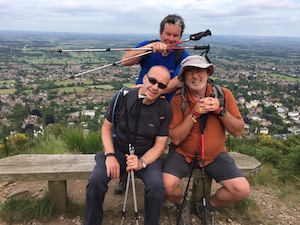
The lump that is North Hill began to loom over us and the end was clearly in sight. We just had to climb over the Malverns and drop down into the town and, more particularly, the Red Lion. This was the hardest bit at the end of a long day. I took my sticks out ready. The flight of steps from lower West Malvern to upper West Malvern are a real killer and they are followed by a steep climb past the now closed Lamb Inn. It was here that I hit a wall. My pace slowed significantly. I had led all the way but now I was at the back, struggling to find the energy for the climb to the top of the ridge. As the path became less steep and eventually levelled out, I found my energy again and enjoyed the circumnavigation of North Hill. Here we paused for photos.

John & I with Mike behind

John & I with Mike behind

Finally we reached the point of descent, the knee jarring route down to the pub. It hurt but we knew that soon the pain would end, John’s blisters could have the pressure taken off them, David’s saw bits would no longer chafe. If Mike had any problems he kept them to himself. Our wives would be there at the end waiting to mop our brows, pat us on the back, fetch us pints, massage our sore bits. They would be there at our beck and call. And so they were, all except Chris, who was caught up in watching Andy Murray, much more important than seeing her husband and eldest son finish a 32.11 mile walk in twelve and half hours.

Having sat at the pub for an hour, getting up to go to the car was painful, not only to achieve but also to watch. And so it was for the next twenty four hours until my became accustomed to moving. They felt as though somebody had stamped on them. Despite the aches and pains, it was a great day out in perfect conditions. I don’t need to do it again, I have done it. Would I do it again, if asked? Probably, yes!

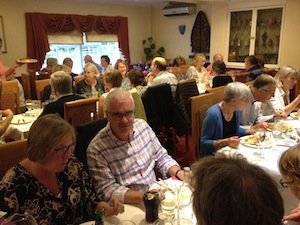
Still aching a little from Friday’s exertions, I organised a fundraising meal at Cromwells, a Nepali/Indian restaurant at Powick, just outside Worcester. I arrived an hour before the main body of guest in order to set things up to find a number of table occupied by people I didn’t know. While I was setting up other came in looking for a meal, and were accepted by the Nepali staff. There were still a few tables occupied when the main thrust of of my booking arrived between 7.00 and 7.30pm. It did not matter, as the sixty four people who came all knew each other but had not necessarily seen each other for a while. They were happy to crowd around the bar, and it was an impenetrable crowd for a while, have a drink or two and chat. Anna, my daughter, got trapped and could not easily move around the room to sell raffle tickets.

Satisfied diners

Satisfied diners

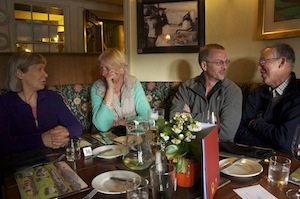
Eventually the tables all cleared and we were able to release the pressure around the bar as people sat down and Anna could move freely, making the most of the selling opportunity. It still took a while for the food to be brought to the buffet table. I was concerned that people would be feeling hungry but nobody seemed to mind and once the food did arrive and people began to taste its delights, any negative feelings I might have had soon disappeared. The food was stunning. So much so that Pradip declared it was the best authentic Nepali food he had tasted outside Nepal. High praise indeed. Nobody had a bad word to say about the food and when I offered the chance for people to return to the buffet table for more, many did.

Before we got down to the serious business of the evening we played the birthday game, which, if it had worked out properly would have had one winner. As it happened we ended up with four, who shared the massive box of Swiss chocolates with the whole room, although I think it bypassed me. The aim of this game was to raise some quick cash to give to Gill and Pradip for all the fabulous work they do with their charity, Jamarko.

More happy diners

More happy diners

I spoke briefly about the trust and showed the assembled crowd two short films of the trust’s day to day work in education and health. Gill Spilsbury, a good friend, spoke for a few minutes about her experiences of the earthquake and the impact it has had on peoples’ lives. I then showed a short, graphic film of the quake and some of the images that have since come out of Nepal. This was designed to be emotive just before I held an auction. I have seen the film many times but it never fails to draw upon my emotions.

The auction was approached light heartedly and we even got £50 for Kevin Poole’s flat cap that he bought on the Dales Way and that we pinched. We did have some special items, the best of which was a summer print by the Sherpa deaf and dumb artist Temba that had been signed by Ed Hillary, George Lowe, George Band, Mike Westmacott, Doug Scott, Stephen Venables, Chris Bonington and Rebecca Stephens, a venerable collection of Everest achievers.

We concluded the evening with a game of Heads and Tails for a bottle of wine, the proceeds of which also went to Jamarko before drawing the raffle with its wide selection of prizes.

Afterwards many people stood talking, reluctant to leave, but gradually the numbers thinned out. It was great seeing so many good friends in such a convivial atmosphere. While the shape of the room was not perfect for such an event, it was cosy and the food was truly exceptional. Financially, it was a huge success, raising approximately £4500 for the Himalayan Trust UK Earthquake Appeal. Thank you to all my friends who contributed in such a positive way.


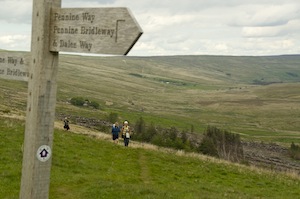
The Dales Way

On a blustery Saturday morning in early June a group of eleven and one small dog, Dodja, climbed aboard the minibus to Appletreewick, our base for the first three days of the Dales Way. David and Angela had gone earlier in the morning to set up camp. It was unseasonally windy, the gusts being felt by the minibus as it ploughed its way up the busy M6. By the time we arrived at Masons Campsite in the beautiful area that is Appletreewick (pronounced Apwick by some) the wind was bending the trees over, branches were snapping off and carnage was being done to tents and shelters in the camp. While David and Angela had been struggling to put up tents others were abandoning their weekend camp and returning home. Conditions were so difficult that David and Angela had only managed to put up five tents and had decided to abandon any idea of erecting the shelters. Sending the group off to the nearest pub, the Craven Arms, the three of us battled the winds to erect the rest of the tents.

Reluctantly confined to the pub for our evening meal

Reluctantly confined to the pub for our evening meal

It was clear by the time we had finished that we would not be able to cook without a shelter; the wind would constantly blow the stoves out. Neither of the pubs in Appletreewick could take us but the Red Lion in Burnsall, a couple of miles down the road, bent over backwards to accommodate us if we were prepared to eat early and release the table by 8.00pm. I can’t think of many pubs that would be so willing to help, particularly as they had 130 cyclists arriving during the course of the evening. The meal was excellent and made up for the poor conditions back at camp. As the evening drew on the winds abated but the temperature dropped well into single figures sending people off to their tents well before it got properly dark. Some would find the night cold as their sleeping bags were not designed for such low temperatures, but who would have expected a ground frost in June?

The following morning dawned early and bright. Curlews seemed to be calling all night and one of the first birds to make its presence known in the morning was a noisy oyster catcher squawking loudly as it flew over the camp. There was an air of anticipation as we prepared for our first day of walking but the conversation never strayed far from talking about how cold it had been. Kath had a particularly cold night and, upon inspection of her sleeping bag, it was hardly surprising. She brightened up when I swapped my sleeping bag for hers but it took a while for her to warm up, both physically and to the adventure she had embarked upon.

The start of the Dales Way

The start of the Dales Way

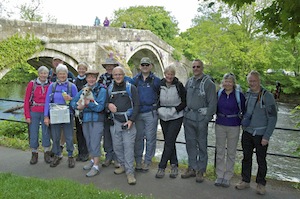
After breakfast we travelled to Ilkley and the official starting point of the Dales Way at the Old Bridge over the River Wharfe. Ilkley Moor looked enticing, hovering above the town, and had we had more time we might have been tempted to explore but we had a walk to do.

We were following the River Wharfe all day, 12 miles back to camp through some really spectacular English countryside. We were soon out of the town and walking along beautiful, tree-lined stretches of the river with hills rising on all sides. In amongst the rural landscape were some magnificent stone built houses surrounded by expansive manicured grounds; houses built by wealthy industrialists from the mill towns of Yorkshire. At Addingham, an hour or so into the walk, the once industrial mills that hummed with the sound of machinery, are now converted into desirable dwellings, largely for those who are prepared to commute daily to Leeds and Bradford, or for those who can afford a second home, rural retreat. The conversions are good and have turned what would have been derelict buildings into something much more attractive and useful.

Bolton Abbey

Bolton Abbey

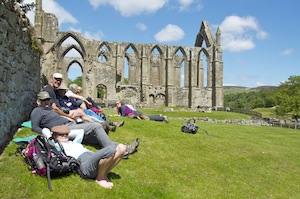
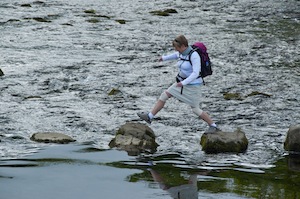
This stretch of the first day, because it was easily accessible and had a number of attractions, was quite busy at times. It was, after all, a Sunday on a summer’s day. The people increased as we neared the stunning ruins of Bolton Abbey. Angela met us there and we enjoyed our picnic lunch among the well manicured ruins. For those less interested in ancient ruins, the river provides a playground for children of all ages, with stoney beaches leading to shallow waters that are safe to play in.  Here, there is also the challenge of crossing the river by stepping stones, although there is a bridge for those less willing to expose themselves to the possibility of falling in. We all chose the more adventurous option and it was Steve, and then Ann, who very nearly came a cropper. Steve wobbled mid river and, for a while lost his nerve. My camera, set to video mode, waited to capture the moment. A young boy offered to go out to him to “motivate” him. We didn’t want him motivated! We wanted him wet! Composing himself, he regained his balance and confidence to finish the crossing, as did Ann who had a similar mid river wobble. Shortly after the group crossed a young woman obliged us by satisfying our thirst for action, falling in fully clothed. She survived, but I am not sure whether her phone did.

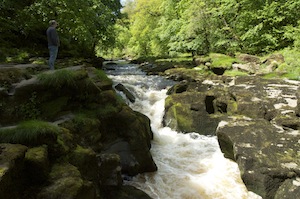
The Strid

The Strid

The crowds were never very far away as this area has many circular walks linking Bolton Abbey with the next attraction, the Strid, a section of river that is squeezed through a narrow limestone gorge. The Strid has been the downfall of many a hot head who cannot turn down the temptation of jumping across the narrow gap. It is quite narrow in places, maybe a couple of metres but the two sides are not level, making the jump more difficult than it may appear. The water rushes through the narrow gap, which is almost 100m long but is 10m deep. The currents swirl around and anybody unfortunate enough to fall in tends to get sucked under and by the time they emerge they have long drowned. Not pleasant.

At Barden Bridge the attraction was not the beautiful stone bridge, a feature to be repeated many times on this walk, but the ice cream we all enthusiastically bought and savoured.

House Martins

House Martins

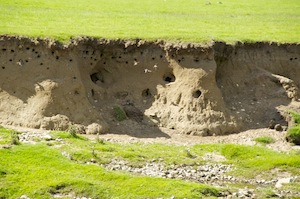
The last couple of miles to camp took us along a stretch of river with sand martins nesting in the earth banks. It was fascinating watching them swoop into their tiny holes without a second thought. Having delivered their tasty catch of insects to their young, secure in the depths of their nest, the adults perched on the edge before swooping off in search of more food. A goosander entertained us as it dived and later emerged a long way from its entry point. A quick shake of the head and off it dived again in search of food. It eats fish, but as we had struggled to see any fish in the river all day, and on subsequent days for that matter, it probably had to spend much of its time seeking them out. I put down the lack of sightings, not to the banana skin that Steve accidentally threw into the river killing them all, but to the peatiness of the water that may not be particularly suitable for fish to thrive in. The banana skin would not have helped. However, there must be fish in there as we did see the occasional fisherman standing in the middle of the river casting his fly. We never saw them catch anything.

Camp had calmed down a lot and many weekenders had gone home by the time we arrived. David and I put up the shelter and normal service was quickly resumed, with tea brewed, cake shared, wine and beer on offer and dinner cooking. It was still very cold in the evening and the night time temperature was forecast to drop to 2 degrees. Kath would undoubtedly be warm in my sleeping bag. Would I survive the night in hers?

Picknickers?!!

Picknickers?!!

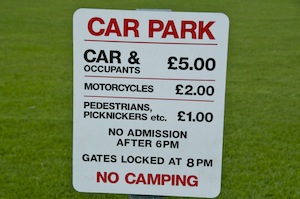
It was a little cool at times but, importantly, Kath had a good night and was in good spirits for the 12 mile walk ahead of her. Logistics were easy with us walking from camp, continuing along the river to Burnsall where we had eaten so well on the evening of our arrival. On the approach to Burnsall we crossed an area of beautifully kept grassland which appeared to be a car park, although no cars were parked on it when we passed through. The sign by the entrance, and thus the point at which we left the ground, there was a sign advising us of the various charges. The pedestrian tariff was £1 but nobody challenged us for it. The sign held some amusement for us with its variation on spelling. Clearly part of the Yorkshire dialect!

Gerry flirts with danger

Gerry flirts with danger

Continuing along the river, which still had no apparent fish in it, we came to a suspension bridge with adjacent stepping stones. Most opted for the thrill of the bridge, but Gerry tested her nerve with the stepping stones and nearly came to grief on a wobbly one, causing her to possibly regret her decision. Dodja, carried in the arms of Ann, was none too happy crossing the bridge.

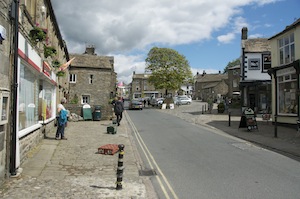
Stopping to pause by the falls at Linton, not overly impressive, we headed into Grassington, an attractive, if not touristically twee, Yorkshire market village. A range of shops and cafes lined the main street and we took advantage of one of the cafes for a restful coffee while we bought Kath a second sleeping bag and Kevin bought himself a very “country gent” flat cap. He was obviously so impressed with the “wally award” flat cap presented each day to the person who most deserved it, he couldn’t wait for that honour to befall him and took matters into his own hands, or should I say on his own head?

Grassington

Grassington

One shop worthy of a visit was the butchers with its range of award winning pork pies. It would be a wasted opportunity if we did not try them and judge them for ourselves, so I bought a couple, fully prepared to share them at lunchtime. While I was buying pies others were buying chocolate and other such confectionaries, all designed to delay our continuation of the walk. David, not tempted by such treats, was not feeling too well and decided to abandon his walk in favour of returning to camp for some recovery time.

DSC_0104The route now left the river and climbed up to open moorland with exposed patches of limestone pavement carved smooth and crenelated by centuries of water erosion. In among the nooks and crannies brightly coloured flowers sprouted. Despite the nature of the landscape it was still criss-crossed with the ever-present drystone walls, each with their complicated system of combined stile and heavily sprung gate, making crossing them anything but smooth and dignified.

We were now high above Wharfedale walking between two escarpments, one above and one below, with stunning views up the valley towards Kettlewell and across the valley towards Kilnsey Crag, an attraction to anybody with an inclination to climb. Little dots could be seen inching their way up the crag. There is a particularly difficult overhang on the left hand side, which requires a lot of skill to climb through.

Atop Conistone Pie

Atop Conistone Pie

Stopping briefly for photos on Conistone Pie, a small outcrop of rock, just begging to be ascended for the views it gave and the opportunity to rest and appreciate where we were.

Descending into Kettlewell, an attractive village with three pubs, a couple of cafes and a shop that transports you back to the 1950s with its floor to ceiling wooden shelving. It was not only a shop but a museum to everything that was good about the village shop and the importance it held for the community. This one patronised local producers and while it may have been a little more expensive, the quality was excellent and a lot more friendly than our supermarkets!

The following morning we set out from Kettlewell to cover the 16+ miles to Gearstones, trekking along the upper reaches of the River Wharf, over the watershed at Cam Houses and down towards the spectacular viaduct at Ribblehead.

Yockenthwaite Church

Yockenthwaite Church

A coffee break at the pub in Hubberholme, something I dreamt about from the start of the walk, remained a dream as it was closed on Tuesdays. Why a Tuesday? It was made worse by the fact that the landlord stuck his head out of the window to confirm, with a smile, that he was closed. Instead, we sat by the river looking across at the closed pub and ate a snack. We also took the opportunity to take a look at the church with its ‘mouse’ furniture.

Above Yockenthwaite the valley narrowed and the sides steepened. The now much narrower River Wharfe tumbled over a bed of limestone, at times disappearing underground, leaving an exposed bed of water smoothed rock dotted with small pots.  A collection of stones trapped in the bottom of each pot act as erosive tools when the river is much fuller.

As we climbed gently up towards Cam Houses we passed Nethergill Outdoor Activity Centre. We did not exactly pass it. A sign outside advertising hot and cold drinks and homemade flapjack was too much of a draw. It was a help yourself, DIY place with an honesty box. It provided some welcome respite.

Approaching the junction with the Pennine Way

Approaching the junction with the Pennine Way

The river was no more than a mountain stream and the path took us across boggy tributaries. Above Cam Houses the path joined the Pennine Way as it descended towards Gearstones on a wide gravel track built for lorries to take logs from the forest that covers the watershed area. Ahead of us was the Ribblehead viaduct with its many arches carrying the Settle to Carlisle railway, upon which the group would travel on their rest day while David, Angela and I moved camp from Appletreewick to Dent.

The Ribblehead Viaduct

The Ribblehead Viaduct

In the morning Angela took the group to Settle to catch the train, not as comfortable an experience as it might have been. The train was full and without reserved seats, Claire found herself sitting on the luggage rack with a restricted view of the countryside passing by. None of the gentlemen in our party proved to be gentlemen!

David and I finished the packing up at Masons before heading off to Dent. Masons Campsite, although quite expensive had excellent facilities and was a lovely flat site. I certainly would not hesitate to return if the need arose.

High Laning Campsite in Dent was equally flat, much less crowded with good facilities. Views all around were beautiful and the sun set down the valley, making sure it was light until after 10.00pm. Margaret, who ran the site, was a lovely down to earth character, always eager for a chat and keen to know about us.

Looking down on Dentdale

Looking down on Dentdale

The next day was the longest walking day as the minibus returned us to Gearstones, leaving us to walk beyond camp to Sedburgh, a distance of a little over 18 miles. Sadly, I forgot my camera on this day so was limited to the few I could take on my phone before the battery ran out. We climbed up over rough moorland, with curlews flying noisily to distract us from going too near their nests. At Dent Head we chose not to walk for three miles along the road into Dent Dale but to take the higher, much more attractive route over the tops and via a terrace overlooking the length of Dentdale. It added a little more to the distance but it was worth it just for the views.

Descending into the valley we now followed the River Dee. On the tops there was a cooling breeze but now that we were in the valley it was hot. It was a gloriously sunny day and for much of the walk there was no respite from the sun. The path crossed many field boundaries, each one necessitating us to cross a stile or pass through a gate made for a stick thin person, not a slightly broad adult male carrying a rucksack! People were beginning to run out of water, so I phoned ahead to Angela to meet us at Dent Bridge with the minibus and supplies of water and snacks to keep us going. It was here that we also met Peter and Cynthia Hardyman who were joining us for two days. They should have joined us earlier but because of a series of miscommunications we missed each other at various points along the way. It was good to see them now that they have moved to Yorkshire.

Passing our camp on the way to Sedbergh

Passing our camp on the way to Sedbergh

From Dent Bridge we had just another four and a half miles to go to reach Sedbergh. The going was easy so I put my foot down and set a good pace, believing that the group would relish getting it done sooner rather than later. It came as a bit of a shock to Peter and Cynthia causing Cynthia to ask, “Do you not stop to take photos?” Not when you have forgotten your camera! We were not actually finishing in Sedbergh but in the picturesque village of Millthrop on the near side of the river and noted for its very colourful gardens. Before we descended into the village we did take time to relax on the hillside and admire the view looking across at Sedbergh and the Howgills beyond. In the late afternoon sun the light was stunning highlighting so many shades of green. It was a disappointment to have to get up and leave the view behind.

The evenings in Dent were much warmer and sitting in camp, chatting and laughing was very pleasant, although we were plagued a little by midges, which eventually drove us to retire to our tents, and the fact that we might also be a little tired after the day’s activity.

What am I doing?!!

What am I doing?!!

The next morning dawned bright and sunny with the prospect of it remaining so throughout the day. Our route initially took us through the grounds of Sedbergh School along side a grass running track marked our for the summer term. It was impossible to resist, and thus proceeded one of the funniest events of the whole trip. Dropping our rucksacks, we took our positions behind the start line. There was Geraldine ‘Go-Faster’ Poole, Steve ‘Speedy’ Crowcroft, John ‘The Geriatric’ Walton and Guy ‘ The Nearly Gotcha’ Busher. The cameras were out to catch this epic event. Thomas, now recovered, held the stop-watch at the finish line, which seemed a hell of a long way off. (I thought the 100m was a sprint, not a long distance race!) Warming up I tried the athletic standing jump, bringing knees up to the chest. Unfortunately something got in the way and my feet hardly left the ground. We took our marks, Ann counted us down and we were off. The top half of my body wanted to go much faster than my legs and it took every ounce of my strength to stay upright while Crowcroft and Busher disappeared in the distance. Now my target was not to be beaten by a woman so I put in a herculean effort which disheartened Poole and forced her to quit after 50m. At least I was going to get the bronze medal. There was no point in trying to catch up as Crowcroft spurned a last gasp surge by Busher to win in 18.05secs. Busher was close behind and I came in third. Thomas referred to his calendar for my time. It was great fun and entertainment for those watching but left the participants knackered and demanding supplementary oxygen.

The tranquil waters of the River Lune

The tranquil waters of the River Lune

The race killed a little time and gave Peter and Cynthia time to meet up with us. We were heading for Burnside, close to Kendal. It seemed strange that having left the Dales behind in favour of the Lake District, we were still walking the Dales Way. The scenery was very different and not at all Dales like.The route we took undulated through the valleys of the Rivers Rawthey, Lune and Mint, through many meadows of buttercups in full bloom.

Soon the noise of the M6 motorway could be heard as traffic ploughed north to Scotland and south to the industrial North-West and beyond. Before crossing the motorway we came across a cottage providing hot and cold drinks, scones, toasted sandwiches and Magnum ice-creams. The opportunities for unscheduled stops had been few and far between so when they did occur we had to stop, refresh ourselves and help the local economy. This was a welcome break sitting on the lawn in a shady patch of garden, watching the traffic on the motorway and the trains on the adjacent railway line – very tranquil but for those elements.

Camp sunset

Camp sunset

Much of the remainder of the route, like that that we had covered so far in the day, was across pastureland and meadows with its usual array of gates and stiles. We proved yet again that the guide book distances are not as accurate as they might be and that what should have been, according to the guide book, a 15.9 mile walk, turned out to be closer to 18 miles. Nevertheless, we met up with Angela in Burnside in good time and, having said our farewells to Peter and Cynthia, enjoyed the hour long drive back to camp in Dent for another pleasantly warm evening.

The last day was a short one, supposedly nine and half miles from Burnside to Bowness, but, in fact, more like eleven. It was less sunny but still dry. For the first few miles we followed the River Kent to Staveley before heading out across undulating pastureland with patches of open moorland and woodland to add variety. There were supposed to be good views of the Lake District from a number of high points but the cloud and very hazy atmosphere obliterated them almost totally.

The finish!

The finish!

As we neared Bowness the land became more manicured, with large houses and gardens, many laid out with the ever present Lakeland purple rhododendron. Suddenly, on a hill above Bowness, was the end of the Dales Way, a stone bench with a plaque. The guide book refers to it as an 80 mile trek but, using GPS, it was nearer 88 miles. Whatever it turned out to be it was a superb walk. But why end above the town? Why does it not end at the water’s edge where you can walk no further? We were soon to find out as we dropped into the town, fought our way through the crowds to the water’s edge. It was horribly crowded, not only with people but with a constant stream of traffic. It was hell and we could not wait to leave. As we dropped Steve off at Windermere Station I popped into the supermarket and bought some bubbly to celebrate with back at camp. In the evening we celebrated further with a meal and a few drinks in the George & Dragon in Dent.

During the night the first rain of the week fell to make sure that the striking of camp was a wet affair and that all the kit was thoroughly soaked. Neverthless, I think we got off very lightly, enjoying all 88 miles, or whatever it was, in good, dry conditions. It was not just the weather, the beautiful scenery or the quaint villages that made this walk such a pleasure, it was the company of the people we shared the experience with. A great week.

Nepal Earthquake Appeal

Following the devastating earthquakes that hit Nepal there has been a flurry of activity around Adventure Guide and the Himalayan Trust UK. To begin with the news coming out of Nepal was very distressing and you really didn’t know where to start, but soon ideas began to galvanise. In those early days we were given the impression that the military and the commercial airlines would help in any way they could to get relief materials out to Nepal. A plea came for tents, shelters and sleeping bags for the survivors who had lost their homes or for those too afraid to return to them. An appeal went out to the pupils and parents of King’s School, to friends and fellow travellers. Everybody was being very generous, giving away their used tents and sleeping bags or going out to buy new just so that they could donate them to the cause. Soon we had too much to handle and not enough space to store it all in. Fortunately, we heard of an organisation called LED (Light Education Development) had gathered a lot of stuff and had flights arranged. Using a van loaned to us by Greenline, we filled it with kit from here in Worcester and added more when I called in at Ann Brooks’ house in Sutton in Ashfield. There we packed and sorted everything and transported it to Ripon in North Yorkshire where it was being gathered prior to being shipped out to Nepal. A total of six and a half tonnes went with this shipment.

With Andrew Lewis at the Shelsley Hill Climb

With Andrew Lewis at the Shelsley Hill Climb

Meanwhile, I was invited, through Chris Perks, to shake buckets at the Shelsley Hill Climb meeting on the Sunday, 8 days after the earthquake. I had never been to the hill climb before and it proved to be a very interesting and exciting experience, as well as raising £850 the the Himalayan Trust UK earthquake appeal. It was good to see Andrew Lewis, a boy I taught as an eleven year old, driving a racing car at the event. I even got the chance to see him crash out at his first attempt. Thankfully, neither he nor the car were damaged.

And still stuff kept coming in! Very soon my garage was full of tents, sleeping bags and blankets. With the prospect of many more to come, I had to find an alternative place to store them. To the rescue came StocknLock in Worcester who gave me free storage space for a month.

Half a tonne of tents

Half a tonne of tents

While all this was going on I was working Monday to Friday in Wales running the Old Chapel Camps for St Alban’s, meaning I was unable to do anything towards getting the kit out to Nepal. Ann had the contacts and it was arranged that Turkish Airlines would take the tents etc. on the first available flight. But first we had to get everything weighed, packed, stacked on pallets, fastened down and properly labelled. It was going to be impossible to do this at StocknLock, there simply wasn’t enough room. We had to find more space. We transferred everything from storage to a barn on Andy and Max Cullen’s farm, managing to source some pallets at the same time.

All the sleeping bags and blankets packed and ready to go.

All the sleeping bags and blankets packed and ready to go.

Now we had space to organise what we had and pack it appropriately. We had 76 tents weighing a tonne, 260 sleeping bags weighing half a tonne and half a tonne of blankets. It took us a day of back breaking work to pack everything as it should be ready for the haulage company to collect and deliver to Heathrow. During the week the lorry took them to Heathrow, where they waited for a few days for space on a flight. They eventually arrived in Nepal and have since been collected and transported to the Solu Khumbu, an area which suffered most during the second quake, and which urgently needed relief materials.

It was not an easy process to get all the kit out to Nepal and the generosity of the international transport companies did not materialise. It cost a lot to get the items out but I am very grateful to the kind donor who paid for the transport costs. Without him, it would still be sitting in a barn in Worcestershire.

Throughout the period following the earthquake there have been many fundraising activities organised by friends who have, with me, had experience of the wonders of Nepal. They have done a fantastic job and raised a lot of money for the Himalayan Trust UK. It must not end now that Nepal is out of the media spotlight. It is going to take many years to put this wonderful country back on its feet and it is going to take a great deal of money. We need people to be actively fundraising for many months ahead. The Himalayan Trust UK has set a target of US$1,000,000 to rebuild schools, clinics and restore communities. So far we have raised over half but that was the easy half. The next half is going to be much harder and take much longer to achieve. We are determined to achieve it and put all of it into “Building Back Better”. It is not too late to donate. Visit www.himalayantrust.co.uk/donate and be as generous as you can. Thank you