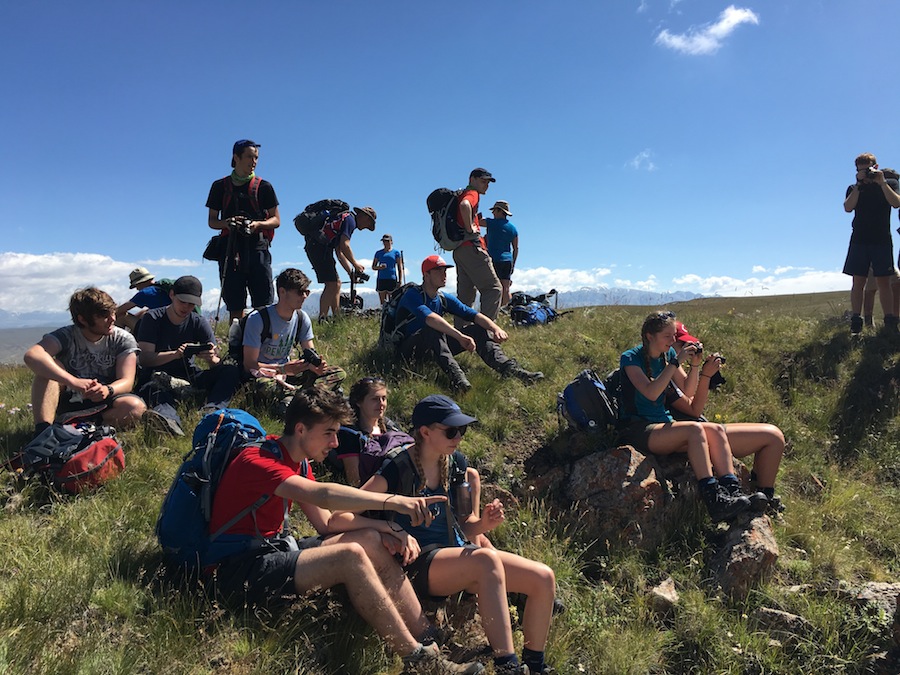
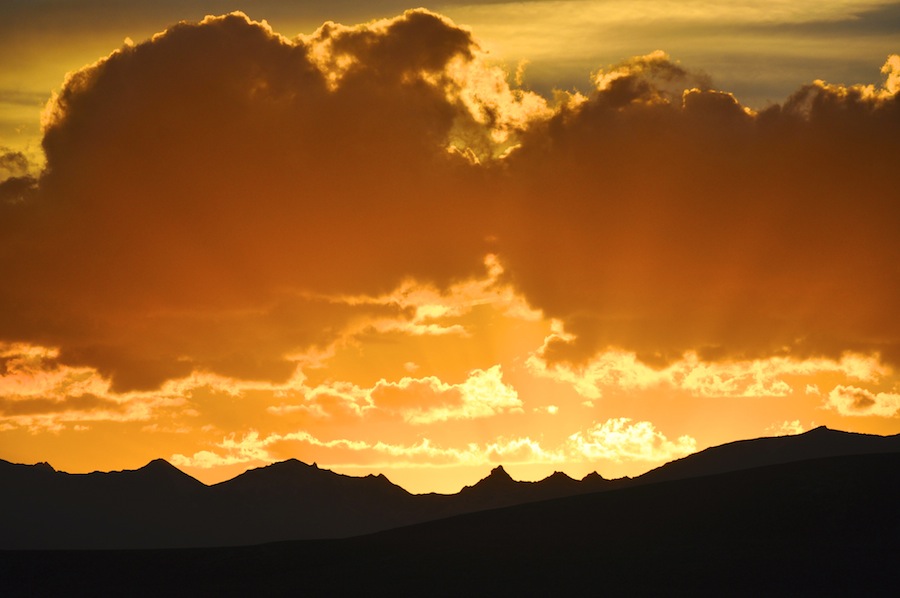
Another bright start to the day, although it was not long before cloud built up, which fortunately did not lead to any inclement weather while we were walking.
The group functioned well, packing their bags (no easy task after three days in the same camp), taking their tents down, breakfasting on a large bowl of porridge and stale bread and getting themselves prepared for a full day’s walking.

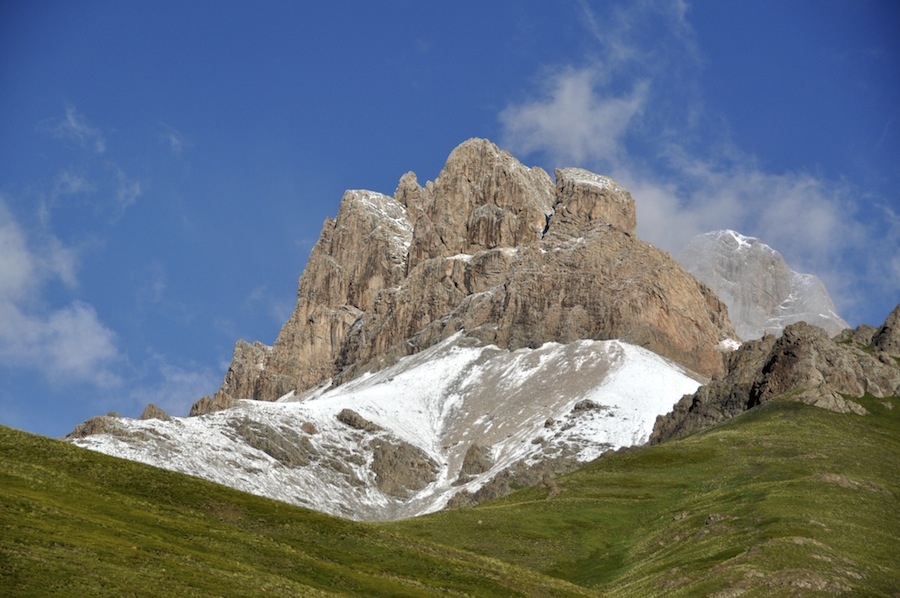
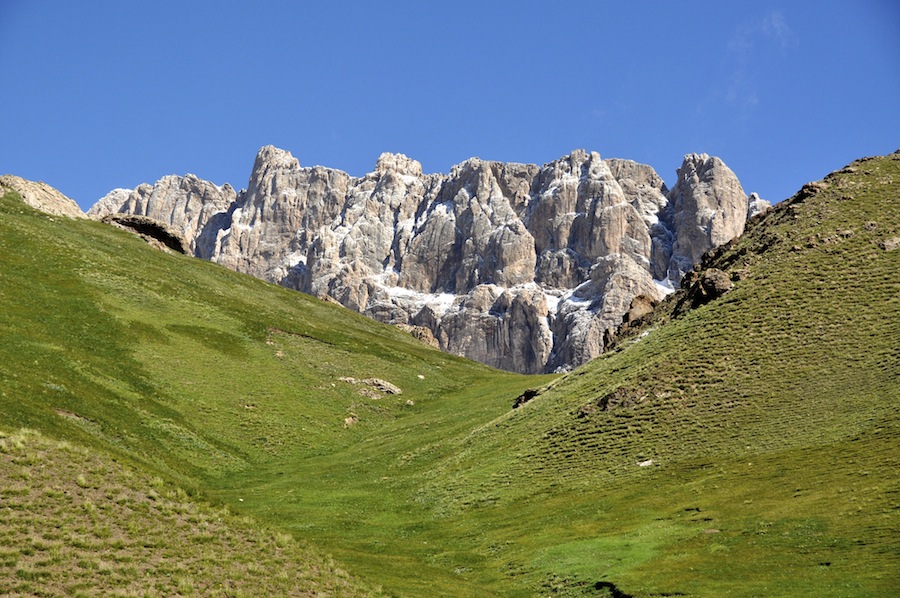
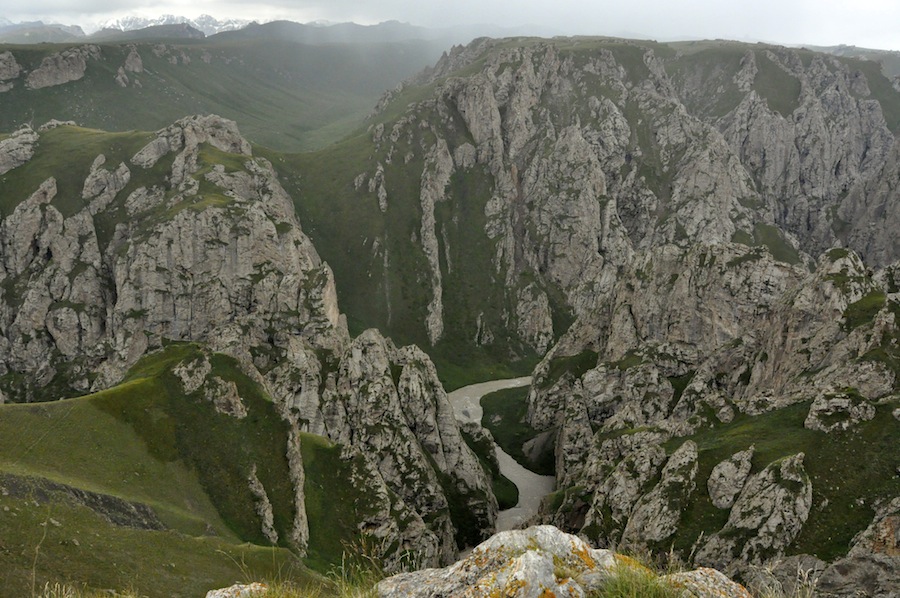
Glipses of the Kok-Kiya Gorge
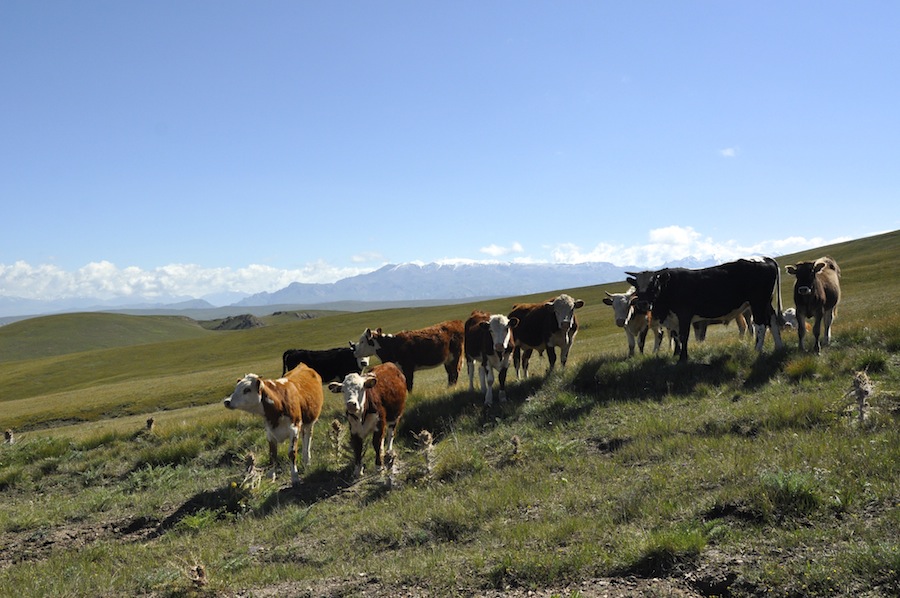
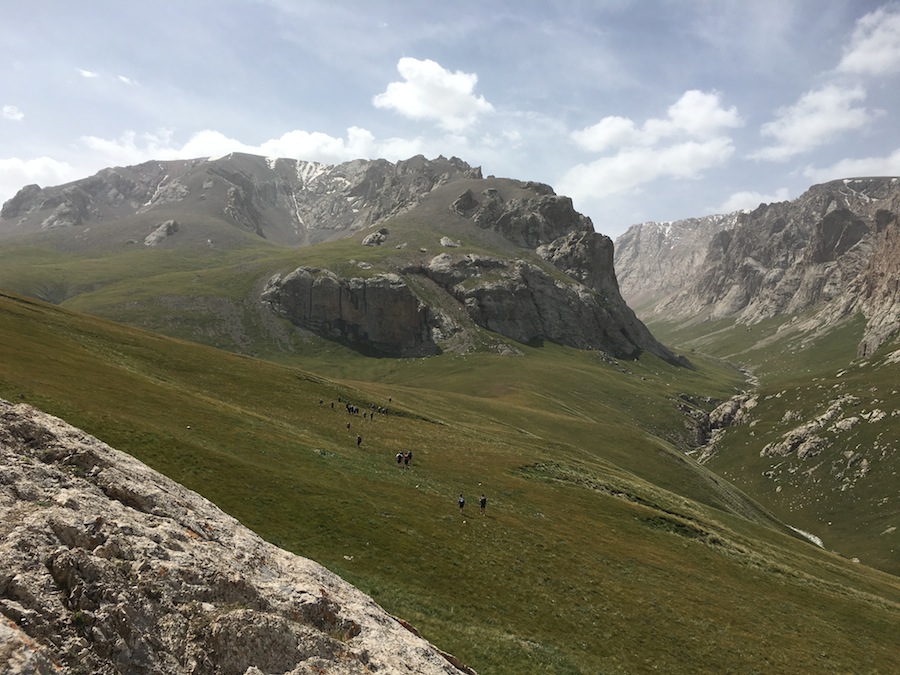
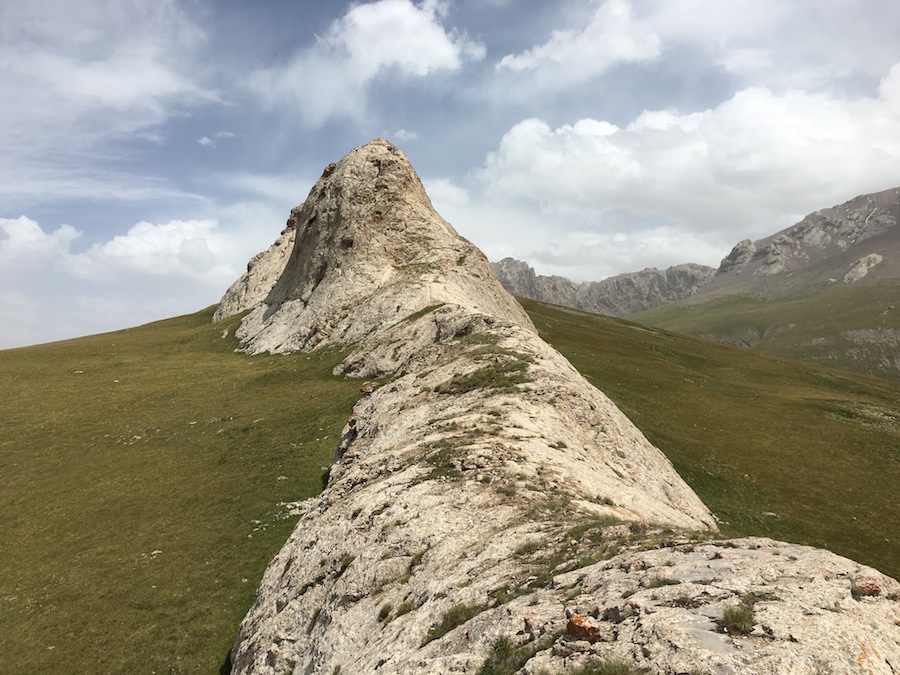
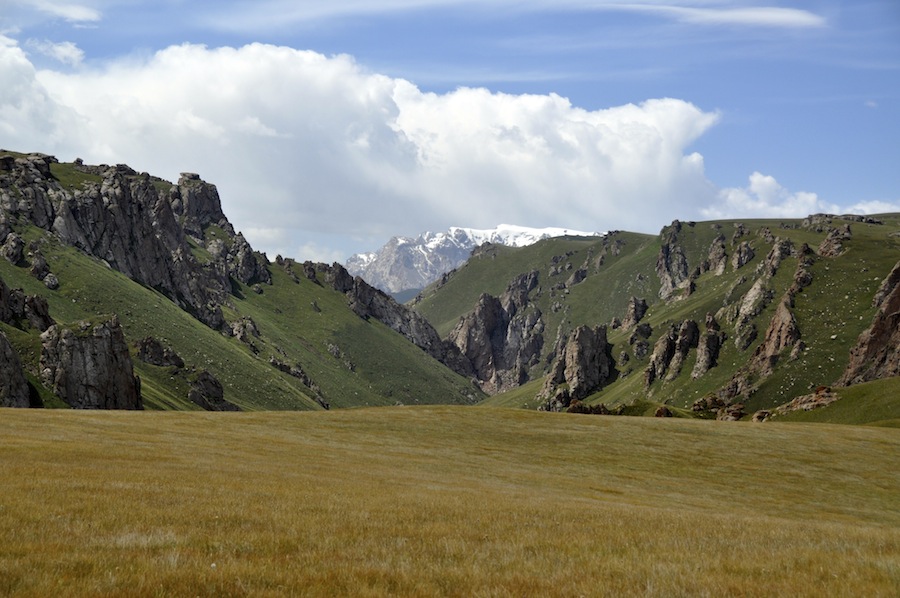
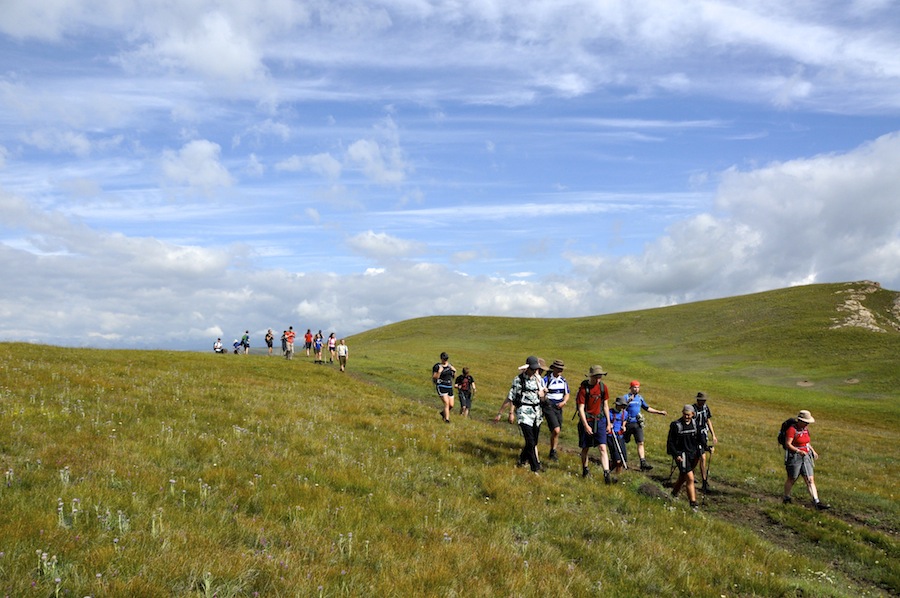
Leaving camp at 8.30, we climbed steadily up on to the plateau with the upper crags of the Kok Kiya Gorge on our left. To the right a long ridge trailed off into the distance. Instead of following the ridge line we traversed around the mid slopes of the ridge climbing and descending regularly as clefts disappeared steeply into the gorge. This was remote country with a derelict shepherd’s cabin being the only evidence of human activity. Vultures circled overhead.
Some of the girls were finding the pace on the uphill sections a little fast so I introduced them to the plod. Alex had slowed the pace a little but, when walking in a group, they felt under pressure. Detaching ourselves from the group we plodded up the hills at a set pace which allowed us to maintain a steady breathing pattern and reach each uphill section without stopping for a rest. Setting this pace also helps me.
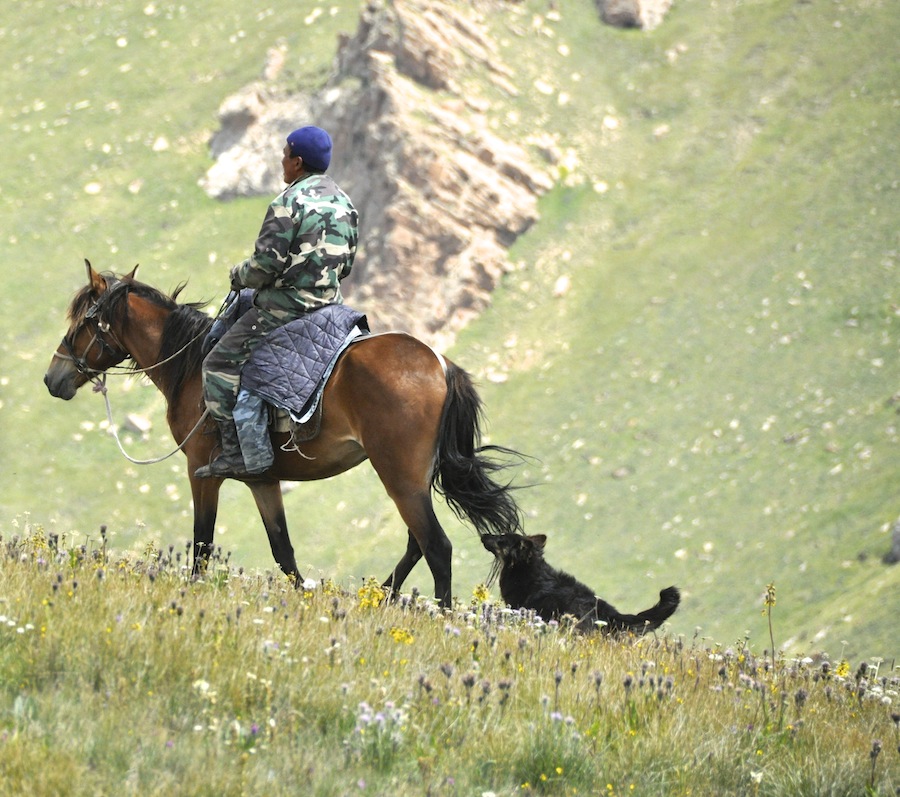
 At the top of one of the rises we stopped for lunch overlooking a beautiful hillside with a large flock of sheep and goats making their way across it. Later a lone rider and his dog came into view, and after redirecting the flock, he came over to see us. Hand shakes all round. Having chatted, he climbed back on his horse and as he rode off his dog kept jumping up and taking a bite at the horses tail.
On the next climb we were overtaken by Magda on his horse, being led by the shepherd. She had been at the back, so feeling sorry for her he gave her a boost up the hill.
Eventually our path joined the ridge and it was here we descended into the upper reaches of the Kok Kiya Gorge. It was a steep descent made more difficult because of the many hidden marmot holes in the long grass, just waiting to break an unsuspecting ankle.

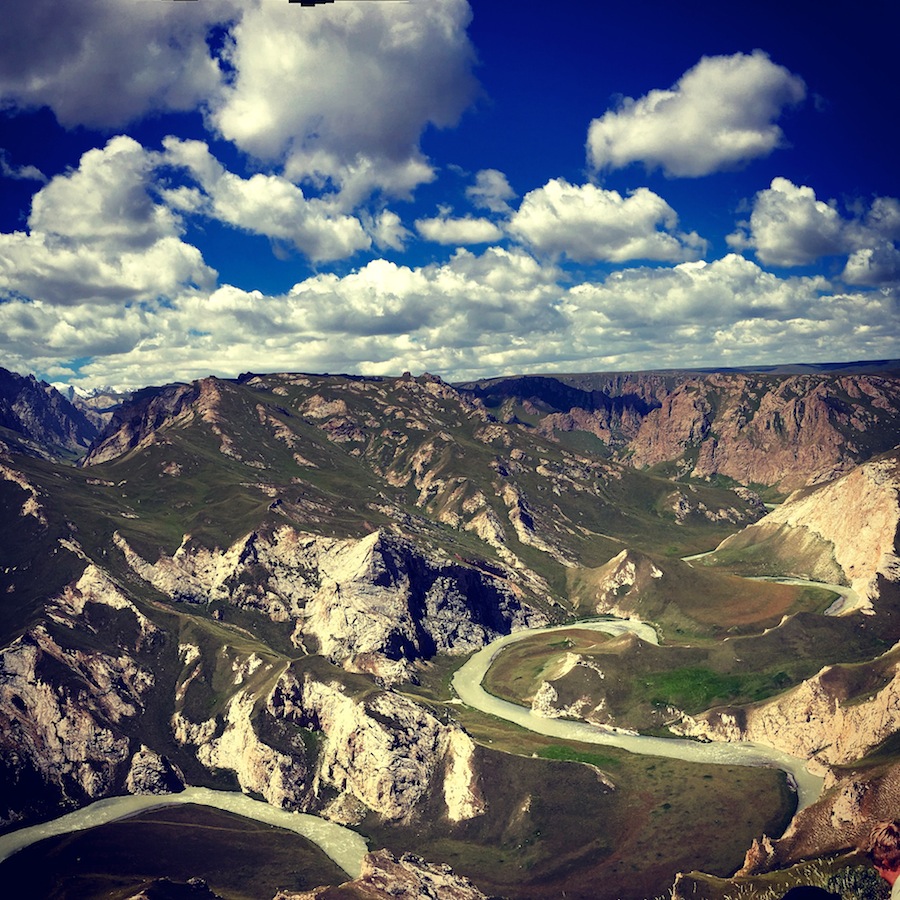
Exiting from the top of the gorge
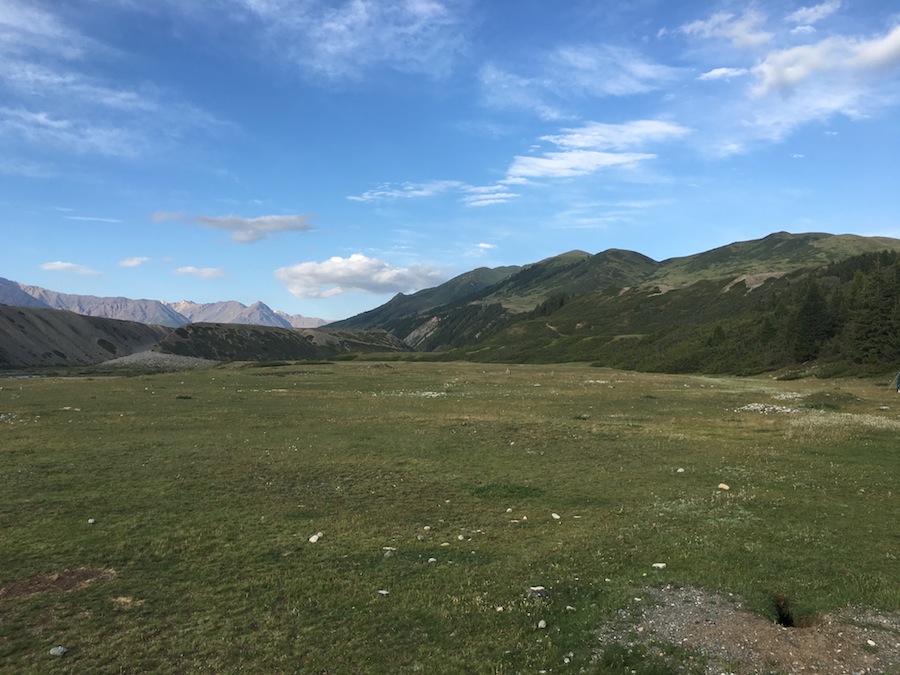
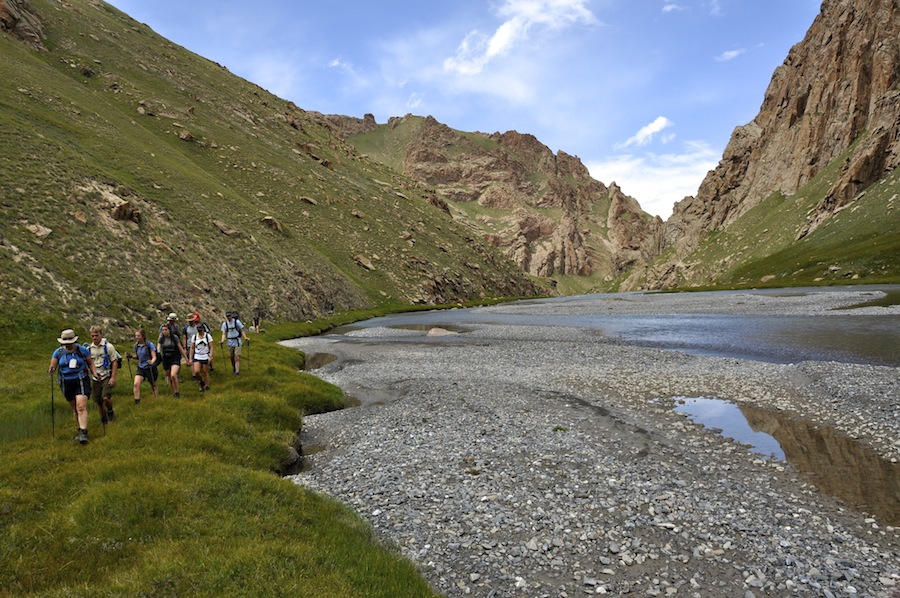
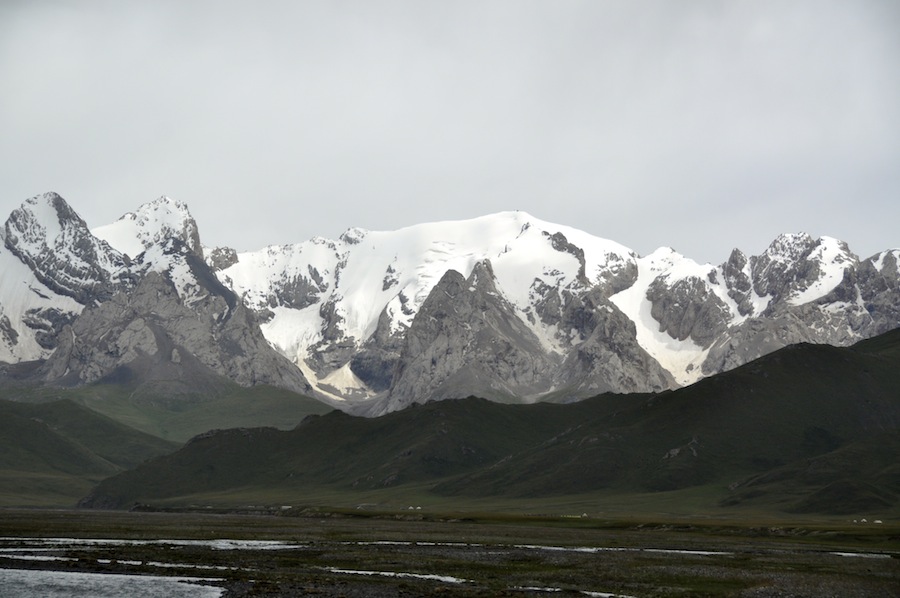
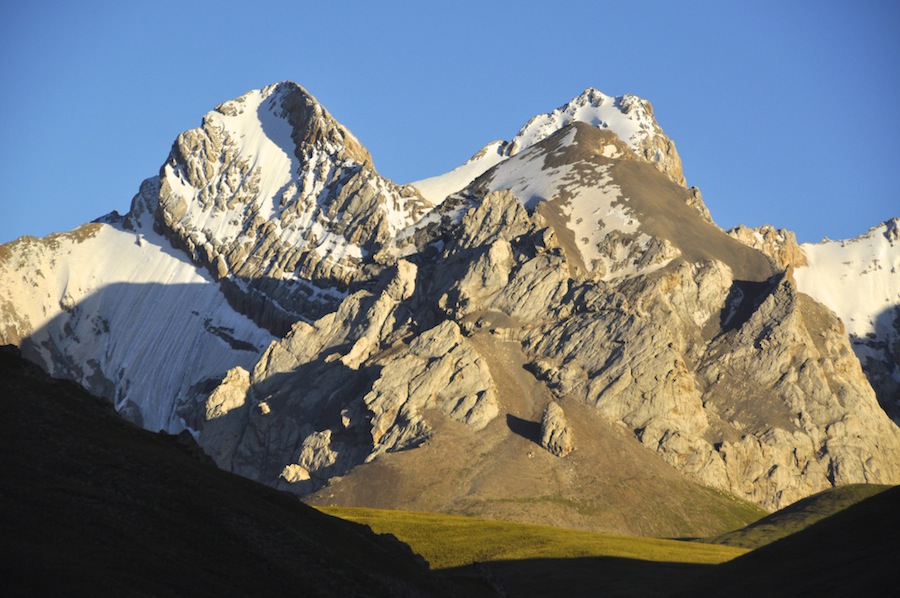
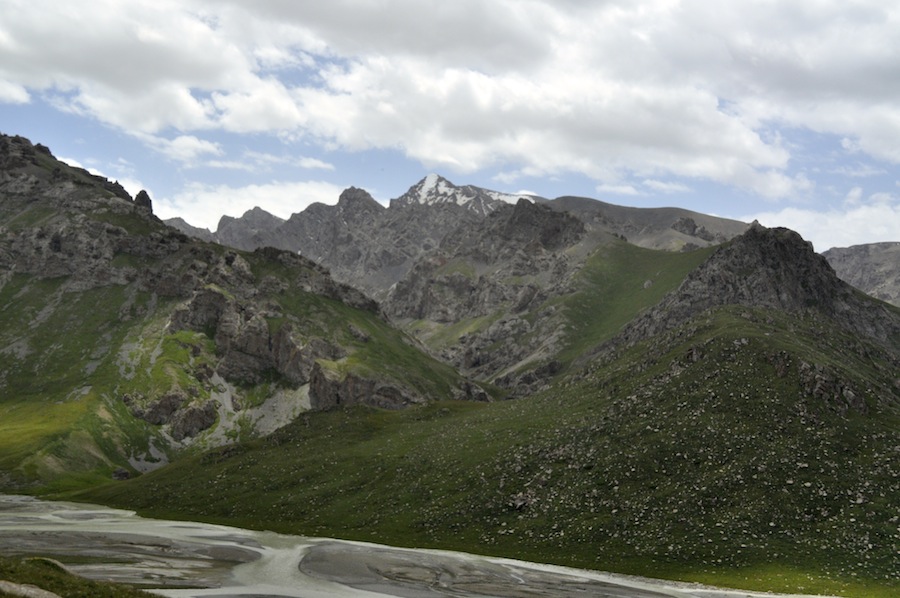
On reaching the river we headed up stream for about 6km, the valley gradually widening the further we went. We could see camp but it took an age to reach it. It is in a beautiful location, completely surrounded by mountains, the highest of which are snow covered.
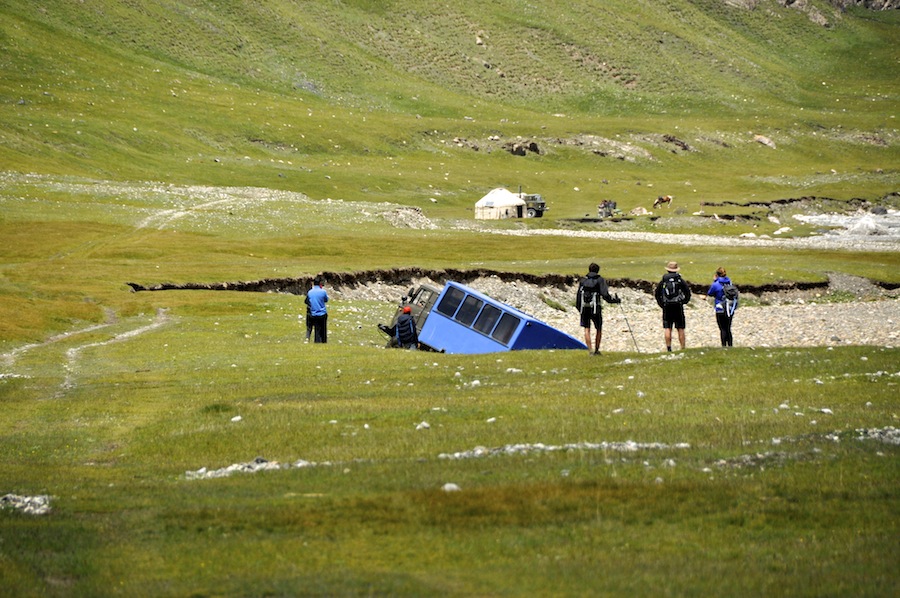
Shortly after getting settled into camp Alex came over with two Kyrgyz who needed help. They had a car seriously stuck in mud and needed to use my satellite phone. They offered to pay me but I would not accept anything. We had been made to feel welcome wherever we had been and I saw nor reason why I should not reciprocate.
Our camp, just visible, in the shadow of snow capped mountains
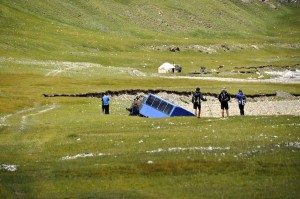
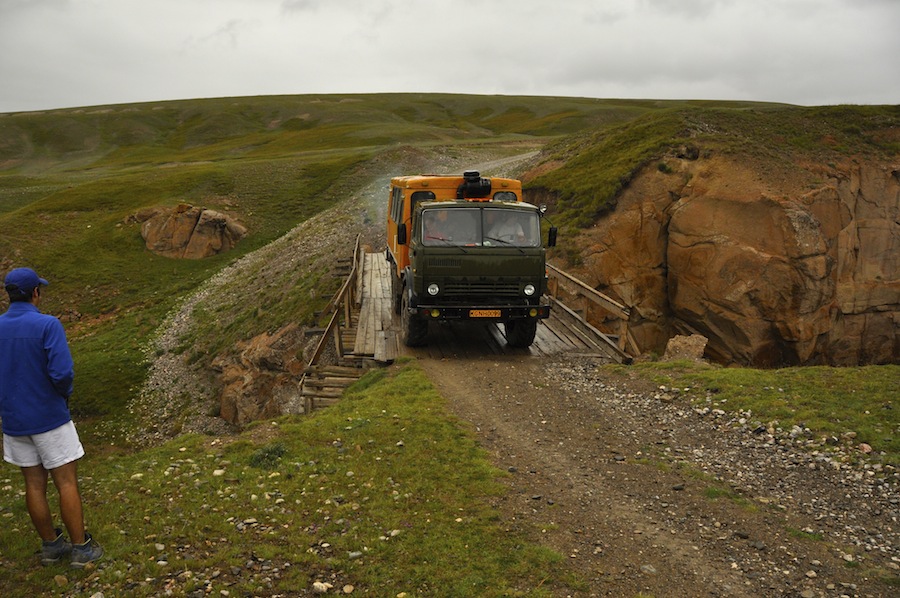
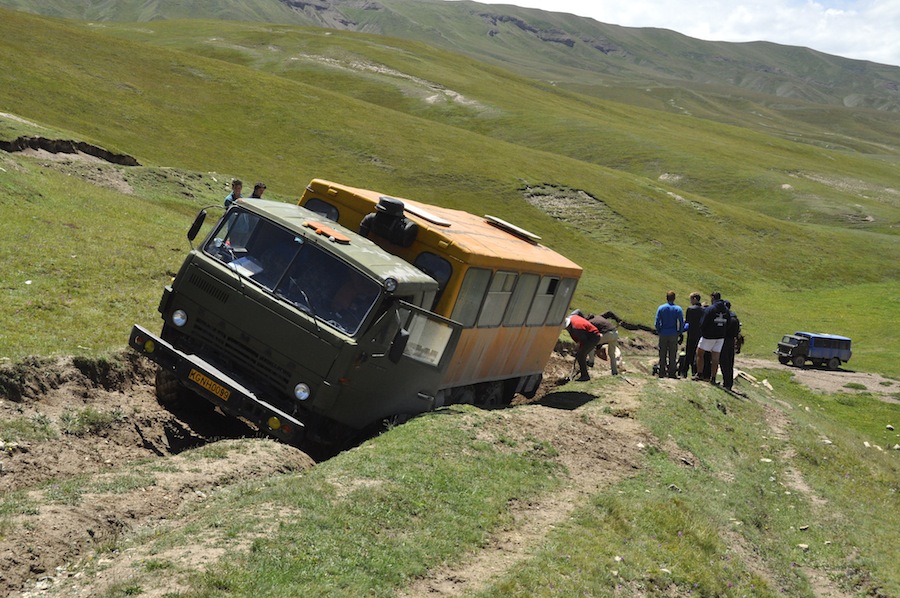
The support lorry climbing precariously up from the river bed
An hour or so later they came back to camp with the previously stuck car and thanked me again. It needed a wash!
A thunder storm with heavy rain confined us to our tents until dinner was ready.
The one feature missing in these mountains is waterfalls cascading down rocky gullies from lofty snowfields. There are none. Instead, the water from on high seeps down through the Rock and emerges at the bottom of the valley in extensive soggy bogs, but with the disguising feature of lush, green grass. This sums up a large part of the walk we achieved today (Friday) as we made our way a few kilometres up stream of the Kok Kiya River. Working a route through the quagmire was tedious and I found it distracted me from the beauty of the valley we were walking in. To our left, on the other side of the river a range of relatively accessible mountains trailed off up the valley and into the distance. To our right we were passing the large rock wall which marked the end of a jagged snow capped range. In front and behind more mountains pierced the greying sky. Rain was on its way and fortunately it held off until we had established camp fairly early in the afternoon. I get the impression that there is a lot more soggy ground this year, which is restricting where the two support vehicles can go. Hence our itinerary is being slightly adjusted to compensate for that difficulty.
During a break in the showers I wandered up the valley we are venturing into tomorrow. It looks stunning.
We are camped here for the next two, possibly three, nights. It is fine but we become a little exposed to the wind which seems to accompany the showers.
Storms rattled through camp during the night, accompanied with strong winds which had the tents straining at their anchors. Nobody slept through them. When we emerged out of out tents several hours later there was a layer of snow over everything and any washing that had been left out was frozen stiff.

Rocky slopes above camp
The walk today was voluntary. It involved a climb up to a pass which would give us views of turquoise Kol-Suu Lake. One or two were feeling a little under the weather with chesty colds or slightly wobbly tummies, while others were tired. Also, I had indicated that boots were essential and the resulting wet boots from the very boggy ground of yesterday ruled them out. There were thirteen students, Alice and myself, as well as our guides Alex and Sasha.

Stunningly beautiful in crystal clear light
The morning was bright and clear, with the last remnants of the overnight cloud evaporating from the rocky summits. We set off up the valley behind camp, climbing gently towards the headwall, some 5km ahead of us. There are no nomads in this valley but there is one abandoned hut and plenty of evidence of livestock having ventured up here.
During our first short break I had a conversation with Alex about the lack of waterfalls in the area. He assured me there were waterfalls. I was right about water permeating its way to the valley floors but what I hadn’t appreciated that these watery places were permafrost areas that had melted, rather more than normal, it would appear.
Bird life was everywhere but almost impossible to spot in the vastness of the valley. Many of the birds are the same colour as the rock and blend in so well. The most popular species were Crossbills.How many times did I look for a bird when, what I had heard was a warning cry from a marmot. We were lucky enough to see a young vulture sitting on top of a rocky ridge and then swoop off to glide to another part of the valley.

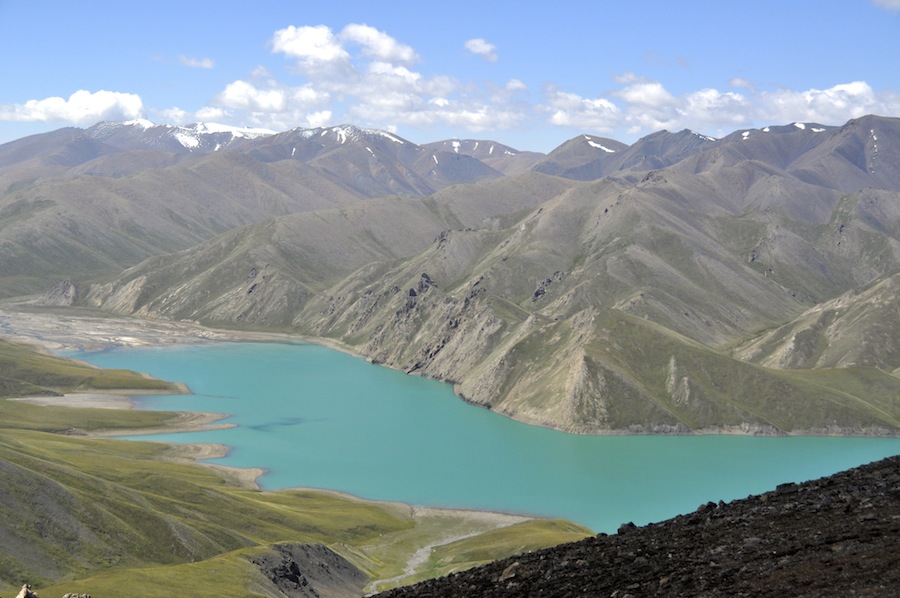
Kol-Suu Lake
As we delved deeper into the valley the slope became steeper and the going slowed accordingly. Grass was replaced with scree, which led to the crest of the pass at 3975m. The view on the other side was stunning. Beneath, on the other side were the turquoise waters of Lake Kol-Suu fed by the River Kurumduk. Surrounding it were mountains as far as the eye could see. These were not the jagged mountains we had seen on our right as we walked up the valley but layer upon layer of similarly sculptured mountains.

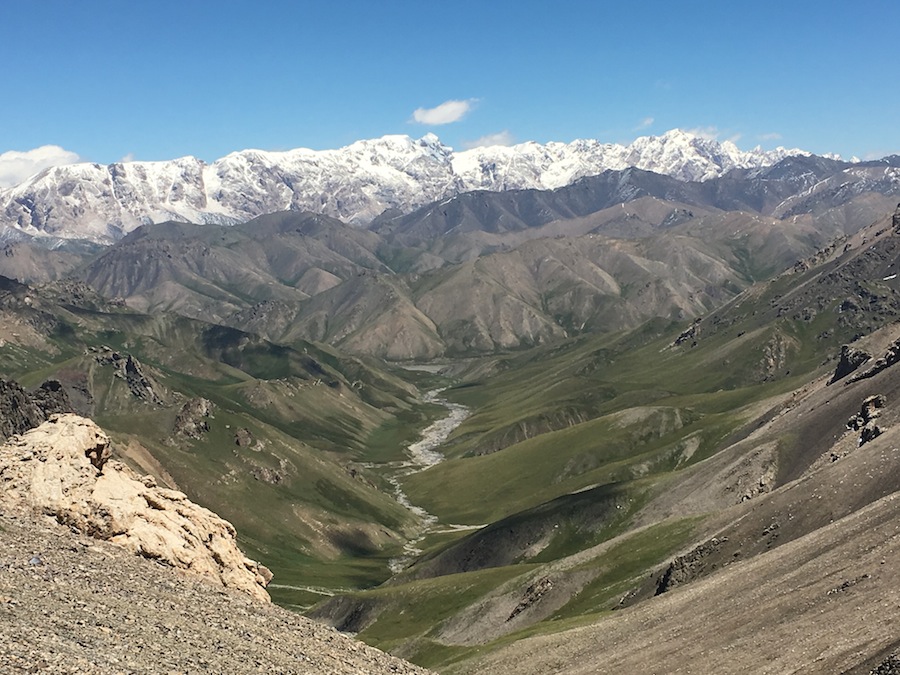
Looking back the way we had come
While the rest of the group climbed up to a ridge on the right of the pass in order to reach 4000m, I happily sat on the pass admiring the view on either side. Looking down the length of the valley we had travelled, at the wall of snow capped mountains across its lower end was equally spectacular.
When the group returned they were so enthused they went up the much higher ridge to the left of the pass. Meanwhile, having recovered from my own ascent I went up the ridge to the right. Stunning!

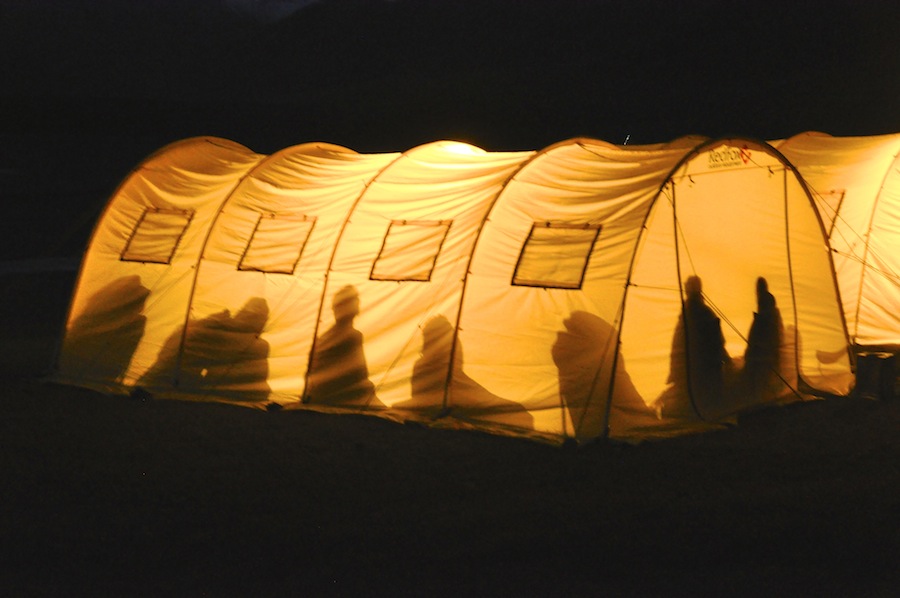
Mess tent shadows
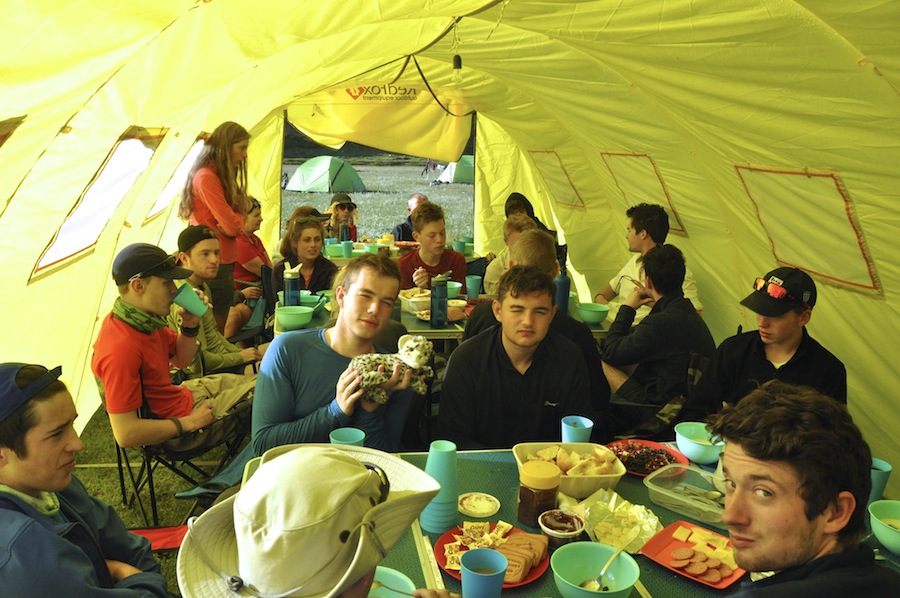
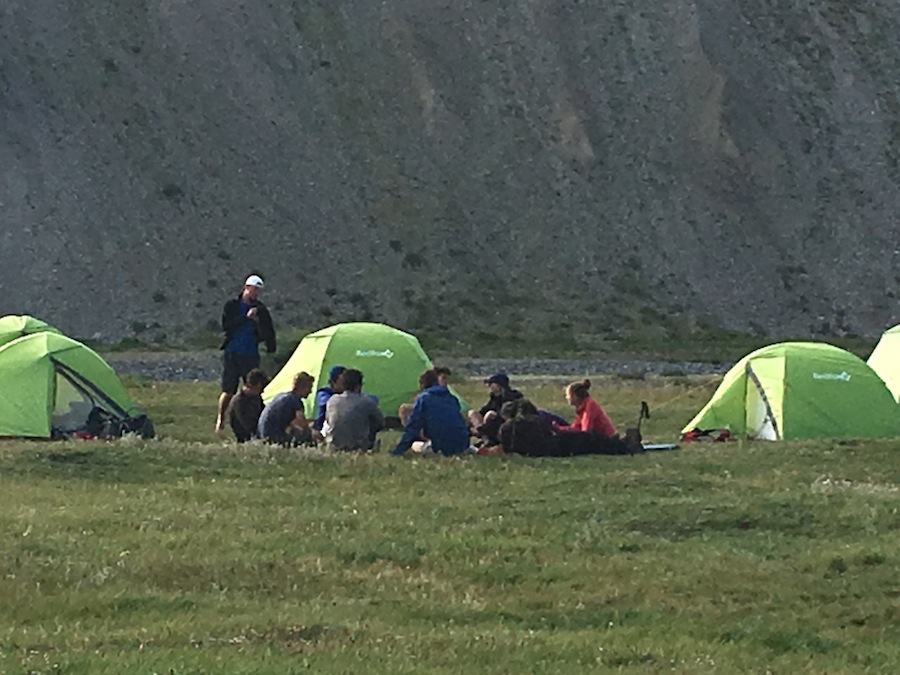
As I went to bed I looked back at the mess tent and the shadows of those still deep in conversation. Looking further afield the dark shapes of the mountains stood out against the clear night sky. Predictably, this meant it was going to be a cold night and, indeed, so it proved to be the coldest night so far with a heavy frost clinging to the tents in the morning. The sky remained clear and the early morning sun soon melted the frost as the temperature rose rapidly.
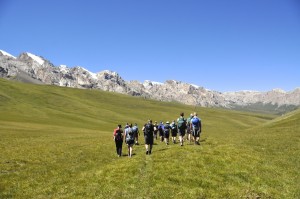
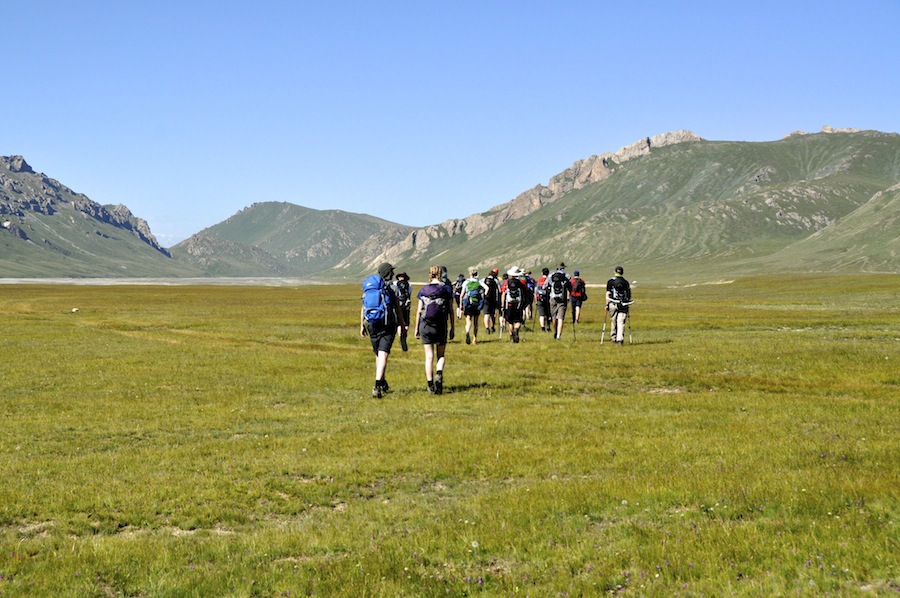
Walking through an almost perfect valley
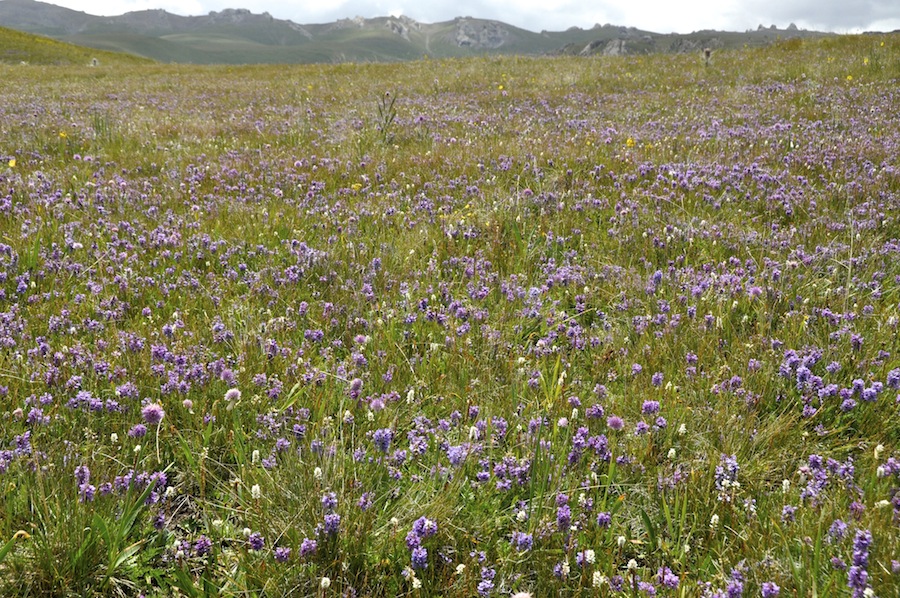
The lorry transported us some way down valley, following the river bed rather than negotiating the sodden ground on either side of it. It dropped us off at a side valley. I felt tired. I could not make up my mind as to which reason made me so. Was it Magda coughing in the tent next to me, disturbing my sleep, or my own developing cold, or the energy I had used to reach the pass yesterday? I suspect a combination of all three. However, once I got started climbing into the valley I began to feel better. It only necessitated a climb of 200m and we reached our high point. On reaching this point we turned right into a valley that at first ought to have had a lake in it. It was beautiful and, apart from the odd cowpat looked as if there had been no human interference. On the left the grassy slope gave way to rock, snow and ice, while to the right the grassy slopes provided homes for a multitude of marmots. A stream gradually formed from the boggy areas creating crystal clear pools. Towards the end of the valley, as it joined with another, was a lone shepherd’s hut, abandoned now but the only evidence of human activity. The valley we had walked down was about as pristine as it could be.
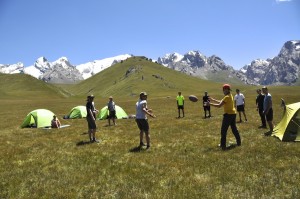
Enjoying a bit of down time before heading up to Kol-Suu Lake
We now turned into another valley running back towards the main valley we had been deposited a few hours earlier. There were our trucks negotiating a boggy bit with difficulty. Eventually it was decided that they could travel no further up the valley with safety, so camp was established where they stopped.
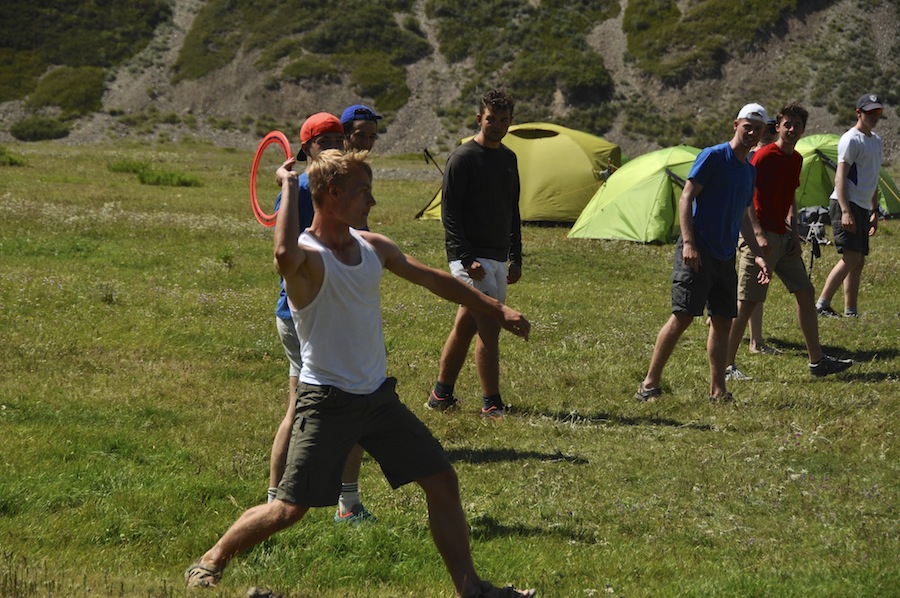
Looking out from my tent at the wall of mountains, I could see the cleft where Kol-Suu Lake was situated. It was about 4km away, so I told Alex that I would take myself for a stroll to have a look at it. He thought that was a good idea and the whole group would go. There goes my peaceful stroll without any pressure. Who was I to argue, it was still an absolutely gorgeous day, still with hardly a cloud in the sky.
Predictably the route was not straight forward. If you took the lower level where the dirt road runs you would spend a lot of time working your way through boggy terrain. The alternative was the higher route over tussocky grass littered with marmot holes and at an awkward angle across our direction of travel. We took the higher. It was hard work, particularly as there were several hidden descents and ascents along the way. The final ascent is up a natural barrier that retains the water of the lake. Part way up a white gash of water emerges through this barrier where water has found an escape route.
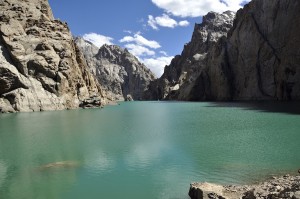
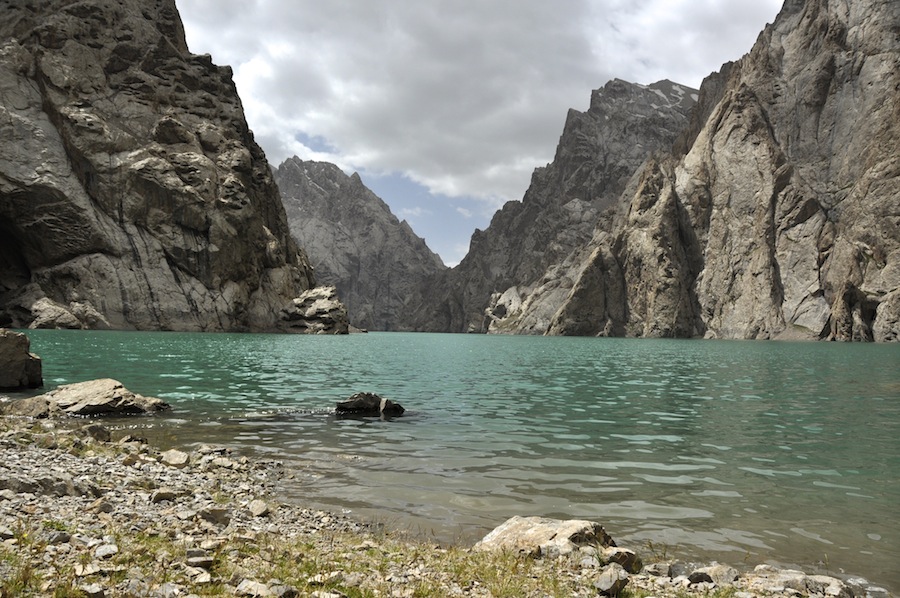
Kol-Suu Lake
It took ninety minutes to get there but it was well worth the effort. Lake Kol-Suu has to be one of the most beautiful lakes I have ever set eyes on. The water is turquoise blue with sheer cliffs rising from it on either side. It is never more than 100m wide. All we can see is about 1km length of it before it is hidden by towering cliffs closing in on each other. A rocky island pokes above the water at the far end. It is hard to imagine that this us the same lake we looked down on from the pass. I sat on a rock a few meters above the water level and was mesmerised by the pure splendour of the sight in front of me.
But there hasn’t always been a lake here. The River Kurumduk used to flow through a gorge here until an earthquake 10,000 years ago caused dramatic landslides and cliff collapses to block off the flow. Gradually the water built up behind the natural dam forming the lake that filled the gorge. Its length and depth varies according to the climate. Its length can vary from 7 to 12km and the depth, which is normally around 10m can rise by 3m. In 2012, during a particularly dry period it drained itself so that there was no lake there for a while. I am very grateful it was there for me to see.
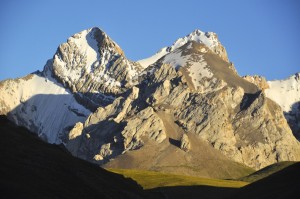
Evening light
Having started the day feeling very tired, by the time I got back to camp I was tired again and decided I was going to have a more relaxing day the next day.
If last night was the coldest night of the trip so far, the one that followed was the warmest.
The rest of the group were going to return to the lake, then explore a cave system before scrambling up a 140m gully to look down on the lake. I decided that while they were doing that Magda, still recovering from her chest infection, and I would amble up to the lake in our own time and join the group before they went to the cave and beyond. I fully expected them to spend a couple of hours by the water, those brave enough to have a swim. Certainly there was talk of swimming before they left camp. As we arrived at the lake we saw them heading off to the cave. The weather was not as good as yesterday, with the threat of potential rain, so they didn’t linger there too long.
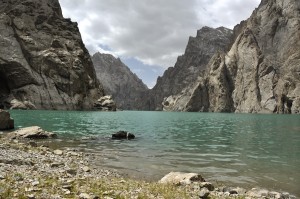
I could never tire of looking at this view and photographing it
There was still some warm sunshine around so I tested the water. It was cold. I did manage to sit in it, briefly.
After an hour or so the rain drops began to fall so we headed back to camp and waited to hear from the group, as they returned, how they had enjoyed their day. All positive, I am pleased to say.
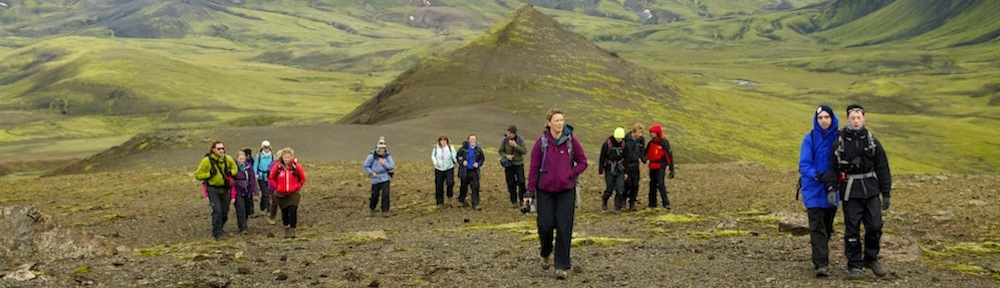
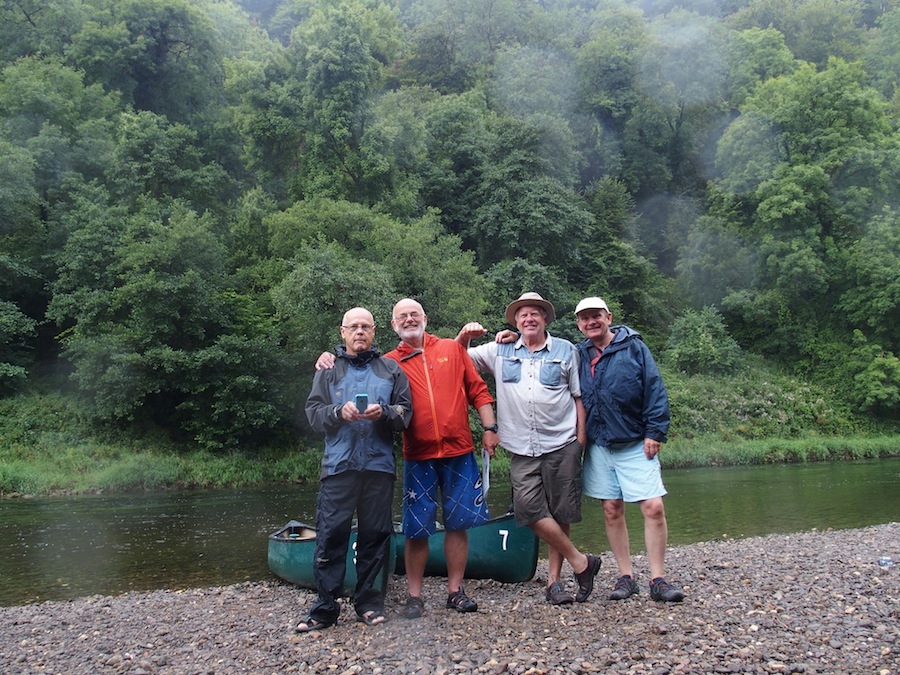
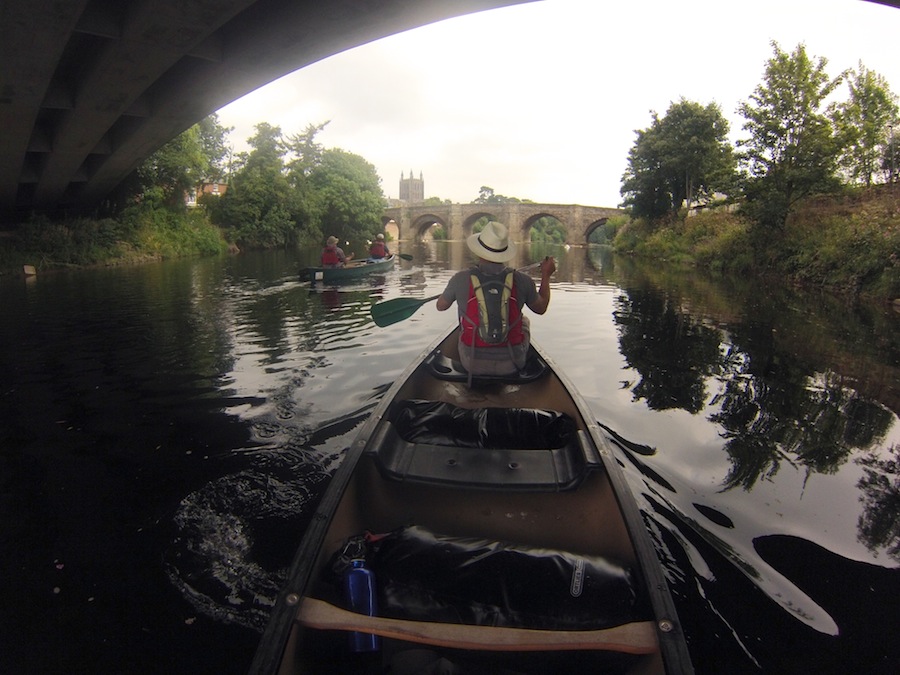
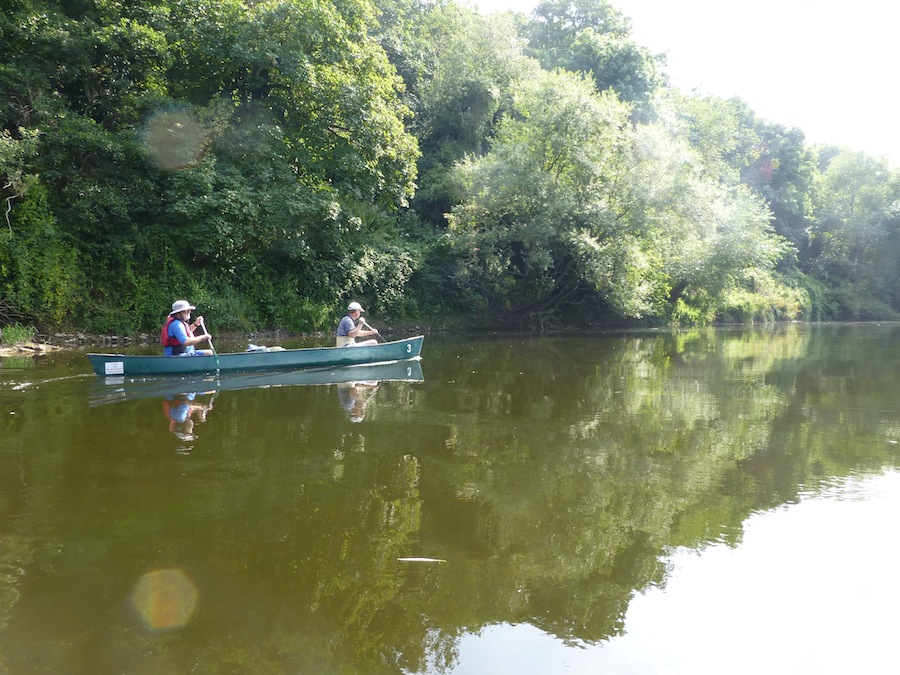
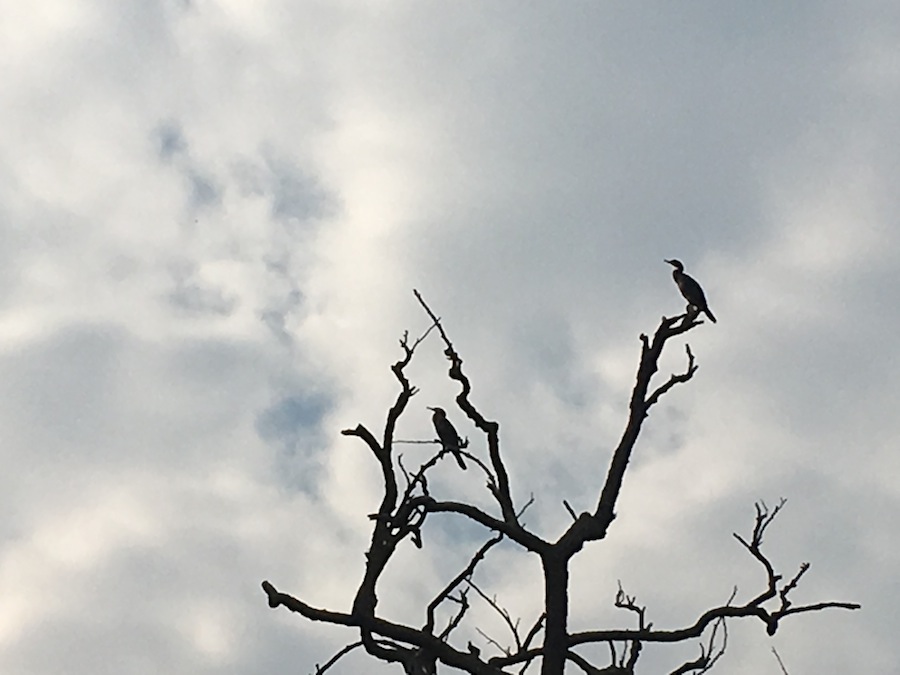 There was always something to fascinate us as we paddled, flashes of vivid blue as a kingfisher darted for cover, heron gracefully lifting off and flying laconically as they relied on their huge wingspan to make them airborne with the minimum of effort, cormorants standing on the uppermost branches of dead trees affording them the best aerial view of fish below, fish leaping with flashes of silver, cattle cooling their feet, standing in the shallows at the side of the river, sheep gathering in the shade of a river bank tree as they avoid the glorious sunshine, and of course, the fishermen lurking in their camouflage outfits semi-hidden on the river bank. Often we would just catch the sun glinting on their tight line, forcing us to give them a wide birth, in an effort to share this glorious space.
 Pulling into the bank for a lunch break, Rob provided me with the best egg sandwiches I have ever had in my 65 years. I had to have them as the bacon butty I bought in Ross en route was, predictably, long gone.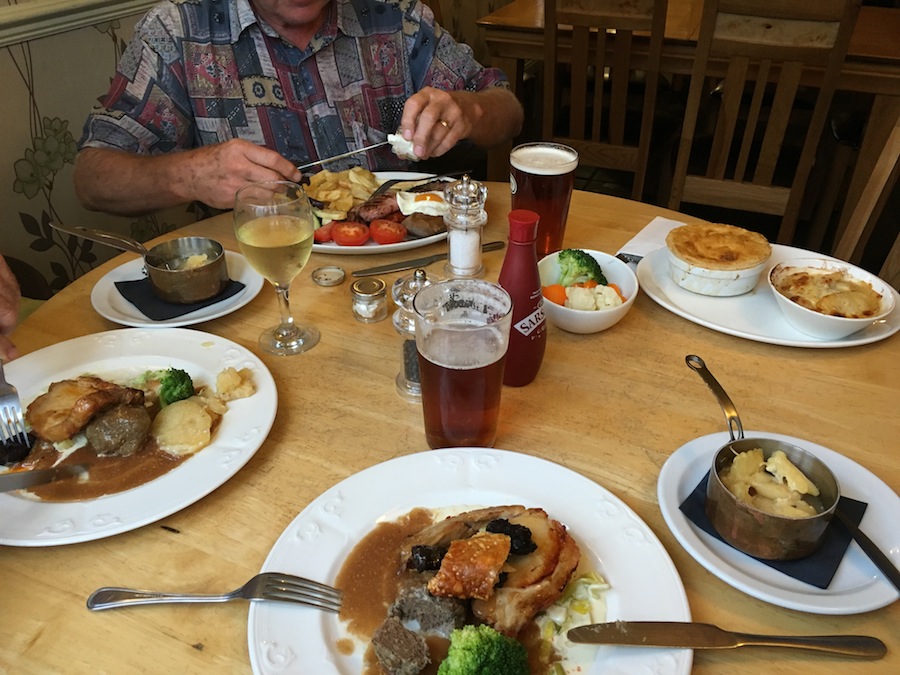

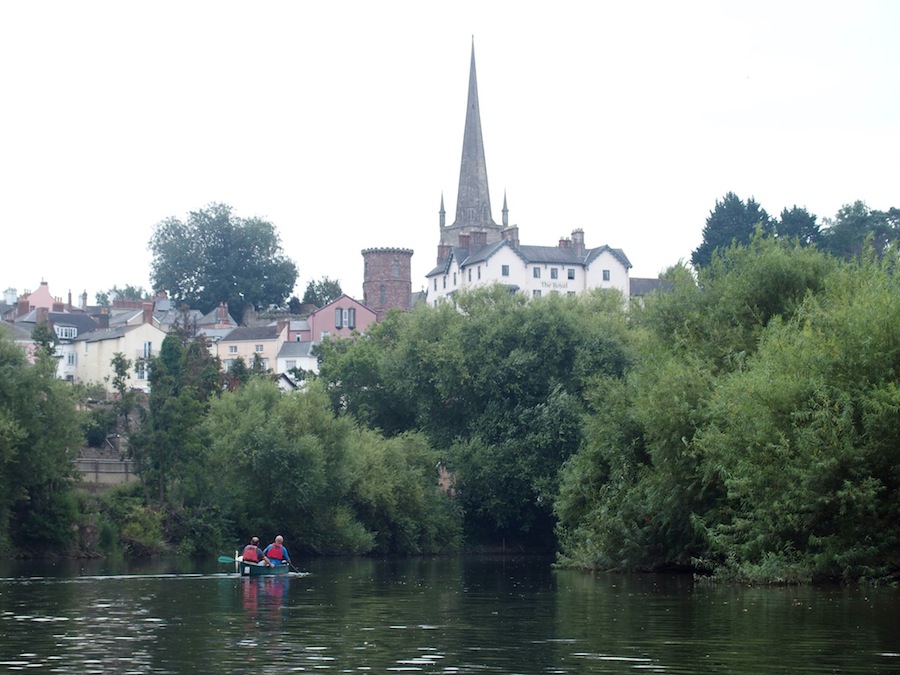
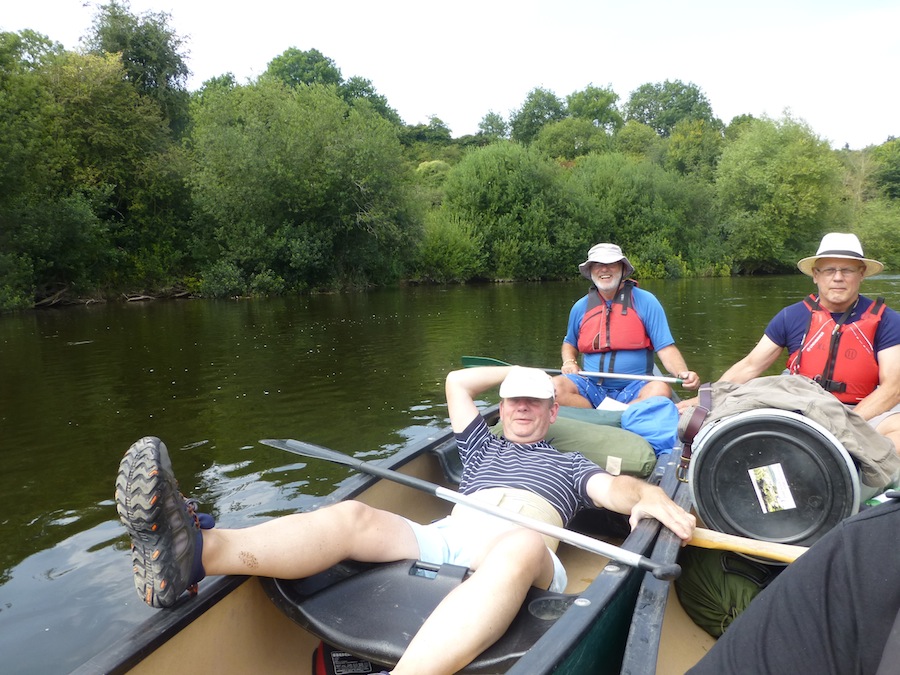
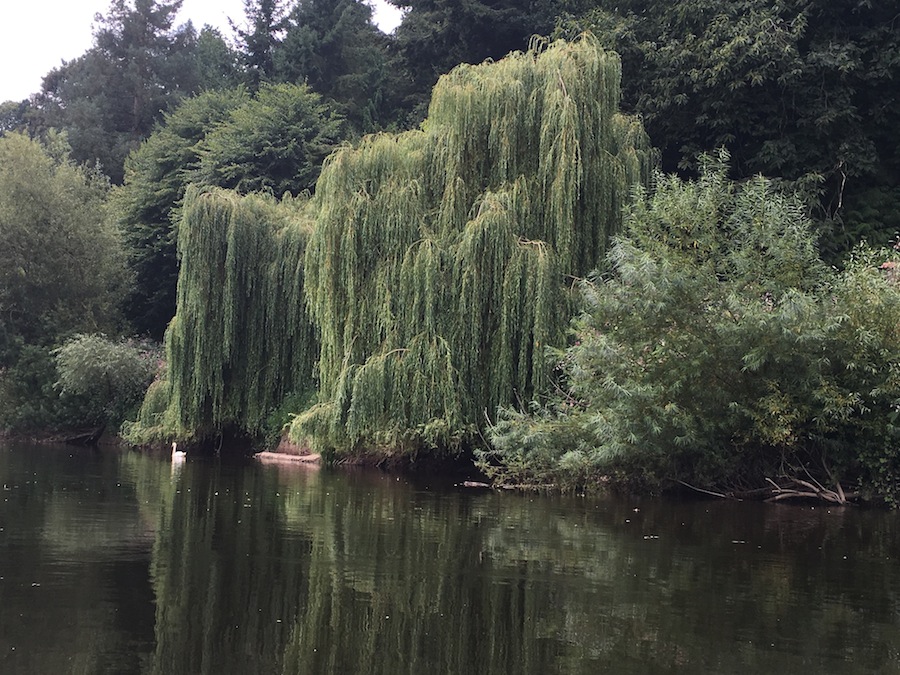 Throughout our journey so far we had been impressed by some of the houses along the river bank. Many of them were very “Grand Designs”. Now that we were coming into forested gorge there were fewer in evidence. However, high on the hill the was a large stone building rising above the trees. Rob pointed it out to us, saying, “Look at that monstrosity up there. How can they be allowed to build something like that?” It was only Goodrich Castle.
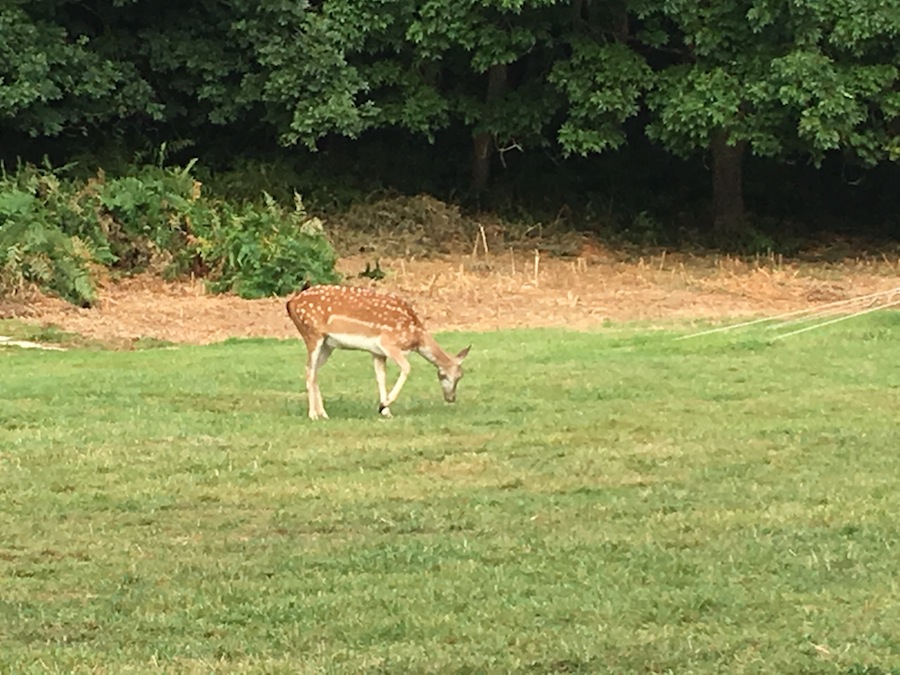 Youth hostels are so much better than they used to be with facilities to suit all tastes and needs. We were camping but we had full use of the hostel, choosing to eat their set meals. It was a short walk from the camp to the impressive building, once a large country house. Adjacent was an old church going through a full renovation paid for by the new owner of the large country estate further up the hill. As we relaxed on the grass outside our tents in the evening sunshine, three deer dropped out of the trees and started grazing on the camping field, not bothered that we were there. It is these unexpected little joys that make trips like this such a pleasure.
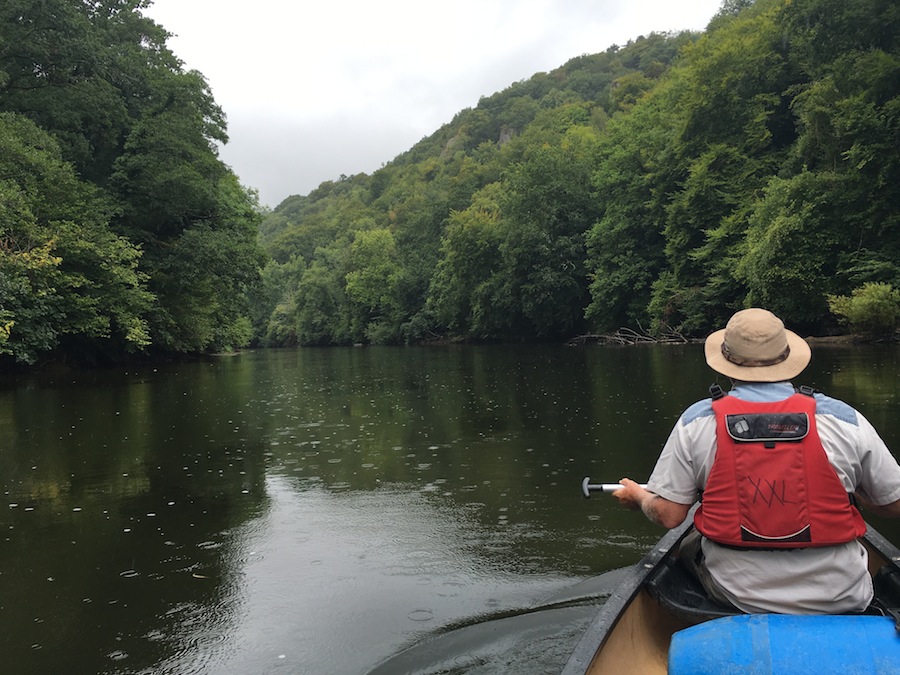 During the night it started to rain; the good weather had come to an end. Fortunately we had the shortest of our days with only ten miles to paddle to Monmouth. After a full English breakfast we loaded our canoes and set off with the only disturbance on the water, the rings created by raindrops and our bow waves. Despite the rain it did not detract from the pleasure of what we were doing.
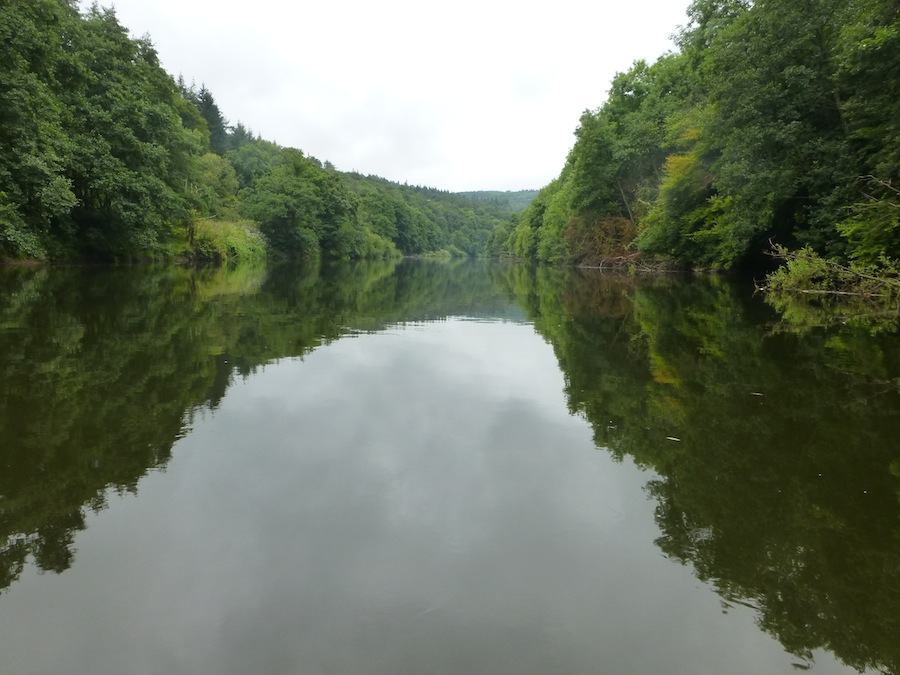 Just before the famous Symonds Yat Rapids we moored up outside the Royal Lodge, a wedding and conference venue, and took our wet selves into the bar for a coffee. I have to say that I felt rather conspicuous as wet as I was but nobody seemed to mind.
 From then on it was plain sailing through the gorge with sporadic rain. After a beachside lunch stop by Biblins Bridge we continued the last three miles to Monmouth in increasingly heavy rain. Despite the rain we were happy to spend some of our last moments on the water simply drifting along. It would have been nice to have sunshine on our last day but it did not matter and in no way diminished our enjoyment of the trip. In fact, all of us have agreed to do it again, or something similar next year, and others have already said they want to join us. Maybe the full 80 miles of navigable water on the Wye, or perhaps we will find something better. Difficult to imagine when we have arguably canoed the best canoe-able river in England. Watch this space.