The Hidden Kingdom of Mustang – The Trek

Leaving Kagbeni behind

Leaving Kagbeni behind

At last I have entered Upper Mustang. I first looked into it from the gate at the police check point in Kagbeni in 1999. I was fascinated by the shapes the cliffs made, by the mule trains disappearing in the distance and by what lay beyond the last visible corner in the river. I vowed then that I would one day venture into Upper Mustang and it has taken fourteen years to accomplish that vow.

The sky was not as clear this morning with heavy cloud rising over the mountains from the south. There would be no flights to Jomsom today. To the north the skies were much clearer.
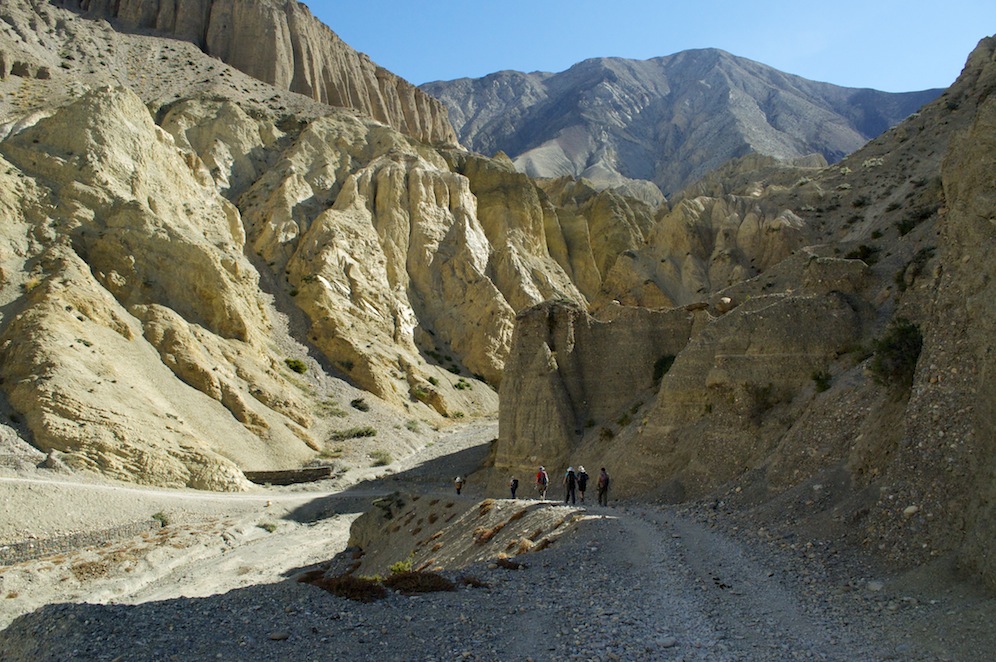
Heading into new territory

Heading into new territory

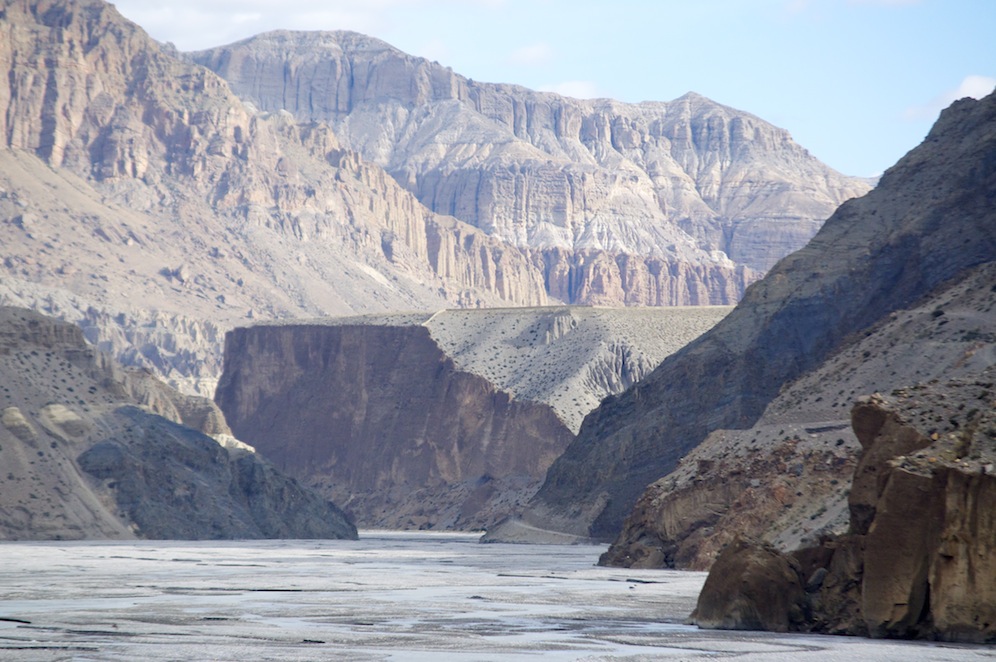
Having dealt with the formalities at the check point we entered Upper Mustang, not by dropping down to the river as used to be the case but by climbing up to the road. Much of the walk on this first day was along the road but, because there was virtually no traffic, it did not feel like a road, but more of a mule track with two lanes. The walking was comfortable. From our elevated position we had super views to the braided Kali Gandaki with cliffs rising from the flat, stoney river bed.  To our right pillared gullies, carved by wind and water, climbed spectacularly up to the ridge top. Little vegetation grew on the infertile, arid land except in small pockets close to the river where irrigation allowed small communities to farm.

DSC_0278Unexpectedly, as we were nearing Tangbe, we came across a new project, the Tangbe Organic Apple Farm. Behind a mud wall thousands of young apple trees have been planted. This is some way up from the river so a new irrigation system has been built bringing water from higher up in the mountains. Each tree has its own reservoir so water gathers around its base rather than being wasted. These trees should be producing fruit in about five years time and when they do they will boost the village economy. The road makes projects like this far more likely to succeed.

Looking towards Chhusang

Looking towards Chhusang

From Tangbe we walked to Chhusang where we had lunch. This stretch of the gorge was becoming really interesting with towering cliffs of yellow and red sandstone. The yellow stone was dotted with ancient caves carved out centuries ago and have had a number of functions throughout their history. They have been homes, places of meditation for monks, places for storage of artefacts etc. and burial chambers.
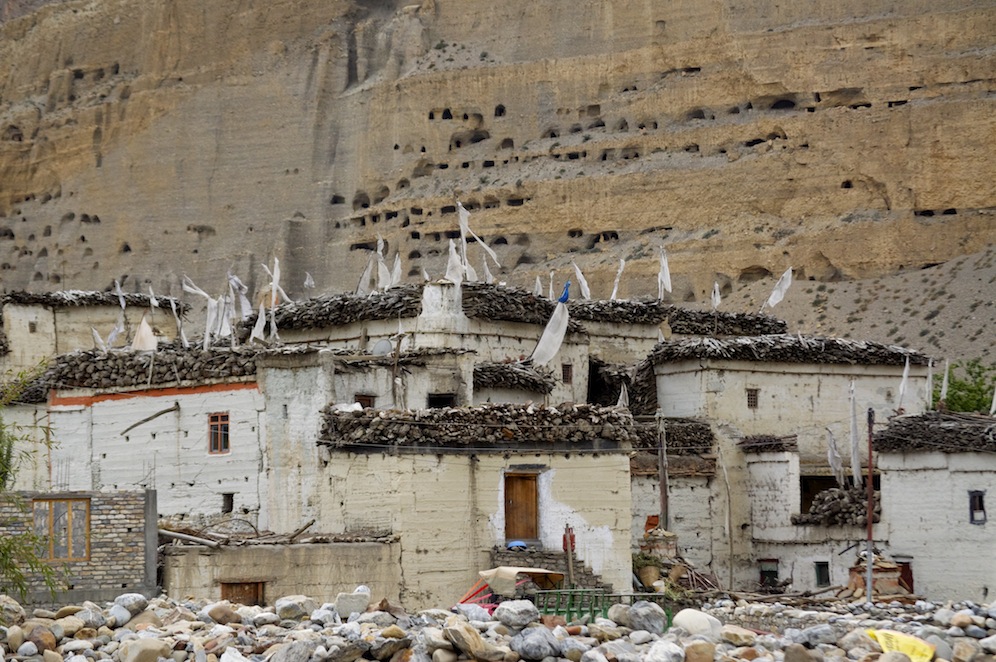
Some of the many caves above Chhusang

Some of the many caves above Chhusang

Looking at them today they are totally inaccessible from above and below! They must have been accessible at some time but it is hard to see how. The red cliffs make up huge columns with deep clefts. Above are more layers of coloured rock eroded by wind and water, making a forever interesting scene to look upon.

After lunch and some time for wandering down to the river and gazing at the stunning features on the opposite bank we walked to Chele. For the first time we were able to walk on the river bed, an area well known for having lots of fossils. Heads down, gazing at the stones, looking for any tell-tale signs of fossils we ambled along the river bed. Every-so-often a black stone would catch our attention. If it was heavier than expected for the size, then it was worth further investigation. We found some interesting specimens but no classic examples.
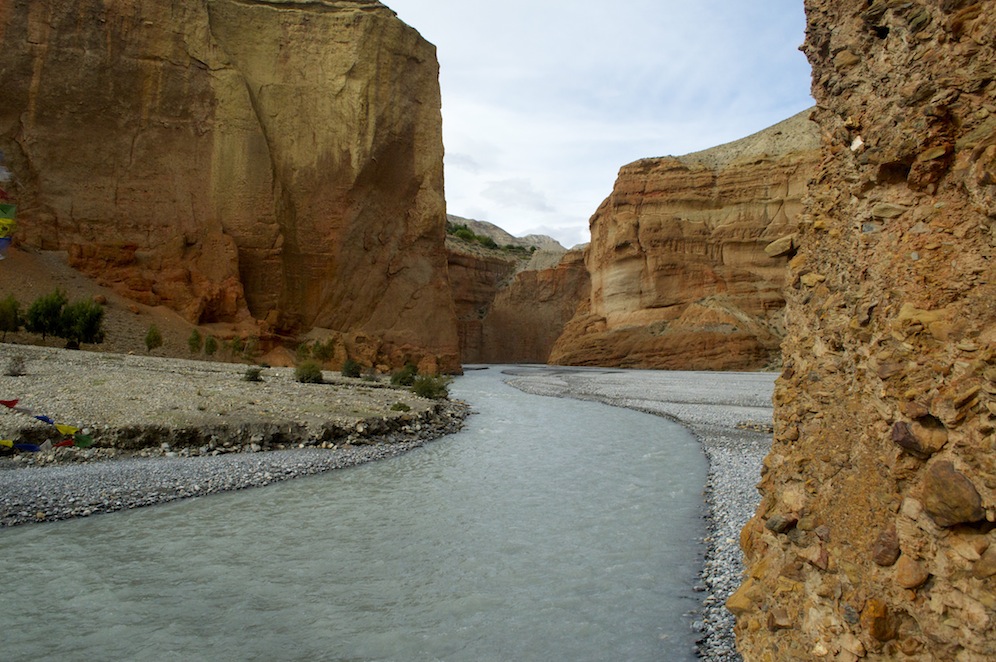
Taken from the bridge near Chele

Taken from the bridge near Chele

A bridge crossing the river led to a steep climb up to Chele. Adjacent to the bridge is a vivid orange/red cliff with a strand of the river coming out of it to join the main stream. The village of Chele is perched on the top of a cliff overlooking the Kali Gandaki gorge. The houses continue to climb up the hill while the agricultural land is concentrated on the flatter land closest to the edge of the cliff. Our campsite was in the garden to a lodge and was very cramped, particularly as we shared it with some Swiss girls.

As I went to bed a horrendous howling cut through the air, emanating from somewhere nearby. It came from several animals but it did not last long. It occurred again just before we got up. I learned at breakfast that it came from a pack of jackals that live in the hills but come to the village, under cover of darkness, in search of food.
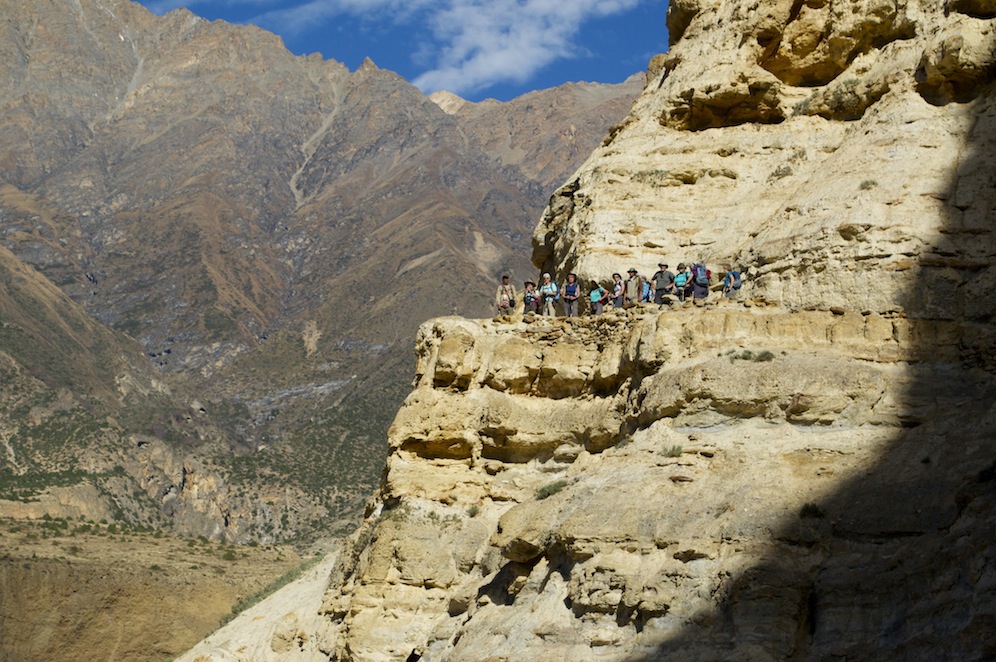
The canyon

The canyon

Climbing steeply out of Chele we soon, disappointingly, joined the road. The disappointment did not last long as we turned off and round a corner into a stunning canyon. The path took us along the wall with severe drops to the river below on the left and towering walls above us to the right. Occasionally a large lump of rock sat in the middle of the path, a stark reminder of what could happen to anybody unlucky enough to be in the wrong place at the wrong time. Cracks in the red rock suggested it could happen any time.

Gradually the canyon became less dramatic and the path finally topped out at a pass with an easy and pleasant descent to Samar where we had lunch.

There is no mistaking the look of pleasure on her face

There is no mistaking the look of pleasure on her face

I had brought out with me from England a soft toy horse, the nearest thing I could find to a Mustang horse. This was to be the ‘Wally’ award. Each day so far we had found it difficult to award as nobody did anything really foolish. I had carried it for two days in the hope of finding a child to give it to. Outside the lodge where we were lunching a little girl was making a fuss of a good natured pony. She was a natural recipient and because she was alone there would be no argument. She was very grateful and her eyes lit up with joy when I handed it to her.
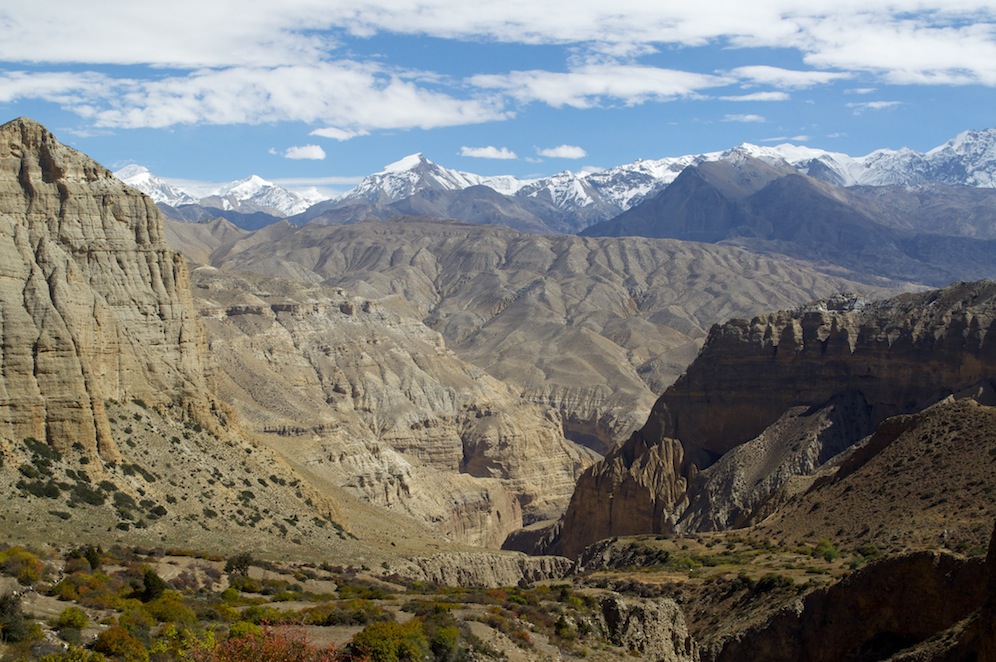
DSC_0445The afternoon’s walk proved hard at times with some steep descents and ascents. Often we could see where we were heading and it all looked close, but it was never that straightforward. In order to reach each target we had to dig deep and take each challenge at a time. What kept our morale up were the stunning views. Looking down into the jumbled rock pinnacle chaos of the Kali Ganadaki gorge amazed at every turn. Raising our gaze above the gorge we feasted our eyes on a wall of snowcapped peaks forming the band of Greater Himalaya. It was stunning but words hardly do it all justice.
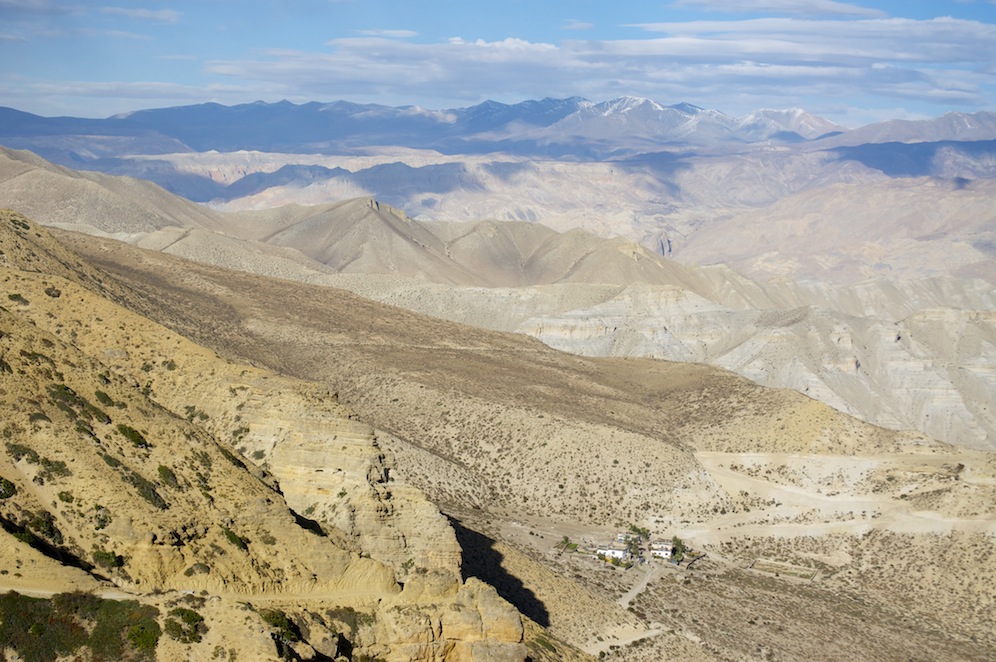
Looking north from the Tamda La. Syangboche is in the foreground

Looking north from the Tamda La. Syangboche is in the foreground

When we reached the last pass of the day, the Yamda La (3860m) the whole of Upper Mustang opened out in front of us, a mass of rolling hills, layer upon layer, to the north and a wall of snowcapped mountains to the east and south. Below, seemingly quite close, was our camp at Syangboche, which consisted of four lodges and some camping grounds and nothing more. As close as it seemed, getting there was not straightforward. By the time we reached camp we had been walking for almost nine hours.

Leaving Syangboche the following morning we immediately climbed the Syangboche La above the village. Ahead lay a long path, sometimes stretches of road, to the next pass. I found the going hard. It wasn’t steep and I felt I should be able to keep up a good pace but the gradient was steep enough for the pace to make me breath harder than I would have liked. This stretch of the path held less interest, the scenery less dramatic. Below us was the village of Ghiling, which we were bypassing. This village was the home of the Khampa fighters seeking to defeat the Chinese in Tibet. They had come over from Tibet after the Cultural Revolution and set up a training camp for fighters. They were supported and funded by the CIA and India with money, weapons and ammunition. They were at their strongest in the early 1970s but after President Nixon visited China, relations between America and China improved. The CIA withdrew support and America put pressure on the Nepalese government to deal with the problem. The Nepalese army went in heavily with 10,000 soldiers and the Khampa warriors fled. Those that didn’t were slaughtered.
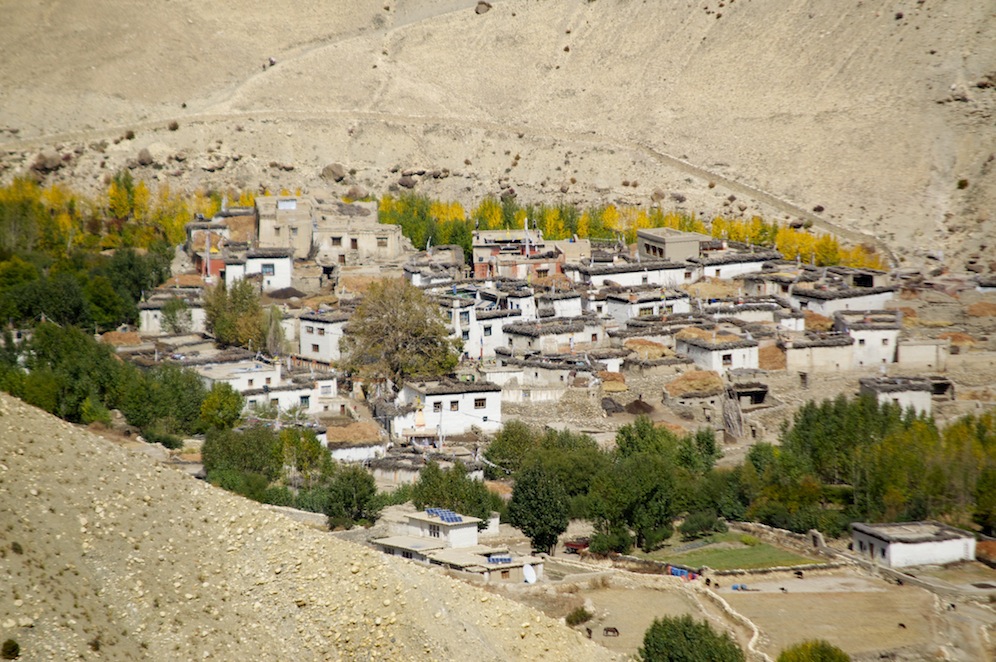
Ghami

Ghami

Having bypassed Ghilling the gradient steepened with a final steep climb up to the Nyi Nya La, at over 4000m the highest point of our trek. The pass provided some superb views, especially looking down on to the village of Ghami and its surrounding farmland. Ghami is the third largest village in Upper Mustang and is home to the great nephew of the King of Mustang. It was at his home that we had lunch although he was away in Kathmandu. It is a lovely village with hollyhocks flowering around every house. It also appeared to be a very active village with lots going on, men leading mule trains around the mani stones that lined the centre of the streets, women washing clothes and children playing. The children were not at school because of Diwali  and this was the first village we had come across where they pestered us for school pens.
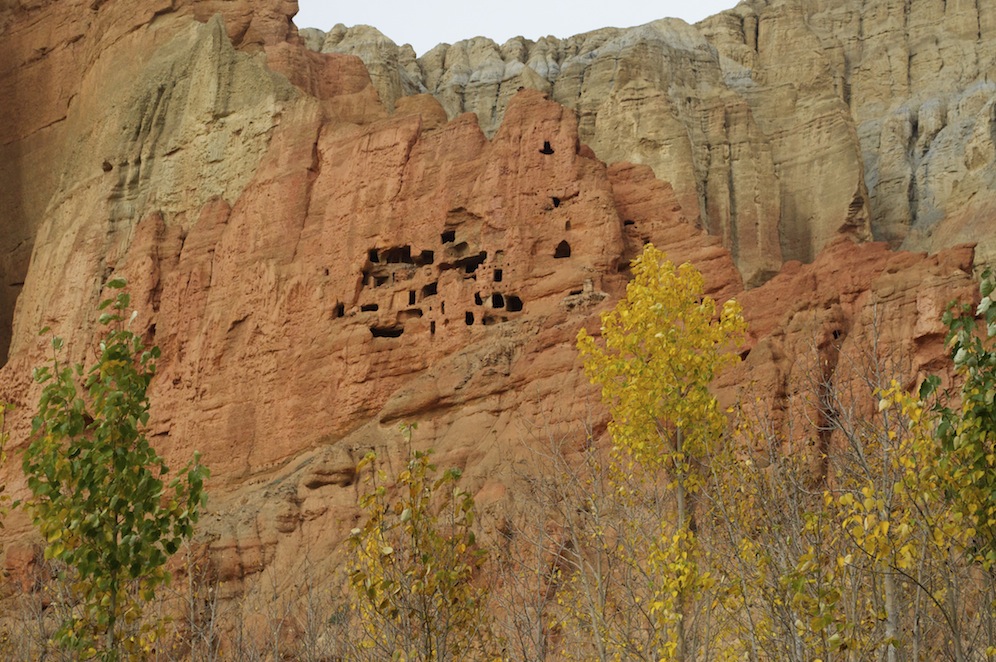
The red cliffs above Dhakmar

The red cliffs above Dhakmar

After lunch we just had one more climb up to a pass before descending gently to Dhakmar. The name means ‘red wall’ and it is aptly named as a massive wall of red stone rises above it. Caves have been carved into the cliffs at some point in history. The people in this village are now Tibetan in nature, where many of the villages we had been through so far were Gurung, although the differences are not necessarily that obvious. From now on they look Tibetan, speak Tibetan and they consider themselves to be Tibetan.

Having expected a cool night at Dhakmar it proved to be too hot. I have had a few sleeping bag issues over recent nights. My tent has had rather too many feathers flying around it. Turning it inside out I discovered a hole at the foot end leaking feathers. Having sewn up the hole I hoped to have less feathers tickling me. Another issue I have, which may be bag related, is the number of bites I have from my middle down. I notice them most when I get hot at night and cannot decide whether I am sharing my sleeping bag with some little friends.

It was cloudier this morning when we got up and cloud hung around the mountain tops. In small breaks in the cloud fresh snow could be seen.
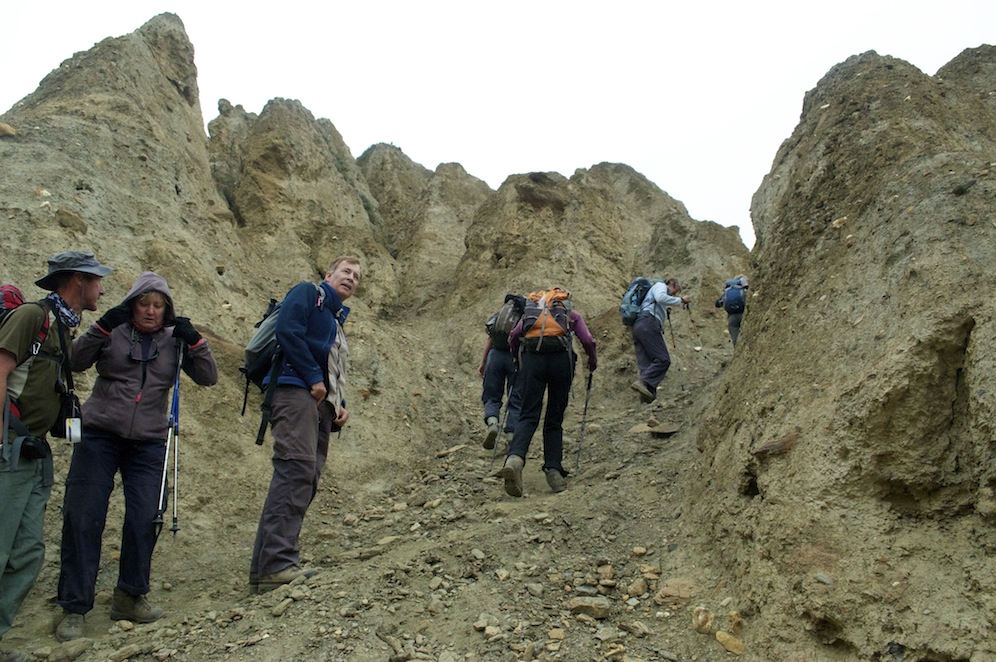
DSC_0545Leaving Dhakmar we began the steep climb up through the rock pillars as drops of rain fell from the sky. Thankfully it did not come to much. The route was superb taking us through bands of yellow, red and grey rock to the summit. In contrast the other side was smooth and gently sloped down to the village of Charang. It proved a short day’s walking and we arrived in Charang in good time for lunch.

While walking down towards Charang, I turned my phone on to take a photo. I picked up a message from Neeraj in India with the news that Lotus, who had led us on Stok Kangri and who welcomed us so warmly into his home, had been killed on expedition. I had no more detail than that. He was a lovely man who had smiling eyes as well as smiling lips. He was an inspirational mountain guide who always made you feel safe on the mountains. He will be sadly missed in Ladakh by his family and by the guiding community.
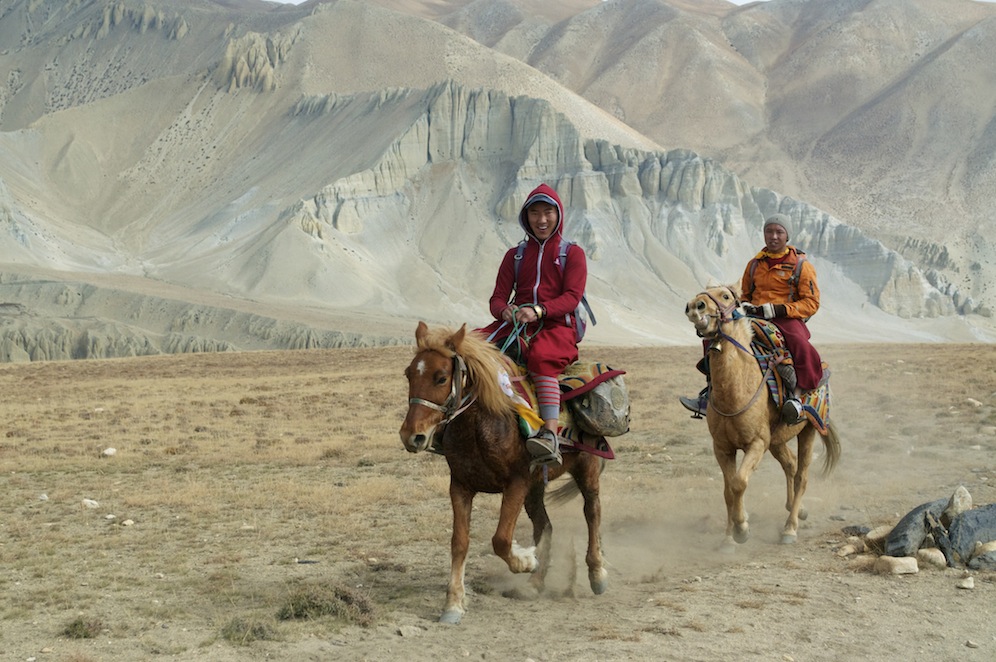
Monks leaving Cherang and heading south for the winter

Monks leaving Cherang and heading south for the winter

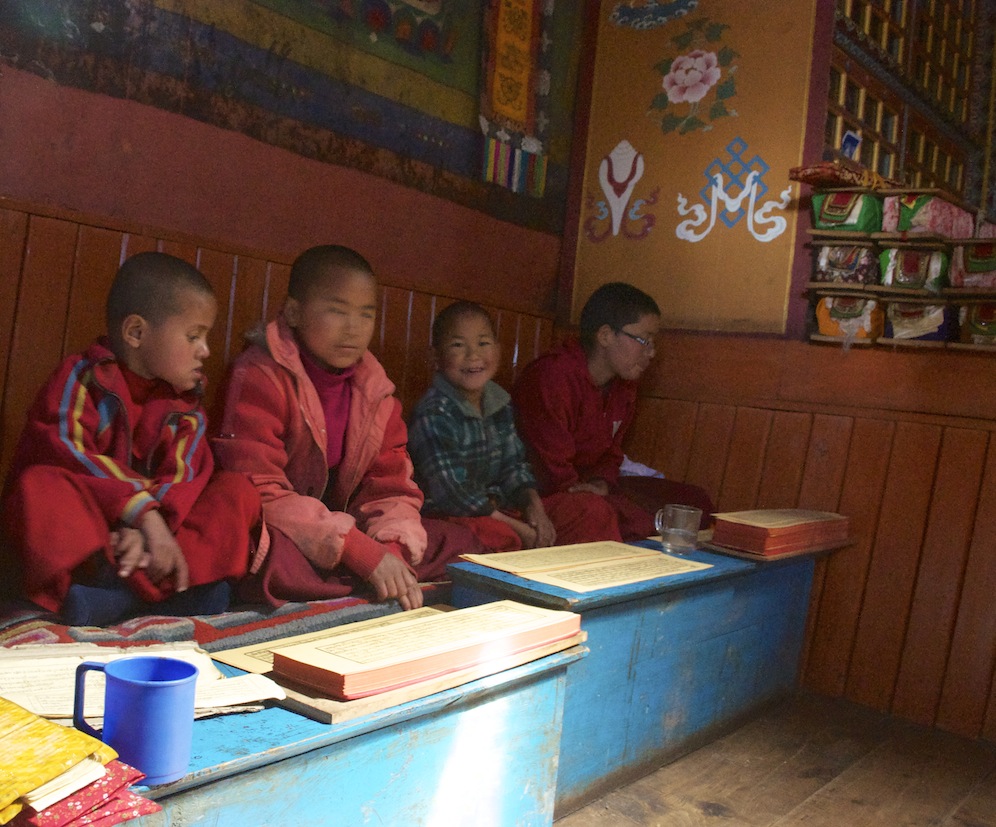
Charang is the second largest village in Upper Mustang and is dominated by two buildings, the old royal palace and the gompa, both dating from the 14th C. In the afternoon we visited both, first the gompa, home to about fifty monks but now mostly deserted as all the child monks and their carers have left for the winter. We saw some monks riding horses as we walked towards Charang in the morning and they all seemed very end of term-ish. The monastery has had no renovation work done throughout its history. It does look run down but the prayer room is the most ornate we have seen so far. It was difficult to appreciate how good it was as there was only candle light to show it off.
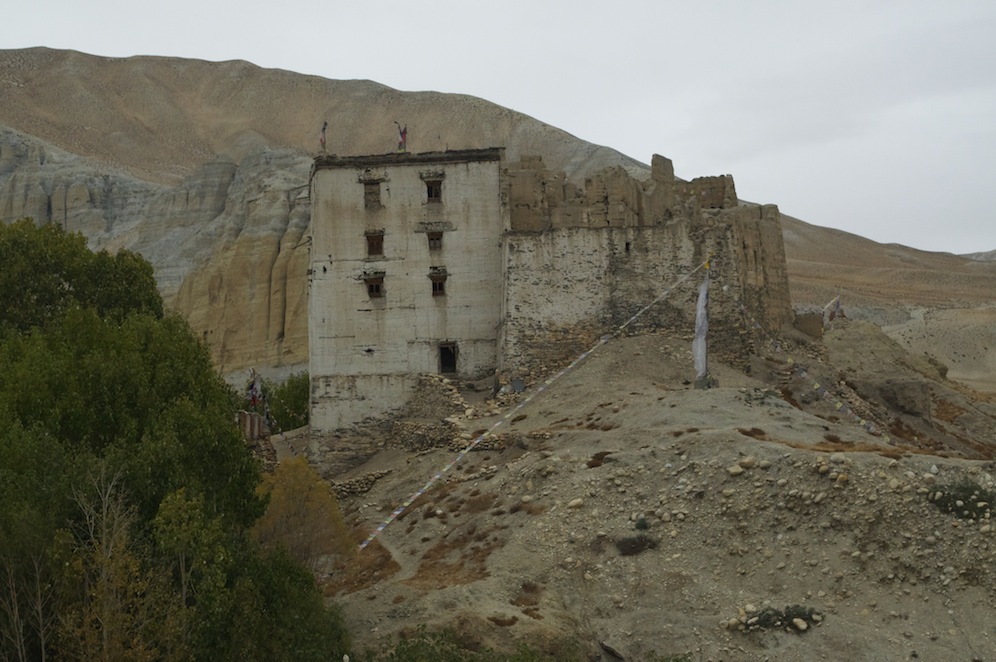
The old royal palace at Cherang

The old royal palace at Cherang

A monk then took us to the old royal palace on an adjacent hilltop. He told us that although he was born only a few miles from Charang, his home is a monastery in India. He had been sent to Charang to catalogue and to look after the many artefacts stored in the old palace. The remarkable thing that struck me was that the palace was now largely a ruin having been abandoned sixty years ago. We were led up some dark stairs to a room full of these precious artefacts and books. The roof was open to the elements with a willow and mud canopy the only protection. Apparently it does the job but I couldn’t see such a relaxed approach to looking after such precious items ever occurring in the UK.
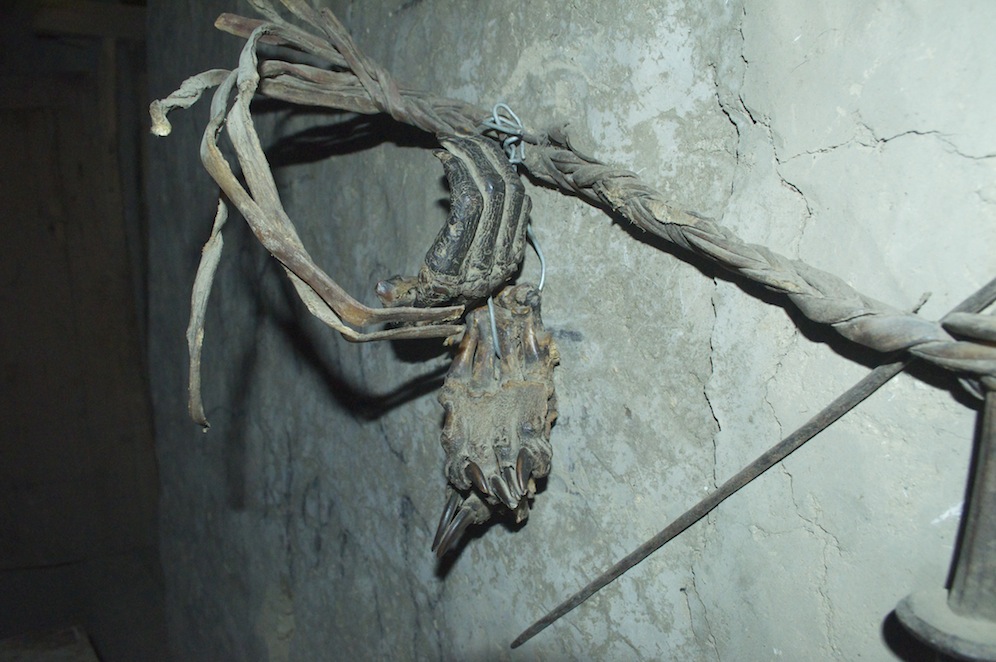
The mummified hands of the master builder

The mummified hands of the master builder

In another room, the one where the monk lived and slept, there were more artefacts, all supposedly catalogued. There seemed to be little sense of order in the room. Hanging on one wall were two mummified hands once belonging to the master builder who built the palace back in the 14th C. Having finished his masterpiece his hands were chopped off so that he could not build anything better. The monk spoke enthusiastically about his work as guardian of the library and carer of the artefacts but he spoke even more enthusiastically about returning to his own monastery in India. He had spent a year in Charang and would be finishing in five days. To show us his monastery he brought out his mobile phone and proudly showed us many pictures of where his heart is. They gave us an insight into a modern monk’s life with a library, a gymnasium, a computer room, communal living and a capacity for 4000 monks to pray together. It was hardly surprising that he was looking forward to getting back.

It was good to have a short walking day and an opportunity to do some household chores. It is a shame that the sun could not oblige and dry the washing.

After another disturbed night I am convinced I am sharing my sleeping bag. I now have bites on my legs, thighs and around my waist. They are very irritating and uncomfortable. I certainly have more this morning than I had last night. I am going to have to ditch my present sleeping bag and come up with an alternative.

News has reached us that there has been a cyclone on the east coast of India. This has had a devastating effect on the weather patterns in Nepal, particularly in the east. Kathmandu is experiencing torrential rain and many internal flights have been cancelled, including to Pokhara. All flights to Jomsom have been cancelled in the last few days. There have been reports of massive snowfall in the Everest region and you can rest assured that other regions will have been similarly affected.
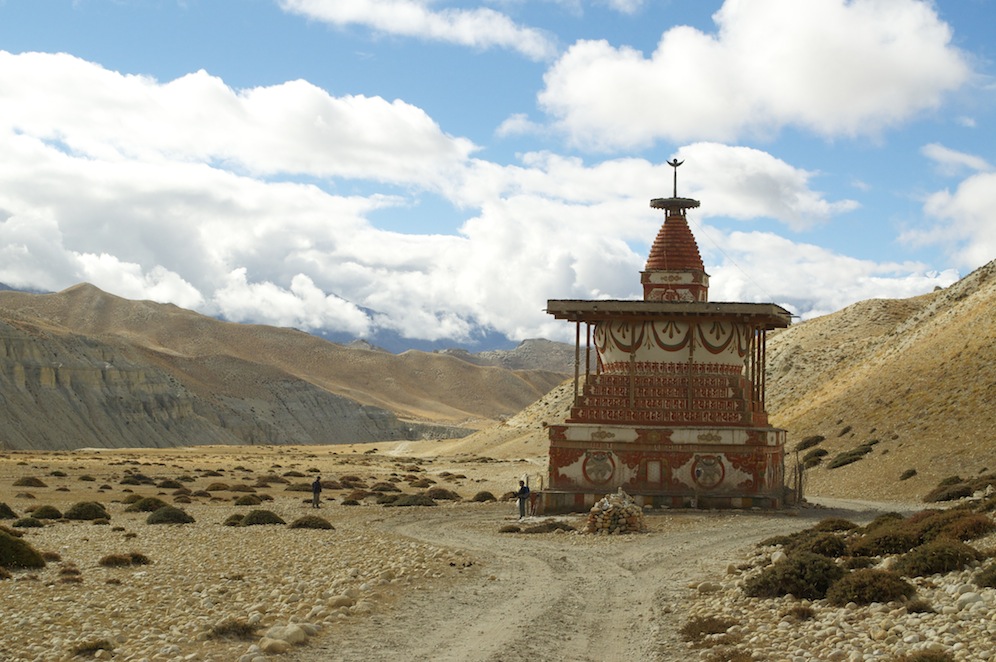
The chorten which marks the half way point between Cherang and Lo Manthang

The chorten which marks the half way point between Cherang and Lo Manthang

The weather has affected where we are trekking. During the night we had rain and this pattern continued for much of the day. None of the rain was heavy but the clouds were and there was a cold wind. We had no alternative but to follow the road today so I put my head down and got on with it. It took some time for me to realise that the voices behind me had faded to nothing. Stopping at a chorten, which marked the half way point between Charang and Lo Manthang, I waited for the rest to catch up. I got quite cold in the twenty minutes it took for them to reach me.
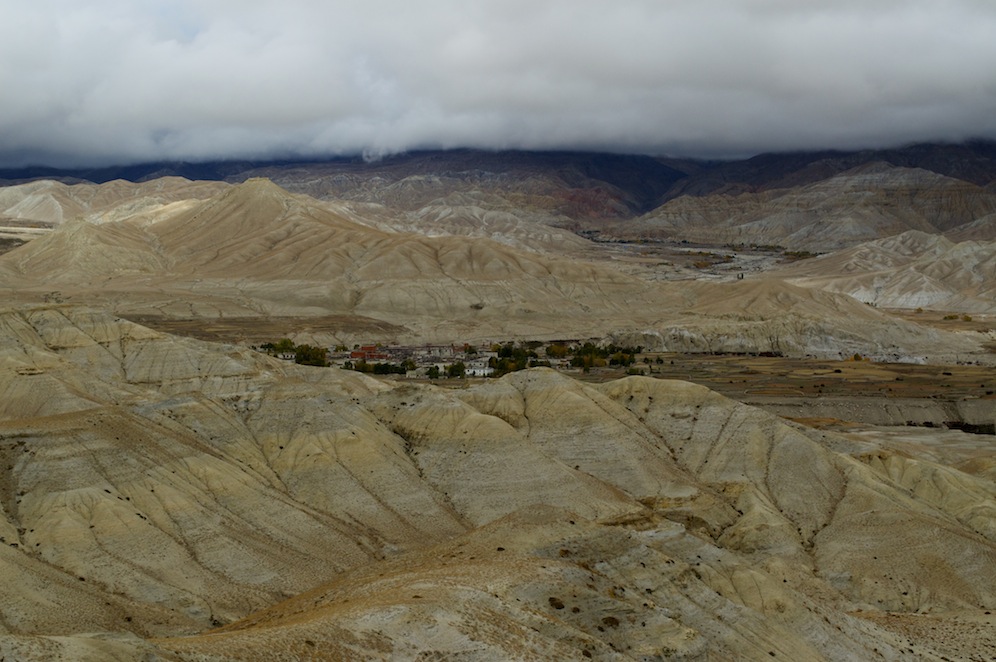
Our first view of Lo Manthang

Our first view of Lo Manthang

Crossing another pass we had one more valley and a final pass before reaching Lo Manthang. The weather showed signs of improving as soon as we crossed the first pass, with breaks appearing in the cloud. By the time we reached camp the sun was out and it was extremely hot. Camp was in an orchard just outside the city walls. As we sat around enjoying the peace and quiet a couple of men came, laid out cloths on the floor and displayed their array of jewellery and other Tibetan artefacts. There was no pressure from them for us to go and have a look but, inevitably curiosity got the better of us and we went to them. When that happens, they have won.

Lunch time

Lunch time

After lunch we went into the walled city to visit the various gompas and a museum. Everything was extremely old and in need of some repair. While we waited for a monk to give us a guided tour a number of boy monks were collecting their plates of rice and dhal and sitting in the middle of the courtyard to eat. It was a very social affair and they came across very much as young boys and not necessarily monks.

We were first guided into the school passing classrooms with hard wooden benches and little else in them in order to visit the museum. It was much more organised than the collection of items we saw in Cherang, but all items, large or small, were crowded on to shelves gathering dust. Touching and taking photos was prohibited. The Tibetan/Nepali concept of a museum is such a contrast to our own cultural approach. Their innocence is quite refreshing.
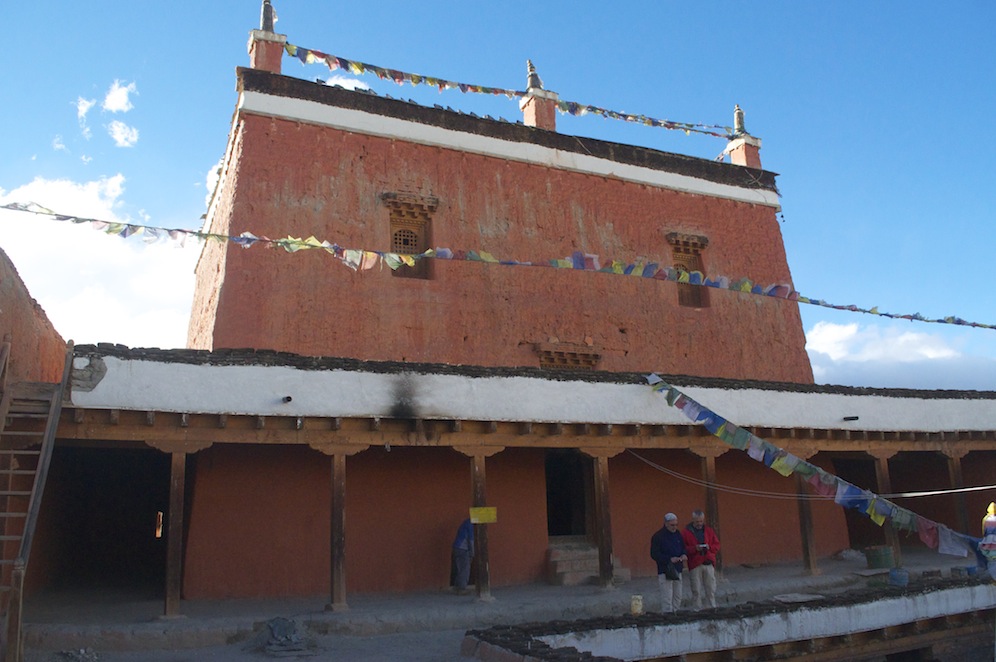
One of the gompas in Lo Manthang

One of the gompas in Lo Manthang

There are three gompas in Lo Manthang and we visited them all. Much of the art work has been damaged and the wall paintings are not complete. Work has been done to repair the plaster work and I guess the paintings  will be restored in time. How they do it is beyond me; the light in the gompas is very poor and the artificial light hardly improves the quality. In order to see the paintings we had to use our head torches and they had a very limited effect.

Ramesh had a spare sleeping bag but it was not only very thin but also far too small for my frame. Using it to cover my bottom half I wore my down jacket on the top half and borrowed Shona’s to wrap around my legs and feet. I was remarkably warm and comfortable.
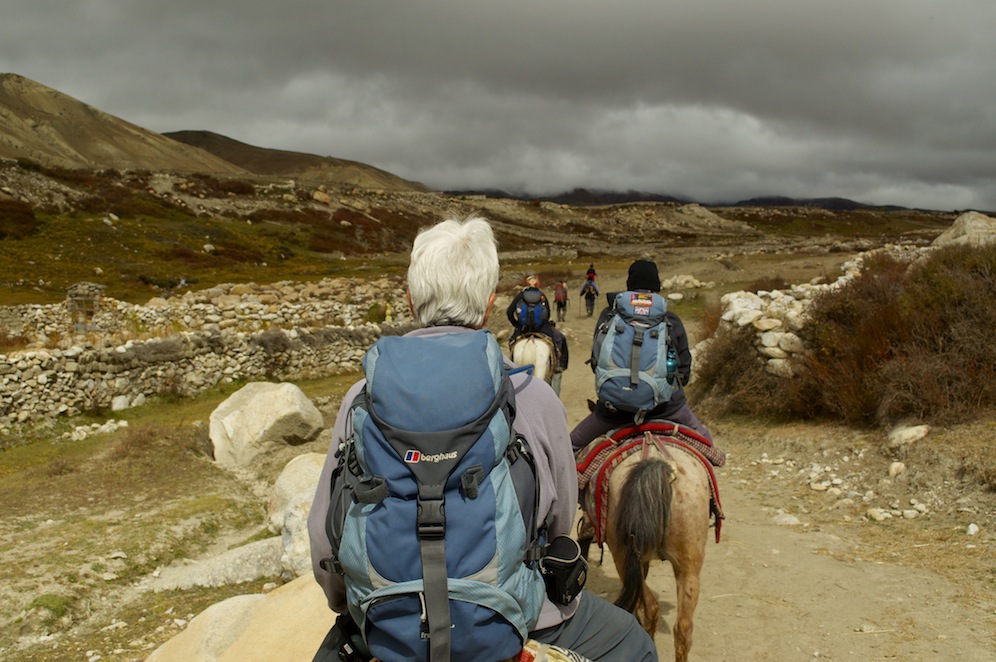
DSC_0657The following day we had to explore Lo Manthang and beyond. We had a choice as to how we would like to spend our time. We could go horse riding up to the caves at Chosar but that would involve six hours sitting on a horse. We all felt that would be too long so suggested a shorter ride taking us to Namgyal Monastery. Eight of us took the opportunity while the rest explored Lo Manthang. Five of our horses belonged to the King but they were all easy rides, almost knowing which way to go without instruction, just a gentle tweak was needed on the reigns.
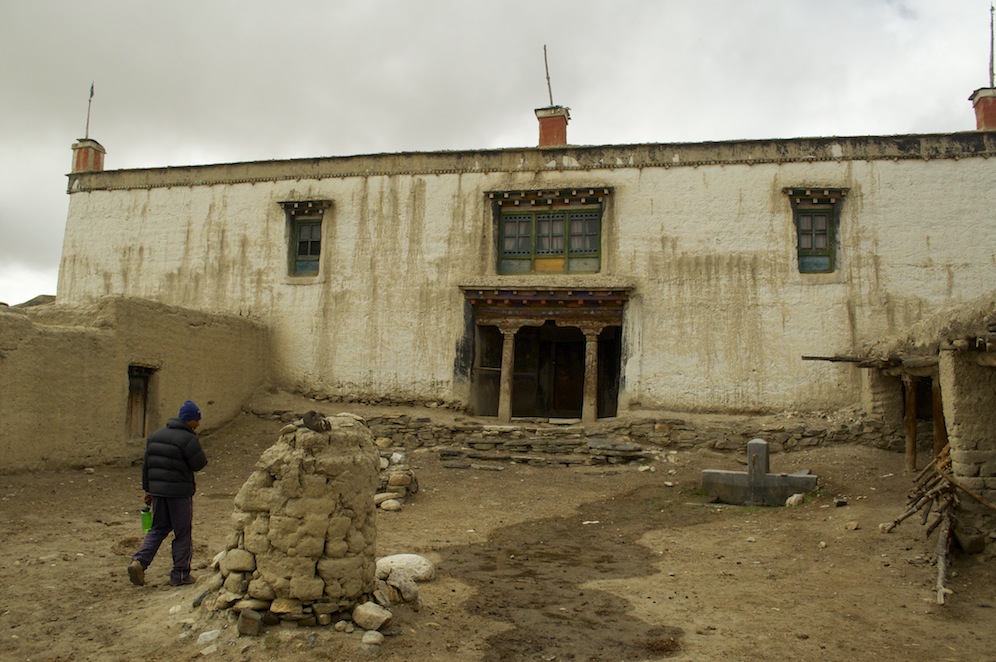
The Summer Palace!

The Summer Palace!

Namgyal was closed to visitors so we decided to visit Thinggar where the King’s summer palace is situated. It was a super ride through some stunning country. I don’t know what image you conjure up when you think of a summer palace. I know I think of somewhere I would rather be than anywhere else. The summer palace at Thinggar shatters all previous images. It has the look of somewhere that is not only abandoned but abandoned for some time.
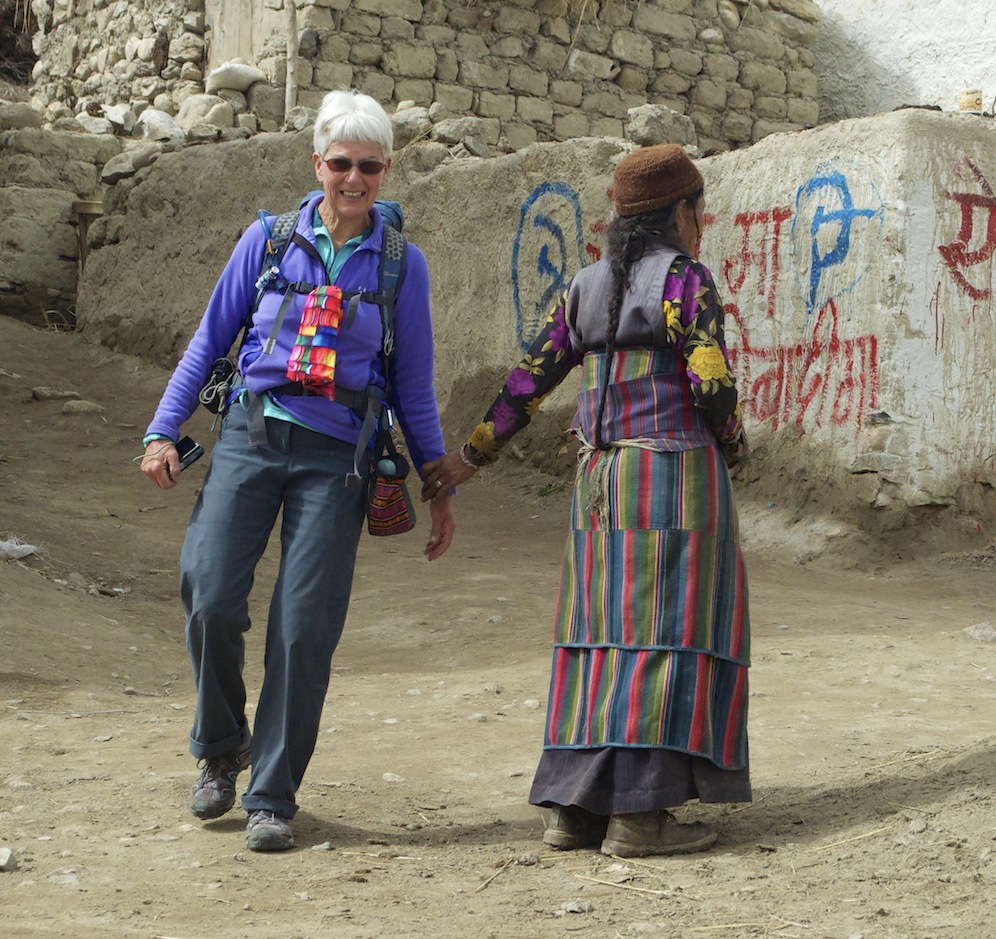
Tenderness

Tenderness

However, the village was interesting and it gave us an opportunity to dismount and explore its narrow passageways. It also gave the horses a rest! The people were friendly. There was one lovely cameo where Claire, as she walked past a woman, felt her wrist held; a warm gesture of friendship.

We returned to Lo Manthang by a different route in time for lunch.

In the afternoon we explored the ancient passageways of the walled city. As well as the gompas and the royal palace there are 180 homes. There are others outside the walls but they are much more recent. At most about 800 people live in Lo Manthang.

Our 'Old City' guide

Our ‘Old City’ guide

We met an old man who took us up through his house on to the roof and the city wall. Here we could walk along the wall and look down into the city. Taking us back down he diverted us through his living room and into his shop, full of curios. He was a delightful old man who enthusiastically told us about his city in a form of pigeon English and deserved our custom.
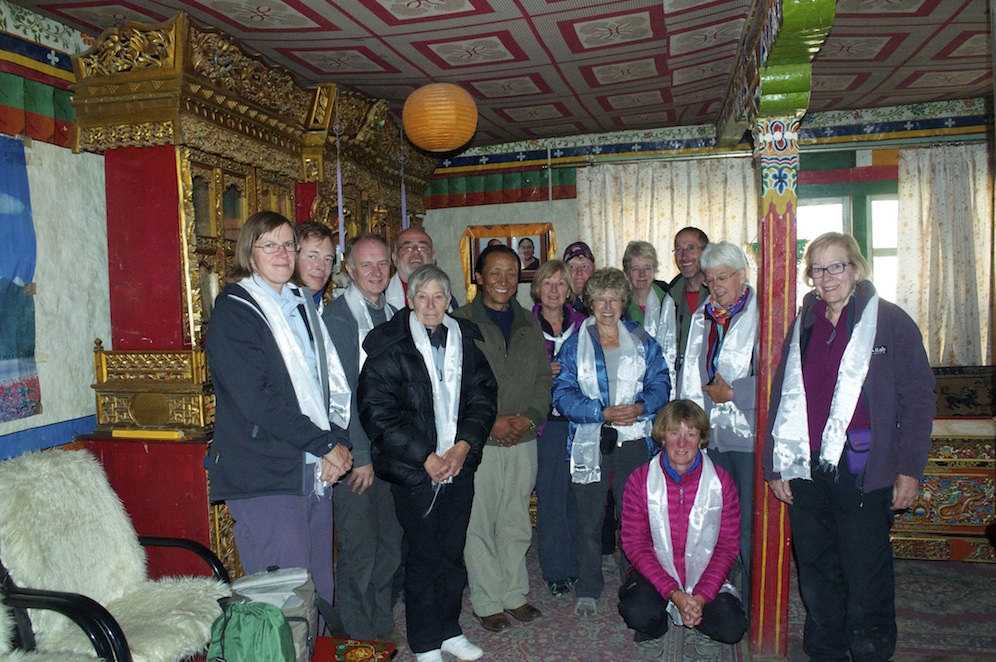
Our audience with the Crown Prince

Our audience with the Crown Prince

At 4.00pm we had an audience with the Crown Prince in the royal palace. The building is like all others in Mustang, ancient, dirty and in need of repair and decoration. The room where we met him was typical of houses and lodges with bench seats all around the edge covered with carpets. In front were elaborately painted tables. We each, in turn, gave him a Katar scarf for him to bless us with and I gave him a bottle of whiskey as a present from the group. Formalities completed, we were then served with mint tea. While we sat there we were able to ask him questions about all sorts of subjects from the construction of the road to his daily routine. His English was very good and it was a very relaxed occasion. We concluded with some photos.

My night was not quite as comfortable!

The morning we were due to leave Lo Manthang and begin our journey south dawned cloudy. We were starting earlier than normal as the day was going to be quite long. As we headed up to the Lo La taking us out of the Lo Manthang valley fresh snow could be seen on the hills around. This had fallen during the night although nothing had fallen on us. Winter is on its way.
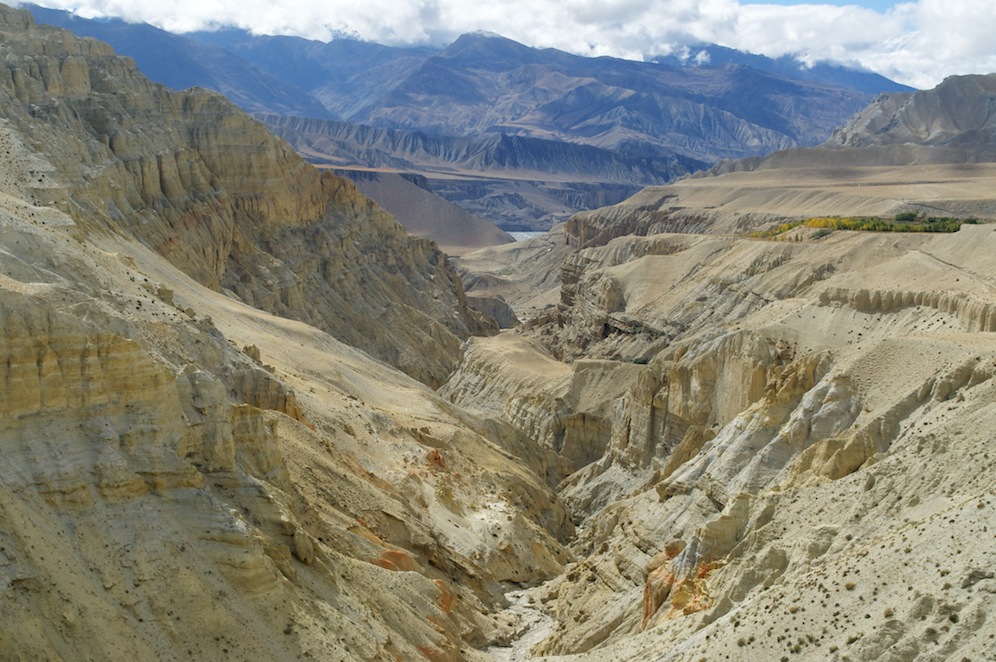
DSC_0788It was a case of heads down and cover the distance to Charang as quickly as possible. Having said that we didn’t want to arrive too early or we would have to sit around waiting for lunch. The weather had improved with our journey south so we spent a very pleasant half hour sitting on a superb vantage point overlooking a deep gorge with spectacular cliffs on either side.
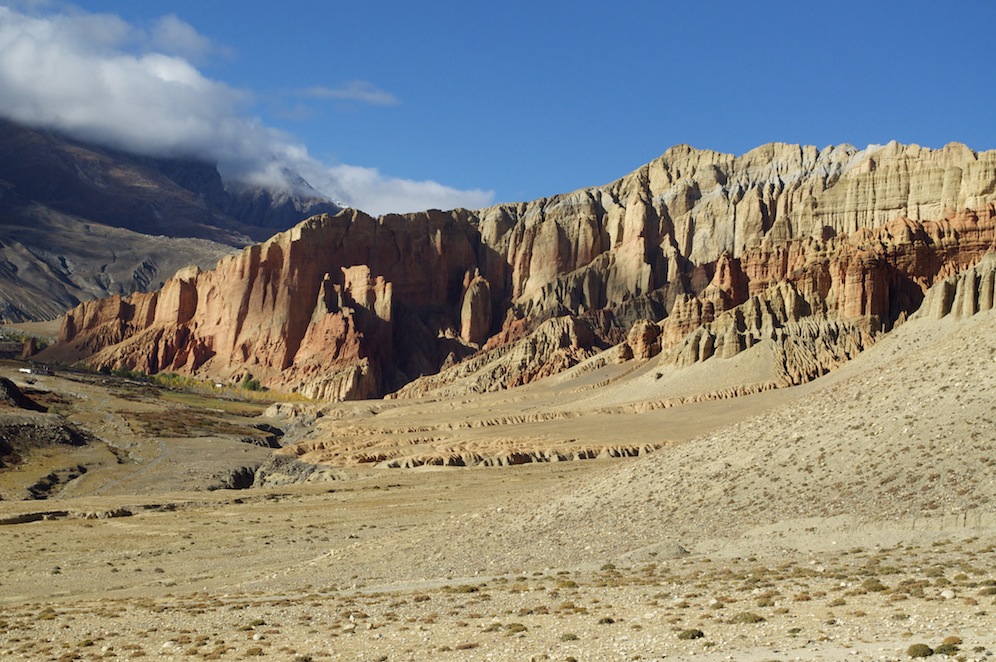
Looking along the cliffs above Dhakmar

Looking along the cliffs above Dhakmar

After lunch we had a long climb up the Choya La. Although it was only 300m higher than Charang it was a long, steady climb. Views from the top were stunning. The descent was much steeper and shorter down to Ghami. The light on the crenelated and pinnacled cliffs was superb. As we descended the red cliffs above Dhakmar came into view and with the light looked so much more impressive than when we first encountered them a few days earlier.

The sting in the tail today came right at the end of the walk. Dropping to the river below Ghami we had a final steep climb to our camp in an apple orchard with heavily laden trees. It was the hardest climb of the day. The orchard was very spacious and it was one of the few campsites where we were not hemmed in and tightly pitched. We were in danger of being hit by falling apples, although, having picked one and tasted it, they were still not fully ripened. With winter approaching it seemed unlikely that they will reach full ripeness and will be used for something other than eating.

DSC_0831Leaving Ghami to retrace our steps of a week before, we had a super walk. It started with a steep climb up the Ghami La, and after a short descent, a long protracted climb up the Nyi La (4010m). This really acts as the boundary between Lo district and the rest of Mustang. All villages north of here are typically Tibetan. From now on until Kagbeni the people are predominantly Gurung. The views of Upper Mustang were superb with layer upon layer of textured ridges with snow capping the furthest peaks. The views of the Annapurnas to the south were limited as a result of cloud covering them in part. The peaks immediately to the west were covered in heavy black cloud and it looked as if it was snowing among them throughout the day. The long descent from Nyi La was followed by a long ascent to Syangboche La before dropping into Syangboche for lunch. The breeze had got up and there was certainly more chill to it than when we were travelling up. Clearly signs were becoming very apparent that winter was approaching. This was confirmed by tractors carrying local people from high in Mustang on their annual migration south to Pokhara and beyond.

After lunch we climbed steeply up the Yamda La (3860m), probably the steepest ascent of the whole trek. From there it was an undulating path with a series of fairly steep descents and ascents with stunning views across the Kali Gandaki gorge towards the high Himalaya. Camp for the night was at Samar, where I had given our soft toy horse to the girl. The horse was now on display on a shelf with two yaks. I have a suspicion that her parents have taken it off her and placed it in the dining room along with several other garish ornaments. I hope she is allowed to take it off the shelf occasionally to play with it.

Jackals provided an alarm call the next morning. I’m not sure what time they started howling but it must have been in the early hours. They were very close. We learned later that a pack of about six gathered round our kitchen tent hoping for food. The howling woke everybody up, including the kitchen crew who were sleeping in the kitchen tent. They chased them off and we were all able to go back to sleep. A sensible time elapsed before anybody felt brave enough to venture out to the loo.

While we were waiting to leave Samar for our last full day’s trek I got talking to a film crew from Estonia making a film about Mustang through the eyes of a monk, with the emphasis on changes that may or may not be occurring as a result of development, particularly the road. They hope it will be on release next summer.

Again, while we were waiting, we heard that there had been no flights in or out of Jomsom for the past week because of the weather in Lower Mustang. It would not be the end of the world if we had to take the 8 – 10 hour drive to Pokhara, but it would be an inconvenience. We also began to hear stories of people who had been on the Annapurna Circuit. They had had terrible conditions with no mountain views and snow laden clouds obliterating them and, just to add insult to injury, dropping lots of snow on the trail making it very hard going. We have been very fortunate in Mustang.
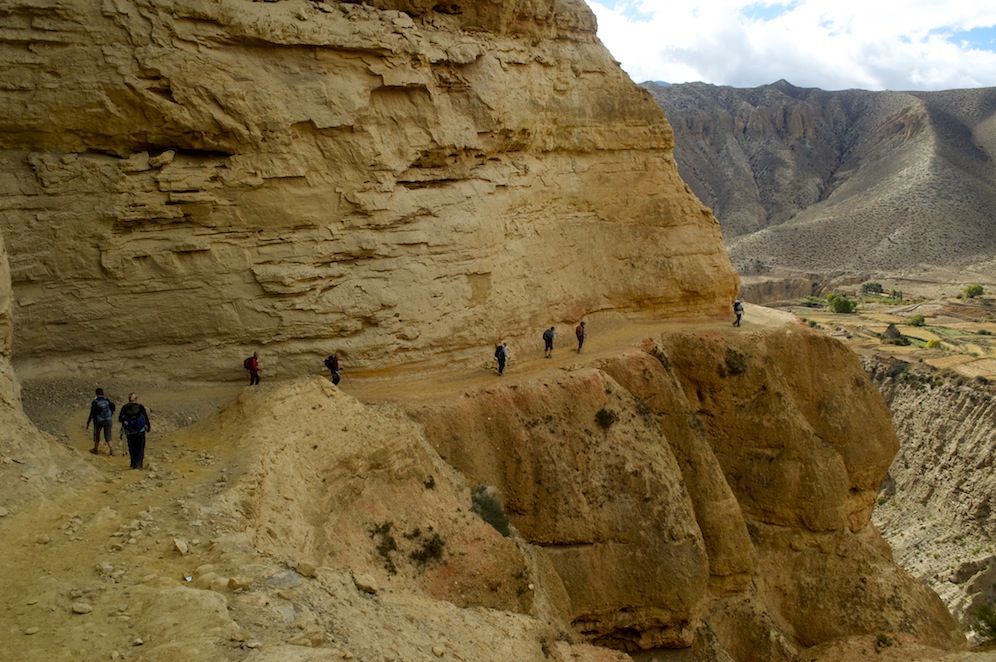
DSC_0851Finally getting away, we climbed gently up to an unnamed pass before traversing the hillside into the stunning canyon we had climbed up several days earlier. Walking down it was no less spectacular than walking up. The path follows a ledge in the cliff face. In places it has been reinforced with stone supports. Far below the Ghyakar Khola rushes through with cliffs rising, not so high to a plateau with a small village and agricultural land. At the bottom end of the canyon a suspension bridge spans the gorge connecting the village to the rest of Mustang and the world beyond. It is a bridge not for the faint hearted.
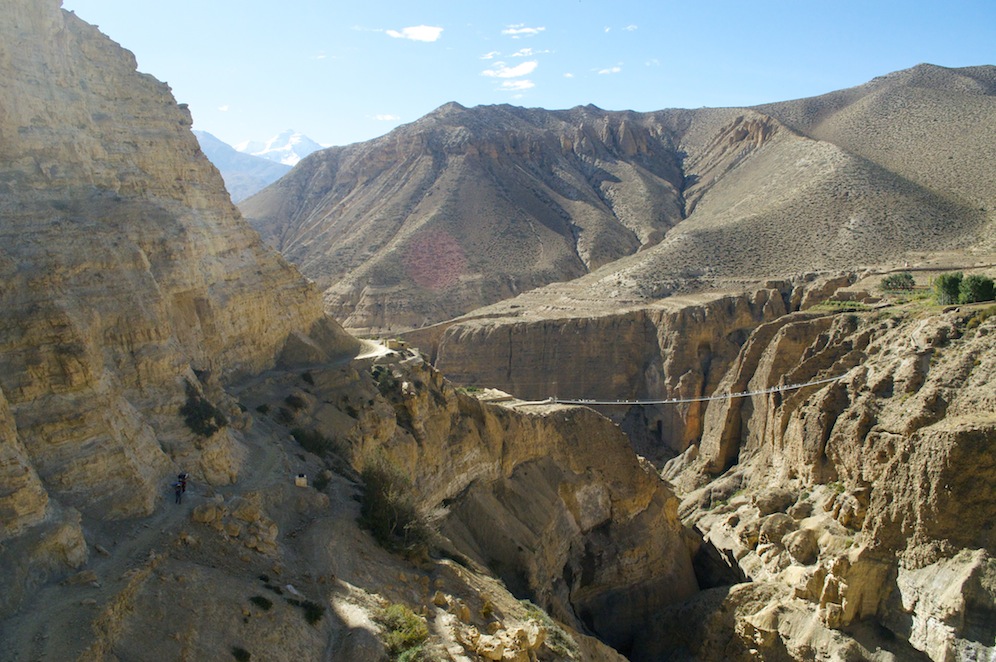
The 'heart in the mouth' bridge at the end of the canyon

The ‘heart in the mouth’ bridge at the end of the canyon

We soon reached Chele and dropped steeply to the Kali Gandaki. Although we were followint our footsteps in reverse it was as if we were seeing it for the first time because we were encountering the spectacles at a different time of day and the light was so different. It is important to have good light to highlight so many spectacular features.

We dawdled along the river bed looking for fossils. Bella had more success than all of us put together, which tempts me to make a comment about her being closer to the ground than the rest of us, but that would be too cruel. Lunch was at the next village, Chhusang, and as it was only a little after 10.00am we needed a delaying distraction.
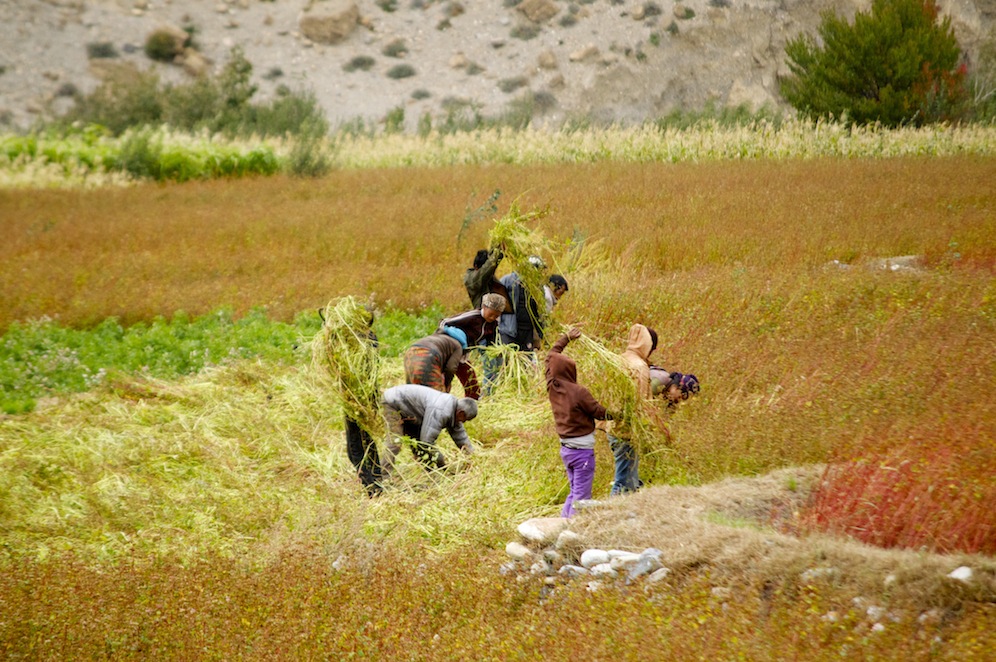
Gathering in the harvest in Chhusang

Gathering in the harvest in Chhusang

Having lunched early we left Chhusang for the march to Kagbeni. The wind had developed, as expected, so it was very much heads down and let’s get it over with. Most of the way was on the unmade road, undulating on the east bank of the Kali Gandaki. There were fewer features to create interest, and, as rain drops were whipped into our faces and those of us with bare legs felt them being sand blasted, the desire to reach Kagbeni increased. We actually made good time and to celebrate we poured into Applebee’s coffee bar at the check point and drank luxurious cups of coffee and hot chocolate. Although we had a two to three hour walk to Jomsom the following morning it really felt as if we had completed the task and I certainly felt justified in having a beer!
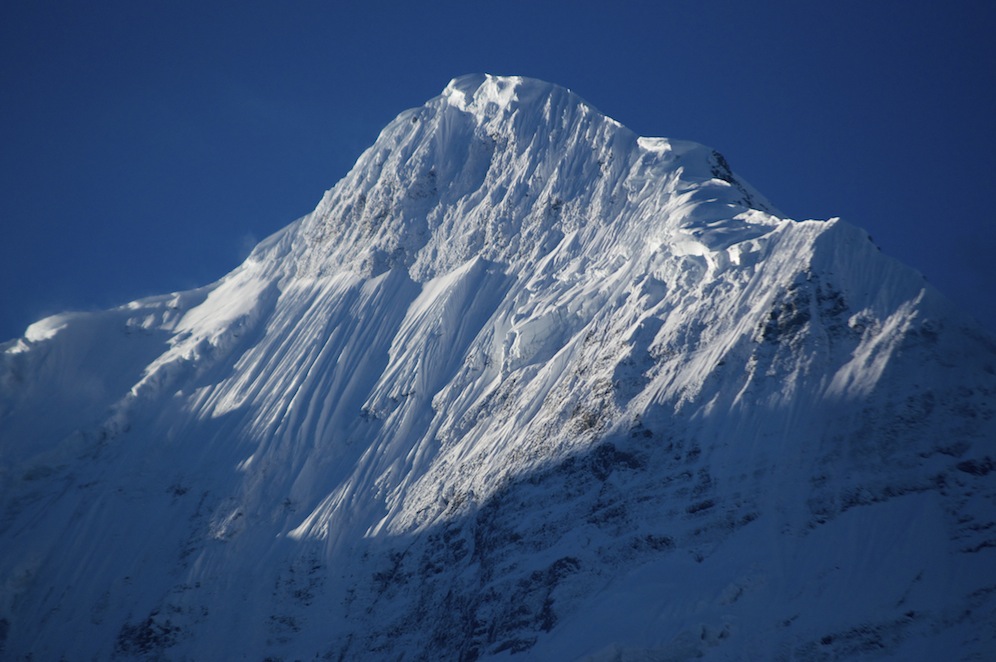
Nilgiri from Jomsom

Nilgiri from Jomsom

Completing the walk the following morning in perfect conditions and before the wind funnelled up the Kali Gandaki, we spent a restful day in Jomsom. Flights were back to normal and the prospect of us leaving on schedule the next day looked good. The stories we had heard about atrocious conditions on the Annapurna Circuit proved accurate as we met and chatted to people who had been unfortunate enough to be committed to it. They talked of heavy rain, high winds, snow on higher areas of the route and, perhaps most disappointing of all, no mountain views until they reached the Kali Gandaki Valley and saw Nilgiri towering over the valley. The night before our flight to Pokhara we heard that it was raining heavily in Pokhara. It proved to be exceptional rain with the main street awash and cars being picked up in the flow and carried along the street. By the time we arrived there the following morning the sun was out, it was warm and the only sign of the rain were some damp and muddy patches at the sides of the road. The weather this October has been very uncharacteristic but I can only stress how lucky we were to be trekking in Mustang.
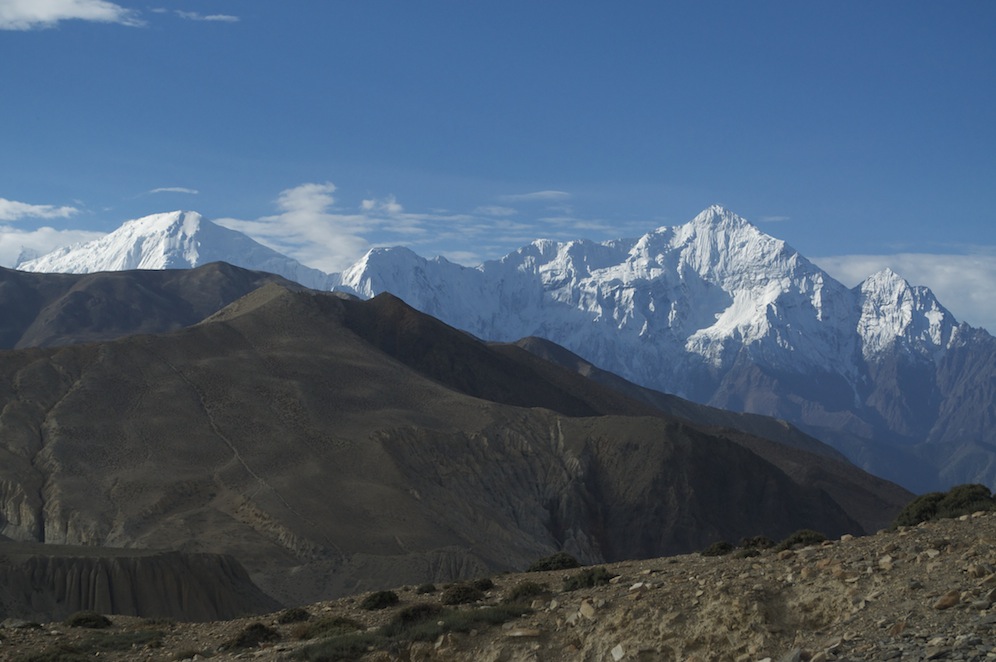
Looking south at the Greater Himalaya from Mustang

Looking south at the Greater Himalaya from Mustang

The warmth and the relaxed atmosphere of Pokhara gave me time to reflect upon our experiences of the previous two weeks and on Mustang in particular. Mustang did not disappoint. It really is a fabulous destination with interest throughout. I am glad I have done it now and not left it any longer. I fear Mustang will change quite quickly over the next few years. The road is going to make a huge difference. Not only is it opening up Mustang to the rest of the world but it is also opening up the rest of the world to Mustang. There are thirty one villages in the whole of Mustang and the population is a little under 6,000. Each year, after the annual seasonal migration, a few less come back. The road, which will make movement a lot easier, is in danger of speeding up the gradual reduction in population. There already appears to be an imbalance in the demographics. Children seemed to be cared for by grandmotherly figures as the mothers are busy in the field, in the shops etc. There do not seem to be many men apart from the elderly and those running lodges or leading mule trains. I can only assume that many men, while not necessarily abandoning Mustang are, perhaps, working away.

It is stunningly beautiful

It is stunningly beautiful

I think there will be a significant building programme in the years to come to develop Mustang. The prince is already building a luxury lodge at Namgyal, which might have been the reason why we could not visit the gompa there. He alluded to the fact that Mustang does not receive any of the $500 entry fee. He would like to see that fee cut, for it come to Mustang instead of government coffers, and for more people to be allowed into Mustang. He may get his way when his father dies and he becomes king. Hopefully, if that does happen, it might encourage the residents of Mustang to remain in Mustang rather than going further afield for a living. Whatever happens, Mustang will change.
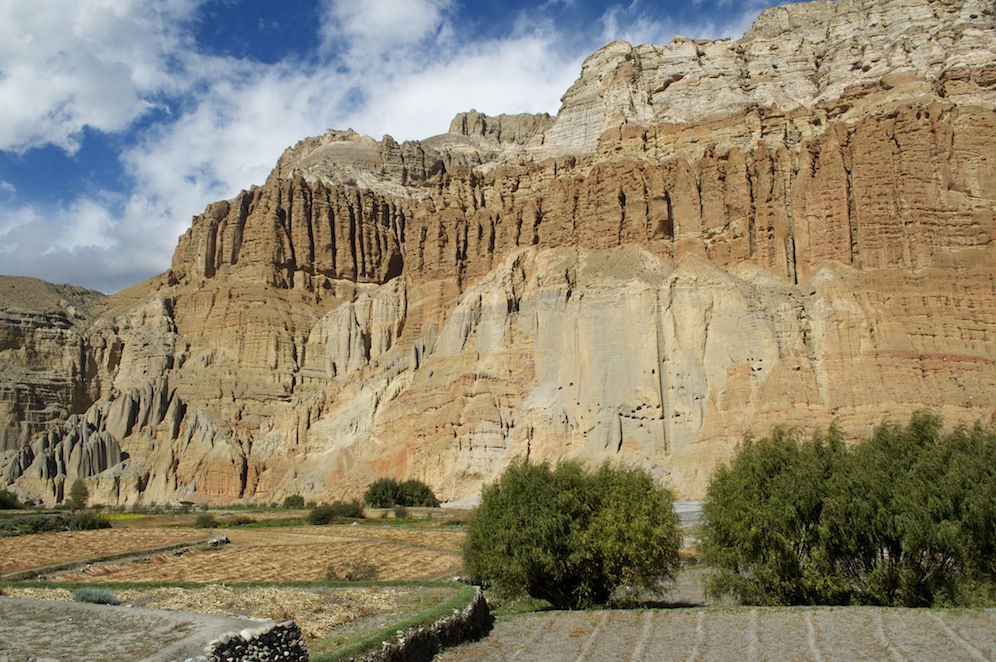
The cliffs above Chhusang

The cliffs above Chhusang

Whilst it would be hypocritical of us to want to deny the people of Mustang opportunity, we have seen so many areas of the world and people lose the very things that make them unique. I think the present king, now 95 years of age, has kept his foot on the brake as far as progress is concerned. But he is ill and is not going to last much longer. I hope his son is discerning in his decisions regarding the development of Mustang and that while it moves into the 21st C it still maintains much of its character and charm. It is an incredibly beautiful part of the world.

DSC_0886The tourist information office in Lo Manthang keeps a record of all tourists who enter Upper Mustang. Last year only 135 British people visited. Our group was equivalent to 10%. Perhaps we have yet to discover Mustang. Perhaps we don’t like paying the $500 fee. Irrespective of whether the money is used in Mustang or elsewhere, it is worth every cent. Mustang is a fabulous destination within the capabilities of most trekkers and I cannot recommend it highly enough. If you have a chance go, but don’t leave it too long, because it will change.


The Hidden Kingdom of Mustang, Nepal – The Approach

When I left Nepal last April I left rather disillusioned with the lack of organisation, frustrated by the dirt and chaos, the slow pace of progress and the constant battle with traffic, crowds and street hawkers. Travelling to Nepal again in October, I forgot about those niggling criticisms and found myself excited.  Perhaps it was because I had no responsibilities beyond enjoying the trek and looking after the twelve people with me. Whatever the reasons I keenly peered out of the window as our plane descended towards Kathmandu through cloud, eventually emerging to see a green, lush landscape beneath us.  The heavy monsoon rains of the summer had transformed the land from varying shades of brown to shades of vivid green.  The so dominant brick factories during the dry season were lost in a sea of green.  It was raining so perhaps the monsoon was not yet finished.

Having landed the pilot welcomed us to Kathmandu and told us it was 5.15 in the afternoon. It was, in fact, 3.15. I am glad that was the only dial he got wrong on his approach to the airport.

October is usually a dry month in Nepal but, although the month was still in its infancy, there had been several days of rain turning the often unsurfaced roads and pavements into a sea of mud.  The road widening that had been taking place for two years was still not finished, adding to the poor travelling conditions. Thankfully we had arrived on a Saturday, the quietest day of the week on Kathmandu’s roads.

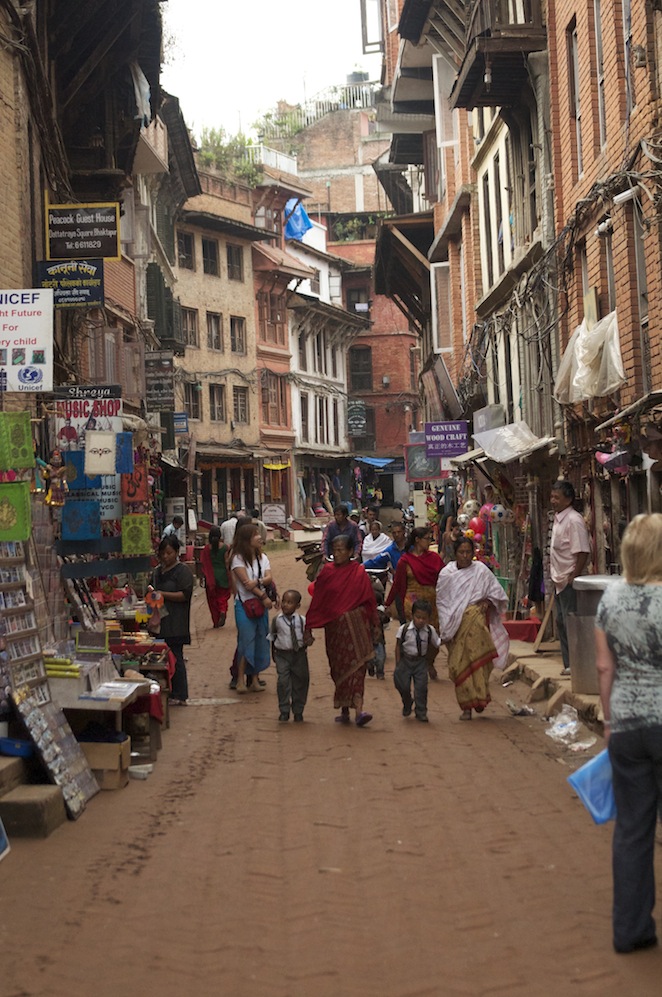
A narrow street in Bhaktapur

A narrow street in Bhaktapur

Virtually all of the group had been to Nepal before so, the following morning, instead of heading for the usual tourist spots of Pashupatinath and Swayambunath, we headed for the quieter Bhaktapur.  Having been there only six months earlier during the New Year celebrations it was good to see it on a normal working day as people went about their daily business.  Bhaktapur is like a living museum where you gain a much better insight into the lives of those who live there than you do in both Kathmandu or Patan. It is a little reminiscent of an old peoples’ home. There are so many old people, bent almost double with years of toil, shuffling about the narrow streets and squares doing what they can or just making themselves go out to maintain some level of mobility. Being out must be preferable to sitting in a darkened room.

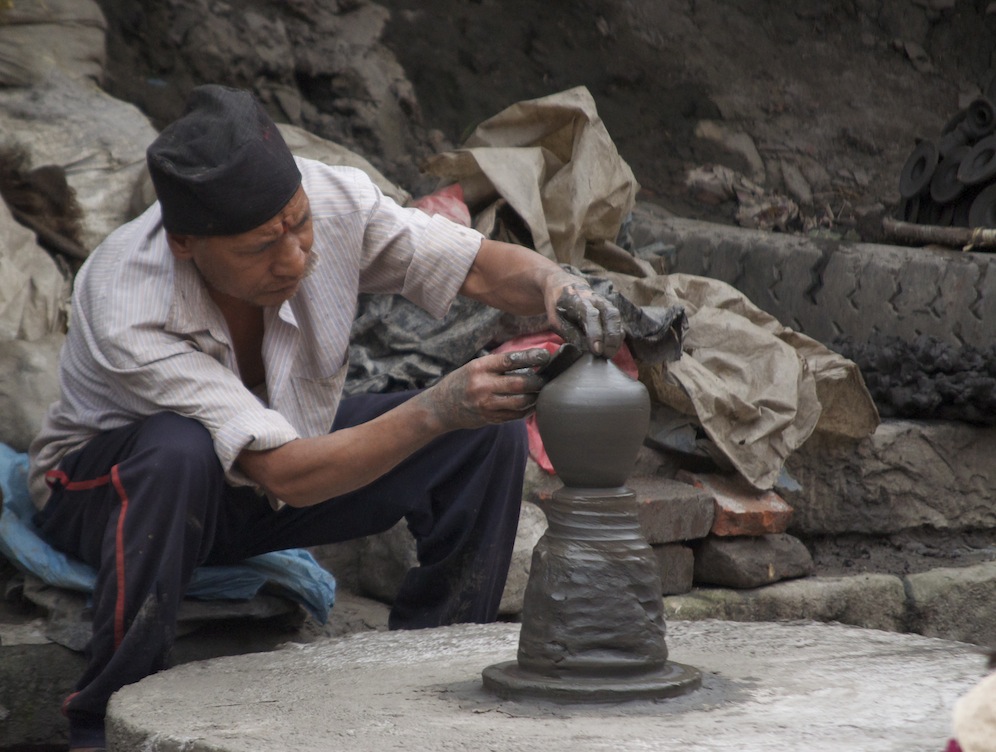
The highlight for me, as always, was the pottery square, full of colour and activity.
Women bent double turning pots to dry in the sun, men producing more at an alarming DSC_0025rate on a wooden wheel which they turned with a stick between each pot thrown, men sweeping out a recently used fire while another was being prepared. Everything was done with maximum efficiency and no fuss; everybody knew their job and got on with it without the need for instruction, a well tried system that probably hasn’t changed in decades. Chickens wandered among the pots picking bits from in between. A child, probably only a year old sat among the pots while her mother moved them around. Given a pot to play with, she rolled it around until the top broke off. Clearly the child was in charge of quality control.

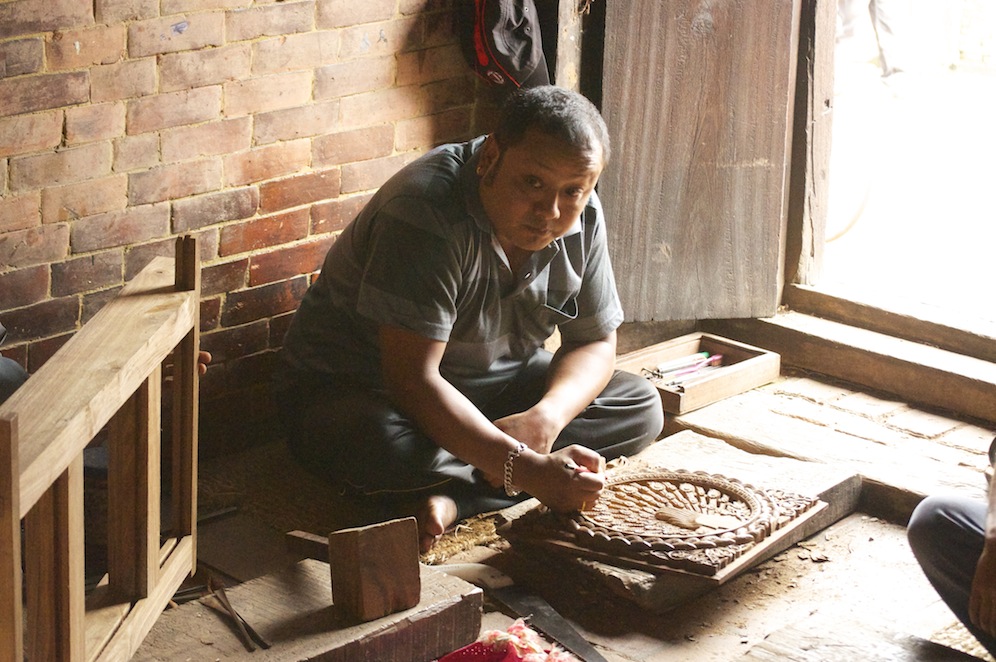
DSC_0010In another square we watched wood carvers at work. The detail they were carving to make windows or ornamental pillars was very intricate, but the remarkable thing was the light in the area they were working. The light quality was extremely poor and it is hard to believe that they could produce such fine work and also not damage their eyes.

Finishing our visit to Bhaktapur the bus returned us to Thamel for lunch. The traffic was so congested it turned into a late lunch at Gaia before we went to Shona’s to buy kit and Azam’s little jewellery shop. He was not his usual chirpy self, having recently lost his mother and taken the loss badly.

The following morning we had a leisurely breakfast before heading off to the airport for a civilised 11.05 flight to Pokhara.  Traffic was moving well until we came to a crossroads controlled by a policeman.  There the minutes ticked away as he gave priority to the traffic on the ring road, leaving us waiting for fifteen minutes. On the other side of the crossroads is Pashupati, now a World Heritage Site and undergoing some major developments, including the building of a crematorium.  While this will be a much more efficient method of cremation and take away the voyeuristic aspect where tourists openly photograph the ceremony of cremation, I am guessing that there will be some who will continue to prefer the traditional methods on the ghats overlooking the river.

Domestic departures was heaving with trekkers heading for the hills with the preference seeming to be Everest. Rising above the cloud afforded us clear views of dramatic snowcapped peaks.

The tranquil waters of Phewa Tal

The tranquil waters of Phewa Tal

Pokhara was warm and sunny and a short minibus ride took us to Lakeside View Retreat, a new boutique type hotel which afforded no lakeside view.  Having settled in we went our own way to explore Pokhara and have some lunch. Pokhara is nothing like Kathmandu. The streets are relatively traffic free, there is little or no pressure from shopkeepers to patronise them and there is a much more relaxed atmosphere. It is a resort town. Joining Mike and Julie we took a boat out on the lake for a couple of hours. It was a thoroughly relaxing afternoon, the main attraction watching a tribe of monkeys on the far shore and marvelling at the vast numbers of butterflies.

The following morning I got up for the mountain view but my optimism of the night before that it would be clear proved fruitless. A band of cloud obliterated the view.

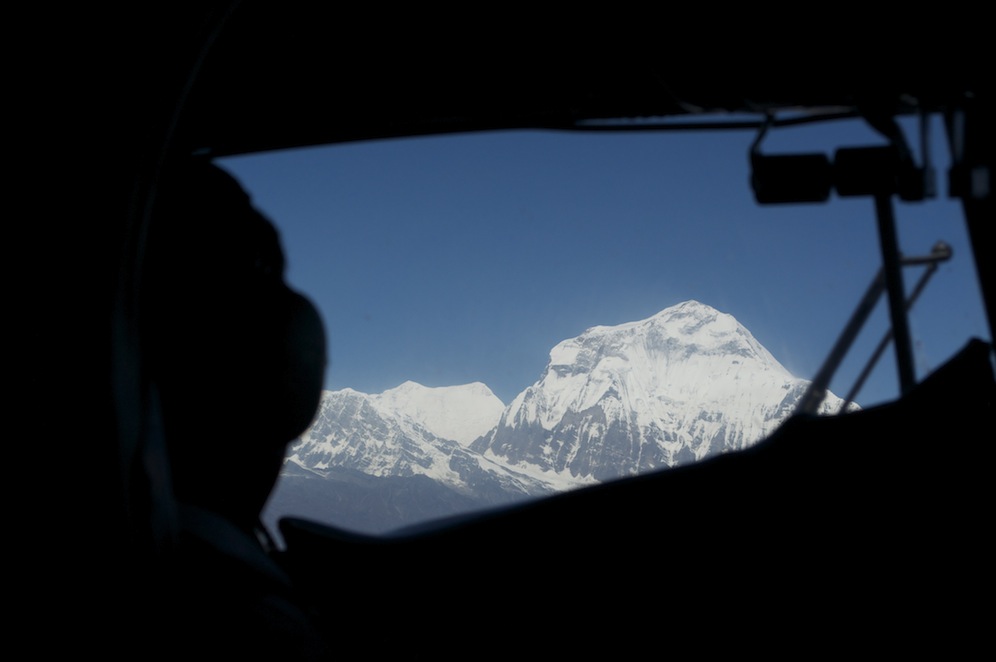
Dhaulagiri over the pilot's shoulder

Dhaulagiri over the pilot’s shoulder

After an early breakfast we headed off for the airport for a 7.55am flight to Jomsom. Leaving Ramesh to deal with the check-in we sat on the roof of the departures building and watched the mountains gradually appear as the cloud began to dissolve. The flight was delayed by three hours and we finally got away at 11.00am.  The flight from Pokhara to Jomsom is stunning and once we emerged from the cloud we were rewarded with the entire Annapurna range. It was not long before Dhaulagiri could be seen over the pilot’s shoulder and then to our left as we headed up the Kali Gandaki Valley. It has to be one of the world’s most spectacular short flights
Marpha

Marpha

Having landed we went to a lodge in Jomsom to sort out our kit before heading back down the valley to Marpha, a walk of a little over an hour. The history behind Marpha is that in 1899 a Japanese monk, Ekai Kawaguchi stayed there on his journeying. His objective was to get into Tibet at a time when Tibet was closed to the outside world. As a result he spent quite some time in Marpha, was made welcome and became attached to the community. Since then the Japanese have patronised the village, have maintained their attachment, and generously given annual scholarships for the children of Marpha to study in Japan.

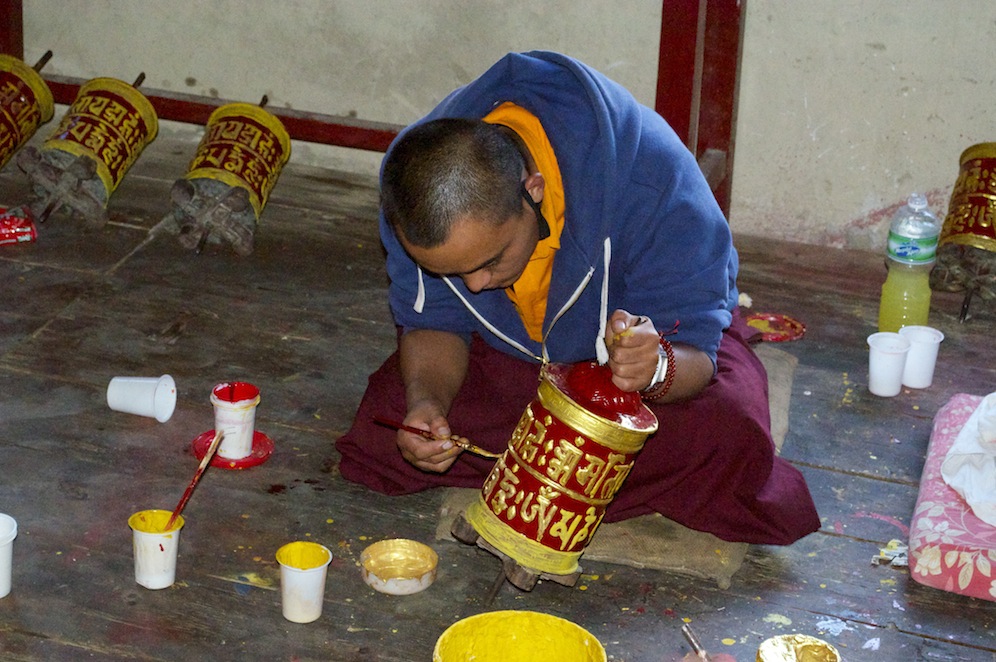
Freshening up the prayer wheels

Freshening up the prayer wheels

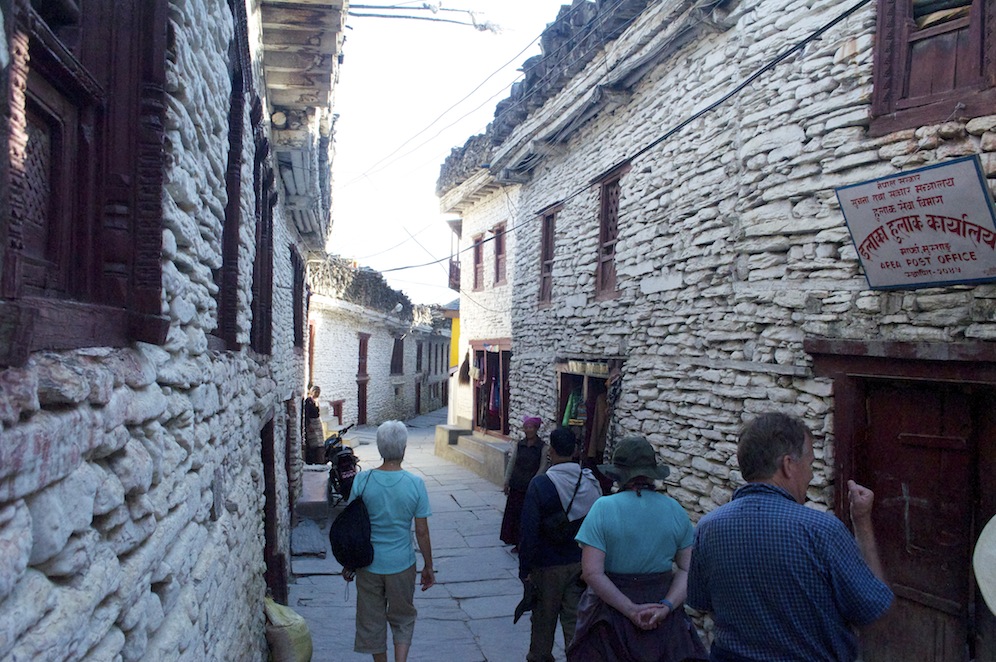
It is the smartest and cleanest Nepalese village I have ever seen. The streets are paved and all the houses, made of stone, have been whitewashed. The streets are clean. Dominating the village is a large monastery, the Rinjin and Solmi Gompa, built on many levels up the hillside. It too is clean and well cared for. There seemed to be bit of a makeover taking place in preparation for a prestigious visitor. All the prayer wheels were being taken off their spindles and given a fresh coat of paint.

Extracting beans from their pods

Extracting beans from their pods

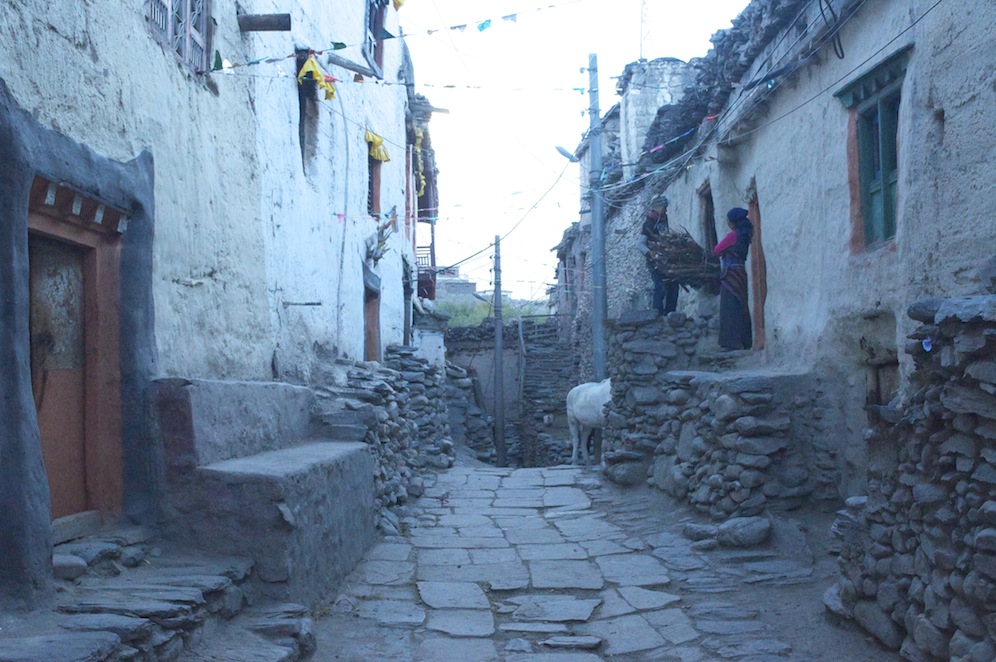
A young monk opened up the gompa and, through Ramesh, told us all he knew of the monastery. He was eight years old but brimming with confidence. From the outside terraces we had good elevated views into the labyrinth of passages linking the houses together. The roof is where everything is done from beating the vines of beans with a stick to extract the beans from the pods to drying goat skins in the sun. There were many shops in the village but very little business. I am sure there must be a great many visitors to Marpha during the course of a year but I also suspect that the road, which bypasses the village, encourages people to go passed without stopping.

There is more to Marpha than at first meets the eye.  It has a thriving artist community but I suspect it is best known for its apples. It is surrounded by apple orchards.  Where we were camping had an outhouse with a strong apple aroma. Many of the apples are cut into slices and dried. There is a solar drying syatem in the village but it does look as if it has seen better days. Some apples are distilled to produce a locally famous spirit, Marpha Apple Brandy. I was very impressed with Marpha.

The following morning we returned to Jomsom by the same route we had taken the previous day and continued up the Kali Gandaki Valley to Kagbeni. Towards the end of the walk the wind developed and the grains of sand and grit picked up tingled against our legs. We arrived in time for lunch and used the Paradise Hotel as our mess tent.

Old Kagbeni

Old Kagbeni

In the afternoon we explored Kagbeni. From a distance it doesn’t look as if it has changed much in the eleven years since my last visit but now, walking through the narrow streets it was easy to appreciate that there has been a lot of development. The most significant is at the monastery. All the surrounding buildings have been replaced. These house the monastic accommodation and the school, which seems to be a new addition to the role of the monastery. A new gompa is in the early stages of building, adjacent to the five hundred year old one, which despite being made of mud walls is still standing. The speed at which the new gompa is built is very much dependent upon donations from passing trekkers like us. The young 18 year old monk was quick to tell us of the importance of funds, prior to us making a generous donation out of the kitty.

Down by the river there is a small Hindu temple which I don’t remember seeing before and must be there as a result of the road development. Here, devotees can step safely into the very cold, fast flowing Kali Gandaki, which has religious significance, and immerse themselves or not depending on the strength of their devotion.

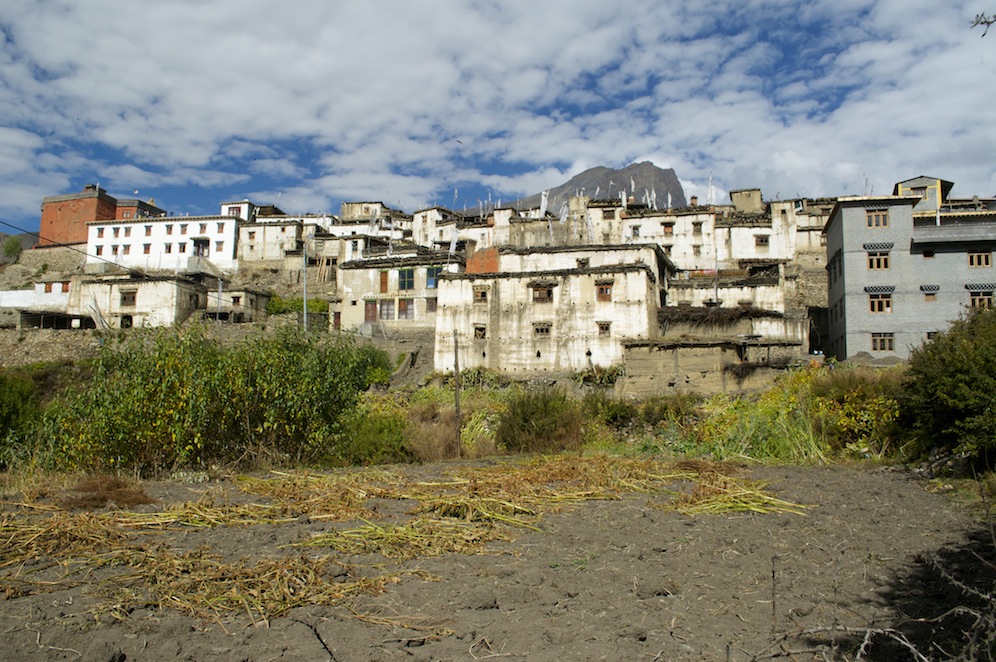
Looking into Upper Mustang

Looking into Upper Mustang

The old part of the village within the old fort has not changed. It is amazing that it is still standing, the mud walls having eroded in the daily winds that batter them, forcing cracks into their weakest points. Finishing up at the check point entrance to Upper Mustang we looked up the valley. I had the same fascination for what was up there and around each bend that I had when I first saw it in 1999. The only difference this time was that I would soon find out what was up there and around the bends.

Muktinath

Muktinath

Using the next day as an acclimatisation day we took land cruisers up to Muktinath. Again there had been a lot of buiding work and development with new hotels and a new temple. Some things were still the same with the weaving looms lining the main street and the strangely named Bob Marley Bar. On my previous visits to the religious sites of Muktinath there had been very few pilgrims, largely because it took a great deal of effort to get there. Today, while not crowded, there were significantly more and I can attribute this to the road, making it a lot more accessible. However, the road does not go all the way to the shrines and temples. Most people have to walk the last half mile, up hill to the entrance. For those who are either lazy or incapable there is a motorbike pillion service which will take you to the entrance. While we were there a motorbike delivered an elderly woman, bent double, to the entrance where younger members of her family took over the responsibility of looking after her.

DSC_0213Inside, the pilgrims, undaunted by non-Hindus watching them changed out of their day clothes for the various watery ceremonies they were to undertake. The women wore thin silk saris while the men stripped down to their underwear. They then either walked under the 108 water spouts gushing icy, cold water or, if they were less brave rather than less devout, they walked by each spout spraying a little water on to their heads with their hand. The old woman we saw arriving earlier walked through each spout. Having completed this ritual they had two pools to immerse themselves in. Again, the degree of immersion was very much left to the individual. Some just went waist deep while others totally immersed themselves. The first pool was to wash away their sins while the second represented virtue. Now, having completed the watery part of their pilgrimage, they dried and dressed so that they could enter the temple with offerings to the gods. We were not able to see what was happening in this part of the ceremony.

Young nuns at Muktinath

Young nuns at Muktinath

We spent quite a long time soaking up the atmosphere, people watching. Occasionally they would talk to us and explain some of the things they were doing. From there we moved on to the Buddhist part of the complex and the nunnery where the nuns were seated around chanting. They ranged in age from about eight to sixty, all wearing their red nun’s habits but often with a down jackets over the top. The fascinating thing about this experience was that they could join in and drop out of the chanting as they pleased. Some were keen to be distracted and to observe us. They didn’t seem to be chanting from the same books but there was nothing discordant about the sound they were making. It was very relaxing to sit cross legged on the floor, close our eyes and drift wherever our thoughts took us.

Jharkot

Jharkot

After lunch we walked back to Kagbeni via Jharkot. I remember it being a super walk, and it still is, but it is spoilt now because significant stretches of it have to follow the road. Whilst this makes the walking easier, and, despite the fact that there is very little traffic, it becomes tedious.

As I went to sleep that night my mind passed through the check point into Upper Mustang. I was looking forward to a new experience and the next day it would be more than my mind going into the Hidden Kingdom of Mustang.

Cotswold Diamond Way

The weather is usually reliable in September; children go back to school, cricket tournaments come to a thrilling climax, autumn mists linger in the dells before the sun burns it off and it is a great time of year to go for a walk. This year, after the prolonged summer, September has been a bit of a climatic disappointment but the rain, cooler temperatures and wind did not deter us from completing the 60+ mile, four day, Cotswold Diamond Way, a circular walk starting and finishing in Moreton-in-the-Marsh.

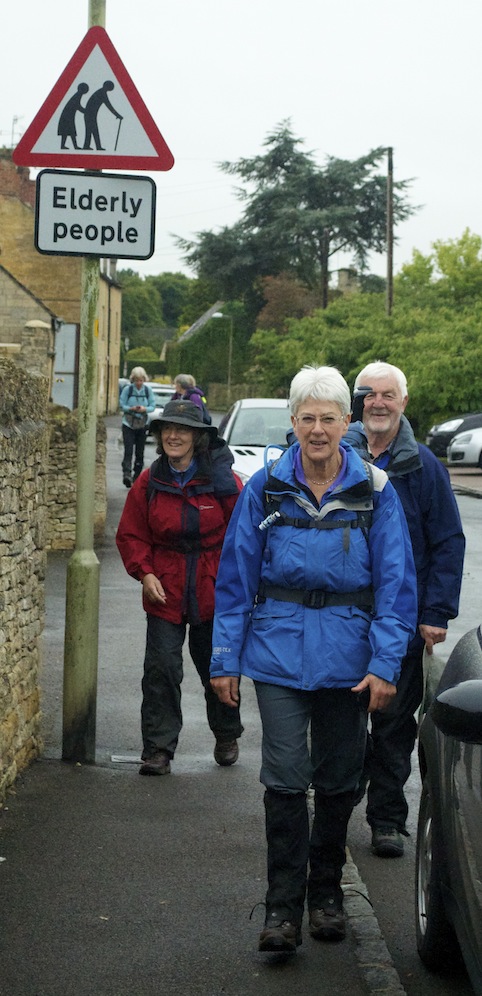
Need I say more?

Need I say more?

We were largely a group of a certain age, all with different reasons for wanting to do it. A number of us will be flying off to Nepal in less than three weeks to trek in Mustang, so it was useful preparation, while others just wanted the camaraderie of walking and camping with friends. Everybody arrived on the Thursday evening for a delicious paella and fruit crumble, and to reacquaint ourselves with each other, many of whom had not seen each other for some time.

Friday morning dawned damp with the prospect for improvement as the day wore on. Spirits were high as we walked away from Moreton-in-the-Marsh, aiming for the northern tip of the diamond just beyond Ebrington. The improvement in the weather seemed reluctant to adhere to the forecast and it remained damp until lunchtime.  A brief spell of sunshine allowed us to have lunch in some comfort before the weather turned very wet for the last hour or so.

Dinner that night was a very soggy affair with the gazebos acting as reservoirs before a gust of wind deposited their load on us, the seats or anything else that got in the way. The delicious bolognese warmed us up but, needless to say, we all disappeared to our tents for some comfort and an early night.

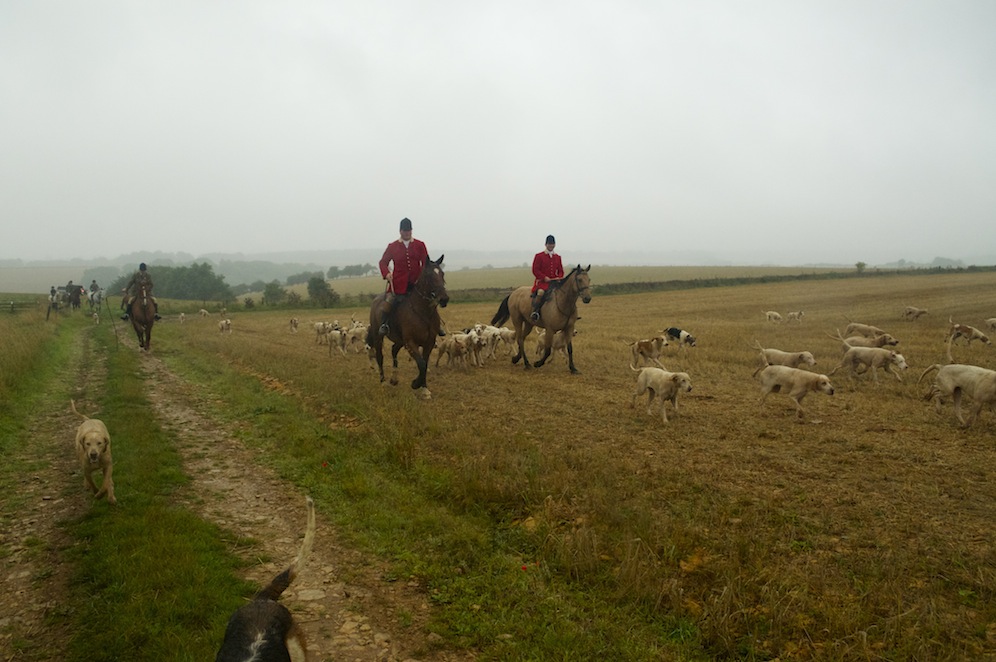
DSC_0021The forecast said there would be no rain on Saturday but it rained with us until about midday. Our start point at Far Upton Wold was not the quiet place it had been the evening before.  All along the verges horse boxes and four wheeled drive vehicles were parked. Why? The hunt was out and we had not gone far when we met them returning.

The walk entailed travelling through some lengthy stretches of long grass and it was not long before we had wet legs and, more uncomfortably, wet feet. It also entailed walking through Jackdaw’s Castle, Jonjo O’Neil’s racing stables. Security cameras monitor us entering his land, acre upon acre of manicured lawn with race tracks for training and exercising the horses.  We see very little activity but, perhaps because it is Saturday, the activity is all at the race tracks around the country.

Stopping for coffee at The Plough in Ford was an interesting experience of logistics. Being wet and wearing muddy boots we chose to sit outside at the picnic tables underneath a huge canopy. Eventually getting somebody to take our order for coffee or hot chocolate, we waited. One by one our drinks arrived, not in a steady flow but punctuated so that what should have been a ten or fifteen minute break extended to half an hour. The bill came very quickly upon request.

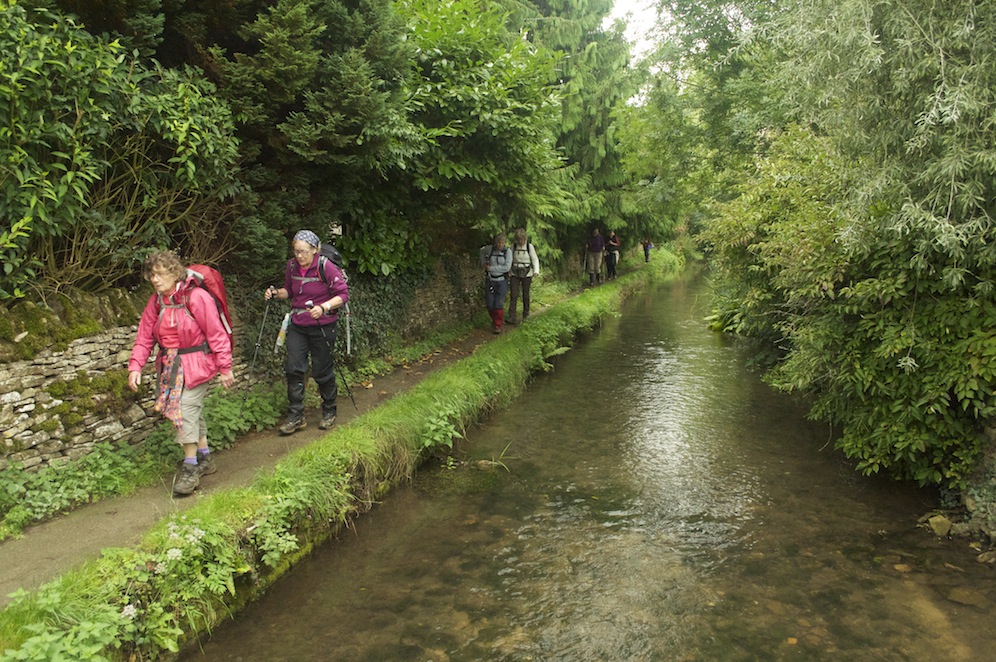
The Windrush River at Naunton

The Windrush River at Naunton

We continued through Temple Guiting, stopping for lunch in a field overlooking the Windrush Valley as the sun came out. We were to follow the Windrush River for much of the rest of the day, and indeed the proceeding days walking. We managed to get to Guiting Power just after the pub, The Farmer’s Arms, had closed at 2.30. I didn’t think pubs closed on Saturday afternoons any more. Despite being closed we were served provided we sat in the garden.

Our walk for the day concluded at Notgrove a quiet, sleepy village with llamas and alpacas watching us from a field. The villages are beautifully kept and there are some stunning properties but they seem lifeless. Most of those we passed through we saw not a sole; nobody washing their car, tending their already immaculate gardens.  Most villages seemed deserted and is a sad indication that most of the houses are second homes and not often lived in. Somehow the local character has gone and we were passing through show villages reminiscent of the 1960s TV series The Prisoner with Patrick McGoohan.

On Saturday evening we ate a super meal at The Halfway House in Kineton. When we arrived there were a few people in but by the time we left soon after nine we left the place deserted.

The forecast for Sunday was not at all good so we decided to start earlier in order to try to finish before the worst of it arrived. We set a good pace down to the southern end of the Diamond at Northleach before heading towards Bourton-on-the-Water. Northleach, a former wool town, is a small market town with a main street of interesting buildings. The first we came across as we entered the village was the old police station, magistrates court and prison, all housed in the same building.  It is now a cafe, closed because it was Sunday, but looking through the window there were picnic benches where once prisoners had exercised.

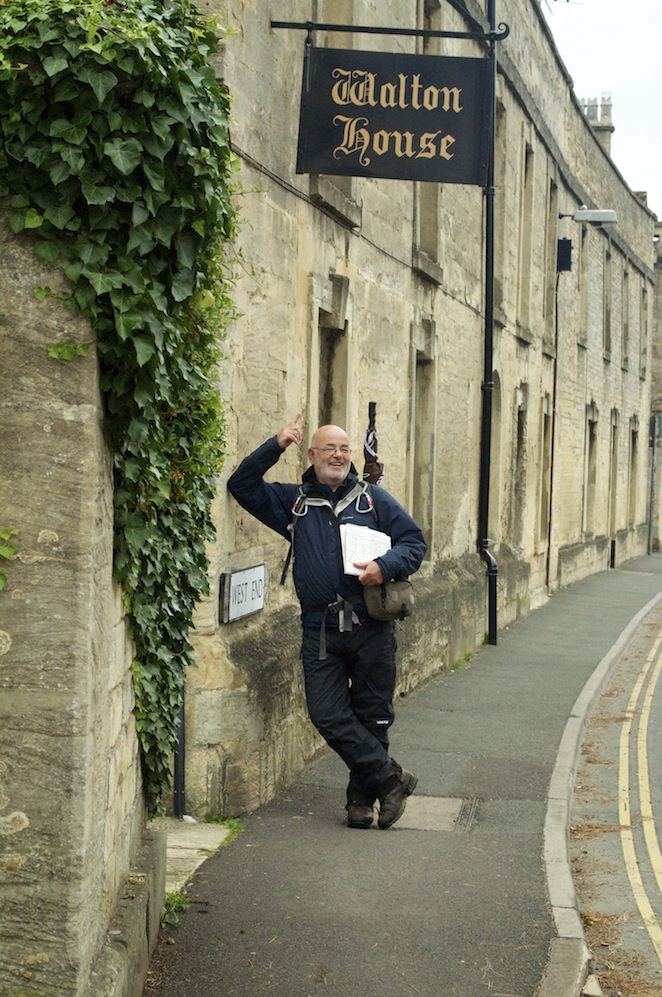
DSC_0033Further down the main street is Walton House, a grand Cotswold stone town house now used for sheltered and retirement housing. Before the war it was a large, old coaching house but with the onset of war it was a billet for RAF pilots of No. 87 Squadron who flew Hurricanes from an airstrip between Northleach and Bibury. There is a blue plaque marking their wartime occupation.

We stopped in the village square to take advantage of the facilities and for me to buy water as I had been stupid enough to forget my Sigg bottle.

The countryside was beautiful without being dramatic. As we had started earlier we were able to see much more wildlife. Soon after leaving Notgrove Red kites circled overhead, their spirally route only interrupted occasionally by an anxious crow making a threatening approach. Later we saw, across a field, a red deer with a fawn, both anxious to escape our view, leaping over a fence into trees, although the fawn had some difficulty in following its mother for a while.

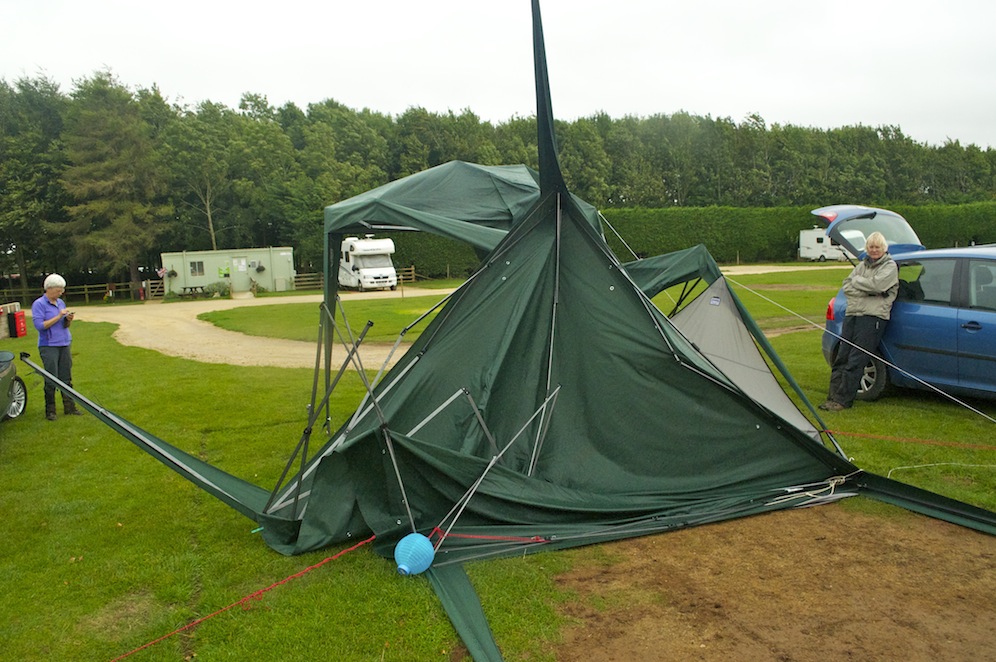
Gazebo carnage

Gazebo carnage

The forecasted rain managed to hold off but the wind gathered strength as the day wore on. One gust hit us and I commented that that was the gazebos gone. How true that turned out to be. Finishing our walk in Bourton just as the first few drops of rain fell, we returned to camp and the devastation of our gazebos.  The warden and his wife had done what they could to save them but it was useless against such wind in a very exposed place.  Thankfully, no cars were damaged.

That evening the rain hammered down and we adjourned to Stella and Richard’s in Chipping Campden for supper rather than trying to cope with very adverse weather conditions. By the time we left Chipping Campden to return to camp the skies were clearing and temperatures were dropping.

The next day dawned bright and we decided to make an early start again. This was necessary because of the distance we had to travel. By our calculations the mileages in the guide book were not quite accurate. Each day should have been 15 miles but the first had been 17 and this last day was going to be close to 20 miles.

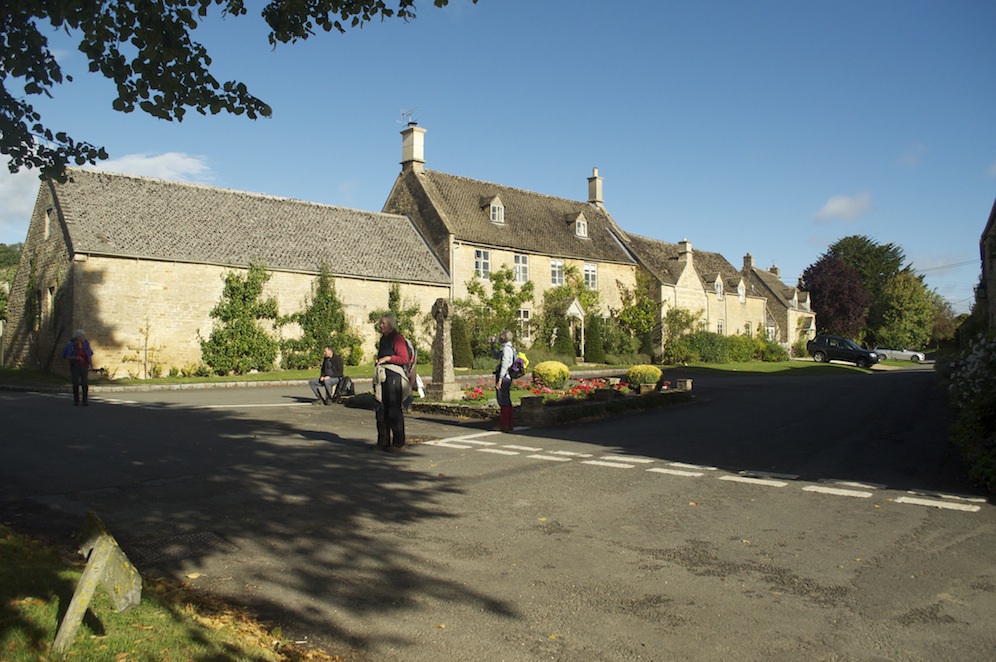
Icomb

Icomb

This section of the walk took us through some of the prettiest villages on the diamond.  I particularly like Icomb, a picture postcard village with hanging baskets adorning the beautiful Cotswold stone, particularly when illuminated by brilliant sunshine, at last. Another village that stands out is Church Westcote with outstanding views from its slightly elevated position. Sadly, these villages continued the trend of not showing any signs of life. The only place that was busy was the organic farm shop, Bamfords, at Daylesford.

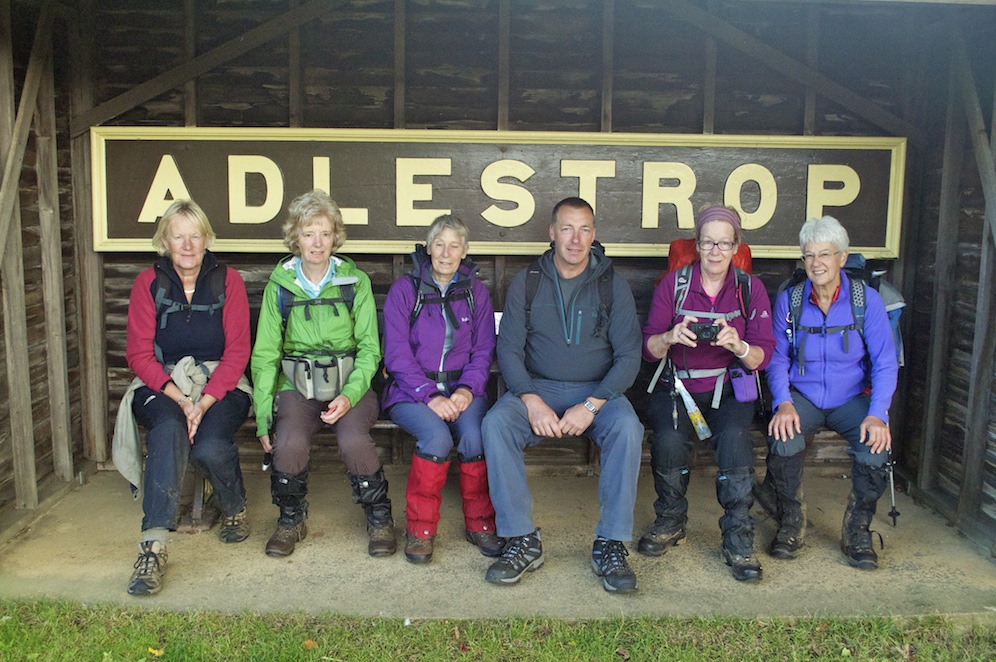
Another pretty village is Adlestrop made famous by poet Edward Thomas.

DSC_0044Adlestrop

Yes, I remember Adlestrop — 
The name, because one afternoon 
Of heat the express-train drew up there 
Unwontedly. It was late June. 

The steam hissed. Someone cleared his throat. 
No one left and no one came 
On the bare platform. What I saw 
Was Adlestrop — only the name 

And willows, willow-herb, and grass, 
And meadowsweet, and haycocks dry, 
No whit less still and lonely fair 
Than the high cloudlets in the sky. 

And for that minute a blackbird sang 
Close by, and round him, mistier, 
Farther and farther, all the birds 
Of Oxfordshire and Gloucestershire.

The Sue Ryder shop marked our achievement in their window display

The Sue Ryder shop marked our achievement in their window display

Soon our journey came to an end and after a little over nine hours after we started in the morning we walked into Moreton-in-the-Marsh and completed the Cotswold Diamond Way. It was a brilliant walk in not so brilliant weather and although one or two found the length of days and the weather quite hard, an enjoyable time was had by all.  We had seen a part of England criss-crossed with numerous long distance paths – The Cotswold Way, The Gloucestershire Way, The Wardens Way, The Gustav Holst Way, The Archeology Way, The Heart of England Way, The Windrush Way to name but a few. The route is not always easy to follow as the way marks are not consistent or regular for long stretches of the route. I was very grateful that I had done the route earlier in the year so was familiar enough with it to not go wrong too often.

What next? Probably Hadrian’s Wall next year.


Iceland

The fourth King’s/NCW joint expedition took us to Iceland for a whole range of exciting activities. The NCW students are either blind or visually impaired and the King’s students provide the eyes and the guiding to allow these young people to experience the great outdoors. It is a hugely rewarding experience for all involved. This is the story of our twelve day trip to Iceland.

As we approached Keflavik airport we saw glimpses, through gaps in the cloud, of black coastline fringed with white surf. It looked bleak with little evidence of any human activity. As we walked out of the airport the temperature was hovering around 10 degrees as we were met by our guide, Oskar.  Despite the sunshine it was raining lightly.

The landscape between Keflavik and Reykjavik is a volcanic pavement broken by time and weather.  Occasional domes of solidified lava cracked and split along the ridge stand out above all else like giant discarded nuts.  Scrubland, grass and pathetic shrubs cling to life and the infertile surface. There are no trees in sight until we reach the suburbs or Reykjavik. Volcanically created mountains rise from the coastal plain but their summits are shrouded in heavy, rain laden, clouds.  Between these clouds the pale blue sky makes a stark contrast and is reflected in the sea.

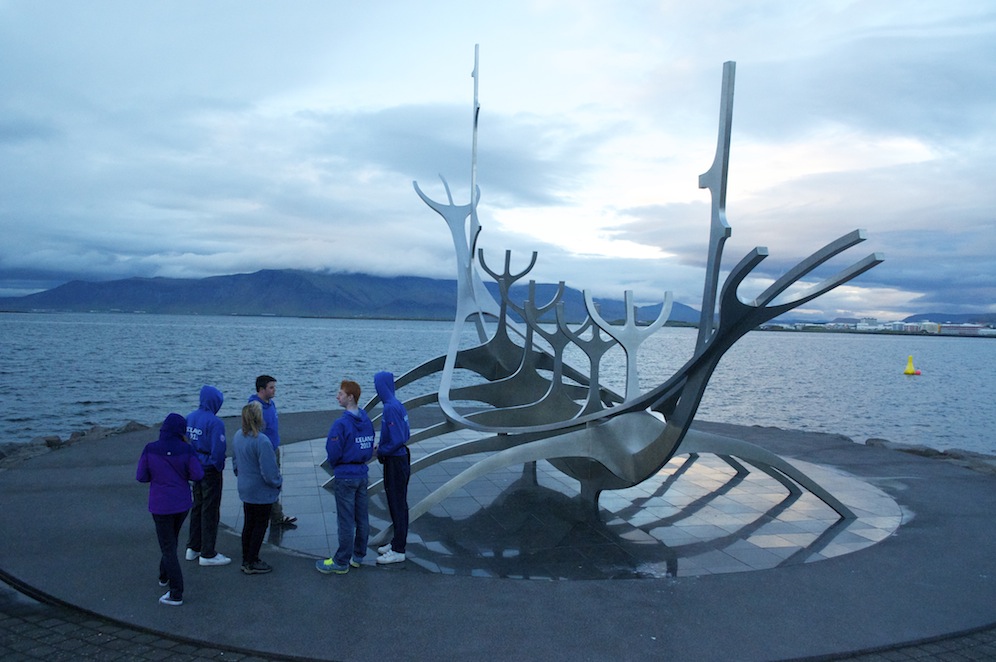
The steel sculpture depicting a Viking vessel

The steel sculpture depicting a Viking vessel

Reykjavik is a sprawling capital of largely pre-fabricated, architecturally bland buildings, built primarily for purpose than for looks.  In the evening we walk along the sea front to watch it not get quite dark. It is bleak. A cold wind blows in from the sea and I am wearing two fleeces. Cyclists are dressed as we would dress in our coldest winters.  Such a contrast to Indonesia and our good summer back home. The sun goes down but it is never very far away from the horizon, preventing true darkness to occur. We walked as far as the sculpture depicting the viking ships which brought the first settlers to Iceland before scurrying back to the warmth of our hotel.

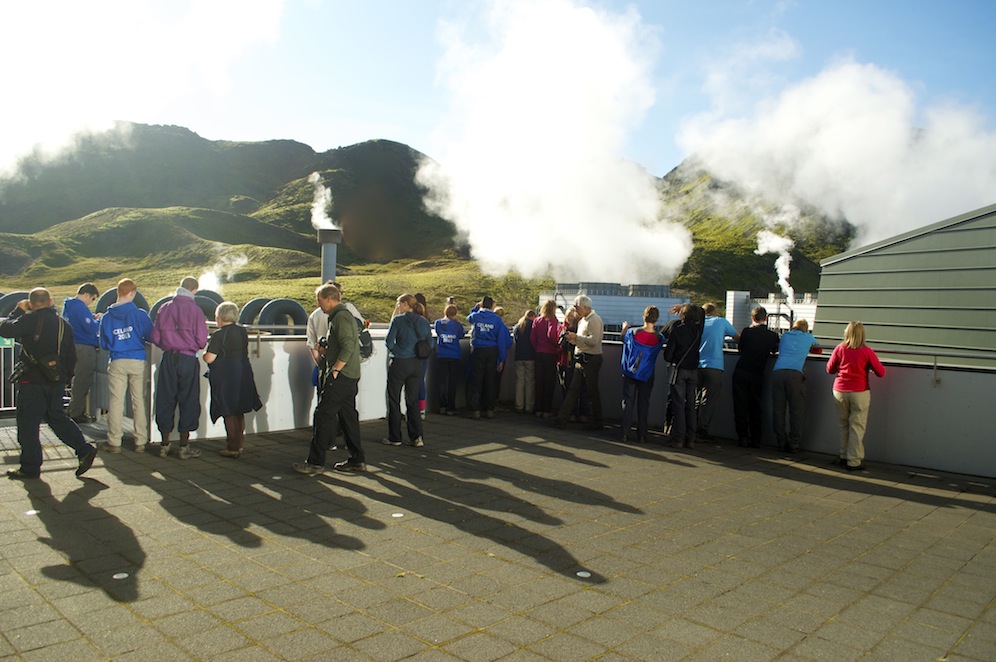
The geothermal energy plant

The geothermal energy plant

The morning dawned bright and sunny with clear mountain tops. The group was well organised and were ready when Oskar and our driver Arnie came to collect us from the hotel.  Our first visit was to a thermal power station 27km to the east of Reykjavik.  Here we learnt the history of geothermal energy development in Iceland and learnt of the economic and environmental values of the system. Energy production in Iceland has a zero carbon footprint. Not many countries can boast such an achievement.

Big Sky

Big Sky

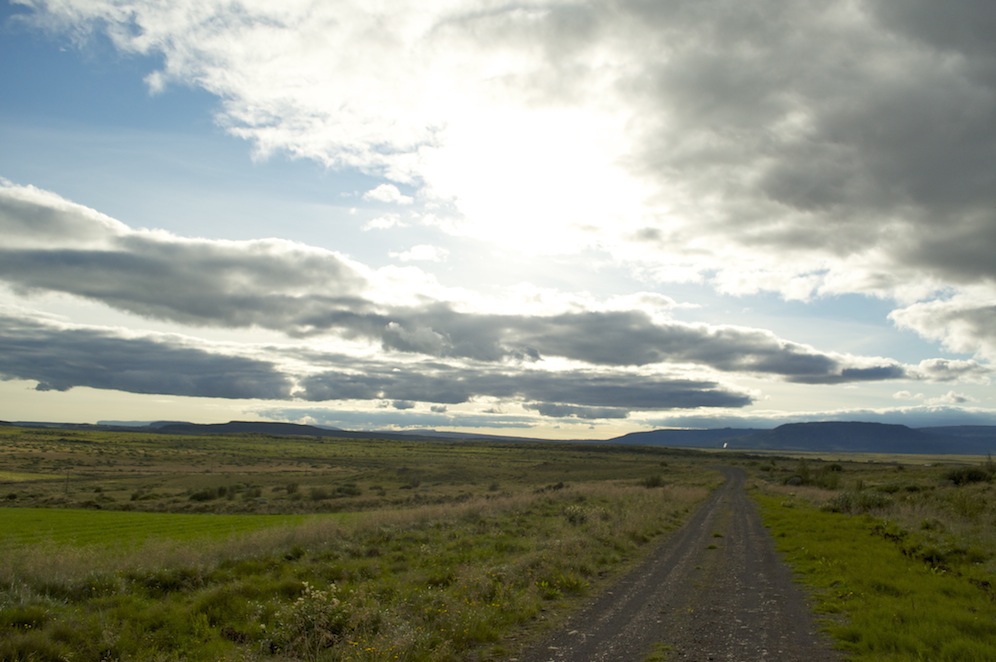
Our journey next took us further inland and off road to the start of a short walk to a hot stream. On the journey we had far reaching views of snowcapped mountains and permanent ice fields. None of the mountains are impressively high but they are impressive. Above them is a dramatic sky scape. This is “Big Sky” country. There is little to obstruct our view, no trees, no imposing mountains but plenty of long and wide lava flows giving us free access to the skies above. The variety of clouds just enhances the view, with white, cotton wool clouds interspersed with dark, heavy, dramatic  clouds depositing rain, fortunately on distant slopes rather than on us.

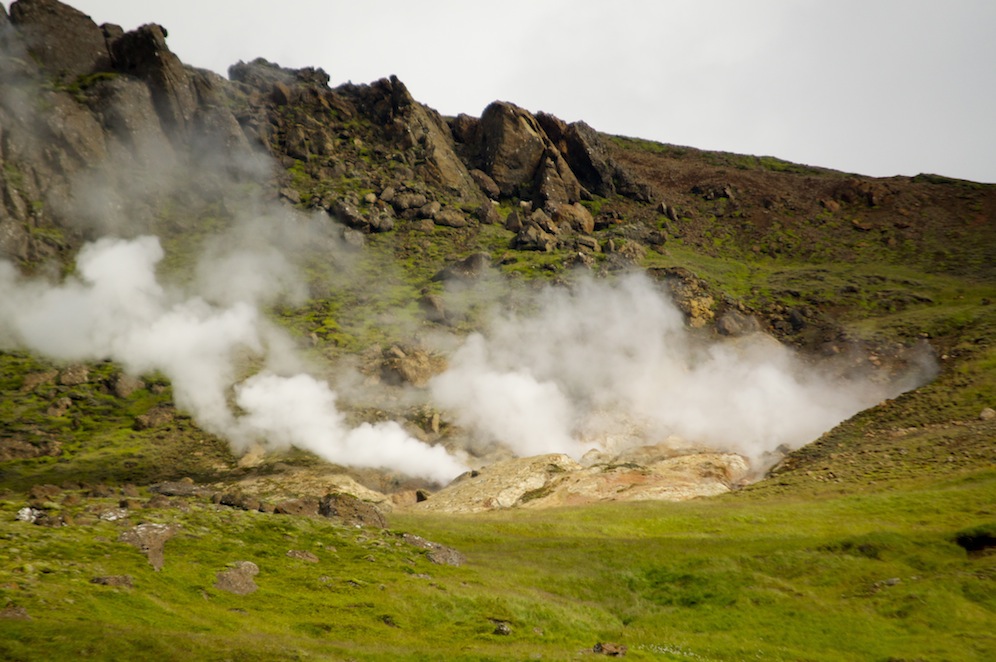
One of the many geothermal activity sites that we saw

One of the many geothermal activity sites that we saw

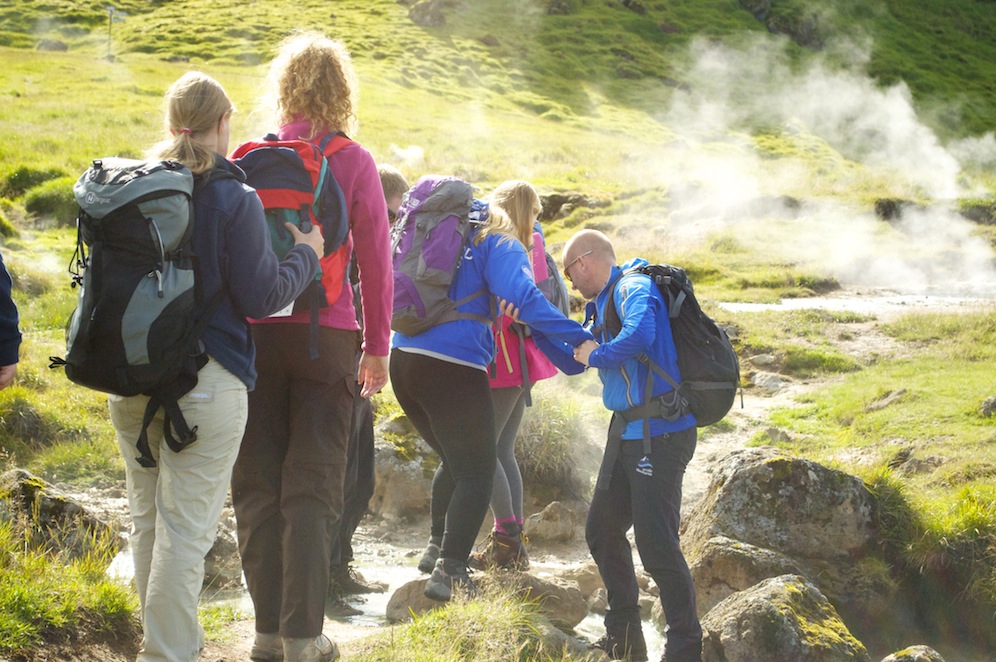
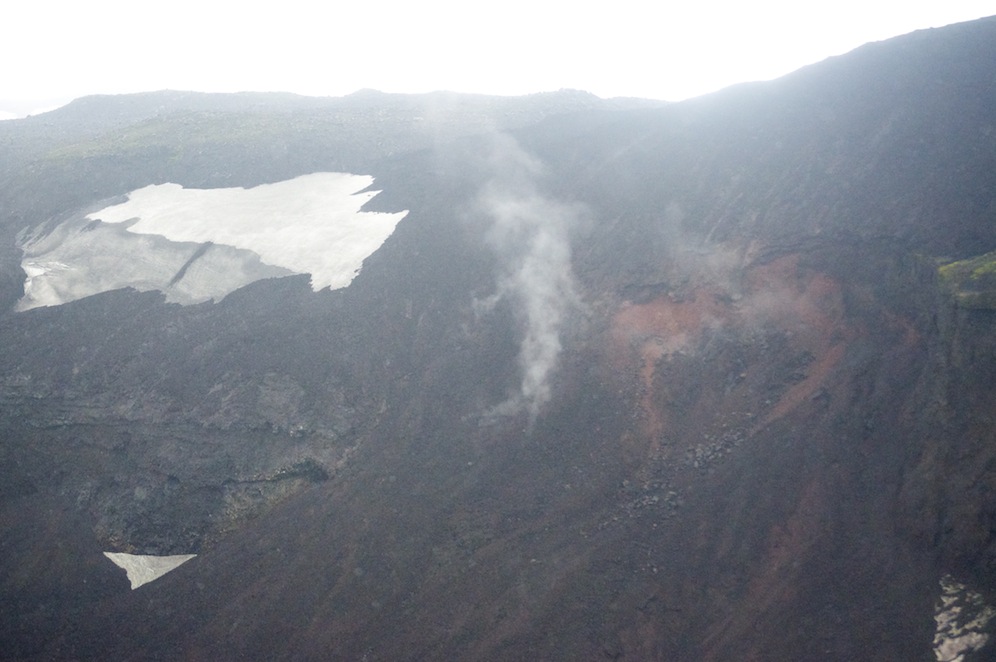
Throughout our journey puffs of white steam could be seen emerging from fissures in the mountainsides. Now our walk took us amongst them, smelling the sulphur and hearing the gurgling water and mud.  We were joined by two other guides, Gunnilla, a Swedish girl, and Thor lending a helping hand to Oskar and helping the guides over streams and difficult stretches of the path.  We were also joined by millions of flies.  They were everywhere! They were not of the biting or stinging variety but they were extremely annoying.  Clearly they were attracted to the warm air above the fissures and the strand of warm air above the hot streams.

Oskar lending a hand over a stream

Oskar lending a hand over a stream

This was the first in country mountain walking test for the group and while they have sometimes seemed a little reticent to get involved, they rose to the occasion well, negotiating streams, avoiding holes of boiling water and taking care near precipitous drops. This meant that it took an hour to cover the two kilometres to the bathing spot. The first opportunity for bathing seemed too hot so we moved a little further down stream where the temperature was more acceptable.

Russ and me enjoying our lunch

Russ and me enjoying our lunch

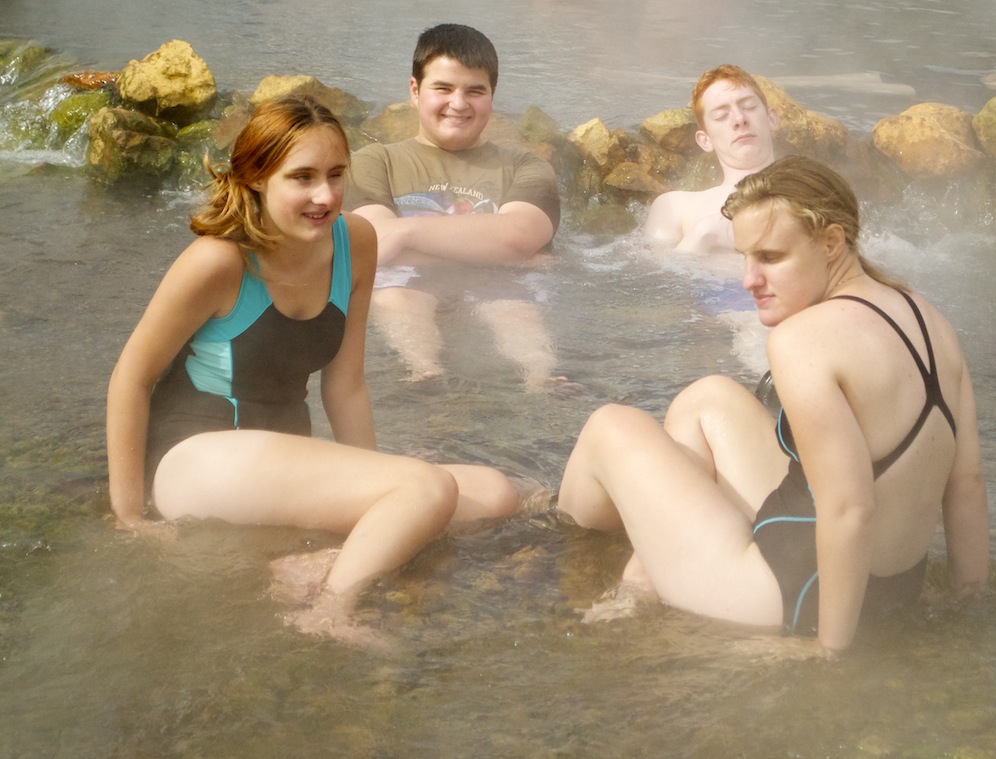
Once there, everybody settled down to have their picnic lunch but I was eager to sample the waters of the stream, so I stripped down to my swimmers and sat gingerly in the stream to eat my lunch. Russ soon joined me. It was like sitting in a bath of hot water, the advantage being that the temperature remains constant and never needs topping up as a bath does. It was just bearable and soon those parts of the body exposed to the water glowed red.  Just below us a cold stream fed into the hot one giving us an opportunity to cool down rapidly or just gently.

Enjoying the hot stream

Enjoying the hot stream

Soon the rest of the group joined me  and we had a pleasant hour wallowing in the water.  Some were more reluctant than others to get in and had to be encouraged but it was much warmer in the water than out as the air temperature struggled to reach double figures. All too soon we had to turn our attention to walking back. Now the group were well aware of the needs of each of the individuals and it seemed to take much less time.  The guides felt more confident in their role and the visually impaired students had more confidence in their guides.  Progress was being made in every respect.

The drive to Drombo, our home for the next three nights, gave us far reaching views of distant, freshly snowcapped mountains and glacial domes, of the island of Surtsey off the south coast, which broke the surface of the sea so dramatically during the 1960s.  Wild horses grazed on the rough pasture and occasionally the land was flat enough and fertile enough for some arable farming. Occasionally we passed fields of handsome looking cows. Brightly lit greenhouses grew the necessary vegetables and salads that cannot be grown in the open fields because the growing season is too short for them to mature.

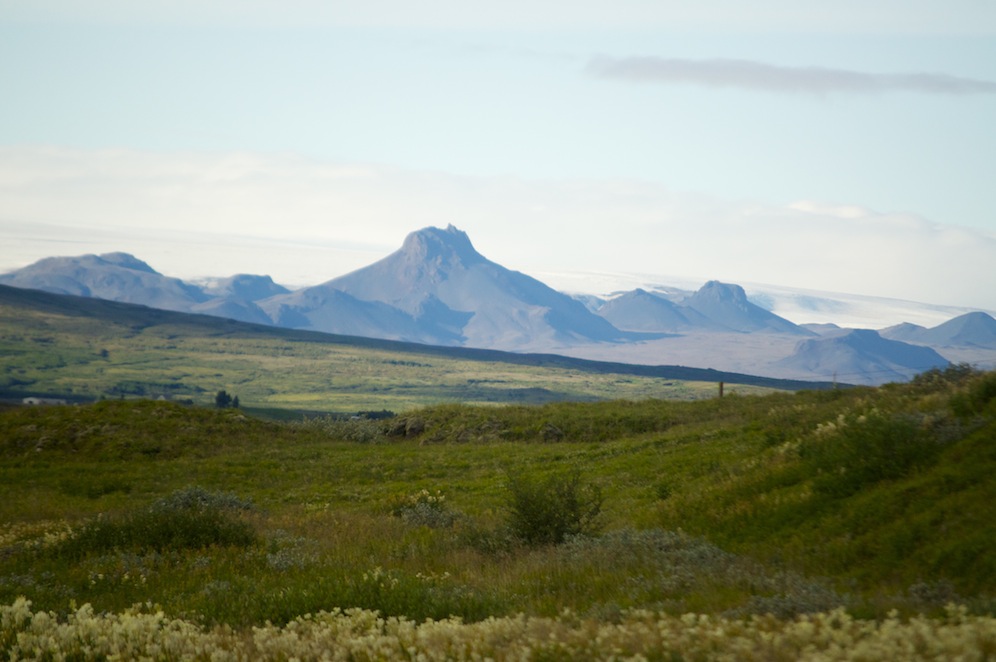
Distant, interesting hills

Distant, interesting hills

Arriving at Drombo in good time, we settled in. It is a rafting centre for the nearby Hvita River, although, until recently, it had been a working farm. New farm buildings have been built nearby making the existing ones redundant and ripe for conversion. I took myself off to explore the area and to gain some views of a distant range of interestingly shaped mountains and ridges with just a hint of an ice field behind them.

Predictably, the relatively bright skies of our first full day in Iceland were gone. Despite the fact that it wasn’t actually raining, a very heavy blanket of cloud loomed menacingly over us hiding all high ground within its mists. It was only a matter of time before the rain fell. Rain was not going to be an issue this morning as we were destined to get wet white water rafting. Kitting ourselves out in wetsuits, buoyancy aids and helmets we boarded the bus to take us to the Hvita River. By now it was raining. Arranging ourselves in three rafts with sufficient guides and staff to look after the NCW students, we carried our rafts to the river, launched them, climbed aboard and almost immediately hit our first rapid. Negotiating it successfully, we continued down river for some distance before pulling into a small area of quiet water part way down a gorge. here we climbed out and had the opportunity to jump from the cliff into the water.  There were two jumping spots, one 5m above the river and the other 7m. The temperature of the water was a chilly 4 degrees!

Unfortunately I do not have any pictures of either the rafting or the jumping as the conditions were not conducive to expensive cameras, but I did have my Gopro mounted on my helmet and have some good video footage.

It is incredibly rewarding to watch a blind or visually impaired person grasp the opportunity to do something out of the ordinary. One student admitted to being terrified but knew she had to do it as there would not be a similar opportunity again. I don’t think I could jump when I cannot see my surroundings, my landing area etc. It takes a very special courage to do such things and I am immensely proud of the students who did take the plunge.
Continuing our journey down the Hvita River we negotiated a few more rapids before entering a stretch of fairly placid water. However, there was no respite from a good soaking as we engaged in a few silly games, which, inevitably, ended up with participants falling into the river.

Back at Drombo it was hot showers, hot sauna and hot soup.  The combination of all three soon had us enjoying both inner and outer warmth and ready for the afternoon’s activity. While we were warming up another group returned from their own rafting trip. I couldn’t help but notice that they looked fairly old and some were clearly being looked after by younger members of the group. I later learned that the oldest in the group was 94! I also learnt that the oldest to jump from the cliff was 84!

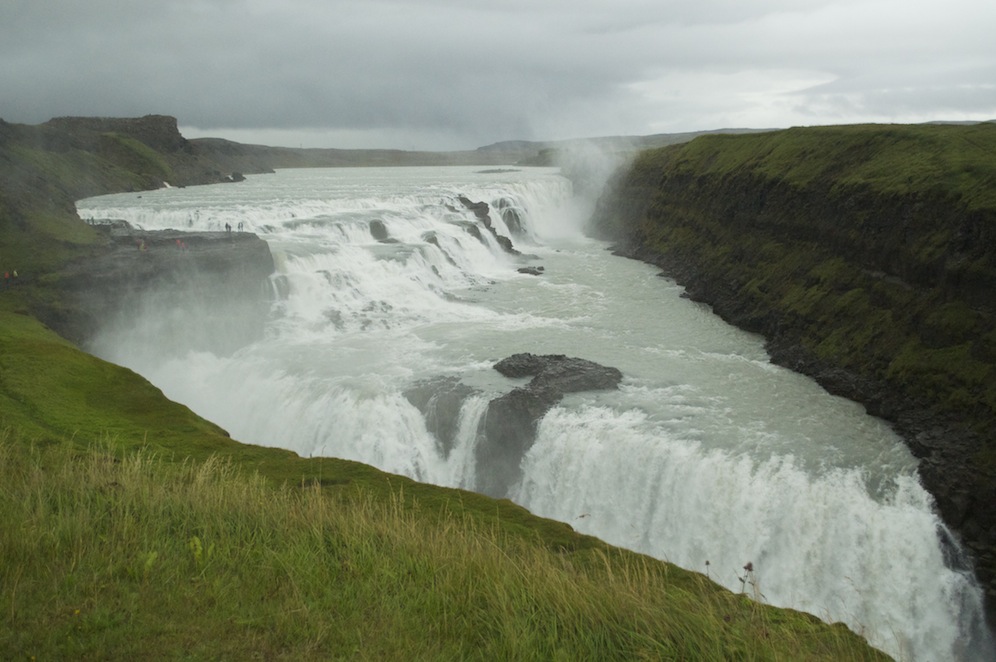
Gulfoss

Gulfoss

Our coach, driven by Arnie, first took us to Gullfoss, a most spectacular waterfall. We could see the mist rising from it long before we got there.  From the coach park we had a short walk, still only able to see the mist but the noise was deafening. Gullfoss is stunning. The Hvita River, above where we were rafting tumbles over a cataract before dropping vertically 20m into a gorge. The volume of water is incredible but we were told that during really wet times, coinciding with meltwater, there can be so much water in the gorge that it backs up over the lip of the waterfall as there is too much for the gorge to handle. Everything about Gullfoss is spectacular.
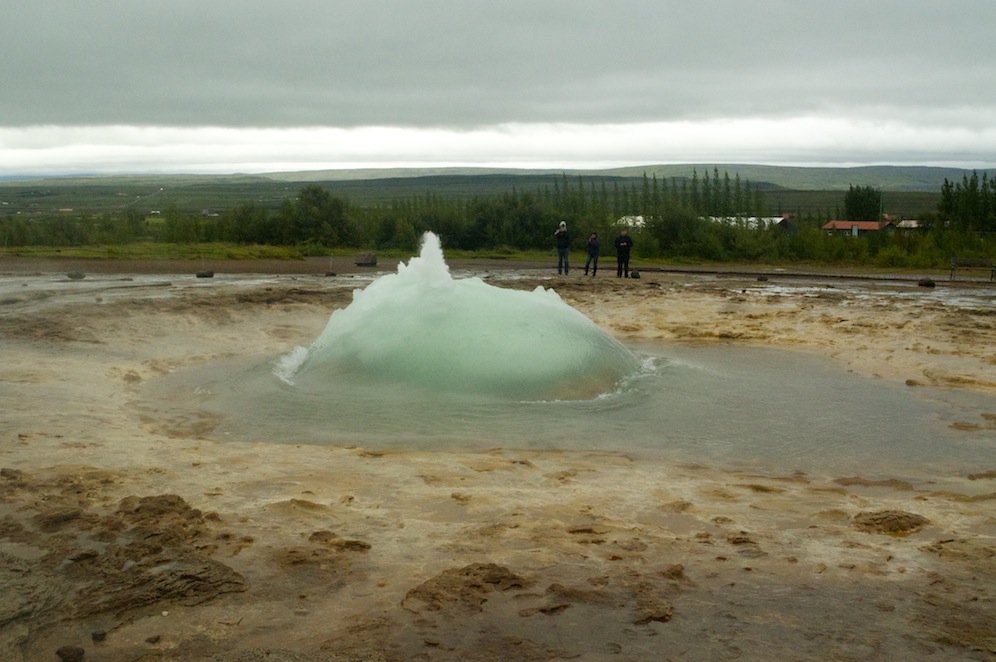
Geysir about to blow!

Geysir about to blow!

Having explored the waterfall and got thoroughly soaked by the rain and spray we travelled the short distance to Geysir, a geothermal area actively throwing jets of hot water into the air. The main geysir has become less active over recent years but Little Geysir performs approximately every four minutes. Here the water pressure underground wells up causing  the water in the pool the bulge before exploding in a jet of water and steam, rising ten to fifteen metres. Once the pressure is released the water level is much lower in the vent, creating a depression, which is refilled with water draining back into it and starting the process all over again. It is fascinating to watch and the blind students could feel the excitement in the sounds it created and the spray which fell upon them.

The American plate on the left with the European on the right.

The American plate on the left with the European on the right.

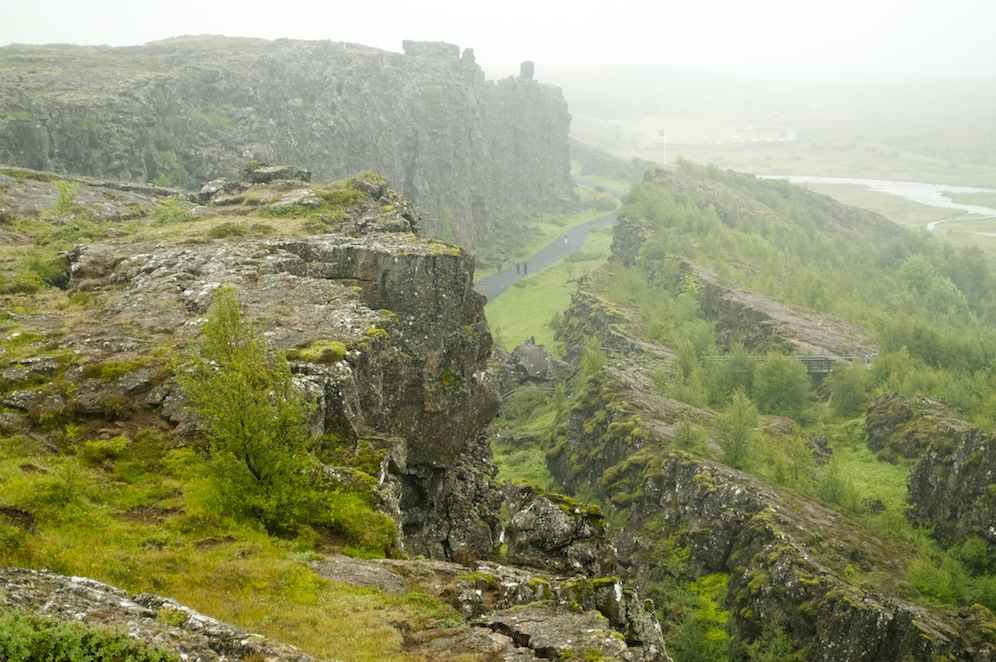
Our final destination of the day was the UNESCO World Heritage site of Pingvellir, Parliament Fields.  Not only is it the original birthplace of the oldest parliament in the world but also the place where the tectonic plates of America and Europe meet, or rather pull apart. They separate at the rate of 2cm a year and a rift valley has been created to fill the void. Not only is it a spectacular creation of geology, it also has a sense of history and is therefore a special place. The ridge which creates the rift valley looks out across a large lake with a lone white house standing out starkly on its shoreline. The lake disappeared into the distance and the mists which shrouded it.

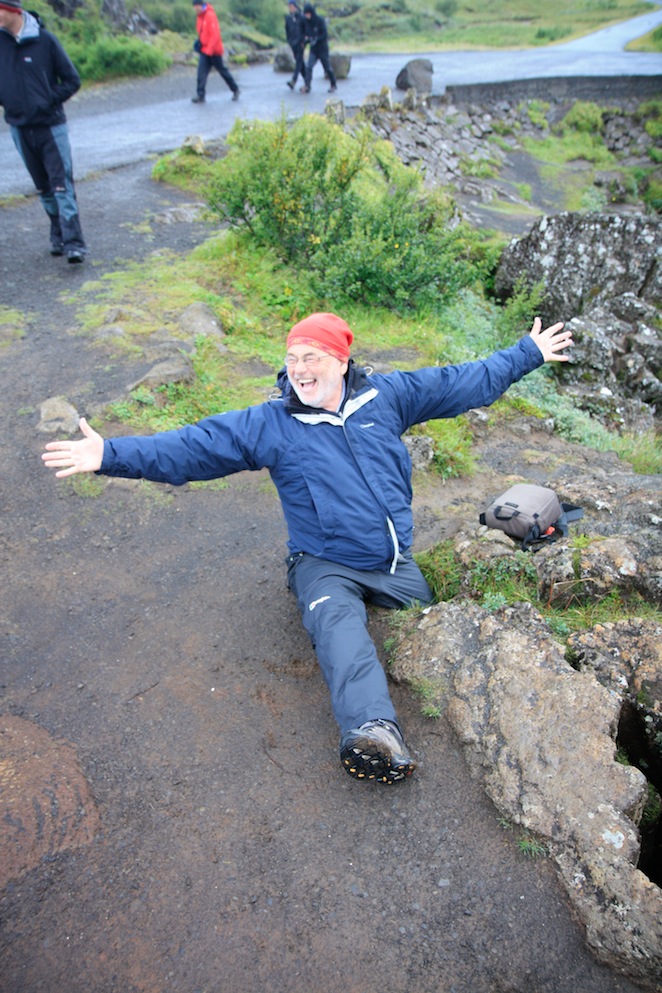
_MG_4924While making our way back to the bus we looked into a couple of pools of extremely clear water.  Many visitors had thrown coins into the water and they glistened on the bottom of the pool despite being, perhaps beneath fifteen feet of water. Around the edges of the pool were cracks in the lava caused by the tearing apart of the plates.  They were not wide cracks but they were quite deep.  Taking care to avoid stepping into a crack I placed my left foot on some grass in the belief that I was placing it on firm ground. My foot and my left leg disappeared until my backside prevented it from sinking further. Thankfully, it was only my pride that was hurt, but it was very funny.

The next day, before we could do anything, we had an early morning appointment with the King’s students to give them their GCSE results. There was a air of nervous apprehension as they received a piece of paper with their results. Having received them they took themselves off to a quiet spot to digest before sharing with each other and, finally, contacting their parents with the news. Thankfully, everybody was happy with their achievements and it meant they could enjoy the rest of the trip. Congratulations to all.

Experiencing the glacier

Experiencing the glacier

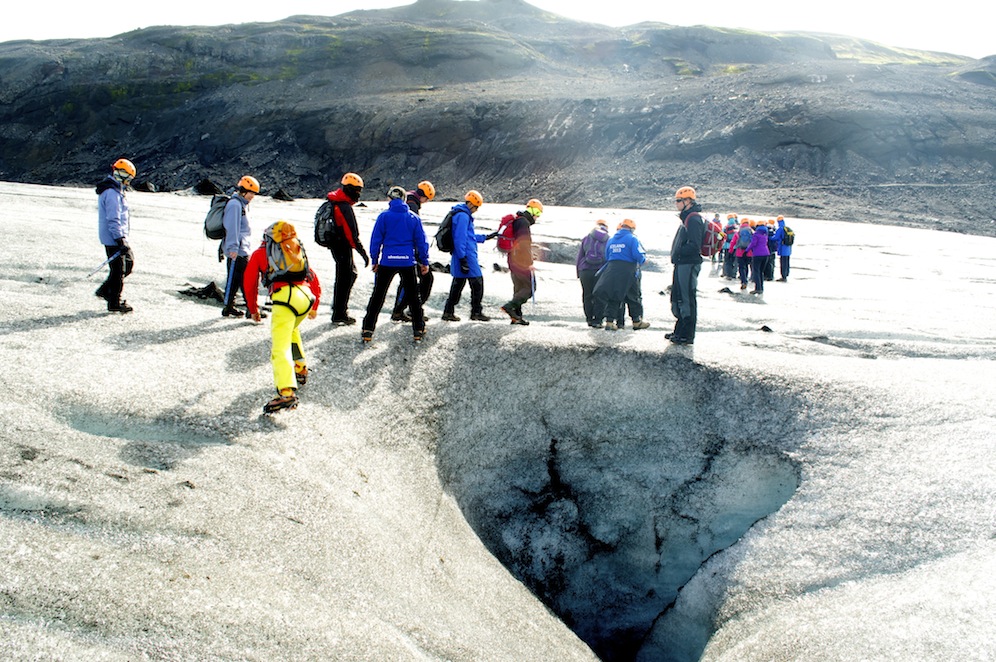
Our third day in the Golden Circle area took us first to experience a glacier walk on Solheimajokull Glacier, a tongue of glacial ice flowing south from the Myrdalsjokull icecap. Meeting with our glacier guide we were fitted with crampons before heading across the moraines towards the snout of the glacier. This activity was kept fairly simple because of the nature of the group but it gave an insight into travelling on a glacier.  Each step the teeth of the crampons bit into the ice giving the NCW students an audible impression of their activity and confidence walking on the ice. We did not stray far from the snout as above, although accessible, it was a jumble of ice towers and crevasses as the ice tumbled steeply towards its end.  Its surface was crisscrossed with crevasses and water channels, channels of extremely pure water, which we filled our water bottles with.

On the journey to the glacier we had travelled east along the coastal plain with the wall of mountains on our left. Occasionally we had seen mist rising or flashes of white water from the numerous waterfalls that tumbled from the mountains to the coastal plain. Having enjoyed the glacier experience we now retraced our route with the intention of having a closer look at two of these falls. Whilst not as big as Gullfoss in terms of volume, they are dramatically spectacular as they tumble 60m to their plunge pools below.

Skogarfoss

Skogarfoss

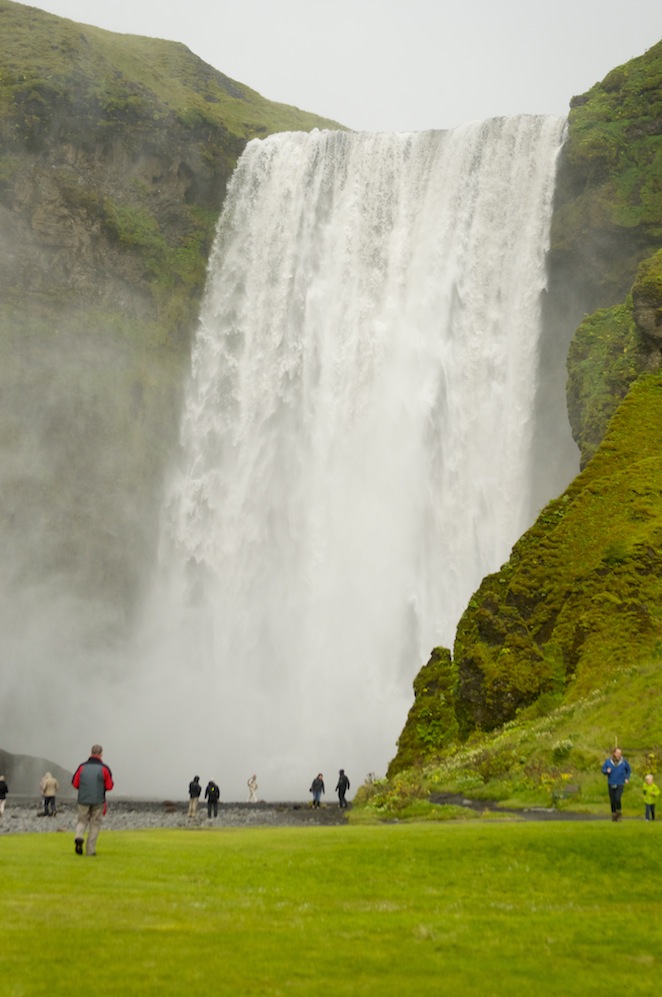
The first fall was Skogarfoss, a wall of water that falls cleanly over a lip and drops vertically to the pool below. Get too close and the spray gives you a good soaking. When the sun comes out a rainbow arcs across the face of the fall but with gloomy skies above the sun struggles to make an appearance and when it does the moment is short-lived. A path up the side of the fall takes you to vantage points to gain different perspectives of this stunning waterfall. The constant spray and moisture in the air means that the plants around the fall are lush and very green.

Like many of the spectacular sights of south-west Iceland, Skogarfoss is a popular destination for tourists and you have to be prepared to share the experience with others, particularly during the short summer season when tourists flock to Iceland.

Continuing west along the coast road we were travelling through farmland with largely arable fields of grazing cattle. The wall of mountains rose sharply out of the farmland. In the shadow of this wall was a prosperous looking farm. However, the wall holds a sinister threat as it forms the southern flanks of Eyjaflallajokull, the unpronounceable volcano that brought the world’s airlines to a standstill in 2010. The farm was seriously affected by the eruption but instead of cutting and running they have capitalised on the event by opening an Eyjaflallajokull Erupts exhibition showing a film of the eruption and how it affected, not only the farm, but the surrounding area. The film of the eruption is incredible; how people can think of filming in such circumstances, but it makes you want to see the dramatic natural event for yourself.

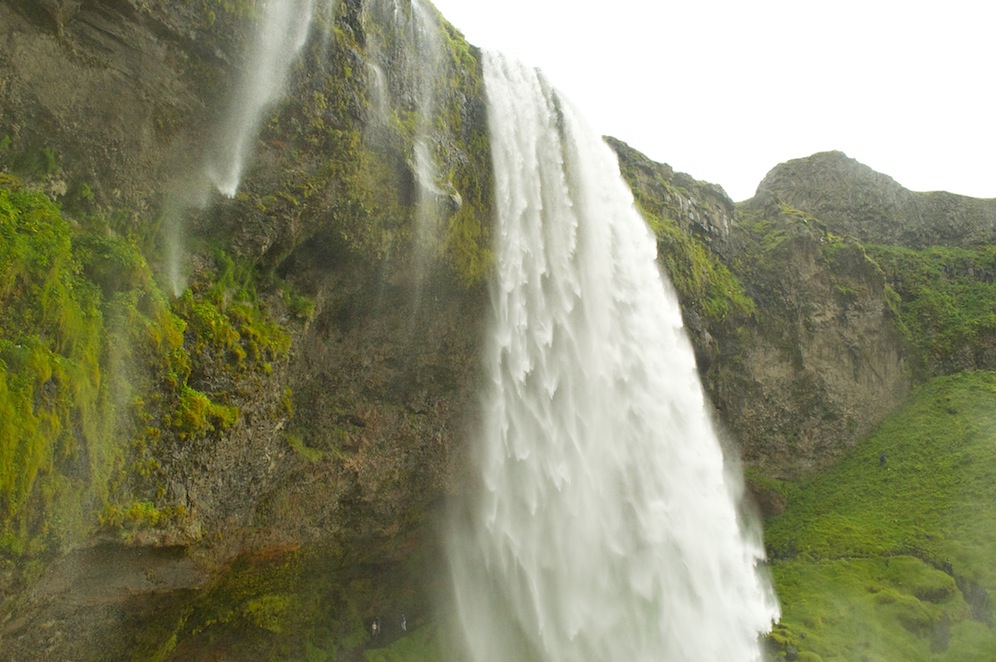
Seljalandsfoss

Seljalandsfoss

The second waterfall, Seljalandsfoss, has less volume to it but is none the less spectacular. It seems to be much more vulnerable to the wind, partly because it is in a more exposed position but also because the cliff behind is deeply undercut, allowing the wind to get behind and force the water even further out from the rock. a path passes all the way round the back allowing you to experience the fall from every angle. Again, the vegetation surrounding the waterfall was lush and extremely vivid.

A lunch time oasis

A lunch time oasis

The next day was a travelling day to Landmannalaugar, the start point for our trek. We had a leisurely start to the day as there was no need to rush. The weather held little promise for the day and it was destined to get worse as the it wore on. The route took us into some fairly inhospitable volcanic desert where little or nothing grew. Oskar had plans to take us to a lush little oasis among it for lunch, a green and pleasant valley fed by several waterfalls tumbling from the barren land above.

Continuing after lunch across ever more inhospitable territory the weather took a serious turn for the worse with heavy rain driven by a vicious wind. We stopped at a crater lake and , despite the fact that it was surrounded by high volcanic walls, the wind still managed to whip sheets of water from the surface.  We received news from our crew, already at Landmannalaugar, that the wind was too strong to even attempt to pitch tents. By the time we reached the camp the weather was evil. As we sat in the bus contemplating what to do a tent flew past the front of the bus with its owner frantically chasing it across the rocks. The prospect of camping seemed impossible in the circumstances and the huts nearby were overcrowded.  The rescue services had refused to allow groups to set out on the trek  so new arrivals had nowhere to stay. The toilet block was full of people making a makeshift home, cooking, drying kit and catching up on lost sleep. There was no way we were going to be able to stay here.

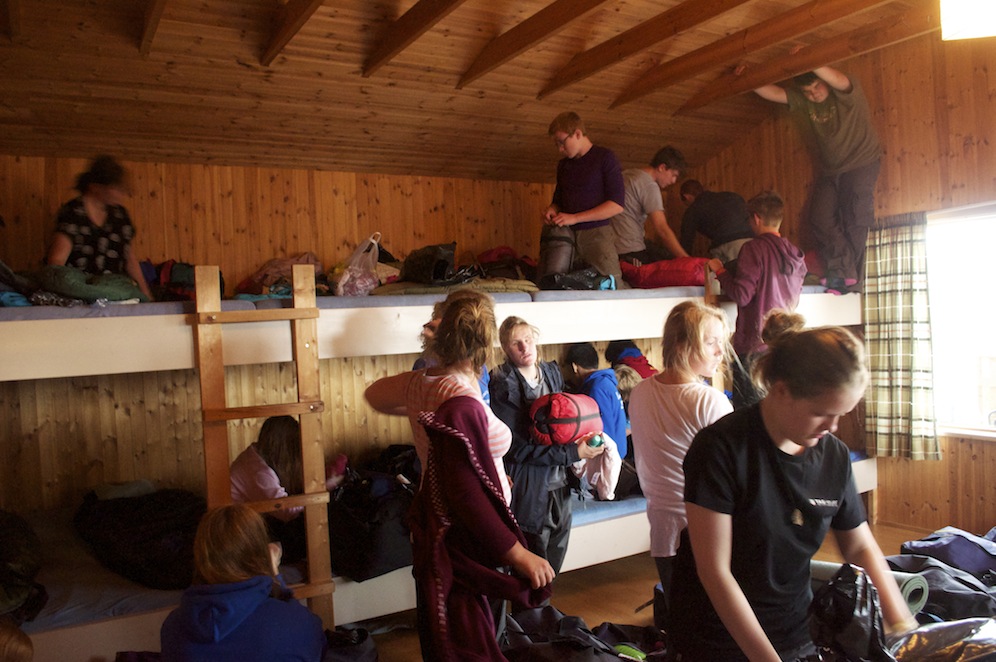
Sorting themselves out in the bunk house

Sorting themselves out in the bunk house

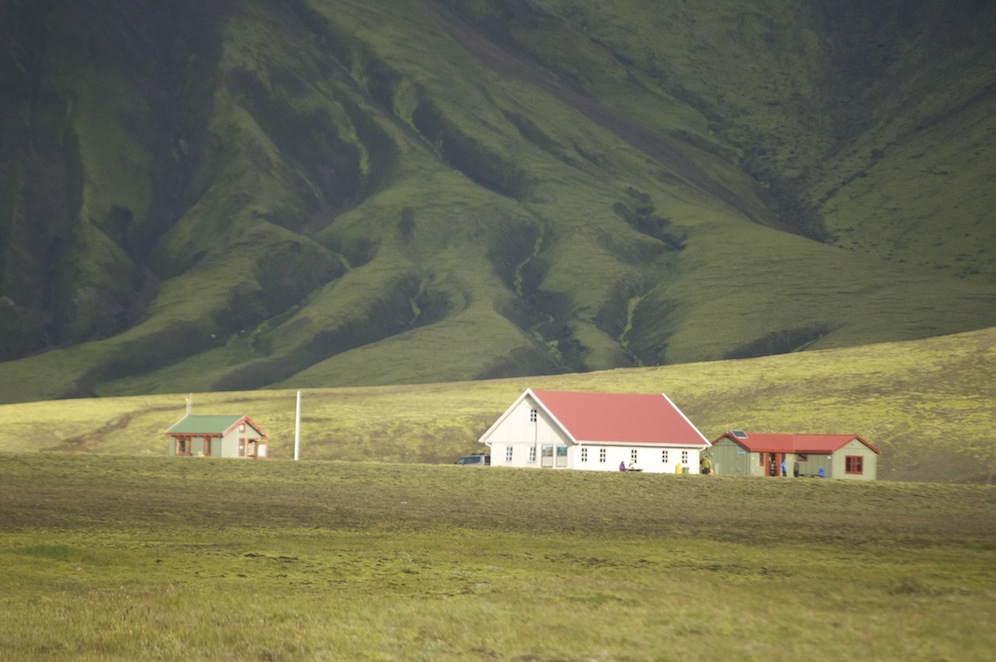
A couple of phone calls from Oskar and we were heading back down over the volcanic desert to a cabin at the foot of Mt. Hekla, Iceland’s most active volcano on a regular basis. The weather wasn’t much better hear, 500m lower. The cabins were very well equipped and comfortable. There were two rows of bunks so we put all the NCW students on the bottom and the King’s students on the top level. It was a little cramped but they all coped very well.

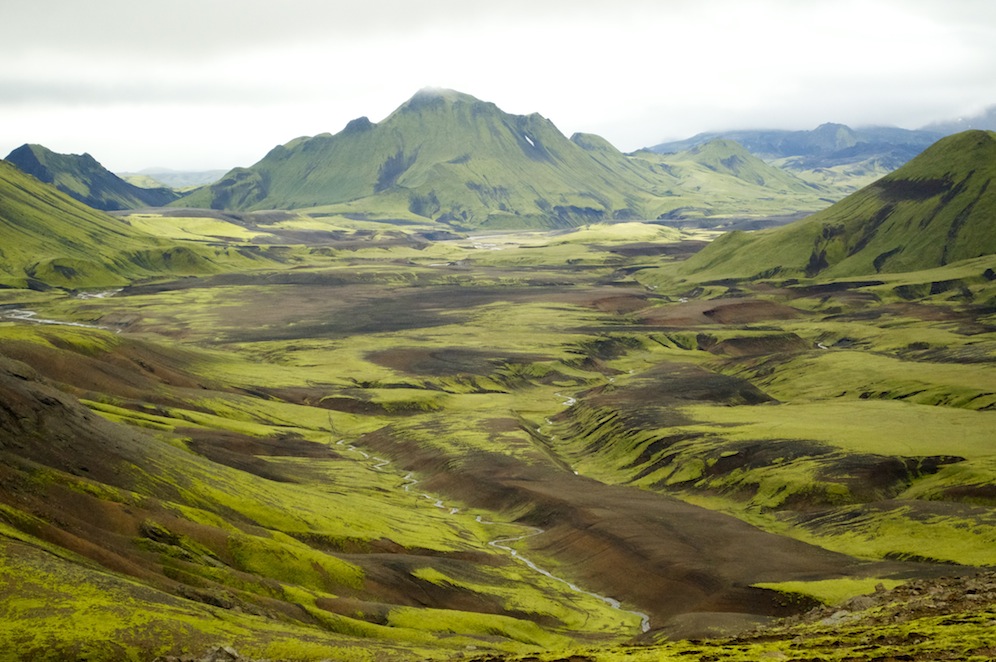
Vivid green moss on black lava

Vivid green moss on black lava

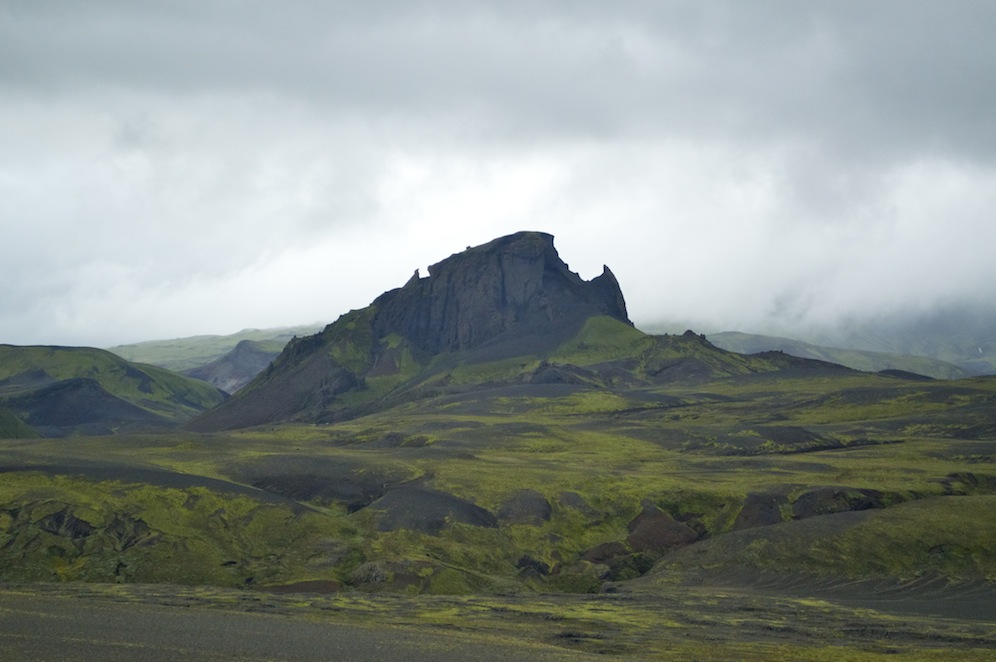
The following morning the weather was no better and, if anything, the wind was stronger, suggesting that life up at Landmannalaugar would be very difficult. In fact we soon learned that there had been a fresh fall of snow above Landmannalaugar, which would have made the going significantly more difficult and camping higher up even more unpleasant. Taking advice from Oskar we drove round to Alftavatn, the half way point of our trek. Here we were able to stay in a cabin rather than camp, making the experience not only more pleasant, if not a little crowded, but also a lot more sociable. The route to Alftavatn took us through some stunning scenery.  The darkness of the lava was contrasted with vivid green brush strokes of colour from the moss that seems to grow so well while all other plants fail.

Alftavatn. We had the hut on the right to ourselves

Alftavatn. We had the hut on the right to ourselves

Alftavatn is a lone hut just set back from the shore of Lake Alftavatn with super views of green peaks down the valley. It is in a perfect position. The huts are very well supplied and our cabin could cater for all twenty seven of us. It was a bit crowded with all our kitbags but it was ideal for our needs. It was a remarkable sight when a local service bus pulled in to collect passengers. The nearest tarmac road is many miles away but they manage to maintain a twice daily bus service.

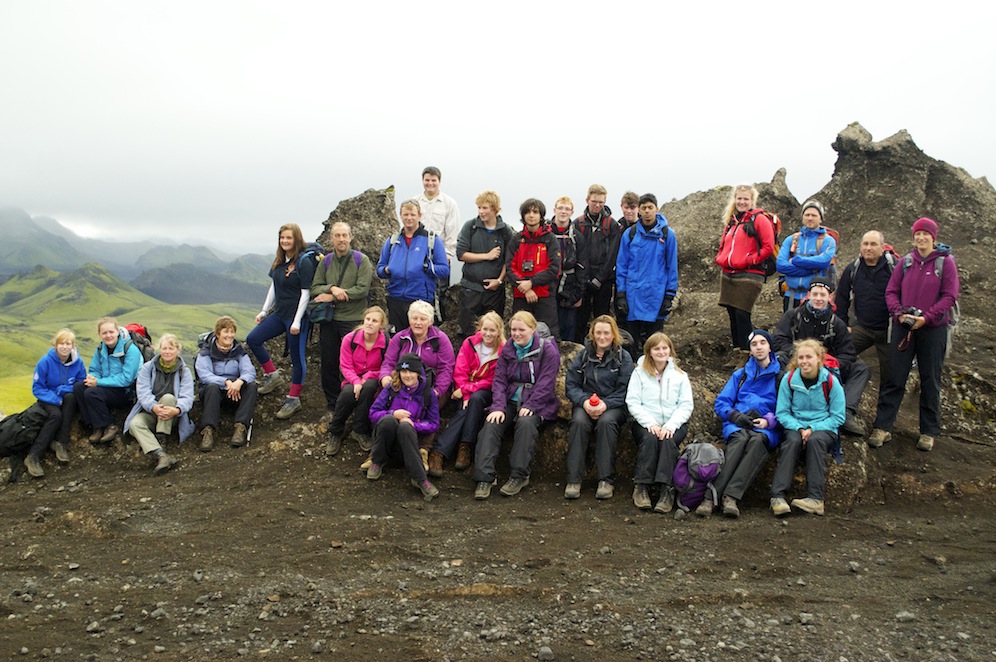
The group on the summit

The group on the summi

After some lunch, and during some respite in the weather, we decided to climb a small peak overlooking the lake. It was a steady climb up through some really dramatic volcanic rock formations to a summit that gave us a stunning 360 degree view.  To the north we could see where we should have walked with fresh snow covering the higher slopes. To the south we could see virtually the whole of the next days’s walk. It was good to be walking at last and the students seemed to appreciate it. Although we had had a super time and seen so many dramatic scenes, we had spent quite a bit of time travelling in a coach.

Later in the afternoon I took myself off for a walk along the lake shore. The sky was moody. In the black sand by the lake there was brief evidence of wildlife, fox footprints and wading birds. No sign of the animals themselves.

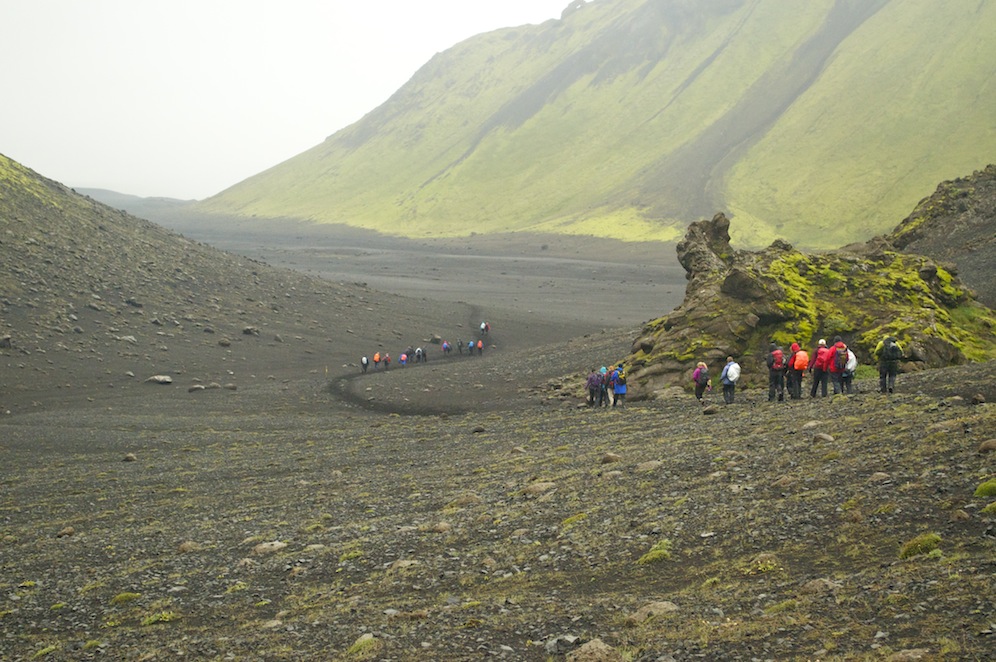
Trekking from Alftavatn to Emstrur

Trekking from Alftavatn to Emstrur

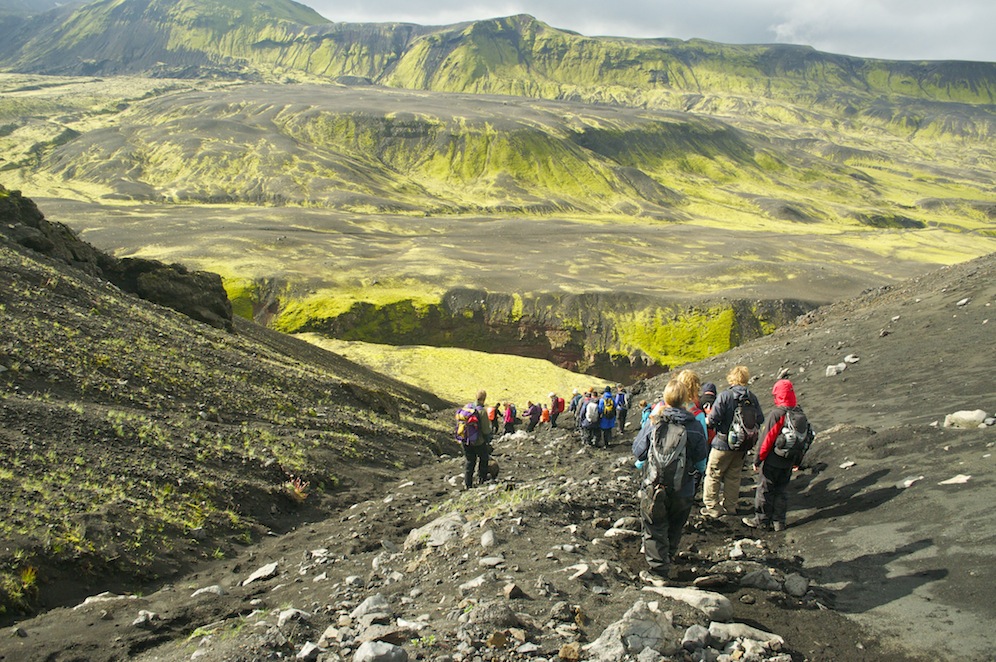
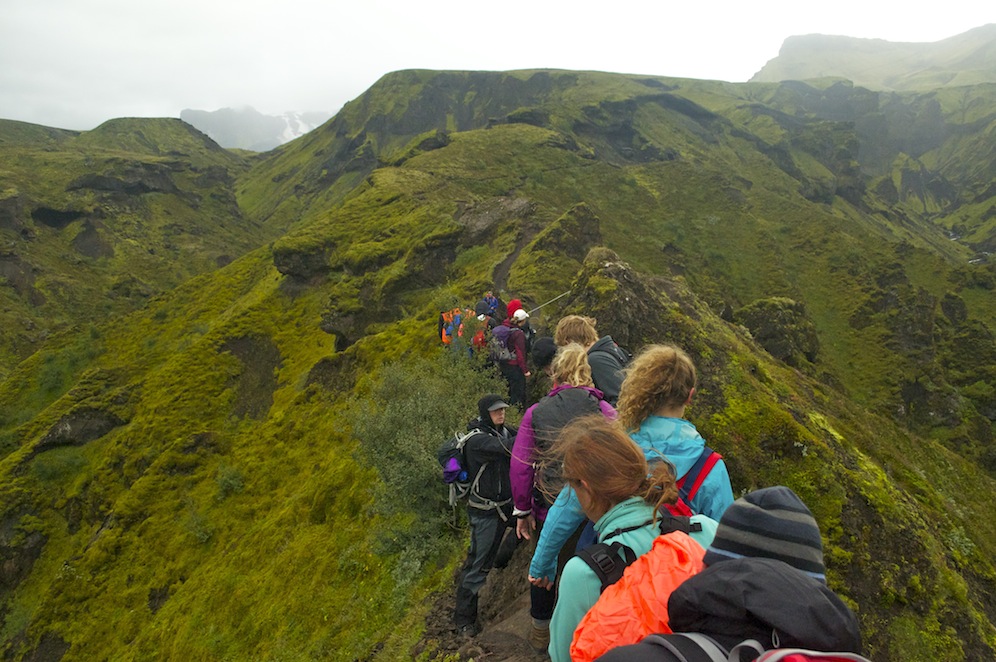
The following morning we set out on our now shortened trek walking the 16km from Alftavatn to Emstrur. It involved a couple of river crossings and took us through a variety of scenery. Much of the time we were flanked by steep, mossy, green slopes of interesting conical peaks while we were walking on black lava. The walking was easy with few obstacles, allowing progress to be made at a reasonable pace. Whenever we met other trekkers, once they realised the nature of our group, they often stood back in awe. Sometimes, as I stood away from the group to film them, it gave me a different perspective of the trek and I found myself standing in awe of the work the King’s students were doing and the positive attitude and approach of the NCW students.

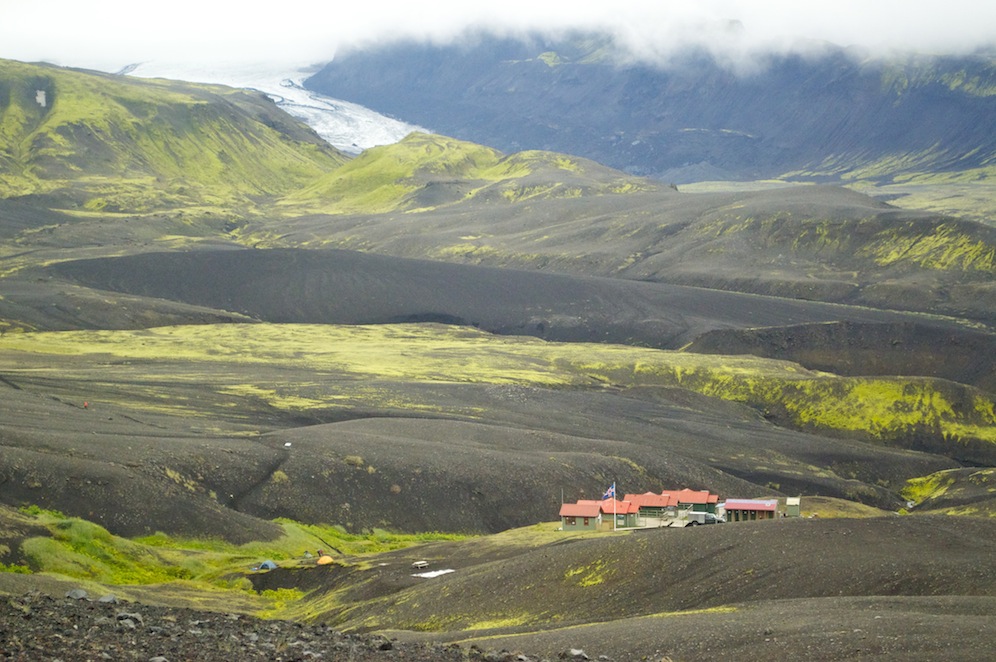
Emstrur

Emstrur

At Emstrur, as the temperature dropped, we had to decide whether to camp or spread ourselves out between two huts. For simplicity sake we chose the huts. Emstrur is in a stunning position. Its immediate vicinity is a mixture of green moss on a volcanic slag heap. At the head of the valley is a tongue of ice from the Myrdalsjokull icecap. The river, rushing from the snout, cuts its way through the Markarfjlotsgljufur Canyon. Beyond, to the south is the Eyjafjallajokull icecap. If only it wasn’t shrouded in cloud.

Heading down towards the Markarfjlotsgljufur Canyon

Heading down towards the Markarfjlotsgljufur Canyon

The journey from Emstrur to Porsmork is longer (19km) and also involves a lot more up and down. Add to that that we were subjected to a mixture of sunshine and showers, we were expecting a more challenging day. So it proved to be but it was also an incredibly enjoyable day. There were no actual river crossings but there were plenty of water courses to cross. These, with blind and visually impaired people always take a lot longer than normal but it is remarkable how they cope with these obstacles.

Unicorn Peak

Unicorn Peak

None of the mountains around us are particularly high but they all have interesting shapes. For most of the day we had views of a peak called Unicorn Peak. We had some debate as to whether is should be called Rhino Peak or Scarab Beetle Peak. I’ll let you decide which name suits it best.

Towards the end of the walk there was a significant change to the landscape through which we were walking. We were walking through a forest of dwarf birch trees. The moisture from a recent shower glistened in the sunshine giving the impression that each leaf was covered in jewels. Now the ground covering between the trees was grass. We had left the moss behind.

DSC_0602As we dropped into the Porsmork valley and walked along the wide river bed another sharp shower was followed by a spell of sunshine casting a rainbow across the valley rising from somewhere near our campsite. Sadly no pot of gold when we got there. Just before we reached camp we had one last obstacle to overcome, another river. Rather than de-boot every effort was made to help everybody across abd while there were some stumbles most managed to keep their feet dry.

At Porsmork we camped. The campsite was grassy and the dwarf birch trees provided protection from the wind. It was good to be camping and gave the students a fresh experience and a new set of challenges. It wasn’t all hardship as we had an ample structure to socialise and eat in.

We had now arrived at Porsmork a day early so we decided to use the spare day to climb up to the sight of the eruption on Eyjafjallajokull. There were some potentially difficult sections to this walk so we allowed it to be optional. Luckily those whom we had most concern for chose not to come. Again, some of the NCW students showed their determination to take every opportunity presented. The weather was reasonable.

Negotiating the ridge

Negotiating the ridge

It was a beautiful walk through trees on the lower slopes, circumnavigating a rocky outcrop a little higher with a serious drop on one side. This became a serious drop on both sides as we crossed a narrow ridge. Perhaps, not surprisingly, the blind students showed little concern for the exposure around them.  Their guides were a little more anxious but did a fantastic job.

Smoking Eyjafjallajokull

Smoking Eyjafjallajokull

There was some awesome scenery, stunning valleys showing layer upon layer of lava, creating a volcanic timeline, lava arches and towers. Climbing up to a plateau we approach the last climb to our goal. As we did so the weather took a serious turn for the worst. With just 240 vertical metres to climb to the summit with another tricky section to reach it, we decided to turn back. Before we did so, and before the cloud engulfed all before us we were able to look upon some of the recent volcanic activity, with some still smoking.

Returning to camp via the same route we enjoyed a superb BBQ with six legs of lamb cooked to perfection.

The following day, after some delay because Arnie’s coach broke down, we returned to Reykjavik for our last two nights.

Feeling the 3D map of Iceland

Feeling the 3D map of Iceland

On our last full day in Reykjavik we had arranged to visit the Town Hall. There is on display a large three dimensional relief map of Iceland. Normally people cannot touch it but we had sought permission to take the group to see it and for the blind students to be able to feel its shape and texture. Julius, a government official met us and talked to the group about the various landscapes that make up Iceland. (Everybody in Iceland, including the Prime Minister, is always referred to by their first name.) We were made to feel very welcome.

Reykjavik Cathedral

Reykjavik Cathedral

Leaving the Town Hall we visited the cathedral. It is unique as far as cathedrals are concerned, being made entirely of concrete. The tower is made up of a series of increasingly high pillars of concrete. Inside it is the least fussy church I have ever been in. The internal walls and pillars are all of concrete with no decoration. There is a massive organ with 5725 pipes. Sadly we weren’t given the pleasure of hearing it play.

A colourful patchwork of houses and roofs

A colourful patchwork of houses and roofs

The opportunity to go up the tower to look over Reykjavik had to be taken. Unlike most other cathedrals I have visited, it was not a matter of climbing dozens of steps up a narrow spiral staircase but a short, speedy lift journey to the top of the tower. Had it been a clear day there would have been a fantastic view of distant mountain ranges and icecaps. However, it was not a clear day and the view was much more immediate, the colourful roofs of the buildings below.

The rest of the day was spent enjoying a relaxed lunch (I had a whale steak) and shopping.

The Blue Lagoon below menacing skies

The Blue Lagoon below menacing skies

Before returning to England we had one more experience to enjoy. En route to the airport we called in at the Blue Lagoon, a power station that has made good use of its facilities to create a hot bathing area, mud treatments, steam rooms and much, much more. The general temperature of the water is 38C, with some parts significantly hotter. In the pool a bar serves drinks of all varieties. It was a great way to end our time in Iceland and it was particularly enjoyable for the NCW students who could compensate for the loss of sight with their other, more astute senses.

This was my first trip to Iceland but it certainly won’t be my last. We were so well looked after by Oskar and his team who made this such a memorable trip. I am extremely grateful to them all.  This year Iceland has had its wettest summer on record. Certainly, the weather did its best to spoil our experience, but it failed, miserably. I plan to return next year and see more of this fantastic country. Maybe next year she will help me achieve my ambition to witness a full-blown dramatic eruption.


Indonesia – Dragons by the sea

Stephen had flown in from Papua the day before we arrived in Bali and he now joined us for the remainder of our time in Indonesia.  We chose to eat in the hotel that evening rather than introduce the students to the nightlife that Bali has to offer.  Service was very slow and we began to regret the decision.  There would be time to explore Kuta Bali when we return at the end of our trip.

Labuan Bajo harbour

Labuan Bajo harbour

Having overnighted in Bali we caught an early flight to Labuan Bajo, the capital of Flores and one of the most beautiful places on earth.  Perched on a hillside dropping down to the port, Labuan Bajo has a population of about 18,000 and despite its status still maintains a feeling of being a small coastal village.  The view from the top of the town, overlooking the harbour to the myriad of islands beyond is stunning.

Our main guide for this leg of the adventure was Dom Bosco. I immediately took a liking to him as he was engaging, interesting and interested in us.  He freely talked to the students and made them feel important to him.  He was everything that our previous guide was not. We had a day and a night of luxury to look forward to as we were staying at the Jayakarta Hotel a little way out of town along the coast.  The rooms were comfortable, well appointed and looked down on to well cared for gardens on one side and the pool and gardens on the other with the beach and sea just beyond. When we arrived our rooms were not ready so Dom Bosco took us to the Batu Cermin caves, an interesting cleft and series of tunnels in a rocky outcrop.  The stalactites and stalagmites created interesting shapes and if you were creative in your imagination you could see several faces in them.

Enjoying the pool

Enjoying the pool

Back at the Jayakarta Hotel we made the most of the facilities and enjoyed strolls along the beach collecting interesting pieces of coral debris, watching the local fishermen and supping a long drink while watching the sunset.

Fishing

Fishing

The fishing techniques were fascinating.  Along the beach there was a small creek.  Three boys beat the water in the creek to frighten the fish out into the open water where their father waited with a net.  While it looked impressive it was hardly productive and the boys were more inclined towards having fun rather than fishing.  Another group of men. standing waste deep in the water, were having a little more success as they drove the fish into a waiting net.  However, nobody was going to get fat on what they were catching.

Magda letting the children take photos and share the results.

Magda letting the children take photos and share the results.

While we were watching and taking photographs of the sunset a group of children came down to the water’s edge.  On realising what we were doing they made every attempt to get themselves into our photographs. They were fun and we started to let them take pictures of themselves and show them the results.  They were a happy bunch of children and, while there must be shortcomings in their life on Flores, I could not help but think that they were growing up in a fantastic part of the world.

DSC_0701I took many shots of the sunset but think this is probably the best.

That night the hotel arranged the tables around the pool for a romantic candlelit dinner for twenty-two! the food was good, the temperature was just right and the company of twenty-two was fantastic.  There was a brief interruption to the tranquility of the meal when a large crab decided to travel under the tables, between the feet on its journey to or from the sea.

All aboard on the sun deck

All aboard on the sun deck

The following morning we took the short drive to the harbour to board our two boats.   While we would spend most of our time all travelling together on the larger boat, at night the staff would adjourn to the smaller boat moored up alongside. We quickly clambered over moored boats to board our own and no sooner were we all aboard, we were off.  The students quickly positioned themselves on the open top deck to enjoy the sunshine and the views of the passing islands as we headed for Rinca.

Coastline fishing village

Coastline fishing village

The water was deep blue but where it was shallower the shade lightened. It was so inviting. Nowhere were we very far from land and we passed many beachside fishing communities where the houses are built on stilts. The style and design of these houses has remained the same for centuries, as have the fishing techniques the fishermen use.  Nothing is done on a large scale but just sufficient for subsistent use and to sell a few at market.  Behind the houses are banana trees providing fruit for the villagers. Sometimes traders in rice or vegetables visit these fishing communities and trade for fish instead of money.

Entrance to Komodo National Park, Rinca

Entrance to Komodo National Park, Rinca

After a pleasant morning sailing the blue sea we arrived at Rinca Island, the second largest island in the Komodo National Park and home to the Komodo Dragon. As we approached our mooring just away from the jetty we watched a white and grey fish eagle swoop down to the water to come up with a fish in its talons. To add to the drama a darker coloured Flores eagle harassed the fish eagle in the hope it would relinquish its catch. On the jetty we were greeted by monkeys who were keen to take food from our hands, although we advised against doing so, just in case. Around the jetty shoals of fish swarmed around the boats moored. There is so much life in the air, on the land and in the water.

A Water Buffalo

A Water Buffalo

Our 5km walk around Rinca Island proved somewhat fruitless regarding the Komodo Dragon.  July and August is the mating season so the males have all gone off in search of partners. Our guides took us to all the usual spots where dragons can often be found but unlike my experiences three years ago none were to be found.  We did see a number of water buffalo, wallowing in water holes to keep cool and safe from their main predator, the dragon. A buffalo is too large for a dragon to kill in an attack so they often stalk their prey and catch it off guard, tending to take a bite from the hind quarters.  There is so much bacteria in the saliva of a Komodo Dragon that soon the wound becomes fatally infected.  It can take weeks for the buffalo to die or to become too weak to fend off a second attack. Everything is eaten, with the exception of the skull and horns.  All other bones are consumed and digested.  Every so often on the trail there was evidence of dragon poo, a white powder of crushed bones.

DSC_0833However, it was not a fruitless excursion.  There are always some dragons which are lazier than others and wait in hope by the kitchens in the wardens’ camp.  Here we found four dragons, two males and two females.  These were not particularly healthy looking specimens; their ribs were clearly visible. The wardens do not feed them but the smell of food draws them to the kitchen in a forlorn hope that they might be fed. In the end hunger forces them to find food for themselves.

DSC_0823The wardens have to be very careful.  These hungry dragons often hide underneath the stilted houses.  As a result the wardens have to check before coming down the steps.  There have been a number of attacks this year where wardens have fallen victim to a dragon hiding underneath the steps to their room.

Two males eyeing each other up

Two males eyeing each other up

The good thing about having a number of dragons who are so attached to the kitchens is that they are easy to photograph.  The wardens ensured that we kept a safe distance from them and warned us to move back if any began to approach. The wardens are armed with a forked staff, which presumably is the most effective way of keeping dragons at bay without causing them any harm, although I am sure that with one snap of their powerful jaws they could reduce the staff to matchsticks.

An Angel Fish swimming over a seabed of dead colal

An Angel Fish swimming over a seabed of dead colal

Returning to our boat, we set sail again to anchor off a beach where we could swim, snorkel and enjoy the warmth of the water and all that was within it.  On the way we had a sumptuous lunch of rice, chicken, fish, tofu and vegetables followed with pineapple and watermelon. Having digested our meal the swimming was wonderful and the braver members of the group jumped or dived off the top of the boat, four or five metres above the surface of the water. Snorkelling was like swimming in a tropical fish tank.  I spent time getting used to using my camera underwater.  Using the waterproof case is brilliant but you have no way of knowing whether you are taking what you want.  It is impossible to use the viewfinder and also to check each picture or video on the screen.  It is very hit and miss and I found the best policy was to just click away in the hope that there would be something worth having. The colours and variety of fish was amazing and it was fantastic just to pick on a particular fish or shoal and follow it.  They were unconcerned by our presence, unless we got too close, and continued uninterrupted in their quest for food.  As they nibbled at the coral their chomping could be heard very clearly.  Sadly, at this location most of the coral was dead.

The sun disappears for another day

The sun disappears for another day

As the afternoon drew on we set sail again for a mangrove swamp to watch the fruit bats at dusk as they rose from the mangrove to fly to the mainland for food.  The Indonesians call them flying foxes.  They are huge and in the course of about half an hour a million of them will rise from the swamp.  Our boat was positioned so that it was beneath the flight path. While we waited we watched the spectacular sunset. Unfortunately, my photos of the flight do not do the event justice.

That night we slept on deck, under a myriad of stars.  The cloudy haze of the Milky Way was clearly visible and shooting stars flew across the sky at various intervals. A light, cooling breeze fanned across our faces and made sleep more comfortable.

At 4.30am the engines chugged into life, the anchor was lifted and we headed off towards Komodo Island, a journey of about two and a half hours.  Lying on deck, feeling the movement of the boat as it rode the water and watching the sky lighten in the east was a wonderful way to greet the new day.

DSC_0012_2Anchoring off Komodo village we enjoyed breakfast.  We were soon visited by children paddling out on makeshift rafts of polystyrene wrapped in discarded fishing net wanting to sell us trinket Komodo Dragons carved out of shells.

DSC_0004_2Komodo village is much larger than I expected. From the boat we could see stilted houses following the line of the shore. There were several rows of houses beyond. From our vantage point the houses seemed to be made mainly of wood with planks or woven reeds making up the walls with corrugated iron roofing.  On the beach high bowed fishing boats were parked or were moored in the shallows.  Dom Bosco told us that the population was about 1400. There were far more children than we were expecting.

Whilst the group explored Komodo village, Jim and I met with the village head to discuss the toilet building programme.  This took a long time.  It was decided that we would try to get one toilet finished, leaving the other two for the villagers to build when the sites were prepared.  We went to visit the first site at the far end of the village. It was just outside a house! I’m not sure I would want a public toilet within two feet of where I lived. There was much discussion between the village head and several other men as to positioning etc. With so much discussion I began to wonder if we would ever get started.

Eventually we got the green light and had to return to the other end of the village to collect all the building materials, gathering the group together to carry steel rods, lengths of timber, bags of cement and corrugated iron across the village to the building site.  By the time we returned with the materials the men had marked out the dimensions and dug the foundations for the building.

Mixing cement for the foundations with a paddle!

Mixing cement for the foundations with a paddle!

It was always our intention to not only provide the funding for these toilets but also the labour force for the building of them. Things do not always work out as planned and the villagers seemed determined to do the work themselves while we watched.  Some of the tools were a little unusual. For mixing the cement we only had one shovel so a short paddle was used. This gave Jim, as head of rowing, some ideas for the boat club.  The rocks for the foundations were gathered from the beach, as was the sand for mixing with the cement. Occasionally we would try to become involved but whatever we were doing would be taken over by a local. It was becoming increasingly frustrating and as the day got hotter and hotter, standing around in the sun became less pleasant.

Henry having a bit of a workout while entertaining the children.

Henry having a bit of a workout while entertaining the children.

The work, or our presence, was generating a fair amount of interest in the village, particularly among the children, and soon we were surrounded by children craving our attention.  The students enjoyed the attention and were happy to entertain the children in a variety of ways.

Anna keeping cool with friend

Anna keeping cool with friend

It became clear that we were probably not of much use and that we were wasting our time watching the construction process. When it came to lunchtime I suggested that we return to the boat, enjoy lunch, and then go to a beach/bay within easy reach for a cooling swim, to return to Komodo later in the day to witness the progress the men had made. This idea was approved by all and we returned to the boat, taking with us our entourage of children as far as the end of the jetty.

Freddy Toubro in full flight

Freddy Toubro in full flight

Instead of sailing off we stayed where we were and spent the afternoon playing in the water and diving off the boat.  Everybody was gaining confidence, having done it once, and began to be more adventurous in their jumps and dives.  We had individual dives, twists, turns and artistic impressions, sequence jumping and group plunges. It was great fun and a lovely way to spend the afternoon after some of the frustrations of the morning. The only disappointment was that Stephen lost his Gopro on a dive, it slipping off its anchorage to his wrist and sinking to the bottom in 21m of water.  He tried diving but without success.  Dom Bosco asked if any of the villagers could dive to that depth but their limit was about 16m. His camera would continue to take intermittent pictures from its watery grave until the battery ran out.

Helen mastering the art of paddling a dugout canoe.

Helen mastering the art of paddling a dugout canoe.

Children came out from the village in a dug out canoe to try to sell us their trinkets.  They would come along side and climb out onto our boat. They were not very persistent with their sales but were happy to be in our company.  Helen, being a kayaker, wanted a go in the dug out. She struggled to get in, the boat being extremely narrow, and balance was quite an issue.  We all watched, expecting her to capsize, but she managed to stay afloat much to our disappointment.

DSC_0156_2As the afternoon drew to a close we returned to the building site to see how the work was progressing. The framework was almost finished.  As we watched the final pieces of the structure were nailed into place and the corrugated iron roof was hammered home. The children were again a distraction, following us wherever we went and demanding our full attention.  All around the building site, hair was being plaited, songs and dances were being taught and some were given control of cameras to take pictures.

As the afternoon blended into evening the work stopped as the men, all muslim, needed to return home for their meal, having gone throughout the day without both food and water as they were fasting for Ramadan. We returned to the boat and sailed off for our night time anchorage away from the village.

I do hope this property was one to be replaced!

I do hope this property was one to be replaced!

The village of Komodo seems to have had a huge amount of input from all sorts of organisations in recent months.  Wherever you go on Flores and on Komodo there are banners and posters advertising “Sail Komodo”. In September there will be sailing events and large cruise liners coming specifically to Komodo. In order to cater for such an influx of people, central government and various NGOs have invested heavily in Komodo.  A new paved footpath is being created the length of the village and trees have been planted with protective fences around them.  We counted at least fourteen new toilets, none of which seemed to be finished, and there were one hundred houses being built to replace houses that needed replacing. I knew none of this when we were looking for a project and while, at the time of planning, toilets and Komodo Dragons may well have been an issue, the development of Komodo village has moved ahead rapidly. What was not clear was whether this investment was for a one-off event or whether the impetus for improvement and development would be continued as the event was repeated year by year.

The following morning, having again slept on deck, we headed back towards Komodo Island but this time not to the village but to the national park for more Komodo Dragons. We docked our boat at the brand new, not yet used, quay big enough for ocean going cruise liners to dock at and obviously part of the “Sail Komodo” project.  This suggests that the project is a long term concept and not just a one off event.

An ever alert stag

An ever alert stag

The walk was on similar terrain as Rinca but shorter in distance.  Despite it being shorter, we saw a great deal more with sightings of deer, wild boar, parakeets and dragons, not just lingering around the kitchen area but out in the bush.  It was fortunate that we were there early in the morning as dragons need to bask in the sunshine to bring their temperature up.  Once it is up they tend to find shady areas to shelter from the sun and are therefore less easy to spot.

A large male

A large male

On top of Sulphur Hill we came across a pair, a male and a female, basking in the early morning sunshine. It was immediately noticeable how much more healthy these animals seemed.  They were plumper and generally more alert and robust.

As we were nearing the end of our walk and returning to the centre via the beach two stags strolled down the beach looking very out of place in such an environment. More dragons were waiting near the buildings but unlike those on Rinca, these looked more healthy.

Striding purposefully along the beach.

Striding purposefully along the beach.

It was while photographing these that we noticed another dragon marching purposefully along the beach. Rushing down to see it it proved difficult to film and keep up with so I ran on ahead to photograph it from the front.  Again I had to move quickly in order to get into a good position.  Eventually I positioned myself by the old wooden jetty and started filming.  The dragon continued with its determined stride along the beach but as it approached the jetty it turned towards me.  The wardens became concerned and I had to retreat up the beach to make room and allow the dragon to go the route it wanted to take. On the other side of the jetty it disappeared into the trees at the top of the beach.

Enjoying the underwater scene

Enjoying the underwater scene

Returning to our boat for breakfast we sailed the short distance to Pink Beach, a favourite spot for snorkelling over the coral reef.  It is called Pink Beach because of the slight pink hue the sand has when wet.  It is made up of thousands of tiny shell particles and coral. Snorkelling here is a fabulous experience.  I snorkelled here three years ago and my memory was of brilliant coloured coral and a huge variety of exotic fish.  The exotic fish were there but the coral seemed much less colourful than I remember. Patches of it were dead or dying, and I don’t remember that. There were some splashes of colour but fewer than I remember. Certainly the camera seems to fail to pick up the colours, dulling them down.

CSC_0082We spent the bulk of the morning exploring the coral and the best fish seemed to be closer to the headland where the rocks tumbled steeply into the sea.  I could not tire of gently swimming around, watching the marine life beneath me, all within touching distance.

Having spent the morning at Pink Beach we sailed across to an island on the other side of a narrow gap of turbulent water to another island for lunch and for further swimming in the afternoon.  We had arranged to return to Komodo village later in the afternoon to visit the school to distribute our gifts of stationary, toys, clothing etc. to the children.  As there were far more children than we anticipated it had been agreed that we would give to particular age groups.

DSC_0090Typically, more children turned up than expected and what should have been a very enjoyable occasion turned into a chaotic shambles. It started off reasonably well.  We were ushered into a classroom where we separated and laid out everything we had brought on to desks.  It was an impressive array of items. It brought the nostalgic child out in the group members as they played with the toys, waiting for the next instruction in the proceedings.  It became clear that while we were doing this the teachers were trying to organise the children into two groups.

It started out quite well

It started out quite well

We were ushered into a second classroom where there was a group of 28 children.  We sang a couple of songs, “If You’re Happy and You Know It” and “Heads, Shoulders, Knees and Toes”. The children sang a couple in return. While this was happening the teachers and Dom Bosco collected 28 items from the classroom for us to give one to each child.  This worked reasonably well.

In the second classroom there were in excess of 60 children.  Having gone through the song routine again the teachers brought in twenty items and selected twenty children to receive them. The remainder looked crestfallen, particularly when they were told they would get theirs the following morning. That is when the chaos started.

DSC_0113Eventually, to satisfy the children they were told to come to the classroom where the gifts were stored and they would receive them on the veranda to the room. Bedlam ensued with children pushing and shoving to get to the front.  It was a sea of hands grabbing and pulling. One fight broke out. Many took one item, hid it and then put their hand out for another.  Our students who were caught up in the melee found it very difficult and quite distressing.  In the end I decided to pull everybody away and leave it to the teachers to sort out, teachers who seemed to have very little control in such situations.

Oh, and it needs a door!

Oh, and it needs a door!

We now went to the other end of the village to inspect the progress on the toilet.  The men had been busy all day and with the exception of the concrete lining to the tank behind the structure, it was finished.  The pedestal was cemented in place and the outflow pipe had been connected.  All the walls were complete.  Behind the shed a pit had been dug, which is what had to be lined round the sides.  The bottom of the pit would remain a bed of sand. The effluent would flow into the pit, become liquid and gradually filter through the sand. A concrete lid would be constructed to enclose the pit. Nothing could be simpler.

I was quite pleased when we left Komodo for the last time. En route to our night time mooring we stopped briefly.  In that brief stop a dugout canoe came alongside selling wooden carved dragons.  Jim was just contemplating buying one and was holding it to help his decision making when our boat chugged into life and set off across the bay, chased by two men frantically paddling their dugout in pursuit. It was remarkable how fast they could go in such a flimsy and unstable canoe but they stuck to the task and within a few minutes of us dropping anchor they were alongside again.  Jim felt guilty and probably paid over the odds but felt they deserved it for the effort they had made to secure a sale.

The next day was pure fun. We sailed from sandy beach to sandy beach, taking time to swim in the clear waters, to marvel at the marine life and to become ever more daring in our attempts to dive or jump off the boat. Here is a selection of some of them with varying degrees of success.

DSC_0179DSC_0166DSC_0158DSC_0153DSC_0187That night, back on dry land we enjoyed a meal in a restaurant overlooking the harbour before returning to the luxury of the Jayakarta Hotel, although it should be mentioned that after four days and three nights on a boat, it was difficult to stop the room from rocking gently from side to side.

DSC_0242The following day we flew back to Bali for a couple of nights with retail therapy high on the agenda. It was a relaxing way to end a very active, multi faceted trip, although it became a little tiresome fending off the very persistent street sellers. The group responded well to the environment, avoided the pitfalls that Bali presents and enjoyed the opportunity to relax.  Our last evening was spent on the beach.  Stephen arranged for us to go to Double Six, a beach with surfing opportunities but also a relaxed beach bar atmosphere where bean bags were supplied from which to enjoy our last Indonesian sunset.

A Bali sunset

A Bali sunset

To conclude, I would just like to say how enjoyable the students made this trip,  They were a pleasure to be with and very easy to look after.  They cared for each other and were a credit to all concerned, parents, school and themselves. I cannot finish without mentioning my colleagues, Jim, Helen, Magda and Ellie, without whom none of this would have been possible. I feel it was a fitting end to my twenty years of running the Himalayan Club at King’s and look forward to helping Josh Hand and watching him take the Himalayan Club into its third decade.